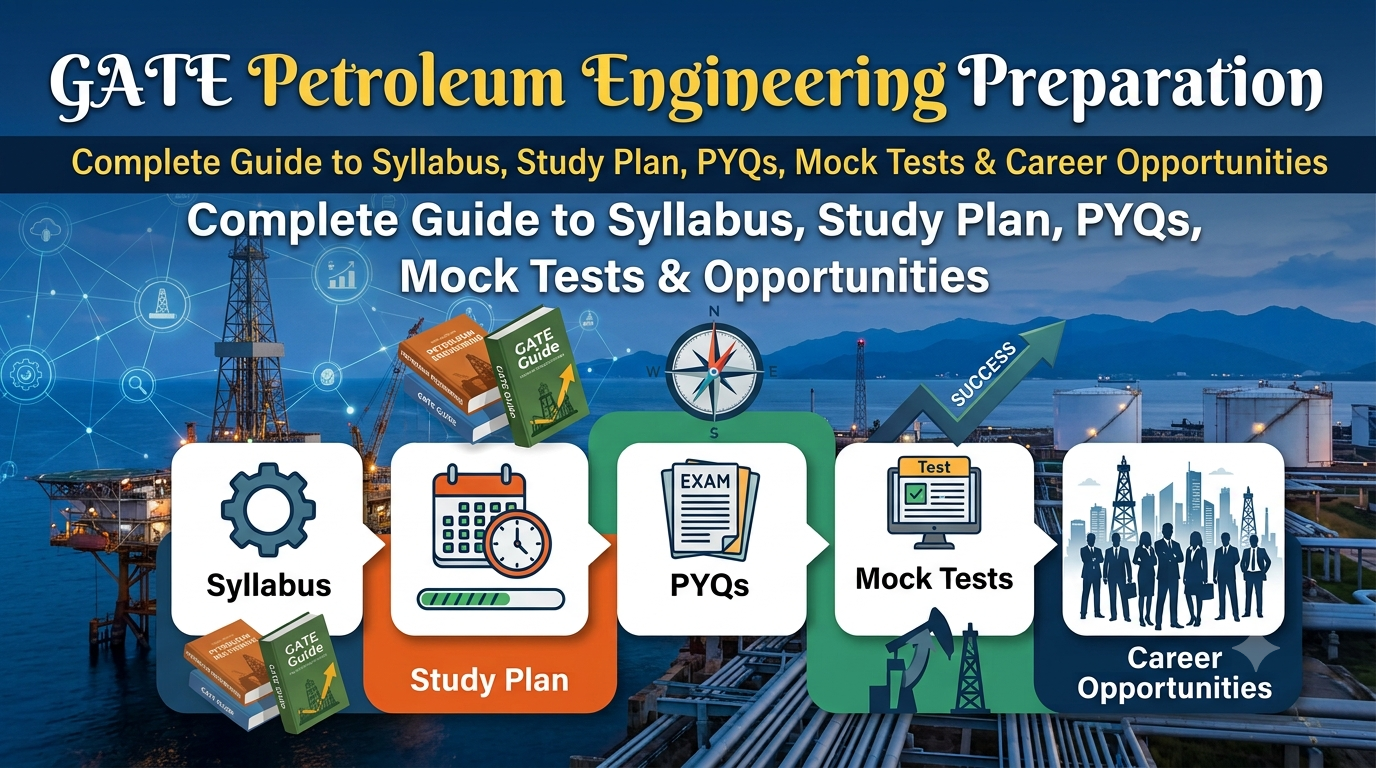
Preparing for GATE Petroleum Engineering (PE) requires a clear understanding of the syllabus, strong conceptual knowledge, regular numerical practice and consistent revision. With the right preparation strategy, students can organise their studies and work systematically towards their GATE goals.
This guide covers the GATE Petroleum Engineering syllabus, important subjects, study plan, PYQs, mock tests, online classes, common mistakes and career opportunities.
What Is GATE Petroleum Engineering?
The Graduate Aptitude Test in Engineering (GATE) is a national-level examination used for admission to various postgraduate programs and for other opportunities depending on the requirements of individual institutes and organisations.
For Petroleum Engineering students, the GATE PE paper covers core petroleum engineering concepts along with Engineering Mathematics and General Aptitude.
Students preparing for GATE PE should focus on understanding concepts rather than simply memorising formulas. The ability to apply concepts to numerical and theoretical questions is an important part of effective preparation.
GATE Petroleum Engineering Syllabus
The GATE Petroleum Engineering syllabus consists of General Aptitude, Engineering Mathematics and core Petroleum Engineering topics.
Important areas include:
- Engineering Mathematics
- General Aptitude
- Petroleum Geology
- Petroleum Exploration
- Drilling Engineering
- Reservoir Engineering
- Production Engineering
- Formation Evaluation
- Well Testing
- Other topics mentioned in the current official syllabus
Students should always refer to the latest official GATE website for the current syllabus, eligibility criteria and examination pattern.
Important GATE PE Subjects
Reservoir Engineering
Reservoir Engineering is an important area of Petroleum Engineering. Students should understand reservoir and fluid properties, fluid flow, material balance, pressure behaviour and reservoir performance.
Focus on understanding the concepts first and then practise numerical problems.
Drilling Engineering
Drilling Engineering includes several practical and theoretical concepts.
Important areas include:
- Drilling fluids
- Well control
- Casing
- Cementing
- Drilling operations
- Drill-string concepts
- Drilling-related calculations
Production Engineering
Production Engineering focuses on bringing hydrocarbons from the reservoir to the surface.
Students should study concepts related to:
- Well completion
- Well performance
- Artificial lift
- Production operations
- Flow fundamentals
Petroleum Geology and Exploration
These subjects help students understand the geological aspects of hydrocarbon exploration.
Important concepts include:
- Rock properties
- Geological structures
- Sedimentary environments
- Source rocks
- Reservoir rocks
- Traps
- Exploration techniques
Formation Evaluation and Well Testing
Students should understand the fundamentals of well logging, formation properties, pressure behaviour and interpretation techniques.
Along with these core subjects, Engineering Mathematics and General Aptitude should be included consistently in the preparation schedule.
How to Start GATE PE Preparation
A structured approach can make GATE PE preparation easier to manage.
1. Understand the Syllabus
Start with the official syllabus and divide it into individual topics. Identify subjects that you already understand and areas that need more attention.
2. Create a Realistic Study Schedule
Plan your study hours according to your college, work and other responsibilities. A consistent schedule is more useful than an unrealistic timetable.
3. Build Strong Concepts
Before solving difficult questions, make sure you understand the underlying concept, assumptions and formulas.
4. Practise Numerical Problems
After completing each topic, solve numerical problems to understand how theoretical concepts are applied.
5. Solve Previous-Year Questions
Include GATE PE previous year questions throughout your preparation instead of leaving them only for the final stage.
6. Take Mock Tests
Begin with topic-wise tests and gradually move towards full-length mock tests.
7. Analyse Your Mistakes
After every test, identify whether your mistakes were due to concepts, calculations, formulas, time management or question selection.
GATE Petroleum Engineering Study Plan
Six-Month Preparation Plan
Months 1–2: Build the Foundation
- Start core subjects
- Cover important fundamentals
- Begin Mathematics and Aptitude
- Make concise notes
- Practise basic numerical questions
Months 3–4: Complete Major Topics
- Cover remaining subjects
- Increase numerical practice
- Solve topic-wise PYQs
- Revise previously completed subjects
- Identify weak areas
Month 5: Practice and Testing
- Solve more PYQs
- Take subject-wise tests
- Start full-length mock tests
- Review mistakes
- Strengthen weak topics
Month 6: Revision
- Revise short notes and formulas
- Practise important PYQs
- Take regular full-length tests
- Work on time management
- Focus on topics where mistakes are repeated
Three-Month GATE PE Preparation Plan
If you have only three months, prioritise the syllabus carefully.
Month 1: Focus on important concepts and begin PYQs.
Month 2: Complete remaining priority topics and increase numerical practice.
Month 3: Focus mainly on revision, PYQs, mock tests and error analysis.
Students with limited daily study time can divide their available hours between concept learning, problem-solving and revision.
For example:
Concept Learning → Numerical Practice → PYQs → Revision
Importance of GATE PE Previous Year Questions
PYQs are an important part of Petroleum Engineering GATE preparation.
They help students understand:
- How concepts are tested
- Different question formats
- Numerical application
- Frequently practised areas
- Difficulty levels
- Time required to solve questions
Maintain an error notebook and record questions that you repeatedly get wrong. Revisiting these mistakes can make revision more focused.
Importance of GATE PE Mock Tests
Regular GATE PE mock tests can help students become familiar with solving questions within a fixed time.
Mock tests can help improve:
- Speed
- Accuracy
- Time management
- Question selection
- Problem-solving confidence
However, simply taking tests is not enough. After every test, spend time analysing incorrect and unanswered questions.
A useful cycle is:
Test → Analyse → Revise → Practise → Test Again
Choosing GATE Petroleum Engineering Online Classes
Students looking for GATE Petroleum Engineering online classes or coaching should consider the overall learning support rather than promotional claims.
Look for:
- Experienced faculty
- Concept-focused lectures
- Live or recorded classes
- Doubt-solving support
- Quality study material
- PYQ discussions
- Mock tests
- Regular practice
- Revision support
GATEIIT can be considered by students looking for structured GATE Petroleum Engineering preparation with academic guidance, study resources and practice support.
Before choosing any course, students should consider their learning style, schedule, preparation level and specific requirements.
Common Mistakes GATE PE Aspirants Should Avoid
Studying Without a Plan
Without a clear syllabus-based plan, students may spend too much time on certain topics and neglect others.
Ignoring Mathematics and Aptitude
These sections should have a regular place in your preparation routine.
Only Reading Theory
Conceptual understanding is important, but numerical and application-based practice is equally necessary.
Skipping PYQs
PYQs provide valuable practice and help students understand how concepts are tested.
Taking Tests Without Analysis
A mock-test score alone does not show where you need improvement. Analyse your mistakes carefully.
Using Too Many Resources
Stick to a manageable set of reliable resources instead of constantly switching between books, courses and study materials.
Delaying Revision
Revision should happen throughout the preparation rather than being postponed until the final weeks.
How to Improve Your GATE PE Preparation
A few simple habits can make your preparation more organised:
- Maintain short revision notes.
- Keep a separate formula sheet.
- Maintain an error log.
- Practise numerical problems regularly.
- Revise completed subjects at intervals.
- Track your syllabus progress.
- Take mock tests under exam-like conditions.
- Focus on understanding mistakes rather than simply checking scores.
Consistency is often more useful than studying for long hours occasionally.
Career Opportunities After GATE Petroleum Engineering
A GATE PE qualification can open different academic and professional pathways, depending on eligibility and current requirements.
M.Tech/M.E. Programs
Students can explore postgraduate programs related to Petroleum Engineering, Reservoir Engineering, Drilling, Production and other energy-related areas.
Research and Higher Education
Students interested in research can explore opportunities in petroleum, energy, subsurface engineering and related fields.
PSU Opportunities
Some public-sector organisations may consider GATE scores for recruitment. However, requirements vary by organisation and recruitment cycle, so candidates should always check the latest official notification.
Petroleum and Energy Sector
Career opportunities may exist across areas such as:
- Exploration
- Drilling
- Production
- Reservoir Engineering
- Oil and gas services
- Energy
- Research and technical roles
Career outcomes depend on individual qualifications, skills, eligibility and recruitment requirements.
Frequently Asked Questions
What is the GATE Petroleum Engineering syllabus?
It includes General Aptitude, Engineering Mathematics and core Petroleum Engineering topics such as Reservoir Engineering, Drilling Engineering, Production Engineering, Petroleum Geology, Exploration, Formation Evaluation and Well Testing.
How should I prepare for GATE PE?
Start with the syllabus, build concepts, practise numerical problems, solve PYQs, take mock tests and revise regularly.
Which subjects are important for GATE PE?
All subjects listed in the official syllabus are important. Students should give particular attention to core Petroleum Engineering subjects while maintaining regular practice in Mathematics and Aptitude.
Are PYQs important for GATE PE?
Yes. PYQs help you understand question patterns, practise applications and identify topics that need more attention.
Are online classes useful for GATE Petroleum Engineering?
Online classes can provide structured learning, lectures, study material, doubt-solving and testing support. Their effectiveness depends on the course quality and the student’s consistency.
How many months are required for GATE PE preparation?
There is no fixed duration. It depends on your existing knowledge, available study time and syllabus coverage. A consistent and realistic plan is more important than simply counting months.
How can I improve numerical problem-solving?
Understand the concept first, solve basic examples, practise examination-level problems and analyse every incorrect solution.
Conclusion
Effective GATE Petroleum Engineering preparation is built around four key areas: conceptual clarity, regular practice, PYQs and revision.
Start by understanding the syllabus, create a realistic GATE PE preparation strategy, practise numerical questions regularly and use mock tests to identify your weaknesses.
Whether you choose self-study, GATE Petroleum Engineering online classes or coaching, consistency and regular self-analysis should remain at the centre of your preparation.
If you are looking for structured guidance and preparation support, GATEIIT can be explored as an option for GATE PE aspirants.
Start with a clear plan, practise consistently and keep improving with every test and revision cycle.