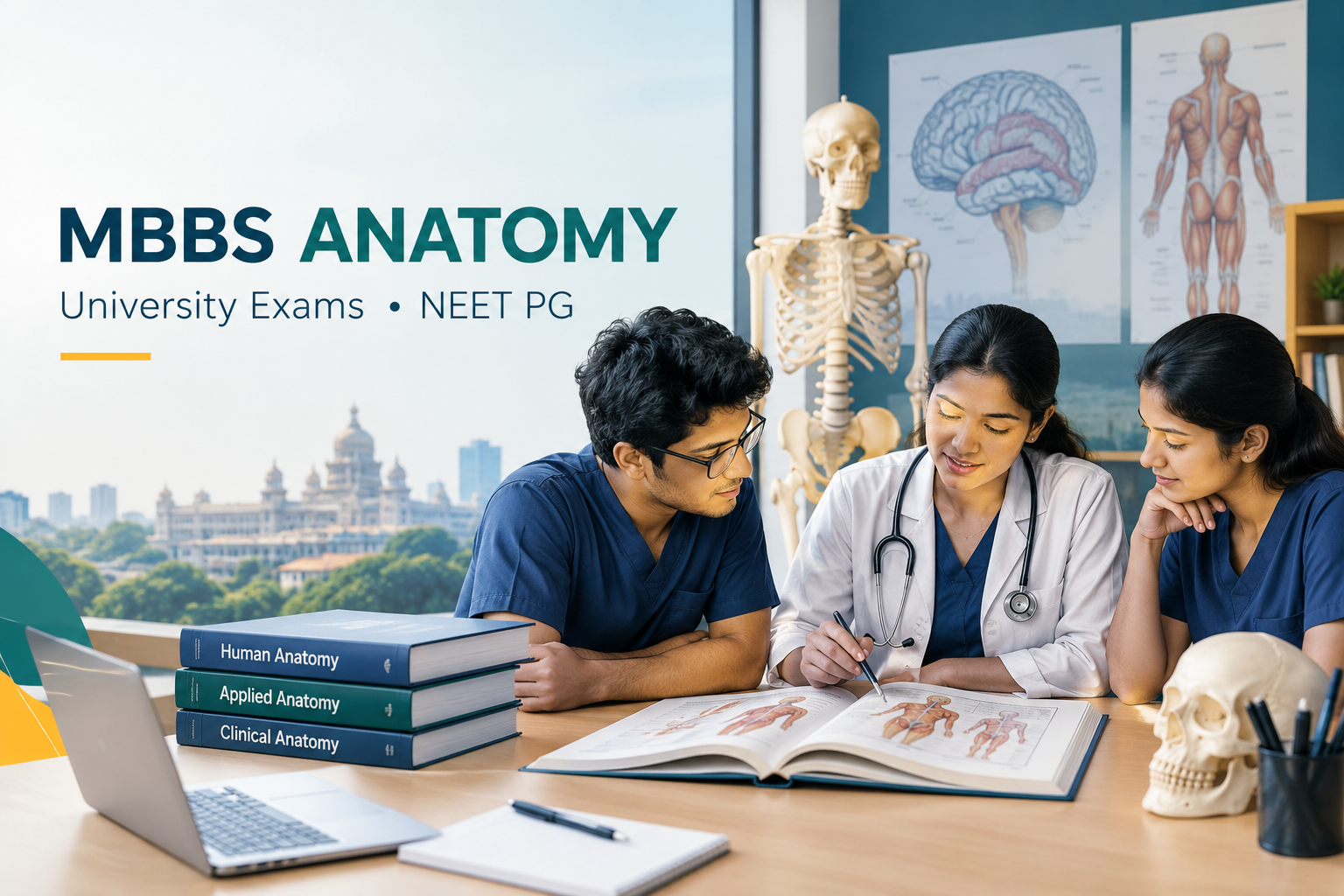
Anatomy is one of the most important foundation subjects in MBBS. It is also a subject that many medical students find difficult because it combines extensive terminology, three-dimensional structures, diagrams, embryology, histology, neuroanatomy, practical identification and clinical correlations.
For students preparing for MBBS university examinations as well as those who want to build a strong foundation for NEET PG, the key is not simply memorising anatomical facts. The real goal is to understand relationships between structures, visualise them correctly, revise systematically and apply the knowledge to clinical questions.
For the 2026–2027 academic period, students should also make sure that their preparation follows the curriculum and examination requirements applicable to their own batch and university. The National Medical Commission’s revised Competency Based Medical Education (CBME) Curriculum 2024 applies to MBBS batches admitted from 2024–25 onwards.
GATEIIT provides Anatomy tutoring for MBBS students through Online and Offline/Hybrid learning options with One-to-One academic support, allowing students to seek help according to their individual learning requirements.
Quick Answer: How Can MBBS Students Master Anatomy?
The most effective approach is to combine:
- Conceptual understanding rather than isolated memorisation
- Regular diagram and structure-based revision
- Gross anatomy with histology, embryology and neuroanatomy
- Clinical correlation wherever relevant
- Active recall and spaced revision
- University-question practice
- Practical and viva preparation
- MCQ practice for postgraduate entrance preparation
- Personalised guidance when particular topics remain difficult
Students preparing for both university examinations and NEET PG should avoid treating these as two completely separate subjects. A strong understanding of anatomy can support both goals, although the style of preparation and question practice may differ.
Why Is Anatomy So Important in MBBS?
Anatomy provides the structural foundation for understanding medicine.
The NMC’s CBME curriculum identifies important anatomy learning outcomes including understanding normal structures and their relationships, functional and cross-sectional anatomy, microscopic anatomy, development, congenital anomalies and principles of modern imaging such as CT, ultrasound, MRI and angiography.
This means anatomy is not simply about learning the names of bones, muscles, nerves and vessels.
A good anatomy foundation helps students understand subjects such as:
- Surgery
- Orthopaedics
- Radiology
- Neurology
- Obstetrics and Gynaecology
- ENT
- Ophthalmology
- Pathology
- Clinical medicine
For a medical student, the question should therefore not only be “What is this structure?” but also:
“Where is it, what is related to it, what does it supply or drain, and why does this relationship matter clinically?”
What Does MBBS Anatomy Include?
The exact teaching sequence and assessment approach can vary by medical college and applicable curriculum. Students should always refer to their college’s current syllabus and university requirements.
However, major areas of MBBS Anatomy commonly include:
1. Gross Anatomy
This deals with structures that can be studied at the macroscopic level.
Important regional areas include:
- Upper limb
- Lower limb
- Thorax
- Abdomen
- Pelvis and perineum
- Head and neck
- Back
Students need to understand not only individual structures but also their anatomical relationships.
2. Neuroanatomy
Neuroanatomy can initially feel overwhelming because of the number of pathways, nuclei and anatomical relationships involved.
Important areas include:
- Brain and spinal cord
- Cranial nerves
- Ascending and descending pathways
- Brainstem
- Cerebellum
- Ventricular system
- Blood supply of the brain
- Major neurological correlations
A useful strategy is to learn pathways as organised systems rather than attempting to memorise disconnected lists.
3. Histology
Histology focuses on microscopic structures and tissue organisation.
Students should learn to recognise characteristic features and connect microscopic appearance with function.
4. Embryology
Embryology explains how structures develop and why certain congenital abnormalities occur.
Instead of memorising isolated developmental events, try to understand:
developmental event → anatomical change → possible abnormality
This makes revision considerably easier.
5. Osteology
Osteology involves the study of bones and their important landmarks.
Students should practise identifying:
- Bone
- Side
- Important surfaces
- Borders
- Processes
- Attachments
- Articulations
- Important foramina and structures passing through them
6. Surface and Applied Anatomy
Surface anatomy helps connect textbook knowledge with the location of structures on the body.
Applied anatomy further connects anatomical knowledge with clinical situations.
How Should You Prepare Anatomy for MBBS University Exams?
University examination preparation requires more than repeatedly reading a textbook.
A practical approach is to divide preparation into four stages.
Stage 1: Build the Concept
Start with the basic anatomy of the topic.
For example, while studying the brachial plexus, first understand:
- Its roots
- Trunks
- Divisions
- Cords
- Major branches
- Anatomical relationships
- Important clinical correlations
Once the structure is understood, memorisation becomes much easier.
Stage 2: Draw and Label
Anatomy is highly visual.
Regularly practise diagrams rather than only looking at them.
Depending on your university’s requirements, practise important diagrams such as:
- Nerve pathways
- Arterial supply
- Anatomical sections
- Organ relationships
- Developmental diagrams
- Important regional structures
The objective is not artistic perfection. The objective is clear, accurate and appropriately labelled representation.
Stage 3: Practise University Questions
Previous university questions can help you understand how topics are commonly examined in your institution.
Create three categories:
| Category | What to Do |
|---|---|
| Strong topics | Revise periodically |
| Average topics | Practise questions and diagrams |
| Weak topics | Relearn concepts and seek guidance |
Do not wait until the final weeks to identify weak areas.
Stage 4: Active Revision
After studying a topic, close the book and ask yourself:
- Can I explain this structure without looking?
- Can I draw the important diagram?
- Can I describe its relationships?
- Can I recall its blood supply or nerve supply where applicable?
- Can I answer a basic clinical question about it?
This is much more effective than passive rereading.
How Can Anatomy Preparation Help With NEET PG?
Students preparing for NEET PG need to approach anatomy differently from university-only preparation.
NEET PG is the national eligibility-cum-entrance examination for postgraduate medical courses, conducted by NBEMS. The official NBEMS NEET-PG page provides the applicable information bulletin, notices, application information and examination updates.
For the 2026 examination cycle, NBEMS published an official schedule notice and subsequently issued examination-related notices during 2026. Students preparing for a future cycle should rely on the latest NBEMS bulletin rather than assuming that dates, eligibility conditions or examination arrangements will remain unchanged.
For anatomy preparation aimed at postgraduate entrance exams, focus on:
- Concept-based learning
- Image-based questions
- Clinical correlations
- Anatomical relationships
- High-yield revision
- Repeated MCQ practice
- Error analysis
- Spaced revision
The exact examination pattern and requirements should always be checked against the latest official NBEMS information bulletin for the relevant examination year.
A Practical Anatomy Study Plan for MBBS Students
Here is a simple framework that can be adapted around your college timetable.
Daily
Step 1 — Learn
Study one defined anatomy topic rather than attempting an entire region at once.
Step 2 — Visualise
Use diagrams, anatomical illustrations, models or other reliable visual resources.
Step 3 — Recall
Close your notes and reproduce the important points from memory.
Step 4 — Apply
Attempt relevant university questions or MCQs.
Step 5 — Review
Spend a few minutes revisiting older topics.
Weekly
At the end of every week:
- Review completed topics
- Revisit weak areas
- Practise diagrams
- Attempt questions
- Record repeated mistakes
- Plan the next week’s topics
Before University Exams
Move from learning mode to examination mode.
Prioritise:
- Your university syllabus
- Frequently examined areas
- Previous university questions
- Important diagrams
- Practical identification
- Viva preparation
- Rapid revision
Alongside NEET PG Preparation
Do not allow entrance-exam preparation to completely replace your university studies.
Instead, use your MBBS anatomy preparation to create a strong foundation and gradually add:
- MCQs
- Image-based questions
- Clinical correlations
- Repeated revision
- Topic-wise error analysis
How to Study Difficult Anatomy Topics
Some anatomy topics are difficult because they contain too many interconnected details.
A useful technique is to break the topic into five questions:
1. Where is it?
Understand its anatomical location.
2. What is it related to?
Learn important neighbouring structures.
3. What does it supply or receive?
Study relevant arteries, veins, nerves or lymphatic relationships.
4. What happens if it is damaged?
Connect anatomy with clinical presentation.
5. How can I recognise it?
Practise diagrams, images, specimens or identification-based questions.
This approach converts anatomy from a list of facts into a logical map.
Common Anatomy Mistakes Made by MBBS Students
1. Trying to Memorise Everything at Once
Anatomy contains a large amount of information. Attempting to memorise entire chapters in one sitting usually leads to poor retention.
Break large topics into smaller units.
2. Ignoring Diagrams
Reading anatomy without drawing or visualising structures makes spatial relationships harder to remember.
3. Studying Only Before the Examination
Last-minute preparation may help with short-term recall but leaves little time for repeated revision.
4. Neglecting Practical and Viva Preparation
Knowing a structure theoretically is different from identifying it in a practical setting and explaining its significance.
5. Memorising Without Understanding Relationships
A list of branches or structures is easier to forget when there is no anatomical context.
6. Ignoring Weak Topics
Students often keep revising subjects they already know because it feels comfortable.
Your study time should also address areas where you repeatedly make mistakes.
7. Preparing for NEET PG Too Early in an Unstructured Way
Early preparation is useful, but attempting large volumes of MCQs without understanding basic anatomy can become inefficient.
Build the concept first, then increase question practice.
Self-Study vs Online Classes vs Offline Tutoring
There is no single learning method that works equally well for every medical student.
| Method | Useful When | Possible Challenge |
|---|---|---|
| Self-study | You understand concepts independently and can maintain a schedule | Difficult topics may remain unresolved |
| Online tutoring | You need flexibility or cannot attend a physical centre | Requires a disciplined study environment |
| Offline tutoring | You learn better through direct interaction | Travel and fixed timings may need consideration |
| Hybrid learning | You want flexibility combined with direct academic support | Requires coordination between learning modes |
| One-to-One tutoring | You need personalised attention in specific topics | Course suitability and schedule should be discussed beforehand |
The right choice depends on your current understanding, timetable, learning preferences and academic goals.
How GATEIIT Can Help With MBBS Anatomy
GATEIIT offers Anatomy coaching and tuition in Bangalore for MBBS students, with Online and Offline/Hybrid options and One-to-One academic support.
This format can be useful for students who want additional guidance alongside their medical college studies.
One-to-One Learning
Individualised sessions can allow students to focus on topics where they need additional explanation or practice.
Online Learning
Online classes can be considered by students who need flexibility or prefer learning remotely.
Offline/Hybrid Learning
Students who prefer face-to-face interaction can explore offline or hybrid options, depending on the currently available arrangement.
Academic Support for Different Goals
Anatomy tutoring can be structured around different academic requirements, such as:
- Understanding difficult anatomy concepts
- Preparing for university examinations
- Strengthening diagrams and applied anatomy
- Revising important topics
- Building an anatomy foundation for postgraduate entrance preparation
Students should discuss their current academic level, syllabus, preferred learning mode and preparation objectives with GATEIIT before choosing an appropriate plan.
Explore GATEIIT Anatomy Coaching & Tuition in Bangalore
Who Can Consider MBBS Anatomy Tutoring?
Anatomy tutoring may be useful for:
- MBBS students who find anatomy difficult
- Students preparing for university examinations
- Students who need additional one-to-one academic support
- Students looking for online anatomy tuition
- Students looking for offline or hybrid tutoring in Bangalore
- Students who want to strengthen anatomy before postgraduate entrance preparation
- Students who need help with specific anatomy topics rather than the entire subject
If you are already performing well, tutoring can also be used selectively for difficult units instead of replacing your normal college preparation.
How to Choose an Anatomy Tutor in Bangalore
Before enrolling, students should ask practical questions.
Ask About the Learning Format
Is the course:
- Online?
- Offline?
- Hybrid?
- One-to-one?
Ask About Your Academic Requirement
Tell the tutor whether your priority is:
- University examination preparation
- Practical/viva preparation
- Concept clarification
- NEET PG foundation
- Specific difficult topics
Ask About Scheduling
Your MBBS timetable can be demanding, so confirm whether the available schedule fits your academic commitments.
Ask About Course Scope
Make sure you understand exactly what is included before enrolling.
Ask About Fees
Fees can vary according to the course, subjects, mode and level of customisation. Confirm the current fee directly with the institute rather than relying on outdated online information.
Admission and Enquiry Guidance
Students interested in GATEIIT’s MBBS Anatomy tutoring can contact the institute to discuss:
- Online or Offline/Hybrid learning
- One-to-One tutoring
- Current availability
- Course structure
- Batch/session timings
- Fee details
- Academic requirements
For current course information, visit the official GATEIIT page or contact the institute directly.
GATEIIT’s published contact information includes 8884416155 and 8884416154.
Frequently Asked Questions About MBBS Anatomy Tutoring
1. Is Anatomy difficult for MBBS students?
Anatomy can be challenging because of its volume, terminology and three-dimensional nature. Understanding relationships and revising systematically can make the subject more manageable.
2. Can I study Anatomy through one-to-one tutoring?
Yes. GATEIIT offers One-to-One academic support for MBBS Anatomy, allowing students to seek personalised guidance.
3. Does GATEIIT offer online Anatomy tuition?
Yes. GATEIIT offers online learning options for MBBS Anatomy.
4. Is offline Anatomy tutoring available in Bangalore?
GATEIIT offers Offline/Hybrid learning options for its MBBS Anatomy tutoring. Students should confirm current centre availability and schedules before admission.
5. Can Anatomy tuition help with university exams?
Additional tutoring can help students clarify concepts, organise revision and practise examination-oriented preparation. Students should continue following their university’s official syllabus and requirements.
6. Can MBBS Anatomy preparation also help with NEET PG?
Yes. A strong conceptual foundation in anatomy can support later postgraduate entrance preparation. NEET PG preparation additionally requires systematic MCQ practice, clinical application and revision.
7. Should I start NEET PG preparation while studying MBBS?
Students may gradually build a strong conceptual foundation during MBBS. The appropriate intensity of dedicated entrance preparation depends on the student’s academic stage and priorities.
8. What are the major areas of MBBS Anatomy?
Major areas include gross anatomy, neuroanatomy, histology, embryology, osteology and clinically relevant anatomy. The exact syllabus should be checked against the curriculum applicable to your batch and university.
9. How can I remember anatomy for longer?
Use active recall, diagrams, spaced revision, self-testing and clinical correlations rather than relying only on repeated reading.
10. How important are diagrams in Anatomy?
Diagrams are important because anatomy is a visual subject. Practising clear and correctly labelled diagrams can improve understanding and examination preparation.
11. How should I prepare for Anatomy viva?
Practise identifying structures and answering short questions about location, relations, supply, function and clinical relevance.
12. Is self-study enough for Anatomy?
It can be sufficient for some students. Additional tutoring becomes useful when a student has persistent conceptual difficulties, needs individual attention or struggles to maintain a structured preparation plan.
13. Should I choose online or offline Anatomy classes?
Choose according to your learning preference, schedule and need for direct interaction. Online, offline and hybrid formats each have different practical advantages.
14. Can I take tutoring only for difficult Anatomy topics?
Discuss this requirement with the institute. One-to-One tutoring can be particularly useful when a student needs focused academic support.
15. Does GATEIIT provide One-to-One MBBS Anatomy tutoring?
Yes. One-to-One academic support is one of the currently offered formats listed by GATEIIT for MBBS tutoring.
16. Is GATEIIT Anatomy tutoring available for students outside Bangalore?
GATEIIT offers online learning options, making remote participation possible. Students should confirm current availability and session arrangements directly with the institute.
17. What should I ask before joining an Anatomy course?
Ask about the teaching format, session schedule, syllabus coverage, personalisation, academic support, fees and the way the course fits your university preparation.
18. Where can I find the current MBBS curriculum?
For MBBS batches covered by the revised curriculum, students should refer to the latest applicable National Medical Commission curriculum documents and their university’s academic instructions. The NMC states that its revised CBME Curriculum 2024 applies from the MBBS batch admitted in 2024–25 onwards.
19. Where should I check current NEET PG requirements?
Students should use the official NBEMS NEET PG page and the latest Information Bulletin applicable to their examination cycle. The NBEMS website provides the official examination information and notices.
20. How do I enquire about GATEIIT MBBS Anatomy classes?
You can visit the official GATEIIT Anatomy page or contact GATEIIT using the currently published contact details to discuss the available online, offline/hybrid and One-to-One options.
Final Thoughts: Build Anatomy as a Foundation, Not Just an Exam Subject
Mastering MBBS Anatomy takes time. The subject becomes easier when students stop approaching it as a collection of disconnected facts and start seeing the relationships between structures.
For university examinations, focus on conceptual clarity, diagrams, practical preparation, viva practice and previous questions. For NEET PG preparation, gradually add clinical correlations, image-based learning, MCQs and repeated revision.
Most importantly, do not compare your learning speed with someone else’s. Identify the topics you find difficult, address them systematically and keep revising what you have already learned.
For students looking for additional academic support in Bangalore, GATEIIT offers MBBS Anatomy tutoring through Online and Offline/Hybrid modes with One-to-One support. Students can enquire about the current course structure, availability and schedule before making a decision.
Visit GATEIIT for MBBS Anatomy Coaching & Tuition in Bangalore
Contact: 8884416155 / 8884416154