Preparing for IB Grade 12 Physics HL can feel challenging because the subject is not only about remembering formulas. You need to understand physical concepts, apply mathematical reasoning, analyse data, interpret experiments and communicate your answers clearly.
The good news is that Physics HL becomes much more manageable when you prepare systematically. Instead of trying to memorise every equation, focus on understanding why a formula works, when to use it, how to interpret the information given and how to present your solution.
This guide explains how to prepare for the IB DP Physics HL examination for 2026–2027, including the current syllabus structure, assessment pattern, study plan, question-solving strategy, practical work, common mistakes and revision techniques.
Quick answer: To prepare effectively for IB Physics HL, combine conceptual learning with regular problem-solving, data analysis, practical-work skills and timed examination practice. Start with the IB syllabus, build topic-wise notes, practise questions after every topic, maintain an error log and gradually move from untimed practice to full timed papers.
Quick Answer: How Should You Prepare for IB Physics HL?
A strong IB Physics HL preparation strategy should include:
- Understand the current IB Physics HL syllabus.
- Learn concepts before trying to memorise equations.
- Build a formula and concept sheet for each major topic.
- Practise numerical problems regularly.
- Learn to interpret graphs, tables, diagrams and experimental data.
- Give special attention to HL-only material.
- Practise applying concepts to unfamiliar situations.
- Review your practical and scientific-investigation skills.
- Solve official-style questions and past examination material where available.
- Complete timed Paper 1, Paper 2 and Paper 3 practice.
- Maintain an error log and revisit repeated mistakes.
- Keep your Internal Assessment work on schedule.
- Use the final weeks for targeted revision rather than learning everything from scratch.
IB assessment is criterion-related, meaning performance is judged against defined standards rather than simply against the performance of other students. The IB also assesses skills such as analysing information, solving problems, applying methods and evaluating evidence.
What Makes IB Physics HL Different?
IB Physics is an experimental science subject with a strong mathematical component. The IB describes data analysis as a key skill and places significant emphasis on practical and investigative work.
This means that successful preparation needs to cover more than textbook theory.
You should become comfortable with:
- Understanding physical models and principles
- Applying equations correctly
- Rearranging equations
- Using units and significant figures appropriately
- Interpreting graphs
- Analysing experimental data
- Identifying relationships between variables
- Explaining physical phenomena
- Evaluating experimental methods
- Solving unfamiliar problems
- Communicating reasoning clearly
A student who only memorises formulas may struggle when the question presents a familiar concept in an unfamiliar context.
IB Physics HL Syllabus: What Do You Need to Study?
The current IB Physics curriculum is organised into five broad themes, with the concepts of forces, energy and particles running throughout the course.
The current Physics framework includes:
| Theme | Major areas |
| A. Space, time and motion | Kinematics, forces and momentum, work/energy/power, rigid body mechanics, Galilean and special relativity |
| B. The particulate nature of matter | Thermal energy transfers, greenhouse effect, gas laws, thermodynamics, current and circuits |
| C. Wave behaviour | Simple harmonic motion, wave model, wave phenomena, standing waves and resonance, Doppler effect |
| D. Fields | Gravitational fields, electric and magnetic fields, motion in electromagnetic fields, induction |
| E. Nuclear and quantum physics | Atomic structure, quantum physics, radioactive decay, fission, fusion and stars |
Several areas contain additional higher-level content. The IB’s current Physics material specifically identifies topics such as rigid body mechanics, relativity, thermodynamics, quantum physics and electromagnetic induction as HL-only or additional higher-level content depending on the topic.
Important note about the syllabus
The IB Physics course currently uses a newer framework, with first assessment in 2025. Therefore, students preparing for 2026–2027 should use the syllabus and assessment materials applicable to their examination session rather than relying blindly on older notes or websites.
IB Physics HL Exam Pattern
For the current Physics HL framework, the assessment consists of three examination papers and an Internal Assessment component.
| Component | HL weighting | Duration |
| Paper 1 | 20% | 1 hour |
| Paper 2 | 36% | 2 hours 15 minutes |
| Paper 3 | 24% | 1 hour 15 minutes |
| Internal Assessment | 20% | 10 hours* |
The current IB Physics subject brief gives the above weighting and examination durations.
*The IA figure represents recommended/allocated assessment time rather than a conventional examination sitting.
Why should you prepare differently for each paper?
Because each assessment component tests different combinations of knowledge and skills.
Your preparation should therefore include:
- Fast and accurate question reading
- Conceptual understanding
- Numerical problem-solving
- Extended reasoning
- Data interpretation
- Experimental analysis
- Scientific communication
Do not prepare for the entire Physics HL course as though it were one giant multiple-choice test.
A Practical IB Physics HL Study Plan
A good study plan should change as the examination gets closer.
A useful approach is to divide preparation into four stages.
Stage 1: Build Your Foundation
Goal: Understand the syllabus and strengthen concepts
Start by identifying:
- Topics already completed
- Topics you understand well
- Topics you partially understand
- Topics you have not studied properly
- Areas where your mathematical skills are weak
For each topic, create a simple study cycle:
Learn → Understand → Practise → Review → Test
For example:
Mechanics
- Understand displacement, velocity and acceleration.
- Connect equations with motion graphs.
- Study forces and momentum.
- Solve basic numerical problems.
- Progress to multi-step problems.
- Complete exam-style questions.
- Record mistakes.
Do not move forward simply because you have read the chapter.
Move forward when you can use the concept independently.
Stage 2: Topic-Wise Question Practice
Once the basic concepts are clear, increase your problem-solving practice.
For every major topic, practise three levels of questions:
Level 1: Basic application
These test whether you understand the direct use of a concept or equation.
Level 2: Multi-step problems
These require you to combine two or more concepts.
Level 3: Unfamiliar application
These require you to identify the relevant physics before deciding which equation or principle to use.
This third category is particularly important for IB Physics HL.
Ask yourself:
“What physics principle is this question actually testing?”
rather than:
“Which formula looks familiar?”
Stage 3: Examination-Focused Preparation
Once most of the syllabus is covered, shift from learning mode to examination mode.
Your weekly routine should increasingly include:
- Timed question sets
- Paper 1 practice
- Paper 2 practice
- Paper 3 practice
- Data-analysis questions
- Experimental questions
- Mixed-topic questions
- Error-log revision
At this stage, avoid spending all your time rereading notes.
Your priority should become:
Question → Attempt → Mark → Analyse → Correct → Reattempt
Stage 4: Final Revision
During the final revision phase, focus on:
- Weak topics
- Frequently repeated mistakes
- Difficult HL concepts
- Formula application
- Graph interpretation
- Experimental skills
- Data analysis
- Time management
- Full-length examination practice
Do not attempt to completely relearn Physics in the final few days.
Your final revision should be about accuracy, confidence and consistency.
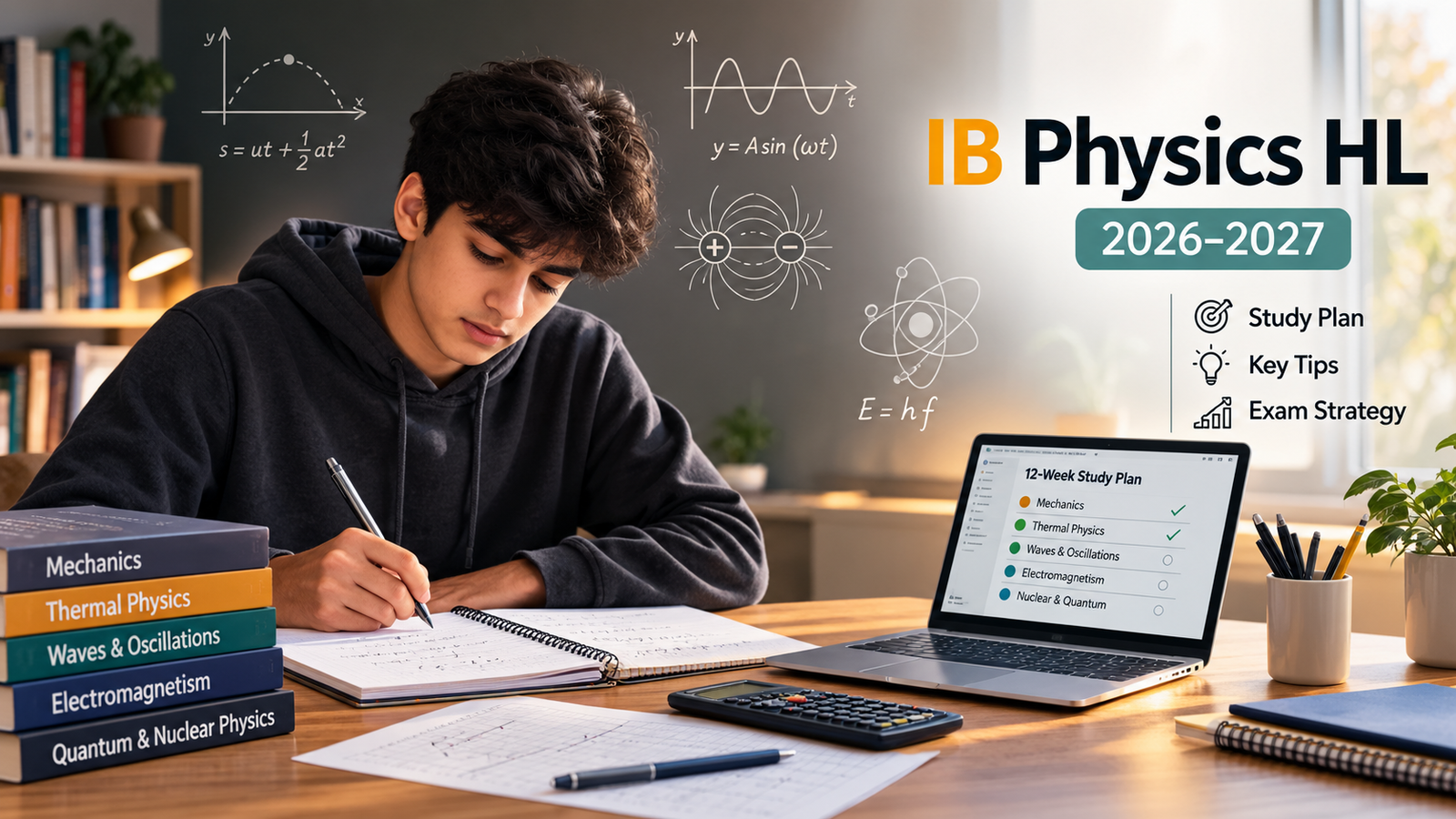
Recommended 12-Week IB Physics HL Study Plan
If you have approximately three months available, the following structure can help.
| Weeks | Main focus |
| Weeks 1–2 | Diagnostic test + mechanics + mathematical foundations |
| Weeks 3–4 | Thermal physics + current/circuits |
| Weeks 5–6 | Waves + oscillations + wave phenomena |
| Weeks 7–8 | Fields + electromagnetic applications |
| Weeks 9–10 | Nuclear and quantum physics + remaining HL areas |
| Week 11 | Mixed-topic examination practice + weak areas |
| Week 12 | Timed papers + error correction + final revision |
This is a flexible framework rather than an official IB timetable. Adjust it according to your school’s teaching schedule, examination session and personal strengths.
What Should You Do Every Day for Physics HL?
You do not necessarily need to study Physics for several hours every day.
A focused 60–120 minute session can be productive if it has a clear purpose.
Example 90-minute session
15 minutes: Review concepts/formulas
35 minutes: Solve problems
20 minutes: Attempt an unfamiliar or exam-style question
10 minutes: Check answers
10 minutes: Update your error log
The important thing is consistency.
Studying Physics for a long period once a week is generally less useful than shorter, focused sessions spread across the week.
How to Study IB Physics HL Effectively
1. Understand the concept before memorising the formula
Take a familiar equation such as:
F = ma
Don’t stop at knowing the equation.
Ask:
- What does each variable represent?
- What are the units?
- What assumptions are being made?
- What happens if one variable changes?
- Can the equation be rearranged?
- How could the relationship appear on a graph?
- Can I recognise a situation where the equation applies?
This approach turns formulas into tools rather than isolated facts.
2. Create a Physics Formula and Concept Book
Keep one compact revision resource containing:
- Important equations
- Definitions
- Units
- Graph relationships
- Key assumptions
- Common mistakes
- Important diagrams
- Difficult concepts
Avoid copying entire textbook chapters.
Your final revision resource should be something you can actually review quickly.
3. Practise Graphs Regularly
Graphs are an important part of scientific reasoning.
Practise:
- Reading gradients
- Identifying intercepts
- Understanding proportional relationships
- Interpreting curves
- Comparing experimental data
- Identifying anomalies
- Discussing uncertainty
- Linking graph features to physical meaning
Whenever you see a graph, ask:
“What physical relationship is this graph showing?”
4. Strengthen Your Mathematical Skills
Physics HL requires mathematical confidence.
Make sure you are comfortable with:
- Algebraic manipulation
- Rearranging equations
- Scientific notation
- Powers and indices
- Ratios and proportionality
- Graph gradients
- Basic trigonometry
- Vectors
- Unit conversions
- Significant figures
- Standard mathematical reasoning used in your course
If your Physics mistakes are actually caused by mathematics, identify that early.
5. Learn How to Use Units
Units are not an afterthought.
They can help you identify errors.
For every numerical answer, ask:
Does the unit make physical sense?
For example, an answer for acceleration should not end in joules.
Develop the habit of writing:
formula → substitution → calculation → unit → final answer
when appropriate.
6. Build an Error Log
An error log can become one of your most valuable Physics resources.
Create columns such as:
| Question | My mistake | Why I made it | Correct approach | Reattempt date |
| Mechanics | Used wrong equation | Misread information | Identify known quantities first | Friday |
| Waves | Graph interpretation error | Did not identify axes | Read axes before calculating | Sunday |
| Circuits | Unit conversion error | Skipped unit check | Convert before substitution | Wednesday |
After several weeks, patterns will appear.
You may discover that you are not actually weak in Physics overall—you may simply repeat three or four specific types of mistakes.
How to Prepare for IB Physics HL Paper 1
Paper 1 requires efficient decision-making.
Practise:
- Identifying the relevant concept quickly
- Eliminating clearly incorrect options
- Checking units
- Estimating when exact calculation is unnecessary
- Recognising graphs and relationships
- Avoiding overthinking simple questions
Paper 1 strategy
Read the question carefully.
Identify:
What is given?
What is being asked?
Which principle connects the two?
Then solve.
Don’t automatically perform lengthy calculations when a conceptual or proportional argument is enough.
How to Prepare for IB Physics HL Paper 2
Paper 2 deserves significant preparation because it carries a large proportion of the HL assessment weighting.
Practise writing solutions in a way that makes your reasoning visible.
A useful structure is:
Given → Principle/Equation → Substitution → Calculation → Unit → Conclusion
For explanation questions:
Statement → Physics principle → Explanation → Conclusion
Don’t assume that the examiner will infer every step in your reasoning.
How to Prepare for IB Physics HL Paper 3
Paper 3 requires preparation beyond simply memorising theory.
Give attention to:
- Data analysis
- Experimental interpretation
- Scientific reasoning
- Practical contexts
- Uncertainty
- Evaluation
- Application of concepts to experimental situations
The IB places significant emphasis on practical work and scientific investigation within Physics.
Therefore, do not leave Paper 3-style preparation until the final week.
How Important Is the Internal Assessment in IB Physics HL?
The Internal Assessment contributes 20% to the current Physics HL assessment structure.
The Physics course includes a scientific investigation, which the IB describes as an assessed independent research paper. Practical work is also a central part of the course.
Your IA preparation should therefore not be treated as a last-minute project.
Pay attention to:
- Research question
- Variables
- Method
- Data collection
- Data processing
- Uncertainty
- Analysis
- Evaluation
- Scientific communication
Follow your school’s current IB guidance and the requirements applicable to your examination session.
How to Use Past Papers Effectively
Past papers are useful only when you analyse your performance.
Don’t simply solve paper after paper.
Use a three-step approach.
First attempt
Solve under realistic conditions.
Second stage
Mark your work carefully.
Categorise mistakes:
- Concept error
- Formula selection
- Mathematical error
- Unit error
- Data interpretation
- Misreading
- Time management
- Incomplete explanation
Third stage
Reattempt difficult questions after a gap.
This tells you whether you have actually fixed the problem.
The IB’s official Questionbank provides teachers with access to official examination questions, markschemes and subject reports aligned with current IB syllabuses.
Students should use legitimate and school-approved examination resources rather than relying on outdated or unauthorised material.
How Many Past Papers Should You Solve?
There is no magic number.
Quality matters more than quantity.
For example:
10 papers analysed carefully
can be more useful than
20 papers completed without reviewing mistakes.
As the examination approaches, increase the frequency of timed practice.
The goal is to become comfortable with:
- The wording of questions
- Time pressure
- Multi-step problems
- Data interpretation
- Switching between topics
- Checking answers
How to Manage Time During the Physics HL Exam
Time management should be practised before examination day.
During practice papers:
- Start with questions you can approach confidently.
- Avoid spending excessive time on one difficult problem.
- Mark questions you want to revisit.
- Keep calculations organised.
- Leave time to check units and signs.
- Review unanswered questions before finishing.
The exact examination instructions and permitted materials should always be checked against the official information supplied for your examination session.
Common Mistakes IB Physics HL Students Make
Mistake 1: Memorising without understanding
Knowing an equation does not guarantee that you know when to use it.
Better approach: Understand the physical relationship first.
Mistake 2: Ignoring practical work
Physics is not purely theoretical.
Better approach: Regularly revise experimental concepts, uncertainty, data analysis and evaluation.
Mistake 3: Doing only easy questions
Easy questions create confidence but do not necessarily prepare you for unfamiliar applications.
Better approach: Gradually increase question difficulty.
Mistake 4: Not reviewing mistakes
Completing a paper and checking the score is not enough.
Better approach: Identify why each error occurred.
Mistake 5: Leaving HL-only topics until the end
HL material can require substantial conceptual understanding.
Better approach: Integrate HL content into your regular study schedule.
Mistake 6: Ignoring units
A calculation can look correct while the unit is completely wrong.
Better approach: Make unit checking part of your solution routine.
Mistake 7: Relying completely on memorised notes
Physics questions can be presented in unfamiliar contexts.
Better approach: Practise applying principles rather than reproducing memorised answers.
Self-Study vs Online Classes vs Classroom Coaching
Different students need different preparation methods.
| Method | Advantages | Possible limitation |
| Self-study | Flexible, independent and cost-conscious | Requires strong discipline and easy access to doubt support |
| Online classes | Convenient, can fit around school schedules | Requires consistent participation and independent practice |
| Classroom learning | Direct interaction and structured routine | Fixed schedule and travel may be required |
| Hybrid learning | Combines online flexibility with classroom support | Requires good planning |
| One-to-one learning | Personalised pace and focused doubt-solving | Requires consistent engagement from the student |
There is no universally “best” method.
Choose the approach that matches your:
- Current Physics level
- School workload
- Learning style
- Available time
- Need for personalised support
- Ability to study independently
How GATEIIT Can Help With IB Physics Preparation
Students who want structured support alongside school preparation can explore the IB DP preparation options offered by GATEIIT.
Based on the course information provided, GATEIIT offers:
- Online learning
- Offline/Hybrid learning
- One-to-One support
- Structured academic guidance and other currently offered course support
The most suitable format depends on the student’s learning requirements and schedule.
The objective should not be to replace independent practice. Even with coaching, students need to solve problems, review mistakes, work on practical skills and practise examination questions independently.
You can learn more about the IB DP preparation approach here:
GATEIIT IB DP Exam Preparation – Complete Strategy, Syllabus, Exam Pattern & Study Tips 2026–2027
When Should You Start Preparing for IB Physics HL?
Ideally, preparation should begin from the start of the IB course rather than only before the final examination.
However, the right strategy depends on how much time remains.
If you have 6–12 months
Focus on:
- Complete conceptual understanding
- Topic-wise practice
- HL content
- IA progress
- Regular examination questions
If you have 3–6 months
Focus on:
- Completing remaining syllabus areas
- Mixed-topic practice
- Weak-topic revision
- Past-paper practice
- Data analysis
If you have 1–3 months
Focus on:
- High-frequency weaknesses
- Timed practice
- Full papers
- Error correction
- Practical/data-analysis skills
If you have only a few weeks
Do not panic.
Prioritise:
- Your weakest topics
- Important concepts
- Formula application
- Examination technique
- Timed practice
- Repeated mistakes
A Weekly IB Physics HL Revision Routine
A balanced weekly routine might look like this:
| Day | Suggested activity |
| Monday | Concept revision + numerical problems |
| Tuesday | HL topic + exam-style questions |
| Wednesday | Data/graph analysis |
| Thursday | Topic revision + difficult questions |
| Friday | Mixed-topic practice |
| Saturday | Timed paper/question set |
| Sunday | Error-log review + weak-topic revision |
Modify this around your school timetable and other IB subjects.
Remember that Physics is only one component of the IB Diploma. Your study plan should protect time for other subjects and the DP core as well.
How to Stay Consistent Without Burning Out
IB Grade 12 can involve significant academic pressure.
Instead of setting unrealistic daily targets, set measurable tasks.
Instead of:
“I will study Physics all evening.”
Try:
“I will complete 15 mechanics questions, review the errors and revise one difficult concept.”
Specific goals are easier to track.
Also make room for:
- Sleep
- Breaks
- Exercise and normal activities
- Other IB subjects
- School assignments
- CAS/EE/TOK responsibilities
A sustainable study routine is more useful than an extreme timetable that lasts only a few days.
Frequently Asked Questions About IB Physics HL
1. Is IB Physics HL very difficult?
Physics HL can be challenging because it combines conceptual understanding, mathematics, problem-solving, data analysis and practical skills. However, consistent practice can make the course much more manageable.
2. How can I get a 7 in IB Physics HL?
There is no guaranteed formula for achieving a particular grade. A strong approach is to master the syllabus, practise a wide range of questions, analyse mistakes, develop data-analysis skills and complete timed examination practice.
3. Should I memorise all Physics formulas?
You should know the important relationships and understand how and when to apply them. Memorisation without understanding is not an effective long-term strategy.
4. How early should I start IB Physics HL preparation?
Starting from the beginning of the course is ideal. If you are already in Grade 12, begin with a diagnostic assessment and identify your weakest areas instead of trying to revise everything randomly.
5. Are past papers important for IB Physics HL?
Yes. Examination-style practice helps you understand question structures, time management and application of concepts. Always use materials appropriate to your current syllabus.
6. How should I revise Physics one month before the exam?
Prioritise weak areas, mixed-topic questions, timed papers, data analysis, practical skills and your error log. Avoid spending most of the month passively rereading notes.
7. What should I do if I understand theory but cannot solve questions?
Start with simpler application problems and gradually increase difficulty. When stuck, identify the known quantities, unknown quantity and physical principle involved before looking for an equation.
8. Why do I make mistakes even when I know the formula?
The issue may be application rather than memory. Check whether you are choosing the correct model, interpreting the question correctly, converting units and understanding the physical situation.
9. Is mathematics important for Physics HL?
Yes. IB Physics uses a mathematical approach to understanding models, theories and laws, and mathematical confidence supports numerical problem-solving and data analysis.
10. How important is data analysis?
Very important. The IB specifically identifies data analysis as a key skill in DP Physics and provides opportunities to develop it through the experimental programme.
11. Should I focus only on HL-only topics?
No. You need a strong understanding of the complete Physics HL course. HL-only areas deserve additional attention, but they should not replace revision of the rest of the syllabus.
12. How important is the Physics Internal Assessment?
The current Physics HL assessment structure gives the Internal Assessment a 20% weighting, so it should be treated as an important part of your overall preparation.
13. Can I prepare for IB Physics HL through self-study?
Yes, some students can prepare effectively through self-study, particularly when they have strong discipline and access to suitable resources. Students who need structured guidance or personalised doubt support may benefit from additional academic support.
14. Is online IB Physics coaching useful?
Online learning can be useful when it provides structured teaching, opportunities to ask questions and sufficient scope for independent practice. The effectiveness depends on the student’s consistency and the quality of the learning support.
15. Is one-to-one Physics coaching better?
One-to-one learning can be useful when a student needs personalised explanations, a flexible pace or targeted support for particular weaknesses. It is not automatically better for every student.
16. How can I improve my Physics problem-solving skills?
Solve questions regularly and analyse your mistakes. Gradually progress from direct applications to multi-step and unfamiliar problems.
17. Should I make handwritten Physics notes?
You can, but keep them concise. A useful revision notebook should focus on concepts, equations, diagrams, mistakes and difficult examples rather than copying textbook material.
18. What should I do if I am behind the syllabus?
Don’t try to study everything simultaneously. Make a topic checklist, identify high-priority gaps, build basic understanding first and then move into exam-style practice.
19. Can Physics HL help with university courses?
Physics can be relevant to several higher-education pathways. The IB notes that Physics may be a prerequisite for areas such as mechanical engineering, architecture, astronomy and geophysics, although individual university requirements vary and should always be checked directly with the institution.
20. Where can I get current information about the IB Physics syllabus?
The IB’s official Physics subject page and current subject brief should be your primary references. Students should also follow information supplied by their IB school and coordinator for their specific examination session.
Final IB Physics HL Preparation Checklist
Before the examination, ask yourself:
- [ ] Have I reviewed the complete current syllabus?
- [ ] Can I explain major concepts without simply reading notes?
- [ ] Can I select appropriate equations independently?
- [ ] Can I rearrange equations confidently?
- [ ] Are my units correct?
- [ ] Can I interpret graphs and tables?
- [ ] Can I analyse experimental data?
- [ ] Have I revised HL-specific material?
- [ ] Have I practised unfamiliar questions?
- [ ] Have I completed timed examination practice?
- [ ] Have I analysed my mistakes?
- [ ] Is my Internal Assessment work complete and properly reviewed?
- [ ] Can I manage my time during each examination paper?
- [ ] Have I checked the latest official IB information for my session?
Conclusion: Prepare for Physics HL With Understanding, Not Just Memorisation
IB Grade 12 Physics HL is challenging, but it is also a subject where structured preparation can make a major difference.
The most effective approach is to combine conceptual understanding, mathematical practice, experimental reasoning, data analysis and examination technique.
Don’t measure your preparation only by the number of chapters you have completed. Measure it by whether you can take an unfamiliar question, identify the relevant physics, construct a logical solution and explain your reasoning clearly.
Start early, practise consistently, learn from mistakes and keep checking your preparation against the current IB requirements.
If you are looking for structured academic support alongside your school preparation, GATEIIT offers Online, Offline/Hybrid and One-to-One learning options for IB DP preparation. Students and parents can review the available course format and enquire about the most suitable learning approach through the GATEIIT IB DP preparation page.
Your Physics HL preparation should start with understanding—and grow through consistent practice.