Preparing for IB Board Exams can feel very different from preparing for a conventional school examination. The International Baccalaureate (IB) Diploma Programme (DP) does not focus only on remembering information. Students are expected to understand concepts, apply knowledge, analyse information, construct arguments, solve problems and communicate their thinking clearly.
For students preparing for the IB DP examinations in 2026–2027, the most effective approach is therefore not simply to study for longer hours. It is to understand the assessment requirements, organise the syllabus, practise the right question types, complete internal and core requirements on time, and regularly review performance.
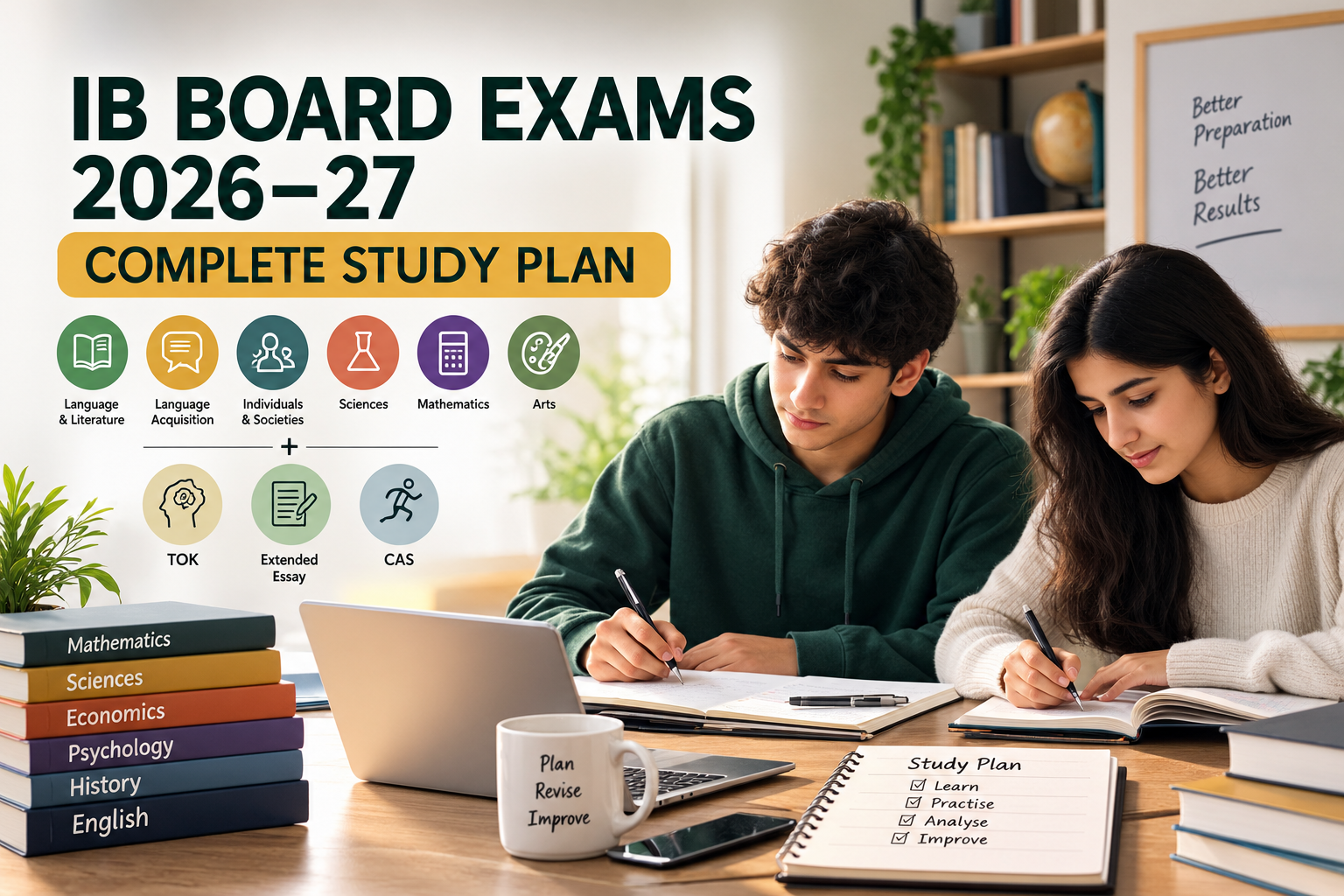
The IB Diploma Programme consists of six subject groups alongside the DP core: Theory of Knowledge (TOK), the Extended Essay (EE), and Creativity, Activity, Service (CAS). Most DP courses use written examinations as an important part of assessment, while many courses also include internally or externally assessed coursework and other assessment components.
This guide explains how IB students can create a realistic study plan, prepare for different subjects, use past papers effectively, manage internal assessments and core requirements, and approach the final months before examinations.
Quick Answer: What Is the Best Way to Prepare for IB Board Exams?
The best IB exam preparation strategy is to:
- Understand your HL and SL syllabus and assessment requirements.
- Divide every subject into manageable topics.
- Identify strong, average and weak areas.
- Study concepts before attempting large numbers of questions.
- Use IB-style questions and past examination papers for practice.
- Review mark schemes and examiner expectations where officially available.
- Maintain a separate revision plan for HL subjects.
- Complete IA, EE and TOK work well before the final revision period.
- Practise timed answers regularly.
- Track mistakes and revise them systematically.
- Balance all six subjects instead of over-focusing on one.
- Protect sleep, breaks and regular physical activity so that preparation remains sustainable.
The key principle is simple:
Learn → Practise → Analyse mistakes → Improve → Repeat.
What Is the IB Diploma Programme?
The International Baccalaureate Diploma Programme (IB DP) is a two-year programme generally designed for students aged 16–19. Students study six subject areas along with the DP core.
The six subject groups are:
Subject Group| Examples
Studies in Language and Literature| Language A, Literature, Language and Literature
Language Acquisition| Language B, Ab Initio and other language courses
Individuals and Societies| Economics, Business Management, Geography, History, Psychology and others
Sciences| Biology, Chemistry, Physics, Computer Science and others
Mathematics| Mathematics: Analysis and Approaches; Mathematics: Applications and Interpretation
Arts| Visual Arts, Music, Theatre, Film, Dance
The exact subjects available to a student depend on the IB school and its authorised course offerings. The IB’s current curriculum information should therefore be checked alongside the subject guide provided by your school.
The IB DP Core
Alongside the six subjects, students complete three core components:
– Theory of Knowledge (TOK)
– Extended Essay (EE)
– Creativity, Activity, Service (CAS)
These are not optional additions that should be left until the end of Grade 12. They form an important part of the Diploma Programme.
How Is the IB Diploma Assessed?
IB assessment is broader than a final written examination.
For most courses, written examinations at the end of the DP form an important part of assessment. However, students may also have internally assessed work, externally assessed coursework, oral components, investigations, projects or other subject-specific assessment tasks depending on their course.
IB DP course grades range from 1 to 7, with 7 being the highest grade.
The overall Diploma score combines subject results with the contribution from TOK and the Extended Essay. CAS does not contribute points to the total, but successful completion is a requirement for the Diploma.
The IB currently states that the Diploma requires a minimum of 24 points, subject to additional Diploma requirements and minimum performance conditions. Students should always check the latest official passing criteria applicable to their examination session rather than relying only on a total-score calculation.
Important for 2026–2027 students
The IB is also transitioning towards digital examinations. The organisation states that digital examinations began with a small number of DP and CP subjects in 2026 as part of a multi-year transition, while paper examinations continue during the transition. Students should therefore follow the examination format communicated by their school and the IB for their particular subjects and session.
Who Is This IB Exam Preparation Plan For?
This study strategy is particularly useful for:
– IB DP Grade 11 students building a strong foundation
– IB DP Grade 12 students preparing for final examinations
– Students studying HL and SL subjects
– Students struggling with time management
– Students who understand concepts but lose marks in examinations
– Students looking for an IB study timetable
– Students preparing for university admission after IB
– Students who want structured online or classroom support
– Students balancing school, IA, EE, TOK and examination preparation
It can also be adapted to students taking individual IB DP courses rather than the full Diploma Programme.
Step 1: Understand Your Exact IB Subjects and Requirements
Before creating a timetable, make a complete list of your subjects.
For each subject, record:
– Subject name
– HL or SL
– Syllabus units/topics
– Assessment components
– Internal assessment requirements
– Coursework deadlines
– Areas you find difficult
– Areas you are confident in
– Available practice papers
– School revision schedule
Do not prepare using a generic “IB syllabus” found online.
Your subject guide, school instructions and the latest official IB information should be your primary references because assessment requirements can change.
Step 2: Divide Your Preparation Into Four Stages
A good IB study plan should not treat the entire academic year as one long revision period.
Stage 1: Build the Foundation
Focus on:
– Understanding concepts
– Completing class notes
– Reading required texts
– Learning definitions and terminology
– Practising basic questions
– Identifying weak topics
At this stage, avoid spending all your time on full-length papers.
Your objective is:
“I understand what the topic means and can explain it without looking at my notes.”
Stage 2: Complete and Consolidate the Syllabus
Once the foundation is established:
– Finish remaining topics.
– Create concise revision notes.
– Practise subject-specific questions.
– Review difficult concepts.
– Start connecting related topics.
– Work on IA and other coursework alongside academic preparation.
For HL subjects, give additional attention to areas requiring deeper analysis, application or problem-solving.
Stage 3: Examination Practice
This is when past-paper and timed practice become increasingly important.
Practise:
– Individual questions
– Topic-based questions
– Data-response questions
– Essay questions
– Structured problems
– Case-study questions
– Source-based questions
– Long-answer questions
– Full examination papers where appropriate
The IB uses different assessment formats across subjects, including essays, structured problems, short-response questions, data-response questions, text-response questions, case studies and, in some contexts, multiple-choice questions.
Stage 4: Final Revision
The final revision stage should not involve trying to learn the entire syllabus again.
Focus on:
– Weak topics
– Frequently made mistakes
– Important definitions
– Formulae where applicable
– Essay structures
– Required terminology
– Command terms
– Diagrams and processes
– Past-paper errors
– Timing
– Exam technique
At this stage, revision should become increasingly targeted.
A Practical 12-Month IB Study Plan
The exact academic calendar varies by school and examination session, so use this as a framework rather than a fixed calendar.
Preparation Phase| Main Objective
Months 1–3| Build concepts and organise syllabus
Months 4–6| Complete major topics and strengthen weak areas
Months 7–9| Intensive question practice and coursework completion
Months 10–11| Past papers, timed practice and targeted revision
Final Month| High-yield revision, mistakes and exam strategy
If you have less time, compress the phases rather than abandoning them.
If You Have Only 6 Months for IB Exams
A six-month plan can be structured like this:
Month 1: Diagnose
– Review the complete syllabus.
– Take diagnostic tests.
– Identify weak subjects.
– Identify weak topics.
– Organise notes and resources.
Month 2: Strengthen Fundamentals
– Complete important concepts.
– Revise foundational chapters.
– Practise basic and intermediate questions.
– Begin systematic mistake tracking.
Month 3: Complete Syllabus
– Finish remaining academic topics.
– Increase question practice.
– Review difficult HL units.
– Keep IA/EE/TOK work on schedule.
Month 4: Application
– Start more timed practice.
– Solve past questions.
– Practise extended responses.
– Work on answer structure and precision.
Month 5: Examination Practice
– Attempt full or substantial sections of papers.
– Analyse every mistake.
– Repeat weak topics.
– Improve time management.
Month 6: Final Revision
– Revise weak areas.
– Review mistakes.
– Practise selected papers.
– Memorise only what genuinely needs memorisation.
– Avoid starting large new resources unnecessarily.
If You Have Only 3 Months
Three months requires prioritisation.
First 4 Weeks
Concept consolidation
Focus on syllabus coverage and weak topics.
Next 4 Weeks
Question practice
Move strongly towards IB-style questions and timed answers.
Final 4 Weeks
Exam simulation
Practise under realistic time limits, analyse mistakes and revise only the areas that need improvement.
Do not spend the first two months making beautiful notes and leave question practice until the final weeks.
How Many Hours Should an IB Student Study?
There is no universal number of study hours that guarantees a particular IB grade.
Instead of setting an unrealistic target such as “I must study 10 hours every day”, build a sustainable routine.
A school-going student might divide independent study into:
– Concept learning
– Question practice
– Revision
– Assignment/coursework
– Error correction
The exact number of hours should depend on your school schedule, subject combination, current performance and proximity to examinations.
A productive two-hour session is generally more useful than several hours spent passively reading.
The Best Daily Study Routine for IB Students
A practical weekday routine could look like:
Session 1: Difficult Subject
45–60 minutes
Work on a challenging HL/SL topic while your concentration is high.
Short Break
10–15 minutes
Session 2: Practice
45–60 minutes
Solve questions without referring continuously to notes.
Short Break
Session 3: Review
30–45 minutes
Review mistakes, flashcards, definitions, diagrams or essay plans.
Final 10 Minutes
Write down:
– What did I learn?
– What did I get wrong?
– What must I revise tomorrow?
This makes your study sessions measurable.
How to Study IB HL Subjects Effectively
HL subjects should not simply receive “more hours”.
They require deeper preparation.
For an HL subject:
- Understand the concept.
- Explain it in your own words.
- Apply it to unfamiliar situations.
- Practise higher-level questions.
- Analyse your mistakes.
- Revisit the topic after a gap.
- Practise under time pressure.
For essay-based subjects, practise constructing arguments.
For numerical subjects, practise applying methods to unfamiliar problems.
For sciences, combine conceptual understanding with practical/application-based questions.
For languages, combine content knowledge with regular writing, reading and communication practice.
How to Prepare for IB Mathematics
For IB Mathematics, passive reading is rarely enough.
A better sequence is:
Concept → Worked Example → Independent Question → Difficult Variation → Timed Practice
Keep a “mistake notebook” containing:
– Formula mistakes
– Conceptual mistakes
– Calculation errors
– Interpretation errors
– Questions you could not complete
– Questions where you lost marks despite knowing the method
Do not simply write the correct solution.
Write:
“Why did I make this mistake?”
That question can be more valuable than copying another solution.
How to Prepare for IB Sciences
For Biology, Chemistry, Physics and other science subjects, use a three-layer approach.
Layer 1: Knowledge
Know:
– Definitions
– Processes
– Equations
– Key concepts
– Diagrams
– Terminology
Layer 2: Application
Practise applying concepts to:
– Data
– Experiments
– Graphs
– New situations
– Real-world contexts
Layer 3: Examination
Practise:
– Command terms
– Structured responses
– Data interpretation
– Calculations
– Extended answers
– Timed questions
This prevents the common mistake of memorising science content without learning how to use it.
How to Prepare for IB Economics, Business, Psychology, History and Other Essay-Based Subjects
Essay-based subjects require more than knowing the textbook.
Your preparation should include:
– Key concepts
– Definitions
– Relevant examples
– Arguments
– Counterarguments
– Evaluation
– Comparison
– Cause-and-effect relationships
– Evidence
– Subject-specific terminology
Practise creating an answer structure before writing the full answer.
For example:
Point → Explanation → Evidence/Example → Analysis → Evaluation
The exact structure should be adapted to your subject and the question.
How to Prepare for IB English and Language Subjects
Language preparation should be regular rather than concentrated into one weekend.
Build a routine around:
– Reading
– Vocabulary
– Text analysis
– Writing
– Argument development
– Grammar where relevant
– Oral practice where applicable
– Timed responses
For literature-based courses, do not rely on memorised essays.
Instead, learn:
– Major themes
– Character relationships
– Literary techniques
– Important contextual ideas
– Authorial choices
– Evidence and interpretation
Then practise adapting these ideas to unfamiliar questions.
TOK Preparation: Do Not Leave It Until the End
Theory of Knowledge is part of the mandatory DP core.
The current IB information states that TOK is assessed through an exhibition and a 1,600-word essay.
TOK preparation should therefore involve:
– Understanding the nature of knowledge
– Exploring different perspectives
– Questioning assumptions
– Connecting examples to claims
– Developing clear arguments
– Evaluating counterclaims
– Reviewing feedback
Avoid treating TOK as a last-minute essay-writing exercise.
Extended Essay: Start Early
The Extended Essay is a required component of the IB Diploma Programme and culminates in a 4,000-word research paper.
The EE develops skills such as:
– Formulating a focused research question
– Researching independently
– Analysing information
– Developing an argument
– Communicating ideas
– Reflecting on the research process
For students taking the new EE, the IB states that first assessment takes place in May 2027. Students in that examination session should follow the requirements and guidance applicable to their EE subject and session.
Do not make these EE mistakes
– Choosing an excessively broad topic
– Leaving research until the last minute
– Treating the EE like an ordinary school essay
– Ignoring supervisor feedback
– Failing to keep track of sources
– Writing first and researching later
– Neglecting reflection requirements
CAS and IB Exam Preparation
CAS is not a component you should suddenly attempt to complete immediately before examinations.
Because CAS is a requirement for the award of the Diploma but does not add points to the final total, students should manage it alongside their academic schedule rather than allowing it to accumulate into an avoidable deadline problem.
A balanced weekly schedule can include academic preparation alongside CAS commitments
How to Use IB Past Papers Correctly
Past papers are among the most useful preparation resources—but only if used correctly.
The wrong approach
- Download a paper.
- Solve it.
- Check the score.
- Move to another paper.
The better approach
- Attempt the question without notes.
- Mark it carefully.
- Identify exactly where marks were lost.
- Categorise the mistake.
- Review the underlying concept.
- Attempt a similar question.
- Record the mistake.
- Revisit it later.
Create four categories:
Mistake Type| Example
Knowledge| Did not know the concept
Application| Knew concept but could not apply it
Technique| Answer did not meet question requirements
Timing| Could not complete within the available time
This turns past papers into a learning tool rather than merely a score generator.
Understand IB Command Terms
IB students should pay close attention to the wording of questions.
Words such as:
– Define
– Describe
– Explain
– Analyse
– Compare
– Contrast
– Discuss
– Evaluate
– To what extent
Do not necessarily require the same type or depth of response.
Before answering, ask:
What exactly is the question asking me to demonstrate?
A technically correct answer can still lose marks if it does not address the task demanded by the question.
How to Improve Your IB Grade
If your current performance is below your target, don’t simply study everything again.
First identify the problem.
If you forget content
Use:
– Active recall
– Spaced revision
– Flashcards
– Short quizzes
If you understand content but lose marks
Use:
– Past-paper analysis
– Mark-scheme review
– Timed responses
– Answer-writing practice
If you run out of time
Use:
– Timed sections
– Full-paper simulations
– Question prioritisation
– Writing-speed practice
If you feel overwhelmed
Use:
– Weekly planning
– Smaller tasks
– Subject rotation
– A realistic daily workload
A Weekly IB Study Timetable
Here is a sample structure that can be adapted to your own subjects.
Day| Main Focus| Secondary Focus
Monday| HL Subject 1| Language
Tuesday| HL Subject 2| SL Subject
Wednesday| Science/Maths| TOK/EE
Thursday| HL Subject 1| Language
Friday| HL Subject 2| SL Subject
Saturday| Past-paper practice| Weak topics
Sunday| Weekly revision| Planning + light review
The goal is not to copy this timetable exactly.
The goal is to ensure that every subject receives regular attention.
Monthly IB Preparation Checklist
At the beginning of each month, ask:
Academic
– Have I completed the planned topics?
– Which subject is currently weakest?
– Which topics need another revision cycle?
– Am I practising enough questions?
Examination
– Have I completed timed practice?
– What types of questions cause problems?
– Am I losing marks because of knowledge or technique?
Core
– Is my EE progressing?
– Are my TOK responsibilities on schedule?
– Am I maintaining CAS requirements?
Well-being
– Am I sleeping properly?
– Am I taking breaks?
– Is my timetable realistic?
Online vs Classroom vs Self-Study for IB Preparation
There is no single best learning method for every IB student.
Method| Advantages| Possible Challenge
Self-study| Flexible and independent| Requires strong discipline
Classroom coaching| Structured routine and interaction| Fixed schedule
Online learning| Convenient and accessible| Requires self-management
One-to-one tutoring| Personalised attention| Requires consistent participation
Hybrid learning| Can combine online and in-person support| Needs good scheduling
The best option depends on your learning style, subjects, school workload and the areas where you need help.
When Should an IB Student Consider Extra Academic Support?
Additional support may be useful when:
– You repeatedly struggle with the same topics.
– You understand lessons but cannot solve examination questions.
– You need individual feedback.
– Your school schedule leaves limited time for revision.
– You are finding it difficult to balance several subjects.
– You need help creating a structured preparation routine.
– You need targeted support in particular HL or SL subjects.
Extra classes should complement your own study rather than replace it.
How GATEIIT Can Help IB DP Students
For students looking for structured academic support, GATEIIT offers IB DP preparation through Online and Offline/Hybrid learning options, along with One-to-One support.
These options can be useful for students who want:
– Structured academic guidance
– Personalised learning support
– Online learning flexibility
– Offline/Hybrid learning
– One-to-One academic support
– Additional guidance alongside school preparation
The most useful support is the one that addresses the student’s actual learning gaps rather than simply adding more study hours.
Students and parents should enquire directly with GATEIIT about the currently available IB DP subjects, batch structure, schedule, fees and specific support available for the 2026–2027 academic session, as these details may vary.
How to Choose the Right IB Coaching or Tuition Support
Before enrolling, ask:
- Which IB subjects are currently supported?
- Are HL and SL students both supported?
- Is the teaching online, offline or hybrid?
- Is One-to-One support available?
- How is student progress monitored?
- Does the teaching focus on conceptual understanding?
- Is examination-question practice included?
- How are weak areas identified?
- Can the schedule fit around school?
- What exactly is included in the programme?
Do not select a course simply because it promises a high score.
Look for a learning system that helps you understand, practise and improve.
Common Mistakes IB Students Should Avoid
- Studying Only From Notes
Notes are useful, but examination preparation requires application.
- Ignoring Weak Subjects
Students often spend more time on subjects they already enjoy.
Your weakest subject may need more attention.
- Leaving IA, EE and TOK Until the Last Minute
These components require planning and cannot always be completed effectively through last-minute preparation.
- Solving Past Papers Without Analysing Mistakes
A paper is valuable only when you learn from it.
- Memorising Without Understanding
IB assessment often requires application, analysis and evaluation.
- Using Too Many Resources
Ten books do not necessarily provide ten times the benefit.
Choose reliable resources and use them properly.
- Ignoring Time Management
Knowing the answer is not enough if you cannot complete the paper appropriately.
- Comparing Your Preparation With Other Students
Your subject combination, strengths, weaknesses and school schedule may be completely different.
Track your own progress.
- Overloading the Final Weeks
A sustainable routine is more useful than extreme last-minute studying.
IB Exam Preparation and University Admissions
IB preparation should also be considered in the context of your future university plans.
Subjec selection, HL/SL choices and academic performance can matter for university applications, but requirements vary by university, country, programme and course.
The IB itself advises students to consider their higher-education goals when making subject choices and recommends using guidance from school or university counsellors because universities may have specific subject and HL/SL requirements.
Therefore, if you are planning to apply to universities in India, the UK, USA, Canada, Australia, Europe or elsewhere, check the official admission requirements of each university and programme rather than assuming that one IB score or subject combination applies everywhere.
A useful university-planning checklist
– Target universities
– Intended degree/course
– Required IB subjects
– HL requirements
– Minimum predicted/final grades
– English-language requirements where applicable
– Admission tests, if applicable
– Application deadlines
– Personal statement/essay requirements where applicable
– Scholarship requirements
Start this research early.
A Simple IB Student Success Formula
Think of your preparation as five connected steps:
- Understand
Learn the concept rather than memorising isolated facts.
- Apply
Solve questions and use the concept in unfamiliar situations.
- Practise
Use IB-style questions and timed tasks.
- Analyse
Identify why marks were lost.
- Improve
Revisit the weakness and attempt a similar task again.
Repeat this cycle throughout the academic year.
Frequently Asked Questions About IB Board Exam Preparation
- How should I start preparing for IB Board Exams?
Start by listing all six subjects, identifying HL and SL courses, reviewing your syllabus and assessment requirements, and conducting a realistic self-assessment of your strengths and weaknesses.
- Is IB harder than other boards?
IB has a distinctive assessment approach that combines subject knowledge with skills such as analysis, application, evaluation and communication. Whether it feels harder depends on the student’s learning style, subject combination and preparation.
- How many hours should I study for IB exams?
There is no fixed number of hours that guarantees success. Focus on productive study, regular practice, revision and adequate rest rather than an unrealistic daily-hour target.
- When should I start preparing for IB final exams?
Ideally, preparation should begin from the start of the DP rather than being postponed until the final months. Grade 12 students should gradually transition from learning new content to intensive revision and examination practice.
- Are past papers important for IB preparation?
Yes. Past examination questions can help students understand question styles, practise application and improve time management. They are most useful when students analyse their mistakes after attempting them.
- Should I focus more on HL subjects?
HL subjects generally cover a greater scope than SL courses, so students should plan sufficient preparation time for them. However, every subject contributes to the overall Diploma result.
- How do I prepare for IB Mathematics?
Understand the concepts, practise problems regularly, maintain a record of mistakes and gradually introduce timed practice.
- How do I prepare for IB Science subjects?
Combine factual knowledge with conceptual understanding, data interpretation, application and examination-style questions.
- How can I improve my IB essay answers?
Practise understanding the question, building a logical argument, using appropriate evidence or examples, analysing rather than merely describing, and evaluating where required.
- Should I memorise IB answers?
No. Memorising complete answers is risky because examination questions can be unfamiliar. Understand concepts, arguments, examples and structures so that you can adapt them.
- How important is TOK?
TOK is a mandatory part of the DP core and is assessed through an exhibition and a 1,600-word essay. It should be planned alongside subject preparation rather than treated as an afterthought.
- How long is the Extended Essay?
The Extended Essay culminates in a 4,000-word paper. It is an independent research component of the DP core.
- Does CAS add points to the IB score?
CAS does not contribute points to the total Diploma score, but successful completion is a requirement for the award of the Diploma.
- What is the maximum IB Diploma score?
The IB Diploma is scored out of 45 points, combining subject results with the points available through TOK and the Extended Essay. Students should also understand that meeting the total-score threshold alone does not automatically mean every Diploma requirement has been satisfied.
- Can I prepare for IB exams through self-study?
Yes, many students use self-study successfully, particularly when they have strong organisation and access to reliable resources. Students who need structured guidance or individual feedback may benefit from additional academic support.
- Is online IB coaching effective?
Online learning can be effective when it provides clear teaching, regular practice, feedback and a structured schedule. The quality of the learning process matters more than whether the class is online or offline.
- Is One-to-One IB tuition useful?
One-to-One support can be particularly useful when a student has specific learning gaps or needs personalised academic attention. It should be used alongside independent practice.
- How can I balance IB preparation with school?
Use a weekly schedule rather than trying to plan every minute of the year. Prioritise school assignments, revision, examination practice and DP core deadlines while leaving enough time for rest.
- Should I study all six subjects every day?
Not necessarily. A subject-rotation system can be more practical. The important thing is to ensure that no subject is ignored for long periods.
- Where can I verify the latest IB requirements?
Use the official IB website and the information provided by your IB school or coordinator. Assessment formats, subject requirements and programme information can change, so students should verify details for their specific examination session.
Final Thoughts: Prepare Smart, Not Just Hard
IB Board Exam preparation becomes much more manageable when students stop treating it as a race to finish textbooks and start treating it as a continuous process of learning, practising, analysing and improving.
A strong preparation plan should cover more than six subjects. It should also account for TOK, the Extended Essay, CAS, internal assessment requirements, examination practice and university planning.
If you are a Grade 12 student preparing for the 2026–2027 IB examinations, start by asking three questions:
What do I already know?
Where am I losing marks?
What specific action will improve my performance?
Then build your study plan around the answers.
For students who need additional academic support, GATEIIT provides Online and Offline/Hybrid IB DP learning options and One-to-One support. Students and parents can enquire with GATEIIT to understand the currently available IB DP subjects, schedules and programme structure for 2026–2027.
The objective should not simply be to study more.
The objective is to study with direction, practise with purpose and improve consistently.
Start Your IB DP Preparation With a Clear Plan
Whether you choose self-study, school support, online learning, classroom coaching, hybrid learning or One-to-One guidance, begin with a realistic plan and review your progress every week.
Your IB preparation is a long-term process. Start early, stay consistent and make every practice session teach you something new.