
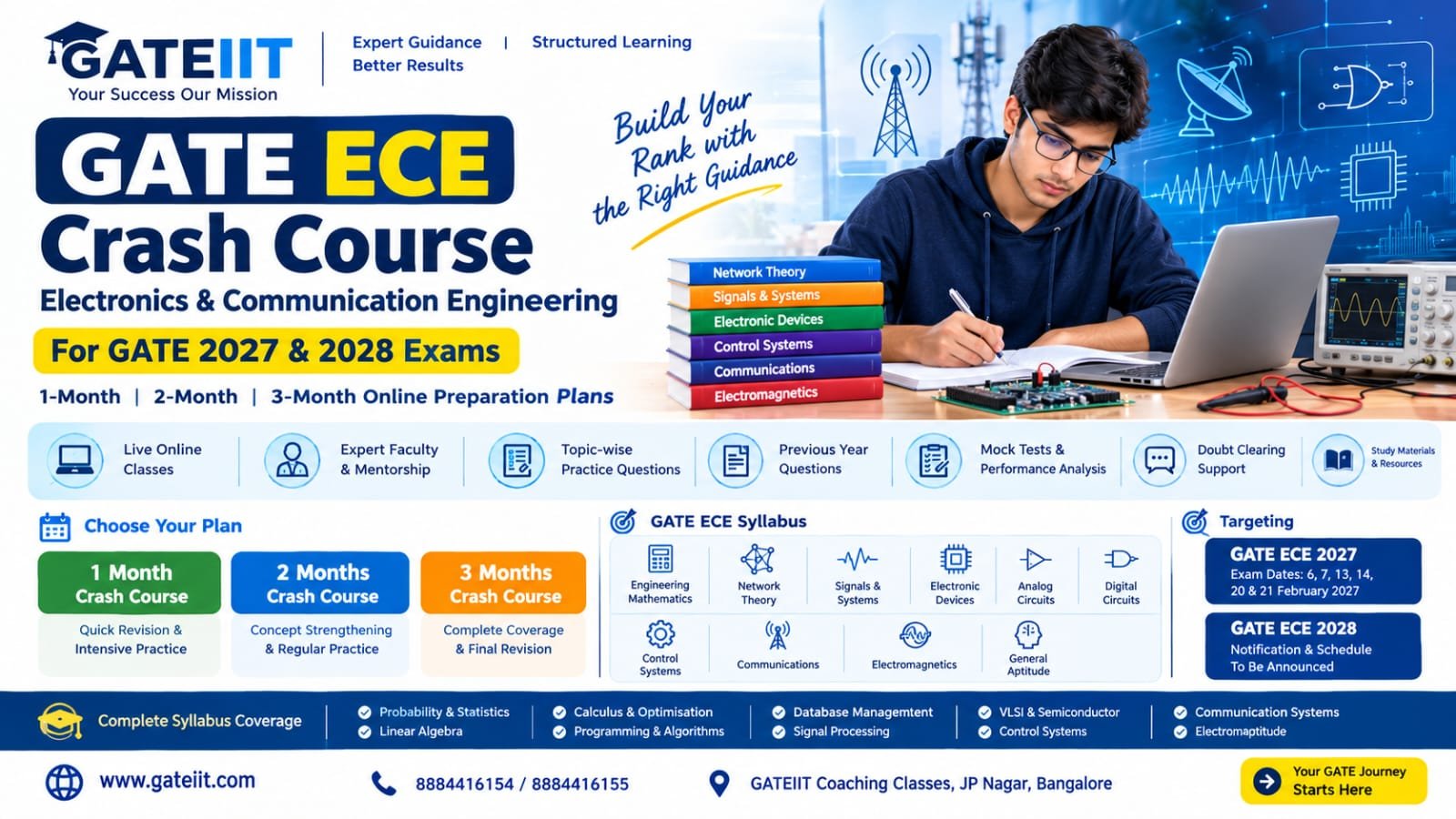
GATE ECE Crash Course 2027 & 2028 – Online Classes by GATEIIT
GATE Branches & Streams
GATE Electronics & Communication Engineering Online Crash Course for 1, 2 and 3 Months
Preparing for GATE Electronics and Communication Engineering (ECE/EC) in 2027 or 2028? GATEIIT offers online GATE EC preparation options for students who want to revise core engineering concepts, practise examination-level questions and prepare with a structured study plan.
Choose a 1-month, 2-month or 3-month GATE ECE crash course according to your preparation level, available study time and examination target. Whether you are an ECE student, an engineering graduate, a final-year student, a working professional or a GATE repeater, a focused preparation strategy can help you identify weak areas and improve problem-solving accuracy.
The GATE EC paper covers Engineering Mathematics, Network Theory, Signals and Systems, Electronic Devices, Analog Circuits, Digital Circuits, Control Systems, Communications and Electromagnetics, along with General Aptitude. Understanding the fundamentals and practising numerical problems are essential parts of preparation.
GATEIIT’s online coaching options are designed for students seeking structured guidance for GATE EC preparation. Contact our team to confirm current batch schedules, course fees, syllabus coverage, teaching hours, study materials and mock-test availability.
GATEIIT contact numbers: 8884416154 / 8884416155
Website: https://www.gateiit.com/
Location: GATEIIT Coaching Classes, JP Nagar, Bangalore.
Why Choose GATEIIT for GATE ECE Online Coaching?
GATE ECE requires a strong understanding of electrical networks, electronic circuits, signals, communication systems and mathematical techniques. A good preparation plan should combine concept revision with consistent question practice.
Depending on the selected batch and confirmed course inclusions, preparation support may cover:
- Structured online classes for GATE Electronics and Communication Engineering.
- Revision aligned with the applicable official EC syllabus.
- Concept explanations, solved examples and numerical problem-solving.
- Practice with previous-year GATE questions.
- Topic-wise assignments and revision exercises.
- Support for identifying and improving weak subjects.
- Mock tests and performance analysis, where included in the selected plan.
- General Aptitude and Engineering Mathematics practice.
- Revision planning and examination time-management strategies.
- Doubt-clearing support according to the batch arrangement.
Before enrolling, ask for the detailed course schedule and written confirmation of the resources and support included in your chosen crash course.
GATE ECE Crash Course Options: 1 Month, 2 Months and 3 Months
Different students require different preparation timelines. A student who has already completed the syllabus needs intensive revision, while someone with incomplete fundamentals may need more time to understand difficult concepts.
1-Month GATE ECE Crash Course
Best suited for students who have already covered most of the syllabus and need focused revision.
The one-month plan is intended for intensive revision, formula review, problem-solving practice and mock-test analysis. It is most suitable for candidates who have a reasonable foundation in core ECE subjects.
Suggested preparation priorities:
- Rapid revision of Engineering Mathematics.
- Network Theory and Signals and Systems problem-solving.
- Electronic Devices and Analog Circuits revision.
- Digital Circuits and Control Systems practice.
- Communication Systems and Electromagnetics revision.
- General Aptitude practice.
- Previous-year questions and timed mock tests.
- Analysis of calculation errors and weak concepts.
Who should choose this plan? Candidates who have studied the syllabus previously and can dedicate substantial time to self-study.
A one-month crash course may not be sufficient for students starting the entire ECE syllabus from scratch.
2-Month GATE ECE Crash Course
Best suited for students who have some subject knowledge but need more time for revision and practice.
A two-month plan provides additional time to strengthen concepts, practise numerical problems and identify weak areas before the examination.
Suggested preparation priorities:
- Review of mathematical fundamentals and network analysis.
- Signals and Systems problem-solving.
- Electronic Devices, Analog Circuits and Digital Circuits.
- Control Systems and Communication Systems.
- Electromagnetics and transmission-line problems.
- Previous-year questions arranged by topic.
- Regular revision of formulas and important methods.
- Mixed-subject tests and mock-test analysis.
Who should choose this plan? Students who have completed some subjects and need a balanced preparation schedule for revision, practice and improvement.
3-Month GATE ECE Crash Course
Best suited for students who need a longer revision window and more systematic preparation.
The three-month option provides more time to revisit difficult concepts, work through numerical problems and build consistency across the syllabus.
Suggested preparation priorities:
- Initial assessment of subject knowledge.
- Systematic revision of Engineering Mathematics.
- Network Theory and Signals and Systems.
- Electronic Devices, Analog Circuits and Digital Circuits.
- Control Systems, Communications and Electromagnetics.
- General Aptitude practice throughout the course.
- Topic-wise question practice and previous-year papers.
- Mixed-subject tests, mock examinations and error analysis.
- Final revision of formulas, concepts and frequently repeated mistakes.
Who should choose this plan? Candidates who have some foundational knowledge but want a more structured revision and practice schedule.
Students who have not studied substantial portions of the syllabus should discuss their preparation level with GATEIIT before choosing a crash course.
Compare the GATE ECE Crash Course Plans
Course feature | 1 Month | 2 Months | 3 Months |
Main focus | Intensive revision | Revision and concept strengthening | Structured revision and practice |
Suitable preparation level | Syllabus mostly completed | Partial preparation | Partial preparation with more time needed |
Concept revision | Rapid | Balanced | More time for difficult topics |
Question practice | Intensive and selective | Regular topic-wise practice | More extensive practice opportunity |
Mock-test strategy | Timed practice and analysis | Progressive testing | Progressive testing and final revision |
Recommended goal | Consolidate existing knowledge | Improve weak areas | Improve coverage and consistency |
This comparison describes suggested study approaches. Actual class hours, subject coverage, tests, recordings and support depend on the course offered by GATEIIT. Confirm the details before admission.
Complete GATE ECE Syllabus for 2027 and 2028
The GATE EC paper covers eight major subject areas, in addition to General Aptitude. Candidates preparing for GATE 2027 should use the revised official syllabus published by IIT Madras. For GATE 2028, verify the applicable official syllabus when it is released.
1. Engineering Mathematics
Engineering Mathematics provides the analytical foundation for many ECE topics.
Linear Algebra
- Vector spaces, basis and linear dependence and independence.
- Matrix algebra, eigenvalues and eigenvectors.
- Rank and solutions of linear equations.
Calculus
- Mean value theorems.
- Definite and improper integrals.
- Partial derivatives and maxima and minima.
- Multiple integrals, line integrals, surface integrals and volume integrals.
- Taylor series.
Differential Equations
- Linear differential equations.
- Euler-Cauchy equations and nonhomogeneous equations.
- Variation of parameters, complementary functions and particular integrals.
- Partial differential equations.
- Variable-separable methods and initial and boundary value problems.
Vector Analysis
- Vectors in two and three dimensions.
- Gradient, divergence and curl.
- Gauss’s, Green’s and Stokes’ theorems.
Complex Analysis
- Analytic functions.
- Cauchy’s integral theorem and integral formula.
- Sequences, series and convergence tests.
- Taylor and Laurent series.
- Residue theorem.
Probability and Statistics
- Mean, median, mode and standard deviation.
- Combinatorial probability and probability distributions.
- Binomial, Poisson, exponential and normal distributions.
- Joint and conditional probability.
- Correlation and regression analysis.
2. Networks, Signals and Systems
Network Theory and Signals and Systems are important areas for developing strong numerical problem-solving skills.
Circuit Analysis
- Node and mesh analysis.
- Superposition theorem.
- Thevenin’s and Norton’s theorems.
- Reciprocity theorem.
- Sinusoidal steady-state analysis using phasors.
- Complex power and maximum power transfer.
- RL, RC and RLC circuit analysis.
- Laplace-transform methods.
- Two-port network parameters and wye-delta transformation.
Signals and Systems
- Linear time-invariant systems.
- Causality, stability and impulse response.
- Convolution, poles and zeros.
- Frequency response, group delay and phase delay.
- Fourier series and Fourier transform.
- Nyquist sampling theorem, sampling and reconstruction.
- DTFT, DFT and Z-transform.
- FIR and IIR filter design.
3. Electronic Devices
This section tests the understanding of semiconductor physics and electronic devices.
Topics include:
- Formation of energy bands in solids.
- Intrinsic and extrinsic semiconductors.
- Equilibrium carrier concentration.
- Direct and indirect band-gap semiconductors.
- Drift current and diffusion current.
- Mobility and resistivity.
- Carrier generation and recombination.
- Poisson and continuity equations.
- P-N junctions and Zener diodes.
- Bipolar junction transistors (BJTs).
- MOS capacitors and MOSFETs.
- MOSFET scaling.
- LEDs, photodiodes and solar cells.
4. Analog Circuits
Analog Circuits preparation involves understanding circuit operation, biasing, amplification and frequency response.
Topics include:
- Diode clipping and clamping circuits.
- BJT and MOSFET amplifier biasing.
- AC coupling and small-signal analysis.
- Amplifier frequency response.
- Current mirrors and differential amplifiers.
- Operational amplifier circuits.
- Amplifiers, summers, differentiators and integrators.
- Active filters.
- Schmitt triggers and oscillators.
- Dominant-pole (Miller) compensation and phase margin.
5. Digital Circuits
Digital Circuits requires a clear understanding of Boolean algebra, combinational logic and sequential systems.
Topics include:
- Binary, integer and floating-point number representation.
- Boolean algebra and logic minimisation.
- Karnaugh maps and logic gates.
- Static CMOS implementations.
- Arithmetic circuits and code converters.
- Multiplexers and decoders.
- Latches and flip-flops.
- Counters and shift registers.
- Finite-state machines.
- Propagation delay, setup time and hold time.
- Critical-path delay.
- Sample-and-hold circuits, ADCs and DACs.
- ROM, SRAM and DRAM.
- Machine instructions and addressing modes.
- ALU, datapath and control unit.
- Instruction pipelining.
6. Control Systems
Control Systems preparation focuses on modelling, stability, time-domain response and frequency-domain analysis.
Topics include:
- Basic control-system components.
- Feedback principles.
- Transfer functions.
- Block diagrams and signal-flow graphs.
- Transient and steady-state analysis of LTI systems.
- Frequency response.
- Routh-Hurwitz and Nyquist stability criteria.
- Bode plots and root-locus methods.
- Compensators and PID controllers.
- State-variable models.
- Solutions of state equations for LTI systems.
7. Communications
Communication Systems covers random processes, analog and digital communications, and information theory.
Random Processes
- Autocorrelation and power spectral density.
- Properties of white noise.
- Filtering random signals through LTI systems.
Analog Communications
- Amplitude modulation and demodulation.
- Angle modulation and demodulation.
- AM and FM spectra.
- Superheterodyne receivers.
Information Theory
- Source coding.
- Mutual information.
- Channel-capacity theorem.
Digital Communications
- PCM and DPCM.
- ASK, PSK, FSK and QAM modulation.
- Bandwidth and inter-symbol interference.
- MAP and maximum-likelihood detection.
- Matched-filter receivers.
- Signal-to-noise ratio and bit-error rate.
- Error-correction fundamentals.
- Hamming codes and CRC.
8. Electromagnetics
Electromagnetics covers electromagnetic fields, waves, transmission lines and antennas.
Topics include:
- Maxwell’s equations in differential and integral forms.
- Boundary conditions.
- Wave equation and Poynting vector.
- Plane-wave propagation.
- Reflection, refraction and polarisation.
- Phase velocity and group velocity.
- Propagation through different media and skin depth.
- Transmission-line equations and characteristic impedance.
- Impedance matching and impedance transformation.
- S-parameters and Smith chart.
- Rectangular and circular waveguides.
- Optical-fibre propagation.
- Dipole and monopole antennas.
- Linear antenna arrays.
Important syllabus note: The list above is a preparation guide. Download and follow the complete official EC syllabus for the applicable examination year, including any clarifications or revisions.
GATE ECE 2027 Exam Pattern
According to the official GATE 2027 question-paper pattern, the EC examination has the following structure.
Particular | GATE EC 2027 |
Paper code | EC |
Examination mode | Computer-Based Test (CBT) |
Duration | 3 hours |
Total questions | 65 |
Total marks | 100 |
General Aptitude | 15 marks |
Engineering Mathematics | 13 marks |
EC technical subject questions | 72 marks |
Question types | MCQ, MSQ and NAT |
Examination language | English |
GATE ECE Negative Marking
- One-mark MCQ: one-third mark is deducted for an incorrect answer.
- Two-mark MCQ: two-thirds mark is deducted for an incorrect answer.
- MSQ and NAT: no negative marking for incorrect answers.
- MSQ: no partial marking.
Students should practise identifying when to attempt a question, when to move on and how to avoid unnecessary calculation errors.
The official examination pattern and instructions for GATE 2028 should be checked when published.
Latest GATE 2027 ECE Updates
IIT Madras is the organising institute for GATE 2027. The official website states that the test-paper syllabi have been revised, so candidates should not depend entirely on older syllabus PDFs.
The revised EC syllabus specifically includes topics such as:
- Correlation and regression analysis in Engineering Mathematics.
- FIR and IIR filter design in Discrete-time Signals.
- Formation of energy bands in solids.
- MOSFET scaling.
- Dominant-pole (Miller) compensation and phase margin.
- Source coding in Information Theory.
Candidates should verify the exact scope of each topic in the official syllabus.
GATE 2027 Important Dates
The official schedule lists the following examination dates:
- 6 February 2027
- 7 February 2027
- 13 February 2027
- 14 February 2027
- 20 February 2027
- 21 February 2027
The result announcement is scheduled for 19 March 2027, subject to official updates.
As of 26 October 2026, the regular and extended registration deadlines, including the special registration window on 15–16 October 2026, have passed. The official website lists 31 October 2026 as the deadline for rectifying scrutiny defects. This is not a general new-registration deadline.
Candidates who have already applied should check their GOAPS status and registered email for official instructions.
Official resources:
- GATE 2027 website: https://gate2027.iitm.ac.in/
- EC syllabus: https://gate2027.iitm.ac.in/static/doc/GATE2027_Syllabus/EC_GATE2027_Syllabus.pdf
- Question-paper pattern: https://gate2027.iitm.ac.in/question_paper_pattern
- Important dates: https://gate2027.iitm.ac.in/important_dates
GATE 2028 Preparation
Students targeting GATE 2028 can start building a strong foundation in mathematics, circuit theory, signals, electronics and communication systems.
As of 26 October 2026, the official GATE 2028 notification and examination schedule have not been confirmed here. Candidates should check the official notification when released and adjust their study plan if the syllabus or examination rules change.
How to Prepare for GATE ECE in 1, 2 or 3 Months
A short preparation window requires a clear understanding of your strengths and weaknesses. Instead of trying to study every subject randomly, organise your preparation around the official syllabus.
Step 1: Assess Your Preparation Level
Attempt a diagnostic test or a selection of previous-year questions. Record which topics you understand well, which need revision and which you have not studied.
Step 2: Revise Engineering Mathematics
Review linear algebra, calculus, differential equations, vector analysis, complex analysis and probability and statistics. Practise numerical problems rather than only reading formulas.
Step 3: Strengthen Network Theory and Signals
Practise circuit analysis, network theorems, Laplace transforms, convolution, Fourier analysis and Z-transforms. Pay attention to units, sign conventions and calculation accuracy.
Step 4: Revise Electronics and Digital Circuits
Work through semiconductor devices, transistor operation, amplifier circuits, operational amplifiers, Boolean algebra, sequential circuits and timing-related problems.
Step 5: Practise Control Systems and Communications
Revise stability criteria, Bode plots, root locus, modulation, random processes, information theory and digital communication techniques.
Step 6: Prepare Electromagnetics
Review Maxwell’s equations, plane waves, transmission lines, impedance matching, waveguides and antennas. Practise numerical problems involving the underlying equations.
Step 7: Solve Previous-Year Questions
Use previous-year questions to understand how concepts are tested. Review every incorrect answer and identify whether the problem was conceptual, mathematical or related to time management.
Step 8: Take Mock Tests and Revise
Use timed tests to practise exam conditions. Analyse performance after each test, revisit weak topics and maintain a short list of formulas and recurring mistakes.
Suggested 12-Week GATE ECE Preparation Plan
This sample plan can be adapted to the student’s existing knowledge and actual course schedule.
Weeks | Suggested preparation focus |
1–2 | Engineering Mathematics and Network Theory |
3–4 | Signals and Systems |
5–6 | Electronic Devices and Analog Circuits |
7 | Digital Circuits |
8 | Control Systems |
9–10 | Communications and Electromagnetics |
11 | General Aptitude, previous-year questions and weak topics |
12 | Mock tests, revision and examination strategy |
Students should practise General Aptitude throughout the preparation period instead of leaving it entirely for the final week.
This is an illustrative timetable, not a guarantee of complete syllabus mastery within 12 weeks. Students with weaker fundamentals should allocate additional time to difficult subjects.
Who Should Join a GATE ECE Online Crash Course?
GATEIIT’s online preparation options may be relevant to:
- E. and B.Tech Electronics and Communication Engineering students.
- ECE and related engineering graduates.
- Final-year engineering students preparing for GATE.
- Students who have already completed most of the syllabus and need revision.
- Repeat candidates looking for a more structured preparation plan.
- Working professionals preparing for postgraduate study.
- Candidates interested in electronics, communication systems, signal processing and related engineering fields.
Candidates from other disciplines should verify the current GATE eligibility criteria and the admission requirements of their intended institutions.
What Can You Do After Qualifying GATE ECE?
A GATE EC score may be considered for postgraduate admission, doctoral programmes and other opportunities, depending on the requirements of the institution or recruiting organisation.
Potential areas of further study include:
- Communication engineering.
- Signal processing.
- VLSI and semiconductor technology.
- Embedded systems.
- RF and microwave engineering.
- Electronics and control-related fields.
The opportunities available depend on the candidate’s academic qualifications, score, selected paper, programme requirements and applicable admission or recruitment rules.
Qualifying GATE does not guarantee admission to an IIT or any other institution, a scholarship, financial assistance or a PSU job.
Frequently Asked Questions About GATE ECE Crash Courses
1. Does GATEIIT offer an online GATE ECE crash course for 2027?
GATEIIT provides GATE Electronics and Communication Engineering coaching options. Contact the institute to confirm the current crash-course batches, availability, teaching schedule and exact inclusions.
2. Can I prepare for GATE ECE in one month?
One month may be suitable for candidates who have already covered most of the syllabus and need intensive revision and question practice. It is generally a challenging timeline for learning the entire syllabus from the beginning.
3. Is a two-month GATE ECE crash course enough?
A two-month plan can provide a useful revision window for students who already have some subject knowledge. Its suitability depends on your current preparation level, available study hours and consistency.
4. Is three months enough for GATE ECE?
Three months can provide time for structured revision, question practice and mock-test analysis. Students who have not studied important fundamentals may need a longer preparation programme.
5. What is the paper code for GATE Electronics and Communication Engineering?
The official paper code is EC.
6. What is the total marks distribution for GATE EC 2027?
The paper is for 100 marks: 15 marks for General Aptitude, 13 marks for Engineering Mathematics and 72 marks for the remaining EC subject questions.
7. How many questions are there in GATE ECE?
The GATE 2027 EC paper has 65 questions to be answered in three hours.
8. Does GATE ECE have negative marking?
Yes. Incorrect MCQ answers attract negative marking. There is no negative marking for incorrect MSQ or NAT answers.
9. Which subjects are included in the GATE ECE syllabus?
The major areas are Engineering Mathematics, Networks, Signals and Systems, Electronic Devices, Analog Circuits, Digital Circuits, Control Systems, Communications and Electromagnetics, along with General Aptitude.
10. Has the GATE ECE syllabus changed for 2027?
Yes. The official GATE 2027 website states that syllabi have been revised. Candidates should consult the latest EC syllabus published by IIT Madras.
11. When is the GATE 2027 ECE examination?
The official GATE 2027 examination dates are 6, 7, 13, 14, 20 and 21 February 2027. The specific session for EC should be confirmed through official examination updates.
12. Has the GATE 2028 examination schedule been released?
The GATE 2028 examination schedule has not been confirmed here. Check the official notification when released.
13. Can working professionals join online GATE ECE coaching?
Online classes may be convenient for working professionals. Confirm the class timings, recordings, access duration and doubt-clearing arrangements before enrolling.
14. Where can I download the official GATE EC syllabus?
Visit the official GATE 2027 syllabus page or download the EC syllabus directly from the IIT Madras website. For GATE 2028, use the applicable official syllabus when released.
15. Does qualifying GATE guarantee admission to an IIT?
No. Admission depends on the institution’s eligibility criteria, score requirements, application process, seat availability and selection rules.
Start Your GATE ECE Preparation with GATEIIT
A good GATE ECE preparation plan starts with an honest assessment of your current level, a clear understanding of the official syllabus and consistent practice.
Whether you are preparing for GATE EC 2027 or starting early for GATE EC 2028, GATEIIT can help you explore online coaching options suited to your preparation timeline.
Contact GATEIIT to enquire about:
- 1-month GATE ECE revision crash course.
- 2-month GATE ECE crash course.
- 3-month GATE ECE preparation plan.
- Batch schedules, fees and available study resources.
Call: 8884416154 / 8884416155
Website: https://www.gateiit.com/
Address: 3rd Floor, #1743, Sri Raghavendra Plaza, 17th Main Road, JP Nagar 2nd Phase, Bangalore – 560078, Karnataka.
GATEIIT is an independent coaching institute and is not affiliated with or endorsed by IIT Madras, IISc or the GATE organising authorities. Examination information, eligibility, syllabus and admission requirements should be verified through official sources.
Our Toppers
