
Prepare for GATE ME 2027 and 2028 with GATEIIT – Classroom Coaching in JP Nagar, Bangalore and Online Coaching Across India.
The Graduate Aptitude Test in Engineering (GATE) is a national-level examination that assesses a candidate’s understanding of undergraduate engineering subjects. For Mechanical Engineering graduates and final-year students, GATE can open pathways to postgraduate study, research, technical careers and recruitment opportunities where GATE scores are accepted.
A strong GATE result is built through conceptual clarity, consistent problem-solving, revision and disciplined mock-test practice—not through memorising formulae alone.
The 2027 and 2028 examinations offer different preparation timelines. Candidates targeting 2027 may need a focused revision or crash-course plan, while 2028 aspirants can build fundamentals steadily and complete multiple revision cycles.
1. Introduction: Why Prepare for GATE Mechanical Engineering?
GATE Mechanical Engineering is an important examination for students who want to pursue higher education, research or technical career opportunities. A good GATE score may be considered for admission to postgraduate programmes at IITs, IISc, NITs and other participating institutions. Certain public-sector organisations and other employers may also use GATE scores as part of their recruitment process.
GATE preparation helps students strengthen their understanding of core engineering subjects, develop analytical skills and improve their ability to solve complex technical problems.
Whether you are a final-year BE/BTech student, a recent graduate or a working professional, a well-planned preparation strategy can make your preparation more structured and effective.
2. What Is GATE Mechanical Engineering (ME)?
GATE ME is the Mechanical Engineering paper of the Graduate Aptitude Test in Engineering. It evaluates a candidate’s understanding of fundamental and advanced undergraduate-level Mechanical Engineering concepts.
The examination generally includes:
- General Aptitude
- Engineering Mathematics
- Applied Mechanics and Design
- Fluid Mechanics and Thermal Sciences
- Materials, Manufacturing and Industrial Engineering
Questions may assess recall, comprehension, application, analysis and multi-step problem-solving abilities.
The paper generally includes multiple-choice questions (MCQ), multiple-select questions (MSQ) and numerical-answer type (NAT) questions. The official information brochure for the relevant examination year is the final authority for the exact pattern and marking scheme.
3. Who Should Appear for GATE ME 2027 or 2028?
GATE Mechanical Engineering is suitable for:
- BE/BTech students and graduates in Mechanical Engineering.
- Final-year undergraduate students who satisfy the official eligibility requirements.
- Candidates seeking MTech, ME, MS or research opportunities.
- Working professionals planning a technical or academic career transition.
- Candidates interested in PSU or other recruitment opportunities that explicitly accept a valid GATE score.
- Students seeking to strengthen their technical knowledge and engineering fundamentals.
Eligibility, qualifying degrees and accepted disciplines can change. Always verify the current year’s official GATE information brochure before applying.
4. GATE ME 2027 and 2028: Important Dates and Official Updates
GATE examination dates, application windows, correction periods, admit-card release, examination sessions and result dates are announced by the organising institute.
Candidates should regularly check the official website instead of relying entirely on unofficial social-media posts or third-party websites.
Official GATE 2027 portal:
https://gate2027.iitg.ac.in/
For GATE 2028, candidates should follow the official notification when it is released.
Before applying, verify:
- Application start and closing dates.
- Eligibility requirements.
- Examination fee.
- Paper selection and permitted combinations.
- Examination dates and sessions.
- Admit-card release.
- Result announcement.
- Counselling and admission procedures of individual institutions.
5. GATE Mechanical Engineering Exam Pattern
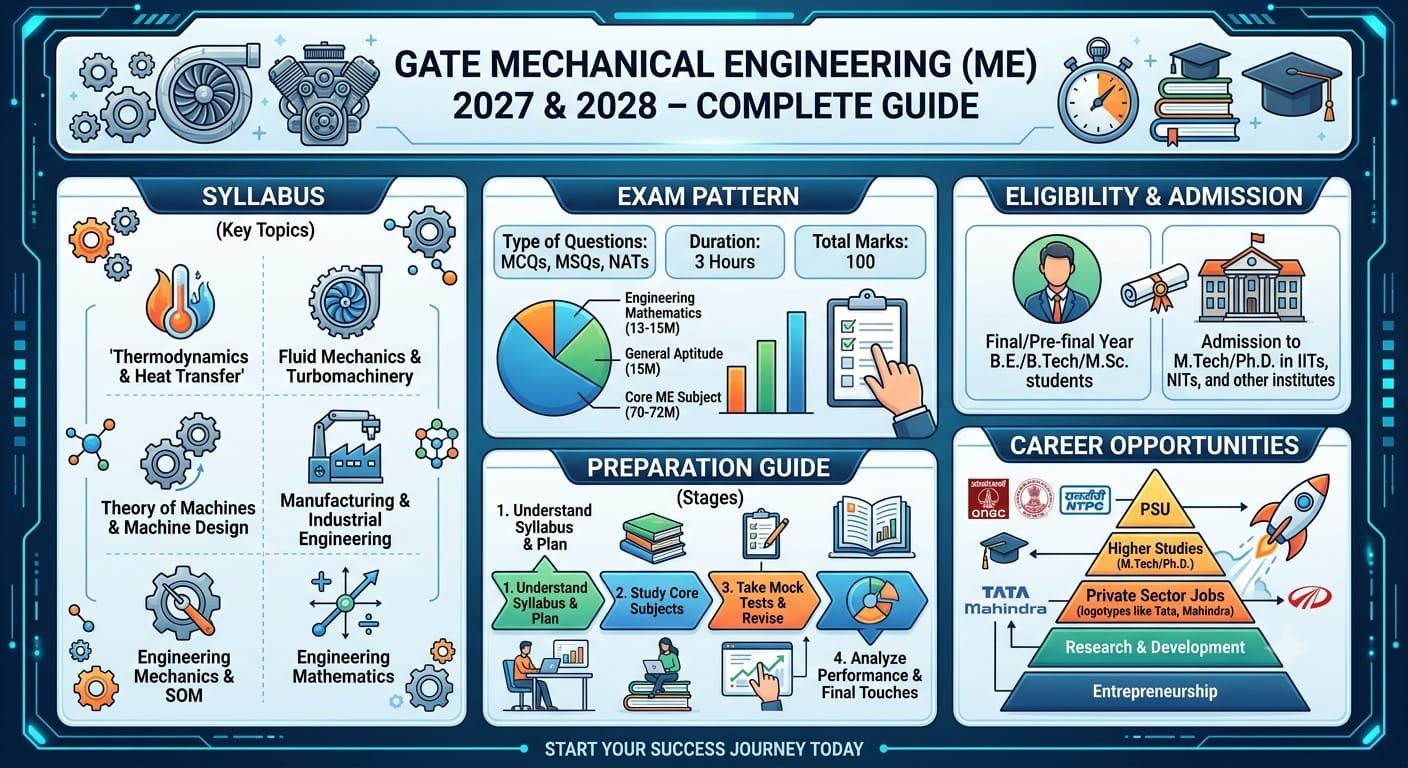
GATE papers are generally of three hours’ duration and carry 100 marks. The paper typically includes General Aptitude, Engineering Mathematics and subject-specific Mechanical Engineering questions.
The precise distribution and question structure must be checked in the official brochure for the year you appear.
Major components
General Aptitude: Verbal and numerical reasoning, comprehension and analytical ability.
Engineering Mathematics: Mathematical tools used across engineering disciplines.
Mechanical Engineering: Core subjects spanning design, thermal sciences, manufacturing and industrial engineering.
Question types
- Multiple Choice Questions (MCQ)
- Multiple Select Questions (MSQ)
- Numerical Answer Type (NAT)
MCQs may carry negative marking for incorrect answers. MSQ and NAT questions generally follow different marking rules. Read the official instructions carefully; do not assume all question types are marked identically.
6. GATE ME Syllabus: Major Subject Areas
The GATE Mechanical Engineering syllabus is broad. Candidates should divide it into manageable subject blocks and map every topic to the official syllabus.
Engineering Mathematics
- Linear algebra
- Calculus
- Differential equations
- Probability and statistics
- Numerical methods
- Relevant mathematical transforms
Applied Mechanics and Design
- Engineering mechanics
- Strength of materials
- Theory of machines
- Vibrations
- Machine design
Fluid Mechanics and Thermal Sciences
- Fluid mechanics
- Thermodynamics
- Heat transfer
- Applications of thermodynamics
- Relevant thermodynamic cycles
Materials, Manufacturing and Industrial Engineering
- Engineering materials
- Casting
- Forming
- Machining
- Joining processes
- Metrology
- Operations research
- Production planning
- Quality control
Use the official syllabus wording as your checklist. Topic labels and subtopic coverage should be verified against the relevant year’s published document.
7. Engineering Mathematics for Mechanical Engineering
Engineering Mathematics supports problem-solving throughout the GATE ME paper.
Important areas include:
- Linear algebra and matrices.
- Differential and integral calculus.
- Vector calculus.
- Ordinary differential equations.
- Probability and statistics.
- Numerical methods.
- Relevant mathematical techniques.
How to prepare Engineering Mathematics
- Practise short, timed question sets several times a week.
- Revisit errors involving signs, units, limits and boundary conditions.
- Maintain a concise formula notebook.
- Understand the assumptions behind every formula.
- Connect mathematical methods to mechanics, fluids and thermal problems.
- Solve previous-year questions after completing each topic.
8. General Aptitude: A Scoring Opportunity
General Aptitude rewards careful reading, numerical accuracy and structured reasoning.
Important areas include:
- Verbal ability.
- Reading comprehension.
- Grammar and vocabulary in context.
- Numerical estimation.
- Ratios and percentages.
- Number series.
- Data interpretation.
- Logical reasoning.
- Analytical ability.
Practise General Aptitude consistently rather than leaving it until the final weeks. Review every wrong answer to distinguish a concept gap from a reading or calculation error.
9. Applied Mechanics and Strength of Materials
Applied Mechanics and Strength of Materials form an important foundation for Mechanical Engineering.
Important topics
- Free-body diagrams.
- Moments of inertia.
- Stress and strain.
- Axial and torsional loading.
- Bending stress.
- Shear force and bending moment diagrams.
- Deflection of beams.
- Principal stresses.
- Failure theories.
- Columns and buckling.
Draw diagrams before writing equations. Check sign conventions, units and boundary conditions.
For each topic, learn the governing equations, assumptions and typical limiting cases. Solve a mix of direct, conceptual and multi-step questions.
10. Theory of Machines and Vibrations
Theory of Machines and Vibrations tests the candidate’s understanding of mechanisms, machine motion and dynamic behaviour.
Important topics
- Kinematics of mechanisms.
- Velocity and acceleration analysis.
- Gears and gear trains.
- Balancing of rotating and reciprocating masses.
- Gyroscopic effects.
- Free vibrations.
- Forced vibrations.
- Vibration isolation and transmissibility.
Understand natural frequency, damping, resonance and forced response. Sketch mechanisms and identify degrees of freedom before solving.
11. Machine Design
Machine Design involves the application of engineering principles to the design of machine components.
Important topics
- Design philosophy.
- Stress concentration.
- Static and dynamic failure.
- Keys and couplings.
- Brakes and clutches.
- Bolted and welded joints.
- Factor of safety.
- Material selection.
Learn how material choice, loading, reliability and factor of safety influence design. Avoid memorising isolated formulae without understanding their applicability.
12. Fluid Mechanics
Fluid Mechanics is a major subject in GATE Mechanical Engineering.
Important topics
- Fluid properties.
- Pressure measurement.
- Fluid kinematics.
- Continuity equation.
- Momentum equation.
- Bernoulli equation.
- Dimensional analysis.
- Boundary layers.
- Internal flows.
- Flow measurement.
Draw control volumes and state assumptions explicitly. Practise unit consistency and sign conventions.
13. Thermodynamics
Thermodynamics is one of the fundamental subjects in Mechanical Engineering.
Important topics
- Basic concepts and properties.
- First law of thermodynamics.
- Second law of thermodynamics.
- Properties of pure substances.
- Equations of state.
- Availability and exergy.
- Thermodynamic cycles.
- Gas power cycles.
- Vapour power cycles.
- Refrigeration and heat pump fundamentals.
Use property tables and diagrams efficiently. Be clear about closed systems versus control volumes, sign conventions and idealisations.
14. Heat Transfer
Heat Transfer deals with the movement of thermal energy through different modes.
Important topics
- One-dimensional conduction.
- Transient conduction.
- Heat exchangers.
- Thermal resistance networks.
- Relevant dimensionless groups.
Understand when lumped-capacitance assumptions are valid. Practise interpreting temperature profiles and heat-flow direction.
15. Manufacturing Engineering
Manufacturing Engineering covers production processes and their practical applications.
Important topics
- Metal forming.
- Welding and joining.
- Machine tools.
- Tool life.
- Cutting forces.
- Unconventional machining.
- Powder metallurgy.
- Additive manufacturing.
- Production technology.
Link process selection to material, geometry, tolerance, surface finish, production volume and cost.
16. Engineering Materials and Metrology
Engineering Materials
- Material structure and properties.
- Phase diagrams.
- Heat treatment.
- Ferrous alloys.
- Non-ferrous alloys.
Metrology
- Limits, fits and tolerances.
- Measurement systems.
- Surface texture.
- Inspection principles.
- Engineering drawing interpretation.
Practise reading drawings and tolerance specifications.
17. Industrial Engineering and Operations Research
Industrial Engineering focuses on productivity, process improvement and optimisation.
Important topics
- Work study.
- Method study.
- Time study.
- Facility layout.
- Inventory control.
- Project management.
- Quality control.
- Operations research.
- Linear programming.
- Transportation and assignment models.
- Queuing theory.
- Decision theory.
- Network analysis.
Learn both the mathematical model setup and the interpretation of results.
18. How to Start GATE ME Preparation
A systematic approach helps candidates avoid confusion and wasted effort.
- Download the official syllabus and make a topic-wise checklist.
- Take a diagnostic test to identify strengths and weaknesses.
- Create a realistic weekly timetable around college, work and personal commitments.
- Study one major subject at a time while retaining a small daily practice block for Mathematics and Aptitude.
- After each topic, solve previous-year questions and record recurring mistakes.
- Schedule revision and mock tests from the beginning rather than postponing them until the end.
19. GATE ME 2027 Preparation Strategy
With a nearer examination, prioritise syllabus coverage, high-value fundamentals, previous-year questions and revision.
Avoid repeatedly changing resources. Divide the remaining time into learning, consolidation and testing.
If fundamentals are weak, use a structured crash plan with diagnostic assessment and guided doubt resolution rather than attempting to watch every available lecture.
Suggested approach
- Complete a realistic topic audit in the first few days.
- Prioritise prerequisite concepts and frequently tested fundamentals.
- Use topic-wise PYQs immediately after learning each chapter.
- Reserve fixed weekly slots for mixed practice and full-length tests.
- Maintain an error log and revise it every week.
- Practise time management and question selection.
20. GATE ME 2028 Preparation Strategy
A longer preparation period allows deeper conceptual study and more practice cycles.
Complete core subjects in a planned sequence, revisit them through spaced revision and gradually increase timed problem-solving.
Suggested approach
- Build fundamentals before speed.
- Create concise notes while studying, not during the final week.
- Complete a systematic PYQ cycle after first-pass learning.
- Use mock-test analytics to adjust the plan.
- Protect consistency and avoid unsustainable daily targets.
- Reserve sufficient time for final revision.
21. 30, 45, 60, 90, 120 and 180-Day Preparation Plans
A short-duration plan should be selected according to the candidate’s current level, available study hours and syllabus completion—not simply the number of days remaining.
30-Day Plan
A rapid revision plan for candidates with strong prior preparation. Focus on formula consolidation, selected PYQs, error-log review and frequent tests.
45-Day Plan
A focused revision programme covering priority topics, topic-wise practice and a structured mock-test schedule.
60-Day Plan
A balanced plan for revision across core subjects, PYQs, General Aptitude and mock analysis.
90-Day Plan
A plan that combines remaining priority-topic coverage, weak-area improvement and full-length testing.
120-Day Plan
A structured programme combining syllabus completion, problem-solving, revision and progressively timed practice.
180-Day Plan
A longer preparation cycle allowing deeper learning, multiple PYQ cycles, spaced revision and a fuller mock-test programme.
These are planning frameworks, not guarantees of syllabus completion or a particular rank. The actual timetable should be personalised after a diagnostic assessment.
22. Daily and Weekly Study Timetable
A practical timetable is one that can be followed consistently.
A full-time student may allocate several focused study blocks each day, while a working professional may need shorter weekday sessions and longer weekend blocks.
Include breaks, sleep and exercise. Each week should contain concept learning, problem-solving, revision, aptitude and a review of progress.
Recommended study habits
- Start each session with a specific learning outcome.
- Use active recall instead of repeatedly rereading notes.
- Solve problems without looking at solutions first.
- End the week by reviewing mistakes and planning the next week.
- Keep a record of completed topics and pending topics.
23. Previous-Year Questions (PYQs)
Previous-year questions reveal the style and depth of questions and help students understand how concepts are tested.
Solve them topic-wise after learning a subject, then attempt mixed-year sets under timed conditions.
Do not memorise answer keys. Explain why the correct option or numerical result follows and why alternative approaches fail.
24. Mock Tests and Performance Analysis
A mock test is useful only when followed by careful analysis.
Track:
- Time per question.
- Unattempted questions.
- Avoidable errors.
- Topic-wise performance.
- Conceptual mistakes.
- Calculation mistakes.
- Question-reading mistakes.
Classify mistakes as conceptual, procedural, calculation, time-management or question-reading errors. Revisit the underlying concept and solve a fresh set before considering the issue closed.
Do not judge readiness from a single mock score. Look for stable improvement across several tests and compare performance under similar conditions.
25. Revision Strategy and Formula Notes
Use short, structured revision notes containing:
- Key equations.
- Common traps.
- One representative solved problem.
Revise at increasing intervals. Keep a separate error notebook.
In the final phase, focus on retrieval practice, PYQs, formula recall and test strategy rather than collecting new resources.
26. Common Mistakes to Avoid During GATE Preparation
- Studying without checking the official syllabus.
- Collecting too many books, apps, notes and video courses.
- Watching lectures passively without solving problems.
- Ignoring Engineering Mathematics or General Aptitude.
- Leaving PYQs and mock tests until the final weeks.
- Repeating tests without analysing mistakes.
- Making unrealistic timetables and abandoning them after a few days.
- Assuming a coaching course, score or rank can guarantee admission or recruitment.
- Neglecting revision.
- Spending too much time on one difficult topic at the expense of the overall syllabus.
27. Books, Notes and Learning Resources
Choose a limited set of standard textbooks and one dependable set of concise notes for each subject.
Use the official GATE website for notifications, syllabus and examination instructions. Previous-year papers and carefully designed mock tests should form the backbone of practice.
Check the edition and syllabus relevance before purchasing any book. No single resource is sufficient for every candidate.
28. Career Opportunities After GATE ME
A valid GATE score may be considered by participating institutions for postgraduate admissions, research programmes and certain recruitment processes.
Possible pathways include:
- MTech and ME programmes.
- MS and research programmes.
- Doctoral and research opportunities.
- Technical roles through recruitment processes that accept GATE scores.
- Further academic and professional specialisation.
Opportunities and eligibility vary by institution, discipline, category, year and recruitment notification. Candidates should verify each institution’s admission brochure and each employer’s recruitment advertisement.
A GATE score does not automatically guarantee a job, stipend, admission or interview call.
29. How to Choose a GATE ME Coaching Programme
Compare programmes on:
- Teaching quality.
- Syllabus coverage.
- Faculty accessibility.
- Doubt resolution.
- Test quality.
- Performance feedback.
- Batch size.
- Revision support.
- Online and classroom access.
- Written details of fees and inclusions.
Ask for a clear schedule and written details of inclusions, fees, validity, refund terms and any additional charges.
Different learning options
Personal Mentorship: Suitable for candidates who want individual attention and a customised preparation plan.
Small-Group Classes: Suitable for students who prefer interaction and guided practice in a focused group.
Regular Structured Batches: Suitable for systematic syllabus coverage.
Crash and Short-Term Courses: Suitable for focused revision and exam practice.
Online, Classroom and Hybrid Formats: Candidates can select a format based on learning preferences, schedule and location.
30. GATE ME Coaching at GATEIIT, JP Nagar, Bengaluru
GATEIIT offers GATE Mechanical Engineering preparation support for students seeking classroom coaching in JP Nagar, Bengaluru, as well as online learning options for candidates across India.
Depending on the batch and programme, learning support may include:
- Structured classes.
- Personal mentorship.
- Small-group learning.
- Doubt-clearing sessions.
- Study material.
- Previous-year question practice.
- Test series and mock tests.
- Revision planning.
- Performance feedback.
Confirm the current batch schedule and inclusions directly with the institute.
GATE ME Course Duration Options
Programme formats may include regular preparation and focused short-term options such as:
- 30-Day GATE ME Crash Course.
- 45-Day GATE ME Crash Course.
- 60-Day GATE ME Crash Course.
- 90-Day GATE ME Preparation Programme.
- 120-Day GATE ME Preparation Programme.
- 180-Day GATE ME Preparation Programme.
The appropriate duration depends on your existing knowledge, syllabus coverage and study availability.
Indicative Course Fees and Scholarship Support
Indicative course-fee range for planning: ₹4,000–₹20,000, subject to programme, duration, delivery mode and current offer.
Scholarship support may be available up to 100% based on applicable scholarship-test performance and published terms.
These are not automatic entitlements. Confirm current eligibility, availability and conditions before enrolment.
GATEIIT Contact Details
GATEIIT – Gate Indian Institute of Tutorials
Website: www.gateiit.com
Phone / WhatsApp: 8884416154 | 8884416155
Address:
3rd Floor, #1743, Sri Raghavendra Plaza,
17th Main Road, JP Nagar 2nd Phase,
Bangalore – 560078, Karnataka.
Google Maps:
https://maps.app.goo.gl/MtzbVkqywCkwKcc4A
31. Frequently Asked Questions: GATE ME 2027 & 2028 – 70 FAQs
1. What is GATE Mechanical Engineering?
It is the GATE paper that tests undergraduate-level Mechanical Engineering, Engineering Mathematics and General Aptitude.
2. Can final-year students apply for GATE?
Candidates who meet the current official eligibility requirements may apply. Check the year-specific brochure.
3. Is there an age limit for GATE?
GATE has generally not prescribed an upper age limit, but verify the current brochure.
4. How many marks is the GATE paper worth?
The paper is generally worth 100 marks; confirm the current pattern in the official brochure.
5. What is the usual exam duration?
GATE papers are generally three hours long, subject to the official notification.
6. What question types appear in GATE?
MCQ, MSQ and NAT question types are generally used.
7. Is negative marking applicable?
Negative marking generally applies to incorrect MCQs; rules differ for MSQ and NAT. Check official instructions.
8. Is a calculator allowed?
An on-screen virtual calculator is generally provided. Personal calculators are not permitted; verify current rules.
9. Is GATE ME difficult?
Difficulty varies by year and candidate. Strong fundamentals, practice and exam strategy improve preparedness.
10. Can a beginner prepare for GATE 2027?
Yes, but the plan must reflect the time remaining and the candidate’s baseline knowledge.
11. When should I start preparing for GATE 2028?
Starting early gives time for fundamentals, PYQs, revision and mock tests.
12. How many hours should I study daily?
There is no universal number. Set sustainable targets based on your commitments and learning needs.
13. Which subject should I study first?
Start with prerequisite subjects and your diagnostic weaknesses, while following a planned sequence.
14. Is Engineering Mathematics important for GATE ME?
Yes. It supports problem-solving and is a distinct part of the paper.
15. Is General Aptitude important?
Yes. It contributes marks and should be practised consistently.
16. Which Mechanical subjects should I prioritise?
Prioritisation should follow the official syllabus, your strengths and weaknesses, and PYQ analysis.
17. Are previous-year questions enough?
They are essential but should be combined with concept learning, fresh practice and mock tests.
18. How many years of PYQs should I solve?
Solve as many relevant official papers as practical, analysing concepts rather than memorising answers.
19. Are mock tests necessary?
Yes. They help develop timing, question selection and exam temperament.
20. When should I start full-length mock tests?
Begin once you have sufficient syllabus coverage, then increase frequency as the exam approaches.
21. How should I analyse a mock test?
Review accuracy, time, skipped questions and conceptual, calculation and reading errors.
22. What is a good GATE ME score?
A competitive score depends on the year, paper difficulty, category and target institution or employer.
23. What is a good GATE ME rank?
The rank needed varies by programme, institution, category and recruitment process.
24. Can I get admission with a low GATE score?
Possibilities depend on the institution, programme, category, year and available seats; check official cut-offs.
25. Does GATE guarantee an IIT admission?
No. Admission depends on each institute’s selection process, eligibility, score and seat availability.
26. Does GATE guarantee a PSU job?
No. Recruitment depends on the employer’s notification and selection process.
27. Can Mechanical students apply for MTech in other areas?
Some programmes accept allied disciplines. Check each programme’s eligibility rules.
28. Can working professionals prepare for GATE?
Yes, with a realistic timetable and consistent practice.
29. Can I prepare for GATE while in college?
Yes. Integrate preparation with coursework and plan revision around academic commitments.
30. Is coaching compulsory for GATE?
No. Self-study can work; coaching may provide structure, feedback and doubt support.
31. What are the benefits of GATE coaching?
A good programme can offer structured teaching, guided practice, doubt resolution and test analysis.
32. Should I choose online or classroom coaching?
Choose based on learning style, schedule, travel, interaction needs and course quality.
33. Does GATEIIT offer online GATE ME coaching?
GATEIIT provides online learning options; confirm current batch format and availability.
34. Does GATEIIT offer classroom coaching in Bangalore?
GATEIIT’s classroom location is in JP Nagar, Bengaluru; confirm current ME batch schedules.
35. Where is GATEIIT located?
3rd Floor, #1743, Sri Raghavendra Plaza, 17th Main Road, JP Nagar 2nd Phase, Bangalore – 560078.
36. How can I contact GATEIIT?
Call or WhatsApp 8884416154 or 8884416155, or visit www.gateiit.com.
37. Does GATEIIT provide personal mentorship?
Mentorship options may be available depending on the programme and batch; confirm current details.
38. Are small-group classes available?
Small-group options may be offered subject to batch availability.
39. Does GATEIIT provide study material?
Material inclusions depend on the selected programme; confirm before enrolment.
40. Are recorded lectures available?
Availability and access duration depend on the batch or course selected.
41. Does GATEIIT provide mock tests?
Test and mock-test support may be included in selected programmes; verify the current package.
42. What is a GATE crash course?
It is a focused programme designed for revision, priority topics and exam practice over a shorter period.
43. Is a 30-day crash course enough?
It may suit candidates with strong prior preparation; it is usually not a substitute for learning the entire syllabus from scratch.
44. Who should choose a 45-day course?
Candidates needing a compact revision and practice plan may consider it after assessing their preparation level.
45. Who should choose a 60-day course?
It may suit candidates with partial syllabus coverage who need structured consolidation.
46. What is a 90-day preparation plan?
It can combine priority syllabus completion, PYQs, revision and mock tests.
47. Is a 120-day plan useful?
Yes, where the candidate needs more time for systematic coverage and practice.
48. Who should choose a 180-day plan?
Candidates seeking a longer structured preparation cycle may benefit, depending on their starting level.
49. What is the indicative GATEIIT course fee?
The indicative range is ₹4,000–₹20,000, depending on programme and current terms; confirm directly.
50. Are scholarships available at GATEIIT?
Scholarship support may be available up to 100% based on applicable test performance and terms; confirm current details.
51. Does a scholarship guarantee free coaching?
No. Eligibility, award amount and conditions depend on the current scholarship policy and test result.
52. Can I change my course duration after joining?
This depends on institute policy and the programme terms; ask before enrolment.
53. How do I choose the right course duration?
Base the choice on a diagnostic test, syllabus status, available hours and target date.
54. How important are revision notes?
They help consolidate formulas, assumptions, diagrams and recurring mistakes.
55. Should I make a formula notebook?
Yes, but include conditions and examples so you understand when each formula applies.
56. How can I improve calculation speed?
Practise regularly, strengthen fundamentals and review avoidable arithmetic errors.
57. How can I reduce silly mistakes?
Read questions carefully, track units and signs, and maintain an error log.
58. Should I attempt every question?
No. Select questions based on confidence, time and the marking scheme.
59. How should I manage exam time?
Use a planned question-selection strategy and avoid spending too long on one problem.
60. Can I prepare using only YouTube?
It is possible to learn from free resources, but organise them carefully and add structured problem practice.
61. Are coaching notes enough?
Notes alone are not enough; combine them with concepts, PYQs and independent problem-solving.
62. What should I do in the final month?
Prioritise revision, PYQs, mock analysis, sleep and exam logistics; avoid unnecessary resource changes.
63. What should I do on the day before the exam?
Keep the day light, review concise notes, prepare required documents and rest adequately.
64. How do I check the official GATE syllabus?
Download it from the official GATE website for the relevant year.
65. Where can I check GATE 2027 updates?
Use the official portal: https://gate2027.iitg.ac.in/ and official notices.
66. Will the GATE 2028 syllabus be identical to 2027?
It may be similar, but always compare the official 2028 syllabus and brochure when released.
67. Can I use a 2027 plan for GATE 2028?
Use it as a starting framework, then update it against the 2028 notification and your progress.
68. What is the most important factor for GATE success?
Consistent conceptual learning, deliberate practice, revision and honest test analysis are central.
69. How do I begin with GATEIIT?
Contact the institute to discuss your current preparation level, target year, preferred mode and suitable programme.
70. Where can I get more information about GATE ME coaching in Bangalore?
Visit www.gateiit.com or contact GATEIIT at 8884416154 or 8884416155 for current course details.
Final Preparation Checklist and Conclusion
Before the GATE examination, ensure that you have:
- Downloaded and read the official syllabus and information brochure.
- Completed a diagnostic assessment and made a realistic study plan.
- Covered Engineering Mathematics, General Aptitude and core Mechanical Engineering subjects.
- Practised topic-wise and mixed previous-year questions.
- Taken mock tests and analysed every test carefully.
- Revised concise notes and maintained an error log.
- Verified admissions, recruitment, eligibility and dates from official sources.
- Chosen coaching or self-study resources based on your needs and verified all course terms.
GATE Mechanical Engineering preparation is a process of building understanding, applying concepts and improving through feedback. Whether you are targeting GATE 2027 or 2028, a realistic plan and consistent execution matter more than an unrealistic timetable.
Identify your current level, work systematically through the syllabus, practise questions regularly and use mock-test analysis to guide revision.
Start your GATE ME 2027 or 2028 preparation with GATEIIT, JP Nagar, Bengaluru.
Call / WhatsApp: 8884416154 | 8884416155
Website: www.gateiit.com