
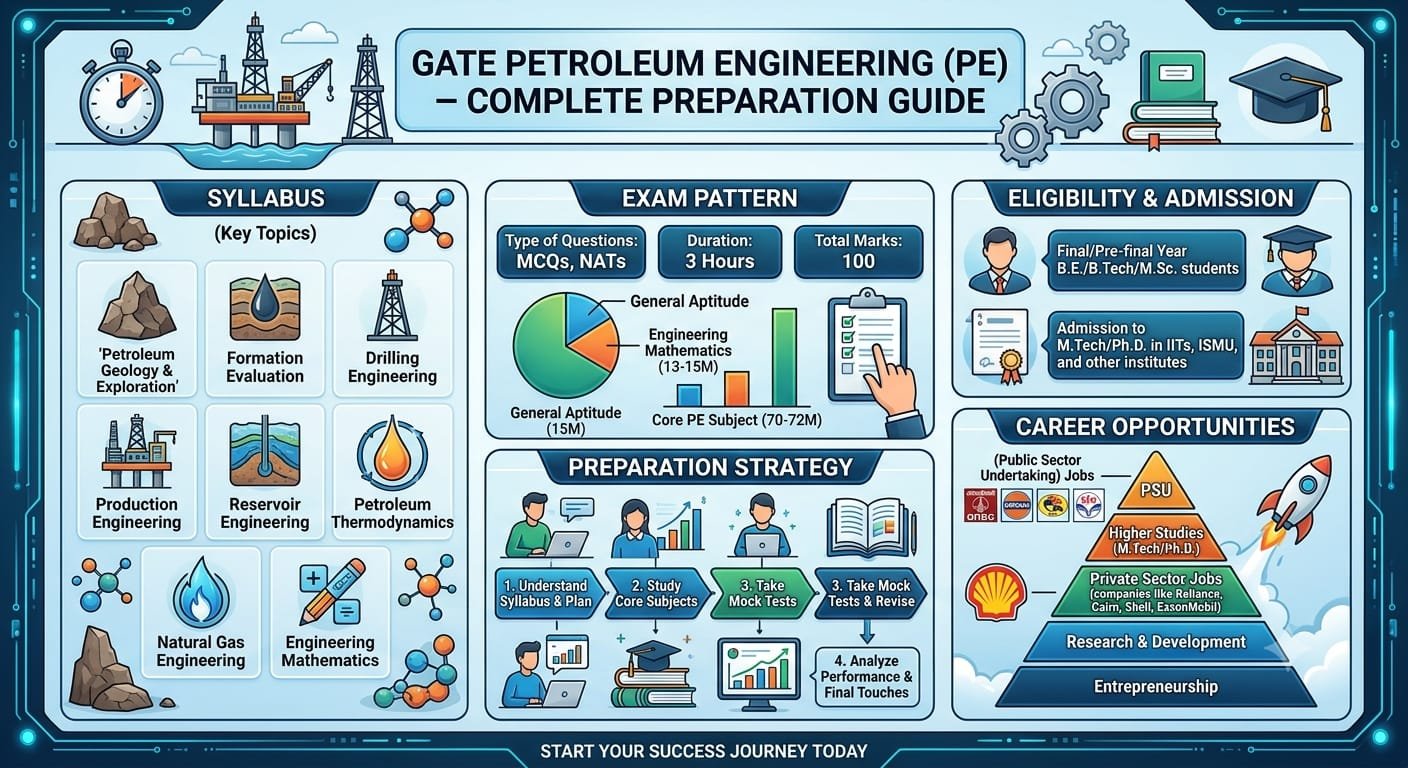
Are you preparing for GATE Petroleum Engineering (PE) 2027 and looking for a complete preparation strategy, updated syllabus, examination details, study materials, previous-year questions, mock tests and expert guidance?
The Graduate Aptitude Test in Engineering (GATE) is one of India’s most important national-level competitive examinations for engineering graduates aspiring to pursue postgraduate studies, research opportunities, higher education at IITs and IISc, and selected Public Sector Undertaking (PSU) recruitment opportunities.
For Petroleum Engineering graduates and students, GATE PE provides an important opportunity to demonstrate their technical knowledge in petroleum exploration, drilling engineering, reservoir engineering, production operations, well testing, formation evaluation, offshore technology and enhanced oil recovery.
However, preparing for GATE Petroleum Engineering requires more than simply reading textbooks or memorising technical formulas. Candidates need a systematic understanding of petroleum engineering concepts, strong numerical problem-solving skills, familiarity with the latest examination pattern, regular practice of previous-year questions and a well-planned revision strategy.
GATEIIT offers structured GATE Petroleum Engineering coaching programmes through online classes for students throughout India and offline classroom programmes at its JP Nagar, Bangalore centre. Students can choose one-year comprehensive preparation programmes, regular weekday batches, weekend classes, short-term courses and intensive crash courses of 30, 45, 60 and 90 days.
With personal attention, individual mentorship, customised preparation schedules, doubt-clearing sessions, practice tests, online study material and performance analysis, GATEIIT aims to help aspirants prepare systematically for GATE PE.
This comprehensive guide explains everything students need to know about GATE Petroleum Engineering 2027, including examination details, eligibility, syllabus, preparation strategies, self-study resources, examination fees, admission opportunities, career prospects and coaching options.
1. What Is GATE Petroleum Engineering (PE)?
GATE stands for Graduate Aptitude Test in Engineering. It is a national-level examination conducted jointly by the Indian Institute of Science (IISc) and the Indian Institutes of Technology (IITs) on behalf of the National Coordination Board (NCB), Department of Higher Education, Ministry of Education, Government of India.
GATE evaluates candidates’ understanding of undergraduate-level engineering and science subjects through a computer-based examination.
Petroleum Engineering is one of the specialised examination papers offered under GATE.
The GATE Petroleum Engineering paper is identified by the examination code PE.
The examination evaluates a candidate’s knowledge of the scientific, mathematical and engineering principles involved in the exploration, drilling, development, production and management of petroleum resources.
The major subject areas include:
- Petroleum Exploration
- Oil and Gas Well Drilling Technology
- Reservoir Engineering
- Petroleum Production Operations
- Offshore Drilling and Production Practices
- Petroleum Formation Evaluation
- Oil and Gas Well Testing
- Health, Safety and Environment in the Petroleum Industry
- Enhanced Oil Recovery Techniques
- Latest Trends in Petroleum Engineering
- Engineering Mathematics
- General Aptitude
A good GATE PE score can help candidates compete for postgraduate engineering programmes, research opportunities, fellowships and selected recruitment opportunities, depending on the eligibility and selection requirements of the respective institutions or organisations.
2. GATE 2027 Petroleum Engineering Examination: Latest Official Details
The GATE 2027 examination is organised by the Indian Institute of Technology Madras (IIT Madras).
The examination will be conducted across six dates in February 2027.
The following table provides the important examination information.
GATE Petroleum Engineering 2027 – Examination Overview
Examination Name: Graduate Aptitude Test in Engineering 2027
Paper Name: Petroleum Engineering
Paper Code: PE
Organising Institute: Indian Institute of Technology Madras
Conducting Authority: IISc and IITs through the National Coordination Board, GATE
Examination Level: National Level
Examination Mode: Computer-Based Test (CBT)
Examination Language: English
Total Marks: 100
Total Questions: 65
General Aptitude: 15 Marks
Engineering Mathematics: 13 Marks
Petroleum Engineering Core Subjects: 72 Marks
Examination Duration: 3 Hours
Question Types: MCQ, MSQ and NAT
Negative Marking: Applicable only to incorrect MCQ answers
GATE 2027 Examination Dates: 6, 7, 13, 14, 20 and 21 February 2027
Result Announcement: 19 March 2027
GATE Score Validity: Three Years from the date of announcement of results.
Official Website: https://gate2027.iitm.ac.in/
Candidates should note that the examination dates above represent the overall GATE examination schedule. The exact PE examination date, session and reporting time must be confirmed through the official examination timetable and individual admit card. Candidates should not assume that every GATE paper is conducted on every examination date.
3. Who Conducts GATE 2027?
GATE is conducted jointly by the Indian Institute of Science and seven Indian Institutes of Technology.
These institutions are:
- Indian Institute of Science, Bengaluru
- IIT Bombay
- IIT Delhi
- IIT Guwahati
- IIT Kanpur
- IIT Kharagpur
- IIT Madras
- IIT Roorkee
For GATE 2027, IIT Madras is the organising institute.
The organising institute is responsible for coordinating examination-related activities, application processing, examination arrangements, official notifications, answer keys and results.
The examination is conducted on behalf of the National Coordination Board (NCB), Ministry of Education, Government of India.
4. GATE 2027 Important Dates and Examination Schedule
Candidates preparing for GATE Petroleum Engineering should carefully follow the official examination calendar.
The important dates published for GATE 2027 include:
- Online application portal opened: 2 September 2026.
- Regular registration closed: 5 October 2026.
- Extended registration with late fee closed: 12 October 2026.
- Special registration window: 15–16 October 2026.
- Application defect rectification: 14–31 October 2026.
- Examination city allotment notification: 4 January 2027.
- Admit card release: To be announced.
- GATE 2027 examinations: 6, 7, 13, 14, 20 and 21 February 2027.
- Result declaration: 19 March 2027.
Important update for candidates: As of 30 October 2026, the GATE 2027 application registration portal is closed. The application scrutiny and defect-rectification process is currently underway. Candidates who have already registered should check their GOAPS accounts and registered email addresses for any instructions from the examination authorities.
The application defect-rectification window is scheduled to close on 31 October 2026.
Candidates should not assume that the defect-rectification facility allows fresh registration. It is intended for applicants whose submitted applications require corrections or supporting documents.
The date for the subsequent application data-correction window, if applicable, is subject to official notification.
All examination dates are subject to changes announced by IIT Madras.
5. GATE Petroleum Engineering 2027 Examination Pattern
Understanding the examination pattern is one of the most important steps in preparation.
GATE PE 2027 follows a computer-based examination format consisting of General Aptitude, Engineering Mathematics and Petroleum Engineering subject questions.
The examination contains 65 questions carrying a total of 100 marks.
Section-wise Marks Distribution
General Aptitude: 15 Marks
Engineering Mathematics: 13 Marks
Petroleum Engineering Core Subjects: 72 Marks
Total: 100 Marks
Total Questions: 65
Total Duration: 180 Minutes
The paper generally includes:
- 10 General Aptitude questions.
- 55 questions covering Engineering Mathematics and Petroleum Engineering.
Questions carry either one mark or two marks.
Types of Questions in GATE PE
- Multiple Choice Questions (MCQ)
These questions contain four answer options, of which only one is correct.
Candidates must select the most appropriate answer.
Negative marking applies to incorrect MCQ answers.
- Multiple Select Questions (MSQ)
These questions may contain one or more correct options.
Candidates must select the complete correct combination.
There is no negative marking for incorrect MSQ responses, but partial marking is not awarded.
- Numerical Answer Type (NAT)
These questions require candidates to calculate the answer and enter a numerical value using the virtual numerical keypad.
There are no multiple-choice options.
There is no negative marking for incorrect NAT answers.
Negative Marking Scheme
For incorrect MCQ answers:
- 1-mark question: 1/3 mark deducted.
- 2-mark question: 2/3 mark deducted.
No negative marking applies to MSQ and NAT questions.
Candidates should develop the ability to identify questions that can be solved confidently and avoid unnecessary guessing.
Important Skills Evaluated
GATE assesses four broad abilities:
- Recall – Remembering important concepts, definitions, formulas and technical principles.
- Comprehension – Understanding scientific and engineering concepts.
- Application – Applying theoretical knowledge to numerical and practical problems.
- Analysis and Synthesis – Analysing complex situations and combining concepts to arrive at logical solutions.
Consequently, conceptual clarity and numerical practice are equally important.
6. Complete GATE Petroleum Engineering (PE) 2027 Syllabus
The official GATE 2027 Petroleum Engineering syllabus contains ten core technical sections along with Engineering Mathematics.
Candidates should refer to the revised 2027 syllabus instead of relying exclusively on older coaching notes or previous-year syllabus documents.
SECTION 1: ENGINEERING MATHEMATICS
Engineering Mathematics is an important component of GATE Petroleum Engineering and carries 13 marks.
It includes the following topics.
- Linear Algebra
- Matrix algebra.
- Systems of linear equations.
- Eigenvalues and eigenvectors.
- Calculus
- Functions of a single variable.
- Continuity and differentiability.
- Taylor series.
- Mean value theorems.
- Evaluation of definite integrals.
- Improper integrals.
- Partial derivatives.
- Total derivatives.
- Maxima and minima.
- Divergence and curl.
- Vector identities.
- Directional derivatives.
- Line integrals.
- Surface integrals.
- Volume integrals.
- Stokes’ theorem.
- Gauss’ theorem.
- Green’s theorem.
- Differential Equations
- First-order linear differential equations.
- First-order nonlinear differential equations.
- Higher-order linear differential equations with constant coefficients.
- Cauchy’s equations.
- Euler’s equations.
- Initial value problems.
- Boundary value problems.
- Laplace transforms.
- Solution of one-dimensional diffusivity equations.
- Laplace equation.
- Complex Variables
- Complex numbers.
- Polar form of complex numbers.
- Triangle inequality.
- Probability and Statistics
- Definitions of probability.
- Sampling theorems.
- Conditional probability.
- Standard deviation.
- Random variables.
- Poisson distribution.
- Normal distribution.
- Binomial distribution.
- Linear regression analysis.
- Numerical Methods
- Numerical solutions of linear algebraic equations.
- Numerical solutions of nonlinear algebraic equations.
- Trapezoidal integration.
- Simpson’s rule.
- Single-step numerical methods for differential equations.
- Multistep numerical methods for differential equations.
Preparation Tip:
Candidates should practise mathematical problems regularly. Particular attention should be given to calculus, differential equations, probability, statistics and numerical methods because these concepts are useful in several petroleum engineering applications.
SECTION 2: PETROLEUM EXPLORATION
Petroleum Exploration deals with the origin, migration, accumulation and identification of petroleum resources.
The syllabus includes:
- Classification of common rocks.
- Description of common rocks.
- Clastic reservoir rocks.
- Non-clastic reservoir rocks.
- Origin of petroleum.
- Migration of petroleum.
- Accumulation of petroleum.
- Petroleum exploration methods.
- Petroleum resource classification.
- Petroleum resource evaluation.
Important preparation areas include understanding the geological characteristics of reservoir rocks and the processes responsible for hydrocarbon generation and accumulation.
Candidates should develop a clear understanding of how petroleum resources are identified and evaluated before drilling operations begin.
SECTION 3: OIL AND GAS WELL DRILLING TECHNOLOGY
Drilling Engineering is one of the fundamental areas of Petroleum Engineering.
It deals with the planning, design and execution of oil and gas well drilling operations.
The syllabus includes:
Well Planning and Drilling Methods
- Well planning.
- Drilling methods.
- Drilling rigs.
- Rig operating systems.
Drilling Fluids
- Functions of drilling fluids.
- Properties of drilling fluids.
- Drilling fluid maintenance equipment.
Cementing Operations
- Oil well cementing.
- Gas well cementing.
- Cementing operations and their applications.
Drill Bits and Drill Strings
- Different types of drill bits.
- Applications of drill bits.
- Drill string functions.
- Drill string operations.
- Drill string selection.
- Drill string design.
- Casing string functions.
- Casing string operations.
- Casing string selection.
- Casing string design.
Drilling Problems
- Common drilling problems.
- Prevention and control of drilling problems.
- Remedies for drilling-related difficulties.
Directional and Advanced Drilling
- Directional drilling tools.
- Directional survey.
- Horizontal drilling.
- Multilateral drilling.
- Extended-reach drilling.
- Slim wells.
- Intelligent drilling and completion techniques.
- Image-assisted drilling.
- Managed pressure drilling.
- Underbalanced drilling.
Preparation Tip:
Focus on understanding the functions of drilling equipment, drilling fluid properties, casing design, cementing operations and common drilling problems.
Numerical problems involving drilling hydraulics, fluid properties and operational parameters should be practised systematically.
SECTION 4: RESERVOIR ENGINEERING
Reservoir Engineering is one of the most important technical subjects for GATE Petroleum Engineering.
It involves the study of fluid behaviour inside petroleum reservoirs and the methods used to estimate, develop and manage hydrocarbon reserves.
The syllabus includes:
Reservoir Rock Properties
- Petrophysical properties of reservoir rocks.
- Core analysis.
Reservoir Fluid Properties
- Reservoir fluid properties.
- Phase behaviour of hydrocarbon systems.
Fluid Flow Through Porous Media
- Single-phase flow.
- Multiphase flow.
- Flow through porous media.
- Water coning.
- Gas coning.
Reservoir Pressure and Drive Mechanisms
- Reservoir pressure measurement.
- Reservoir drives.
- Drive mechanisms.
- Recovery factors.
Material Balance and Reserves
- Theory of material balance.
- Reserve estimation.
- Reserve estimation techniques.
Reservoir Management
- Field development.
- Reservoir management.
Reservoir Geomechanics
- Stress analysis.
Reservoir Simulation
- Fundamentals of reservoir simulation.
- Mathematical models.
- Finite difference discretisation.
- Cartesian grid systems.
- Radial grid systems.
- Black oil reservoir simulation.
- History matching.
Preparation Tip:
Reservoir Engineering requires a combination of mathematical ability and conceptual understanding.
Candidates should practise problems involving porosity, permeability, fluid saturation, reservoir pressure, material balance, recovery factor, fluid flow and reservoir performance.
Understanding the physical meaning of each equation is more valuable than memorising formulas without understanding their applications.
SECTION 5: PETROLEUM PRODUCTION OPERATIONS
Petroleum Production Engineering deals with the extraction of hydrocarbons from underground reservoirs and their processing, transportation and storage.
The syllabus includes:
Well Equipment and Completion
- Well equipment.
- Well completion techniques.
Production Problems
- Well production problems.
- Production problem mitigation.
- Well servicing.
- Workover operations.
- Workover fluids.
- Completion fluids.
- Formation damage.
Well Stimulation and Artificial Lift
- Well stimulation techniques.
- Artificial lift techniques.
Oil and Gas Processing
- Field processing of oil and gas.
- Storage of petroleum.
- Transportation of petroleum and petroleum products.
- Metering and measurement of oil and gas.
Production System Analysis
- Production system analysis.
- Production optimisation.
- Inflow performance.
- Tubing performance.
- Nodal analysis.
- Production testing.
Multiphase Flow and Flow Assurance
- Multiphase flow in tubing.
- Multiphase flow in flowlines.
- Flow assurance problems.
- Flow assurance remedies.
Production Equipment
- Pressure vessels.
- Storage tanks.
- Shell and tube heat exchangers.
Preparation Tip:
Give special importance to production system analysis, inflow performance relationships, artificial lift methods, nodal analysis and production optimisation.
These topics require repeated numerical practice.
SECTION 6: OFFSHORE DRILLING AND PRODUCTION PRACTICES
Offshore petroleum operations involve the exploration and production of hydrocarbons from marine environments.
The syllabus includes:
- Offshore oil and gas operations.
- Ocean environment.
- Offshore fixed platforms.
- Offshore mobile units.
- Station-keeping methods.
- Mooring systems.
- Dynamic positioning systems.
- Offshore drilling from fixed platforms.
- Jack-up rigs.
- Drilling ships.
- Semi-submersible drilling units.
- Offshore well completion.
- Deepwater subsea technology.
- Oil processing platforms.
- Water injection platforms.
- Offshore storage.
- Single Point Mooring (SPM).
- Single Buoy Mooring (SBM).
- Transportation and utilities.
- Deepwater drilling and production systems.
Preparation Tip:
Students should understand the differences between offshore drilling units, platform arrangements, subsea systems and offshore production facilities.
Illustrations and comparison charts can make these concepts easier to remember.
SECTION 7: PETROLEUM FORMATION EVALUATION
Formation Evaluation involves analysing subsurface formations to determine their geological and petrophysical characteristics.
Well logging is a particularly important area.
The syllabus includes:
Petrophysical Evaluation
- Principles of petrophysical evaluation.
- Applications of formation evaluation.
- Advantages and disadvantages of different evaluation techniques.
Well Logging Methods
- Spontaneous Potential (SP) logging.
- Resistivity logging.
- Radioactive logging.
- Acoustic logging.
- Gamma Ray logging.
- Types of logging tools.
Advanced Logging Techniques
- Logging While Drilling (LWD).
- Cement Bond Log (CBL).
- Variable Density Log (VDL).
- Ultrasonic Imager Tool (USIT).
- Segmented Frequency Tool (SFT).
- Repeat Formation Tester (RFT).
- Production logging tools.
- Special types of logging tools.
- Casing inspection tools.
- Formation MicroScanner (FMS).
- Nuclear Magnetic Resonance (NMR) logging.
Log Interpretation
- Standard log interpretation methods.
- Cross-plotting methods.
Preparation Tip:
Candidates should understand the working principles of different logging tools, the properties measured by each tool and the interpretation of logging results.
Comparative tables are useful for understanding the differences between resistivity, gamma ray, SP and acoustic logging techniques.
SECTION 8: OIL AND GAS WELL TESTING
Well Testing is essential for evaluating reservoir characteristics and determining the productivity of oil and gas wells.
The syllabus includes:
- Diffusivity equation.
- Solutions of diffusivity equations.
- Radius of investigation.
- Principle of superposition.
- Horner’s approximation.
- Drill Stem Testing.
- Pressure transient testing.
- Drawdown test analysis.
- Build-up test analysis.
- Pressure derivative analysis.
- Wellbore effects.
- Multilayer reservoirs.
- Injection well testing.
- Multiple well testing.
- Interference testing.
- Pulse testing.
- Well-test analysis using type curves.
- Gas well testing.
- Inflow testing.
Preparation Tip:
Well Testing requires strong conceptual clarity and numerical problem-solving skills.
Students should practise pressure transient analysis, drawdown and build-up calculations, Horner plots and related reservoir engineering applications.
SECTION 9: HEALTH, SAFETY AND ENVIRONMENT IN THE PETROLEUM INDUSTRY
Health, Safety and Environment (HSE) is an essential component of petroleum industry operations.
The syllabus includes:
Health Hazards
- Physiological effects.
- Respiratory effects.
- Skin effects of petroleum hydrocarbons.
- Hazards associated with sour gases.
Safety Systems
- Manual shutdown systems.
- Automatic shutdown systems.
- Blowdown systems.
- Gas detection systems.
- Fire detection systems.
- Fire suppression systems.
- Personal protection systems.
- Personal protection measures.
- HSE policies.
Emergency and Disaster Management
- Disaster management.
- Crisis management in petroleum industry.
Environmental Management
- Environmental concepts.
- Impact on ecosystems.
- Impact on air.
- Impact on water.
- Impact on soil.
- Environmental impact of drilling operations.
- Environmental impact of production operations.
- Environmental transport of petroleum wastes.
- Offshore environmental studies.
- Offshore oil spills.
- Oil spill control.
- Environmental regulations.
- Environmental compliance.
Preparation Tip:
Focus on understanding the different types of petroleum industry hazards, safety systems, emergency response procedures and environmental protection practices.
SECTION 10: ENHANCED OIL RECOVERY TECHNIQUES
Enhanced Oil Recovery (EOR) refers to advanced methods used to improve hydrocarbon recovery beyond conventional primary and secondary recovery methods.
The syllabus includes:
- Basic principles of Enhanced Oil Recovery.
- EOR mechanisms.
- Screening of EOR processes.
- Pattern flooding.
- Recovery efficiency.
- Permeability heterogeneity.
- Macroscopic displacement efficiency.
- Microscopic displacement efficiency.
Enhanced Oil Recovery Methods
- Chemical flooding.
- Miscible flooding.
- Thermal recovery.
- Steam stimulation.
- Hot water flooding.
- Steam flooding.
- In-situ combustion.
- Microbial Enhanced Oil Recovery.
- Low-salinity water flooding.
Preparation Tip:
Understand the mechanisms behind different EOR techniques, their applications, operating principles and suitability for different reservoir conditions.
Comparative analysis of thermal, chemical, miscible and microbial recovery techniques is useful for conceptual questions.
SECTION 11: LATEST TRENDS IN PETROLEUM ENGINEERING
The latest GATE PE syllabus also covers emerging and unconventional petroleum resources.
The topics include:
- Coal Bed Methane (CBM).
- Shale gas.
- Oil shale.
- Gas hydrates.
- Heavy oil.
- Physical trapping of CO2 in underground reservoirs.
- Chemical trapping of CO2 in underground reservoirs.
Candidates should understand the basic principles, characteristics and extraction or storage concepts associated with these resources.
This section connects conventional petroleum engineering with emerging energy technologies and carbon management.
7. Which Subjects Are Most Important for GATE Petroleum Engineering?
All topics in the official syllabus are relevant, and candidates should not completely ignore any prescribed section.
However, students can prioritise their preparation based on conceptual depth, numerical requirements, personal strengths and analysis of previous-year question papers.
The following areas deserve particular attention:
- Reservoir Engineering – Material balance, reservoir properties, fluid flow and reservoir simulation.
- Drilling Engineering – Drilling fluids, drill strings, casing, cementing and drilling operations.
- Production Engineering – Artificial lift, nodal analysis, inflow performance and production optimisation.
- Petroleum Formation Evaluation – Well logging principles and interpretation.
- Well Testing – Pressure transient analysis and related numerical problems.
- Engineering Mathematics – Calculus, differential equations, probability and numerical methods.
- Petroleum Exploration – Geological principles and hydrocarbon accumulation.
- Enhanced Oil Recovery – Recovery mechanisms and EOR methods.
- Offshore Engineering – Offshore equipment and production systems.
- HSE and Latest Trends – Safety systems, environmental management and unconventional resources.
An effective preparation strategy should combine high-priority numerical topics with regular coverage of conceptual and theoretical topics.
8. GATE Petroleum Engineering Eligibility Criteria 2027
One of the most common questions among GATE aspirants is whether their educational qualification makes them eligible for the examination.
According to the official GATE 2027 eligibility criteria, candidates currently studying in the third year or higher of an eligible undergraduate degree programme, or candidates who have completed an eligible government-approved degree, can appear for GATE.
Eligible qualifications include:
- E. in Petroleum Engineering.
- Tech. in Petroleum Engineering.
- E. or B.Tech. in other engineering disciplines.
- Sc. and B.S. programmes.
- Arch.
- Pharm.
- Sc.
- A.
- MCA or equivalent qualifications.
- Integrated M.Sc. programmes.
- Integrated B.S.-M.S. programmes.
- Other eligible engineering, technology, science, commerce, arts and humanities qualifications listed in the official eligibility criteria.
Candidates pursuing higher degrees may also be eligible.
International candidates who satisfy the prescribed qualification and year-of-study conditions can also apply.
Is There Any Age Limit for GATE 2027?
No. There is no minimum or maximum age limit specified for appearing in GATE 2027.
How Many Attempts Are Allowed?
There is no restriction on the number of GATE attempts.
Candidates may appear for GATE multiple times, provided they satisfy the applicable eligibility requirements.
Can Non-Petroleum Engineering Students Write GATE PE?
GATE permits eligible candidates to select examination papers irrespective of their qualifying degree discipline, subject to the examination rules.
However, candidates should carefully examine the eligibility conditions of the postgraduate programme or recruitment opportunity they intend to pursue.
Selecting a particular GATE paper does not automatically make a candidate eligible for every postgraduate course or PSU position associated with that paper.
9. GATE Petroleum Engineering: Two-Paper Combination
GATE 2027 permits candidates to appear in one or up to two examination papers, subject to the officially permitted combinations.
For Petroleum Engineering (PE), the currently listed permitted secondary paper is:
CH – Chemical Engineering
Therefore, candidates choosing PE as their primary paper may select Chemical Engineering as their secondary paper, subject to the official rules and applicable registration provisions.
Candidates should check the latest two-paper combination list before making any decision.
The choice of a second paper should be based on academic background, preparation capacity and the eligibility requirements of the programmes they intend to apply for.
10. GATE 2027 Application Fees
The official GATE 2027 examination application fee structure is as follows.
Female / SC / ST / PwD Candidates
One Paper:
- Regular registration: ₹1,000.
- Extended registration: ₹1,500.
Two Papers:
- Regular registration: ₹2,000.
- Extended registration: ₹2,500.
All Other Candidates, Including Foreign Nationals
One Paper:
- Regular registration: ₹2,000.
- Extended registration: ₹2,500.
Two Papers:
- Regular registration: ₹4,000.
- Extended registration: ₹4,500.
Additional payment processing, banking or service charges may apply.
The registration fee is non-refundable except for eligible duplicate transactions supported by valid proof.
These are examination application fees, not coaching or preparation fees.
Candidates should refer to the official GATE website for any permitted application correction charges or additional instructions.
11. GATE Examination Exemptions, Relaxations and Special Provisions
Candidates frequently ask whether GATE offers exemptions based on educational qualifications, age, category or professional experience.
It is important to understand the distinction between examination eligibility, fee concessions, admission requirements and special examination accommodations.
Age Exemption: There is no age restriction for GATE 2027.
Attempt Exemption: There is no limit on the number of attempts.
Academic Qualification: Eligible candidates from different disciplines may appear, subject to the official qualification criteria.
Application Fee Concessions: Female, SC, ST and PwD candidates are eligible for the prescribed reduced examination application fee.
PwD Examination Accommodations: Eligible candidates may receive compensatory time and other permitted accommodations according to the applicable disability guidelines and documentary requirements.
Examination Exemption: There is no general exemption from appearing in GATE merely because a candidate possesses an engineering degree, postgraduate qualification or professional experience.
Admission Exemptions: Qualifying GATE does not automatically waive an institution’s admission requirements. Individual institutes may prescribe additional eligibility conditions, interviews, written tests or other selection procedures.
Candidates should check the official brochure and the relevant institution’s admission notification.
12. What Can You Do After Qualifying GATE Petroleum Engineering?
GATE PE offers several academic and professional opportunities.
The opportunities available depend on the candidate’s GATE score, qualifying degree, institute-specific admission requirements, recruitment notifications and other eligibility conditions.
A. M.Tech Admissions at IITs and IISc
Candidates can explore postgraduate programmes in Petroleum Engineering and related specialisations at eligible institutions.
Depending on the institute and available programmes, areas of specialisation may include:
- Petroleum Engineering.
- Reservoir Engineering.
- Drilling Engineering.
- Production Engineering.
- Energy Engineering.
- Applied Geosciences.
- Subsurface Engineering.
- Energy Resources.
- Related interdisciplinary engineering programmes.
Admission is based on the individual institution’s eligibility criteria and selection procedure.
B. NITs and Other Centrally Funded Institutions
Several National Institutes of Technology and other participating institutions offer postgraduate engineering programmes for which GATE scores may be considered.
Candidates should investigate the specific programme requirements rather than assuming that every institute accepts the PE paper for every specialisation.
C. IISc and Research Opportunities
Eligible candidates may explore postgraduate research and doctoral opportunities in relevant engineering and energy disciplines.
Admission requirements vary according to the programme and department.
D. PSU Recruitment Through GATE
Some Public Sector Undertakings use GATE scores for engineering recruitment.
Depending on the recruitment notification, opportunities may arise in organisations associated with petroleum, oil and gas, energy and allied industries.
Candidates may monitor recruitment notifications from organisations such as:
- Indian Oil Corporation Limited (IOCL).
- Oil India Limited (OIL).
- Bharat Petroleum Corporation Limited (BPCL).
- Hindustan Petroleum Corporation Limited (HPCL).
- GAIL (India) Limited.
- Other eligible energy and petroleum-sector organisations.
Important: PSU recruitment through GATE is not guaranteed. Not every organisation recruits through GATE every year, and individual recruitment notifications specify accepted paper codes, disciplines, qualifications, age limits, categories and other conditions.
Candidates should never assume that a PE score automatically qualifies them for every petroleum-sector PSU vacancy.
E. Research and Higher Education
GATE-qualified candidates may explore:
- Tech programmes.
- D. programmes.
- Research assistantships.
- Academic research.
- Energy-sector research.
- Petroleum technology development.
- Subsurface engineering research.
GATE scores are generally valid for three years from the date of result announcement.
13. Complete Self-Preparation Strategy for GATE Petroleum Engineering
Can you prepare for GATE PE without coaching?
Yes. Self-study is a possible and practical preparation route for candidates who have strong conceptual foundations, access to quality study material, sufficient discipline and a well-planned preparation schedule.
However, Petroleum Engineering has several interconnected technical subjects, and candidates must balance theory, mathematical derivations, numerical calculations and previous-year question practice.
The following strategy can help students organise their preparation.
STEP 1: Download and Understand the Official Syllabus
Start by downloading the latest GATE 2027 Petroleum Engineering syllabus.
Divide the syllabus into individual subjects and chapters.
Prepare a checklist and classify each topic into three categories:
- Strong topics: Concepts you already understand.
- Moderate topics: Topics requiring revision and practice.
- Weak topics: Topics requiring complete study and additional guidance.
Do not start studying randomly from different books.
STEP 2: Understand the Fundamental Concepts
Begin with the basic principles of Petroleum Engineering.
For example:
In Reservoir Engineering, understand porosity, permeability, saturation and fluid flow before attempting complex material balance problems.
In Drilling Engineering, understand drilling systems and fluid properties before solving advanced operational calculations.
In Production Engineering, develop a clear understanding of inflow performance, artificial lift and production systems before attempting optimisation problems.
Strong fundamentals reduce calculation errors and improve the ability to solve unfamiliar questions.
STEP 3: Prepare Engineering Mathematics Alongside Core Subjects
Engineering Mathematics should not be postponed until the final month.
Practise calculus, differential equations, linear algebra, probability and numerical methods regularly.
Mathematics is useful not only for the direct 13-mark component but also for understanding and solving technical numerical problems.
STEP 4: Solve Previous-Year GATE PE Question Papers
Previous-year question papers are among the most useful preparation resources.
Candidates should solve papers from several previous GATE examinations.
The benefits include:
- Understanding the examination difficulty.
- Identifying recurring concepts.
- Learning how questions are framed.
- Improving numerical accuracy.
- Developing time-management skills.
- Identifying weak topics.
- Understanding the application of technical concepts.
Solve questions topic-wise initially.
After completing the syllabus, attempt complete papers under timed conditions.
Remember that previous-year questions are practice resources, not a guarantee of repeated questions.
STEP 5: Develop a Formula Notebook
Maintain a separate notebook for important formulas and concepts.
Include:
- Reservoir engineering equations.
- Fluid flow equations.
- Material balance equations.
- Drilling fluid calculations.
- Production performance equations.
- Well testing equations.
- Engineering mathematics formulas.
- Statistical relationships.
- Numerical methods.
Revise the notebook regularly.
STEP 6: Practise Numerical Problems Every Day
Numerical problem-solving is essential for GATE PE.
Candidates should practise problems involving:
- Porosity and permeability.
- Reservoir fluid properties.
- Material balance.
- Reservoir pressure.
- Recovery factor.
- Drilling operations.
- Production performance.
- Artificial lift.
- Well testing.
- Mathematical methods.
Develop a habit of checking units, assumptions, signs, dimensions and calculation accuracy.
STEP 7: Take Regular Mock Tests
Mock tests help candidates evaluate their preparation under examination conditions.
Start with subject-wise tests.
Move to mixed-topic tests after completing major subjects.
Finally, attempt full-length mock examinations.
After every test, analyse:
- Correct answers.
- Incorrect answers.
- Questions left unanswered.
- Time spent on individual questions.
- Calculation errors.
- Conceptual mistakes.
- Topics requiring revision.
The purpose of a mock test is not simply to obtain a score. It is to identify what needs improvement.
STEP 8: Revise Systematically
Revision should be continuous.
A useful revision cycle is:
- First revision: Within a few days of completing a topic.
- Second revision: After approximately two weeks.
- Third revision: During the monthly revision cycle.
- Final revision: Before the examination.
The precise intervals can be adjusted according to the candidate’s memory, study schedule and topic difficulty.
STEP 9: Improve Examination Time Management
During the examination, candidates should avoid spending excessive time on a single difficult problem.
A practical approach is:
First Round: Solve familiar and relatively straightforward questions.
Second Round: Attempt moderate-difficulty numerical problems.
Third Round: Revisit lengthy or difficult questions.
Reserve sufficient time to check numerical entries and unanswered questions.
Remember the negative marking applicable to MCQs.
STEP 10: Maintain Consistency
A consistent preparation schedule is more effective than irregular long study sessions.
Even candidates with limited daily study time can make meaningful progress when they follow a realistic timetable and revise regularly.
14. Suggested 6-Month GATE Petroleum Engineering Preparation Plan
Candidates with approximately six months of preparation time can divide their study into the following phases.
Month 1: Fundamentals and Engineering Mathematics
- Engineering Mathematics.
- Petroleum Exploration.
- Basic reservoir concepts.
- Basic drilling concepts.
- General Aptitude.
- Topic-wise practice.
Month 2: Drilling Engineering
- Drilling methods.
- Drilling rigs.
- Drilling fluids.
- Drill bits.
- Drill strings.
- Drilling problems.
- Directional drilling.
Month 3: Reservoir Engineering
- Petrophysical properties.
- Reservoir fluids.
- Fluid flow.
- Reservoir pressure.
- Drive mechanisms.
- Material balance.
- Reserve estimation.
- Reservoir simulation.
Month 4: Production Engineering and Well Testing
- Production operations.
- Well completion.
- Artificial lift.
- Well stimulation.
- Nodal analysis.
- Production optimisation.
- Pressure transient analysis.
- Well testing.
Month 5: Remaining Technical Subjects
- Formation Evaluation.
- Offshore Engineering.
- Enhanced Oil Recovery.
- Health, Safety and Environment.
- Latest Trends in Petroleum Engineering.
- Previous-year questions.
- Subject-wise mock tests.
Month 6: Final Revision and Test Series
- Complete syllabus revision.
- Formula revision.
- Full-length mock examinations.
- Previous-year paper practice.
- Weak-topic improvement.
- Time-management practice.
- Final examination strategy.
This is a suggested framework, not a compulsory timetable. Candidates with different academic backgrounds should customise the sequence and duration.
15. GATE Petroleum Engineering Preparation: 90-Day Study Plan
A 90-day preparation plan is suitable for students who already have a reasonable understanding of the core subjects and want to complete syllabus revision, numerical practice and mock tests.
Days 1–15: Engineering Mathematics and Petroleum Exploration
- Linear Algebra.
- Differential Equations.
- Probability and Statistics.
- Numerical Methods.
- Petroleum Exploration.
- General Aptitude.
Days 16–30: Drilling Engineering
- Drilling methods.
- Drilling rigs.
- Drilling fluids.
- Drill bits.
- Drill strings.
- Drilling problems.
- Directional drilling.
Days 31–45: Reservoir Engineering
- Reservoir properties.
- Reservoir fluid behaviour.
- Multiphase flow.
- Material balance.
- Reservoir drives.
- Reserve estimation.
- Reservoir simulation.
Days 46–60: Production Engineering
- Production operations.
- Well completion.
- Workover operations.
- Artificial lift.
- Nodal analysis.
- Production optimisation.
- Multiphase flow.
Days 61–70: Remaining Core Subjects
- Formation Evaluation.
- Well Testing.
- Offshore Engineering.
- Enhanced Oil Recovery.
- Latest Trends.
Days 71–80: Intensive Practice
- Previous-year questions.
- Subject-wise tests.
- Formula revision.
- Numerical problem-solving.
- Weak-topic correction.
Days 81–90: Final Preparation
- Full-length mock tests.
- Complete revision.
- Time-management practice.
- Error analysis.
- Final formula revision.
Candidates should adjust the plan according to their actual preparation level.
16. Recommended Books and Study Resources for GATE Petroleum Engineering
Selecting the right study resources is important.
Students should avoid collecting too many books and reference materials without completing them.
The following textbooks and resources can be considered for developing subject knowledge.
Reservoir Engineering
- Fundamentals of Reservoir Engineering – L.P. Dake.
- Applied Petroleum Reservoir Engineering – Craft, Hawkins and Terry.
Drilling Engineering
- Applied Drilling Engineering – Bourgoyne, Millheim, Chenevert and Young.
- Drilling Engineering – J.J. Azar and G. Robello Samuel.
Production Engineering
- Petroleum Production Systems – Michael J. Economides, A. Daniel Hill, Christine Ehlig-Economides and Ding Zhu.
- Production Operations – Thomas O. Allen and Alan P. Roberts.
Petroleum Geology and Exploration
- Petroleum Geoscience – Knut Bjørlykke.
- Petroleum Geology – F.K. North.
Well Testing
- Well Testing – John Lee.
- Modern Well Test Analysis – Roland N. Horne.
Engineering Mathematics
- Higher Engineering Mathematics – B.S. Grewal.
- Advanced Engineering Mathematics – Erwin Kreyszig.
The books listed above are reference resources, not an official recommended-book list issued by IIT Madras.
Candidates should use the official GATE syllabus as the primary reference and select chapters relevant to the examination.
Other Important Study Resources
Students should also use:
- Official GATE PE syllabus.
- Previous-year GATE PE question papers.
- Official GATE mock-test interface.
- Topic-wise numerical problem collections.
- Subject-wise practice tests.
- Engineering mathematics worksheets.
- Formula revision notes.
- Full-length mock examinations.
17. Common Mistakes to Avoid While Preparing for GATE PE
Many students spend considerable time studying but do not achieve their expected results because their preparation lacks direction.
Avoid these common mistakes.
- Studying Without Following the Official Syllabus
Studying unrelated topics wastes valuable preparation time.
- Ignoring Engineering Mathematics
Mathematics contributes 13 marks and supports technical problem-solving.
- Memorising Formulas Without Understanding Them
Formula memorisation without conceptual understanding makes it difficult to solve application-based questions.
- Ignoring Previous-Year Questions
Previous-year questions provide valuable insight into the examination’s approach.
- Avoiding Numerical Practice
Reading theory alone is insufficient for an examination that tests numerical application.
- Taking Mock Tests Without Analysing Them
A test without proper analysis provides limited improvement.
- Ignoring General Aptitude
General Aptitude contributes 15 marks and should be prepared seriously.
- Studying Too Many Reference Books
Choose a limited number of reliable resources and complete them properly.
- Leaving Revision Until the Last Week
Revision should happen throughout the preparation period.
- Following Unrealistic Timetables
A sustainable timetable is more effective than an ambitious schedule that cannot be maintained.
18. GATE PETROLEUM ENGINEERING COACHING 2027 AT GATEIIT, BANGALORE
Are you looking for GATE Petroleum Engineering coaching in Bangalore or online GATE PE classes anywhere in India?
GATEIIT offers structured GATE Petroleum Engineering preparation programmes for engineering students, graduates and working professionals.
Our preparation programmes are designed to accommodate different academic backgrounds, preparation levels, available study time and examination goals.
Whether you are starting your GATE preparation from the fundamentals or revising the entire syllabus before the examination, you can explore a suitable programme based on your requirements.
GATEIIT offers:
- One-Year Long-Term GATE PE Coaching.
- Regular GATE PE Preparation Classes.
- Weekend GATE PE Batches.
- 90-Day GATE PE Crash Course.
- 60-Day GATE PE Crash Course.
- 45-Day GATE PE Crash Course.
- 30-Day GATE PE Crash Course.
- Personal Mentorship Programmes.
- One-to-One Personal Coaching.
- Small Group Coaching.
- Personalised and Customised Learning.
- Online Classes Throughout India.
- Offline Classes at JP Nagar, Bangalore.
- Hybrid Learning Programmes.
A. One-Year Long-Term GATE Petroleum Engineering Course
The one-year programme is suitable for students who want to build strong subject knowledge and prepare systematically for the GATE examination.
The programme can cover:
- Complete GATE PE syllabus.
- Engineering Mathematics.
- General Aptitude.
- Petroleum Exploration.
- Drilling Engineering.
- Reservoir Engineering.
- Production Engineering.
- Offshore Engineering.
- Formation Evaluation.
- Well Testing.
- Enhanced Oil Recovery.
- Latest Trends in Petroleum Engineering.
- Previous-year questions.
- Numerical practice.
- Mock tests.
- Revision sessions.
The course schedule can be planned according to the student’s academic commitments and preparation level.
B. GATE PE Short-Term and Crash Courses
For candidates with limited preparation time, GATEIIT offers intensive short-term programmes.
Available course durations:
- 30 Days.
- 45 Days.
- 60 Days.
- 90 Days.
These programmes are intended to provide structured revision, concept clarification, numerical practice and examination-oriented preparation.
30-Day GATE PE Crash Course
Designed for candidates who have already completed most of the syllabus and need intensive final revision.
Focus areas:
- Important concepts.
- Formula revision.
- Selected numerical problems.
- Previous-year questions.
- Subject-wise practice.
- Mock examinations.
- Doubt clearing.
45-Day GATE PE Crash Course
Suitable for candidates who require additional time for concept revision and problem-solving.
The programme can include:
- Core subject revision.
- Engineering Mathematics.
- Important numerical methods.
- Previous-year questions.
- Topic-wise tests.
- Revision sessions.
60-Day GATE PE Crash Course
Suitable for candidates with a moderate level of preparation who need structured coverage of important subjects.
The programme can include:
- Subject-wise concept revision.
- Important theoretical topics.
- Numerical problem-solving.
- Formula practice.
- Previous-year questions.
- Mock tests.
- Personal guidance.
90-Day GATE PE Crash Course
Designed for candidates who need a more comprehensive short-term preparation programme.
The programme can include:
- Structured syllabus coverage.
- Concept strengthening.
- Engineering Mathematics.
- Core Petroleum Engineering subjects.
- Topic-wise practice.
- Previous-year question analysis.
- Regular tests.
- Performance evaluation.
- Final revision.
The actual course schedule and coverage will depend on the candidate’s starting level and the batch timetable.
C. GATE PE Online Coaching – Classes Across India
GATEIIT provides online GATE Petroleum Engineering coaching for students from different parts of India.
Students do not need to relocate to Bangalore to attend online classes.
Online learning can be suitable for:
- Engineering students.
- Final-year B.Tech students.
- Recent graduates.
- Working professionals.
- Students preparing from home.
- Candidates living outside Bangalore.
- Candidates who prefer flexible study arrangements.
Online programmes may include live interactive classes, online doubt-clearing sessions, digital study materials, practice tests and performance tracking.
D. GATE PE Offline Coaching in Bangalore
Students who prefer classroom learning can attend offline coaching at the GATEIIT centre in JP Nagar, Bangalore.
GATEIIT – Gate Indian Institute of Tutorials
3rd Floor, #1743, Sri Raghavendra Plaza, 17th Main Road, JP Nagar 2nd Phase, Bangalore – 560078, Karnataka.
Classroom programmes are suitable for students who prefer face-to-face interaction, structured study hours, direct faculty interaction and an organised learning environment.
E. Hybrid GATE Petroleum Engineering Coaching
Students can also explore hybrid learning options combining online and offline learning.
Hybrid programmes can be useful for candidates who want classroom interaction along with the convenience of online learning.
The availability of specific hybrid arrangements depends on the selected batch and programme.
19. GATEIIT Personal Mentorship and One-to-One Coaching
Every student has a different academic background, learning speed and preparation requirement.
Some candidates have strong theoretical knowledge but struggle with numerical problems.
Others may have good mathematical skills but require additional support in Reservoir Engineering, Drilling Engineering or Production Engineering.
A common classroom timetable may not adequately address every student’s individual requirements.
GATEIIT therefore offers personalised learning and mentorship options, subject to programme availability.
Personal Mentorship Programme
A personal mentor can help students organise their preparation through:
- Syllabus planning.
- Study timetable preparation.
- Subject prioritisation.
- Preparation progress monitoring.
- Revision planning.
- Practice-test analysis.
- Identification of weak topics.
- Study discipline and consistency.
One-to-One GATE PE Coaching
Candidates requiring individual attention can enquire about one-to-one coaching.
This arrangement may be particularly useful for:
- Working professionals.
- Students with limited preparation time.
- Candidates with academic backlogs.
- Candidates who need help with specific technical subjects.
- Repeat GATE aspirants.
- Students who prefer individual doubt-clearing.
Small Group Coaching
Small-group learning offers opportunities for interactive discussions, numerical problem-solving and concept clarification.
Personalised and Customised Preparation
Students can discuss their requirements and explore a preparation plan based on:
- Previous academic performance.
- Existing subject knowledge.
- Available preparation time.
- Weak and strong subjects.
- Target examination cycle.
- Preferred learning mode.
The programme structure is discussed before enrolment.
20. GATEIIT Course Fees and Scholarship Opportunities
GATEIIT offers different GATE PE preparation options depending on course duration, learning format and level of personal attention.
Indicative GATE PE Crash Course Fee Range
The advertised crash-course fee range is:
₹5,000 to ₹25,000.
The applicable fee depends on:
- 30-day programme.
- 45-day programme.
- 60-day programme.
- 90-day programme.
- Online or offline learning.
- Personalised coaching requirements.
- One-to-one or small-group format.
- Included learning resources.
- Selected programme features.
Candidates should confirm the exact fee, batch schedule, course coverage and inclusions before admission.
Scholarship Test and Fee Discounts
GATEIIT provides scholarship-based fee discount opportunities for eligible students.
Students can appear for the GATEIIT scholarship test and may receive a fee discount of up to 95%, depending on their scholarship test score and the applicable scholarship conditions.
Scholarship benefits are subject to:
- Scholarship test performance.
- Applicable eligibility requirements.
- Programme availability.
- Scholarship rules.
- Verification by the institute.
A scholarship discount is not automatic and should not be interpreted as a guaranteed concession for every applicant.
Candidates are encouraged to enquire about the upcoming scholarship test and applicable terms.
21. Additional Learning Benefits and Free Add-Ons at GATEIIT
Effective GATE preparation requires more than attending lectures.
Students need opportunities to practise, revise, evaluate their performance and clarify doubts.
Depending on the selected programme, GATEIIT may provide additional learning resources such as:
- Online Study Material
Digital study resources to support classroom and independent preparation.
- Practice Questions
Subject-wise questions designed to reinforce technical concepts.
- Online Test Series
Practice tests to assess preparation and identify improvement areas.
- Mock Examinations
Full-length examination practice to develop time-management skills.
- GATE Preparation App Access
Access to the institute’s learning application, subject to the selected course package.
- Doubt-Clearing Sessions
Opportunities to clarify difficult concepts and numerical problems.
- Revision Classes
Structured revision sessions for important topics.
- Previous-Year Question Practice
Practice and discussion of previous GATE questions.
- Performance Analysis
Evaluation of test performance and identification of weak areas.
- Score Booster Programme
Additional examination-oriented preparation focused on improving accuracy, numerical problem-solving, revision efficiency and test-taking strategy.
- Formula Revision Support
Organised revision of important technical and mathematical formulas.
- Personal Preparation Guidance
Guidance on study schedules, subject prioritisation and examination readiness.
Specific free add-ons and inclusions depend on the selected programme and should be confirmed at the time of admission.
22. GATE PE Score Booster Programme
The final stage of GATE preparation is particularly important.
Students who have completed the syllabus often need a different approach from those who are still learning fundamental concepts.
A Score Booster Programme can help candidates concentrate on examination performance rather than simply completing additional lectures.
The focus may include:
- Important GATE PE concepts.
- High-value numerical problem practice.
- Formula revision.
- Previous-year question analysis.
- MCQ solving techniques.
- MSQ problem-solving strategy.
- NAT numerical accuracy.
- Time management.
- Mock-test analysis.
- Error reduction.
- Rapid revision.
- Personalised improvement planning.
A score improvement cannot be guaranteed. Actual performance depends on the candidate’s preparation, understanding, consistency and examination-day performance.
23. Regular and Weekend GATE Petroleum Engineering Batches
Students have different academic and professional commitments.
Some students are pursuing their final-year engineering courses, while others may be employed or preparing for multiple competitive examinations.
To accommodate different schedules, GATEIIT offers regular and weekend learning options, subject to batch availability.
Regular Weekday Batches
Suitable for candidates who can dedicate consistent time to GATE preparation during weekdays.
Weekend Batches
Suitable for students and working professionals who have limited weekday availability.
Flexible Learning Options
Candidates can enquire about customised timetables and suitable online or offline arrangements.
24. Why Choose GATEIIT for Petroleum Engineering Coaching?
Choosing the right coaching institute is an important decision.
Students should consider teaching quality, course structure, learning resources, doubt-clearing support, flexibility and individual attention.
GATEIIT offers the following preparation options and learning features:
- One-year comprehensive preparation programmes.
- 30, 45, 60 and 90-day crash courses.
- Online classes throughout India.
- Offline classes at JP Nagar, Bangalore.
- Hybrid learning options.
- Regular and weekend batches.
- Personal mentorship.
- One-to-one coaching options.
- Small-group learning.
- Personalised and customised study plans.
- Subject-wise practice.
- Previous-year question discussions.
- Online study material.
- Test series and mock examinations.
- Doubt-clearing support.
- Performance analysis.
- Score Booster Programme.
- Scholarship-based fee concessions.
- Learning application access, subject to programme.
- Additional revision and practice support.
GATEIIT aims to provide a structured and student-focused preparation environment for candidates aspiring to qualify for GATE.
Students are encouraged to discuss their academic background and preparation needs before selecting a course.
25. How to Choose the Right GATE PE Coaching Programme?
Not every student requires the same preparation duration.
The following guidelines can help candidates select an appropriate programme.
Choose a One-Year Course If:
- You are starting preparation from the fundamentals.
- You are in the earlier years of engineering.
- You need comprehensive subject coverage.
- You want sufficient time for practice and revision.
- You prefer a structured long-term timetable.
Choose a 90-Day Course If:
- You have completed a reasonable portion of the syllabus.
- You need structured revision.
- You require additional numerical practice.
- You want to prepare through regular tests.
Choose a 60-Day Course If:
- Your fundamental concepts are reasonably strong.
- You need subject-wise revision.
- You want focused problem-solving practice.
- You require examination-oriented guidance.
Choose a 45-Day Course If:
- You have completed most major subjects.
- You need targeted revision.
- You want to identify and improve weak areas.
Choose a 30-Day Course If:
- You have already completed the syllabus.
- You need intensive revision.
- You want to practise previous-year questions.
- You need final mock-test preparation.
Candidates should select a programme based on their actual preparation level rather than choosing the shortest available course simply because it is less expensive.
26. GATE Petroleum Engineering Admission Process at GATEIIT
Students interested in joining GATEIIT can follow the admission process below.
Step 1: Course Enquiry
Contact GATEIIT to enquire about GATE Petroleum Engineering preparation programmes.
Step 2: Discuss Your Academic Background
Share your educational qualification, current preparation level and target examination.
Step 3: Select the Course Duration
Choose between one-year preparation, 90-day, 60-day, 45-day or 30-day programmes.
Step 4: Select Your Learning Mode
Choose online classes, offline classes in Bangalore or an available hybrid programme.
Step 5: Discuss Personal Mentorship Requirements
Candidates requiring individual attention can enquire about personal mentorship, one-to-one coaching or small-group learning.
Step 6: Scholarship Test
Interested candidates can enquire about scholarship test dates and applicable fee concessions.
Step 7: Confirm Admission
Confirm the course fee, batch schedule, study resources, learning facilities and applicable programme conditions.
Step 8: Begin Preparation
Start your preparation with a structured timetable and regular academic guidance.
27. Frequently Asked Questions (FAQs) – GATE Petroleum Engineering 2027
- What is GATE Petroleum Engineering?
GATE Petroleum Engineering is a specialised examination paper conducted under the Graduate Aptitude Test in Engineering. It evaluates candidates’ understanding of petroleum exploration, drilling, reservoir engineering, production operations, formation evaluation, well testing and related subjects.
- What is the paper code for Petroleum Engineering in GATE?
The paper code for Petroleum Engineering is PE.
- Who conducts GATE 2027?
GATE 2027 is organised by IIT Madras on behalf of the National Coordination Board, Ministry of Education, Government of India, in coordination with IISc and IITs.
- When will GATE 2027 be conducted?
The GATE 2027 examination will be conducted on 6, 7, 13, 14, 20 and 21 February 2027. The individual PE paper date and session should be confirmed through the official timetable and admit card.
- What is the total duration of GATE PE 2027?
The examination duration is three hours.
- How many questions are there in GATE PE?
The examination contains 65 questions.
- What are the total marks for GATE Petroleum Engineering?
The examination carries 100 marks.
- How many marks are allotted to General Aptitude?
General Aptitude carries 15 marks.
- How many marks are allotted to Engineering Mathematics?
Engineering Mathematics carries 13 marks in the PE paper.
- How many marks are allotted to Petroleum Engineering subjects?
The core Petroleum Engineering subject component carries 72 marks.
- What are the question types in GATE PE?
The question types are Multiple Choice Questions, Multiple Select Questions and Numerical Answer Type questions.
- Is there negative marking in GATE PE?
Yes. Negative marking applies to incorrect MCQ responses. There is no negative marking for incorrect MSQ and NAT responses.
- Is there an age limit for GATE 2027?
No. GATE 2027 does not prescribe an age limit.
- How many times can I attempt GATE?
There is no restriction on the number of attempts.
- Can final-year B.Tech students appear for GATE PE?
Yes. Students in the third year or higher of eligible undergraduate degree programmes can appear for GATE 2027.
- Can Chemical Engineering students write GATE PE?
Eligible candidates can choose the PE paper. However, they should verify the eligibility requirements of their intended postgraduate programmes or recruitment opportunities.
- Can Mechanical Engineering students appear for GATE Petroleum Engineering?
Yes, eligible candidates may select PE, subject to the official examination rules and the eligibility requirements of their intended programmes.
- Can a B.Sc. graduate appear for GATE 2027?
Eligible B.Sc. graduates and students in the third year or higher of qualifying undergraduate programmes can appear, subject to the official criteria.
- What is the validity of a GATE score?
A GATE score remains valid for three years from the date of announcement of results.
- What is the GATE PE syllabus?
The syllabus includes Engineering Mathematics, Petroleum Exploration, Drilling Technology, Reservoir Engineering, Production Operations, Offshore Engineering, Formation Evaluation, Well Testing, HSE, EOR and Latest Trends in Petroleum Engineering.
- Is Engineering Mathematics important for GATE PE?
Yes. It contributes 13 marks and is also useful for solving numerical problems in core technical subjects.
- Which is the most important subject in GATE PE?
Reservoir Engineering, Drilling Engineering, Production Engineering, Formation Evaluation and Well Testing are important technical areas. However, candidates should prepare the entire prescribed syllabus.
- Is Reservoir Engineering difficult for GATE PE?
Reservoir Engineering can be challenging because it involves mathematical calculations, fluid behaviour and interconnected concepts. Regular numerical practice and conceptual understanding can make it manageable.
- How should I prepare for Drilling Engineering?
Study drilling methods, drilling rigs, drilling fluids, drill bits, drill strings, casing, cementing, drilling problems and directional drilling.
- How important are previous-year GATE PE questions?
Previous-year questions are extremely useful for understanding question patterns, practising numerical problems and identifying important concepts.
- Can I prepare for GATE PE without coaching?
Yes. Self-study is possible with a disciplined timetable, reliable textbooks, official syllabus, previous-year papers and regular mock tests. Coaching may provide additional structure, mentorship and doubt-clearing support.
- How many months are required to prepare for GATE PE?
The preparation duration depends on the candidate’s academic foundation, study hours and existing subject knowledge. A comprehensive preparation plan may require six to twelve months, while candidates with strong fundamentals may benefit from shorter revision programmes.
- Can I prepare for GATE PE in 90 days?
Yes, candidates with a reasonable foundation can use a 90-day plan for syllabus revision, problem-solving and mock-test preparation.
- Can I prepare for GATE PE in 60 days?
A 60-day preparation programme can be useful for candidates who have already covered most of the syllabus and need focused revision.
- Is a 30-day GATE PE crash course sufficient?
A 30-day course is generally more suitable for candidates who have completed their syllabus and require final revision, practice and test preparation.
- Which books are recommended for GATE Petroleum Engineering?
Useful references include L.P. Dake’s Fundamentals of Reservoir Engineering, Applied Drilling Engineering by Bourgoyne and co-authors, Petroleum Production Systems by Economides and co-authors, and relevant Engineering Mathematics textbooks.
- Can GATE PE help me get admission to IITs?
Yes. An appropriate GATE score may be considered for admission to eligible postgraduate programmes at IITs, subject to institute-specific eligibility and selection procedures.
- Can GATE PE help me get admission to IISc?
Candidates may explore eligible postgraduate and research programmes at IISc. Admission depends on the programme’s accepted GATE papers and selection requirements.
- Can I get a PSU job through GATE Petroleum Engineering?
Some PSUs recruit through GATE scores. Recruitment opportunities depend on individual notifications, accepted paper codes, educational qualifications and other eligibility requirements.
- Which PSUs recruit Petroleum Engineering graduates?
Candidates can monitor recruitment notifications from ONGC, IOCL, Oil India, BPCL, HPCL, GAIL and other energy-sector organisations. Recruitment through GATE is not assured every year.
- Can I choose two GATE papers?
Yes. GATE 2027 permits one or up to two papers from the officially approved combinations. PE currently permits CH as its listed secondary paper.
- What is the GATE 2027 application fee for one paper?
The regular application fee is ₹1,000 for Female/SC/ST/PwD candidates and ₹2,000 for other candidates, subject to the official fee rules.
- Is GATE 2027 registration still open?
No. As of 30 October 2026, the registration portal is closed. Candidates who have already applied should check the official application scrutiny and rectification instructions.
- When will GATE 2027 results be announced?
The scheduled result announcement date is 19 March 2027.
- Where can I find the official GATE PE syllabus?
Candidates can download the revised Petroleum Engineering syllabus from the official GATE 2027 website: https://gate2027.iitm.ac.in/
- Does GATEIIT offer GATE Petroleum Engineering coaching in Bangalore?
Yes. GATEIIT offers offline coaching programmes at its JP Nagar 2nd Phase centre in Bangalore, subject to batch availability.
- Does GATEIIT provide online GATE PE coaching throughout India?
Yes. Students from different parts of India can enquire about online GATE Petroleum Engineering preparation programmes.
- What are the GATEIIT crash course durations for Petroleum Engineering?
GATEIIT offers 30-day, 45-day, 60-day and 90-day short-term and crash-course options.
- What is the GATEIIT Petroleum Engineering crash course fee?
The advertised indicative crash-course fee range is ₹5,000 to ₹25,000, depending on the course duration, learning mode and selected programme features.
- Does GATEIIT provide personal mentorship?
Yes. Students can enquire about personal mentorship, individual preparation guidance and customised learning programmes.
- Are weekend GATE PE coaching classes available?
Weekend programmes are available subject to the batch schedule. Candidates should contact the institute for current availability.
- Does GATEIIT offer one-to-one GATE coaching?
Students can enquire about one-to-one coaching arrangements based on their academic requirements and programme availability.
- Can I get a scholarship for GATE PE coaching at GATEIIT?
GATEIIT offers scholarship-based fee discounts of up to 95%, depending on the scholarship test score and applicable conditions.
- Does GATEIIT provide online study materials and mock tests?
Online study material, practice tests, mock examinations and other learning resources may be included depending on the selected programme.
- How can I enquire about GATE Petroleum Engineering admission at GATEIIT?
Students can contact GATEIIT through the official website www.gateiit.com or call 8884416154 and 8884416155 for course details, fees, batch schedules, scholarship opportunities and admission guidance.
28. Start Your GATE Petroleum Engineering Preparation with GATEIIT
GATE Petroleum Engineering is a competitive examination that requires a combination of strong engineering fundamentals, numerical accuracy, systematic revision and effective examination strategy.
Whether you are a third-year engineering student, final-year B.Tech student, recent graduate or working professional, starting your preparation with a realistic study plan can make a significant difference.
Do not wait until the last few weeks to begin preparing.
Build your fundamentals, understand the complete syllabus, practise previous-year questions, revise important formulas and evaluate your progress through regular mock tests.
If you are looking for GATE Petroleum Engineering coaching in Bangalore or online GATE PE classes anywhere in India, explore the preparation programmes offered by GATEIIT.
Choose from one-year comprehensive courses, regular weekday batches, weekend programmes, personal mentorship, small-group coaching and intensive 30, 45, 60 and 90-day crash courses.
Take advantage of structured preparation, individual academic guidance, practice tests, online learning resources and scholarship opportunities.
Your GATE preparation deserves a clear strategy, consistent effort and the right academic support. Start preparing today!
GATEIIT – GATE PETROLEUM ENGINEERING COACHING 2027
Online Classes: Across India
Offline Classes: JP Nagar, Bangalore
Learning Options: Regular | Weekend | Online | Offline | Hybrid | Personal Mentorship | One-to-One | Small Groups
Course Durations: 1 Year | 90 Days | 60 Days | 45 Days | 30 Days
Indicative Crash Course Fees: ₹5,000 – ₹25,000
Scholarship: Fee Discounts up to 95%, Based on Scholarship Test Performance and Applicable Conditions
Contact GATEIIT for Admissions and Course Details
Phone: 8884416154
Phone: 8884416155
Website: https://www.gateiit.com/
Address:
3rd Floor, #1743, Sri Raghavendra Plaza, 17th Main Road, JP Nagar 2nd Phase, Bangalore – 560078, Karnataka.
Google Maps Location:
https://maps.app.goo.gl/MtzbVkqywCkwKcc4A
GATEIIT – Your Preparation Partner for Competitive Engineering Examinations.
IMPORTANT OFFICIAL REFERENCE LINKS
For the latest and most accurate examination information, candidates should consult the following official resources:
GATE 2027 Official Website: https://gate2027.iitm.ac.in/
GATE 2027 Petroleum Engineering Syllabus: https://gate2027.iitm.ac.in/static/doc/GATE2027_Syllabus/PE_GATE2027_Syllabus.pdf
GATE 2027 Eligibility Criteria: https://gate2027.iitm.ac.in/eligibility_criteria
GATE 2027 Examination Pattern: https://gate2027.iitm.ac.in/question_paper_pattern
GATE 2027 Application Fees: https://gate2027.iitm.ac.in/application_fees
GATE 2027 Important Dates: https://gate2027.iitm.ac.in/important_dates
GATE 2027 Notifications: https://gate2027.iitm.ac.in/notifications
GATE 2027 Two-Paper Combinations: https://gate2027.iitm.ac.in/two_paper_combinations
Candidates should regularly check the official website for updated notifications, examination schedules, admit cards, application corrections, results and admission-related information.