Introduction
Are you preparing for GATE Aerospace Engineering (AE) 2027? This comprehensive guide explains the GATE AE examination, eligibility criteria, syllabus, subject-wise preparation strategy, examination pattern, important dates, application fees, recommended books, previous-year question practice, postgraduate admission opportunities and career prospects.
GATE Aerospace Engineering is a national-level competitive examination for engineering graduates and eligible undergraduate students who aspire to pursue postgraduate education, advanced research and technical careers in aerospace and related engineering disciplines.
The examination evaluates candidates on important subjects such as Engineering Mathematics, Aerodynamics, Flight Mechanics, Space Dynamics, Aerospace Structures and Propulsion. A strong conceptual foundation, consistent numerical practice, effective revision and proper examination strategy are essential for achieving a competitive GATE score.
GATEIIT (Gate Indian Institute of Tutorials), Bangalore, provides GATE-related coaching through online classes across India and classroom programmes at its JP Nagar centre. Students can enquire about long-term preparation, regular batches, weekend classes, personalised mentorship, small-group learning and intensive crash courses.
GATEIIT Coaching Location: JP Nagar 2nd Phase, Bangalore, Karnataka.
Online Coaching: Available for students across India, subject to batch availability.
Contact: 8884416154 / 8884416155
Website: www.gateiit.com
1. What Is GATE Aerospace Engineering (AE)?
The Graduate Aptitude Test in Engineering (GATE) is a national-level examination conducted jointly by the Indian Institute of Science (IISc), Bengaluru, and the Indian Institutes of Technology (IITs), on behalf of the National Coordination Board (NCB-GATE), Department of Higher Education, Ministry of Education, Government of India.
For GATE 2027, IIT Madras is the Organising Institute.
Aerospace Engineering is represented by the examination paper code AE. The paper evaluates candidates’ understanding of aircraft, flight systems, aerodynamics, propulsion technologies, aerospace structures, engineering mathematics and space-related engineering principles.
GATE AE assesses a candidate’s ability to:
- Understand fundamental engineering principles.
- Apply mathematical methods to engineering problems.
- Analyse aerodynamic and fluid-flow behaviour.
- Solve aircraft performance and flight mechanics problems.
- Evaluate structural strength, stability and vibration.
- Understand aircraft and rocket propulsion systems.
- Interpret numerical data and engineering relationships.
- Apply theoretical knowledge to unfamiliar technical situations.
The examination is particularly relevant to students interested in aircraft design, aerodynamics, aviation technology, defence research, propulsion systems, space exploration and advanced engineering research.
2. GATE Aerospace Engineering 2027: Important Examination Details
| Particular | Details |
| Examination | Graduate Aptitude Test in Engineering |
| Examination year | 2027 |
| Paper name | Aerospace Engineering |
| Paper code | AE |
| Organising Institute | IIT Madras |
| Conducting authority | IISc and IITs on behalf of NCB-GATE |
| Examination mode | Computer Based Test (CBT) |
| Examination language | English |
| Examination duration | 3 hours |
| Total questions | 65 |
| Total marks | 100 |
| General Aptitude | 15 marks |
| Engineering Mathematics | 13 marks |
| Aerospace Engineering subjects | 72 marks |
| Overall examination schedule | February 2027 |
| Result | Refer to the official GATE 2027 notification |
| GATE score validity | 3 years |
Important: The examination dates, individual paper session, admit card release, result date and other administrative details must be checked against the latest official GATE 2027 notification.
Official website: https://gate2027.iitm.ac.in/
Official syllabus: https://gate2027.iitm.ac.in/exam_papers_and_syllabus
3. GATE Aerospace Engineering 2027 Important Dates
Students should monitor the official GATE 2027 website for the latest examination announcements and administrative updates.
| Activity | Schedule / Status |
| Official notification | July 2026 |
| Registration commencement | 2 September 2026 |
| Regular registration closing date | 5 October 2026 |
| Extended registration closing date | 12 October 2026 |
| Special registration window | 15–16 October 2026 |
| Application scrutiny and rectification | Refer to official portal |
| Admit card | Refer to official portal |
| GATE examination | February 2027 |
| Result announcement | Refer to official portal |
As of October 2026, candidates should check their application status through the official GOAPS portal and monitor notifications regarding application corrections and admit cards.
Students who have missed GATE 2027 registration should begin preparing for the next examination cycle rather than relying on unofficial registration announcements.
4. GATE Aerospace Engineering 2027 Eligibility Criteria
GATE eligibility is not restricted exclusively to students who have completed an Aerospace Engineering degree. Candidates from several recognised undergraduate and postgraduate disciplines may be eligible to appear, subject to the official eligibility conditions.
Eligible qualification categories include:
- E. and B.Tech.
- Pharm.
- Arch.
- Sc. and B.S.
- Sc. (Research).
- Sc. and M.A.
- Integrated M.Sc.
- Integrated B.S.–M.S.
- Integrated B.E. and M.E.
- Integrated B.Tech. and M.Tech.
- Recognised professional society qualifications.
- Other qualifications specifically recognised in the official GATE brochure.
Students studying in the third year or higher of an eligible undergraduate degree programme, as well as candidates who have completed an approved qualifying degree, may be eligible.
Candidates from Mechanical Engineering, Civil Engineering, Electrical Engineering, Electronics Engineering, Mathematics, Physics and other recognised disciplines may also consider GATE AE, provided they satisfy the official eligibility requirements.
Important distinction: Eligibility to write GATE and eligibility for admission to a particular postgraduate programme are different. A candidate may be eligible for the examination but may not necessarily satisfy the subject-specific admission requirements of every institute.
Is there an age limit for GATE Aerospace Engineering?
There is no upper age limit for appearing in GATE.
Can final-year Aerospace Engineering students appear for GATE?
Yes. Eligible students studying in the third year or higher of an undergraduate degree programme can appear, subject to the official eligibility conditions.
Can Mechanical Engineering students write GATE AE?
Yes. Eligible Mechanical Engineering students and graduates can appear for GATE Aerospace Engineering. They should plan additional preparation for specialised aerospace topics.
Can students from other branches appear for GATE AE?
Yes, if they meet the official eligibility requirements. However, candidates should separately verify the admission eligibility of the postgraduate programmes they wish to pursue.
5. GATE Aerospace Engineering Examination Fees 2027
GATE application fees depend on the candidate category, number of papers and registration period.
The following fee structure was published for GATE 2027:
| Candidate category | Regular period: One paper | Regular period: Two papers | Extended period: One paper | Extended period: Two papers |
| Female / SC / ST / PwD | ₹1,000 | ₹2,000 | ₹1,500 | ₹2,500 |
| All other candidates, including foreign nationals | ₹2,000 | ₹4,000 | ₹2,500 | ₹4,500 |
These are examination application fees and are separate from coaching fees, study material charges or admission fees.
For the latest official fee information, candidates should refer to the GATE 2027 information brochure.
Official website: https://gate2027.iitm.ac.in/
6. GATE Aerospace Engineering 2027 Examination Pattern
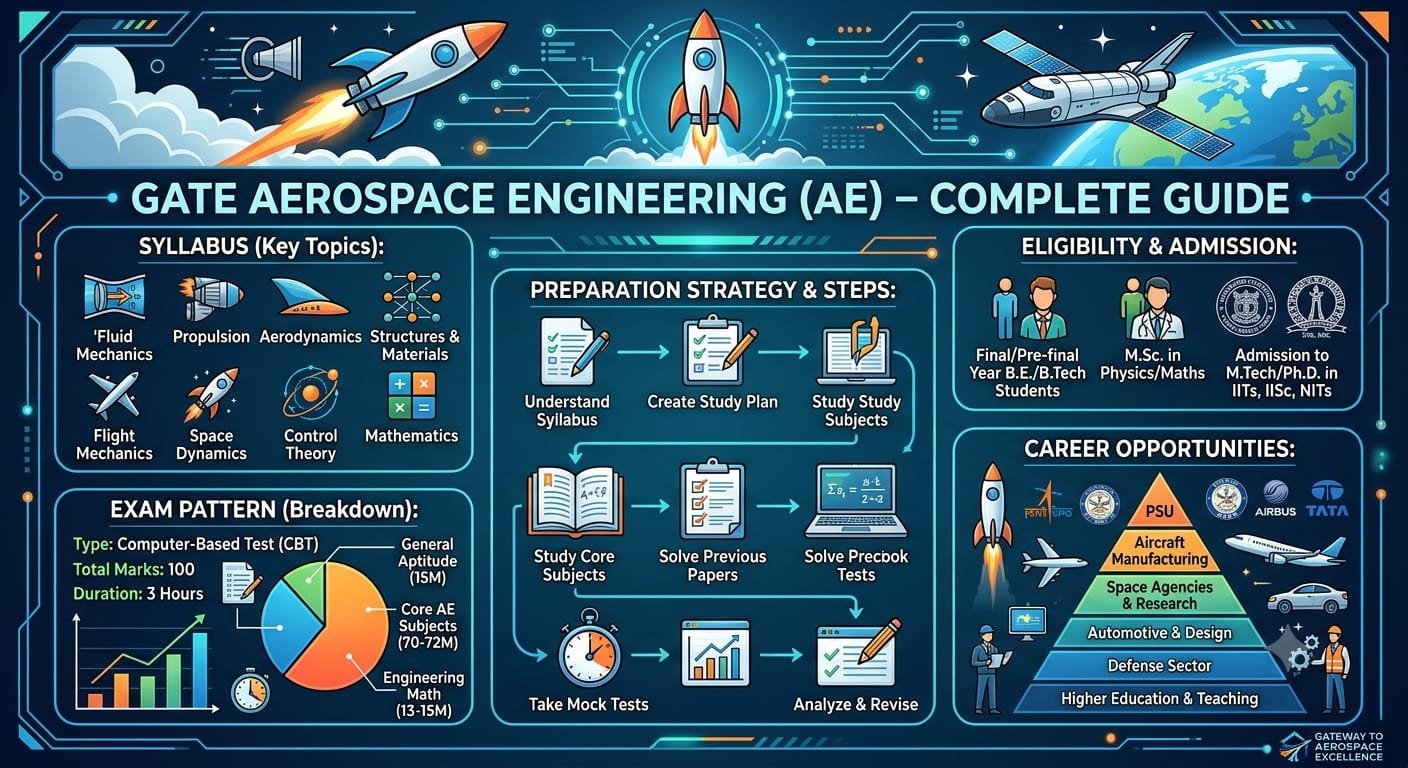
GATE AE is a three-hour computer-based examination containing 65 questions for a maximum of 100 marks.
Subject-wise marks distribution
| Section | Marks |
| General Aptitude | 15 |
| Engineering Mathematics | 13 |
| Aerospace Engineering subjects | 72 |
| Total | 100 |
The paper includes 10 General Aptitude questions and 55 questions from the subject-specific syllabus.
Types of questions
Multiple Choice Questions (MCQs): Candidates must select one correct answer from the available alternatives.
Multiple Select Questions (MSQs): Candidates must select all correct alternatives. There is no negative marking for incorrect answers, but partial marking is not provided.
Numerical Answer Type (NAT): Candidates must calculate and enter the numerical answer using the computer interface.
Negative marking
- Incorrect one-mark MCQ: 1/3 mark deducted.
- Incorrect two-mark MCQ: 2/3 mark deducted.
- No negative marking for MSQ questions.
- No negative marking for NAT questions.
GATE AE evaluates recall, comprehension, application, analysis and problem-solving abilities. Students should understand the underlying engineering concepts rather than memorise formulas without understanding their assumptions and limitations.
7. Is There Any Exemption in GATE Aerospace Engineering?
There is no general exemption from appearing in GATE AE based on an undergraduate degree, postgraduate qualification, college, university or work experience.
- Holding a B.Tech. Aerospace Engineering degree does not automatically exempt a candidate.
- Completing an M.Tech. does not automatically exempt a candidate.
- Previous GATE qualification does not exempt a candidate from a subsequent examination.
- Work experience does not provide automatic exemption.
Some institutions may have independent admission routes or alternative selection procedures. Such provisions are institute-specific and should not be confused with exemption from the GATE examination.
8. Complete GATE Aerospace Engineering 2027 Syllabus
The GATE Aerospace Engineering syllabus covers five major technical subject areas:
- Engineering Mathematics.
- Flight Mechanics and Space Dynamics.
General Aptitude is also included in the examination.
Section 1: Engineering Mathematics
Engineering Mathematics provides the foundation for several aerospace subjects. Mathematical concepts are extensively used in Aerodynamics, Flight Mechanics, Structures, Propulsion and Space Dynamics.
- Linear Algebra
- Vector algebra.
- Matrix algebra.
- Systems of linear equations.
- Rank of a matrix.
- Eigenvalues and eigenvectors.
- Determinants and inverse matrices.
- Linear independence.
- Characteristic equations.
- Calculus
- Functions of a single variable.
- Limits, continuity and differentiability.
- Chain rule.
- Maxima and minima.
- Functions of several variables.
- Partial derivatives.
- Gradient, divergence and curl.
- Directional derivatives.
- Line, surface and volume integrals.
- Stokes’ theorem.
- Gauss’ theorem.
- Green’s theorem.
- Differential Equations
- First-order linear ordinary differential equations.
- Higher-order linear ordinary differential equations with constant coefficients.
- Classification of partial differential equations.
- Wave equations.
- Laplace equations.
- Heat equations using separation of variables.
- Numerical Methods
- Numerical solutions of linear and nonlinear algebraic equations.
- Bisection method.
- Newton-Raphson method.
- Numerical differentiation.
- Numerical integration.
- Trapezoidal rule.
- Simpson’s rule.
- Linear regression.
- Least squares method.
- Linear interpolation.
Special Topics
- Fourier series.
- Complex numbers.
- Analytic functions.
- Cauchy-Riemann equations.
- Probability and statistics.
- Bayes’ theorem.
- Mean, median and mode.
- Binomial distribution.
- Normal distribution.
- Poisson distribution.
Preparation recommendation: Complete Linear Algebra, Calculus and Differential Equations before moving deeply into aerospace-specific subjects. Practise numerical problems regularly.
Section 2: Flight Mechanics and Space Dynamics
Flight Mechanics deals with aircraft motion, stability, performance and control. Space Dynamics introduces the mathematical principles governing the motion of objects under gravitational forces.
- Atmosphere and Aircraft Fundamentals
- Properties of the standard atmosphere.
- Classification of aircraft.
- Fixed-wing aircraft configurations.
- Aircraft components and their functions.
- Pressure altitude.
- Equivalent airspeed.
- Calibrated airspeed.
- Indicated airspeed.
- Primary flight instruments.
- Airspeed indicator.
- Vertical speed indicator.
- Turn-bank indicator.
- Aerodynamic Forces and Aircraft Controls
- Aerodynamic forces and moments.
- Angle of attack.
- Sideslip angle.
- High-lift devices.
- Roll, pitch and yaw control.
- Lift and drag.
- Pitching moment.
- Ailerons, elevators and rudders.
- Flaps and slats.
- Aircraft Performance
- Lift coefficient versus angle of attack curve.
- Drag polar.
- Take-off performance.
- Landing performance.
- Steady climb and steady descent.
- Absolute ceiling and service ceiling.
- Range and endurance.
- Load factor.
- Turning flight.
- V-n diagram.
- Headwinds, tailwinds and crosswinds.
- Static Stability
- Stability derivatives.
- Control derivatives.
- Longitudinal stick-fixed stability.
- Longitudinal stick-free stability.
- Horizontal tail position and size.
- Directional stability.
- Vertical tail position and size.
- Lateral stability.
- Wing dihedral, sweep and position.
- Hinge moments and stick forces.
- Linear and Angular Momentum
- Linear momentum balance for rigid bodies.
- Angular momentum balance for rigid bodies.
- Space Dynamics
- Central force motion.
- Keplerian orbits.
- Kepler’s laws.
- Escape velocity.
Special Topics
- Equations of motion.
- Euler angles.
- Decoupling of longitudinal dynamics.
- Decoupling of lateral-directional dynamics.
- Longitudinal modes.
- Lateral-directional modes.
- Hohmann orbital transfers.
Section 3: Aerodynamics
Aerodynamics examines the behaviour of air and other gases around aircraft, wings, airfoils and other bodies. It is one of the central technical subjects in Aerospace Engineering.
- Basic Fluid Mechanics
- Fluid kinematics.
- Streamlines, streaklines and pathlines.
- Conservation of mass.
- Conservation of linear momentum.
- Conservation of energy.
- Integral forms of conservation laws.
- Differential forms of conservation laws.
- Dimensional analysis.
- Dynamic similarity.
- Incompressibility conditions.
- Newtonian fluids.
- Viscous Flow
- Elementary viscous flow concepts.
- Hagen-Poiseuille flow.
- Couette flow.
- Boundary layers.
- Boundary-layer thickness.
- Two-Dimensional Potential Flow Theory
- Sources and sinks.
- Point vortices.
- Superposition of elementary flows.
- Bernoulli’s equation.
- Velocity potential.
- Stream functions.
- Circulation and pressure distribution.
- Airfoils and Wings
- Airfoil nomenclature.
- Lift coefficient.
- Drag coefficient.
- Moment coefficient.
- Kutta-Joukowski theorem.
- Thin airfoil theory.
- Kutta condition.
- Starting vortex.
- Finite wing theory.
- Induced drag.
- Prandtl lifting-line theory.
- Critical Mach number.
- Drag divergence Mach number.
- Compressible Flow
- Fundamentals of compressibility.
- One-dimensional compressible flow.
- Isentropic flow.
- Normal shocks.
- Oblique shocks.
- Prandtl-Meyer flow.
- Nozzles and diffusers.
Special Topics
- Fanno flow.
- Rayleigh flow.
- Pressure measurement using U-tube manometers.
- Pitot probe.
Section 4: Structures
Aerospace Structures focuses on the strength, stability and dynamic behaviour of aircraft structural components. Aircraft structures must withstand aerodynamic loads, inertial forces and vibration while maintaining minimum weight and structural reliability.
- Strength of Materials
- Stress and strain.
- Stress-strain curves of steel and aluminium.
- Statically determinate and indeterminate trusses.
- Bars, beams and shafts.
- Stresses and deflections.
- Linear elastic behaviour.
- Two-dimensional stress and strain transformations.
- Mohr’s circle.
- Principal stresses and strains.
- Combined loading.
- Failure criteria.
- Maximum stress criterion.
- Tresca criterion.
- von Mises criterion.
- Strain energy.
- Castigliano’s principles.
- Three-dimensional Hooke’s law.
- Plane stress and plane strain.
- Euler buckling of columns.
- Flight Vehicle Structures
- Torsion of thin-walled sections.
- Bending of thin-walled sections.
- Shear of thin-walled sections.
- Open and closed cross-sections.
- Symmetric and unsymmetric cross-sections.
- Loads on aircraft.
- Structural Dynamics
- Free vibrations of undamped single-degree-of-freedom systems.
- Forced vibrations of undamped systems.
- Free vibrations of damped single-degree-of-freedom systems.
- Forced vibrations of damped single-degree-of-freedom systems.
- Free vibrations of undamped two-degree-of-freedom systems.
Special Topic: Equilibrium and compatibility equations in two-dimensional elasticity.
Section 5: Propulsion
Propulsion deals with the generation of thrust required to move aircraft and spacecraft. It covers thermodynamics, aircraft engines, gas turbines, turbomachinery and rocket propulsion.
- Thermodynamics Fundamentals
- Basic thermodynamics.
- Thermodynamic properties.
- Energy equations.
- Thermodynamic cycles.
- First-law applications.
- Second-law fundamentals.
- Aerothermodynamics of Aircraft Engines
- Brayton cycle.
- Thermal efficiency.
- Propulsive efficiency.
- Overall efficiency.
- Specific fuel consumption.
- Aircraft Engine Performance
- Ramjet engines.
- Turbojet engines.
- Turbofan engines.
- Turboprop engines.
- Turboshaft engines.
- Propulsion Components
- Aircraft engine intakes.
- Aerothermodynamics of non-rotating propulsion components.
- Gas Turbine Combustion
- Gas turbine combustor types.
- Combustor configurations.
- Combustion fundamentals.
- Stoichiometric fuel-to-air ratio.
- Turbomachinery
- Axial compressors.
- Angular momentum.
- Work and compression.
- Single axial compressor stage.
- Compressor efficiency.
- Degree of reaction.
- Centrifugal compressors.
- Inducer, impeller and diffuser.
- Axial turbines.
- Turbine stage performance.
Special Topics
- Turbine blade cooling.
- Compressor-turbine matching.
- Rocket Propulsion
- Rocket thrust equation.
- Specific impulse.
- Rocket performance.
- Chemical rockets.
- Solid-propellant rockets.
- Liquid-propellant rockets.
Preparation recommendation: Propulsion requires an integrated understanding of thermodynamics, fluid mechanics and energy conversion. Practise numerical problems involving thrust, specific impulse, engine efficiency, compressor performance and rocket staging.
Official syllabus: https://gate2027.iitm.ac.in/exam_papers_and_syllabus
9. How to Prepare for GATE Aerospace Engineering 2027: Complete Preparation Strategy
Preparing independently for GATE Aerospace Engineering is possible with a well-planned timetable, quality reference materials, previous-year question papers and regular mock tests. However, because Aerospace Engineering involves interconnected technical subjects, students should avoid studying topics randomly.
Step 1: Understand the complete syllabus
Download the official GATE 2027 AE syllabus and divide it into Engineering Mathematics, Flight Mechanics and Space Dynamics, Aerodynamics, Structures, Propulsion and General Aptitude.
Maintain a checklist of topics marked as not started, currently studying, completed, practised, revised and test-ready.
Step 2: Analyse previous-year question papers
Previous-year GATE AE papers are among the most useful preparation resources. Solve questions from multiple examination years and identify frequently tested concepts, common numerical problem types, important formulas, conceptual questions and areas where you repeatedly make mistakes.
The objective is to understand the examination’s problem-solving approach rather than expect exact repetition of questions.
Step 3: Strengthen Engineering Mathematics
Focus on Linear Algebra, Calculus, Differential Equations, Numerical Methods and Vector Calculus. Practise calculations without depending excessively on formula sheets.
Step 4: Build a strong foundation in Aerodynamics
Start with basic fluid mechanics and gradually progress towards viscous flow, boundary layers, potential flow, airfoil theory, finite-wing theory and compressible flow.
Step 5: Study Flight Mechanics systematically
Study aircraft configurations, atmospheric properties, aerodynamic forces and aircraft performance before moving to stability and space dynamics.
Step 6: Master Structures and numerical applications
Develop a strong understanding of stress-strain relationships, beam bending, torsion, deflection, Mohr’s circle, failure theories, thin-walled structures and vibrations.
Step 7: Complete Propulsion with conceptual clarity
Begin with thermodynamics and the Brayton cycle, then study turbojet, turbofan, turboprop, turboshaft, ramjet, turbomachinery and rocket propulsion.
Step 8: Prepare General Aptitude
General Aptitude contributes 15 marks and is common to all GATE papers.
Prepare verbal aptitude, English grammar, vocabulary, sentence completion, reading comprehension, verbal reasoning, percentages, ratios, averages, algebra, geometry, data interpretation and logical reasoning.
Step 9: Create short notes and formula sheets
Maintain separate formula notebooks for Engineering Mathematics, Aerodynamics, Flight Mechanics, Structures, Propulsion and Space Dynamics. Record the formula, meaning of variables, units, assumptions and a representative numerical example.
Step 10: Attempt full-length mock examinations
After every mock test, analyse total marks, accuracy, time spent per question, incorrect answers, unanswered questions, weak subjects and calculation errors. The objective is to identify and correct weaknesses.
10. GATE AE 2027: Recommended Study Timetable
Students preparing for GATE AE 2027 should divide their available time between concept learning, numerical practice, previous-year questions, revision and mock examinations.
November 2026: Foundation strengthening
- Engineering Mathematics.
- General Aptitude.
- Basic Fluid Mechanics.
- Aerodynamics fundamentals.
- Strength of Materials.
- Standard atmosphere and aircraft fundamentals.
- Basic Thermodynamics.
December 2026: Advanced technical preparation
- Compressible Flow.
- Airfoil and Wing Theory.
- Flight Mechanics.
- Aircraft Performance.
- Static Stability.
- Aerospace Structures.
- Structural Dynamics.
- Space Dynamics.
January 2027: Revision and examination practice
- Complete remaining syllabus gaps.
- Revise important formulas.
- Solve previous-year questions.
- Attempt full-length mock examinations.
- Practise numerical answer questions.
- Analyse mock-test performance.
- Improve time management.
- Revise difficult concepts.
Do not spend the final weeks collecting new study material or switching between multiple reference books. Concentrate on revision, practice and error correction.
Suggested Daily Study Schedule
| Activity | Suggested daily time |
| Engineering Mathematics | 1 hour |
| Technical subject 1 | 2 hours |
| Technical subject 2 | 2 hours |
| General Aptitude | 30 minutes |
| Numerical practice | 1 hour |
| Formula revision | 30 minutes |
This is a suggested timetable, not a compulsory daily schedule. Students should adjust study hours according to their academic commitments, preparation level and available time.
11. GATE Aerospace Engineering Preparation Strategies According to Available Time
Six-month preparation strategy
- Month 1: Mathematics and General Aptitude.
- Month 2: Aerodynamics.
- Month 3: Flight Mechanics and Space Dynamics.
- Month 4: Structures.
- Month 5: Propulsion and subject-wise revision.
- Month 6: Mock tests, previous-year questions and final revision.
Three-month preparation strategy
- First month: Core concepts and important technical topics.
- Second month: Advanced numerical practice and remaining syllabus.
- Third month: Revision, mock tests and previous-year papers.
One-month preparation strategy
- Formula revision.
- Important conceptual questions.
- Previous-year questions.
- Weak-topic revision.
- Full-length mock tests.
- Examination strategy.
Trying to learn every technical subject from the beginning in 30 days may not be realistic. A 30-day programme is most appropriate for candidates who have already completed most of the syllabus.
12. Recommended Books and Study Resources for GATE Aerospace Engineering
Selecting the right study material is an important part of preparation. Students should avoid purchasing too many books without a clear study plan.
| Subject | Recommended reference book |
| Engineering Mathematics | Higher Engineering Mathematics – B.S. Grewal |
| Fluid Mechanics | Fluid Mechanics – Frank M. White |
| Aerodynamics | Fundamentals of Aerodynamics – John D. Anderson |
| Flight Mechanics | Flight Stability and Automatic Control – Robert C. Nelson |
| Aircraft Performance | Aircraft Performance and Design – John D. Anderson |
| Aerospace Structures | Aircraft Structures for Engineering Students – T.H.G. Megson |
| Strength of Materials | Mechanics of Materials – R.C. Hibbeler |
| Propulsion | Aircraft Propulsion – Saeed Farokhi |
| Gas Turbine Theory | Gas Turbine Theory – Cohen, Rogers and Saravanamuttoo |
| Rocket Propulsion | Rocket Propulsion Elements – George P. Sutton and Oscar Biblarz |
These are reference resources, not books that every candidate must complete from cover to cover. Prioritise the official syllabus, selected chapters, previous-year questions and examination-oriented numerical practice.
Useful Online Resources
- Official GATE 2027 syllabus.
- Previous-year GATE question papers.
- Official examination information brochure.
- NPTEL engineering courses.
- IIT and IISc academic resources.
- Engineering mathematics practice material.
- Subject-specific numerical problem collections.
13. Common Mistakes to Avoid While Preparing for GATE AE
- Ignoring Engineering Mathematics:Mathematics supports almost every technical subject.
- Studying only theory:Numerical problem-solving must be part of daily preparation.
- Avoiding difficult subjects:Skipping Aerodynamics, Structures or Propulsion can leave significant gaps.
- Ignoring General Aptitude:This section contributes 15 marks.
- Collecting too many books:Too many resources can reduce revision time.
- Not solving previous-year questions:These questions help students understand the examination approach.
- Taking mock tests without analysis:Every mock test should lead to improvement.
- Delaying revision:Revise completed subjects regularly.
- Memorising formulas without understanding assumptions:Understand the conditions under which equations apply.
- Poor time management:Develop a strategy for attempting questions efficiently.
14. GATE Aerospace Engineering Admission Opportunities After Qualification
A major reason students prepare for GATE Aerospace Engineering is to pursue higher education and research at leading engineering institutions.
A valid GATE score may be considered for admission to:
- Tech. programmes.
- E. programmes.
- S. by Research programmes.
- Certain doctoral programmes.
- Interdisciplinary engineering programmes.
- Research-oriented postgraduate programmes.
Aerospace Engineering Specialisations
- Aerospace Propulsion.
- Flight Mechanics.
- Aircraft Structures.
- Aerospace Design.
- Computational Fluid Dynamics.
- Aerospace Systems.
Related Engineering Specialisations
- Mechanical Engineering.
- Applied Mechanics.
- Fluid Mechanics.
- Thermal Engineering.
- Computational Engineering.
- Robotics and Control.
- Materials and Structural Engineering.
- Space and Satellite Technology.
Which Institutes Can GATE AE Aspirants Target?
Depending on the current admission notification, programme eligibility and accepted GATE paper codes, candidates can investigate opportunities at:
- Indian Institute of Science (IISc), Bengaluru.
- Indian Institute of Technology Bombay.
- Indian Institute of Technology Madras.
- Indian Institute of Technology Kanpur.
- Indian Institute of Technology Kharagpur.
- Indian Institute of Technology Hyderabad.
- Indian Institute of Technology Roorkee.
- Indian Institute of Technology Guwahati.
- Indian Institute of Technology Delhi.
- National Institutes of Technology.
- Other participating universities and research institutions.
This is an illustrative list, not a guarantee that every institution offers an AE-specific programme or accepts AE scores for every specialisation.
How Does the Postgraduate Admission Process Work?
- Qualify in the GATE examination.
- Obtain the GATE scorecard.
- Identify institutes accepting the relevant GATE paper.
- Check institute-specific eligibility requirements.
- Submit admission applications.
- Participate in counselling, shortlisting or interviews wherever applicable.
- Complete document verification.
- Accept the admission offer and complete admission formalities.
Some IIT admissions are coordinated through COAP, while many NIT admissions use CCMT. Other institutions may have independent admission portals and selection procedures.
GATE qualification does not automatically guarantee admission. Selection depends on the institute’s eligibility criteria, available seats, GATE score, category, programme requirements and selection process.
What Is the Validity of the GATE Score?
The GATE score is valid for three years from the date of result announcement, subject to the applicable admission requirements of individual institutions.
15. Career Opportunities After GATE Aerospace Engineering
Aerospace Engineering is a specialised discipline with applications across civil aviation, military aviation, space technology, defence, manufacturing and advanced research.
Aircraft Design and Development
- Aircraft configuration design.
- Aerodynamic analysis.
- Structural design.
- Aircraft performance analysis.
- Flight testing and evaluation.
Aerodynamics and Computational Fluid Dynamics
- External aerodynamic analysis.
- Computational Fluid Dynamics (CFD).
- Wind tunnel testing.
- Flow simulation.
- Aircraft drag and lift optimisation.
Propulsion Engineering
- Aircraft engine design and analysis.
- Gas turbine performance.
- Combustion systems.
- Rocket propulsion.
- Propulsion testing.
Space and Satellite Technology
- Satellite systems.
- Orbital mechanics.
- Spacecraft structures.
- Launch vehicle systems.
- Space mission analysis.
Defence and Aviation Research
Aerospace graduates may explore technical opportunities in defence research, aviation manufacturing, aircraft maintenance and engineering, research laboratories, public-sector organisations and private aerospace companies.
Recruitment requirements vary between organisations. GATE AE scores are accepted only when specifically mentioned in the relevant recruitment notification. A GATE score does not guarantee a job or PSU recruitment.
16. Is GATE Aerospace Engineering Difficult?
GATE AE is a challenging examination because it requires students to understand several specialised engineering subjects and apply mathematical concepts to numerical problems.
The difficulty level depends on a candidate’s academic foundation, preparation time, conceptual clarity, problem-solving ability and examination strategy.
Some of the areas students commonly find challenging include:
- Compressible flow and shock waves.
- Thin airfoil theory and finite-wing aerodynamics.
- Aircraft stability and control.
- Flight dynamics.
- Structural analysis and vibration.
- Rocket propulsion.
- Engineering Mathematics.
A structured study plan, regular numerical practice and continuous assessment can make preparation more manageable.
17. Why Consider GATE Aerospace Engineering Coaching?
Self-study can work well for students who are disciplined, academically strong and comfortable planning their own preparation. However, candidates who need structured guidance may benefit from a dedicated coaching programme.
GATE Aerospace Engineering coaching can help students:
- Understand the complete syllabus systematically.
- Build strong fundamentals in difficult subjects.
- Learn problem-solving methods.
- Practise examination-level numerical questions.
- Identify weak topics through regular tests.
- Maintain a consistent preparation timetable.
- Receive guidance on revision and mock-test strategy.
- Clarify doubts and improve conceptual understanding.
Students should select a coaching programme based on faculty expertise, syllabus coverage, teaching methodology, doubt-clearing support, test quality, batch size and the amount of individual attention provided.
18. GATE Aerospace Engineering Coaching at GATEIIT Bangalore
GATEIIT – Gate Indian Institute of Tutorials provides coaching and academic preparation programmes for competitive engineering examinations, including GATE-related preparation.
Students interested in GATE Aerospace Engineering can enquire about programme availability, subject coverage, batch schedules and learning options.
GATEIIT focuses on structured learning, concept clarity, personalised attention and examination-oriented preparation.
Key Learning Features
- Structured syllabus-based preparation.
- Concept-oriented teaching.
- Personal attention and academic guidance.
- Small-group learning options, subject to availability.
- Personal mentorship programmes.
- Customised preparation plans.
- Online learning options.
- Classroom coaching at JP Nagar, Bangalore.
- Hybrid learning options, subject to availability.
- Regular practice and assessment.
- Previous-year question discussion.
- Mock-test and revision support.
- Doubt-clearing sessions.
Course structure, faculty allocation, class frequency, batch size and included learning resources should be confirmed with GATEIIT before admission.
19. GATE Aerospace Engineering Coaching: Online, Offline and Hybrid Options
A. Online GATE Aerospace Engineering Coaching
Online coaching is suitable for students who live outside Bangalore, are pursuing their undergraduate studies or prefer learning from home.
Depending on the selected programme, online learning may include:
- Live interactive classes.
- Concept explanations.
- Numerical problem-solving sessions.
- Online doubt-clearing support.
- Digital study resources.
- Practice questions.
- Test and revision support.
Online programmes are intended for eligible students across India. Availability and programme inclusions should be confirmed during admission counselling.
B. Offline GATE Aerospace Engineering Coaching in Bangalore
Students who prefer face-to-face learning can enquire about classroom coaching at the GATEIIT centre in JP Nagar, Bangalore.
Offline coaching may be suitable for students who value classroom interaction, direct discussion with faculty, a structured learning environment and regular academic monitoring.
GATEIIT Bangalore Address:
3rd Floor, #1743, Sri Raghavendra Plaza,
17th Main Road, JP Nagar 2nd Phase,
Bangalore – 560078, Karnataka.
C. Hybrid GATE Aerospace Engineering Coaching
Hybrid learning combines online and offline learning options, subject to programme availability. It can be useful for students who need flexibility because of college schedules, work commitments or travel limitations.
20. GATE Aerospace Engineering Long-Term Coaching Programme
A long-term GATE AE programme is suitable for students who want to prepare systematically over an extended period rather than complete the syllabus under last-minute pressure.
The programme may be suitable for:
- Second-year engineering students planning early preparation.
- Third-year Aerospace Engineering students.
- Final-year B.Tech. students.
- Graduates planning postgraduate admission.
- Working professionals planning a return to technical studies.
Suggested Long-Term Programme Structure
- Engineering Mathematics foundation.
- General Aptitude preparation.
- Complete technical subject coverage.
- Conceptual and numerical practice.
- Previous-year question discussions.
- Subject-wise tests.
- Full-length mock examinations.
- Revision and performance analysis.
Long-term course duration, timetable, fee and available batches should be confirmed directly with GATEIIT.
21. GATE Aerospace Engineering Crash Course and Short-Term Coaching
Students who have already studied most of the syllabus may benefit from an intensive short-term GATE AE preparation programme.
GATEIIT offers enquiries for different crash-course and short-term preparation formats, including:
- 30-day GATE AE crash course.
- 45-day GATE AE crash course.
- 60-day GATE AE crash course.
- 90-day GATE AE preparation programme.
These programmes may be structured around revision, important concepts, numerical problem-solving, previous-year questions and mock-test preparation.
30-Day GATE Aerospace Engineering Crash Course
The 30-day programme is intended for students who have already covered a substantial portion of the syllabus and need focused revision and examination practice.
Possible areas of focus:
- Important formulas and concepts.
- High-priority technical topics.
- Previous-year questions.
- Numerical problem-solving.
- Mock-test practice.
- Final revision strategy.
45-Day GATE Aerospace Engineering Crash Course
The 45-day programme provides additional time for revision and subject-wise practice.
It may include:
- Subject-wise revision.
- Important derivations and formulas.
- Concept clarification.
- Numerical practice.
- Previous-year question analysis.
- Mock examinations.
60-Day GATE Aerospace Engineering Crash Course
The 60-day programme is suitable for candidates who require a more balanced combination of concept revision and problem-solving.
Possible components:
- Technical subject revision.
- Engineering Mathematics practice.
- General Aptitude practice.
- Topic-wise question solving.
- Subject tests.
- Full-length mock tests.
90-Day GATE Aerospace Engineering Preparation Programme
The 90-day programme provides more time for candidates who need to strengthen selected concepts, cover remaining topics and improve examination readiness.
It may include:
- Concept revision and selected topic teaching.
- Structured subject-wise preparation.
- Numerical problem-solving.
- Previous-year question discussions.
- Regular tests.
- Mock-test analysis.
- Revision planning.
Important: The suitability of a crash course depends on the student’s existing preparation level. A short-term course cannot be assumed to replace complete foundational learning for someone starting from zero.
22. Personal Mentorship and One-to-One GATE Aerospace Engineering Coaching
Every student has a different academic background, learning speed and preparation requirement. Some candidates need complete syllabus teaching, while others need help with selected technical subjects or difficult numerical problems.
Personal mentorship and one-to-one coaching options can be considered by students who prefer individual academic attention.
Possible Features of Personal Mentorship
- Assessment of the student’s current preparation level.
- Identification of weak technical subjects.
- Customised study planning.
- Subject-wise learning targets.
- Individual doubt-clearing support.
- Progress monitoring.
- Revision guidance.
- Mock-test performance discussion.
One-to-one classes and personal mentorship are subject to faculty availability, scheduling and the selected programme.
23. Small-Group and Customised GATE AE Coaching
Some students prefer small-group learning because it provides opportunities to discuss concepts, solve problems and learn through interaction.
GATEIIT can be contacted to enquire about small-group and customised coaching options, subject to batch availability.
Possible learning arrangements include:
- Small-group technical classes.
- Subject-specific coaching.
- Weekend batches.
- Regular weekday batches.
- Customised revision programmes.
- Individual doubt-clearing sessions.
- Online and offline learning combinations.
Students should discuss their requirements with the academic team before selecting a batch.
24. GATEIIT Course Fees and Scholarship Opportunities
GATE Aerospace Engineering coaching fees depend on the course duration, teaching format, number of subjects, batch type and level of individual academic support.
GATEIIT offers enquiries for different preparation formats, including long-term coaching, short-term crash courses, small-group programmes and personalised learning options.
Indicative Crash-Course Fee Range
Short-term crash-course fees may fall within an indicative range of ₹5,000 to ₹25,000, depending on the selected duration, programme structure and learning support.
This is an indicative range, not a confirmed fee quotation for every course. Students should contact GATEIIT for the current fee, inclusions, batch availability and applicable terms.
Scholarship and Fee Concession
Eligible students may enquire about scholarship tests and performance-based fee concessions. GATEIIT may offer scholarship discounts of up to 95%, based on the applicable scholarship test score and programme conditions.
The actual concession depends on the scholarship assessment, eligibility, course selected and applicable terms. A scholarship discount is not automatic or guaranteed.
What May Be Included in a Coaching Programme?
Depending on the selected programme, students may enquire about:
- Live or scheduled classes.
- Online study resources.
- Digital learning application access.
- Practice questions.
- Subject-wise assessments.
- Mock-test access.
- Revision support.
- Doubt-clearing sessions.
- Performance feedback.
Students should confirm exactly which resources and services are included in their selected course before making payment.
25. How to Choose the Right GATE Aerospace Engineering Coaching Programme
Choosing a coaching programme should be based on the candidate’s preparation level and learning needs, not only on the advertised course duration.
| Student profile | Programme to consider |
| Student beginning preparation early | Long-term comprehensive programme |
| Student with incomplete syllabus | Structured comprehensive or extended preparation |
| Student who has completed most subjects | 90-day or 60-day revision programme |
| Student requiring focused revision | 45-day or 30-day crash course |
| Student needing individual attention | Personal mentorship or one-to-one programme |
| Student preferring interactive learning | Small-group coaching |
| Student living outside Bangalore | Online coaching |
| Student preferring classroom learning | Offline coaching in JP Nagar, Bangalore |
Before enrolling, ask about the syllabus covered, class schedule, faculty allocation, batch size, doubt-clearing support, tests, study material, course validity and fee structure.
26. Why Choose GATEIIT for GATE Preparation in Bangalore?
GATEIIT – Gate Indian Institute of Tutorials is based in JP Nagar, Bangalore, and provides academic coaching and competitive examination preparation programmes.
Students considering GATE Aerospace Engineering preparation can enquire about the following learning options:
- Personal attention and academic guidance.
- Concept-focused teaching.
- Structured preparation planning.
- Small-group learning options.
- Customised academic support.
- Personal mentorship options.
- Online coaching for students across India.
- Offline classes in JP Nagar, Bangalore.
- Hybrid learning options, subject to availability.
- Short-term and long-term preparation programmes.
- Practice and revision support.
The appropriate programme should be selected after discussing the candidate’s academic background, target examination, available preparation time and subject-wise requirements.
27. How to Enrol for GATE Aerospace Engineering Coaching at GATEIIT?
Students interested in GATE Aerospace Engineering coaching can contact GATEIIT to enquire about available courses and admission procedures.
- Contact the GATEIIT academic team.
- Discuss your educational background and preparation level.
- Explain whether you need long-term coaching or a crash course.
- Ask about online, offline or hybrid options.
- Check the available batch timings.
- Discuss personal mentorship or small-group options if required.
- Confirm course fees and inclusions.
- Enquire about applicable scholarship tests and fee concessions.
- Complete the admission process after reviewing the programme details.
28. Frequently Asked Questions About GATE Aerospace Engineering 2027
1. What is GATE Aerospace Engineering?
GATE Aerospace Engineering is a national-level examination with paper code AE. It evaluates knowledge of Engineering Mathematics, Aerodynamics, Flight Mechanics, Structures and Propulsion.
2. Who conducts GATE 2027?
GATE is conducted jointly by IISc and the IITs on behalf of NCB-GATE. IIT Madras is the Organising Institute for GATE 2027.
3. What is the paper code for Aerospace Engineering?
The paper code for Aerospace Engineering is AE.
4. What is the duration of the GATE AE examination?
The examination duration is three hours.
5. How many questions are asked in GATE AE?
The examination contains 65 questions carrying a total of 100 marks.
6. How many marks are allocated to General Aptitude?
General Aptitude carries 15 marks.
7. How many marks are allocated to Engineering Mathematics?
Engineering Mathematics carries 13 marks in the GATE AE paper.
8. Which subjects are included in GATE Aerospace Engineering?
The technical subjects are Engineering Mathematics, Flight Mechanics and Space Dynamics, Aerodynamics, Structures and Propulsion.
9. Can Mechanical Engineering students write GATE AE?
Yes. Eligible Mechanical Engineering students and graduates can appear for GATE AE, subject to the official eligibility conditions.
10. Can students from Electrical Engineering appear for GATE AE?
Yes, provided they satisfy the GATE eligibility requirements. They should prepare for the complete Aerospace Engineering syllabus.
11. Can Physics graduates appear for GATE AE?
Candidates with eligible recognised qualifications may appear, subject to the official GATE eligibility rules.
12. Is there an age limit for GATE AE?
No upper age limit is prescribed for appearing in GATE.
13. Can final-year students appear for GATE AE?
Yes. Students studying in the third year or higher of an eligible degree programme may appear.
14. Is Aerospace Engineering compulsory for GATE AE?
No. GATE eligibility is not restricted to Aerospace Engineering graduates. However, candidates must prepare for the complete AE syllabus.
15. What is the negative marking in GATE AE?
Incorrect one-mark MCQs attract a deduction of one-third mark, and incorrect two-mark MCQs attract a deduction of two-thirds mark. MSQ and NAT questions do not have negative marking.
16. Are numerical questions included in GATE AE?
Yes. Numerical Answer Type questions form part of the examination.
17. Is Engineering Mathematics important for GATE AE?
Yes. Engineering Mathematics carries 13 marks and provides the foundation for several technical subjects.
18. Is Aerodynamics difficult in GATE AE?
Aerodynamics can be challenging because it includes fluid mechanics, potential flow, boundary layers, airfoil theory, finite-wing theory and compressible flow. Regular conceptual and numerical practice is important.
19. Which subject should I study first for GATE AE?
Students can begin with Engineering Mathematics and basic Fluid Mechanics while gradually building foundations in Flight Mechanics, Structures and Propulsion.
20. How many months are required to prepare for GATE AE?
The preparation period depends on the student’s academic foundation and available study time. A six-month or longer structured plan is useful for comprehensive preparation, while shorter programmes may suit students who have already covered most of the syllabus.
21. Can I prepare for GATE AE in three months?
Yes, if you have a reasonable foundation and can devote sufficient time to revision, numerical practice and mock examinations. Starting the entire syllabus from zero in three months may be challenging.
22. Is a 30-day GATE AE crash course sufficient?
A 30-day crash course is generally more appropriate for candidates who have already studied most of the syllabus and need focused revision and examination practice.
23. Which books are useful for GATE Aerospace Engineering?
Common reference books include John D. Anderson’s Fundamentals of Aerodynamics, T.H.G. Megson’s Aircraft Structures for Engineering Students, Frank M. White’s Fluid Mechanics and Saeed Farokhi’s Aircraft Propulsion.
24. Are previous-year question papers important?
Yes. Previous-year papers help students understand question styles, technical concepts, numerical problem types and examination difficulty.
25. How many mock tests should I attempt?
There is no fixed number suitable for everyone. Students should attempt regular subject-wise tests and full-length mock examinations, with detailed analysis after each test.
26. What is the validity of the GATE score?
The GATE score is valid for three years from the result announcement date, subject to applicable admission requirements.
27. Can I get admission to IITs through GATE AE?
Yes. Eligible candidates may apply to relevant IIT postgraduate programmes that accept the AE paper code. Admission depends on programme-specific eligibility, score, selection procedures and available seats.
28. Can I get admission to IISc through GATE AE?
Some IISc programmes may accept GATE scores, depending on the programme’s current admission requirements and accepted paper codes. Candidates should check the official IISc admission notification.
29. Can GATE AE help with admission to NITs?
Yes, where the relevant NIT programme accepts the AE paper and the candidate satisfies its eligibility conditions. Some NIT admissions are coordinated through CCMT.
30. Does qualifying GATE guarantee admission?
No. Admission depends on the institute’s eligibility criteria, GATE score, programme requirements, available seats and selection procedure.
31. Can GATE AE help in PSU recruitment?
Some organisations may use GATE scores for recruitment when their notifications specify the relevant paper code. Candidates should verify each recruitment advertisement. A GATE score does not guarantee PSU employment.
32. What career opportunities are available after Aerospace Engineering?
Career areas include aircraft design, aerodynamics, propulsion, computational fluid dynamics, aircraft structures, space technology, satellite systems, defence research and aerospace manufacturing.
33. Is online GATE Aerospace Engineering coaching available?
GATEIIT offers online coaching enquiries for students across India. Contact the institute to confirm the current AE batch and course availability.
34. Is offline GATE coaching available in Bangalore?
Students can enquire about classroom coaching at the GATEIIT centre in JP Nagar 2nd Phase, Bangalore.
35. Does GATEIIT offer personal mentorship?
Students can enquire about personal mentorship and individual academic support options, subject to faculty and programme availability.
36. Are small-group GATE AE classes available?
Small-group learning options may be available depending on the current batch schedule and enrolment.
37. Does GATEIIT provide crash courses?
GATEIIT offers enquiries for short-term preparation programmes, including 30-day, 45-day, 60-day and 90-day formats, subject to availability.
38. What is the fee for GATE Aerospace Engineering coaching at GATEIIT?
Indicative short-term course fees may range from ₹5,000 to ₹25,000 depending on duration and programme structure. Contact GATEIIT for the current fee quotation and inclusions.
39. Does GATEIIT offer scholarships?
Students can enquire about scholarship tests and performance-based fee concessions of up to 95%, subject to the applicable assessment and programme terms.
40. Where is GATEIIT located in Bangalore?
GATEIIT is located at 3rd Floor, #1743, Sri Raghavendra Plaza, 17th Main Road, JP Nagar 2nd Phase, Bangalore – 560078, Karnataka.
41. How can I contact GATEIIT for GATE AE coaching?
Call or WhatsApp 8884416154 or 8884416155. You can also visit www.gateiit.com.
42. Can working professionals prepare for GATE AE?
Yes. Working professionals can prepare through a suitable study schedule and enquire about flexible, weekend or online learning options.
43. Can I prepare for GATE AE while studying in college?
Yes. A structured preparation plan that balances academic coursework and GATE subjects can help undergraduate students prepare alongside their degree.
44. Is self-study enough for GATE AE?
Self-study can be effective for disciplined students with a strong foundation and access to good resources. Coaching can provide additional structure, guided learning, doubt-clearing and assessment support.
45. How should I revise before the GATE examination?
Revise formula sheets, important concepts, previously incorrect questions, difficult numerical problems and mock-test observations. Avoid starting too many new resources immediately before the examination.
Final Preparation Advice for GATE Aerospace Engineering 2027 Aspirants
GATE Aerospace Engineering is a specialised examination that rewards conceptual clarity, mathematical understanding and consistent problem-solving practice. Students should avoid depending entirely on memorisation or last-minute preparation.
A practical preparation strategy should include:
- Complete understanding of the official syllabus.
- Strong Engineering Mathematics fundamentals.
- Systematic coverage of Aerodynamics, Flight Mechanics, Structures and Propulsion.
- Regular General Aptitude practice.
- Previous-year question solving.
- Formula revision and short notes.
- Subject-wise tests.
- Full-length mock examinations.
- Performance analysis and correction of weak areas.
Whether you are a student beginning early, a final-year engineering candidate, a graduate preparing for postgraduate admissions or a working professional planning to return to academics, the right preparation strategy can make your learning more focused and organised.
Enquire About GATE Aerospace Engineering Coaching at GATEIIT Bangalore
Are you looking for GATE Aerospace Engineering coaching in Bangalore or online classes across India?
GATEIIT invites eligible students to enquire about available GATE preparation programmes, including long-term courses, regular batches, weekend classes, personal mentorship, small-group learning, customised preparation and short-term crash courses.
Discuss your preparation level, preferred learning mode, course duration and academic requirements with the GATEIIT team before selecting a programme.
GATEIIT – Gate Indian Institute of Tutorials
GATE Aerospace Engineering Coaching – Online and Offline
Offline Centre Address:
3rd Floor, #1743, Sri Raghavendra Plaza,
17th Main Road, JP Nagar 2nd Phase,
Bangalore – 560078, Karnataka.
Call / WhatsApp:
8884416154
8884416155
Website: www.gateiit.com
Google Maps Location: https://maps.app.goo.gl/MtzbVkqywCkwKcc4A
Online Coaching: Enquire about available online batches for students across India.
Offline Coaching: Enquire about classroom programmes at JP Nagar, Bangalore.
Crash Course Options: 30 Days | 45 Days | 60 Days | 90 Days, subject to availability.
Scholarship: Enquire about scholarship tests and applicable fee concessions.
Take the next step towards your GATE Aerospace Engineering preparation. Contact GATEIIT to discuss the right programme for your academic goals.
Disclaimer: GATE examination dates, syllabus, eligibility, application fees, admission rules and recruitment requirements are governed by the respective official authorities and may change through official notifications. Candidates must verify the latest information from the official GATE website and individual institute or recruitment websites. GATEIIT course durations, fees, batch schedules, scholarship concessions and programme inclusions are subject to availability and confirmation by the institute. Coaching does not guarantee a particular GATE score, rank, admission or employment.