
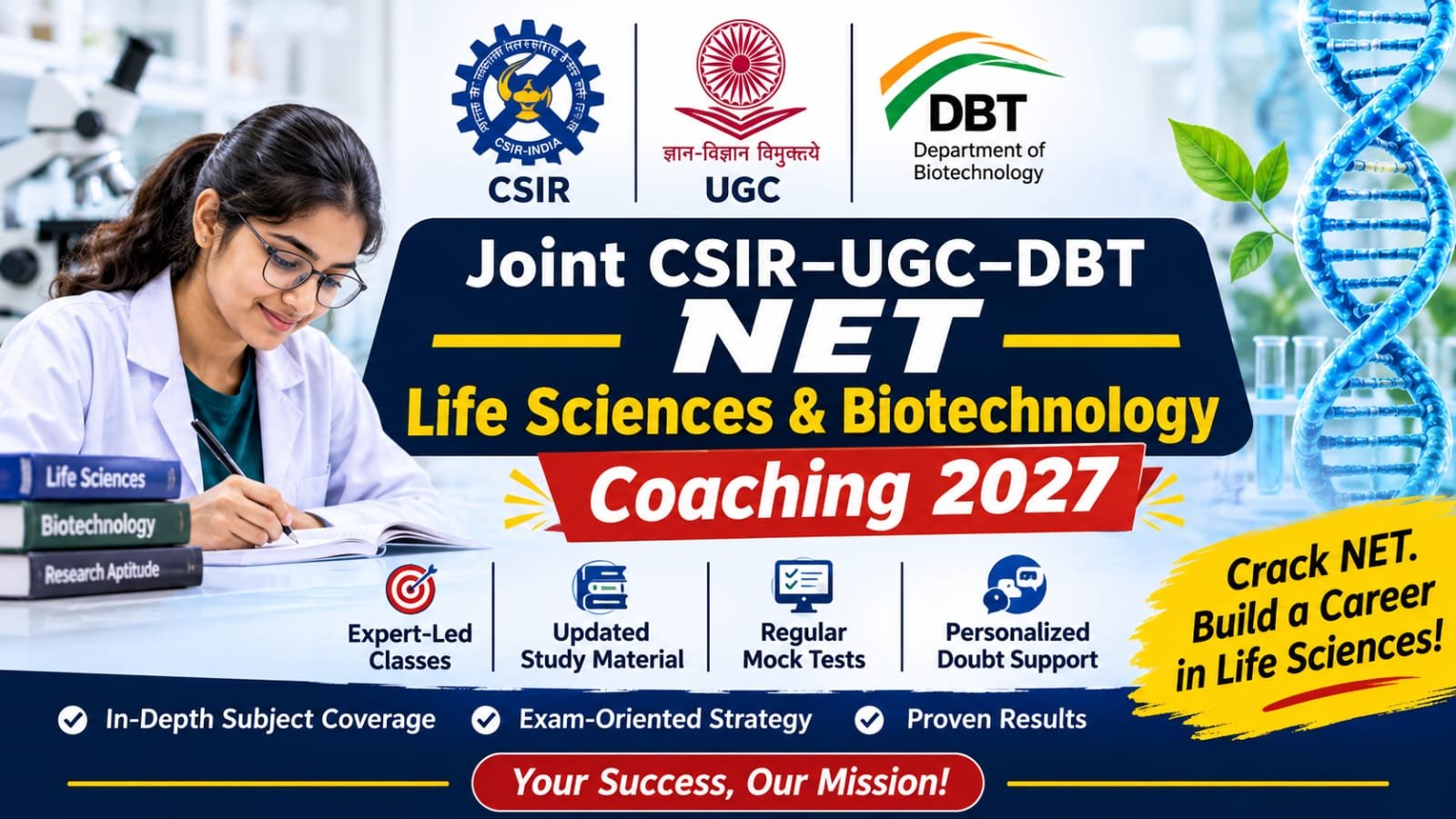
JOINT CSIR–UGC–DBT NET LIFE SCIENCES & BIOTECHNOLOGY COACHING 2027
Complete Online, Offline & Hybrid Coaching for JRF, NET and PhD Aspirants | GATEIIT Bangalore
Prepare for the New Joint CSIR–UGC–DBT JRF-NET Examination with Expert Guidance, Personal Mentorship and Structured Preparation
Are you preparing for the Joint CSIR–UGC–DBT NET Examination in Life Sciences and Biotechnology? Are you looking for specialised coaching to qualify for Junior Research Fellowship (JRF), Assistant Professor eligibility or PhD admission?
GATEIIT offers structured coaching for the newly introduced Joint CSIR–UGC–DBT NET Life Sciences and Biotechnology (LS-BT) examination, with preparation programmes designed for students from Life Sciences, Biotechnology and related biological science backgrounds.
With personalised one-to-one teaching, small-group interactive classes, customised study plans, topic-wise preparation, previous-year question practice, mock tests and individual academic guidance, GATEIIT aims to help aspirants prepare systematically for this evolving examination.
Choose from online classes across India, offline coaching at GATEIIT’s JP Nagar 2nd Phase centre in Bangalore, or flexible hybrid classes combining online and classroom learning.
Admissions Open – Joint CSIR–UGC–DBT NET 2027 Preparation Programmes
Contact GATEIIT: 8884416154 / 8884416155
Website: www.gateiit.com
[ENQUIRE NOW – GET A PERSONALIZED COURSE PLAN]
What Is the New Joint CSIR–UGC–DBT NET Examination?
The Joint CSIR–UGC–DBT JRF-NET is a unified national-level examination introduced by bringing together the CSIR-UGC NET Life Sciences examination and the Department of Biotechnology’s DBT-BET examination.
The new examination framework is being implemented from the December 2026 examination cycle.
Under the revised arrangement, the biological sciences subject is named Life Sciences and Bio-Technology (LS-BT).
The objective is to provide a common examination framework for candidates seeking research fellowship and other academic eligibility opportunities in Life Sciences and Biotechnology.
This is an important development for students who previously prepared separately for CSIR NET Life Sciences or DBT-BET.
The revised examination brings together traditional Life Sciences concepts and advanced Biotechnology subjects under one broader syllabus.
GATEIIT’s Joint CSIR–UGC–DBT NET coaching programme is designed to help students understand this integrated syllabus, identify their academic strengths and weaknesses, and prepare for both conceptual and application-based questions.
What Has Changed After the CSIR NET Life Sciences and DBT-BET Merger?
The merger introduces a unified examination discipline instead of the earlier separate CSIR NET Life Sciences and DBT-BET examination routes.
Some important changes include:
- Life Sciences and Biotechnology are covered under the new LS-BT subject.
- The revised syllabus contains 14 major units.
- Biotechnology-related topics such as biochemical engineering, industrial biotechnology, advances in biotechnology and computational biology have an important place in the syllabus.
- Candidates from traditional Life Sciences backgrounds need to become comfortable with relevant Biotechnology concepts.
- Candidates from Biotechnology backgrounds need a sound understanding of traditional Life Sciences topics.
- The examination includes conceptual, analytical and application-based questions.
- The common examination framework provides access to the relevant CSIR and DBT fellowship opportunities under the applicable rules.
The official merger notice also clarifies that the total number of fellowships will not be reduced merely because of the syllabus merger. CSIR and DBT will continue to provide fellowships through the common examination framework, subject to their respective processes.
What does this mean for students?
A student who previously prepared only for CSIR NET Life Sciences or DBT-BET should carefully study the revised LS-BT syllabus and identify topics requiring additional preparation.
A preparation strategy based entirely on the older syllabus may leave important gaps.
Joint CSIR–UGC–DBT NET Coaching at GATEIIT – What Makes Our Preparation Different?
Preparing for a national-level research fellowship examination requires more than reading textbooks and memorising biological concepts.
Students need conceptual clarity, scientific reasoning, analytical ability, problem-solving skills and consistent practice.
At GATEIIT, the preparation programme is structured around the requirements of the revised Life Sciences and Biotechnology examination.
1. Complete LS-BT Syllabus Coverage
Systematic preparation across all 14 units of the revised Joint CSIR–UGC–DBT NET syllabus.
2. Personalised One-to-One Mentorship
Individual academic guidance based on the student’s educational background, preparation level, available study time and examination target.
3. Small-Group Interactive Classes
Learn through discussions, conceptual explanations, problem-solving and interaction with faculty.
4. Biotechnology and Life Sciences Bridging
Identify gaps between traditional Life Sciences and Biotechnology preparation and strengthen the areas requiring additional attention.
5. Part A, Part B and Part C Preparation
Separate preparation strategies for general aptitude, subject knowledge and higher-order analytical questions.
6. Previous-Year Question Practice
Understand the examination style, recurring concepts and question-solving approaches through relevant previous-year questions and available practice material.
7. Mock Tests and Performance Analysis
Assess preparation through topic-wise tests, sectional assessments and full-length mock examinations.
8. Flexible Learning Options
Choose online, offline, hybrid, one-to-one or small-group classes according to your requirements and batch availability.
Our focus is to make preparation structured, understandable and academically meaningful rather than simply completing topics in a hurry.
Joint CSIR–UGC–DBT NET Life Sciences and Biotechnology 2027 – Coaching Programmes
GATEIIT offers different preparation pathways for students with different academic backgrounds and examination timelines.
Programme 1: Complete Joint CSIR–UGC–DBT NET Preparation Course
This programme is suitable for students beginning their preparation or those who want comprehensive coverage of the revised syllabus.
Course coverage:
- Complete 14-unit LS-BT syllabus.
- Fundamental biological concepts.
- Biotechnology and interdisciplinary topics.
- General aptitude and Part A preparation.
- Subject-specific MCQ practice.
- Higher-order analytical problem-solving.
- Previous-year questions and relevant practice questions.
- Topic-wise assessments.
- Revision and mock examination practice.
Suitable for MSc students, recent graduates meeting the examination eligibility requirements, research aspirants and candidates preparing for their first attempt.
Programme 2: Joint CSIR–UGC–DBT NET JRF Long-Term Coaching 2027
A structured long-term preparation programme for students targeting JRF and other examination qualifications in the 2027 examination cycles.
This programme is suitable for:
- MSc Life Sciences students.
- MSc Biotechnology students.
- MSc Microbiology students.
- MSc Biochemistry students.
- MSc Zoology students.
- MSc Botany students.
- Genetics and Molecular Biology students.
- Students from other relevant biological sciences backgrounds.
Preparation includes:
- Conceptual teaching from fundamentals to advanced levels.
- Detailed coverage of all 14 units.
- Integration of Life Sciences and Biotechnology topics.
- Scientific reasoning and analytical problem-solving.
- Part A aptitude preparation.
- Part B conceptual MCQs.
- Part C application-oriented questions.
- Topic-wise tests and regular assessments.
- Revision schedules.
- Individual performance evaluation.
The programme duration and class frequency can be customised according to the student’s academic level and target examination.
Programme 3: Joint CSIR–UGC–DBT NET Crash Course and Intensive Revision Programme
Already familiar with the syllabus but struggling with question-solving, revision or time management?
The intensive preparation programme is designed for candidates who have studied the subjects earlier and want focused examination preparation.
Focus areas:
- Important concepts across the 14 syllabus units.
- High-priority topics based on syllabus analysis.
- Biotechnology and Life Sciences integration.
- Previous-year question practice.
- Part A aptitude revision.
- Part B and Part C question-solving.
- Scientific data interpretation.
- Mock examinations.
- Time management and examination strategy.
Crash-course duration and available batches will depend on the examination schedule and the student’s preparation level.
Programme 4: Life Sciences to Biotechnology Bridging Programme
This programme is designed for students with a stronger academic background in traditional Life Sciences who need additional preparation in Biotechnology-related areas.
Who should consider this programme?
Students from:
- Life Sciences.
- Other related biological science disciplines.
Additional preparation areas may include:
- Biochemical Engineering.
- Industrial Biotechnology.
- Genetic Engineering.
- Recombinant DNA Technology.
- Molecular Biotechnology.
- Advanced Biotechnology.
- Bioinformatics and Computational Biology.
- Biotechnology methods and applications.
The objective is to help students strengthen their understanding of biotechnology concepts that may not have received sufficient coverage in their earlier academic programmes.
Programme 5: Biotechnology to Life Sciences Bridging Programme
Students with a Biotechnology background may have strong knowledge of molecular biology, genetic engineering and bioprocess technology but may need additional preparation in traditional biological science areas.
This programme focuses on strengthening those areas.
Additional preparation may include:
- Plant Physiology.
- Animal Physiology.
- Developmental Biology.
- Biodiversity and Taxonomy.
- Behavioural Biology.
- Inheritance Biology.
- Classical Genetics.
- Fundamental Life Sciences concepts.
The programme is planned according to the student’s academic background and the revised examination syllabus.
Programme 6: Personalised One-to-One CSIR–UGC–DBT NET Mentorship
Not every student requires the same teaching speed, number of classes or preparation strategy.
GATEIIT offers personalised one-to-one coaching options for aspirants who prefer individual academic attention.
Features may include:
- Personalised syllabus coverage.
- Dedicated faculty interaction.
- Individual study planning.
- Flexible class scheduling.
- Focus on weak academic areas.
- Individual doubt-clearing sessions.
- Customised question practice.
- Regular academic progress reviews.
This option is particularly useful for working professionals, research scholars, repeaters and students balancing MSc coursework with competitive examination preparation.
Programme 7: Small-Group CSIR–UGC–DBT NET Coaching
Students who prefer collaborative learning can opt for small-group classes, subject to batch availability.
Small-group teaching allows:
- Interactive discussions.
- Doubt-clearing sessions.
- Collaborative problem-solving.
- Regular academic interaction.
- Better engagement with difficult concepts.
- Structured preparation in a focused learning environment.
Programme 8: Working Professionals and Research Scholars Preparation
Are you pursuing a PhD, working in a laboratory, employed in the biotechnology industry or teaching at a college?
GATEIIT can help you plan your examination preparation around your professional responsibilities.
Flexible learning options can include:
- Weekend classes.
- Evening classes.
- Online sessions.
- One-to-one mentorship.
- Customised topic-wise preparation.
- Revision-oriented classes.
Class timings and arrangements will be finalised according to faculty availability and the student’s requirements.
Complete Joint CSIR–UGC–DBT NET 2027 Syllabus – Life Sciences and Biotechnology
The revised Life Sciences and Biotechnology syllabus contains 14 major units.
Understanding the syllabus is the first step towards developing a successful preparation strategy.
GATEIIT’s preparation programme is structured around the following syllabus areas.
Unit 1: Structure and Function of Biomolecules
This unit focuses on the chemical and structural foundations of biological systems.
Important topics include:
- Structure of atoms, molecules and chemical bonds.
- Carbohydrates, lipids, proteins and nucleic acids.
- Vitamins and biological molecules.
- Stabilising interactions in biological macromolecules.
- pH, buffers and biophysical chemistry.
- Thermodynamics and reaction kinetics.
- Glycolysis and oxidative phosphorylation.
- Enzymes and enzyme kinetics.
- Enzyme regulation and catalysis.
- Protein structure and folding.
- DNA and RNA structure.
- Metabolism of carbohydrates, lipids, amino acids and nucleotides.
Unit 2: Cellular Organization
Understand the structural and functional organisation of cells.
Important topics include:
- Cell structure and organisation.
- Cell wall and plasma membrane.
- Membrane transport.
- Membrane proteins and ion channels.
- Intracellular organelles.
- Nucleus and chromosome organisation.
- Mitochondria and chloroplasts.
- Endoplasmic reticulum and Golgi apparatus.
- Lysosomes and peroxisomes.
- Cytoskeleton and cell motility.
- Cell cycle.
- Cell division.
- Cellular organisation in prokaryotes and eukaryotes.
Unit 3: Fundamental Processes
This unit focuses on the molecular mechanisms responsible for the transmission and expression of genetic information.
Important topics include:
- DNA replication.
- DNA damage and repair.
- RNA processing.
- Genetic code.
- Regulation of gene expression.
- Molecular mechanisms in prokaryotes and eukaryotes.
- Chromatin and epigenetic regulation.
- Protein synthesis and processing.
Unit 4: Cell Communication and Cell Signalling
Understand how cells communicate and respond to internal and external signals.
Important topics include:
- Cell signalling pathways.
- Receptors and signal transduction.
- G-protein-coupled receptors.
- Enzyme-linked receptors.
- Second messengers.
- Hormonal signalling.
- Intracellular signalling networks.
- Cell adhesion.
- Cell-cell interactions.
- Cancer biology.
- Immune system signalling.
Unit 5: Developmental Biology
This unit examines the processes involved in the growth and development of organisms.
Important topics include:
- Embryonic development.
- Early developmental stages.
- Pattern formation.
- Cell differentiation.
- Developmental signalling.
- Plant development.
- Animal development.
- Developmental genetics.
Unit 6: System Physiology – Plant
Understand the physiological and functional mechanisms in plants.
Important topics include:
- Water relations.
- Mineral nutrition.
- Nitrogen metabolism.
- Plant hormones.
- Plant growth and development.
- Stress physiology.
- Plant responses to environmental conditions.
- Transport of water and nutrients.
Unit 7: System Physiology – Animal
This unit covers the functioning of different physiological systems in animals.
Important topics include:
- Blood and circulation.
- Cardiovascular physiology.
- Renal physiology.
- Nervous system.
- Muscle physiology.
- Endocrine system.
- Digestion and absorption.
- Animal adaptation.
Unit 8: Inheritance Biology
This unit focuses on genetic principles and the inheritance of biological characteristics.
Important topics include:
- Mendelian genetics.
- Extensions of Mendelian genetics.
- Gene interactions.
- Linkage and recombination.
- Chromosome mapping.
- Quantitative genetics.
- Population genetics.
- Human genetics.
- Microbial genetics.
- Chromosomal abnormalities.
- Genetic variation.
Unit 9: Evolution and Diversity of Life Forms
Understand the origin, diversity and evolutionary relationships of living organisms.
Important topics include:
- Origin of life.
- Evolutionary theories.
- Natural selection.
- Molecular evolution.
- Phylogenetic relationships.
- Classification and taxonomy.
- Evolutionary mechanisms.
- Microbial diversity.
- Plant and animal diversity.
Unit 10: Ecology and Behavioural Biology
This unit examines the interaction between organisms and their environment.
Important topics include:
- Population ecology.
- Community ecology.
- Ecosystem structure.
- Energy flow.
- Nutrient cycling.
- Ecological succession.
- Biodiversity conservation.
- Environmental interactions.
- Behavioural ecology.
- Animal behaviour.
- Social behaviour.
- Environmental adaptation.
Unit 11: Bioinformatics and Computational Biology
This unit is particularly relevant to modern biological research and interdisciplinary Biotechnology.
Important topics include:
- Biological databases.
- Sequence alignment.
- DNA and protein sequence analysis.
- Computational biology.
- Phylogenetic analysis.
- Structural bioinformatics.
- Molecular modelling.
- Biological data analysis.
- Computational approaches in life sciences.
Unit 12: Biochemical Engineering and Industrial Biotechnology
This unit introduces the engineering and industrial applications of biological systems.
Important topics include:
- Biochemical engineering principles.
- Bioreactor design.
- Fermentation technology.
- Microbial growth kinetics.
- Industrial microorganisms.
- Bioprocess technology.
- Downstream processing.
- Industrial enzymes.
- Bioproduct development.
- Industrial biotechnology applications.
Unit 13: Advances in Biotechnology
Understand the latest and applied areas of Biotechnology.
Important topics include:
- Recombinant DNA technology.
- Genetic engineering.
- Molecular biotechnology.
- Gene cloning.
- Genetic transformation.
- Transgenic organisms.
- Genome editing.
- CRISPR-related technologies.
- Animal and plant biotechnology.
- Medical biotechnology.
- Agricultural biotechnology.
- Environmental biotechnology.
- Modern applications of biotechnology.
Unit 14: Methods in Biology
This unit covers experimental and analytical methods used in modern biological research.
Important topics include:
- Molecular biology techniques.
- DNA and RNA analysis.
- Protein analysis.
- Immunological techniques.
- Cell culture techniques.
- Histological methods.
- Radioisotope techniques.
- Experimental design.
- Scientific data interpretation.
Important: The above is a topic-oriented overview of the 14 units, not a replacement for the official detailed syllabus. Candidates should consult the latest CSIR-HRDG syllabus and NTA Information Bulletin for the complete topic list.
Joint CSIR–UGC–DBT NET Examination Pattern 2026–2027
The December 2026 NTA Information Bulletin provides the revised examination pattern for Life Sciences and Bio-Technology, Subject Code 703.
The examination is conducted in Computer-Based Test (CBT) mode.
Examination Overview
Particular | Details |
Examination | Joint CSIR–UGC NET |
Biological sciences subject | Life Sciences and Bio-Technology |
Subject code | 703 |
Examination mode | Computer-Based Test |
Question type | Multiple Choice Questions |
Total duration | 3 hours |
Maximum marks | 200 |
Total questions | 145 |
Maximum questions to attempt | 75 |
Negative marking | 25% for incorrect answers |
Part-Wise Examination Pattern
Section | Total Questions | Questions to Attempt | Marks per Question | Maximum Marks |
Part A | 20 | 15 | 2 | 30 |
Part B | 50 | 35 | 2 | 70 |
Part C | 75 | 25 | 4 | 100 |
Total | 145 | 75 |
| 200 |
What Does Each Part Test?
Part A – General Aptitude
This section evaluates general aptitude and analytical ability.
Areas include:
- Logical reasoning.
- Quantitative reasoning.
- Numerical ability.
- Graphical analysis.
- Analytical reasoning.
- Quantitative comparison.
- Series formation.
Part B – Subject Knowledge
This section evaluates understanding of the prescribed Life Sciences and Biotechnology syllabus.
Questions generally assess conceptual knowledge, subject understanding and familiarity with important scientific principles.
Part C – Higher-Order Analytical Questions
This section tests the ability to apply scientific knowledge to unfamiliar situations and complex biological problems.
Students need to develop:
- Conceptual reasoning.
- Experimental interpretation.
- Scientific data analysis.
- Application-based problem-solving.
- Analytical thinking.
- Research-oriented understanding.
Negative Marking: The LS-BT examination carries 25% negative marking for incorrect answers across Parts A, B and C. Therefore, students must develop both accuracy and appropriate question-selection strategies.
The examination pattern stated above is based on the official December 2026 NTA Information Bulletin. Future examination cycles should always be checked against their respective notifications.
Who Can Apply for the Joint CSIR–UGC–DBT NET Examination?
The examination is relevant to candidates pursuing academic and research careers in Life Sciences and Biotechnology.
The eligibility conditions depend on the candidate’s educational qualification, category, age and intended qualification.
As per the December 2026 NTA Information Bulletin:
Master’s Degree Eligibility
Candidates belonging to the General, Unreserved and General-EWS categories must generally secure at least 55% aggregate marks in their Master’s degree or equivalent qualification.
Candidates belonging to OBC-NCL, SC, ST, PwD/PwBD and Third Gender categories must generally secure at least 50% marks.
Final-year Master’s students and candidates whose results are awaited may also apply provisionally, subject to the conditions and prescribed time limits in the official notification.
Four-Year Bachelor’s Degree Candidates
Candidates holding an eligible four-year/eight-semester Bachelor’s degree may also apply under the prescribed conditions.
The minimum aggregate marks are generally 75%, with applicable relaxations for eligible categories.
Candidates qualifying through a four-year Bachelor’s degree are eligible for JRF and PhD admission under the applicable rules, but not for appointment as Assistant Professor through this route.
Age Limit for JRF
For the December 2026 examination:
- The upper age limit for JRF is 30 years.
- Applicable age relaxation is available for eligible categories and candidates as specified in the official notification.
- There is no upper age limit for the Assistant Professor and PhD-admission-only categories.
Important: Eligibility rules can change. Students should verify their qualifications, subject eligibility, category and age conditions from the current NTA Information Bulletin before applying.
GATEIIT can help students understand the examination structure and plan their preparation. Final eligibility decisions rest with the examination authorities.
What Opportunities Are Available After Qualifying Joint CSIR–UGC–DBT NET?
The examination offers three qualification categories under the December 2026 framework.
Category 1: Junior Research Fellowship (JRF) and Assistant Professor
Candidates qualifying in this category are eligible for:
- Junior Research Fellowship, subject to the applicable fellowship rules.
- Assistant Professor eligibility.
- PhD admission under applicable institutional procedures.
Category 2: Assistant Professor and PhD Admission
Candidates qualifying in this category are eligible for:
- Appointment as Assistant Professor, subject to applicable recruitment rules.
- PhD admission.
This category does not provide JRF eligibility.
Category 3: PhD Admission Only
Candidates qualifying in this category can use their examination qualification for PhD admission under the applicable rules.
This category does not provide JRF or Assistant Professor eligibility.
Why prepare seriously for JRF?
A JRF qualification can open opportunities to pursue doctoral research in recognised universities, research institutions, laboratories and other eligible research organisations.
However, qualification does not guarantee admission, employment or a research position. Candidates must satisfy the respective institutional requirements and selection procedures.
How Should You Prepare for Joint CSIR–UGC–DBT NET 2027?
The new examination requires a well-planned preparation strategy.
Students should not simply divide their preparation time equally among all 14 units without considering their academic background and level of understanding.
A better approach is to build a strong conceptual foundation, identify weaker areas, practise analytical questions and evaluate progress regularly.
Step 1: Understand the Revised Syllabus
Download the official 14-unit LS-BT syllabus.
Identify topics already covered during graduation and postgraduation, and compare them with the revised syllabus.
Step 2: Assess Your Academic Strengths
A Biotechnology student may be strong in genetic engineering and molecular biology but need additional preparation in plant physiology, ecology or evolution.
A traditional Life Sciences student may have strong subject fundamentals but require additional preparation in biochemical engineering, industrial biotechnology or computational biology.
Step 3: Build Conceptual Clarity
Develop a strong understanding of fundamental topics such as:
- Molecular Biology.
- Cell Biology.
- Developmental Biology.
These subjects provide the foundation for many interdisciplinary concepts.
Step 4: Develop Part A Aptitude Skills
Practise logical reasoning, numerical ability, graphical analysis and quantitative reasoning regularly.
Step 5: Practise Part B Questions
Solve conceptual MCQs and topic-wise questions after completing each unit.
Step 6: Strengthen Part C Analytical Ability
Focus on experimental data interpretation, biological applications, scientific reasoning and higher-order questions.
Step 7: Analyse Previous-Year Questions
Previous-year questions help students understand the nature of the examination and identify important conceptual areas.
Candidates should also recognise that the new LS-BT syllabus and examination structure differ from the earlier separate examinations. Old question papers should be used as supplementary practice rather than treated as a complete representation of the new examination.
Step 8: Take Regular Mock Tests
Mock tests help improve:
- Time management.
- Question selection.
- Examination confidence.
- Identification of weak topics.
- Performance consistency.
Step 9: Revise Systematically
Regular revision is essential for retaining scientific concepts, pathways, processes, formulae and experimental methods.
Step 10: Follow an Individual Preparation Plan
The preparation timeline should depend on the student’s existing knowledge, available study hours, target examination cycle and academic commitments.
Why Life Sciences and Biotechnology Students Should Consider the Bridging Approach
The new examination framework makes interdisciplinary preparation particularly important.
Consider two students.
Student A – MSc Zoology
This student may have a good understanding of animal physiology, developmental biology, ecology and genetics.
However, the student may require additional preparation in:
- Biochemical Engineering.
- Industrial Biotechnology.
- Advanced Biotechnology.
- Computational Biology.
- Modern molecular techniques.
Student B – MSc Biotechnology
This student may be comfortable with molecular biology, recombinant DNA technology, genetic engineering and bioprocess technology.
However, additional preparation may be required in:
- Plant Physiology.
- Animal Physiology.
- Behavioural Biology.
- Biodiversity and Taxonomy.
Both students require an integrated preparation strategy, but their learning needs are different.
This is why GATEIIT emphasises customised teaching, academic assessment and individual preparation planning.
The objective is not to make every student follow an identical study schedule. It is to identify the knowledge gaps that matter and address them systematically.
Online Joint CSIR–UGC–DBT NET Coaching Across India
Cannot attend classroom coaching in Bangalore?
You can prepare through GATEIIT’s online learning options.
Online coaching is suitable for students living in:
- Other cities across India.
Depending on the programme and batch availability, online learning options may include:
- Live interactive classes.
- Personalised online sessions.
- Small-group classes.
- Topic-wise teaching.
- Doubt-clearing sessions.
- Online assessments.
- Academic progress reviews.
Students can discuss their preferred schedule and learning requirements before enrolment.
Offline Joint CSIR–UGC–DBT NET Coaching in Bangalore
GATEIIT provides offline coaching at its learning centre in JP Nagar 2nd Phase, Bangalore.
Students who prefer direct faculty interaction and classroom-based learning can enquire about available offline batches.
GATEIIT – Gate Indian Institute of Tutorials
3rd Floor, #1743, Sri Raghavendra Plaza,
17th Main Road, JP Nagar 2nd Phase,
Bangalore – 560078, Karnataka.
Contact: 8884416154 / 8884416155
Offline coaching is subject to faculty and batch availability.
Hybrid Joint CSIR–UGC–DBT NET Classes
Do you want the benefits of classroom teaching along with the flexibility of online learning?
GATEIIT’s hybrid learning option allows students to explore a combination of online and offline classes, depending on the programme and available arrangements.
This can be useful for students who live in Bangalore but have academic, research or professional commitments that make regular classroom attendance difficult.
Discuss your preferred learning format with our academic team.
Which GATEIIT Course Should You Choose?
The right course depends on your educational background and preparation level.
Your Background | Suggested Preparation |
MSc Life Sciences | Complete LS-BT preparation |
MSc Biotechnology | Complete LS-BT preparation with Life Sciences bridging |
MSc Zoology | LS-BT preparation with Biotechnology bridging |
MSc Botany | LS-BT preparation with Biotechnology bridging |
MSc Microbiology | Integrated LS-BT preparation |
MSc Biochemistry | Integrated LS-BT preparation |
MSc Genetics | Integrated LS-BT preparation |
MSc Molecular Biology | Integrated LS-BT preparation |
Working Professional | Flexible online or personalised mentorship |
Research Scholar | Weekend or customised preparation |
Previous CSIR NET Aspirant | Revised syllabus gap assessment and targeted preparation |
Previous DBT-BET Aspirant | Revised syllabus gap assessment and targeted preparation |
This table is a preparation guide, not an official subject-wise eligibility list. Candidates must verify examination eligibility independently.
Why Choose GATEIIT for Joint CSIR–UGC–DBT NET Coaching?
GATEIIT – Gate Indian Institute of Tutorials – offers competitive examination preparation and personalised academic coaching in Bangalore and through online classes.
Our teaching approach focuses on understanding the student’s requirements rather than providing a one-size-fits-all programme.
Flexible Teaching Formats
Choose between one-to-one tuition, small-group classes and customised academic programmes.
Individual Academic Attention
Students can discuss their existing preparation level, difficult topics and learning requirements.
Concept-Based Teaching
Focus on understanding biological concepts and their scientific applications rather than depending entirely on memorisation.
Structured Examination Preparation
Follow a systematic approach to syllabus coverage, practice, assessment and revision.
Flexible Online and Offline Learning
Access available learning programmes from Bangalore or other parts of India.
Personalised Academic Planning
Preparation plans can be adjusted according to the student’s academic background, target examination and available time.
Our objective is to help students build the knowledge, analytical ability and examination discipline required for serious JRF and NET preparation.
Joint CSIR–UGC–DBT NET 2027 Admissions – Enquire Now
Are you ready to begin your preparation for the new Life Sciences and Biotechnology examination?
Whether you are an MSc student, Biotechnology graduate, Life Sciences aspirant, research scholar, working professional or repeater, GATEIIT can help you explore an appropriate preparation programme.
You can enquire about:
- Complete Joint CSIR–UGC–DBT NET coaching.
- Life Sciences and Biotechnology long-term courses.
- JRF-focused preparation.
- Short-term intensive courses.
- Biotechnology bridging programmes.
- Life Sciences bridging programmes.
- Personalised one-to-one mentorship.
- Small-group interactive classes.
- Online coaching across India.
- Offline classes in Bangalore.
- Hybrid learning programmes.
Speak to GATEIIT
Call: 8884416154 / 8884416155
Visit: www.gateiit.com
Centre: JP Nagar 2nd Phase, Bangalore.
Enquire today to discuss your academic background, preparation requirements and available batches.
[CONTACT GATEIIT FOR ADMISSION]
[WHATSAPP GATEIIT]
Frequently Asked Questions – Joint CSIR–UGC–DBT NET Coaching 2027
1. What is the Joint CSIR–UGC–DBT NET examination?
It is a unified national-level examination framework introduced by merging CSIR NET Life Sciences and DBT-BET. The biological sciences subject is now called Life Sciences and Bio-Technology (LS-BT), effective from the December 2026 examination cycle.
2. Is CSIR NET Life Sciences merged with DBT-BET?
Yes. The CSIR NET Life Sciences and DBT-BET examinations have been brought together under the Joint CSIR–UGC–DBT JRF-NET framework. The revised LS-BT syllabus applies from December 2026 onwards.
3. What is the new subject name for CSIR NET Life Sciences and Biotechnology?
The new subject is called Life Sciences and Bio-Technology (LS-BT), Subject Code 703, under the December 2026 Joint CSIR-UGC NET examination.
4. How many units are there in the new LS-BT syllabus?
There are 14 major units covering biomolecules, cellular organisation, fundamental processes, cell signalling, developmental biology, plant physiology, animal physiology, inheritance biology, evolution, ecology, bioinformatics, biochemical engineering, advances in biotechnology and biological methods.
5. What is the examination pattern for Joint CSIR–UGC–DBT NET?
For LS-BT, the December 2026 examination consists of 145 questions, with 75 questions to be attempted for a maximum of 200 marks.
Part A has 20 questions, of which 15 must be attempted. Part B has 50 questions, of which 35 must be attempted. Part C has 75 questions, of which 25 must be attempted.
The examination duration is three hours, with 25% negative marking for incorrect answers.
6. Who can prepare for Joint CSIR–UGC–DBT NET?
Students from Life Sciences, Biotechnology, Zoology, Botany, Microbiology, Biochemistry, Genetics, Molecular Biology and related academic backgrounds can explore this examination, subject to the official eligibility conditions.
7. Can MSc Biotechnology students appear for the new Joint CSIR–UGC–DBT NET?
Candidates with an eligible Master’s degree in Biotechnology or a related discipline may apply if they satisfy the applicable educational qualification, marks and other conditions prescribed by NTA.
8. Can MSc Zoology and Botany students prepare for the new LS-BT examination?
Yes. Zoology and Botany are relevant biological sciences backgrounds for preparation. Candidates should study the integrated syllabus, including Biotechnology-related topics, and verify their eligibility under the official rules.
9. Is there a separate DBT-BET examination after the merger?
The December 2026 framework integrates DBT-BET and CSIR NET Life Sciences into the unified examination. Candidates should refer to the latest official DBT and NTA notifications for any subsequent changes.
10. Can I prepare for JRF and Assistant Professor together?
Yes. The examination framework includes qualification categories for JRF and Assistant Professor, as well as PhD admission. The category for which a candidate qualifies depends on their performance and the applicable examination rules.
11. Does GATEIIT offer online Joint CSIR–UGC–DBT NET coaching?
GATEIIT offers online coaching options for eligible aspirants across India, subject to the available course formats and batches.
12. Does GATEIIT provide offline CSIR NET Life Sciences coaching in Bangalore?
GATEIIT offers offline coaching options at its JP Nagar 2nd Phase centre in Bangalore, subject to faculty and batch availability.
13. Can I join one-to-one Joint CSIR–UGC–DBT NET coaching?
Yes. Students can enquire about personalised one-to-one mentorship and customised academic preparation.
14. Does GATEIIT provide small-group coaching?
Small-group interactive classes can be arranged according to the available faculty and batch schedule.
15. Can working professionals join CSIR–UGC–DBT NET coaching?
Yes. Working professionals and research scholars can enquire about flexible online, evening, weekend and personalised learning arrangements.
16. Is there a special course for students from Life Sciences backgrounds?
Students from traditional Life Sciences backgrounds can enquire about complete LS-BT preparation and additional Biotechnology-focused bridging classes.
17. Is there a special course for students from Biotechnology backgrounds?
Yes. Biotechnology students can enquire about integrated LS-BT preparation and additional Life Sciences-focused bridging classes.
18. How should I prepare for Part C of the Joint CSIR–UGC–DBT NET examination?
Part C requires higher-order scientific reasoning and application of concepts. Candidates should practise experimental interpretation, data analysis, scientific problem-solving and application-based MCQs.
19. Does GATEIIT provide mock tests and previous-year question practice?
Students can enquire about available topic-wise assessments, mock examinations, previous-year question practice and performance evaluation as part of their chosen programme.
20. When should I start preparing for Joint CSIR–UGC–DBT NET 2027?
It is advisable to start early, particularly because the revised LS-BT syllabus includes both traditional Life Sciences and Biotechnology areas. The ideal preparation duration depends on your academic background, current knowledge and target examination cycle.
21. What is the difference between the old CSIR NET Life Sciences syllabus and the new LS-BT syllabus?
The revised syllabus integrates traditional Life Sciences with additional Biotechnology-related areas. It contains 14 units and includes topics such as biochemical engineering, industrial biotechnology, advances in biotechnology and computational biology.
22. How can I enrol for Joint CSIR–UGC–DBT NET coaching at GATEIIT?
Contact GATEIIT at 8884416154 or 8884416155, or visit www.gateiit.com. Discuss your academic background, preferred teaching format and examination target to identify a suitable programme.
Official Examination Resources
Candidates should always refer to official sources for the latest examination notifications, eligibility conditions, syllabus and examination instructions.
- National Testing Agency – Joint CSIR-UGC NET: https://csirnet.nta.nic.in/
- CSIR Human Resource Development Group: https://csirhrdg.res.in/
- Department of Biotechnology: https://dbtindia.gov.in/
Official merged LS-BT syllabus: Available through the CSIR-HRDG website.
Important: Coaching and academic guidance provided by GATEIIT are independent educational services. GATEIIT is not affiliated with or authorised by CSIR, UGC, DBT or NTA to conduct the official examination.
About GATEIIT – Gate Indian Institute of Tutorials
GATEIIT provides competitive examination coaching, personalised tuition and academic mentorship through online, offline and hybrid learning programmes.
Our educational programmes cover multiple competitive examinations and academic disciplines, with an emphasis on structured preparation, conceptual understanding and individual academic guidance.
GATEIIT – Gate Indian Institute of Tutorials
3rd Floor, #1743, Sri Raghavendra Plaza,
17th Main Road, JP Nagar 2nd Phase,
Bangalore – 560078, Karnataka, India.
Phone: 8884416154 / 8884416155
Website: www.gateiit.com
Google Maps: https://maps.app.goo.gl/MtzbVkqywCkwKcc4A
Joint CSIR–UGC–DBT NET Life Sciences and Biotechnology Coaching – Online, Offline & Hybrid Classes at GATEIIT Bangalore.
Our Toppers
