
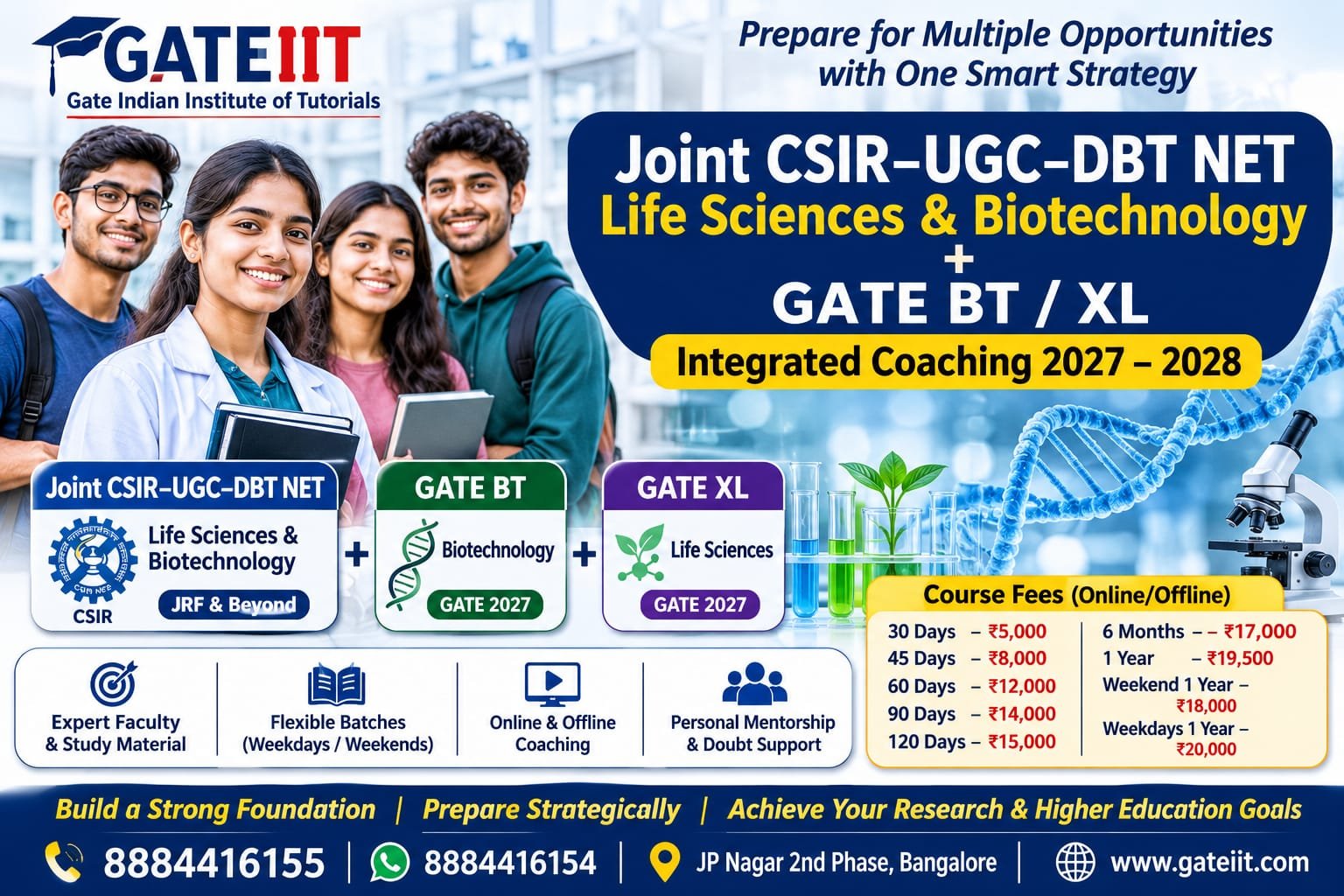
Joint CSIR–UGC–DBT NET Life Sciences & Biotechnology + GATE BT/XL Integrated Coaching 2027–2028
Online Coaching Across India | Classroom Coaching in Bangalore | Hybrid Classes | Personal Mentorship | Subject-Wise Preparation
GATEIIT – Gate Indian Institute of Tutorials
Prepare for the Joint CSIR–UGC–DBT NET Life Sciences & Biotechnology examination and GATE Biotechnology (BT) / GATE Life Sciences (XL) with an integrated, subject-oriented preparation programme designed for postgraduate students, final-year graduates, research aspirants and biotechnology professionals.
If you are preparing for CSIR NET JRF, the newly combined Life Sciences and Biotechnology examination, GATE Biotechnology or GATE Life Sciences, you may not need to study every overlapping concept separately for each examination. A well-planned integrated preparation strategy can help you strengthen common fundamentals, understand the differences between examination syllabi and devote additional time to topics that require separate preparation.
GATEIIT offers integrated coaching options for students who want to prepare for these competitive examinations through structured teaching, topic-wise practice, previous-year questions, mock tests, revision and personalised academic guidance.
Whether you are a Life Sciences student, Biotechnology graduate, Biochemistry postgraduate, Microbiology student, Zoology or Botany graduate, or an aspirant planning to pursue higher studies and research, you can explore a preparation programme suited to your academic background and target examinations.
Admissions and enquiries open for 2027–2028 preparation programmes.
Contact GATEIIT:
Call: 8884416155
WhatsApp: 8884416154
Website: https://www.gateiit.com/
1. What Is the Joint CSIR–UGC–DBT NET + GATE Integrated Coaching Programme?
The Joint CSIR–UGC–DBT NET + GATE Integrated Coaching Programme is designed for students who wish to prepare for more than one national-level examination in the Life Sciences and Biotechnology domain.
The programme brings together preparation for:
- Joint CSIR–UGC–DBT NET Life Sciences & Biotechnology – JRF and other applicable eligibility categories.
- GATE Biotechnology – BT.
- GATE Life Sciences – XL.
The three examination pathways have overlapping academic foundations, but their examination requirements are not identical.
For example, a student preparing for the Joint CSIR–UGC–DBT NET may study molecular biology, genetics, cell biology, biochemistry, biotechnology, physiology, ecology and methods in biology. These subjects also have relevance to GATE BT and selected sections of GATE XL.
However, GATE BT includes engineering-oriented and biotechnology-specific topics, while GATE XL has a different paper structure and requires candidates to select appropriate optional subject sections.
Our integrated preparation approach is intended to help students understand these common areas while separately preparing for the topics, question formats and examination requirements of their chosen papers.
The objective is not simply to combine three examinations into one course. It is to help students prepare intelligently for their selected examination combination without unnecessary repetition.
2. Important Update: CSIR NET Life Sciences and DBT-BET Merger
One of the most significant developments for biological science aspirants is the introduction of the Joint CSIR–UGC–DBT JRF-NET examination.
The earlier CSIR NET Life Sciences and DBT-BET examinations are being brought together under a unified Life Sciences and Biotechnology discipline, effective from the December 2026 examination cycle.
The combined discipline is referred to as Life Sciences and Biotechnology (LS & BT).
This development is particularly important for students who previously prepared separately for CSIR NET Life Sciences and DBT-BET.
The revised syllabus contains 14 units covering fundamental life sciences, modern biotechnology, computational biology, industrial biotechnology and research methodologies.
Students preparing for 2027 and 2028 should use the revised official syllabus rather than relying exclusively on older CSIR NET Life Sciences or DBT-BET study plans.
What does the merger mean for students?
- Life Sciences and Biotechnology candidates will prepare under the unified examination framework.
- The revised syllabus brings together important topics from both disciplines.
- Biotechnology graduates can explore the new examination pathway under the applicable eligibility and examination rules.
- Students must become familiar with the revised syllabus and the latest examination information bulletin.
- Previous-year CSIR NET and DBT-BET questions can still be useful for conceptual practice, but they should be used with an understanding of the changes in syllabus and examination structure.
The merger does not mean that GATE BT and GATE XL have also merged with CSIR NET. They remain separate GATE papers with their own syllabi and examination requirements.
At GATEIIT, the integrated programme is structured around these distinctions.
3. Which Examinations Can You Prepare for Together?
Students can choose the examination combination that matches their academic background and future plans.
A. Joint CSIR–UGC–DBT NET Life Sciences & Biotechnology
This is the unified national examination pathway for candidates interested in research fellowships, applicable Assistant Professor eligibility categories and PhD admission opportunities, subject to the prevailing official rules.
Preparation includes:
- Structure and function of biomolecules.
- Cellular organisation.
- Fundamental biological processes.
- Cell communication and signalling.
- Developmental biology.
- Plant physiology.
- Animal physiology.
- Inheritance biology.
- Evolution and diversity.
- Ecology and behavioural biology.
- Bioinformatics and computational biology.
- Biochemical engineering and industrial biotechnology.
- Advances in biotechnology.
- Methods in biology.
B. GATE Biotechnology (BT)
GATE BT is a separate GATE paper for candidates interested in biotechnology and related postgraduate, research and professional opportunities.
The preparation programme may cover:
- Engineering Mathematics and relevant mathematical foundations.
- General Aptitude.
- Engineering principles relevant to biotechnology.
- Molecular Biology.
- Cell Biology.
- Recombinant DNA technology.
- Plant and animal biotechnology.
- Bioprocess engineering.
- Process calculations and related engineering concepts.
- Relevant biotechnology applications.
The exact topic coverage should follow the official GATE syllabus for the examination year.
C. GATE Life Sciences (XL)
GATE XL is a separate paper with its own structure.
The paper includes General Aptitude, a compulsory Chemistry section and selected optional subject sections.
The optional sections in the GATE 2027 XL structure include:
- Food Technology.
Candidates should carefully select the optional sections permitted under the relevant examination-year rules.
Students who are preparing for GATE XL should not assume that the complete Joint CSIR–UGC–DBT NET syllabus automatically covers every GATE XL requirement.
GATEIIT can help students identify the appropriate preparation pathway according to their chosen sections.
4. The Major Advantage of Integrated CSIR NET + GATE Preparation
Preparing for multiple examinations can become difficult when students follow separate study schedules without identifying common topics.
An integrated approach can help reduce unnecessary duplication and improve preparation efficiency.
Common academic foundations
Several important areas overlap across the examinations:
Subject area | Joint CSIR–UGC–DBT NET | GATE BT | GATE XL |
Biochemistry | Important | Important | Biochemistry section |
Molecular Biology | Important | Important | Relevant biological concepts |
Cell Biology | Important | Important | Relevant biological concepts |
Genetics | Important | Important | Relevant biological concepts |
Microbiology | Important | Important | Microbiology section |
Biotechnology | Important | Important | Relevant concepts |
Plant Biology | Important | Relevant topics | Botany section |
Animal Biology | Important | Relevant topics | Zoology section |
Mathematics and numerical skills | Relevant | Important | Relevant where applicable |
General Aptitude | Examination-specific requirements | GATE GA | GATE GA |
This is a broad academic comparison, not a claim that the syllabi or examination patterns are identical.
How integrated preparation helps
- Less unnecessary repetition
Students can build a common conceptual foundation in subjects such as biochemistry, molecular biology, genetics and cell biology.
- Better use of preparation time
Once the fundamentals are clear, students can devote additional study time to examination-specific topics.
- Stronger conceptual understanding
Preparing for different question styles can encourage deeper understanding and more flexible application of scientific concepts.
- More practice opportunities
Relevant previous-year questions from different examinations can help students develop conceptual clarity and problem-solving skills.
- A wider range of academic opportunities
Students can prepare for different higher-education and research pathways, depending on their eligibility, examination performance and institutional admission criteria.
5. Complete Joint CSIR–UGC–DBT NET Life Sciences & Biotechnology Syllabus
The revised combined LS & BT syllabus contains 14 units.
GATEIIT’s integrated preparation programme gives importance to the following areas.
Unit 1: Structure and Function of Biomolecules
- Chemical bonds and molecular interactions.
- Structure and properties of carbohydrates.
- Amino acids and proteins.
- Protein structure and folding.
- Enzymes and enzyme kinetics.
- Lipids and biological membranes.
- Nucleic acids.
- Vitamins and cofactors.
- Metabolic regulation and biomolecular functions.
Unit 2: Cellular Organisation
- Prokaryotic and eukaryotic cells.
- Cell membrane structure and function.
- Cell organelles.
- Cell division.
- Cell cycle regulation.
- Cell junctions.
- Intracellular transport.
- Cellular organisation and compartmentalisation.
Unit 3: Fundamental Processes
- DNA replication.
- DNA repair.
- RNA processing.
- Regulation of gene expression.
- Protein synthesis and degradation.
- Molecular mechanisms of inheritance.
Unit 4: Cell Communication and Cell Signalling
- Cell surface receptors.
- Signal transduction pathways.
- Second messengers.
- Hormonal signalling.
- Cellular communication.
- Regulation of signalling pathways.
- Cell growth and differentiation.
- Apoptosis and programmed cell death.
Unit 5: Developmental Biology
- Early embryonic development.
- Developmental patterns.
- Organ formation.
- Developmental regulation.
- Model organisms.
- Molecular mechanisms of development.
Unit 6: System Physiology – Plant
- Mineral nutrition.
- Water relations.
- Transport in plants.
- Plant hormones.
- Plant growth and development.
- Stress physiology.
- Plant responses to environmental conditions.
Unit 7: System Physiology – Animal
- Nervous system.
- Circulatory system.
- Respiratory system.
- Digestive system.
- Excretory system.
- Endocrine regulation.
- Reproductive physiology.
- Muscle physiology.
- Animal homeostasis.
Unit 8: Inheritance Biology
- Mendelian genetics.
- Extensions of Mendelian inheritance.
- Linkage and recombination.
- Chromosomal inheritance.
- Population genetics.
- Quantitative genetics.
- Molecular genetics.
- Genetic mapping.
- Genetic variation and inheritance.
Unit 9: Evolution and Diversity of Life Forms
- Origin and evolution of life.
- Evolutionary mechanisms.
- Natural selection.
- Classification and diversity.
- Evolutionary relationships.
- Biological diversity.
Unit 10: Ecology and Behavioural Biology
- Population ecology.
- Community ecology.
- Energy flow.
- Nutrient cycles.
- Conservation biology.
- Environmental interactions.
- Animal behaviour.
Unit 11: Bioinformatics and Computational Biology
- Biological databases.
- Sequence alignment.
- Computational tools.
- Phylogenetic analysis.
- Molecular data interpretation.
- Computational approaches to biological research.
Unit 12: Biochemical Engineering and Industrial Biotechnology
- Bioreactor fundamentals.
- Fermentation technology.
- Microbial growth kinetics.
- Bioprocess development.
- Downstream processing.
- Industrial enzymes.
- Production of biological products.
- Biochemical engineering principles.
- Industrial applications of biotechnology.
Unit 13: Advances in Biotechnology
- Genetic engineering.
- Recombinant DNA technology.
- Genome editing.
- Modern molecular techniques.
- Agricultural biotechnology.
- Medical biotechnology.
- Industrial biotechnology.
- Emerging applications of biotechnology.
- Contemporary developments in biological research.
Unit 14: Methods in Biology
- Molecular biology techniques.
- Immunological techniques.
- DNA and protein analysis.
- Genomics and transcriptomics methods.
- Proteomics and metabolomics.
- Experimental design and biological data analysis.
Important: Students should download and follow the latest official syllabus for their examination cycle. The above is a preparation-oriented overview, not a substitute for the complete official syllabus document.
6. GATE Biotechnology (BT) Preparation: Important Subject Areas
GATE BT requires a combination of biological science fundamentals, biotechnology concepts, mathematical skills and engineering-oriented problem-solving.
The integrated programme can include dedicated preparation for:
Biochemistry
- Protein structure.
- Enzyme kinetics.
- Carbohydrate metabolism.
- Lipid metabolism.
- Amino acid metabolism.
Microbiology
- Microbial growth.
- Microbial physiology.
- Bacterial genetics.
- Microbial metabolism.
- Microbial classification.
- Microbial biotechnology.
- Industrial microbiology.
Molecular Biology and Genetics
- DNA replication.
- Transcription and translation.
- Gene regulation.
- Mutation and repair.
- Recombinant DNA technology.
- Genetic engineering.
- Molecular genetics.
Cell Biology
- Cell structure.
- Membrane transport.
- Cell signalling.
- Cell cycle.
- Cellular organelles.
- Cellular metabolism.
Biotechnology
- Genetic engineering.
- Plant biotechnology.
- Animal biotechnology.
- Industrial biotechnology.
- Bioprocess development.
- Applications of biotechnology.
Bioprocess Engineering
- Material balances.
- Energy balances.
- Microbial growth kinetics.
- Enzyme kinetics.
- Mass transfer.
- Downstream processing.
- Process control.
Engineering Mathematics and Numerical Skills
Students should also prepare the relevant mathematical and quantitative areas prescribed in the official GATE BT syllabus.
7. GATE Life Sciences (XL): Optional Sections and Preparation
GATE XL is particularly relevant for students from Life Sciences, Biotechnology, Biochemistry, Microbiology, Botany, Zoology and related academic backgrounds.
The paper structure includes compulsory and optional components. Students must select their optional sections carefully.
Chemistry – Compulsory Section
Preparation may cover:
- Atomic structure.
- Chemical bonding.
- Chemical equilibrium.
- Chemical kinetics.
- Organic chemistry fundamentals.
- Inorganic chemistry fundamentals.
- Relevant analytical and physical chemistry concepts.
Biochemistry
- Protein structure.
- Molecular biology.
- Biochemical regulation.
Botany
- Plant diversity.
- Plant anatomy.
- Plant physiology.
- Plant genetics.
- Plant development.
- Plant biotechnology.
- Ecology and evolution.
Microbiology
- Microbial diversity.
- Microbial physiology.
- Microbial genetics.
- Microbial metabolism.
- Immunology-related concepts.
- Industrial microbiology.
- Microbial applications.
Zoology
- Animal diversity.
- Animal physiology.
- Developmental biology.
- Animal ecology.
- Relevant molecular biology.
Food Technology
- Food chemistry.
- Food microbiology.
- Food processing.
- Food preservation.
- Food quality and safety.
- Relevant engineering and technology concepts.
The final subject combination and syllabus must be checked against the official GATE examination-year document.
8. Who Should Join CSIR NET + GATE Integrated Coaching?
This integrated programme may be suitable for:
Life Sciences graduates and postgraduates
Students from BSc, MSc and related Life Sciences programmes who want to prepare for JRF, research and postgraduate opportunities.
Biotechnology students
BSc, MSc, BTech and MTech Biotechnology students who want to prepare for the Joint CSIR–UGC–DBT NET and GATE BT or XL.
Biochemistry students
Students interested in molecular biology, metabolism, biotechnology, research and related competitive examinations.
Microbiology students
Candidates who want to build their preparation around microbial biology, molecular biology, biotechnology and relevant GATE XL sections.
Botany and Zoology students
Graduates and postgraduates interested in Life Sciences, research and the relevant GATE XL optional sections.
Genetics and Molecular Biology students
Students who want to strengthen their fundamentals and prepare for multiple examination pathways.
Final-year undergraduate students
Students who wish to begin competitive examination preparation early, subject to the eligibility requirements of their target examination.
MSc students and research aspirants
Students preparing for JRF, PhD admission and other research-related opportunities.
Working professionals
Candidates who need flexible online or customised preparation arrangements alongside their professional commitments.
9. Online CSIR NET + GATE Integrated Coaching Across India
GATEIIT provides online coaching options for students who cannot attend regular classroom sessions in Bangalore.
Online learning can be suitable for candidates from:
- Delhi NCR.
- Other cities and towns across India.
Students can enquire about live online teaching, academic resources, assignments, tests, revision and individual guidance depending on the selected programme.
Benefits of online integrated coaching
- Learn from your home or college.
- Avoid daily travel.
- Access classes from different parts of India.
- Follow a structured preparation timetable.
- Discuss doubts through available academic support channels.
- Prepare alongside college or other commitments.
- Choose a course duration suitable for your examination target.
The precise class schedule, recording access, test facilities and support arrangements will be explained before admission.
10. Offline CSIR NET + GATE Coaching in Bangalore
Students who prefer classroom learning can enquire about offline coaching at GATEIIT’s JP Nagar centre in Bangalore.
GATEIIT – Gate Indian Institute of Tutorials
3rd Floor, #1743, Sri Raghavendra Plaza,
17th Main Road, JP Nagar 2nd Phase,
Bangalore – 560078, Karnataka.
Offline coaching can be suitable for students who prefer:
- Direct faculty interaction.
- Classroom-based concept learning.
- Scheduled study sessions.
- Face-to-face doubt clarification.
- Regular academic monitoring.
- Structured revision and test practice.
Students from JP Nagar, Jayanagar, BTM Layout, Banashankari, Arekere, Bannerghatta Road, Basavanagudi, Kumaraswamy Layout and other parts of Bangalore can contact the institute for batch availability.
11. Hybrid Coaching, Small-Group Classes and Personal Mentorship
Students do not all learn in the same way. Some prefer classroom teaching, while others need flexible online sessions or individual academic attention.
GATEIIT offers different learning arrangements that students can enquire about.
Online Live Coaching
For students who want to attend classes remotely.
Offline Classroom Coaching
For students who prefer face-to-face teaching in Bangalore.
Hybrid Coaching
A combination of online and classroom learning, subject to batch availability.
Small-Group Coaching
Interactive preparation in a smaller learning group, with opportunities for discussion and doubt clarification.
One-to-One Personal Coaching
Customised academic support for students who need individual attention, focused subject preparation or a personalised timetable.
Personal Mentorship
Academic guidance to help students plan their preparation, monitor progress, identify weak areas and improve their examination readiness.
The exact facilities and frequency of sessions depend on the programme selected.
12. CSIR NET + GATE Integrated Coaching: Course Durations and Fees
GATEIIT offers multiple preparation durations to accommodate students with different academic backgrounds and examination timelines.
Whether you are starting from the fundamentals or preparing for an examination after completing most of the syllabus, you can enquire about a suitable programme.
Available Course Durations
- 30-day intensive course.
- 45-day focused preparation.
- 60-day short-term programme.
- 90-day structured preparation.
- 120-day comprehensive preparation.
- 6-month regular preparation.
- 1-year regular preparation.
- Weekend preparation programme.
- Customised personal mentorship programme.
Integrated Coaching Fee Structure
Course Duration | Course Fee |
30 Days | ₹5,000 |
45 Days | ₹8,000 |
60 Days | ₹12,000 |
90 Days | ₹14,000 |
120 Days | ₹15,000 |
6 Months | ₹27,000 |
1 Year – Weekend Programme | ₹28,000 |
1 Year – Regular Weekday Programme | ₹29,500 |
Fee clarification: The above is the published programme fee structure for the integrated coaching options. Students should confirm the current batch schedule, teaching mode, subject coverage, available facilities and applicable fee before registration. Personalised one-to-one or specially customised arrangements may have a separate quotation.
Which Course Duration Should You Choose?
30-Day Course – ₹5,000
Suitable for candidates who have already completed most of the syllabus and need focused revision, important-topic practice and examination-oriented preparation.
45-Day Course – ₹8,000
Suitable for students who need structured revision with additional question-solving practice.
60-Day Course – ₹12,000
Suitable for candidates with a reasonable conceptual foundation who need systematic revision, topic-wise practice and tests.
90-Day Course – ₹14,000
Suitable for students who have completed some portions of the syllabus but need more comprehensive preparation and revision.
120-Day Course – ₹15,000
Suitable for candidates who require an extended preparation period for concept revision, subject-wise practice and examination readiness.
6-Month Programme – ₹27,000
Suitable for students who want a longer preparation schedule, regular teaching and sufficient time for revision and mock tests.
1-Year Weekend Programme – ₹28,000
Suitable for college students and working professionals who need a weekend-oriented study schedule.
1-Year Regular Weekday Programme – ₹29,500
Suitable for students who prefer a more structured and regular preparation timetable.
Students starting from the basics should generally consider a longer preparation programme rather than choosing a crash course solely because it is shorter.
13. What Is Included in the Integrated Coaching Programme?
Depending on the selected course and batch, students can enquire about the following academic facilities:
- Subject-wise teaching.
- Concept-based explanations.
- Complete or selected syllabus coverage according to course duration.
- Separate guidance for CSIR NET, GATE BT and GATE XL requirements.
- Topic-wise assignments.
- Daily Practice Problems (DPPs), where included.
- Previous-year question discussions.
- Numerical and analytical problem-solving.
- Practice tests.
- Sectional and full-length mock examinations.
- Revision classes.
- Doubt-solving support.
- Personal academic guidance.
- Performance review and preparation planning.
The specific number of lectures, tests, study materials and recorded sessions depends on the programme and batch. Students should confirm these details with the academic counsellor before enrolling.
14. Previous-Year Questions, Mock Tests and Practice Strategy
Preparing for competitive examinations requires more than reading textbooks and attending lectures.
Students must learn how to apply concepts, interpret questions, manage examination time and avoid unnecessary mistakes.
Our preparation approach places importance on regular practice.
Previous-Year Question Papers
Students should solve relevant previous-year questions from:
- CSIR NET Life Sciences.
- DBT-BET, for useful historical conceptual practice.
- GATE Biotechnology.
- GATE Life Sciences.
Older papers should be used with care because the revised Joint CSIR–UGC–DBT syllabus and examination framework differ from the earlier separate examinations.
Topic-Wise Practice
Practice should be conducted after completing each topic. This helps students identify conceptual gaps before moving to more advanced chapters.
Sectional Tests
Sectional tests help evaluate preparation in individual subject areas such as biochemistry, molecular biology, genetics, microbiology and biotechnology.
Full-Length Mock Tests
Mock examinations help students practise time management, question selection and examination strategy.
Performance Analysis
Students should review their performance to identify:
- Weak subject areas.
- Frequently misunderstood concepts.
- Incorrect answer patterns.
- Time-management difficulties.
- Topics requiring additional revision.
A consistent practice and revision cycle is essential for effective preparation.
15. How to Prepare for CSIR NET + GATE Together: Suggested Study Plan
A good integrated study plan should combine common subjects with examination-specific preparation.
Phase 1: Build the Fundamentals
Start with:
- Cell Biology.
- Molecular Biology.
- Basic biotechnology.
These subjects provide an important foundation for the biological science examinations.
Phase 2: Cover the Broader Life Sciences Syllabus
Proceed with:
- Plant Physiology.
- Animal Physiology.
- Developmental Biology.
- Diversity of Life Forms.
- Cell Signalling.
Phase 3: Strengthen Biotechnology and Engineering Concepts
For students targeting GATE BT, devote additional time to:
- Bioprocess Engineering.
- Bioreactor Design and Principles.
- Process Calculations.
- Engineering Mathematics.
- Relevant transport and engineering concepts.
- Biotechnology applications.
Phase 4: Prepare GATE XL Optional Sections
Select the appropriate optional sections according to your background and target paper.
Prepare the compulsory Chemistry section as well as the chosen optional subjects.
Phase 5: Examination-Specific Practice
Solve separate question sets for the Joint CSIR–UGC–DBT NET, GATE BT and GATE XL.
Do not assume that success in one examination automatically guarantees performance in another.
Phase 6: Revision and Mock Tests
Use the final preparation period for:
- Repeated revision.
- Previous-year questions.
- Full-length mock tests.
- Weak-topic improvement.
- Formula and concept review.
- Examination strategy.
The actual timetable should be customised according to the candidate’s preparation level and the official examination calendar.
16. Career Opportunities After Joint CSIR–UGC–DBT NET and GATE
These examinations can support different academic and professional pathways. The opportunities available depend on the candidate’s eligibility, score, institutional requirements and selection process.
Opportunities Through Joint CSIR–UGC–DBT NET
Depending on the applicable result category and prevailing rules, qualifying candidates may become eligible for:
- Junior Research Fellowship.
- Assistant Professor eligibility.
- PhD admission.
- Research opportunities in universities and research institutions.
- Biological science and biotechnology research programmes.
Opportunities Through GATE Biotechnology
A valid GATE score may be considered by participating institutions for:
- MTech and related postgraduate programmes.
- MS by Research programmes.
- PhD admissions.
- Research-oriented postgraduate programmes.
- Certain recruitment opportunities where GATE scores are accepted.
Opportunities Through GATE Life Sciences
GATE XL may support admission to relevant postgraduate and research programmes at institutions that accept the paper and meet their individual eligibility requirements.
Important: Qualification in an examination does not automatically guarantee admission, fellowship, employment or a particular research position. Students must check the relevant institution’s admission criteria, accepted paper codes, eligibility conditions and current recruitment rules.
17. Why Choose GATEIIT for Integrated CSIR NET + GATE Preparation?
GATEIIT – Gate Indian Institute of Tutorials – provides competitive examination coaching through different learning formats.
Students can explore preparation options according to their subject background, examination goals and available study time.
What students can discuss with GATEIIT
- Joint CSIR–UGC–DBT NET preparation.
- GATE Biotechnology preparation.
- GATE Life Sciences preparation.
- Integrated examination planning.
- Online coaching across India.
- Classroom coaching in Bangalore.
- Hybrid learning options.
- Small-group classes.
- Personal mentorship.
- One-to-one customised preparation.
- Short-term and long-term programmes.
- Revision and mock-test preparation.
Personal Attention and Academic Guidance
Students often have different levels of understanding in biochemistry, molecular biology, genetics, biotechnology and other subjects.
A suitable preparation plan should take these differences into account.
GATEIIT encourages students to discuss their academic background, previous preparation, examination targets and available study time before selecting a course.
Flexible Learning Options
Students can enquire about regular weekday batches, weekend programmes, online classes, offline classes and customised preparation.
The objective is to help students follow a realistic preparation schedule while balancing college, work and other responsibilities.
18. Frequently Asked Questions – Joint CSIR–UGC–DBT NET + GATE Integrated Coaching
Q1. What is Joint CSIR–UGC–DBT NET Life Sciences and Biotechnology?
It is the unified examination pathway combining the earlier CSIR NET Life Sciences and DBT-BET examination framework under the Life Sciences and Biotechnology discipline, effective from the December 2026 cycle.
Q2. Is DBT-BET merged with CSIR NET Life Sciences?
Yes. The merger is being implemented from the December 2026 examination cycle. Students should refer to the revised official LS & BT syllabus and current NTA notifications.
Q3. What is the new CSIR NET Life Sciences and Biotechnology syllabus?
The revised combined syllabus contains 14 units, covering biomolecules, cellular organisation, fundamental processes, cell signalling, developmental biology, plant and animal physiology, inheritance, evolution, ecology, computational biology, industrial biotechnology, advances in biotechnology and methods in biology.
Q4. Can I prepare for Joint CSIR NET and GATE Biotechnology together?
Yes. Several subjects overlap, including biochemistry, molecular biology, genetics, cell biology and biotechnology. However, GATE BT also requires separate preparation for its engineering-oriented and examination-specific topics.
Q5. Can I prepare for CSIR NET and GATE XL together?
Yes. Students can build a common foundation in relevant biological science subjects and then prepare separately for the GATE XL Chemistry section and their selected optional sections.
Q6. What is the difference between GATE BT and GATE XL?
GATE BT is the Biotechnology paper. GATE XL is the Life Sciences paper, which has a compulsory Chemistry section and optional subject sections. Their syllabi and paper structures are different.
Q7. Can I appear for both GATE BT and GATE XL?
Candidates may be permitted to select up to two GATE papers where the examination-year two-paper combination rules allow it. Check the official GATE brochure and permitted combinations for the year in which you apply.
Q8. Is GATE XL suitable for Biotechnology students?
It may be suitable for some Biotechnology students, depending on their subject strengths and the optional sections they intend to select. Candidates should examine the official syllabus before choosing the paper.
Q9. Which GATE XL optional subjects are available?
The GATE XL structure includes Biochemistry, Botany, Microbiology, Zoology and Food Technology as optional subject sections, alongside compulsory Chemistry. Refer to the official examination-year syllabus for the final structure.
Q10. Can BSc students prepare for CSIR NET and GATE?
Yes, students can begin building their conceptual foundation during their undergraduate studies. However, eligibility to apply for a particular examination, fellowship or admission category depends on the official educational qualification requirements.
Q11. Can MSc Biotechnology students join this integrated course?
Yes. MSc Biotechnology students can explore integrated preparation for the Joint CSIR–UGC–DBT NET, GATE BT and GATE XL, depending on their target examinations.
Q12. Is the course suitable for MSc Life Sciences students?
Yes. Life Sciences students can prepare for the unified LS & BT examination and explore GATE XL or other relevant examination pathways.
Q13. Can Biochemistry students join?
Yes. Biochemistry is an important subject area across the relevant examination pathways. Students can select the appropriate course combination according to their goals.
Q14. Can Microbiology students prepare for CSIR NET and GATE?
Yes. Microbiology students can prepare for the Joint CSIR–UGC–DBT NET and relevant GATE XL sections, as well as GATE BT where appropriate.
Q15. Does the integrated programme cover the complete syllabus of all three examinations?
The programme is designed to address common subject areas and examination-specific topics. The actual syllabus coverage depends on the selected course duration and examination combination. Students should confirm the detailed batch plan before admission.
Q16. Does GATEIIT provide online CSIR NET and GATE coaching?
Students can enquire about online coaching options for candidates across India.
Q17. Is offline coaching available in Bangalore?
Students can enquire about classroom coaching at the GATEIIT centre in JP Nagar 2nd Phase, Bangalore.
Q18. Does GATEIIT offer hybrid classes?
Students can enquire about hybrid learning arrangements combining online and classroom facilities, subject to batch availability.
Q19. Are one-to-one classes available?
Students can enquire about individualised coaching and one-to-one academic support based on faculty availability and the selected programme.
Q20. Are weekend classes available?
Yes. GATEIIT offers a one-year weekend programme option. Students should confirm the current timetable and batch availability.
Q21. What is the fee for the 30-day integrated coaching course?
The listed fee for the 30-day programme is ₹5,000.
Q22. What is the fee for the 45-day course?
The listed fee for the 45-day programme is ₹8,000.
Q23. What is the fee for the 60-day integrated course?
The listed fee for the 60-day programme is ₹12,000.
Q24. What is the fee for the 90-day course?
The listed fee for the 90-day programme is ₹14,000.
Q25. What is the fee for the 120-day programme?
The listed fee for the 120-day programme is ₹15,000.
Q26. What is the fee for six months of integrated coaching?
The listed six-month programme fee is ₹27,000.
Q27. What is the fee for one-year integrated coaching?
The one-year weekend programme is ₹28,000, while the regular weekday programme is ₹9,500.
Q28. Does the course include previous-year question papers?
Students can enquire about previous-year question discussions and practice resources for their selected examination combination.
Q29. Are mock tests included?
Test facilities depend on the selected programme. Students should confirm the available topic-wise, sectional and full-length tests before enrolling.
Q30. Can I join only for GATE BT or only for GATE XL?
Students can discuss individual examination preparation and subject-specific requirements with the academic counsellor.
Q31. Can I join only for the Joint CSIR–UGC–DBT NET?
Yes. Students can enquire about the dedicated Joint CSIR–UGC–DBT NET Life Sciences and Biotechnology preparation programme.
Q32. Is the course suitable for students preparing for 2028?
Yes. Students targeting 2028 can explore longer preparation programmes that allow sufficient time for concept building, syllabus coverage, practice and revision.
Q33. Can working professionals join online classes?
Students can enquire about online and weekend learning arrangements suited to their professional schedules.
Q34. Does qualifying CSIR NET guarantee a JRF?
No. Fellowship eligibility depends on the applicable examination result category, merit and official fellowship rules. Students should refer to the current notification.
Q35. Does GATE qualification guarantee admission to IIT or IISc?
No. Admission depends on the institution’s eligibility requirements, accepted paper codes, score, shortlisting and selection process.
Q36. How can I select the right integrated course?
Your academic background, examination target, existing subject knowledge and available preparation time should determine the course. GATEIIT’s academic counsellor can help you discuss the available options.
19. Start Your Joint CSIR–UGC–DBT NET + GATE Preparation for 2027–2028
The new combined Life Sciences and Biotechnology examination creates an important opportunity for students from both traditional Life Sciences and Biotechnology backgrounds.
At the same time, GATE BT and GATE XL provide separate examination pathways for candidates interested in higher studies, research and related academic opportunities.
Preparing for these examinations requires a clear understanding of the syllabus, consistent practice and a realistic study plan.
At GATEIIT, students can explore integrated preparation options designed to strengthen their concepts, address common subject areas and prepare separately for the requirements of their target examinations.
Whether you are preparing for the Joint CSIR–UGC–DBT NET, GATE Biotechnology, GATE Life Sciences or a combination of these examinations, the first step is to choose a course that matches your academic background and preparation needs.
Start early. Build strong fundamentals. Practise consistently. Prepare strategically.
Enquire About Admissions
GATEIIT – Gate Indian Institute of Tutorials
Joint CSIR–UGC–DBT NET + GATE BT/XL Integrated Coaching 2027–2028
Available learning options:
- Online Coaching Across India.
- Offline Classroom Coaching in Bangalore.
- Hybrid Learning.
- Regular Weekday Batches.
- Weekend Programmes.
- Small-Group Classes.
- One-to-One Personal Coaching.
- Personal Mentorship.
- 30, 45, 60, 90 and 120-Day Courses.
- 6-Month and 1-Year Programmes.
Address:
3rd Floor, #1743, Sri Raghavendra Plaza,
17th Main Road, JP Nagar 2nd Phase,
Bangalore – 560078, Karnataka.
Call: 8884416155
WhatsApp: 8884416154
Website: https://www.gateiit.com/
Contact GATEIIT to discuss your academic background, target examinations, available batches, course duration and admission details.
Our Toppers
