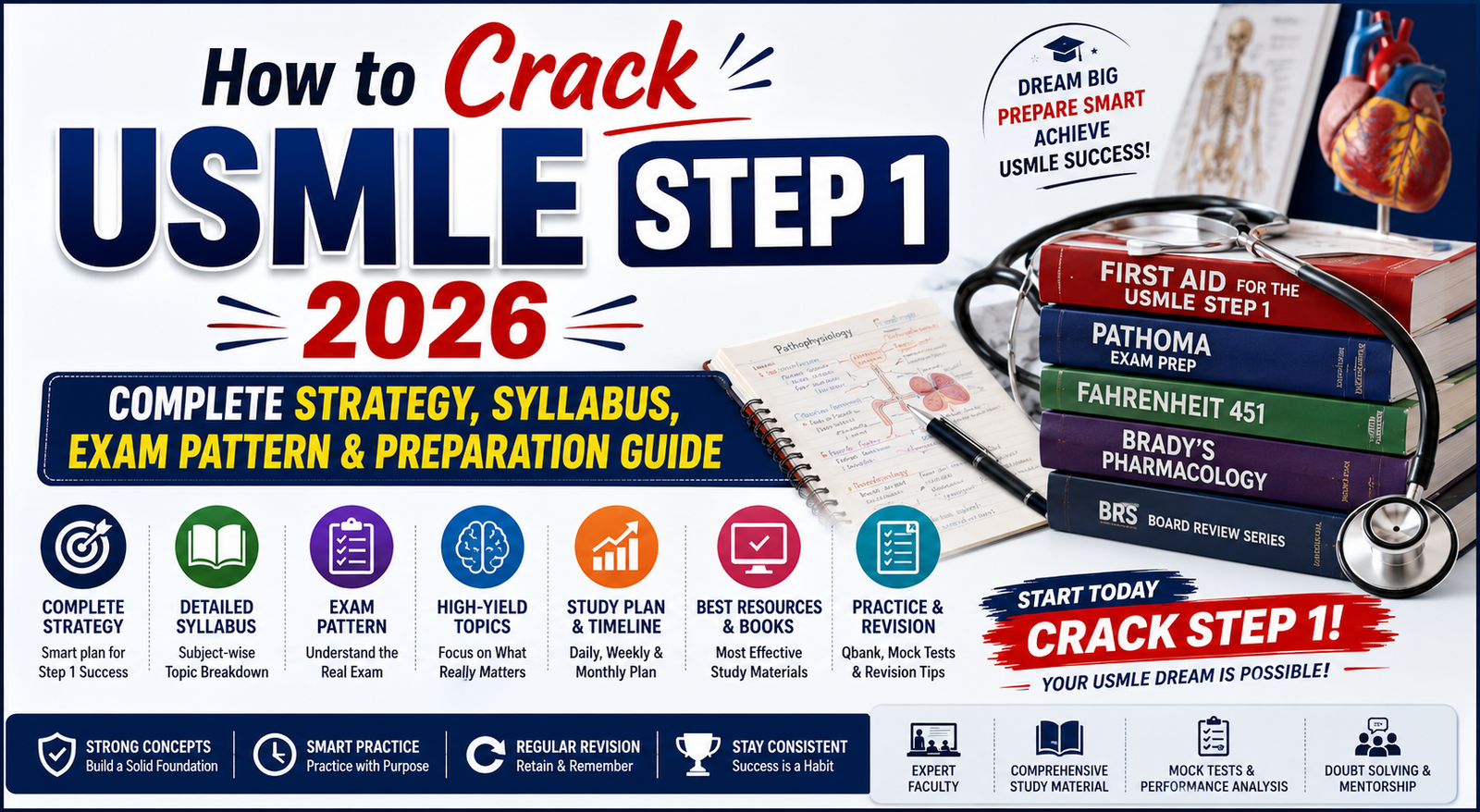
The USMLE Step 1 is an important examination for medical students planning to pursue medical training and licensure in the United States. The exam focuses primarily on understanding and applying basic science concepts to medical practice, rather than simply memorizing facts.
For students preparing for USMLE Step 1 2026, a structured study plan, strong conceptual foundation, regular question practice, and consistent revision are essential.
What is USMLE Step 1?
USMLE Step 1 evaluates whether a candidate can understand and apply important basic science concepts, including the principles and mechanisms underlying health, disease, and therapy. Questions are integrated across organ systems and frequently require application of basic science to clinical scenarios.
Step 1 is currently reported as Pass/Fail, rather than a three-digit score, for examinations taken from January 26, 2022 onward.
USMLE Step 1 2026 Exam Pattern
For exams taken on or after May 14, 2026, the exam is conducted in one day over approximately eight hours and uses 14 blocks of 30 minutes each, with no more than 20 questions per block. It can contain up to 280 questions overall. The updated format provides a minimum of 55 minutes of break time.
Feature
Step 1 2026
Exam type
Computer-based MCQ examination
Result
Pass/Fail
Duration
Approximately 8 hours
Blocks
14 blocks
Block duration
30 minutes
Maximum questions
Up to 280
Break time
Minimum 55 minutes
USMLE Step 1 Syllabus
The Step 1 content is organized around organ systems and integrated scientific concepts. Important areas include:
Pathology
Physiology
Pharmacology
Microbiology
Immunology
Biochemistry
Anatomy and Embryology
Behavioral Sciences
Biostatistics and Epidemiology
Genetics
Histology and Cell Biology
Organ-system-based medicine
According to the official content specifications, pathology and physiology represent major portions of the discipline-based content, while questions integrate foundational science with organ-system disease processes.
How to Prepare for USMLE Step 1
1. Build Strong Concepts
Start with foundational subjects and understand the mechanisms behind diseases rather than relying only on memorization.
2. Study Systematically
Organize your preparation by organ system. Connect anatomy, physiology, pathology, pharmacology, and microbiology within each system.
3. Practice Questions Regularly
USMLE Step 1 questions are designed to test application and reasoning. Practice interpreting clinical vignettes, identifying the key information, and selecting the single best answer.
4. Review Your Mistakes
Don’t simply count correct answers. Maintain a mistake notebook and identify why you selected the wrong option.
5. Take Practice Tests
Use practice examinations to evaluate your readiness, improve timing, and become comfortable with the test interface. The official USMLE website provides sample questions and an interactive Step 1 testing experience.
Simple USMLE Step 1 Study Plan
Preparation Stage
Main Focus
Phase 1
Basic concepts and foundational sciences
Phase 2
Organ-system integration
Phase 3
Question banks and weak areas
Phase 4
Revision and practice tests
Final Phase
High-yield review and exam simulation
Daily Study Strategy
A simple routine can include:
2–3 hours: Core concepts
2 hours: Organ-system review
1–2 hours: Question practice
1 hour: Review of incorrect questions
30–60 minutes: Revision of high-yield notes
Adjust the schedule according to your academic workload and preparation level.
Common Mistakes to Avoid
Memorizing without understanding mechanisms
Using too many study resources simultaneously
Delaying question practice
Ignoring weak subjects
Not reviewing incorrect questions
Taking practice tests without analyzing performance
Neglecting time management
Final 30 Days Strategy
During the final month, concentrate on revision, question practice, and identifying weak areas rather than continuously adding new resources.
Practice under realistic test conditions and become familiar with the current Step 1 interface. For exams from May 14, 2026 onward, candidates should use the new interactive testing experience to understand the updated 30-minute block format.
Frequently Asked Questions
Is USMLE Step 1 difficult?
Step 1 can be challenging because it tests the application of foundational medical science concepts rather than simple recall. Consistent preparation and question practice are important.
Is Step 1 Pass/Fail?
Yes. Step 1 results are reported as Pass/Fail for examinations taken on or after January 26, 2022.
How many questions are there?
The examination can contain up to 280 questions. For the post-May 14, 2026 format, questions are distributed across 14 blocks of up to 20 questions each.
Are practice questions important?
Yes. Practice questions help students develop clinical reasoning, recognize patterns, manage time, and become familiar with the single-best-answer format.
Conclusion
Cracking USMLE Step 1 2026 requires more than memorizing large amounts of information. The key is to understand basic science concepts, connect them with clinical presentations, practice questions consistently, and revise your weak areas.
Start with a realistic study plan, choose your resources carefully, track your progress, and regularly assess your readiness through practice tests. Most importantly, stay consistent throughout your preparation.
How GATEIIT Helps Students Prepare for USMLE Step 1
GATEIIT provides structured USMLE Step 1 preparation with expert guidance, organized study material, regular practice, doubt-solving support, mock-test preparation, and personalized mentorship.
Students can benefit from a systematic approach that combines conceptual learning with question practice and regular performance review.
For course details:8884416155 / 8884416154