
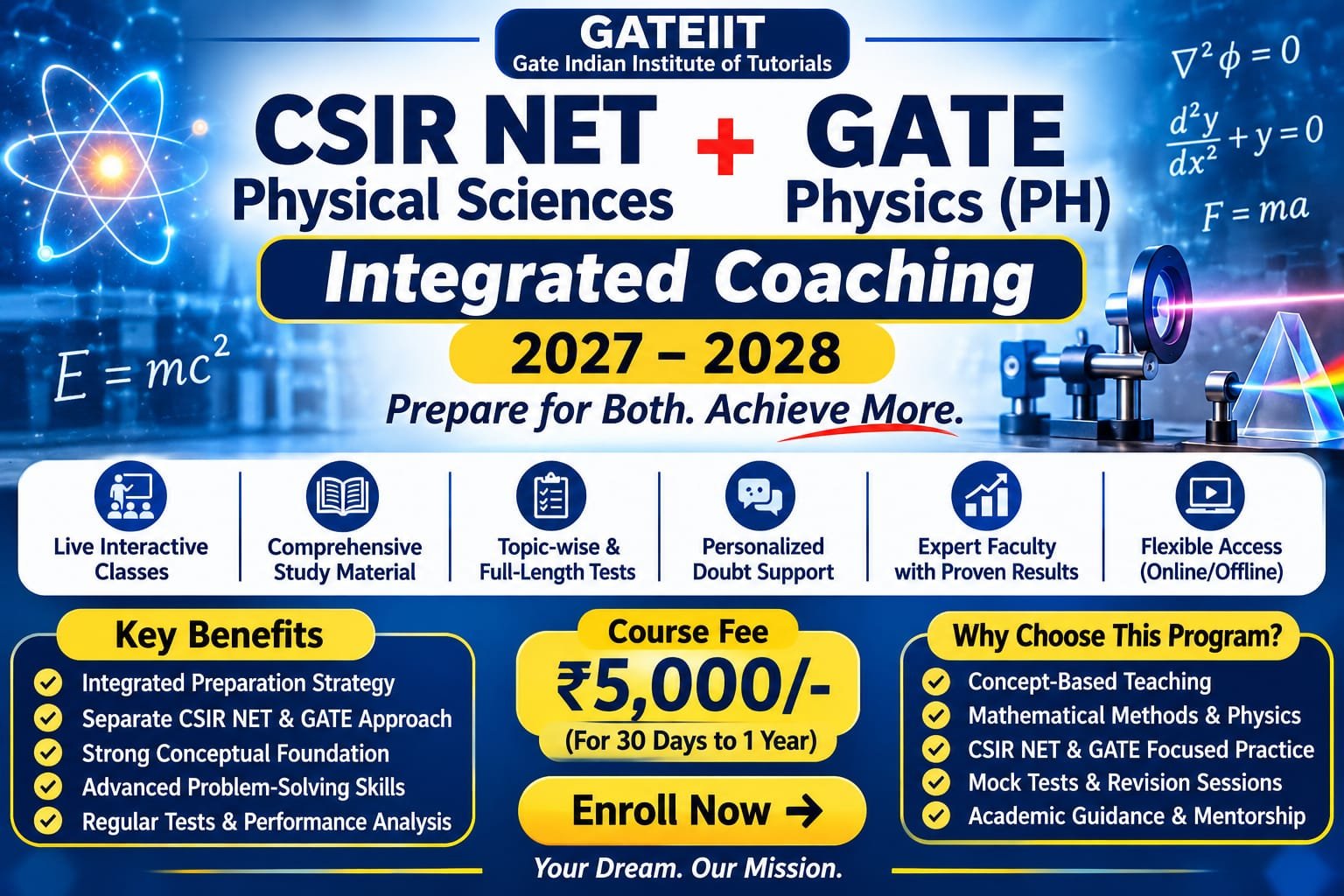
CSIR NET Physical Sciences + GATE Physics (PH) Integrated Coaching 2027–2028
Integrated Coaching for CSIR NET JRF, Assistant Professor Eligibility, PhD Admissions and GATE Physics
GATEIIT – Gate Indian Institute of Tutorials
JP Nagar 2nd Phase, Bangalore
Website: https://gateiit.com
Call: 8884416155 | WhatsApp: 8884416154
Prepare for Two Prestigious National-Level Physics Examinations with One Integrated Learning Programme.
Are you preparing for Joint CSIR–UGC NET Physical Sciences and GATE Physics (PH)? Instead of preparing for both examinations separately, choose an integrated programme that helps you build strong fundamentals, master advanced concepts, improve mathematical problem-solving skills and practise the different question styles of both examinations.
GATEIIT offers CSIR NET Physical Sciences + GATE Physics (PH) Integrated Coaching 2027–2028 for MSc Physics students, postgraduate aspirants, final-year students, graduates and research-oriented candidates who want structured preparation for both examinations.
Our programme combines concept-based teaching, mathematical problem-solving, topic-wise practice, previous-year questions, assignments, mock tests, revision sessions and individual academic guidance.
Course Modes: Online | Offline Classroom | Hybrid
Course Duration: 30 Days to 1 Year
Target Examinations: CSIR NET Physical Sciences and GATE Physics (PH), 2027–2028
1. Why Prepare for CSIR NET Physical Sciences and GATE Physics Together?
CSIR NET Physical Sciences and GATE Physics assess many overlapping areas of undergraduate and postgraduate physics. Both require a strong understanding of fundamental principles, mathematical techniques and the ability to solve numerical and conceptual problems.
However, the examinations have different structures, question styles and preparation requirements. An integrated programme allows students to build a common conceptual foundation while practising separately for the requirements of each examination.
Benefits of integrated preparation
- One structured learning plan covering important overlapping Physics topics.
- Separate CSIR NET and GATE examination-oriented practice.
- Stronger understanding of mathematical methods and their applications.
- Dedicated preparation for CSIR NET Part A, Part B and Part C.
- Dedicated General Aptitude and subject-specific preparation for GATE PH.
- Conceptual learning followed by numerical and analytical problem-solving.
- Previous-year question practice from both examinations.
- Topic-wise tests, full-length mock tests and performance analysis.
- Regular revision to improve retention and examination readiness.
- Reduced duplication of effort while preparing for two competitive examinations.
Our objective: Help students prepare intelligently for two examinations through one coordinated academic programme without treating the two examination patterns as identical.
2. Who Should Join This Integrated Physics Coaching Programme?
This programme is suitable for:
- MSc Physics students preparing for CSIR NET JRF and GATE.
- BSc Physics graduates planning to pursue postgraduate studies.
- Final-year MSc Physics students.
- Students preparing for GATE Physics for admission to IITs and other institutions.
- Aspirants targeting CSIR NET JRF and research fellowships.
- Candidates interested in PhD admissions in Physics and allied research areas.
- Students who have attempted CSIR NET or GATE previously but want better preparation.
- Working candidates and research aspirants who need a structured study schedule.
- Students who want to strengthen their mathematical foundations in Physics.
- Candidates who wish to prepare for both examinations without repeating the same foundational topics in two separate courses.
3. Complete Subject-Wise Syllabus Coverage
The programme is designed around the major areas of Physics required for CSIR NET Physical Sciences and GATE Physics (PH).
The final topic sequence and depth of coverage will be aligned with the official syllabus applicable to the respective examination cycle, including any notified revisions.
Module 1: Mathematical Methods of Physics
Mathematical methods form the foundation of almost every advanced Physics topic. This module receives special attention throughout the programme.
Topics include:
- Vector algebra and vector calculus.
- Differential and integral calculus.
- Linear algebra and matrices.
- Eigenvalues and eigenvectors.
- Cayley-Hamilton theorem.
- Ordinary differential equations.
- Partial differential equations.
- Special functions.
- Legendre polynomials and associated functions.
- Bessel functions.
- Hermite and Laguerre polynomials, wherever prescribed.
- Fourier series.
- Fourier and Laplace transforms.
- Complex analysis.
- Analytic functions.
- Taylor and Laurent series.
- Singularities and residues.
- Contour integration.
- Probability theory and distributions.
- Numerical methods and computational techniques.
- Applications of mathematical methods to physical problems.
Module 2: Classical Mechanics
- Newtonian mechanics.
- Laws of motion.
- Conservation of energy and momentum.
- Central force motion.
- Kepler’s laws and planetary motion.
- Two-body problems.
- Scattering theory.
- Rigid body dynamics.
- Moment of inertia and inertia tensor.
- Non-inertial reference frames.
- Coriolis and centrifugal forces.
- Generalized coordinates.
- Lagrangian mechanics.
- Hamiltonian mechanics.
- Variational principles.
- Canonical transformations.
- Poisson brackets.
- Small oscillations.
- Normal modes.
- Special theory of relativity.
- Relativistic dynamics.
Module 3: Electromagnetic Theory
- Coulomb’s law and Gauss’s law.
- Electric potential.
- Poisson and Laplace equations.
- Boundary-value problems.
- Dielectrics and polarization.
- Biot-Savart law.
- Ampere’s circuital law.
- Magnetic materials.
- Electromagnetic induction.
- Maxwell’s equations.
- Electromagnetic waves.
- Scalar and vector potentials.
- Gauge transformations.
- Boundary conditions.
- Wave propagation in different media.
- Reflection and refraction.
- Interference and diffraction.
- Radiation and electromagnetic energy flow, as prescribed.
Module 4: Quantum Mechanics
- Foundations of quantum mechanics.
- Wave-particle duality.
- Schrödinger equation.
- Time-dependent and time-independent equations.
- Wave functions and probability interpretation.
- Operators and observables.
- Eigenvalues and eigenfunctions.
- Commutators and uncertainty principle.
- One-dimensional potential problems.
- Harmonic oscillator.
- Angular momentum.
- Spin angular momentum.
- Hydrogen atom.
- Central potentials.
- Identical particles.
- Perturbation theory.
- Variational method.
- WKB approximation.
- Scattering theory.
- Approximation methods and applications.
Module 5: Thermodynamics and Statistical Physics
- Laws of thermodynamics.
- Thermodynamic potentials.
- Maxwell relations.
- Entropy and free energy.
- Phase transitions.
- Classical statistical mechanics.
- Microcanonical, canonical and grand canonical ensembles.
- Partition functions.
- Maxwell-Boltzmann statistics.
- Bose-Einstein statistics.
- Fermi-Dirac statistics.
- Quantum gases.
- Blackbody radiation.
- Specific heat.
- Applications of statistical mechanics.
Module 6: Electronics and Experimental Physics
- Semiconductor physics.
- Diodes and transistors.
- Rectifiers and amplifiers.
- Operational amplifiers.
- Feedback circuits.
- Digital electronics.
- Logic gates.
- Boolean algebra.
- Flip-flops and counters.
- A/D and D/A conversion.
- Measurement techniques.
- Error analysis.
- Experimental methods.
- Data interpretation and graphical analysis.
Module 7: Atomic and Molecular Physics
- Atomic structure.
- Hydrogen atom and alkali atoms.
- Fine structure.
- Hyperfine structure.
- Spin-orbit interaction.
- Zeeman effect.
- Stark effect.
- Angular momentum coupling.
- Atomic spectra.
- Molecular energy levels.
- Rotational and vibrational spectra.
- Electronic transitions.
- Molecular spectroscopy.
- Selection rules.
- Laser fundamentals.
Module 8: Condensed Matter Physics
- Crystal structures.
- Crystal symmetry.
- Reciprocal lattice.
- X-ray diffraction.
- Crystal binding.
- Lattice vibrations.
- Specific heat of solids.
- Free electron theory.
- Band theory of solids.
- Electrical and thermal conductivity.
- Dielectric properties.
- Magnetic properties.
- Superfluidity and related concepts where prescribed.
- Modern materials and condensed matter applications.
Module 9: Nuclear and Particle Physics
- Nuclear properties.
- Nuclear models.
- Nuclear forces.
- Radioactive decay.
- Nuclear reactions.
- Nuclear binding energy.
- Fission and fusion.
- Nuclear detectors.
- Particle accelerators.
- Elementary particles.
- Quark model.
- Conservation laws.
- Fundamental interactions.
- Particle classification.
- Standard Model fundamentals.
Module 10: General Aptitude and Examination Skills
For CSIR NET:
- Quantitative aptitude.
- Logical reasoning.
- Numerical ability.
- Graphical analysis.
- Data interpretation.
- Analytical reasoning.
- Research aptitude.
- General science-based questions.
For GATE:
- General Aptitude.
- Verbal ability.
- Numerical ability.
- Quantitative reasoning.
- Logical reasoning.
- Data interpretation.
4. Separate Preparation Strategy for CSIR NET Physical Sciences
CSIR NET requires candidates to demonstrate both conceptual understanding and the ability to apply Physics principles to unfamiliar problems.
Our CSIR NET preparation includes separate practice for all three parts of the examination.
Part A – General Aptitude
- Numerical reasoning.
- Logical reasoning.
- Quantitative comparison.
- Graphical analysis.
- Data interpretation.
- Series and pattern-based questions.
- Analytical and research aptitude.
Part B – Core Physics
- Fundamental concepts from the prescribed Physical Sciences syllabus.
- Standard conceptual and numerical questions.
- Topic-wise practice.
- Formula application.
- Accuracy and speed improvement.
- Previous-year question analysis.
Part C – Advanced Analytical Physics
- Higher-order conceptual problems.
- Multi-step numerical questions.
- Application-based Physics.
- Advanced mathematical problem-solving.
- Conceptual combinations across different Physics topics.
- Analytical reasoning and problem interpretation.
Special focus: Part C preparation through regular advanced problem-solving sessions, because understanding a formula alone is not sufficient to solve unfamiliar analytical questions.
5. Separate Preparation Strategy for GATE Physics (PH)
GATE Physics preparation requires a strong understanding of the subject, mathematical accuracy and the ability to solve questions efficiently.
Our GATE PH module includes:
- General Aptitude preparation.
- Complete Physics syllabus coverage.
- Engineering Mathematics-related mathematical techniques wherever relevant to the PH syllabus.
- Conceptual MCQs.
- Numerical Answer Type (NAT) practice.
- Multiple Select Questions (MSQ) practice.
- Previous-year GATE Physics questions.
- Topic-wise tests.
- Timed practice sessions.
- Full-length mock examinations.
- Accuracy and time-management strategies.
- Score-improvement analysis.
The teaching strategy will reflect the official GATE PH question-paper pattern and syllabus applicable to the target year.
6. How Our Integrated Teaching Method Works
We follow a coordinated preparation model rather than teaching the same subject twice.
Stage 1 – Common Concept Development
Students learn the shared Physics concepts and mathematical foundations required by both examinations.
Stage 2 – Advanced Subject Understanding
Important concepts are developed through derivations, applications, numerical examples and higher-level problems.
Stage 3 – CSIR NET-Oriented Practice
Students practise Part B and Part C question styles, including analytical and application-based problems.
Stage 4 – GATE-Oriented Practice
Students practise MCQ, MSQ and NAT formats, along with General Aptitude and time-bound numerical problem-solving.
Stage 5 – Testing and Performance Improvement
Regular tests help students identify weak areas, improve accuracy and revise important concepts.
Stage 6 – Final Revision and Examination Readiness
The final stage focuses on formula revision, high-priority concepts, previous-year questions, mock examinations and individual performance feedback.
7. Special Features of GATEIIT Integrated Coaching
Our programme is designed to offer structured academic support throughout the preparation journey.
Academic Features
- Integrated CSIR NET + GATE Physics curriculum.
- Separate examination-oriented modules.
- Concept-based live teaching sessions.
- Experienced subject faculty.
- Mathematical foundations and derivation-based teaching.
- Numerical problem-solving classes.
- Advanced analytical question practice.
- Topic-wise assignments.
- Daily Practice Problems (DPPs), wherever scheduled.
- Previous-year question discussions.
- Chapter-wise revision.
- Formula sheets and short notes.
- Doubt-clearing sessions.
- Periodic academic progress reviews.
Testing and Evaluation
- Topic-wise tests.
- Unit-wise assessments.
- Sectional tests.
- CSIR NET Part A, B and C practice.
- GATE PH MCQ, MSQ and NAT practice.
- Full-length mock tests.
- Time-management exercises.
- Test performance analysis.
- Identification of weak topics.
- Improvement-oriented feedback.
Personal Academic Support
- Study planning and academic guidance.
- Individual doubt support.
- Progress monitoring.
- Revision planning.
- Guidance for repeaters.
- Mentorship for students who need additional academic attention.
The frequency and availability of live sessions, tests, mentoring and doubt-solving support depend on the selected batch and course duration.
8. Online, Offline and Hybrid Coaching Options
Students can select the mode that suits their location, schedule and learning preference.
A. Online Live Coaching
Suitable for students living outside Bangalore or those who prefer studying from home.
Features may include:
- Live online classes.
- Digital study material.
- Online assignments.
- Online tests.
- Doubt-clearing support.
- Revision sessions.
- Academic guidance.
B. Offline Classroom Coaching – Bangalore
Students who prefer face-to-face classroom learning can attend coaching at GATEIIT, JP Nagar 2nd Phase, Bangalore.
Features include:
- Classroom-based teaching.
- Direct interaction with faculty.
- Face-to-face doubt clarification.
- Structured academic schedules.
- Classroom problem-solving.
- Periodic assessments.
C. Hybrid Coaching
Hybrid learning combines the advantages of classroom and online learning.
It is suitable for students who want flexibility while maintaining a structured academic routine.
Note: Actual batch schedules, classroom availability, online access and mode-specific facilities will be confirmed during admission.
9. Course Duration and Learning Plans
GATEIIT offers different course durations depending on the student’s preparation level and target examination.
30-Day Intensive Programme
For students who have already completed most of the syllabus and require focused revision, problem-solving and test practice.
45-Day Revision Programme
For candidates who need a structured revision plan with important topics, previous-year questions and examination practice.
60-Day Focused Preparation
For students who have basic subject knowledge and want to strengthen selected topics, solve questions and improve test performance.
90-Day Comprehensive Preparation
A structured programme covering major Physics topics, mathematical methods, numerical practice and examination-specific tests.
120-Day Complete Preparation
For candidates seeking a more extensive study plan with concept development, problem-solving, practice and revision.
6-Month Integrated Coaching
A balanced programme for students who need sufficient time for syllabus coverage, practice, testing and revision.
1-Year Integrated Coaching
Recommended for students who want systematic preparation for the 2027–2028 examination cycles, subject to the actual examination calendar.
The longer-duration programme provides more time for foundational learning, advanced topics, repeated revision and mock-test practice.
10. GATEIIT CSIR NET + GATE Physics Fee Structure 2027–2028
We offer flexible course durations to accommodate students at different stages of preparation.
Course Duration | Fees |
30 Days | ₹5,000 |
45 Days | ₹8,000 |
60 Days | ₹12,000 |
90 Days | ₹14,000 |
120 Days | ₹15,000 |
6 Months | ₹27,000 |
1 Year – Weekend Batch | ₹28,000 |
1 Year – Comprehensive Batch | ₹29,500 |
1 Year – Weekday Regular Batch | ₹30,000 |
Personalised Mentorship: Contact GATEIIT for details.
What is the benefit of the integrated course fee?
Students can prepare for two closely related national-level Physics examinations through one coordinated programme.
The integrated structure helps avoid unnecessary duplication of foundational teaching while retaining separate exam-specific practice.
Important: Fees, batch schedules, course duration and inclusions should be confirmed with the institute before admission. Any additional facility or service not specified in the selected batch should not be assumed to be included.
11. Suggested Study Plan for CSIR NET + GATE Physics
A structured study routine is important for students targeting both examinations.
Daily Study Routine – Suggested
- Concept learning and class revision.
- Mathematical problem-solving.
- Numerical practice.
- Previous-year question solving.
- Formula and short-note revision.
- General Aptitude practice.
- Error analysis and doubt resolution.
Weekly Preparation Routine
- Complete scheduled Physics topics.
- Solve topic-wise question sets.
- Practise CSIR NET Part B and Part C questions.
- Practise GATE MCQ, MSQ and NAT questions.
- Revise previously covered topics.
- Take a sectional test.
- Analyse mistakes and prepare an improvement plan.
Monthly Preparation Review
- Review syllabus completion.
- Identify weak subject areas.
- Evaluate test performance.
- Revise important concepts.
- Adjust the study plan based on progress.
This is a suggested framework. The actual schedule will depend on the student’s starting level, course duration and target examination dates.
12. Why Choose GATEIIT for Physics Coaching?
GATEIIT – Gate Indian Institute of Tutorials focuses on competitive examination preparation through structured teaching, practice and academic guidance.
Reasons to consider our integrated programme:
- Integrated preparation for CSIR NET Physical Sciences and GATE Physics.
- Separate examination-specific preparation strategies.
- Focus on mathematical methods and numerical problem-solving.
- Conceptual and analytical approach to Physics.
- Previous-year question practice.
- Dedicated preparation for advanced CSIR NET questions.
- GATE-style MCQ, MSQ and NAT practice.
- Online, offline and hybrid learning options.
- Multiple course-duration options.
- Regular assignments and assessments.
- Doubt-solving and revision support.
- Academic guidance for beginners and repeaters.
- Flexible learning options for students from different parts of India.
- Affordable course-duration choices.
- Preparation aligned with the official examination syllabus.
Our objective is to help students develop a deeper understanding of Physics and become more confident in competitive examinations.
13. Career Opportunities After CSIR NET and GATE Physics
Qualifying these examinations can support different academic, research and career pathways, depending on the candidate’s score, eligibility, institutional requirements and current recruitment or admission rules.
Opportunities Through CSIR NET
- Junior Research Fellowship (JRF), subject to eligibility and award conditions.
- Research opportunities in universities and laboratories.
- PhD admission pathways under applicable admission rules.
- Assistant Professor eligibility, where applicable under prevailing UGC regulations.
- Research and academic opportunities in Physics and allied areas.
Opportunities Through GATE Physics
- Postgraduate admissions in participating institutions and programmes that accept GATE PH.
- Selected research and doctoral admission pathways.
- Opportunities in scientific and technical research, depending on institutional requirements.
- Certain recruitment opportunities where GATE PH is specifically accepted.
- Academic and interdisciplinary higher education opportunities.
Important: GATE qualification does not guarantee a job, PSU recruitment or admission. Acceptance of GATE PH scores varies by institution, programme and recruitment notification. Similarly, CSIR NET qualification, JRF award and Assistant Professor eligibility are distinct outcomes governed by the applicable rules.
14. Eligibility and Academic Background
Students from relevant Physics and allied academic backgrounds may consider this programme.
Typical candidates include:
- MSc Physics students.
- MSc Applied Physics students.
- MSc Electronics students, subject to examination eligibility.
- Integrated MSc students.
- BSc Physics graduates planning postgraduate study.
- Final-year postgraduate students.
- Candidates with relevant allied qualifications.
The eligibility requirements for CSIR NET and GATE are not identical.
Before applying for either examination, candidates must verify the latest official educational qualification, age, relaxation and other eligibility requirements for that particular examination cycle.
GATEIIT coaching admission is separate from eligibility to appear for the official examinations.
15. CSIR NET and GATE Physics – Important Differences
Parameter | CSIR NET Physical Sciences | GATE Physics (PH) |
Main purpose | JRF, Assistant Professor eligibility and PhD-related pathways | Postgraduate, research and other eligible opportunities |
Question structure | Part A, Part B and Part C | GA and subject-specific sections |
Main emphasis | Core concepts and analytical application | Conceptual, numerical and analytical problem-solving |
Aptitude | General Aptitude in Part A | General Aptitude section |
Preparation focus | Advanced scientific reasoning | Subject knowledge, numerical accuracy and time management |
Practice requirement | Part-wise and advanced analytical questions | MCQ, MSQ and NAT formats |
Both examinations require a strong conceptual foundation, but their preparation strategies must be adapted to their respective question patterns.
16. Admission Process at GATEIIT
Admission to the integrated Physics coaching programme is straightforward.
Step 1: Contact GATEIIT by phone or WhatsApp.
Step 2: Discuss your academic background and target examination.
Step 3: Select the course duration and learning mode.
Step 4: Confirm the batch schedule, course inclusions and fee.
Step 5: Complete the admission process.
Step 6: Begin your integrated CSIR NET + GATE Physics preparation.
Students who have already completed part of the syllabus can discuss a revision-focused or intensive course option.
17. Frequently Asked Questions – CSIR NET Physical Sciences + GATE Physics Integrated Coaching
Q1. Can I prepare for CSIR NET Physical Sciences and GATE Physics together?
Yes. Both examinations have substantial overlap in Physics fundamentals. An integrated programme can help you cover common concepts while practising separately for each examination.
Q2. Is CSIR NET Physical Sciences the same as GATE Physics?
No. Both are different examinations with different purposes, examination patterns and question formats. Their syllabi overlap in several important Physics areas.
Q3. What is the GATE paper code for Physics?
The GATE Physics paper code is PH.
Q4. What is the CSIR NET subject for Physics students?
Physics students generally select Physical Sciences in the Joint CSIR–UGC NET examination, subject to the applicable eligibility and subject requirements.
Q5. Is this course suitable for MSc Physics students?
Yes. The programme is designed particularly for MSc Physics students and other candidates with a relevant academic background.
Q6. Can BSc Physics students join this course?
Yes, students can enquire about coaching admission. However, they must independently verify the official eligibility requirements for CSIR NET and GATE.
Q7. Does the course cover the complete CSIR NET Physical Sciences syllabus?
The comprehensive programme is designed to cover the prescribed syllabus, subject to the applicable official syllabus and the selected course duration.
Q8. Does the programme cover the complete GATE Physics syllabus?
The programme is designed around the official GATE PH syllabus applicable to the target examination year.
Q9. Will CSIR NET Part A be covered?
Yes. General Aptitude preparation for CSIR NET Part A is included in the integrated academic plan.
Q10. Will CSIR NET Part C questions be practised?
Yes. Advanced analytical and application-based problem-solving is an important component of the CSIR NET preparation module.
Q11. Does the course cover GATE MCQ, MSQ and NAT questions?
Yes. The GATE-oriented practice module includes the relevant question formats.
Q12. Are mathematical methods taught separately?
Mathematical Methods of Physics receives dedicated attention because it supports problem-solving across multiple Physics subjects.
Q13. Are previous-year questions included?
Previous-year questions from both examinations are incorporated into topic-wise and examination-oriented practice.
Q14. Are mock tests provided?
Mock-test and assessment support is included according to the selected batch plan.
Q15. Are online classes available?
Yes. Students can enquire about online coaching options.
Q16. Is offline coaching available in Bangalore?
Yes. Students can enquire about classroom batch availability at GATEIIT, JP Nagar 2nd Phase, Bangalore.
Q17. Is hybrid coaching available?
Hybrid learning options can be discussed with the admissions team, depending on batch availability.
Q18. Can students from other states join?
Yes. Students from across India can enquire about the online learning options.
Q19. Is this course suitable for repeaters?
Yes. Repeaters can choose a suitable preparation or revision duration based on their previous preparation.
Q20. Can I join a 30-day course?
Yes. The 30-day programme is intended for intensive revision and focused preparation.
Q21. Which course duration is recommended for beginners?
A longer-duration programme is generally more suitable for students who need to build fundamentals and complete the syllabus systematically.
Q22. Which course duration is suitable for students who have already completed the syllabus?
A 30-day, 45-day, 60-day or 90-day option may be considered depending on the student’s preparation level.
Q23. Are study materials provided?
Study material and academic resources are provided according to the selected batch’s course inclusions.
Q24. Are doubt-clearing sessions available?
Doubt-solving support is part of the academic programme, with frequency and access depending on the batch.
Q25. Will I receive personal attention?
GATEIIT aims to provide academic guidance and doubt support. The level and format of individual attention should be confirmed for the selected batch.
Q26. Can I prepare for CSIR NET JRF through this course?
Yes. The programme supports preparation for CSIR NET Physical Sciences, including the advanced problem-solving needed for JRF-oriented preparation. Qualification and fellowship awards depend on the official examination and eligibility rules.
Q27. Does GATE Physics help with PhD admissions?
Some institutions and programmes accept GATE PH scores for relevant admission pathways. Requirements vary by institution.
Q28. Does qualifying GATE Physics guarantee a PSU job?
No. PSU recruitment through GATE depends on the specific organisation’s recruitment notification, accepted paper codes and eligibility requirements.
Q29. What is the fee for the integrated course?
Fees start at ₹5,000 for 30 days. Longer-duration options are available up to the one-year programmes listed on this page.
Q30. Can I enquire about personalised mentorship?
Yes. Contact the GATEIIT admissions team to discuss individual academic guidance and mentorship options.
Q31. When should I start preparing for CSIR NET and GATE 2027–2028?
Starting early allows sufficient time for fundamentals, syllabus completion, practice and revision. The appropriate starting plan depends on your academic background and target examination cycle.
Q32. Is the course updated according to the latest syllabus?
The academic plan is aligned with the official syllabus applicable to the target examination cycle. Students should always check the latest official notifications before applying.
18. Enrol for CSIR NET Physical Sciences + GATE Physics Integrated Coaching 2027–2028
If you are serious about building a career in Physics, research or higher education, begin your preparation with a structured academic plan.
Prepare for CSIR NET Physical Sciences and GATE Physics with coordinated teaching, mathematical problem-solving, examination-specific practice and regular revision at GATEIIT.
GATEIIT – Gate Indian Institute of Tutorials
Integrated Coaching: CSIR NET Physical Sciences + GATE Physics (PH)
Course Modes: Online | Offline | Hybrid
Course Durations: 30 Days | 45 Days | 60 Days | 90 Days | 120 Days | 6 Months | 1 Year
Location: JP Nagar 2nd Phase, Bangalore
Call: 8884416155
WhatsApp: 8884416154
Website: https://gateiit.com
Start building your Physics fundamentals today. Prepare for two examinations with one integrated learning strategy.
Our Toppers
