
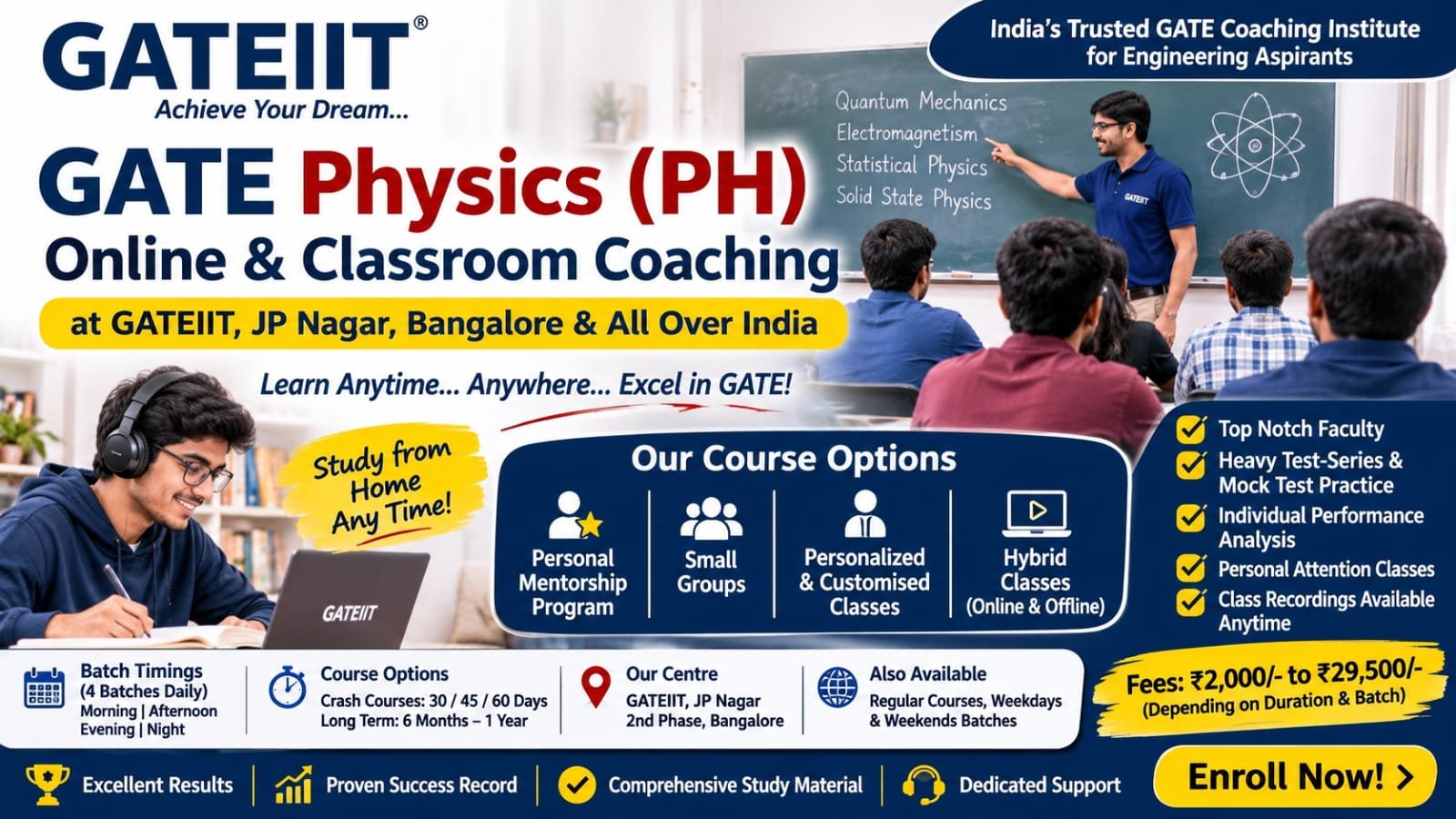
Prepare for GATE Physics (PH) with GATEIIT – Learn from Home Anywhere in India or Attend Classroom Coaching at JP Nagar, Bangalore.
Are you preparing for the Graduate Aptitude Test in Engineering (GATE) Physics paper and looking for structured, concept-oriented, examination-focused coaching? GATEIIT offers flexible GATE Physics coaching programmes through live online classes, classroom coaching in Bangalore and hybrid learning options that combine online and offline education.
Whether you are a B.Sc. Physics student, M.Sc. Physics student, postgraduate aspirant, final-year undergraduate, research-oriented student or working professional, GATEIIT provides multiple preparation pathways to help you strengthen your fundamentals, understand advanced physics concepts, improve numerical problem-solving skills and prepare systematically for the GATE PH examination.
Choose from 30-day, 45-day and 60-day GATE Physics crash courses or comprehensive long-term programmes of 6 months to 1 year. Students can also select personal one-to-one mentorship, small-group coaching, personalised learning, customised study plans, regular batches, weekday classes and weekend batches.
GATEIIT offers four flexible learning schedules: Morning, Afternoon, Evening and Night batches. Learn at a convenient time, attend interactive live classes, access class recordings for revision and practise through extensive topic-wise tests, previous-year questions and full-length mock examinations.
GATEIIT GATE Physics Coaching – Course Highlights
- Course: GATE Physics (PH) Entrance Examination Preparation.
- Target examinations: GATE 2027, GATE 2028 and subsequent examination cycles.
- Learning modes: Online, Offline Classroom and Hybrid.
- Online accessibility: Students from all over India can enrol.
- Classroom location: GATEIIT, JP Nagar 2nd Phase, Bangalore.
- Course duration: 30 Days, 45 Days, 60 Days, 6 Months and 1 Year.
- Batch schedules: Morning, Afternoon, Evening and Night.
- Class options: Personal Mentorship, One-to-One Tuition, Small Groups, Regular Batches and Customised Programmes.
- Class recordings: Available for revision and convenient access, subject to programme access terms.
- Practice: Topic-wise tests, sectional tests, previous-year questions and full-length mock tests.
- Academic support: Doubt clarification, revision sessions and individual performance analysis.
- Course fees: ₹2,000 to ₹29,500, depending on programme duration, batch format and learning support selected.
- Enrolment: Flexible admission options, subject to actual batch availability.
Start your GATE Physics preparation with a learning programme designed around your current knowledge, preparation level, available study hours and target examination.
1. Why Choose GATEIIT for GATE Physics Coaching?
GATE Physics requires more than memorising formulas and solving a collection of numerical problems. It demands conceptual clarity, mathematical maturity, an understanding of physical principles, the ability to connect different areas of physics and consistent practice with examination-oriented questions.
A student may understand quantum mechanics but struggle with numerical applications. Another may be comfortable with classical mechanics but need more time to master mathematical physics or statistical mechanics. Some candidates require complete syllabus coverage, while others need targeted revision, problem-solving practice and mock-test analysis.
GATEIIT aims to address these different preparation requirements through flexible academic programmes.
What makes GATEIIT’s GATE PH programmes different?
- Multiple learning formats
Choose online coaching from anywhere in India, classroom coaching at JP Nagar, Bangalore or a hybrid programme combining both learning modes.
- Personalised academic attention
Students can select individual mentorship, one-to-one personal tuition, small-group classes or regular structured batches according to their learning requirements.
- Flexible batch schedules
Four learning windows are offered: morning, afternoon, evening and night. Weekday and weekend learning options are also available, depending on batch scheduling and enrolment.
- Access to class recordings
Revisit important lectures, revise difficult derivations and listen to recorded explanations at convenient times. Recordings help students manage missed sessions and reinforce concepts.
- Conceptual and mathematical learning
The programme focuses on understanding the mathematical foundations and physical interpretation of important topics rather than depending exclusively on shortcuts.
- Extensive test-series practice
Students can practise topic-wise assessments, chapter tests, sectional examinations, previous-year questions and full-length GATE-pattern mock tests.
- Individual performance analysis
Performance assessments help identify conceptual gaps, accuracy problems, weak chapters, time-management difficulties and areas requiring additional attention.
- Personal mentorship
Students can receive academic guidance, preparation planning, revision recommendations and progress monitoring through their selected mentorship programme.
- Flexible course duration
Choose a short-term crash course or a comprehensive long-term programme based on your preparation stage.
- Learning from home
Students from Delhi, Mumbai, Hyderabad, Chennai, Pune, Kolkata, Kerala, Tamil Nadu, Karnataka, Andhra Pradesh, Telangana, Rajasthan, Uttar Pradesh and other parts of India can access online programmes without relocating to Bangalore.
2. GATE Physics Coaching Programmes – Choose Your Preparation Plan
GATEIIT offers different programme durations and learning formats so students can select a course based on their academic background, preparation progress and examination target.
A. GATE Physics 30-Day Crash Course
The 30-day GATE PH crash course is intended for students who have already studied most of the syllabus and require focused revision and examination practice.
Suitable for:
- Students who have completed the majority of the syllabus.
- Repeat GATE aspirants requiring a structured revision programme.
- Sc. students seeking focused entrance examination preparation.
- Students who need additional numerical practice and test-solving strategies.
Programme focus:
- Important concepts and formula revision.
- High-priority syllabus topics.
- Previous-year GATE Physics questions.
- Numerical problem-solving sessions.
- Topic-wise practice tests.
- Full-length mock examinations.
- Time management and examination strategy.
- Identification of weak areas.
B. GATE Physics 45-Day Crash Course
The 45-day programme provides a slightly more extensive preparation window for candidates who need structured revision and additional problem-solving practice.
Programme focus:
- Revision of major Physics topics.
- Mathematical techniques used in GATE PH.
- Important derivations and applications.
- Concept-based and numerical questions.
- Previous-year questions with explanations.
- Section-wise assessments.
- Mock-test analysis.
- Personalised revision recommendations.
C. GATE Physics 60-Day Crash Course
The 60-day crash course is designed for candidates who require broader syllabus revision, systematic practice and improved examination readiness.
Programme focus:
- Structured revision across the prescribed syllabus.
- Strengthening weak fundamentals.
- Mathematical and conceptual problem-solving.
- Chapter-wise practice.
- Mixed-topic examinations.
- Previous-year question analysis.
- Full-length mock-test practice.
- Individual performance evaluation.
D. GATE Physics 6-Month Long-Term Course
The six-month programme is suitable for students who want to study the syllabus systematically rather than rushing through difficult subjects.
Programme focus:
- Complete syllabus-oriented teaching.
- Mathematical Physics fundamentals.
- Conceptual development in core Physics.
- Guided numerical practice.
- Regular assignments.
- Topic-wise tests.
- Revision and doubt-clearing sessions.
- Progressive mock-test preparation.
- Individual academic feedback.
E. GATE Physics 1-Year Comprehensive Programme
The one-year programme is appropriate for early starters, undergraduate students, students pursuing M.Sc. Physics and candidates preparing alongside their college or employment commitments.
Programme focus:
- Complete syllabus coverage.
- Strong conceptual foundations.
- Mathematical methods and applications.
- Detailed subject-wise teaching.
- Regular problem-solving sessions.
- Assignment-based learning.
- Previous-year question practice.
- Periodic assessments.
- Multiple revision cycles.
- Full-length mock examinations.
- Personal mentorship and performance tracking.
Important: The actual lecture schedule, syllabus coverage, number of sessions and recording-access period depend on the selected programme. Students should confirm the current batch plan before enrolment.
3. Four Flexible GATE Physics Batches – Morning, Afternoon, Evening & Night
Students have different college schedules, work commitments and personal responsibilities. GATEIIT offers multiple batch scheduling options to make systematic preparation more convenient.
Morning Batch
Ideal for students who prefer studying during the first part of the day.
Recommended for:
- Full-time GATE aspirants.
- College students with free morning hours.
- Students who prefer completing academic work early.
Afternoon Batch
Suitable for students who have flexible daytime schedules.
Recommended for:
- Students with morning college commitments.
- Students preparing independently.
- Candidates who prefer daytime learning.
Evening Batch
Designed for students who need to attend college or work during the day.
Recommended for:
- Undergraduate and postgraduate students.
- Working professionals.
- Students with daytime academic commitments.
Night Batch
A convenient option for students who prefer studying after their regular daily activities.
Recommended for:
- Working professionals.
- Students with busy college schedules.
- Candidates who prefer late-evening study sessions.
Weekday and Weekend Classes
Students may enquire about:
- Regular weekday batches.
- Weekend-only classes.
- Weekday plus weekend combinations.
- Flexible individual classes.
- Customised sessions for students with irregular schedules.
Batch allocation: Morning, afternoon, evening and night are the four scheduling options. Actual start times, faculty allocation, batch strength and seat availability must be confirmed with GATEIIT before admission. Enrolment is subject to the availability of the selected programme.
4. Online GATE Physics Coaching Across India – Learn from Home
You do not have to relocate to Bangalore or travel to a coaching centre to prepare for GATE Physics.
GATEIIT provides online learning options for students across India through interactive online classes and recorded learning support.
Students can attend live sessions from their homes, hostels, colleges or workplaces, subject to suitable internet connectivity and the programme’s online-class arrangements.
Benefits of Online GATE PH Coaching
- Learn from any city or state in India.
- Attend live interactive teaching sessions.
- Ask academic questions during classes.
- Access class recordings for revision.
- Study using a flexible morning, afternoon, evening or night schedule.
- Avoid daily commuting.
- Combine GATE preparation with college or employment.
- Practise assignments and online assessments.
- Receive academic guidance and performance feedback.
- Revise difficult topics at your own pace.
Who Should Choose Online GATE Physics Classes?
Online programmes are particularly useful for:
- Students living outside Bangalore.
- Candidates from smaller cities and towns.
- Sc. Physics students studying at universities across India.
- Working professionals.
- Students preparing for multiple entrance examinations.
- Repeat candidates who need focused revision.
- Aspirants who want personal online tuition.
Learn from Home – Without Compromising on Academic Preparation
Online learning should not mean studying without guidance. A well-structured programme must combine live instruction, conceptual explanations, assignments, doubt clarification, recordings and regular assessments.
GATEIIT’s online programmes are designed around these academic requirements.
5. Classroom GATE Physics Coaching in JP Nagar, Bangalore
For students who prefer face-to-face teaching, GATEIIT provides classroom coaching options at its JP Nagar 2nd Phase centre in Bangalore.
Classroom learning can be particularly useful for students who prefer direct interaction, in-person academic discussions, guided problem-solving and a structured study environment.
Benefits of Offline Classroom Coaching
- Direct interaction with faculty.
- Face-to-face conceptual explanations.
- Immediate clarification of academic doubts.
- Guided numerical problem-solving.
- Structured classroom learning.
- Personal academic attention, according to the selected batch.
- Regular practice and assessment.
- Better consistency through a scheduled classroom routine.
GATEIIT Classroom Location
GATE Indian Institute of Tutorials (GATEIIT)
3rd Floor, #1743, Sri Raghavendra Plaza,
17th Main Road, JP Nagar 2nd Phase,
Bangalore – 560078, Karnataka, India.
Students from JP Nagar, Jayanagar, Banashankari, BTM Layout, Arekere, Bannerghatta Road, Kumaraswamy Layout, Basavanagudi, HSR Layout and other parts of Bangalore can enquire about classroom batch availability.
Students are encouraged to visit the centre and discuss the programme before finalising admission.
6. Hybrid GATE Physics Coaching – Online and Offline Together
Not every student wants to follow only an online or only an offline learning format.
GATEIIT also offers hybrid learning options, subject to programme arrangements, allowing students to combine online and classroom learning.
How Does Hybrid GATE Coaching Work?
Depending on the selected programme, students may:
- Attend classroom sessions at the JP Nagar centre.
- Participate in designated online sessions.
- Use recorded lectures for revision.
- Attend additional online academic sessions.
- Continue learning during travel or temporary relocation.
- Follow a combination of classroom and online learning.
Who Should Select Hybrid Coaching?
Hybrid learning can be useful for:
- Students living in Bangalore who occasionally travel.
- Students who prefer classroom interaction but need flexible online access.
- Working professionals.
- Students with irregular academic schedules.
- Candidates who want both classroom and digital learning support.
The exact combination of classroom and online sessions should be confirmed before admission.
7. Personal Mentorship and One-to-One GATE Physics Coaching
Some students require more than regular classroom teaching.
They may have completed their postgraduate studies but need to rebuild their mathematical foundations. Others may have studied the syllabus independently but struggle with numerical questions, conceptual applications or examination speed.
For such students, GATEIIT provides personal coaching and mentorship options.
A. One-to-One Personal Tuition
Individual classes allow the teaching approach to be adjusted according to the student’s preparation level.
Possible academic focus areas include:
- Mathematical Physics.
- Classical Mechanics.
- Electromagnetic Theory.
- Quantum Mechanics.
- Thermodynamics and Statistical Mechanics.
- Atomic and Molecular Physics.
- Solid State Physics.
- Nuclear and Particle Physics.
- Optical Physics.
- General Aptitude.
B. Personal Mentorship Programme
Personal mentorship can include:
- Initial academic-level assessment.
- Preparation-roadmap development.
- Subject-wise study planning.
- Regular progress discussions.
- Identification of weak areas.
- Test-performance analysis.
- Revision planning.
- Time-management guidance.
- Examination strategy.
C. Small-Group GATE Physics Coaching
Small-group programmes provide an opportunity to learn with other aspirants while receiving more focused academic interaction than a large lecture-based environment.
Potential benefits:
- Interactive discussions.
- Guided numerical practice.
- Peer learning.
- Regular assignments.
- Doubt clarification.
- Group-based assessments.
D. Customised GATE Physics Preparation
Customised programmes are suitable for candidates who need a specific combination of subjects, topics, revision sessions or examination practice.
For example:
- Complete GATE Physics preparation.
- Mathematical Physics and Quantum Mechanics only.
- Classical Mechanics and Electromagnetic Theory revision.
- Advanced numerical problem-solving.
- GATE Physics previous-year question practice.
- Last-minute examination revision.
- Test-series-oriented preparation.
Programme design and individual teaching arrangements depend on academic assessment and faculty availability.
8. GATE Physics (PH) Examination – Complete Information
The Graduate Aptitude Test in Engineering (GATE) is a national-level examination conducted jointly by IISc and the Indian Institutes of Technology on behalf of the National Coordination Board, Ministry of Education, Government of India.
GATE assesses a candidate’s understanding of undergraduate-level subjects in engineering, technology, science and other prescribed disciplines.
The Physics paper is identified by the examination code PH.
GATE 2027 – Important Examination Information
- Examination: Graduate Aptitude Test in Engineering.
- Subject: Physics.
- Paper code: PH.
- GATE 2027 organising institute: Indian Institute of Technology Madras (IIT Madras).
- Examination mode: Computer-Based Test (CBT).
- Examination language: English.
- Duration: 3 hours.
- Total marks: 100.
- Total questions: 65.
- General Aptitude: 15 marks.
- Physics subject questions: 85 marks.
- Question types: MCQ, MSQ and NAT.
- GATE score validity: Three years from the date of result announcement, subject to official rules.
GATE 2027 Examination Dates
According to the official GATE 2027 examination calendar, the examination is scheduled on:
- 6 February 2027.
- 7 February 2027.
- 13 February 2027.
- 14 February 2027.
- 20 February 2027.
- 21 February 2027.
The exact examination session allotted to the PH paper should be checked through official announcements.
GATE 2027 Application Status
The GATE 2027 registration portal closed on 16 October 2026 after the special late-fee registration window.
The official schedule lists 31 October 2026 as the closing date for application rectification relating to scrutiny defects. Candidates should check their application status and official portal notices.
For candidates who missed GATE 2027 registration, preparation for the next examination cycle, GATE 2028, is an important alternative.
Official GATE 2027 website: https://gate2027.iitm.ac.in/
Students should refer to the official website for any revised examination dates, admit-card notifications, results and other announcements.
9. GATE Physics 2027 Examination Pattern
The GATE PH examination is a three-hour computer-based test carrying 100 marks.
The examination consists of 65 questions divided into General Aptitude and Physics subject questions.
| Examination component | Details |
| General Aptitude | 10 questions |
| Physics subject | 55 questions |
| Total questions | 65 |
| General Aptitude marks | 15 |
| Physics marks | 85 |
| Total marks | 100 |
| Examination duration | 180 minutes |
| Examination mode | Computer-Based Test |
| Language | English |
Types of Questions
- Multiple Choice Questions (MCQ)
Candidates select one correct answer from the available options.
Negative marking applies to incorrect MCQ responses:
- 1-mark MCQ: 1/3 mark deduction.
- 2-mark MCQ: 2/3 mark deduction.
- Multiple Select Questions (MSQ)
Candidates select one or more correct options.
There is no negative marking for incorrect MSQ responses. However, there is no partial marking.
- Numerical Answer Type (NAT)
Candidates enter a numerical answer using the virtual numeric keypad.
There is no negative marking for incorrect NAT responses.
Why Does the GATE Physics Examination Require Special Preparation?
Physics questions may test more than direct formula application. Candidates should be prepared to:
- Interpret physical situations mathematically.
- Apply fundamental laws to unfamiliar problems.
- Solve multistep numerical questions.
- Understand mathematical expressions and boundary conditions.
- Identify incorrect assumptions.
- Work accurately under time pressure.
- Distinguish between MCQ, MSQ and NAT approaches.
GATEIIT’s preparation approach incorporates conceptual understanding and examination-oriented problem practice.
10. GATE Physics 2027 Syllabus – Complete Section-Wise Coverage
The GATE 2027 Physics syllabus has been revised by IIT Madras.
A particularly important update is the revised organisation of the PH syllabus into 11 sections, including a dedicated Measurements and Error Analysis section and a separate Optical Physics section.
Candidates preparing for GATE 2027 should follow the revised official syllabus rather than relying entirely on older syllabus lists.
Section 1: Measurements and Error Analysis
Topics include:
- Units and dimensions.
- Dimensional analysis.
- Least count.
- Significant figures.
- Methods of measurement.
- Error analysis of physical quantities.
- Two-probe and four-probe resistance measurement methods.
- Grounding for electrical circuits.
- Ground loops.
- Design of DC power supplies.
- Signal processing through lock-in amplifiers.
This section introduces experimental measurement concepts and error analysis that students should prepare systematically.
Section 2: Mathematical Physics
Topics include:
- Linear vector spaces.
- Basis, orthogonality and completeness.
- Similarity transformations.
- Eigenvalues and eigenvectors.
- First-order linear differential equations.
- Second-order linear differential equations.
- Complex analysis.
- Cauchy-Riemann conditions.
- Cauchy’s theorem.
- Residue theorem and applications.
- Fourier analysis.
- Tensor transformations.
- Covariant and contravariant tensors.
Mathematical Physics is one of the foundational areas for understanding the other GATE Physics subjects.
Section 3: Classical Mechanics
Topics include:
- D’Alembert’s principle.
- Euler-Lagrange equations.
- Hamilton’s principle.
- Calculus of variations.
- Symmetry and conservation laws.
- Central-force motion.
- Kepler problem.
- Small oscillations.
- Coupled oscillations.
- Normal modes.
- Rigid-body dynamics.
- Inertia tensor.
- Orthogonal transformations.
- Euler angles.
- Torque-free motion of a symmetric top.
- Hamiltonian mechanics.
- Hamilton’s equations of motion.
- Canonical transformations.
- Poisson brackets.
- Special theory of relativity.
- Lorentz transformations.
- Relativistic kinematics.
- Mass-energy equivalence.
Section 4: Thermodynamics and Statistical Mechanics
Topics include:
- Laws of thermodynamics.
- Macrostates and microstates.
- Phase space.
- Statistical ensembles.
- Partition function.
- Free energy.
- Calculation of thermodynamic quantities.
- Classical statistics.
- Quantum statistics.
- Degenerate Fermi gas.
- Blackbody radiation.
- Planck’s distribution law.
- Bose-Einstein condensation.
- First-order phase transitions.
- Second-order phase transitions.
- Phase equilibria.
- Critical phenomena.
Section 5: Electromagnetic Theory
Topics include:
- Boundary-value problems.
- Method of images.
- Separation of variables.
- Dielectrics and conductors.
- Magnetic materials.
- Multipole expansion.
- Maxwell’s equations.
- Scalar and vector potentials.
- Coulomb gauge.
- Lorentz gauge.
- Electromagnetic waves in free space.
- Electromagnetic waves in conducting and non-conducting media.
- Reflection and transmission at normal and oblique incidence.
- Polarisation of electromagnetic waves.
- Poynting vector.
- Poynting theorem.
- Energy and momentum of electromagnetic waves.
Section 6: Optical Physics
Optical Physics is a separate section in the revised GATE 2027 PH syllabus.
Topics include:
- Wave equation.
- Plane and spherical waves.
- Superposition of waves.
- Standing waves.
- Phase velocity.
- Group velocity.
- Spatial and temporal coherence.
- Dielectric films.
- Newton’s rings.
- Multiple-beam interference.
- Michelson interferometer.
- Fabry-Perot interferometer and etalon.
- Fresnel diffraction.
- Fraunhofer diffraction.
- Rectangular and circular apertures.
- Rayleigh criterion.
- Double-slit diffraction.
- Many-slit diffraction.
- Grating dispersion.
- Jones vectors and matrices.
- Linear, circular and elliptical polarisation.
- Ray-transfer matrices for mirrors and lenses.
- Einstein coefficients.
- Population inversion.
- Two-level and three-level laser systems.
Section 7: Quantum Mechanics
Topics include:
- Basic principles of quantum mechanics.
- Uncertainty principle.
- Linear vectors and operators in Hilbert space.
- Time-independent Schrödinger equation.
- One-dimensional potential problems.
- Step potential.
- Finite rectangular potential well.
- Quantum tunnelling.
- Particle in one-dimensional, two-dimensional and three-dimensional boxes.
- Single and double delta-function potentials.
- Harmonic oscillator in one, two and three dimensions.
- Central potentials.
- Hydrogen-like atoms.
- Orbital angular momentum.
- Spin angular momentum.
- Addition of angular momenta.
- Variational method.
- Time-independent perturbation theory.
- Elementary scattering theory.
- Born approximation.
Section 8: Atomic and Molecular Physics
Topics include:
- Spectra of one-electron atoms.
- Spectra of many-electron atoms.
- Spin-orbit interaction.
- L-S coupling.
- j-j coupling.
- Fine structure.
- Hyperfine structure.
- Zeeman effect.
- Paschen-Back effect.
- Stark effect.
- Electric dipole transitions.
- Selection rules.
- Rotational spectra of diatomic molecules.
- Vibrational spectra of diatomic molecules.
- Electronic transitions.
- Franck-Condon principle.
- Raman effect.
- Raman spectroscopy.
- Nuclear Magnetic Resonance (NMR).
- Electron Spin Resonance (ESR).
- X-ray spectroscopy.
- Mössbauer spectroscopy.
Section 9: Solid State Physics
Topics include:
- Elements of crystallography.
- Diffraction methods for structure determination.
- Bonding in solids.
- Lattice vibrations.
- Thermal properties of solids.
- Free electron theory.
- Band theory of solids.
- Nearly free electron model.
- Metals, semiconductors and insulators.
- Electrical conductivity.
- Electron and hole statistics.
- Intrinsic and extrinsic semiconductors.
- Mobility and effective mass.
- Metal-semiconductor junctions.
- Ohmic contacts.
- Rectifying contacts.
- Dielectric properties.
- Ferromagnetic domains.
- Type-I and Type-II superconductors.
- Meissner effect.
- London equation.
- BCS theory.
- Flux quantisation.
Section 10: Nuclear and Particle Physics
Topics include:
- Nuclear binding energy.
- Electric and magnetic moments.
- Semi-empirical mass formula.
- Nuclear models.
- Liquid drop model.
- Nuclear shell model.
- Nuclear force.
- Two-nucleon problem.
- Alpha decay.
- Beta decay.
- Electromagnetic transitions in nuclei.
- Rutherford scattering.
- Nuclear reactions.
- Conservation laws.
- Nuclear fission.
- Nuclear fusion.
- Particle accelerators.
- Particle detectors.
- Elementary particles.
- Quark model.
- Isospin symmetry.
- Charge conjugation.
- Time-reversal invariance.
Section 11: Electronics
Topics include:
- p-n junction diodes.
- Bipolar junction transistors.
- Field-effect transistors.
- Positive feedback circuits.
- Negative feedback circuits.
- Operational amplifiers.
- Applications of operational amplifiers.
- Active filters.
- Sine-wave generators.
- Square-wave generators.
- Triangular-wave generators.
- Digital logic circuits.
- Combinational circuits.
- Sequential circuits.
- Flip-flops.
- Analogue-to-digital conversion.
- Digital-to-analogue conversion.
General Aptitude
The common General Aptitude component carries 15 marks.
Preparation areas include:
- Verbal aptitude.
- English comprehension.
- Grammar and vocabulary.
- Numerical aptitude.
- Quantitative reasoning.
- Data interpretation.
- Logical reasoning.
- Analytical reasoning.
- Basic mathematical problem-solving.
Official syllabus: https://gate2027.iitm.ac.in/exam_papers_and_syllabus
Students should download the latest PH syllabus PDF from the official portal before beginning their preparation.
11. How GATEIIT Covers the GATE Physics Syllabus
A comprehensive preparation programme should not merely list subjects. It should provide a planned sequence for learning, practising, revising and evaluating each subject.
GATEIIT programmes are structured around the prescribed syllabus, with the actual teaching sequence and depth determined by the selected course duration.
Mathematical Foundation Development
Students work on the mathematical methods required to understand advanced Physics.
Conceptual Teaching
Core theories and physical principles are explained with suitable mathematical reasoning, examples and applications.
Numerical Problem-Solving
Students practise different question formats, including direct numerical applications, multistep problems and concept-based questions.
Previous-Year Questions
Past GATE Physics papers help students understand the nature of examination questions, difficulty levels and the application of concepts.
Topic-Wise Assessment
Regular practice helps identify whether students can independently apply the concepts taught in class.
Revision and Mock Examinations
The preparation process includes revision, timed practice and mock-test analysis.
12. GATE Physics Test Series, Mock Tests and Practice Examinations
A strong GATE preparation programme needs continuous assessment.
Knowing the theory is important, but candidates must also learn how to apply it accurately and efficiently within the three-hour examination.
GATEIIT programmes include extensive test-series and mock-test practice according to the selected course.
Types of Practice Tests
- Topic-wise tests after completing individual concepts.
- Chapter-wise tests covering major syllabus units.
- Subject-wise sectional tests.
- Mixed-topic assessments.
- Previous-year GATE Physics question practice.
- Numerical Answer Type practice.
- MCQ and MSQ practice.
- Full-length GATE-pattern mock examinations.
- Revision tests.
- Timed problem-solving exercises.
Individual Performance Analysis System
A test score alone does not reveal why a student is losing marks.
A useful performance analysis should examine:
- Accuracy percentage.
- Conceptual understanding.
- Time spent per question.
- Incorrect attempts.
- Unattempted questions.
- Weak subject areas.
- Repeated calculation mistakes.
- Difficulty with particular question types.
- Revision requirements.
- Progress across successive tests.
How Students Can Improve Through Test Analysis
For example, a student may consistently score poorly in Quantum Mechanics despite understanding the theory. The underlying issue may be the application of boundary conditions, mathematical manipulation or time management.
Similarly, a candidate may perform well in subject questions but lose marks in General Aptitude.
Performance analysis helps convert these observations into a practical improvement plan.
The objective is not simply to conduct more tests. It is to help students learn from every test.
13. Class Recordings – Revise Anytime, Learn at Your Convenience
GATE preparation requires repeated revision, particularly in mathematically demanding subjects.
Students may understand a derivation during a live class but need to revisit it later while solving related questions.
GATEIIT provides class-recording access for applicable programmes.
Benefits of Recorded Classes
- Revisit difficult concepts.
- Revise important mathematical derivations.
- Review solved numerical problems.
- Catch up on eligible missed sessions.
- Prepare before assessments.
- Revise important chapters before mock tests.
- Learn at a convenient time.
- Reinforce classroom learning.
Students can use recordings along with their notes, textbooks, assignments and test-series practice.
Recording availability, access duration and platform arrangements depend on the selected programme.
14. GATE Physics Faculty and Academic Teaching Approach
Physics requires teachers who can explain the relationship between mathematical expressions and their physical meaning.
The teaching approach should help students understand why an equation works, when it can be applied and how it can be used to solve unfamiliar examination questions.
GATEIIT’s GATE Physics programmes focus on:
- Conceptual clarity.
- Mathematical accuracy.
- Systematic derivations.
- Physical interpretation.
- Problem-solving techniques.
- Previous-year question discussion.
- Doubt clarification.
- Examination-oriented teaching.
Faculty allocation depends on the selected course and batch. Students may enquire about the relevant faculty profile, subject allocation, teaching experience and available demonstration sessions before admission.
15. Who Can Join GATEIIT GATE Physics Coaching?
The GATE Physics coaching programmes are suitable for a range of academic backgrounds.
B.Sc. Physics Students
Students pursuing or completing a B.Sc. in Physics can begin structured preparation and strengthen their core undergraduate concepts.
M.Sc. Physics Students
Postgraduate students can prepare for GATE while studying advanced Physics subjects at university.
Integrated M.Sc. Students
Students enrolled in integrated science programmes can use structured preparation to strengthen their examination readiness.
B.Tech and Engineering Graduates
Candidates with relevant academic backgrounds who wish to appear for the Physics paper can assess their subject preparation requirements before selecting a programme.
Research Aspirants
Students interested in postgraduate research and doctoral opportunities may use GATE preparation to strengthen their understanding of Physics.
Working Professionals
Professionals interested in postgraduate study or career progression can select flexible evening, night or weekend programmes.
Repeat GATE Aspirants
Students who have appeared for GATE previously can choose targeted revision, personal coaching or test-series-focused preparation.
Note: GATEIIT coaching admission and official GATE examination eligibility are separate matters. Candidates must independently verify their eligibility under the applicable GATE notification.
16. GATE Examination Eligibility Criteria
For GATE 2027, candidates who are currently studying in the third year or higher of an eligible undergraduate degree programme, or who have completed an eligible government-approved degree, can apply subject to the official eligibility rules.
Eligible degree categories include prescribed programmes in:
- Medicine and other specified professional degree programmes.
Candidates pursuing or holding higher degrees are also permitted subject to the official eligibility conditions.
There is no general upper age limit for appearing in GATE, and there is no prescribed limit on the number of attempts.
Candidates should check the official GATE 2027 eligibility page for the complete degree-wise requirements:
https://gate2027.iitm.ac.in/eligibility_criteria
Eligibility rules for subsequent examination years should always be checked against the relevant year’s official information brochure.
17. Why Appear for GATE Physics?
GATE Physics can be useful for students seeking advanced academic and research opportunities.
Depending on the institution, programme, score, eligibility and selection criteria, GATE scores may be considered for:
- Sc.-related or other postgraduate opportunities where applicable.
- Tech and specialised interdisciplinary programmes.
- Integrated Ph.D. programmes.
- Direct Ph.D. admissions.
- Research-oriented postgraduate programmes.
- Certain doctoral and research fellowships.
- Academic and research opportunities at participating institutions.
GATE scores may also be accepted by selected institutions for programmes involving Physics, applied physics, materials science, instrumentation, photonics, interdisciplinary science and related research areas.
Opportunities After Qualifying GATE Physics
Candidates may explore opportunities at:
- Indian Institutes of Technology (IITs).
- Indian Institute of Science (IISc).
- National Institutes of Technology (NITs), where relevant programmes accept the score.
- Other participating universities.
- Research institutes and specialised academic institutions.
- Institutions offering interdisciplinary science programmes.
Important Admission Consideration
GATE qualification does not automatically guarantee admission, a scholarship, a research position or employment.
Each institution determines its own eligibility requirements, accepted examination papers, cut-offs, shortlisting procedures, interviews and selection criteria.
Candidates should check the relevant institute’s admission brochure before applying.
18. GATE Physics Preparation Strategy – How to Prepare Effectively
An effective GATE Physics preparation strategy should combine conceptual learning, mathematical development, problem-solving, revision and continuous assessment.
Step 1: Understand the Official Syllabus
Download the latest GATE PH syllabus and divide it into individual topics.
Do not rely exclusively on older notes because the GATE 2027 Physics syllabus has been revised.
Step 2: Evaluate Your Existing Knowledge
Identify which subjects you understand well and which require complete preparation.
A diagnostic test can help identify gaps.
Step 3: Strengthen Mathematical Physics
Mathematical Physics supports many other areas of the examination. Give adequate attention to linear algebra, differential equations, complex analysis, Fourier methods and tensors.
Step 4: Develop Conceptual Understanding
Study each topic with a focus on:
- Fundamental laws.
- Mathematical derivations.
- Physical interpretation.
- Common problem-solving approaches.
Step 5: Solve Problems Every Day
Physics preparation becomes effective when theory is followed by independent problem-solving.
Practise different question formats and maintain a record of mistakes.
Step 6: Solve Previous-Year Questions
Analyse past papers to understand how fundamental concepts are tested.
Avoid relying on predicted questions or unofficial weightage lists as a substitute for full syllabus preparation.
Step 7: Take Regular Tests
Begin with topic-wise tests and gradually progress towards mixed-topic and full-length examinations.
Step 8: Analyse Your Performance
Identify weak subjects, calculation errors, conceptual misunderstandings and time-management problems.
Step 9: Revise Repeatedly
Maintain:
- Formula sheets.
- Concept summaries.
- Important derivations.
- Mistake notebooks.
- Difficult question collections.
- Revision schedules.
Step 10: Practise Full-Length Mock Examinations
Develop the ability to complete the paper within the prescribed three hours while maintaining accuracy.
19. GATE Physics Coaching Fees – Affordable Programmes from ₹2,000 to ₹29,500
GATEIIT offers different fee options to accommodate students with different preparation requirements and budgets.
The course fee depends on:
- Programme duration.
- Crash course or long-term course selection.
- Personal tuition or group coaching.
- Small-group batch selection.
- Online or classroom learning arrangement.
- Mentorship and academic support requirements.
- Customised programme structure.
Indicative GATE Physics Coaching Fee Range
| Programme | Duration | Fee information |
| Short-term revision programme | 30 Days | Within the ₹2,000–₹29,500 range |
| Crash course | 45 Days | Within the ₹2,000–₹29,500 range |
| Intensive crash course | 60 Days | Within the ₹2,000–₹29,500 range |
| Comprehensive preparation | 6 Months | Within the ₹2,000–₹29,500 range |
| Long-term preparation | 1 Year | Within the ₹2,000–₹29,500 range |
| Personal mentorship | Customised | Based on selected programme |
| One-to-one tuition | Customised | Based on teaching requirements |
| Small-group coaching | Customised | Based on batch and duration |
Course fee range: ₹2,000 to ₹29,500.
The above is the overall indicative fee range across the available programmes, not a fixed price for every duration. The exact fee, inclusions, number of sessions and applicable access period should be confirmed with GATEIIT before payment.
Students can contact the academic team to identify an appropriate course based on their preparation level and budget.
20. GATEIIT Admission Process – How to Enrol
Enrolling in a GATE Physics programme is straightforward.
Step 1: Contact GATEIIT
Contact the academic team to enquire about GATE Physics coaching.
Step 2: Discuss Your Preparation Level
Explain your academic background, examination target, completed syllabus and areas where you need support.
Step 3: Select Your Learning Mode
Choose from:
- Online coaching across India.
- Classroom coaching in JP Nagar, Bangalore.
- Hybrid learning.
Step 4: Select Your Programme
Choose the duration and coaching format that suits your requirements.
Step 5: Select Your Batch
Enquire about morning, afternoon, evening or night batches and weekday or weekend scheduling.
Step 6: Confirm Fees and Course Inclusions
Obtain confirmation of the programme fee, class schedule, recording access, tests and mentorship arrangements.
Step 7: Complete Admission
Complete the admission and payment process as instructed by GATEIIT.
Step 8: Begin Your Preparation
Start your classes, follow the study plan, complete assignments and participate in assessments.
Request a GATE Physics Demo Class
Students can enquire about an available demonstration class before selecting their programme, subject to scheduling.
21. Why Start GATE Physics Preparation Early?
Many students begin serious preparation only a few months before the examination. However, Physics includes several interconnected subjects that require mathematical understanding and repeated problem-solving.
Early preparation offers more time for:
- Building mathematical foundations.
- Completing the entire syllabus.
- Understanding advanced concepts.
- Solving previous-year questions.
- Identifying weak subjects.
- Revising multiple times.
- Taking mock examinations.
- Improving speed and accuracy.
Students targeting GATE 2028 can benefit from beginning their preparation well in advance rather than waiting until the examination notification.
Candidates targeting GATE 2027 may select an appropriate intensive revision or crash course depending on their current preparation level.
22. GATEIIT – Online and Offline Coaching for Physics Aspirants Across India
GATEIIT aims to make structured examination preparation accessible to students with different academic backgrounds and learning preferences.
Whether you are preparing from Bangalore, Chennai, Hyderabad, Delhi, Mumbai, Pune, Kolkata, Kochi, Coimbatore, Mysore, Mangalore, Vijayawada, Visakhapatnam, Jaipur, Lucknow, Bhopal, Ahmedabad, Chandigarh or any other Indian city, you can enquire about online GATE Physics programmes.
Students based in Bangalore can additionally explore classroom and hybrid coaching options at the JP Nagar 2nd Phase centre.
The objective is to help each student select an appropriate programme rather than forcing every candidate into the same batch structure.
Your preparation. Your learning schedule. Your preferred mode. Your GATE Physics goal.
23. Frequently Asked Questions – Top 50 GATE Physics Coaching and Examination FAQs
1. Which is the best GATE Physics coaching institute in Bangalore?
The best coaching institute depends on the quality of subject teaching, faculty suitability, syllabus coverage, personal attention, test-series support, class schedules and academic guidance. GATEIIT offers GATE Physics online, offline and hybrid coaching options, including personal mentorship and classroom programmes at JP Nagar 2nd Phase, Bangalore.
2. Does GATEIIT offer online GATE Physics coaching throughout India?
Yes. Students from different states and cities across India can enquire about GATE Physics online coaching. Online programmes allow students to learn from home through scheduled classes and applicable recorded lecture access.
3. Does GATEIIT provide offline GATE Physics classroom coaching in Bangalore?
Yes. GATEIIT offers classroom coaching options at its centre in JP Nagar 2nd Phase, Bangalore, subject to actual batch availability.
4. Where is GATEIIT located in Bangalore?
GATEIIT is located at 3rd Floor, #1743, Sri Raghavendra Plaza, 17th Main Road, JP Nagar 2nd Phase, Bangalore – 560078, Karnataka.
5. Does GATEIIT offer hybrid GATE Physics coaching?
Yes. Hybrid learning options combine online and classroom learning, depending on the selected programme and session arrangements.
6. What is the fee for GATE Physics coaching at GATEIIT?
GATEIIT’s overall programme fee range is ₹2,000 to ₹29,500. The exact fee depends on the duration, teaching format, batch selection and academic support included.
7. Does GATEIIT provide a 30-day GATE Physics crash course?
Yes. A 30-day revision-oriented crash course is available as a programme option for students who have already completed most of the syllabus and require focused revision and practice.
8. Can I join a 45-day GATE Physics crash course?
Yes. Students can enquire about the 45-day crash course for structured revision, numerical practice, previous-year questions and mock-test preparation.
9. Is a 60-day GATE Physics crash course available?
Yes. GATEIIT offers a 60-day intensive crash-course option for candidates seeking a broader revision and examination-practice programme.
10. Does GATEIIT offer six-month GATE Physics coaching?
Yes. A six-month comprehensive preparation option is available for students who require systematic syllabus coverage and regular practice.
11. Is a one-year GATE Physics coaching programme available?
Yes. Students can enquire about the one-year long-term preparation programme for complete syllabus-oriented learning, revision and examination practice.
12. Does GATEIIT provide one-to-one GATE Physics personal tuition?
Yes. Personal tuition and individual learning options are available subject to faculty and scheduling availability.
13. Can I join GATE Physics personal mentorship?
Yes. Students can enquire about personal mentorship programmes that may include academic planning, progress monitoring, performance evaluation and preparation guidance.
14. Are small-group GATE Physics classes available?
Yes. Small-group learning options are available subject to batch formation and enrolment.
15. Does GATEIIT offer customised GATE Physics coaching?
Yes. Students can discuss customised preparation plans based on their academic background, completed syllabus and specific subject requirements.
16. What are the available GATE Physics batch timings?
GATEIIT offers four scheduling windows: morning, afternoon, evening and night. Actual class timings should be confirmed with the academic team.
17. Are weekend GATE Physics classes available?
Weekend learning options are available subject to batch scheduling and faculty availability.
18. Can working professionals join GATE Physics online coaching?
Yes. Working professionals can enquire about evening, night, weekend and personalised learning arrangements.
19. Are class recordings provided?
Yes. Recorded classes are available for applicable programmes, allowing students to revisit lectures and revise important topics. Recording access is subject to programme terms.
20. Can I learn GATE Physics from home?
Yes. Students can join eligible online programmes from home anywhere in India, provided they have suitable internet access and the required learning setup.
21. Is GATE Physics difficult?
GATE Physics can be challenging because it tests conceptual understanding, mathematical skills and problem-solving ability across several areas of Physics. Consistent preparation, strong fundamentals and regular practice can help students improve.
22. What is the paper code for GATE Physics?
The paper code for Physics in GATE is PH.
23. What is the total mark allocation for GATE Physics?
GATE Physics carries 100 marks, consisting of 15 marks for General Aptitude and 85 marks for Physics subject questions.
24. How many questions are there in GATE Physics?
The GATE examination pattern specifies 65 questions, comprising 10 General Aptitude questions and 55 subject questions.
25. What is the duration of the GATE Physics examination?
The examination duration is three hours, or 180 minutes.
26. What types of questions are asked in GATE PH?
GATE Physics includes Multiple Choice Questions (MCQ), Multiple Select Questions (MSQ) and Numerical Answer Type (NAT) questions.
27. Is there negative marking in GATE Physics?
Negative marking applies to incorrect MCQ responses. One-third of the mark is deducted for an incorrect 1-mark MCQ, and two-thirds of the mark for an incorrect 2-mark MCQ. There is no negative marking for MSQ and NAT questions.
28. What is the GATE Physics syllabus for 2027?
The revised GATE 2027 PH syllabus contains 11 sections: Measurements and Error Analysis, Mathematical Physics, Classical Mechanics, Thermodynamics and Statistical Mechanics, Electromagnetic Theory, Optical Physics, Quantum Mechanics, Atomic and Molecular Physics, Solid State Physics, Nuclear and Particle Physics, and Electronics.
29. Has the GATE Physics syllabus changed for 2027?
Yes. The GATE 2027 Physics syllabus has been revised. It includes a dedicated Measurements and Error Analysis section and a separate Optical Physics section. Candidates should download the latest official syllabus.
30. Which subjects are important for GATE Physics preparation?
Mathematical Physics, Classical Mechanics, Quantum Mechanics, Electromagnetic Theory, Thermodynamics and Statistical Mechanics, Atomic and Molecular Physics, Solid State Physics, Nuclear and Particle Physics, Electronics and Optical Physics are all part of the official syllabus. Preparation should cover the complete syllabus rather than depend entirely on predictions about weightage.
31. Is Mathematical Physics important for GATE PH?
Yes. Mathematical Physics provides essential tools for understanding and solving problems across quantum mechanics, classical mechanics, electromagnetism, statistical mechanics and other subjects.
32. Is Quantum Mechanics important for GATE Physics?
Yes. Quantum Mechanics is a major component of the PH syllabus. Candidates should understand operators, the Schrödinger equation, potential problems, angular momentum, perturbation theory and scattering concepts.
33. How should I prepare for GATE Physics numerical questions?
Understand the underlying physical principles, practise mathematical applications, solve previous-year questions and take regular timed tests. Review calculation mistakes and maintain a record of difficult problems.
34. Are previous-year GATE Physics questions covered?
GATEIIT programmes include previous-year question practice as part of the examination-preparation approach, according to the selected course.
35. Does GATEIIT provide GATE Physics mock tests?
Yes. Test-series and mock-test practice are included according to the selected programme. Students can enquire about the available test structure and inclusions.
36. Will I receive an individual performance analysis?
Individual performance analysis is part of GATEIIT’s academic preparation approach. Students can receive feedback to identify weaker areas and improve their preparation.
37. Can B.Sc. Physics students appear for GATE?
Candidates studying in the third year or higher of an eligible undergraduate degree programme, or those who have completed an eligible degree, may appear subject to the official GATE eligibility criteria. Students should verify the current rules.
38. Can M.Sc. Physics students appear for GATE?
Yes. M.Sc. Physics students who satisfy the applicable GATE eligibility criteria can appear for the examination.
39. Can final-year students prepare for GATE Physics?
Yes. Eligible final-year students can prepare while completing their degree programme.
40. Is there an age limit for GATE Physics?
There is no upper age limit under the general GATE eligibility rules. Candidates should verify the applicable official notification.
41. How many attempts are allowed in GATE?
There is no prescribed limit on the number of GATE attempts, subject to the eligibility rules applicable to the examination year.
42. How long is a GATE score valid?
A GATE score is generally valid for three years from the date of result announcement, subject to the official rules for that examination cycle.
43. Which institute conducts GATE 2027?
IIT Madras is the organising institute for GATE 2027, conducted jointly under the GATE framework involving IISc and IITs.
44. When will GATE 2027 be conducted?
The official GATE 2027 examination dates are 6, 7, 13, 14, 20 and 21 February 2027. The PH paper’s exact session should be checked through official notifications.
45. Can I prepare for GATE 2028 through GATEIIT?
Yes. Students can enquire about long-term GATE Physics preparation programmes for GATE 2028 and subsequent examination cycles.
46. Can I join GATE coaching if I have weak Physics fundamentals?
Yes. A student can discuss their academic background and request an appropriate programme. A longer-term or personalised course may be more suitable when foundational concepts require additional attention.
47. Can I join GATE Physics coaching after completing my M.Sc.?
Yes. M.Sc. graduates who meet the official eligibility criteria can enrol in an appropriate GATE preparation programme.
48. Does GATE Physics qualification guarantee admission to IITs or IISc?
No. GATE qualification does not automatically guarantee admission. Institutions apply their own eligibility, score requirements, selection procedures and admission criteria.
49. How can I enrol in GATEIIT GATE Physics coaching?
Contact GATEIIT through its website or telephone numbers. Discuss your target examination, course duration, learning mode, batch schedule and fee before completing admission.
50. How can I contact GATEIIT for GATE Physics coaching admission?
Visit www.gateiit.com or contact the academic team at 8884416154 or 8884416155. Students can also visit the JP Nagar 2nd Phase centre in Bangalore for programme enquiries.
Enrol Now – GATE Physics Online, Offline and Hybrid Coaching at GATEIIT
Your GATE Physics preparation deserves a structured plan, consistent academic guidance and meaningful examination practice.
Whether you are beginning your preparation, revising the complete syllabus or preparing for another attempt, GATEIIT offers flexible programme options to help you move forward.
Choose the learning format that suits you:
- Online GATE Physics coaching from anywhere in India.
- Classroom GATE Physics coaching in JP Nagar, Bangalore.
- Hybrid GATE Physics learning.
- One-to-one personal tuition.
- Personal mentorship programmes.
- Small-group coaching.
- Customised subject-wise preparation.
- 30-day, 45-day and 60-day crash courses.
- Six-month and one-year long-term courses.
- Morning, afternoon, evening and night scheduling.
- Weekday and weekend options.
- Recorded lecture access for applicable programmes.
- Extensive test-series and mock-test practice.
- Individual performance analysis.
Contact GATEIIT – GATE Physics Coaching Admissions
GATE Indian Institute of Tutorials (GATEIIT)
Address:
3rd Floor, #1743, Sri Raghavendra Plaza,
17th Main Road, JP Nagar 2nd Phase,
Bangalore – 560078, Karnataka, India.
Call / WhatsApp:
8884416154
8884416155
Website: https://www.gateiit.com/
Google Maps / Directions: https://maps.app.goo.gl/MtzbVkqywCkwKcc4A
Online Admissions: Students from all over India can enquire about online GATE Physics programmes.
Classroom Admissions: Visit the GATEIIT JP Nagar centre in Bangalore.
Course Fee Range: ₹2,000–₹29,500, depending on programme selection.
Available Learning Formats: Online | Offline | Hybrid.
Take the first step towards your GATE Physics preparation. Contact GATEIIT to discuss the available batches and select an appropriate learning programme.