
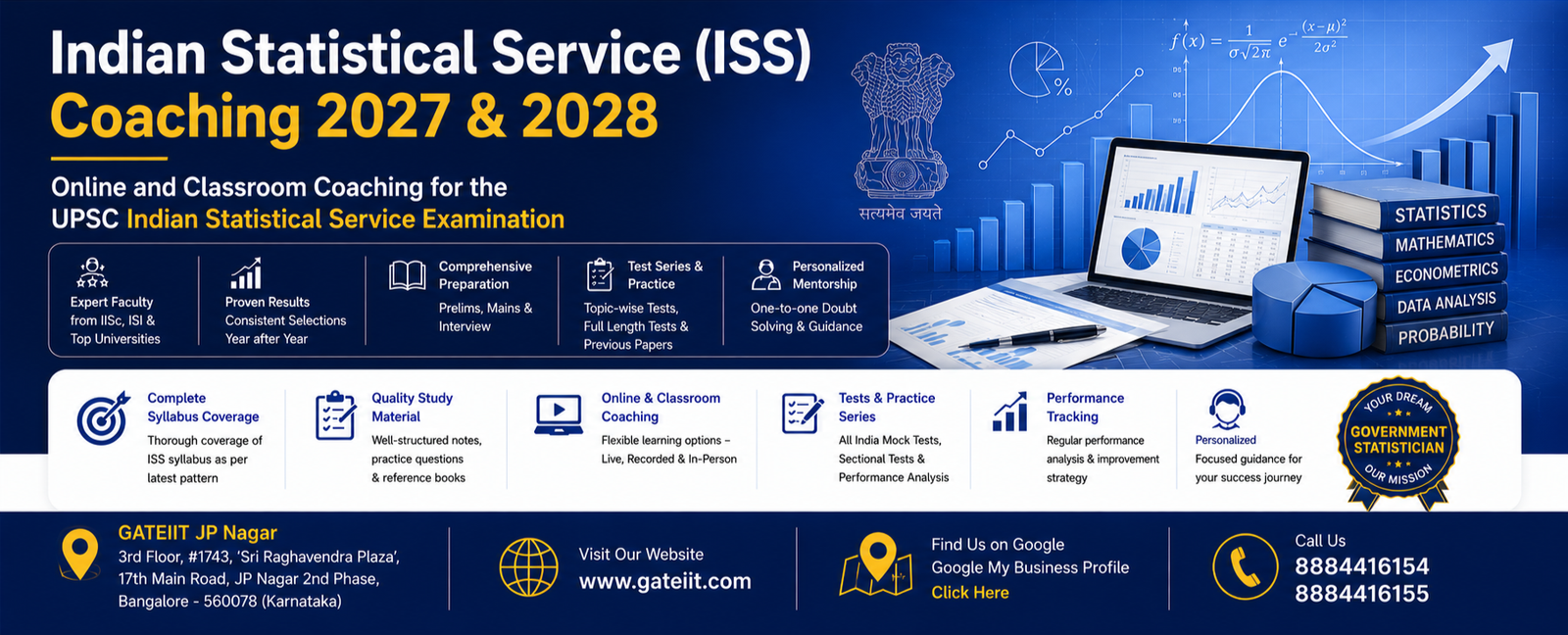
Indian Statistical Service (ISS) Coaching 2027 & 2028
Online and Classroom Coaching for the UPSC Indian Statistical Service Examination
Preparing for the Indian Statistical Service (ISS) Examination requires much more than reading Statistics textbooks or solving a few previous-year papers. The UPSC examination tests whether you can understand statistical theory, apply mathematical and statistical methods, solve unfamiliar problems, write logically and accurately under time pressure, and present answers at the level expected in a competitive national examination.
GATEIIT offers structured Indian Statistical Service (ISS) Coaching for the 2027 and 2028 examinations through online and classroom learning options. The programme is designed for students and graduates who want a systematic preparation plan, strong conceptual foundations, regular practice, expert guidance and continuous performance feedback.
Our ISS preparation programme combines:
- Complete syllabus-oriented teaching
- Conceptual understanding from fundamentals to advanced topics
- Previous Year Question Paper (PYQ) analysis
- Daily and topic-wise practice
- Full-length mock examinations
- Descriptive answer-writing practice
- Regular revision and doubt resolution
- Recorded classes for revision
- Personalised academic guidance
- Performance analysis and improvement planning
Whether you are beginning your ISS preparation from the basics, preparing alongside your postgraduate studies, or looking for a focused programme for your next attempt, the course can be structured around your preparation level and target examination year.
Why Choose a Structured ISS Preparation Programme?
The ISS examination is highly specialised. Many aspirants have studied Statistics at the undergraduate or postgraduate level but still find the examination challenging because UPSC requires preparation across a broad syllabus and demands both conceptual clarity and problem-solving ability.
Common challenges faced by ISS aspirants include:
- Not knowing how to organise the large Statistics syllabus
- Studying topics without understanding their UPSC importance
- Depending only on university notes or standard textbooks
- Not analysing previous-year questions properly
- Weakness in mathematical derivations and statistical applications
- Insufficient practice under examination conditions
- Difficulty writing complete descriptive answers within the available time
- Studying without regular evaluation and feedback
A good ISS preparation system should therefore answer three questions:
What should I study?
The syllabus and examination requirements should be clearly mapped into a structured plan.
How should I study?
Concepts should be taught with theory, derivations, examples, applications and examination-oriented problem solving.
How do I know whether I am improving?
Regular tests, PYQ analysis, answer evaluation, performance tracking and targeted revision should identify what needs improvement.
That is the approach followed in the GATEIIT ISS coaching programme.
UPSC Indian Statistical Service Examination: What Aspirants Should Know
The Indian Statistical Service Examination is conducted by the Union Public Service Commission (UPSC). The examination is a specialised competitive examination for recruitment to the Indian Statistical Service.
The examination structure, eligibility conditions, syllabus and other requirements are determined by the official UPSC notification for the relevant examination year. Aspirants should always verify the latest notification before applying.
For the current examination pattern, UPSC’s official materials show a written examination comprising General English, General Studies and four Statistics papers for ISS candidates. UPSC also publishes the latest question papers and examination notifications on its official website.
For the 2027 and 2028 batches, GATEIIT will update the academic plan and examination guidance whenever the official UPSC notification or syllabus requirements change.
ISS Syllabus-Oriented Preparation
The course is designed around the major areas required for serious ISS preparation, including the following broad domains.
- Probability and Statistical Methods
Preparation includes important areas such as:
- Probability concepts
- Random variables
- Probability distributions
- Mathematical expectation
- Moments and generating functions
- Joint, marginal and conditional distributions
- Limit theorems
- Convergence concepts
- Laws of large numbers
- Central limit theorem
- Statistical methods and applications
The focus is not simply on memorising formulas. Students are trained to understand the assumptions, derivations, interpretation and application of statistical methods.
- Statistical Inference
Important areas include:
- Sampling distributions
- Point estimation
- Properties of estimators
- Sufficiency
- Completeness
- Unbiasedness
- Consistency
- Efficiency
- Maximum likelihood estimation
- Method of moments
- Confidence intervals
- Hypothesis testing
- Neyman-Pearson theory
- Likelihood ratio methods
- Large-sample tests
Students are encouraged to understand why a method works, when it can be used and how to present the solution in an examination.
- Linear Models and Regression
Preparation includes:
- Simple and multiple linear regression
- Least squares estimation
- Analysis of variance
- Regression diagnostics
- General linear models
- Estimation and testing in linear models
- Applications of regression and related statistical techniques
The emphasis is on both theoretical understanding and numerical problem solving.
- Design of Experiments
Important concepts include:
- Principles of experimental design
- Completely randomised designs
- Randomised block designs
- Latin square designs
- Factorial experiments
- Analysis of variance
- Interaction effects
- Statistical interpretation of experimental results
- Sampling Techniques
Students study the principles and applications of important sampling methods, including:
- Simple random sampling
- Stratified sampling
- Systematic sampling
- Cluster sampling
- Multistage sampling
- Ratio and regression methods
- Sampling errors
- Estimation and comparison of estimators
The preparation connects theoretical methods with practical statistical applications.
- Time Series and Index Numbers
Preparation includes:
- Components of time series
- Trend analysis
- Seasonal variation
- Cyclical variation
- Moving averages
- Exponential smoothing
- Forecasting concepts
- Index number construction
- Properties of index numbers
- Applications and interpretation
- Official Statistics and Applied Statistics
A serious ISS aspirant should also understand the application of Statistics in public administration and national development.
The preparation includes relevant areas such as:
- Role of official statistics
- Statistical systems and data collection
- National statistical information
- Population and demographic statistics
- Economic and social statistics
- Survey-based data
- Statistical interpretation
- Data quality and limitations
- Use of statistical evidence in policy and administration
The purpose is to help students understand Statistics not only as a mathematical subject but also as a tool used for evidence-based decision-making.
What Makes GATEIIT ISS Coaching Different?
- Concept-First Teaching
A formula is useful only when you understand the idea behind it.
Classes are designed to help students move from:
Concept → Derivation → Example → Application → PYQ → Practice → Revision
This approach is particularly important for students who have gaps in their fundamentals.
- Complete Preparation from Basics to Advanced Level
The programme can support students at different preparation levels:
Beginners
For students who need to build strong fundamentals.
Intermediate Aspirants
For students who have studied Statistics but need structured UPSC preparation.
Advanced Aspirants
For candidates who want intensive PYQ practice, mock tests, revision and performance improvement.
- Previous-Year Question Paper-Based Preparation
Previous-year papers are not merely practice material. They help students understand:
- The level of questions
- Repeated concepts
- Important areas
- The balance between theory and numerical problems
- The depth expected in answers
- Time-management requirements
GATEIIT integrates PYQs into the preparation process rather than leaving them only for the final stage.
- Regular Practice and Evaluation
The ISS programme includes structured practice through:
- Daily Practice Papers (DPPs)
- Topic-wise assignments
- Chapter tests
- Sectional tests
- Previous-year question practice
- Full-length mock examinations
- Revision tests
- Descriptive practice where required
- Detailed discussion of solutions
The objective is to convert passive study into measurable improvement.
- Personalised Doubt Support
Students can raise academic doubts during and after classes through the available support channels.
Doubts may be discussed through:
- Live classroom interaction
- Online class interaction
- Faculty doubt sessions
- Personal academic guidance
- Available digital communication channels
A difficult topic should not remain unresolved for weeks. Regular doubt resolution is an important part of effective preparation.
ISS Coaching Courses for 2027 and 2028
GATEIIT offers different preparation formats depending on the student’s time available, preparation level and preferred learning mode.
One-Year ISS Coaching Programme
Suitable for students who want a structured preparation plan for the target examination.
The programme may include:
- Complete syllabus coverage
- Conceptual classes
- Topic-wise practice
- PYQ analysis
- Regular tests
- Revision planning
- Recorded class access
- Study material
- Doubt support
- Mock examinations
Two-Year ISS Coaching Programme
A two-year preparation plan is suitable for students who want more time to build fundamentals and complete multiple cycles of learning and revision.
The preparation can be structured into:
Phase 1: Foundation
Build clarity in core mathematical and statistical concepts.
Phase 2: Complete Syllabus Coverage
Study the syllabus in a systematic and examination-oriented manner.
Phase 3: Advanced Problem Solving
Solve higher-level problems and previous-year questions.
Phase 4: Revision and Testing
Complete multiple revision cycles and full-length examination practice.
Early preparation gives students more time to identify weaknesses and improve them without last-minute pressure.
ISS Crash Course
The crash course is designed for students who have already completed a substantial portion of the syllabus and need focused revision and examination practice.
Available formats may include:
- 30-day programme
- 45-day programme
- 60-day programme
- 90-day programme
- 120-day programme
The exact focus depends on the student’s preparation level and the examination schedule.
A crash course should not be treated as a substitute for complete preparation when the syllabus has not yet been studied. It is most useful for revision, consolidation, PYQs and intensive testing.
Personalised ISS Coaching
Students with specific academic needs may opt for a customised preparation plan.
Personalised coaching may be useful for:
- Students with weak fundamentals
- Students preparing while pursuing higher education
- Repeat aspirants
- Students requiring a subject-specific plan
- Students needing additional problem-solving support
- Aspirants requiring a customised study schedule
The aim is to identify the student’s current level and build a realistic plan towards the target examination.
Online ISS Coaching
GATEIIT’s online ISS coaching is designed for students across India who cannot attend regular classroom classes in Bangalore.
Online students can access:
- Live interactive classes
- Recorded lectures for revision
- Digital study resources
- Practice assignments
- Tests and mock examinations
- Faculty interaction
- Doubt support
- Performance feedback
Classes can be accessed through commonly used devices, including:
- Android smartphones and tablets
- iPhones and iPads
- Windows laptops
- Desktop computers
The advantage of online learning is flexibility. Students can attend live classes, revisit recorded lectures and revise difficult topics according to their preparation schedule.
Classroom ISS Coaching in Bangalore
Students who prefer face-to-face learning can join the classroom programme in Bangalore, subject to batch availability.
Classroom learning can be particularly useful for students who benefit from:
- Direct interaction with faculty
- A fixed study routine
- Classroom discussions
- Peer learning
- Immediate academic interaction
- A structured preparation environment
GATEIIT also offers classroom programmes with residential facilities where applicable. Students should contact the institute for current batch details, availability, location and residential arrangements.
Live Classes Plus Recorded Lectures
Life is unpredictable. Students may miss a class because of university examinations, health, travel or other academic commitments.
For this reason, recorded class access is an important part of the learning system.
Students can use recorded lectures to:
- Rewatch difficult concepts
- Revise before tests
- Catch up on missed classes
- Review important derivations
- Strengthen weak topics
Recorded lectures should support live learning—not replace disciplined study and regular practice.
Study Material for ISS Preparation
Students receive faculty-prepared study resources and notes as part of the course structure.
The material is designed to support:
- Concept building
- Quick revision
- Formula and result review
- Topic-wise practice
- PYQ preparation
- Examination revision
Good study material should not become a collection of hundreds of pages that students never revise. The objective is to provide material that students can actually study, practise and revise repeatedly.
Daily Practice Paper and Test Series
Regular testing is one of the most important parts of ISS preparation.
The programme includes practice through:
Daily Practice Papers
Short, regular practice to reinforce classroom learning.
Topic Tests
Tests after completion of important topics.
Sectional Tests
Tests covering larger portions of the syllabus.
Full-Length Mock Tests
Examination-oriented tests designed to develop:
- Speed
- Accuracy
- Question selection
- Time management
- Endurance
- Examination temperament
The exact number and schedule of tests may vary according to the batch and examination plan.
Each test should be followed by analysis. A score alone does not explain how to improve.
Detailed Test Analysis
After a test, students should know:
- Which questions were answered incorrectly
- Which questions were left unanswered
- Whether the mistake was conceptual or computational
- Whether time management affected performance
- Which topics require revision
- Which types of questions are causing difficulty
This is why GATEIIT focuses on discussion and analysis of test questions rather than simply publishing marks.
A Practical ISS Preparation Strategy
Step 1: Understand the Examination
Read the latest official UPSC notification and understand the examination structure, eligibility requirements and syllabus.
Step 2: Assess Your Current Level
Identify your strengths and weaknesses in:
- Probability
- Mathematical Statistics
- Statistical Inference
- Regression and Linear Models
- Sampling
- Design of Experiments
- Time Series
- Official Statistics
- General English
- General Studies
Step 3: Build the Fundamentals
Do not rush into advanced problem solving if your core concepts are weak.
Step 4: Complete the Syllabus Systematically
Follow a structured study plan rather than jumping randomly between topics.
Step 5: Solve Previous-Year Questions
Use PYQs to understand the examination’s actual demand.
Step 6: Practise Regularly
Daily and weekly practice is more effective than occasional long study sessions.
Step 7: Take Mock Tests
Develop the ability to perform under examination conditions.
Step 8: Analyse Your Mistakes
Maintain a mistake notebook or digital error log.
Step 9: Revise Multiple Times
One reading is not preparation. Repeated revision is essential for a large syllabus.
Step 10: Follow the Latest Official Information
The UPSC notification for the relevant year should always be treated as the final authority.
Who Should Join ISS Coaching?
The programme may be suitable for:
- Statistics graduates
- Postgraduate students of Statistics
- Students preparing for the ISS examination after completing the required qualification
- Working professionals planning a serious career transition
- Repeat aspirants
- Students who want structured preparation and regular evaluation
- Aspirants preparing for the 2027 examination
- Aspirants beginning early preparation for the 2028 examination
Before enrolling, candidates should independently verify the eligibility requirements in the latest UPSC notification.
Why Start ISS Preparation Early for 2027 or 2028?
Starting early provides time to:
- Build stronger fundamentals
- Cover the syllabus without rushing
- Solve more PYQs
- Take more mock tests
- Improve answer quality
- Identify weak areas
- Complete multiple revision cycles
The objective of early preparation is not to study everything immediately. It is to create enough time to learn, practise, revise and improve.
Frequently Asked Questions About ISS Coaching
Which coaching is best for Indian Statistical Service preparation?
The right coaching institute depends on factors such as faculty expertise, syllabus coverage, quality of study material, PYQ integration, testing system, doubt support, course flexibility and evidence of student outcomes.
Before choosing a programme, students should attend a demo or speak with the institute and understand exactly what is included.
GATEIIT offers online and classroom ISS preparation programmes with structured teaching, study material, practice, tests, recorded classes and academic support.
How can I prepare for the Indian Statistical Service Examination?
Start by understanding the latest UPSC notification and syllabus. Then create a structured plan covering conceptual learning, problem solving, previous-year questions, regular testing and revision.
A consistent preparation system is generally more effective than collecting multiple books and coaching materials without completing them.
Can I crack the ISS Examination through online coaching?
Yes, online preparation can be effective when it includes live teaching, structured study material, regular practice, mock tests, doubt support and disciplined self-study.
The student’s consistency and practice remain essential.
Is ISS coaching available for students outside Bangalore?
Yes. Online coaching allows students from different parts of India to attend classes without relocating to Bangalore.
Students who prefer face-to-face learning may explore classroom options in Bangalore, subject to batch availability.
What should I study for the ISS Examination?
The exact preparation should follow the latest UPSC notification and syllabus. Broadly, ISS preparation requires strong preparation in the prescribed Statistics papers along with the relevant General English and General Studies components.
The official UPSC notification and question papers should be used as the final reference for the examination year.
Is the ISS Examination difficult?
The examination is competitive and requires specialised preparation. The difficulty usually comes from the breadth and depth of the syllabus, the level of problem solving required and the need to perform consistently across multiple papers.
A structured preparation plan can help students prepare more efficiently.
How many hours should I study for ISS preparation?
There is no single number of hours suitable for every student. The required time depends on:
- Current academic level
- Time remaining before the examination
- Previous preparation
- University or employment commitments
- Speed of learning
- Strength of fundamentals
Consistency, quality of study and regular testing are more important than simply counting hours.
Should I join a one-year or two-year ISS course?
Choose a one-year course if you already have a strong foundation and can follow an intensive schedule.
A two-year programme may be more suitable if you want additional time for foundation building, syllabus coverage, practice and multiple revisions.
The best choice depends on your current level and target examination.
Start Your ISS Preparation for 2027 or 2028
The Indian Statistical Service Examination requires a focused and consistent approach. If you want to prepare through a structured programme with conceptual classes, practice, previous-year question analysis, mock tests, revision support and academic guidance, GATEIIT can help you build a preparation plan suited to your target year.
Enquire about the GATEIIT ISS Coaching Programme
Contact GATEIIT to learn about:
- 2027 and 2028 batches
- Online coaching
- Classroom coaching in Bangalore
- One-year programmes
- Two-year programmes
- Crash courses
- Personalised coaching
- Study material
- Test series
- Class schedules
- Fees
- Demo classes
- Residential facilities, where available
Start early. Prepare systematically. Practise consistently. Revise repeatedly.
Your ISS preparation should be built around understanding—not just collecting material.
Our Toppers
