
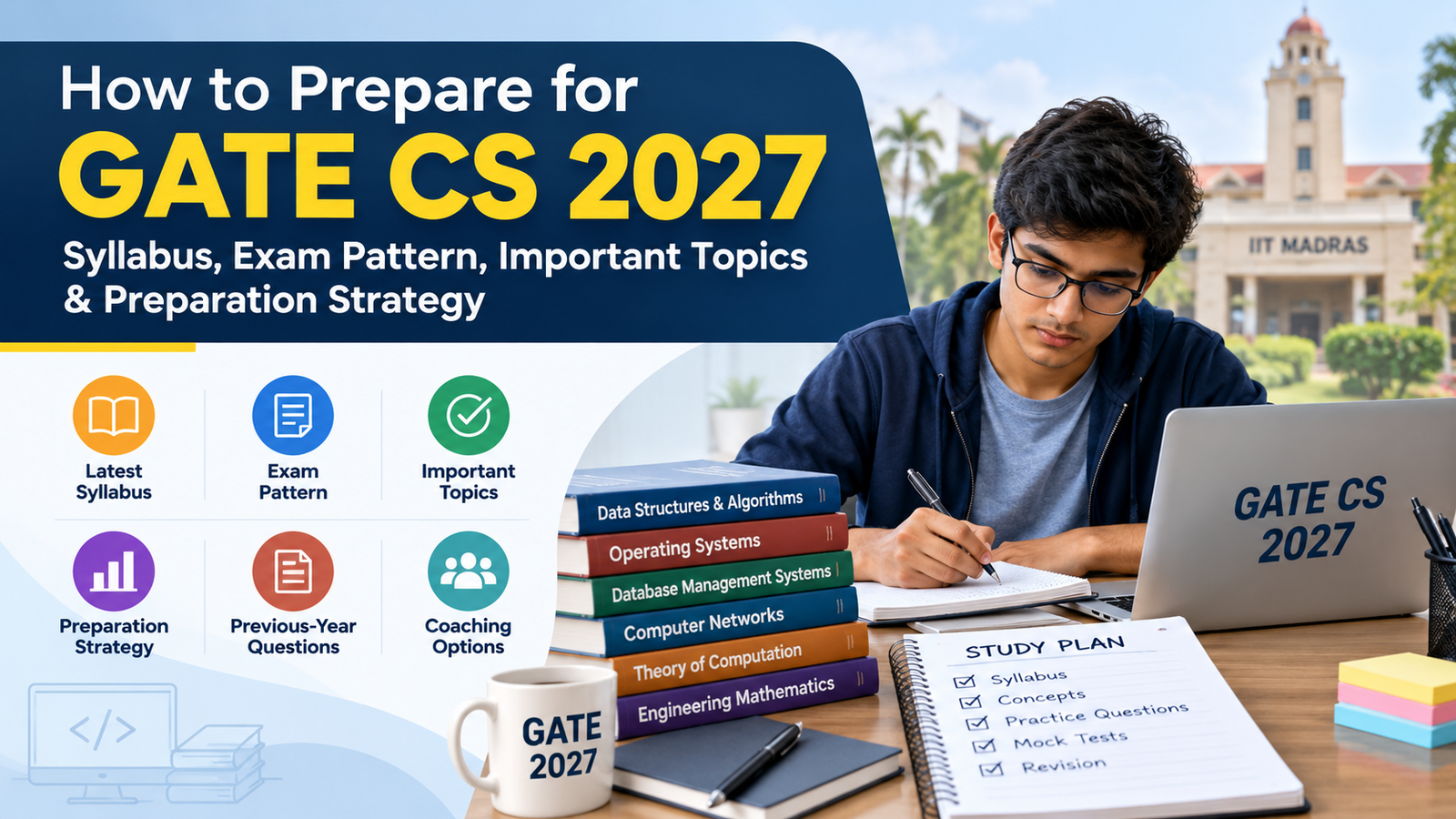
Preparing for GATE Computer Science and Information Technology (GATE CS 2027) requires a clear understanding of the syllabus, strong fundamentals, consistent practice and regular revision. Whether you are a B.Tech Computer Science student, an engineering graduate or an aspirant planning to pursue postgraduate studies, a structured preparation strategy can help you use your study time more effectively.
The first step is to understand what the examination tests. GATE CS covers subjects such as Engineering Mathematics, Digital Logic, Computer Organization and Architecture, Programming and Data Structures, Algorithms, Theory of Computation, Compiler Design, Operating Systems, Databases and Computer Networks. General Aptitude is also an important part of the paper.
For GATE 2027, IIT Madras is the organising institute, and the official syllabus should be your primary reference because the syllabus has been revised for this examination cycle.
In this guide, you will learn how to prepare for GATE CS 2027, understand the exam pattern, identify important topics, build a practical study plan, use previous-year questions effectively and choose between self-study, online coaching and classroom coaching.
Quick Answer: How Should You Prepare for GATE CS 2027?
To prepare effectively for GATE Computer Science 2027, follow these steps:
Download and understand the official GATE 2027 CS syllabus.
Assess your current knowledge of programming, mathematics and core computer science subjects.
Study one subject at a time and build conceptual clarity before solving advanced questions.
Practise previous-year GATE questions after completing each topic.
Revise formulas, algorithms, definitions and common problem-solving methods regularly.
Include General Aptitude in your weekly study schedule.
Take timed mock tests and analyse every mistake.
Adapt your preparation according to your progress and the time remaining before the examination.
The most important principle is to combine conceptual learning, question practice, revision and mock-test analysis. Completing the syllabus without practising questions is not enough to develop examination readiness.
- What Is GATE CS 2027?
GATE CS stands for Graduate Aptitude Test in Engineering — Computer Science and Information Technology. It is the GATE paper intended for candidates who want to demonstrate their understanding of undergraduate-level computer science and related mathematical concepts.
GATE is a national-level examination conducted by IISc and the IITs on behalf of the National Coordination Board, under the Ministry of Education.
A valid GATE score may be used to apply for eligible postgraduate and doctoral programmes. Some public sector undertakings also use GATE scores in their recruitment processes. However, admission, financial assistance and recruitment depend on the relevant institution or organisation’s eligibility criteria and selection process.
Why do students prepare for GATE CS?
Students prepare for GATE Computer Science for several reasons:
Admission to eligible M.Tech and other postgraduate programmes.
Opportunities to pursue research and doctoral studies.
Assessment of their computer science fundamentals.
Recruitment opportunities in organisations that accept GATE scores.
A stronger understanding of algorithms, systems, databases and theoretical computer science.
Your preparation goal should determine how you use your GATE score. For example, a student targeting a postgraduate programme should review the admission requirements and selection criteria of the institutions they are interested in.
- GATE CS 2027 Eligibility Criteria
The official GATE 2027 eligibility criteria allow candidates who are currently studying in the third year or a higher year of an eligible undergraduate degree programme, as well as candidates who have completed an approved degree programme, to appear for the examination.
Eligible educational backgrounds include Engineering, Technology, Architecture, Science, Commerce, Arts and Humanities, subject to the official criteria.
For B.Tech students, this means that candidates in the third year or above of an eligible degree programme can generally apply. Candidates from other academic backgrounds should check the official eligibility table for their specific qualification.
Keep the following points in mind:
There is no upper age limit specified for GATE 2027.
You do not necessarily need to hold a B.Tech degree in Computer Science to be eligible for GATE.
GATE eligibility and eligibility for admission to a particular postgraduate programme are not the same.
Each institute may impose its own degree, subject, qualifying-score or other admission requirements.
Official reference: GATE 2027 Eligibility Criteria — https://gate2027.iitm.ac.in/eligibility_criteria
Always verify the latest eligibility information before applying.
- GATE CS 2027 Exam Pattern
Understanding the exam pattern helps you plan your preparation, allocate time and practise questions in the correct format.
According to the official GATE 2027 question paper pattern, the CS paper has a total of 100 marks and a duration of three hours.
Exam component
GATE CS 2027 details
Paper code
CS
Examination mode
Computer-Based Test (CBT)
Duration
3 hours
Total questions
65
Total marks
100
General Aptitude
15 marks
Engineering Mathematics
13 marks
Computer Science subject questions
72 marks
Question types
MCQ, MSQ and NAT
Examination language
English
The paper includes General Aptitude, Engineering Mathematics and the Computer Science syllabus. The subject portion includes the core CS topics specified in the official syllabus.
Types of questions in GATE CS
Multiple Choice Questions (MCQs): You select one correct option from the choices provided.
Multiple Select Questions (MSQs): More than one option may be correct. You must identify all applicable correct options.
Numerical Answer Type (NAT) questions: You calculate the answer and enter the numerical value rather than selecting from a list of options.
Practise all three formats. Numerical questions require careful calculations, while MSQs demand a clear understanding of the concepts and conditions stated in the question.
GATE CS negative marking
The official marking scheme specifies negative marking for incorrect MCQ answers:
A wrong answer to a 1-mark MCQ attracts a deduction of one-third of a mark.
A wrong answer to a 2-mark MCQ attracts a deduction of two-thirds of a mark.
There is no negative marking for incorrect MSQ or NAT answers.
MSQs do not receive partial marks.
These rules make accuracy and sensible time management important. During mock tests, evaluate not only the number of correct answers but also whether incorrect attempts are reducing your score.
Official reference: GATE 2027 Question Paper Pattern — https://gate2027.iitm.ac.in/question_paper_pattern
- GATE CS 2027 Syllabus: Subject-Wise Breakdown
The official GATE 2027 Computer Science and Information Technology syllabus contains ten sections. Use the official PDF as your final checklist and refer to it whenever you plan or revise a topic.
- Engineering Mathematics
- Engineering Mathematics supports several areas of computer science, particularly algorithm analysis, theoretical computer science and quantitative problem-solving.
Important syllabus areas include:
Discrete Mathematics: Propositional and first-order logic, sets, relations, functions, partial orders, lattices, monoids, groups, graph theory and combinatorics.
Linear Algebra: Matrices, determinants, systems of linear equations, eigenvalues, eigenvectors and LU decomposition.
Calculus: Limits, continuity, differentiability, maxima and minima, the mean value theorem and integration.
Probability and Statistics: Random variables, probability distributions, mean, median, mode, standard deviation, conditional probability and Bayes’ theorem.
How to prepare: Practise mathematical problems regularly rather than relying only on formula memorisation. Pay particular attention to logic, counting, graphs, probability and linear algebra.
- Digital Logic
- Digital Logic focuses on the representation and manipulation of digital information and the design of digital circuits.
Important topics include:
Boolean algebra and Boolean function minimisation.
Karnaugh maps and tabular minimisation methods.
Combinational circuits.
Sequential circuits.
Number representation and arithmetic.
Fixed-point and floating-point representation.
How to prepare: Learn Boolean simplification step by step, understand circuit behaviour and practise number-system conversions and arithmetic questions.
4.3 Computer Organization and Architecture
This subject explains how a computer executes instructions and manages memory and input/output operations.
Important topics include:
Instruction sets and addressing modes.
Arithmetic and Logic Unit (ALU).
Hardwired and microprogrammed control units.
Memory hierarchy and cache mapping.
Memory interfacing.
Interrupts and Direct Memory Access (DMA).
Instruction pipelining and pipeline hazards.
How to prepare: Draw diagrams of memory hierarchies and instruction pipelines. Practise numerical questions involving cache memory and performance, and understand why pipeline hazards occur.
- Programming and Data Structures
- Programming and Data Structures test your ability to understand program behaviour, organise data and reason about operations on common data structures.
Important topics include:
Programming in C.
Recursion.
Arrays.
Stacks and queues.
Linked lists.
Trees and binary search trees.
Binary heaps.
Graphs.
How to prepare: Trace short C programs manually, especially those involving pointers, arrays, recursion and control flow. Learn the operations and properties of each data structure and practise questions that require you to predict the output of a program.
4.5 Algorithms
Algorithms focus on problem-solving methods and the efficiency of computational procedures.
Important topics include:
Searching and sorting.
Hashing.
Worst-case time and space complexity.
Greedy algorithms.
Dynamic programming.
Divide-and-conquer.
Graph traversals.
Minimum spanning trees.
Shortest-path algorithms.
How to prepare: Understand why an algorithm works before memorising its steps. Compare the time and space requirements of alternative approaches, and practise tracing algorithms on small examples.
- Theory of Computation
- Theory of Computation examines formal languages, computational models and the limits of computation.
Important topics include:
Regular expressions.
Finite automata.
Context-free grammars.
Push-down automata.
Regular and context-free languages.
Pumping lemma.
Turing machines.
Undecidability.
How to prepare: Practise converting between regular expressions and automata, tracing state transitions and analysing grammars. Make a comparison chart of different language classes and computational models.
4.7 Compiler Design
Compiler Design explains how source programs are processed and translated into executable or intermediate representations.
Important topics include:
Lexical analysis.
Parsing.
Syntax-directed translation.
Runtime environments.
Intermediate code generation.
Local optimisation.
Data-flow analysis.
Constant propagation, liveness analysis and common subexpression elimination.
How to prepare: Understand the sequence of compiler phases and practise parsing, syntax-directed translation and intermediate-code questions. Focus on the reasoning behind each transformation.
- Operating Systems
- Operating Systems covers how computer resources are managed and how multiple processes and threads execute.
Important topics include:
System calls.
Processes and threads.
Inter-process communication.
Concurrency and synchronisation.
Deadlocks.
CPU and I/O scheduling.
Memory management.
Virtual memory.
File systems.
How to prepare: Solve scheduling problems, practise synchronisation and deadlock questions, and understand the difference between paging, virtual memory, processes and threads. Use timelines and diagrams when analysing execution sequences.
4.9 Databases
Database concepts focus on organising, querying and maintaining data while preserving consistency.
Important topics include:
Entity-Relationship (ER) models.
Relational models.
Relational algebra and tuple calculus.
SQL.
Integrity constraints.
Normal forms.
File organisation.
Indexing, including B-trees and B+ trees.
Transactions and concurrency control.
How to prepare: Write SQL queries, practise relational algebra and learn the logic behind database normalisation. Work through examples involving functional dependencies, indexing and transaction schedules.
- Computer Networks
- Computer Networks examines how data is transmitted and how communication protocols operate.
Important topics include:
Layering principles.
Circuit, packet and virtual-circuit switching.
Network performance metrics.
Error detection.
Medium Access Control and Ethernet.
Distance-vector and link-state routing.
IPv4 fragmentation.
CIDR notation and Network Address Translation (NAT).
TCP flow control and congestion control.
Socket API.
DNS and HTTP.
How to prepare: Understand the purpose of each protocol and layer. Practise subnetting, routing and numerical questions, and distinguish flow control from congestion control.
Official GATE CS 2027 syllabus PDF
Download the official syllabus here:
https://gate2027.iitm.ac.in/static/doc/GATE2027_Syllabus/CS_GATE2027_Syllabus.pdf
The official document should take priority over older syllabus summaries, coaching notes or previous-year preparation plans because GATE 2027 includes revised syllabi.
- Important Topics for GATE CS 2027
Students often ask which GATE CS subjects carry the highest marks. The practical answer is that you should study the complete official syllabus while prioritising topics according to your understanding, previous-year question patterns and available preparation time.
The following table is a useful starting point for planning. It identifies topics worth giving focused attention; it does not claim a guaranteed mark distribution or a fixed subject-wise weightage.
Subject
Topics to prioritise during preparation
Engineering Mathematics
Discrete Mathematics, graphs, combinatorics, probability and linear algebra
Digital Logic
Boolean algebra, minimisation and sequential circuits
Computer Organization
Cache memory, addressing modes, pipelining and memory hierarchy
Programming and Data Structures
C programming, recursion, trees, heaps and graphs
Algorithms
Complexity analysis, sorting, greedy methods, dynamic programming and graph algorithms
Theory of Computation
Automata, grammars, regular languages and context-free languages
Compiler Design
Parsing, intermediate code and data-flow analysis
Operating Systems
CPU scheduling, synchronisation, deadlocks and virtual memory
Databases
SQL, normalisation, indexing and transactions
Computer Networks
Routing, subnetting, TCP, flow control and congestion control
General Aptitude
Verbal ability, numerical ability, reasoning and data interpretation
How should you decide which topics to study first?
Use three factors:
Conceptual difficulty: Identify the topics you currently find difficult.
Question practice: Review official previous-year papers to understand how concepts are tested.
Syllabus coverage: Ensure that less familiar topics do not remain untouched until the final weeks.
Avoid relying entirely on unofficial predictions of high-weightage chapters. A topic that appears less frequently in a few past papers may still be relevant in the examination.
- A Practical Preparation Strategy for GATE CS 2027
A successful preparation plan should include learning, practice, revision and assessment. The exact balance will depend on your current level and how much time you can study alongside college or other commitments.
Step 1: Understand your starting point
Before beginning full preparation, review the official syllabus and attempt a small set of questions from different subjects.
Classify each topic as:
Strong: You understand the concept and can solve questions independently.
Developing: You understand the basics but need more practice.
Needs revision: You struggle to recall the concept or apply it to questions.
This simple assessment helps you avoid spending all your time on subjects you already know.
Step 2: Build a subject-wise study plan
Choose a manageable number of subjects for each study period. Complete one topic at a time, moving from basic definitions to solved examples and then independent practice.
For example, when studying Operating Systems, first understand processes and threads, then scheduling, followed by synchronisation and deadlocks.
Do not move to advanced questions merely because you have finished reading a chapter. Check whether you can explain the concept and solve standard questions first.
Step 3: Practise previous-year questions
Previous-year questions are essential because they show how the examination tests concepts.
After finishing a topic:
Solve relevant questions without immediately checking the solutions.
Mark questions that take too long or involve repeated mistakes.
Study the reasoning behind the correct solution.
Reattempt difficult questions after a few days.
Record the underlying concept in your revision notes.
Use official question papers and answer keys whenever available. Remember that previous-year questions help you identify patterns; they do not guarantee that the same questions will appear again.
Step 4: Maintain concise revision notes
Prepare your own notes while studying. These should contain the information you are likely to need during revision, such as:
Important formulas and mathematical identities.
Algorithmic time complexities.
Key properties of data structures.
Differences between related concepts.
Common mistakes and special cases.
Short methods for solving familiar problem types.
Keep the notes concise enough to revise quickly. Rewriting entire textbooks is usually less useful than recording concepts that you find difficult to remember or apply.
Step 5: Practise General Aptitude every week
General Aptitude carries 15 marks in GATE CS 2027. It should be part of your preparation from the beginning rather than something you leave until the final weeks.
Practise verbal ability, numerical reasoning, quantitative questions and data interpretation. Review incorrect answers to identify whether your mistakes arise from a weak concept, misreading or time pressure.
Step 6: Take mock tests and analyse your performance
Start with topic-wise tests. Once you have covered a reasonable portion of the syllabus, introduce full-length timed mock tests.
After each test, review:
Which questions you answered correctly.
Which questions you answered incorrectly.
Which questions you left unanswered.
Where you spent too much time.
Which concepts require additional revision.
Do not judge progress using a single mock-test score. Look for patterns across several tests and use those patterns to adjust your study plan.
Step 7: Revise systematically
Revision should happen throughout preparation, not only at the end.
A useful cycle is to revisit a topic shortly after studying it, practise it again after a few days and review it periodically thereafter. The exact intervals can be adjusted to your memory and schedule.
For example, after completing Database Normalisation, revise your notes, solve a new set of questions and return to the topic during your next revision cycle.
- GATE CS 2027 Study Plan for Working Days and Weekends
If you are a B.Tech student attending college, your preparation schedule should be realistic enough to follow consistently.
Here is an illustrative schedule for a day when you can devote approximately three hours to preparation.
Study activity
Suggested time
Learn or revise a concept
75 minutes
Solve topic-wise questions
60 minutes
Practise General Aptitude
25 minutes
Review mistakes and revision notes
20 minutes
Total
180 minutes
This is an example, not a mandatory timetable. On days with examinations, assignments or practical sessions, you may need to reduce the workload and make up the study time later.
Weekend study routine
Use weekends for activities that need longer, uninterrupted periods:
Complete unfinished topics.
Solve a larger set of previous-year questions.
Attempt a sectional test.
Review difficult concepts.
Update your revision notes.
Plan the following week’s targets.
A weekly review helps you identify whether your preparation plan is realistic and whether you are spending too much time on any one subject.
- A 12-Week GATE CS Revision Plan
If you have already studied most of the syllabus, a 12-week revision plan can help organise the remaining work. It is not a substitute for full syllabus learning if you are starting from the beginning.
Weeks
Main focus
Weeks 1–2
Assess gaps; revise Engineering Mathematics and Digital Logic
Weeks 3–4
Revise Computer Organization, Programming and Data Structures
Weeks 5–6
Revise Algorithms and Theory of Computation
Weeks 7–8
Revise Compiler Design and Operating Systems
Weeks 9–10
Revise Databases and Computer Networks
Week 11
Consolidate weak areas, General Aptitude and mixed-topic practice
Week 12
Timed mock tests, error analysis and focused revision
Throughout these 12 weeks, continue practising previous-year questions and revisiting topics that need improvement.
If you are beginning preparation from scratch, extend the learning phase as needed. It is better to understand the syllabus properly than to follow an unrealistic timetable simply to finish every subject by a particular date.
- How to Use Previous-Year Questions for GATE CS
Previous-year questions are useful for learning the style of the examination, testing conceptual understanding and identifying gaps in preparation.
The right way to practise PYQs
First attempt: Solve the question independently and note your approach.
Solution review: Compare your answer with the official answer key or a reliable explanation.
Error classification: Record whether the mistake came from a conceptual gap, calculation error, incorrect assumption or time-management problem.
Reattempt: Solve the question again later without looking at the original solution.
Mixed practice: After completing several subjects, attempt mixed questions to practise switching between topics.
Should you memorise previous-year questions?
No. Memorising answers without understanding the underlying principles is not a reliable strategy.
For example, if you solve a cache-memory question, understand why the mapping method works and how the answer changes when the address structure or cache parameters change. The same principle applies to algorithms, SQL queries, automata and operating-system scheduling.
- Recommended Study Resources for GATE CS 2027
Choose a small number of reliable resources and use them consistently. Collecting too many books, lecture series and notes can make it difficult to complete revision.
- Official GATE 2027 website
- Use the official website for the syllabus, exam pattern, eligibility, notifications and examination-related instructions.
Website: https://gate2027.iitm.ac.in/
- Standard textbooks and class notes
- Use a recognised textbook or well-structured notes for each subject. Your objective should be to understand the syllabus, not to read every available reference from cover to cover.
Choose resources that include clear explanations, worked examples and practice problems.
10.3 Previous-year question papers
Use official papers and answer keys to test your knowledge and become familiar with question formats.
- Mock tests
- Mock tests can help you practise time management, assess topic coverage and identify areas that need revision. Review the quality of the explanations and the relevance of the questions before selecting a test series.
10.5 Personal revision notes
Your own notes are especially useful during the final revision phase because they focus on the concepts, formulas and mistakes that matter most to your preparation.
- Self-Study vs Online Coaching vs Classroom Coaching
There is no single preparation method that suits every GATE CS aspirant. The right option depends on your learning style, current understanding, available time and need for guidance.
Preparation method
Advantages
Possible challenges
Self-study
Flexible schedule and control over resources
Requires independent planning and consistent self-assessment
Online coaching
Can provide structured learning without daily travel
Requires a suitable study environment and active participation
Classroom coaching
Scheduled classes and an in-person learning environment
Travel and fixed timings may affect flexibility
Hybrid learning
Combines online and offline learning options where available
Requires planning to keep both modes organised
One-to-one guidance
Individual attention to learning needs and doubts
Availability, scope and fees should be confirmed with the provider
Is self-study enough for GATE CS?
Self-study can be suitable if you understand the concepts, can plan your schedule, have access to reliable resources and consistently analyse your performance.
However, if you repeatedly struggle with difficult topics, cannot maintain a study routine or need help understanding solutions, structured guidance may be useful.
Is online coaching better than classroom coaching?
Neither format is automatically better. Online learning may suit students who need flexibility, while classroom learning may help those who prefer a scheduled learning environment.
A hybrid option can be useful when you want access to online and offline learning modes. Before enrolling, check how classes are delivered, how doubts are addressed and whether the schedule fits your existing commitments.
- How GATEIIT Can Help with GATE Computer Science Preparation
Students who prefer a structured learning environment can explore the GATE Computer Science and Engineering coaching options offered by GATEIIT.
GATEIIT’s course page provides information about online and offline/hybrid learning options and one-to-one guidance. These options may be worth exploring if you want support alongside your independent preparation.
Course page: https://gateiit.com/gate-computer-science-engineering-online-and-offline-coaching.html
Before choosing a course, consider the following questions:
Does the learning format fit your college timetable?
Can you clarify doubts about difficult computer science concepts?
Is there a clear plan for covering the official syllabus?
Will you have enough time for independent question practice and revision?
What are the current course duration, fees, batch timings and enrolment conditions?
Which teaching and support arrangements are currently available?
Confirm the current details directly with GATEIIT before enrolling. Course features, schedules and availability should be checked rather than assumed.
Coaching should support your preparation, not replace independent study. Your own problem-solving practice, revision and mock-test analysis remain essential.
- Admission and Enquiry Guidance
If you are considering GATE CS coaching for the 2026–2027 preparation cycle, begin by identifying your current preparation level and preferred learning format.
You can visit the GATEIIT Computer Science and Engineering course page:
https://gateiit.com/gate-computer-science-engineering-online-and-offline-coaching.html
When making an enquiry, you may wish to ask about:
Current online and offline/hybrid course options.
One-to-one guidance and the scope of individual support.
Course start dates and batch timings.
Current fees and payment terms.
The syllabus coverage plan and revision arrangements.
Available question-practice and assessment support.
Choose a course only after checking that its format, schedule and scope suit your needs.
For examination registration, eligibility and official GATE 2027 updates, rely on the organising institute’s website rather than coaching advertisements.
- Common Mistakes to Avoid During GATE CS Preparation
Mistake 1: Studying without checking the official syllabus
Older notes and study plans may not fully reflect the current syllabus. Use the official GATE 2027 document as your checklist.
Mistake 2: Trying to study every subject simultaneously
Constantly switching subjects can interrupt concentration. Organise your preparation into manageable topic blocks and set clear completion targets.
Mistake 3: Ignoring Engineering Mathematics
Mathematical reasoning supports several CS topics and forms part of the examination. Give it regular attention.
Mistake 4: Delaying General Aptitude practice
Since General Aptitude carries 15 marks, regular practice is more sensible than leaving the entire section until the end.
Mistake 5: Watching lectures without solving questions
Understanding a lecture is not the same as solving a question independently. Follow each learning session with practice.
Mistake 6: Memorising solutions
Learn the logic behind the answer. A slightly modified question should not become impossible simply because its wording has changed.
Mistake 7: Taking mock tests without analysing them
A test is useful only when you learn from its results. Review wrong answers, unanswered questions and inefficient approaches.
Mistake 8: Changing resources too frequently
Frequent resource changes can lead to repeated study of familiar material without enough time for practice. Select reliable resources and use them consistently.
Mistake 9: Ignoring revision
Without revision, concepts studied earlier can become difficult to recall. Schedule regular reviews throughout your preparation.
Mistake 10: Comparing your progress with everyone else’s
Students begin with different levels of understanding and different time commitments. Measure your progress through syllabus coverage, question accuracy and improvement in mock-test analysis.
- Frequently Asked Questions About GATE CS 2027
- How should I start preparing for GATE CS 2027?
Start by downloading the official syllabus, assessing your strengths and weaknesses, and creating a realistic study timetable. Begin with foundational concepts, practise topic-wise questions and introduce revision from the first week.
- Is GATE CS difficult for B.Tech students?
The difficulty depends on your conceptual understanding, problem-solving skills and preparation. B.Tech students may already have studied several relevant subjects, but they still need to practise applying those concepts to GATE-style questions.
- Can I prepare for GATE CS 2027 through self-study?
Yes. Self-study can work if you have reliable resources, a realistic timetable, regular question practice and a system for reviewing mistakes. Coaching is an option for students who prefer structured learning or additional guidance.
- What is the exam pattern for GATE CS 2027?
The CS paper is a three-hour computer-based examination containing 65 questions for 100 marks. It includes General Aptitude, Engineering Mathematics and Computer Science subject questions. The question formats are MCQ, MSQ and NAT.
- How many marks are allotted to General Aptitude in GATE CS 2027?
General Aptitude carries 15 marks in GATE CS 2027. Practising verbal and numerical reasoning regularly can help you prepare for this section.
- What is the official GATE CS 2027 syllabus?
The syllabus includes Engineering Mathematics, Digital Logic, Computer Organization and Architecture, Programming and Data Structures, Algorithms, Theory of Computation, Compiler Design, Operating Systems, Databases and Computer Networks.
Refer to the official syllabus PDF for the detailed list of topics.
- Which subjects should I prioritise for GATE CS 2027?
Prioritise subjects according to the official syllabus, your conceptual gaps and your practice results. Algorithms, Data Structures, Operating Systems, Databases, Computer Networks, Theory of Computation and Engineering Mathematics all deserve systematic preparation. Do not rely on unofficial predictions of fixed subject-wise marks.
- How many hours should I study daily for GATE CS?
There is no single number that guarantees success. Plan study hours around your existing commitments and ensure that your schedule includes concept learning, question practice, revision and assessment. A consistent, realistic routine is generally more useful than an unsustainable timetable.
- Are previous-year questions important for GATE CS?
Yes. Previous-year questions help you understand the examination format, test your conceptual knowledge and identify weak areas. Use them for learning and assessment rather than simply memorising answers.
- When should I start taking mock tests?
Begin with topic-wise tests after completing individual chapters. Introduce full-length mock tests once you have covered a reasonable portion of the syllabus, then increase their role as you approach the examination.
- Is there negative marking in GATE CS 2027?
Yes. Incorrect MCQ answers attract negative marking: one-third of a mark for a wrong 1-mark MCQ and two-thirds of a mark for a wrong 2-mark MCQ. MSQ and NAT questions do not have negative marking.
- Can a non-CSE student appear for GATE CS 2027?
Candidates who meet the general GATE 2027 eligibility criteria can choose an eligible paper, including CS. However, eligibility for a particular postgraduate programme depends on the admission requirements of that institution. Check both sets of criteria before applying.
- Is there an age limit for GATE CS 2027?
The official GATE 2027 eligibility information does not specify an upper age limit. Review the official eligibility page for the complete requirements.
- Can I prepare for GATE CS while attending B.Tech classes?
Yes. Organise your study around college classes, practical sessions and internal examinations. Use shorter study sessions on busy days and longer sessions for question practice and revision when you have more time.
- Is online coaching suitable for GATE CS preparation?
Online coaching may suit students who need flexibility or prefer studying without travelling to a classroom. Before enrolling, check the teaching schedule, course coverage, guidance arrangements and current terms.
- What is the difference between online and offline GATE coaching?
Online coaching provides instruction through an online learning format, while offline coaching involves in-person classes. The suitability of either option depends on your learning preferences, schedule and need for direct interaction.
- Does GATEIIT offer online and offline/hybrid GATE CS coaching?
GATEIIT’s Computer Science and Engineering course page lists online and offline/hybrid learning options and one-to-one guidance. Contact the institute to confirm current course availability, timings, fees and the precise scope of support.
- Does qualifying GATE guarantee admission to an IIT or a PSU job?
No. Qualifying GATE does not automatically guarantee admission, financial assistance or employment. Each institute or organisation applies its own eligibility criteria, score requirements and selection process.
Conclusion: Build a Consistent Preparation Strategy for GATE CS 2027
Preparing for GATE Computer Science 2027 is a process of understanding concepts, applying them to unfamiliar problems and improving through regular assessment. A clear study plan can help you manage the syllabus without losing sight of revision and practice.
Start with the official syllabus, build strong fundamentals, solve previous-year questions and use mock tests to identify where you need to improve. Give General Aptitude regular attention, maintain concise revision notes and adapt your timetable to your actual progress.
If you prefer structured learning, explore the online and offline/hybrid and one-to-one guidance options listed on the GATEIIT Computer Science and Engineering course page.
Explore GATEIIT GATE CS coaching:
https://gateiit.com/gate-computer-science-engineering-online-and-offline-coaching.html
Choose a preparation approach that suits your learning needs, remain consistent and focus on understanding the concepts rather than merely completing chapters. Your goal should be to become better at solving problems independently, one topic at a time.

