
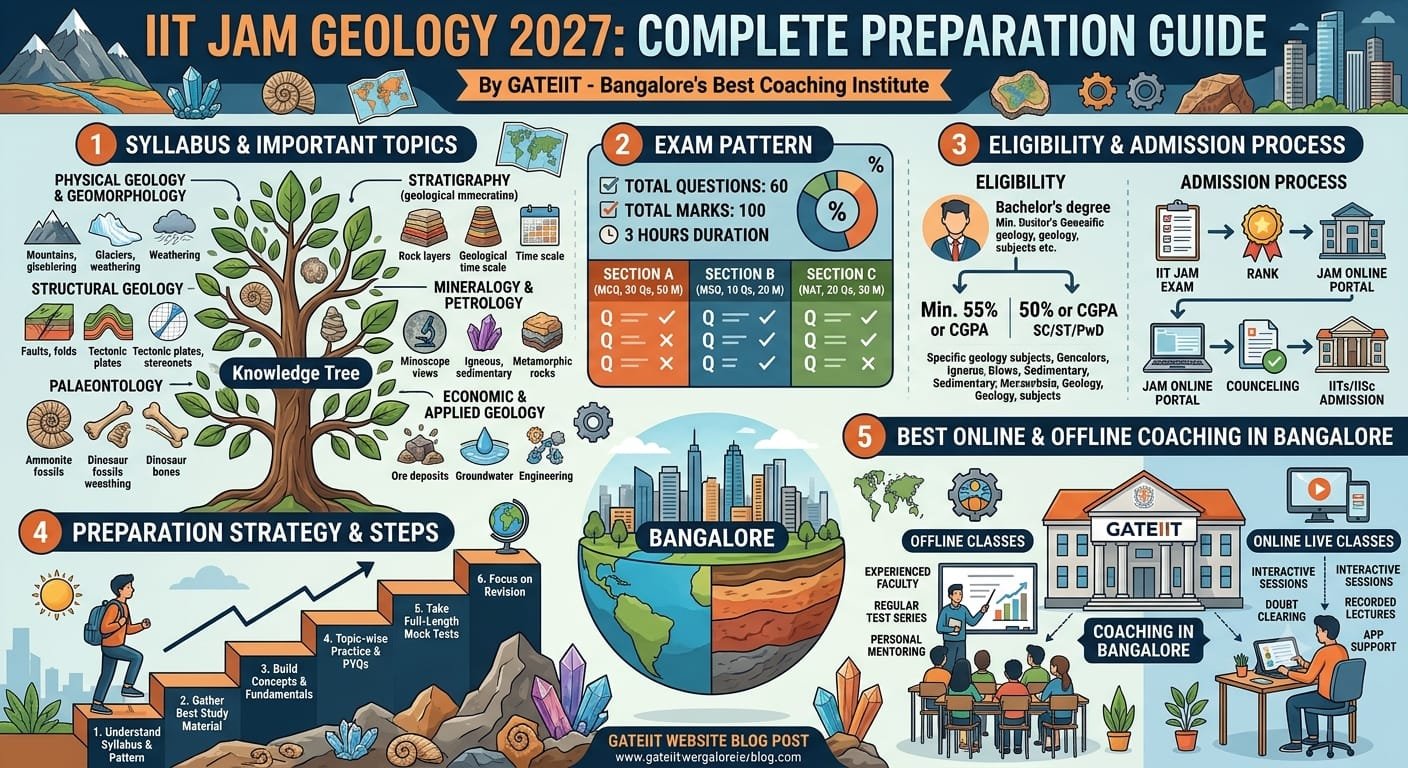
Prepare for IIT JAM Geology 2027 with a complete, structured and personalised preparation strategy. Explore the latest Geology (GG) syllabus, examination dates, eligibility, marking scheme, previous-year question papers, postgraduate admission opportunities, preparation techniques and coaching programmes offered by GATEIIT (Gate Indian Institute of Tutorials), Bangalore.
Are you preparing for IIT JAM Geology 2027? Do you want to secure admission to an IIT, IISc or another reputed postgraduate institution through the Joint Admission Test for Masters? Are you searching for the best IIT JAM Geology coaching in Bangalore, online IIT JAM Geology classes in India, or a short-term Geology crash course?
This comprehensive guide explains everything you need to know about IIT JAM Geology, from understanding the Earth’s structure and mineralogy to mastering petrology, structural geology, palaeontology, stratigraphy and geological applications.
GATEIIT offers structured IIT JAM Geology preparation through long-term programmes, one-year coaching, online live classes, Bangalore classroom coaching, hybrid learning, weekend batches, personalised mentorship and intensive crash courses of 30, 45, 60 and 90 days.
Whether you are a beginner, a B.Sc. Geology student, a final-year undergraduate, a repeater or an aspirant looking for a last-minute score improvement programme, this guide will help you understand the examination and plan your preparation effectively.
1. What Is IIT JAM Geology?
IIT JAM stands for Joint Admission Test for Masters. It is a national-level entrance examination conducted for admission to postgraduate science programmes offered by participating Indian Institutes of Technology and other participating institutions.
The Geology paper is identified by the subject code GG.
IIT JAM Geology evaluates a candidate’s understanding of fundamental and advanced undergraduate-level geological concepts, scientific reasoning, interpretation of geological information and ability to solve conceptual and numerical problems.
The examination tests knowledge across important branches of Earth Science, including:
- General Geology
- Physical Geology
- Geomorphology
- Structural Geology
- Mineralogy
- Crystallography
- Igneous Petrology
- Sedimentary Petrology
- Metamorphic Petrology
- Palaeontology
- Stratigraphy
- Economic Geology
- Applied Geology
- Geological processes and Earth evolution
The examination is particularly suitable for students who wish to pursue postgraduate education in Geology, Earth Sciences, Geological Sciences and related interdisciplinary research areas.
What does IIT JAM Geology help you achieve?
A good JAM Geology score can open opportunities to pursue M.Sc., Joint M.Sc.-Ph.D. and other eligible postgraduate programmes, depending on the participating institution’s programme offerings and admission requirements.
JAM scores are also used by certain result-sharing institutions through their respective admission processes.
Importantly, qualifying in JAM does not automatically guarantee admission. Admission depends on the programme-specific educational requirements, merit, seat availability, category rules and the admission process of the institution.
2. IIT JAM Geology 2027: Latest Examination Details
The following are the important examination details for IIT JAM Geology 2027.
- Examination name: Joint Admission Test for Masters (JAM) 2027
- Subject: Geology
- Subject code: GG
- Examination level: National level
- Organising institute: Indian Institute of Technology Kharagpur
- Examination authority: JAM 2027 Organising Institute
- Examination mode: Computer-Based Test (CBT)
- Examination date: 14 February 2027
- Geology examination session: Forenoon
- Examination timing: 9:30 AM to 12:30 PM
- Examination duration: 3 hours
- Total questions: 60
- Maximum marks: 100
- Question types: MCQ, MSQ and NAT
- Medium: English
- Result date: 18 March 2027
- Official website: https://jam.iitkgp.ac.in/
The JAM 2027 examination is conducted for seven test papers:
- Biotechnology (BT)
- Chemistry (CY)
- Economics (EN)
- Geology (GG)
- Mathematics (MA)
- Mathematical Statistics (MS)
- Physics (PH)
Candidates can appear for a maximum of two test papers, subject to the officially permitted combination and examination-session restrictions.
3. IIT JAM Geology 2027 Important Dates and Schedule
The official JAM 2027 examination calendar contains the following important dates.
- Information brochure: Released
- Online application commencement: 11 September 2026
- Extended application deadline: 24 October 2026
- IIT JAM Geology examination: 14 February 2027
- Geology examination timing: 9:30 AM–12:30 PM
- JAM 2027 result declaration: 18 March 2027
Important application update: The application deadline has passed as of 31 October 2026. Students who have already submitted their applications should regularly check the official website for admit cards, examination instructions, answer keys, results and subsequent admission notifications.
Students preparing for JAM 2028 should begin their preparation early instead of waiting for the next application notification.
4. IIT JAM 2027 Geology Examination Pattern
Understanding the IIT JAM Geology examination pattern is essential for developing an effective preparation strategy.
The examination is conducted through a computer-based test consisting of three compulsory sections.
The paper contains 60 questions carrying a total of 100 marks.
Section A: Multiple Choice Questions (MCQ)
Section A contains 30 multiple-choice questions.
- Questions 1–10 carry 1 mark each.
- Questions 11–30 carry 2 marks each.
- Each question has four options.
- Only one option is correct.
- Negative marking is applicable.
Negative marking:
- Incorrect answer to a 1-mark question: 1/3 mark deducted.
- Incorrect answer to a 2-mark question: 2/3 mark deducted.
Students should avoid random guessing and develop accuracy before attempting uncertain MCQs.
Section B: Multiple Select Questions (MSQ)
Section B contains 10 multiple-select questions.
- Each question carries 2 marks.
- One or more options may be correct.
- There is no negative marking.
- There is no partial marking.
- Full marks require selecting all correct options and no incorrect options.
MSQs require a thorough understanding of concepts because several options may appear scientifically reasonable.
For example, a question on mineral properties may require students to identify all the correct statements concerning hardness, cleavage, crystal structure and chemical composition.
Section C: Numerical Answer Type (NAT)
Section C contains 20 numerical-answer questions.
- Questions 41–50 carry 1 mark each.
- Questions 51–60 carry 2 marks each.
- Answers must be entered using the virtual numerical keyboard.
- There are no multiple-choice options.
- There is no negative marking.
Numerical questions may involve geological calculations, crystallographic relationships, structural geology, geochemistry, physical properties and other quantitative applications within the prescribed syllabus.
Complete IIT JAM Geology Mark Distribution
Section A:
- 30 MCQs
- 50 marks
Section B:
- 10 MSQs
- 20 marks
Section C:
- 20 NAT questions
- 30 marks
Total:
- 60 questions
- 100 marks
- 180 minutes
Important Examination Instructions
Candidates should:
- Download the admit card from the official portal.
- Carry the prescribed photo identification document.
- Reach the examination centre before the reporting deadline.
- Follow all computer-based examination instructions.
- Use only the on-screen virtual calculator where permitted.
- Avoid carrying prohibited electronic devices.
- Carefully read the question instructions before answering.
- Manage time effectively across all three sections.
5. IIT JAM Geology 2027 Eligibility Criteria
One of the most frequently asked questions is: Who can apply for IIT JAM Geology?
The eligibility criteria for appearing in JAM and the eligibility criteria for admission to a particular postgraduate programme are two different matters.
Eligibility to appear for JAM 2027
Candidates who have completed an undergraduate degree or are appearing for the final examination of their qualifying undergraduate degree in 2027 are eligible to appear for JAM 2027, subject to the official examination rules.
Important points:
- Candidates from different undergraduate disciplines may appear for JAM.
- There is no minimum percentage requirement for appearing in JAM 2027.
- There is no upper age limit.
- Candidates with backlogs may appear, subject to the applicable rules.
- Final-year students may apply.
- Foreign nationals are also permitted to apply under the examination rules.
However, appearing for the examination does not automatically establish eligibility for every postgraduate programme.
Who should prepare for IIT JAM Geology?
The following students may consider the Geology paper:
- Sc. Geology students
- Sc. Applied Geology students
- Sc. Earth Science students
- Sc. Geological Science students
- Sc. Physical Science students
- Students from eligible multidisciplinary science backgrounds
- Final-year undergraduate students
- Graduates seeking postgraduate specialisation
- Students interested in geological research and Earth Sciences
The actual eligibility for each admission programme must be checked independently.
Programme-specific eligibility
Different IITs may prescribe different minimum educational qualifications (MEQs).
For example, a particular Geology postgraduate programme may require Geology as a subject for a specified number of semesters, along with prescribed combinations of Physics, Chemistry or Mathematics.
Other programmes may have different qualifying-degree requirements.
Therefore, candidates must check:
- Essential subjects in the qualifying degree.
- Minimum duration of the undergraduate programme.
- Required subject combinations.
- Degree completion requirements.
- Category-specific admission provisions.
- Any additional programme-specific conditions.
Always consult the relevant JAM 2027 admission brochure before filling in admission preferences.
6. IIT JAM Geology 2027 Application Fees
The official JAM 2027 examination application fee is different from the coaching fee charged by private institutes.
The application fee structure is:
Female / SC / ST / PwD candidates:
- One test paper: ₹1,000
- Two test papers: ₹1,350
All other candidates:
- One test paper: ₹2,000
- Two test papers: ₹2,700
The application fee is non-refundable and non-transferable.
Candidates should verify the payment information and category details before submitting their application.
The examination application fee must be paid through the official JOAPS portal.
7. IIT JAM Geology 2027 Complete Syllabus
The IIT JAM Geology syllabus is the foundation of the entire preparation process.
Students should study every prescribed topic systematically rather than concentrating only on a few apparently important chapters.
The following topic-wise guide explains the major areas of Geology that candidates should organise their preparation around. The official JAM 2027 Geology syllabus PDF remains the final authority for the exact prescribed topics.
Unit 1: General Geology and Physical Geology
General Geology introduces the Earth as a dynamic planetary system and explains the geological processes responsible for its evolution.
Important topics include:
- Origin and evolution of the Earth.
- Origin of the solar system.
- Internal structure of the Earth.
- Crust, mantle and core.
- Continental and oceanic crust.
- Lithosphere and asthenosphere.
- Earth’s temperature and pressure distribution.
- Earthquakes and seismic waves.
- Volcanoes and volcanic activity.
- Plate tectonics.
- Continental drift.
- Sea-floor spreading.
- Plate boundaries.
- Convergent, divergent and transform boundaries.
- Geological time and Earth history.
- Weathering and erosion.
- Geological agents and processes.
- Geological cycles.
- Earth materials and their formation.
Students should understand the physical processes behind geological phenomena rather than memorising definitions alone.
Unit 2: Geomorphology
Geomorphology deals with the origin, development and evolution of Earth’s surface features.
Important topics include:
- Weathering: physical, chemical and biological.
- Erosion and transportation.
- Deposition and sediment accumulation.
- Fluvial geomorphology.
- River systems and drainage patterns.
- River valleys and landforms.
- Meanders and oxbow lakes.
- Floodplains and deltas.
- Glacial geomorphology.
- Glacial erosion and depositional landforms.
- Aeolian processes.
- Desert landforms.
- Coastal geomorphology.
- Marine erosion and deposition.
- Karst topography.
- Limestone landscapes.
- Groundwater-related landforms.
- Slope development.
- Mass wasting.
- Geomorphological evolution.
- Topographic maps and contour interpretation.
Students should practise identifying landforms from diagrams and understand the processes responsible for their formation.
Unit 3: Structural Geology
Structural Geology is an important branch of Geology that deals with the deformation, arrangement and structural features of rocks.
Important topics include:
- Stress and strain.
- Types of stress.
- Rock deformation.
- Elastic, plastic and brittle deformation.
- Folds and folding mechanisms.
- Anticlines and synclines.
- Faults and their classification.
- Normal faults.
- Reverse faults.
- Thrust faults.
- Strike-slip faults.
- Joints and fractures.
- Cleavage and foliation.
- Geological structures.
- Strike and dip.
- Apparent dip and true dip.
- Structural measurements.
- Geological maps.
- Cross-section construction.
- Stereographic projection fundamentals.
- Stress-strain relationships.
- Shear zones and structural interpretation.
Practice with geological maps, structural diagrams and numerical problems is essential.
Unit 4: Crystallography and Mineralogy
Crystallography and Mineralogy deal with the internal structure, physical properties, chemical composition and identification of minerals.
Important topics include:
- Introduction to minerals.
- Mineral formation.
- Crystal systems.
- Crystal symmetry.
- Crystal axes.
- Crystal faces.
- Crystal forms.
- Miller indices.
- Lattice structures.
- Unit cells.
- Crystal classes.
- Mineral chemistry.
- Chemical bonding in minerals.
- Mineral identification.
- Physical properties of minerals.
- Specific gravity.
- Crystal habit.
- Optical properties of minerals.
- Silicate structures.
- Non-silicate minerals.
- Important rock-forming minerals
Students should prepare mineral identification charts and understand the relationships between mineral composition, structure and physical properties.
Unit 5: Igneous Petrology
Igneous Petrology focuses on the origin, composition, classification and evolution of igneous rocks.
Important topics include:
- Origin of magma.
- Magma generation.
- Partial melting.
- Magmatic differentiation.
- Fractional crystallisation.
- Magma mixing.
- Bowen’s reaction series.
- Intrusive igneous rocks.
- Extrusive igneous rocks.
- Plutonic rocks.
- Volcanic rocks.
- Hypabyssal rocks.
- Classification of igneous rocks.
- Acidic, intermediate, basic and ultrabasic rocks.
- Txtures of igneous rocks.
- Mineral composition.
- Igneous structures.
- Magmatic processes.
Understanding the relationship between magma composition, cooling rate, texture and mineral assemblages is particularly useful.
Unit 6: Sedimentary Petrology
Sedimentary Petrology studies the origin, transportation, deposition and lithification of sediments.
Important topics include:
- Weathering of source rocks.
- Sediment formation.
- Sediment transportation.
- Sedimentary environments.
- Sedimentary basins.
- Deposition and sedimentation.
- Sedimentary textures.
- Grain size and sorting.
- Roundness and sphericity.
- Sedimentary structures.
- Bedding and lamination.
- Cross-bedding.
- Ripple marks.
- Mud cracks.
- Graded bedding.
- Clastic sedimentary rocks.
- Chemical sedimentary rocks.
- Biochemical sedimentary rocks.
- Sandstone classification.
- Depositional environments.
Students should practise distinguishing sedimentary rocks using their texture, mineral composition and structures.
Unit 7: Metamorphic Petrology
Metamorphic Petrology explains how pre-existing rocks transform under changing temperature, pressure and chemical conditions.
Important topics include:
- Definition and processes of metamorphism.
- Factors controlling metamorphism.
- Temperature and pressure conditions.
- Regional metamorphism.
- Contact metamorphism.
- Dynamic metamorphism.
- Hydrothermal metamorphism.
- Metamorphic grades.
- Metamorphic facies.
- Index minerals.
- Metamorphic reactions.
- Metamorphic textures.
- Gneissic banding.
- Mtamorphic mineral assemblages.
- Metamorphic evolution.
- P-T conditions and interpretation.
Understanding metamorphic facies and the relationship between pressure, temperature and mineral assemblages is important.
Unit 8: Palaeontology
Palaeontology studies ancient life through fossils and helps reconstruct the history of life and the geological evolution of the Earth.
Important topics include:
- Introduction to fossils.
- Fossil formation.
- Fossil preservation.
- Modes of fossilisation.
- Body fossils.
- Trace fossils.
- Fossil classification.
- Geological significance of fossils.
- Index fossils.
- Evolution of life.
- Geological applications of fossils.
- Fossil assemblages.
- Stratigraphic correlation.
- Important fossil groups.
- Invertebrate fossils.
- Vertebrate fossils.
- Plant fossils.
- Basic principles of palaeobiology.
Students should learn important fossil groups, their identifying characteristics and geological significance.
Unit 9: Stratigraphy
Stratigraphy is concerned with the chronological arrangement, correlation and interpretation of rock sequences.
Important topics include:
- Principles of stratigraphy.
- Law of superposition.
- Original horizontality.
- Lateral continuity.
- Cross-cutting relationships.
- Geological succession.
- Relative dating.
- Absolute dating.
- Stratigraphic correlation.
- Sequence stratigraphy fundamentals.
- Geological time scale.
- Precambrian history.
- Indian stratigraphy.
- Major Indian geological formations.
- Stratigraphic classification.
- Depositional history.
- Basin evolution.
- Important geological groups of India.
Indian stratigraphy deserves particular attention because geological formations and their age relationships are important components of undergraduate Geology.
Unit 10: Economic Geology
Economic Geology deals with geological materials and processes that are important for mineral resources and industrial development.
Important topics include:
- Mineral resources.
- Ore deposits.
- Mineral exploration.
- Ore-forming processes.
- Magmatic deposits.
- Hydrothermal deposits.
- Sedimentary deposits.
- Residual deposits.
- Metamorphic deposits.
- Metallic minerals.
- Non-metallic minerals.
- Ferrous minerals.
- Non-ferrous minerals.
- Precious metals.
- Industrial minerals.
- Coal and petroleum basics.
- Ore textures and structures.
- Mineral resource distribution.
- Geological controls of mineralisation.
- Economic importance of mineral deposits.
Students should understand the origin, occurrence and economic importance of important mineral deposits.
Unit 11: Applied Geology and Geological Applications
Applied Geology connects geological knowledge with engineering, environmental protection, groundwater, mineral exploration and resource management.
Important areas include:
- Engineering Geology.
- Environmental Geology.
- Hydrogeology fundamentals.
- Groundwater occurrence.
- Aquifers and aquitards.
- Porosity and permeability.
- Groundwater movement.
- Geological hazards.
- Earthquake-related hazards.
- Soil erosion.
- Remote sensing fundamentals.
- Geological mapping.
- Mineral exploration methods.
- Geophysical exploration fundamentals.
- Geological resource management.
- Sustainable development.
Candidates should use this section to strengthen their understanding of how geological principles are applied in real-world situations.
8. How to Prepare for IIT JAM Geology 2027
The most effective IIT JAM Geology preparation strategy combines conceptual understanding, numerical problem-solving, previous-year question practice, regular revision and mock examinations.
Students should not depend exclusively on memorising textbook content.
Geology is a subject that combines scientific concepts, visual interpretation, classification, geological history and quantitative reasoning.
A successful preparation strategy should therefore develop five important abilities:
- Conceptual understanding.
- Geological interpretation.
- Scientific reasoning.
- Numerical accuracy.
- Examination speed and time management.
Step 1: Understand the Complete Syllabus
Begin by downloading the official JAM 2027 Geology syllabus.
Divide the syllabus into individual chapters and prepare a checklist.
Mark every topic as:
- Not started.
- Currently studying.
- Test-ready.
This prevents important chapters from being overlooked.
Step 2: Build Strong Fundamental Concepts
Students with weak fundamentals should begin with introductory concepts.
For example:
- Understand mineral identification before studying advanced mineral chemistry.
- Understand crystal systems before solving crystallographic problems.
- Learn basic geological structures before attempting complex structural interpretation.
- Understand rock classification before studying petrogenesis.
- Learn stratigraphic principles before studying geological successions.
A strong conceptual foundation reduces the time needed for revision.
Step 3: Prepare Topic-Wise Notes
Create concise revision notes for each chapter.
Your notes should contain:
- Important definitions.
- Scientific principles.
- Classification charts.
- Geological diagrams.
- Mineral properties.
- Rock characteristics.
- Geological time relationships.
- Important formulae.
- Frequently tested concepts.
- Common mistakes.
- Previous-year question references.
Visual notes are particularly helpful in Geology.
Step 4: Practise Previous-Year Question Papers
Previous-year questions are essential for understanding the examination’s actual level.
Students should solve available IIT JAM Geology question papers from previous years.
Analyse each question carefully.
Ask yourself:
- Which concept is being tested?
- Which chapter does the question belong to?
- Is it a direct conceptual question?
- Does it require numerical calculations?
- Does it involve geological interpretation?
- Can the same concept be tested in another way?
Maintain a separate notebook for difficult questions and incorrect answers.
Step 5: Develop Numerical Problem-Solving Skills
Students should practise numerical problems regularly.
Important areas for quantitative practice include:
- Geological calculations.
- Crystallographic relationships.
- Structural geology calculations.
- Map interpretation.
- Mineralogical calculations.
- Petrological relationships.
- Physical properties.
- Other quantitative applications prescribed in the syllabus.
Do not postpone numerical practice until the final month.
Step 6: Attempt Regular Mock Tests
Mock examinations help students understand their preparation level.
A good mock-test programme should include:
- Chapter-wise tests.
- Unit-wise tests.
- Section-wise tests.
- Mixed-topic tests.
- Full-length examinations.
- Previous-year paper simulations.
After each test, analyse:
- Correct answers.
- Incorrect answers.
- Unattempted questions.
- Time spent per question.
- Negative marks.
- Weak chapters.
- Repeated conceptual errors.
The objective is not merely to complete more tests but to improve performance after every test.
Step 7: Revise Repeatedly
Revision is essential because the Geology syllabus contains a large amount of interconnected information.
Prepare at least three levels of revision:
First revision: Complete chapter-wise revision.
Second revision: Important concepts, diagrams, classifications and previous-year questions.
Final revision: Formulae, short notes, difficult topics and mock-test mistakes.
9. IIT JAM Geology Preparation Timetable
A practical study timetable should balance learning, revision and testing.
For a student with approximately 6 months available, the following is a suggested preparation model.
Months 1–2:
- Complete General Geology.
- Study Geomorphology.
- Develop Mineralogy fundamentals.
- Begin Structural Geology.
- Solve basic conceptual questions.
Months 3–4:
- Complete Igneous Petrology.
- Study Sedimentary Petrology.
- Study Metamorphic Petrology.
- Complete Palaeontology.
- Begin Stratigraphy.
- Practise topic-wise PYQs.
Month 5:
- Complete Economic Geology.
- Revise Applied Geology.
- Strengthen difficult chapters.
- Solve mixed-topic question sets.
- Attempt sectional tests.
Month 6:
- Complete comprehensive revision.
- Solve full-length mock examinations.
- Analyse mistakes.
- Improve speed and accuracy.
- Revise frequently tested concepts.
- Practise the examination interface and time management.
This is a suggested plan, not a compulsory sequence. Students should adapt it to their existing subject knowledge and available preparation time.
10. Best Books for IIT JAM Geology Preparation
Selecting appropriate reference books is important, but purchasing too many books can make preparation unnecessarily complicated.
Students should use the prescribed syllabus as their primary guide and select reference books that explain the relevant concepts clearly.
Recommended reference books include:
General Geology
- Physical Geology by Arthur Holmes.
- Essentials of Geology by Frederick K. Lutgens and Edward J. Tarbuck.
- Principles of Physical Geology by Arthur Holmes.
Geomorphology
- Principles of Geomorphology by William D. Thornbury.
- Geomorphology by Savindra Singh.
Structural Geology
- Structural Geology by Marland P. Billings.
- Structural Geology by Haakon Fossen.
Mineralogy and Crystallography
- An Introduction to the Rock-Forming Minerals by W. A. Deer, R. A. Howie and J. Zussman.
- Manual of Mineral Science by Cornelis Klein and Barbara Dutrow.
Igneous and Metamorphic Petrology
- Igneous and Metamorphic Petrology by Myron G. Best.
- Petrology: Igneous, Sedimentary, and Metamorphic by Harvey Blatt, Robert Tracy and Brent Owens.
Sedimentary Petrology
- Principles of Sedimentology and Stratigraphy by Sam Boggs Jr.
Palaeontology
- Invertebrate Palaeontology and Evolution by Euan N. K. Clarkson.
Stratigraphy
- Principles of Stratigraphy by W. C. Krumbein and L. L. Sloss.
Economic Geology
- Economic Mineral Deposits by Alan M. Bateman.
- Ore Deposit Geology by John Ridley.
Students need not read every book from cover to cover. Select the relevant chapters, compare them with the official syllabus and use standard undergraduate notes for quick revision.
11. Common Mistakes to Avoid in IIT JAM Geology Preparation
Even well-prepared students can lose marks because of avoidable mistakes.
Common mistakes include:
- Studying without referring to the official syllabus.
- Ignoring fundamental concepts.
- Memorising mineral classifications without understanding them.
- Neglecting structural geology diagrams.
- Avoiding numerical problems.
- Ignoring Indian stratigraphy.
- Studying only theory without practising questions.
- Solving previous-year papers without analysing mistakes.
- Ignoring MSQ question requirements.
- Guessing excessively in MCQs.
- Not revising completed chapters.
- Taking mock tests without analysing performance.
- Using too many reference books.
- Preparing without a realistic timetable.
- Starting revision too late.
The best approach is consistent study with measurable improvement.
12. IIT JAM Geology Score Improvement Strategy
A good score is the result of a combination of subject knowledge, accuracy, time management and question-selection ability.
Students should focus on the following:
Concept mastery: Understand why a geological process occurs rather than simply memorising its definition.
Diagram-based learning: Practise geological structures, crystal systems, rock textures and geomorphological features.
Classification-based revision: Create comparison tables for minerals, rocks, fossils and geological formations.
Numerical practice: Regularly solve questions involving calculations and quantitative interpretation.
MCQ accuracy: Avoid unnecessary negative marking.
MSQ precision: Evaluate every option independently.
NAT confidence: Practise entering numerical answers accurately.
Mock-test analysis: Track performance across different chapters and identify recurring weaknesses.
13. IIT JAM Geology Admission Opportunities After Qualifying JAM
One of the most important reasons to prepare for IIT JAM Geology is the opportunity to pursue advanced postgraduate education at reputed institutions.
Depending on the admission year, programme availability and eligibility conditions, JAM scores may be considered for:
- Sc. Geology.
- Sc. Applied Geology.
- Sc. Geological Sciences.
- Joint M.Sc.-Ph.D. in Geology.
- Earth and Atmospheric Sciences.
- Other related interdisciplinary programmes.
The precise programme list changes according to the admission cycle.
JAM 2027 provides access to 89 postgraduate programmes across 23 participating IITs in different disciplines. Not all 89 programmes are Geology programmes.
Important IITs and participating institutions
The participating IITs include:
- IIT Bhubaneswar.
- IIT Bombay.
- IIT Delhi.
- IIT (ISM) Dhanbad.
- IIT Gandhinagar.
- IIT Guwahati.
- IIT Hyderabad.
- IIT Indore.
- IIT Jodhpur.
- IIT Kanpur.
- IIT Kharagpur.
- IIT Madras.
- IIT Roorkee.
- IIT (BHU) Varanasi.
- Other participating IITs.
The exact Geology programme availability and admission requirements must be checked in the official admission brochure.
How does the IIT JAM admission process work?
The admission process generally involves:
- Appearing for the JAM examination.
- Checking the JAM result and scorecard.
- Reviewing the admission brochure.
- Checking programme-specific MEQ requirements.
- Registering for the applicable admission process.
- Selecting eligible programme preferences.
- Participating in the centralised admission process or the relevant institutional process.
- Checking admission offers and allocation rounds.
- Accepting the allotted seat.
- Completing document verification and fee payment.
Some result-sharing institutions use JAM scores through their own admission processes, including CCMN where applicable.
Does qualifying in IIT JAM guarantee admission?
No.
A candidate may qualify in JAM but still not receive admission to a preferred programme.
Admission depends on:
- JAM merit and rank.
- Available seats.
- Programme eligibility.
- Preference order.
- Admission-round rules.
- Institutional selection criteria.
Candidates should prepare with the objective of obtaining the best possible rank rather than targeting only the qualifying cutoff.
14. Career Opportunities After M.Sc. Geology
Geology offers opportunities in scientific research, mineral exploration, natural resource management, environmental assessment, infrastructure development and Earth Science-related industries.
After completing a relevant postgraduate degree, candidates may explore opportunities in:
Geological Survey and Research
- Geological mapping.
- Earth Science research.
- Mineral exploration.
- Geological investigations.
- Scientific research projects.
Mining and Mineral Industries
- Mineral exploration.
- Ore deposit evaluation.
- Mining geology.
- Resource assessment.
- Mine planning support.
Oil and Gas Industries
- Petroleum geology.
- Sedimentary basin analysis.
- Subsurface geological interpretation.
- Exploration support.
Environmental and Hydrogeological Sectors
- Groundwater investigations.
- Environmental geology.
- Water resource assessment.
- Geological hazard assessment.
- Environmental monitoring.
Engineering and Infrastructure
- Engineering geology.
- Geotechnical investigations.
- Foundation studies.
- Dam and tunnel investigations.
- Slope stability studies.
Academics and Research
- Research assistantships.
- D. programmes.
- University teaching after meeting applicable qualifications.
- Scientific publications.
- Advanced Earth Science research.
Potential employers and organisations may include GSI, ONGC, CSIR laboratories, government geological departments, mining organisations, environmental consultancies and research institutions, subject to their respective recruitment requirements.
A postgraduate degree alone does not guarantee a government job or employment. Recruitment examinations, experience, technical skills and additional eligibility requirements may apply.
15. Why Choose GATEIIT for IIT JAM Geology Coaching?
GATEIIT (Gate Indian Institute of Tutorials) provides IIT JAM Geology coaching through structured academic programmes designed for students with different levels of preparation.
Our approach focuses on building conceptual clarity, developing examination skills, identifying weak areas and providing individual academic support.
Students can choose online coaching from anywhere in India or classroom coaching at the GATEIIT Bangalore centre.
GATEIIT’s IIT JAM Geology preparation is designed to support both long-term learners and students requiring intensive short-term preparation.
What makes GATEIIT’s Geology coaching different?
- Concept-to-Core Teaching
The programme begins with fundamental concepts and gradually progresses towards advanced topics.
Students are guided through:
- Basic geological concepts.
- Mineral identification.
- Structural interpretation.
- Geological applications.
- Examination-oriented problem-solving.
- Personal Attention
Students receive individual academic attention to help identify conceptual difficulties and improve their understanding.
- Personal Mentorship
Mentorship helps students organise their preparation, follow realistic targets and monitor progress.
- Personalised and Customised Learning
Students can discuss their academic background, available preparation time and weak chapters to develop a suitable learning plan.
- One-to-One Doubt Clearing
Individual doubt-solving support helps students clarify difficult concepts without allowing unresolved doubts to accumulate.
- Live Interactive Classes
Students can interact with faculty during online or classroom sessions and seek clarification.
- Recorded Classes
Recorded sessions provide additional revision support and help students revisit difficult topics.
- Chapter-Wise Tests
Regular assessments help students measure their understanding of individual chapters.
- Daily Practice Papers
Daily practice questions develop consistency and strengthen problem-solving ability.
- Previous-Year Question Analysis
Previous-year questions are discussed to help students understand question patterns and recurring concepts.
- Full-Length Mock Tests
Mock examinations help students practise the actual examination structure.
- Performance Analysis
Test analysis helps identify:
- Weak topics.
- Incorrect answers.
- Accuracy issues.
- Time-management problems.
- Chapters requiring revision.
- Areas needing additional practice.
16. IIT JAM Geology Courses Offered by GATEIIT
GATEIIT offers different learning formats to accommodate students at different preparation stages.
A. One-Year IIT JAM Geology Coaching Programme
<PRIVATE_PERSON> Long-term preparation is particularly suitable for students who want comprehensive syllabus coverage and sufficient time for repeated revision.
The one-year programme may include:
- Complete Geology syllabus coverage.
- Fundamentals-to-advanced teaching.
- Regular live classes.
- Chapter-wise assignments.
- Topic-wise tests.
- Previous-year question discussions.
- Daily practice questions.
- Regular doubt-clearing sessions.
- Personal mentorship.
- Revision classes.
- Full-length mock examinations.
- Performance monitoring.
The programme is suitable for students beginning their JAM preparation well in advance.
B. IIT JAM Geology 90-Day Crash Course
The 90-day crash course is suitable for students who have some familiarity with Geology and require structured examination preparation.
The programme focuses on:
- Systematic syllabus coverage.
- Important conceptual topics.
- High-priority chapters.
- Previous-year question practice.
- Numerical problem-solving.
- Regular tests.
- Mock examination preparation.
C. IIT JAM Geology 60-Day Crash Course
The 60-day programme is designed for students who need an intensive preparation schedule.
It focuses on:
- Important chapters.
- Rapid conceptual revision.
- Frequently tested concepts.
- Chapter-wise tests.
- Doubt resolution.
- Full-length mock examinations.
- Score improvement.
D. IIT JAM Geology 45-Day Crash Course
The 45-day programme is suitable for students who have completed a significant portion of the syllabus and require focused revision and practice.
The emphasis is on:
- High-priority syllabus coverage.
- Important diagrams and classifications.
- Formula revision.
- PYQ analysis.
- Timed practice.
- Mock examinations.
- Individual performance review.
E. IIT JAM Geology 30-Day Crash Course
The 30-day programme is intended for last-stage preparation.
It is especially useful for candidates who have already studied most of the syllabus and want to improve their examination readiness.
The programme may focus on:
- Rapid revision.
- Important concepts.
- Frequently tested topics.
- Difficult-question practice.
- Previous-year papers.
- Mock tests.
- Time management.
- Accuracy improvement.
- Last-minute doubt resolution.
A 30-day programme should not be considered a substitute for a full foundational course for students who are starting Geology from scratch.
17. GATEIIT IIT JAM Geology Coaching Fee Structure
GATEIIT provides multiple course durations and learning options so that students can select a programme according to their preparation requirements.
The advertised crash-course fee range is approximately ₹5,000 to ₹16,000, depending on the duration, learning format and selected academic support.
Indicative programme structure:
- 30-Day Crash Course: Starting from ₹5,000.
- 45-Day Crash Course: Fee according to selected programme.
- 60-Day Crash Course: Fee according to selected programme.
- 90-Day Crash Course: Up to the applicable programme fee within the advertised range.
The exact fee, batch availability, inclusions and applicable discounts should be confirmed with the GATEIIT admissions team before enrolment.
Long-term one-year programmes, individual coaching and customised mentorship programmes may have separate fee structures.
Scholarship and Fee Concessions
GATEIIT provides scholarship opportunities and fee discounts of up to 100%, based on performance in the applicable scholarship test and the institute’s scholarship policy.
Scholarships may be considered based on:
- Scholarship examination score.
- Academic performance.
- Subject knowledge.
- Eligibility conditions.
- Available scholarship provisions.
A 100% scholarship is not automatic and is subject to the applicable selection criteria and approval.
Students are encouraged to enquire about scholarship tests before taking admission.
18. Online IIT JAM Geology Coaching Across India
Students do not need to relocate to Bangalore to attend GATEIIT’s online IIT JAM Geology classes.
GATEIIT provides online learning opportunities for aspirants throughout India.
Students from the following cities and regions can enquire about online coaching:
- Other cities and towns across India.
Online programmes may include:
- Live interactive classes.
- Recorded lectures.
- Digital study material.
- Online practice tests.
- Mock examinations.
- Online doubt-solving.
- Personal mentorship.
- Academic progress monitoring.
- Mobile and computer access.
Students can attend classes using a suitable smartphone, tablet, laptop or desktop with a reliable internet connection.
19. Offline IIT JAM Geology Coaching in Bangalore
Students who prefer face-to-face classroom learning can enquire about offline IIT JAM Geology coaching at the GATEIIT Bangalore centre.
Classroom learning can be beneficial for students who prefer direct interaction with faculty, a structured study environment and regular academic supervision.
GATEIIT Bangalore Centre
GATEIIT – Gate Indian Institute of Tutorials
3rd Floor, #1743, Sri Raghavendra Plaza,
17th Main Road, JP Nagar 2nd Phase,
Bangalore – 560078, Karnataka, India.
Phone / WhatsApp:
8884416154
8884416155
Website: www.gateiit.com
Google Maps location:
https://maps.app.goo.gl/MtzbVkqywCkwKcc4A
Students are advised to contact the institute to confirm the availability of the Geology classroom batch, faculty schedule and admission arrangements.
20. Regular, Weekend and Flexible IIT JAM Geology Classes
Students have different academic schedules.
Some are full-time graduates, while others may be completing their undergraduate examinations, working on projects or preparing for multiple competitive examinations.
GATEIIT offers flexible learning arrangements, subject to batch availability.
Possible options include:
Regular Batches
Suitable for students who want consistent academic instruction throughout the week.
Weekend Batches
Suitable for students who have college or other academic commitments during weekdays.
Three-Days-a-Week Classes
A flexible arrangement for students who need a balanced schedule.
Six-Days-a-Week Classes
Suitable for intensive preparation and comprehensive syllabus coverage.
Individual Personal Coaching
Suitable for students who need customised teaching schedules and individual attention.
Fast-Track Coaching
Designed for students who want focused preparation within a limited period.
21. GATEIIT Score Booster Programme for IIT JAM Geology
The Score Booster Programme is intended for students who have already studied the syllabus but need to improve their performance in competitive examinations.
Many students know the concepts but struggle to convert their knowledge into marks.
This may happen because of:
- Incomplete revision.
- Weak question selection.
- Inaccurate calculations.
- Poor time management.
- Confusion in MSQ questions.
- Excessive guessing.
- Inadequate mock-test practice.
GATEIIT’s Score Booster approach focuses on identifying these performance gaps.
The programme may include:
- Initial preparation assessment.
- Chapter-wise performance analysis.
- Identification of weak topics.
- Focused concept revision.
- Previous-year question practice.
- Numerical problem-solving.
- Timed sectional tests.
- Full-length mock examinations.
- Detailed answer discussions.
- Personal improvement recommendations.
The objective is to improve accuracy, confidence and examination readiness through consistent practice.
22. Personal Mentorship and One-to-One IIT JAM Geology Coaching
Every student has a different academic background.
A student who has studied Geology for three years may require a different preparation strategy from someone who is new to the subject.
Similarly, a repeater who has already attempted JAM may need more attention to question analysis, time management and weak areas.
GATEIIT provides personalised academic support options.
Depending on the selected programme, students can enquire about:
- One-to-one teaching.
- Individual doubt-clearing sessions.
- Personal academic mentorship.
- Customised study plans.
- Flexible class schedules.
- Topic-specific teaching.
- Weak-chapter improvement.
- Individual progress monitoring.
- Special revision sessions.
- Personal test analysis.
The purpose of individual coaching is to ensure that students receive appropriate academic support according to their learning requirements.
23. Free Academic Add-Ons and Student Support at GATEIIT
GATEIIT aims to provide additional learning resources that help students prepare beyond their regular classroom or online sessions.
Depending on the selected course and enrolment terms, complimentary academic support may include:
- Access to selected online study material.
- Digital notes.
- Practice questions.
- Daily Practice Papers (DPPs).
- Chapter-wise assignments.
- Selected online tests.
- Revision worksheets.
- Recorded class access.
- Learning application access.
- Academic announcements.
- Doubt-clearing support.
- Preparation guidance.
- Study-plan assistance.
- Examination strategy sessions.
- Performance feedback.
- Previous-year question discussions.
- Selected mock-test resources.
Students should confirm the exact complimentary services included in their chosen programme.
Free Guidance Before Admission
Students can also enquire about the following academic guidance services:
- Free Course Counselling
Understand the different IIT JAM Geology preparation options.
- Preparation-Level Discussion
Discuss your current preparation level and academic background.
- Course Selection Assistance
Identify a suitable preparation duration.
- Syllabus Guidance
Understand the major units and preparation sequence.
- Study Strategy Discussion
Learn how to organise your daily study schedule.
- Scholarship Enquiry
Understand the scholarship examination and fee concession procedure.
- Demo Class Enquiry
Request information about available introductory or demo sessions.
- Admission Assistance
Understand course enrolment, batch timing and learning options.
24. IIT JAM Geology Coaching: Who Should Join GATEIIT?
GATEIIT’s Geology programmes may be suitable for:
- Sc. Geology students.
- Sc. Applied Geology students.
- Undergraduate Earth Science students.
- Final-year science students.
- Students preparing for JAM 2028.
- Students seeking early preparation for JAM 2029.
- Repeaters preparing for another attempt.
- Students requiring individual coaching.
- Students who prefer online classes.
- Students looking for classroom coaching in Bangalore.
- Students seeking weekend coaching.
- Students requiring short-term crash courses.
- Students who want to improve their mock-test scores.
- Students needing systematic revision.
The right programme should be selected according to the student’s actual subject knowledge, remaining preparation time and learning requirements.
25. IIT JAM Geology 2027: Last-Minute Preparation Strategy
With the Geology examination scheduled for 14 February 2027, students should organise the remaining preparation period carefully.
For candidates who have already completed the application process, the following strategy can help.
November 2026
- Consolidate syllabus coverage.
- Complete remaining major chapters.
- Revise Mineralogy and Petrology.
- Strengthen Structural Geology.
- Solve previous-year questions.
- Begin regular sectional tests.
December 2026
- Complete remaining syllabus portions.
- Focus on Stratigraphy and Palaeontology.
- Revise Geomorphology and General Geology.
- Practise numerical questions.
- Attempt mixed-topic tests.
- Identify weak chapters.
January 2027
- Complete comprehensive revision.
- Attempt regular full-length mock tests.
- Analyse incorrect answers.
- Practise MCQ, MSQ and NAT questions.
- Improve time management.
- Revise short notes and diagrams.
February 2027
- Avoid unnecessary new reference books.
- Revise important concepts.
- Review mock-test mistakes.
- Practise examination timing.
- Maintain a balanced routine.
- Follow the official admit-card instructions.
A well-planned final revision can make a significant difference to examination performance.
26. How to Enrol in GATEIIT IIT JAM Geology Coaching
Students interested in joining GATEIIT can follow these steps:
Step 1: Contact GATEIIT through phone, WhatsApp or the official website.
Step 2: Explain your academic background and preparation requirements.
Step 3: Discuss the available one-year, 90-day, 60-day, 45-day and 30-day programmes.
Step 4: Select online, offline, hybrid, weekend or personalised coaching according to availability.
Step 5: Enquire about the applicable course fees.
Step 6: Ask about scholarship tests and available fee concessions.
Step 7: Confirm the course inclusions, class schedule and admission procedure.
Step 8: Complete the enrolment process.
Step 9: Begin your preparation with the prescribed study plan.
Contact GATEIIT for IIT JAM Geology Admissions
Phone: 8884416154
WhatsApp: 8884416155
Website: www.gateiit.com
Bangalore Centre: JP Nagar 2nd Phase, Bengaluru.
Google Maps: https://maps.app.goo.gl/MtzbVkqywCkwKcc4A
27. Frequently Asked Questions About IIT JAM Geology 2027 – 40 Important FAQs
FAQ 1. What is IIT JAM Geology?
IIT JAM Geology is a national-level postgraduate entrance examination paper conducted under the Joint Admission Test for Masters. It evaluates undergraduate-level Geology knowledge and is used for admission to eligible postgraduate programmes.
FAQ 2. What is the subject code for IIT JAM Geology?
The subject code for IIT JAM Geology is GG.
FAQ 3. Who is conducting IIT JAM 2027?
IIT Kharagpur is the organising institute for IIT JAM 2027.
FAQ 4. When will IIT JAM Geology 2027 be conducted?
The examination will be conducted on 14 February 2027.
FAQ 5. What is the examination timing for IIT JAM Geology 2027?
The Geology paper is scheduled from 9:30 AM to 12:30 PM in the forenoon session.
FAQ 6. What is the duration of the IIT JAM Geology examination?
The examination duration is three hours.
FAQ 7. What is the total mark for IIT JAM Geology?
The IIT JAM Geology paper carries 100 marks.
FAQ 8. How many questions are asked in IIT JAM Geology?
The examination contains 60 questions divided into MCQ, MSQ and NAT sections.
FAQ 9. Is IIT JAM Geology conducted online or offline?
It is conducted as a Computer-Based Test. Candidates answer questions on a computer at an examination centre.
FAQ 10. Is there negative marking in IIT JAM Geology?
Negative marking applies only to Section A MCQs. There is no negative marking in Sections B and C.
FAQ 11. What is the IIT JAM Geology syllabus?
The syllabus covers major geological subjects such as General Geology, Geomorphology, Structural Geology, Mineralogy, Crystallography, Petrology, Palaeontology, Stratigraphy, Economic Geology and related areas.
FAQ 12. Can B.Sc. Geology students apply for IIT JAM?
Yes. B.Sc. Geology students can apply, provided they satisfy the examination requirements and the relevant programme-specific admission eligibility.
FAQ 13. Can final-year students apply for JAM 2027?
Yes. Candidates appearing for their qualifying undergraduate degree examination in 2027 are eligible to apply, subject to the prescribed conditions.
FAQ 14. Is there any age limit for IIT JAM?
There is no upper age limit for appearing in JAM 2027.
FAQ 15. Is there any minimum percentage required for IIT JAM 2027?
There is no minimum percentage requirement for appearing in JAM 2027. However, individual postgraduate programmes may have their own admission requirements.
FAQ 16. Can students from other science backgrounds apply for JAM Geology?
Yes, candidates from other undergraduate disciplines may appear for the examination. However, admission to a particular Geology programme depends on its prescribed MEQ.
FAQ 17. What is the application fee for IIT JAM 2027?
For one test paper, the fee is ₹1,000 for Female/SC/ST/PwD candidates and ₹2,000 for other candidates. Two-paper fees are ₹1,350 and ₹2,700 respectively.
FAQ 18. Has the IIT JAM 2027 application deadline passed?
Yes. The extended deadline was 24 October 2026. Candidates should monitor the official website for subsequent examination updates.
FAQ 19. When will the IIT JAM 2027 result be declared?
The scheduled result date is 18 March 2027.
FAQ 20. Can I get admission to IITs after qualifying in JAM Geology?
Yes, eligible candidates can apply for postgraduate programmes offered by participating institutions. Admission depends on rank, eligibility, preferences and seat availability.
FAQ 21. Does qualifying in JAM guarantee an IIT seat?
No. Qualification alone does not guarantee admission. The final selection depends on the relevant admission criteria and merit.
FAQ 22. Which books are best for IIT JAM Geology preparation?
Standard books by Holmes, Thornbury, Fossen, Klein and Dutrow, Best, Boggs, Clarkson and other recognised authors can be useful. Students should select books according to the prescribed syllabus.
FAQ 23. How many months are required to prepare for IIT JAM Geology?
The preparation period depends on the student’s background. A structured preparation period of 6–12 months is useful for many students, while those with strong fundamentals may need a shorter revision programme.
FAQ 24. Can I crack IIT JAM Geology in three months?
Yes, it may be possible for students with an adequate foundation and disciplined preparation. A 90-day programme should include syllabus revision, PYQs, mock tests and focused doubt resolution.
FAQ 25. How should beginners prepare for IIT JAM Geology?
Beginners should start with General Geology, mineralogy fundamentals and basic geological concepts before moving towards advanced topics. Regular practice and structured guidance are important.
FAQ 26. How important are previous-year question papers?
Previous-year papers help students understand question formats, test conceptual knowledge and identify important areas requiring additional practice.
FAQ 27. Is IIT JAM Geology difficult?
The difficulty depends on a student’s conceptual preparation, numerical ability and examination practice. Students with systematic preparation can improve their performance substantially.
FAQ 28. Which topics should I prioritise in IIT JAM Geology?
Students should give sufficient attention to Mineralogy, Petrology, Structural Geology, Stratigraphy, Geomorphology, Palaeontology and General Geology while completing the entire prescribed syllabus.
FAQ 29. Which is the best IIT JAM Geology coaching in Bangalore?
Students should compare faculty expertise, syllabus coverage, class schedules, individual attention, test series, study material and doubt-clearing facilities. GATEIIT offers online and classroom IIT JAM Geology coaching in Bangalore.
FAQ 30. Does GATEIIT provide online IIT JAM Geology coaching throughout India?
Yes. Students from different parts of India can enquire about GATEIIT’s online Geology coaching programmes.
FAQ 31. Does GATEIIT offer offline Geology coaching in Bangalore?
Yes. GATEIIT offers classroom coaching at its JP Nagar 2nd Phase centre, subject to batch availability.
FAQ 32. What are the course durations available at GATEIIT?
GATEIIT offers a one-year long-term programme and short-term crash courses of 30, 45, 60 and 90 days.
FAQ 33. What is the fee for IIT JAM Geology crash courses at GATEIIT?
The advertised crash-course fee range is approximately ₹5,000–₹16,000, depending on duration and selected learning option. Contact the institute for the current applicable fee.
FAQ 34. Does GATEIIT provide weekend IIT JAM Geology classes?
Weekend learning options are available subject to batch scheduling and enrolment requirements.
FAQ 35. Does GATEIIT provide personal mentorship?
Yes. Students can enquire about individual academic guidance, personal mentorship and customised preparation support.
FAQ 36. Are one-to-one doubt-clearing sessions available?
GATEIIT provides individual doubt-resolution options depending on the selected programme.
FAQ 37. Does GATEIIT provide study material and mock tests?
Yes. GATEIIT’s Geology programme includes academic study resources, practice questions, assignments and test preparation support, according to the selected course.
FAQ 38. Can I get a scholarship for IIT JAM Geology coaching at GATEIIT?
Yes. Scholarship opportunities and fee discounts of up to 100% are available based on scholarship test performance and the applicable scholarship policy.
FAQ 39. Does GATEIIT offer a 30-day IIT JAM Geology crash course?
Yes. A 30-day fast-track programme is available for students seeking intensive revision and examination-oriented preparation.
FAQ 40. How can I contact GATEIIT for IIT JAM Geology admission?
You can call or WhatsApp 8884416154 or 8884416155, or visit www.gateiit.com. Students can also visit the Bangalore centre in JP Nagar 2nd Phase.
Final Message to IIT JAM Geology Aspirants
IIT JAM Geology is an excellent opportunity for students who want to advance their education in Earth Sciences and pursue postgraduate studies at reputed institutions.
However, success requires more than collecting study material or watching lectures. Students must develop conceptual clarity, practise scientific reasoning, solve previous-year questions, understand geological diagrams and continuously evaluate their examination performance.
Whether you are starting your preparation early or looking for an intensive final-stage revision programme, a properly structured study plan can help you use your available time effectively.
At GATEIIT (Gate Indian Institute of Tutorials), we aim to support students through structured teaching, personalised attention, flexible learning options, regular assessments, mentorship and academic guidance.
Choose the preparation format that suits your requirements:
- One-Year IIT JAM Geology Coaching.
- 90-Day IIT JAM Geology Crash Course.
- 60-Day IIT JAM Geology Crash Course.
- 45-Day IIT JAM Geology Crash Course.
- 30-Day IIT JAM Geology Fast-Track Programme.
- Online Classes Across India.
- Offline Classroom Coaching in Bangalore.
- Weekend and Regular Batches.
- Personal Mentorship.
- Individual Doubt-Clearing Support.
- Scholarship Opportunities up to 100%.
Your journey towards advanced Geology education begins with the right preparation.
Contact GATEIIT today to discuss your IIT JAM Geology preparation and admission requirements.
GATEIIT – Gate Indian Institute of Tutorials
Website: www.gateiit.com
Phone / WhatsApp: 8884416154 / 8884416155
Address: 3rd Floor, #1743, Sri Raghavendra Plaza, 17th Main Road, JP Nagar 2nd Phase, Bangalore – 560078, Karnataka.
Google Maps: https://maps.app.goo.gl/MtzbVkqywCkwKcc4A
GATEIIT – Learn with Clarity. Prepare with Confidence. Progress with the Right Guidance.