
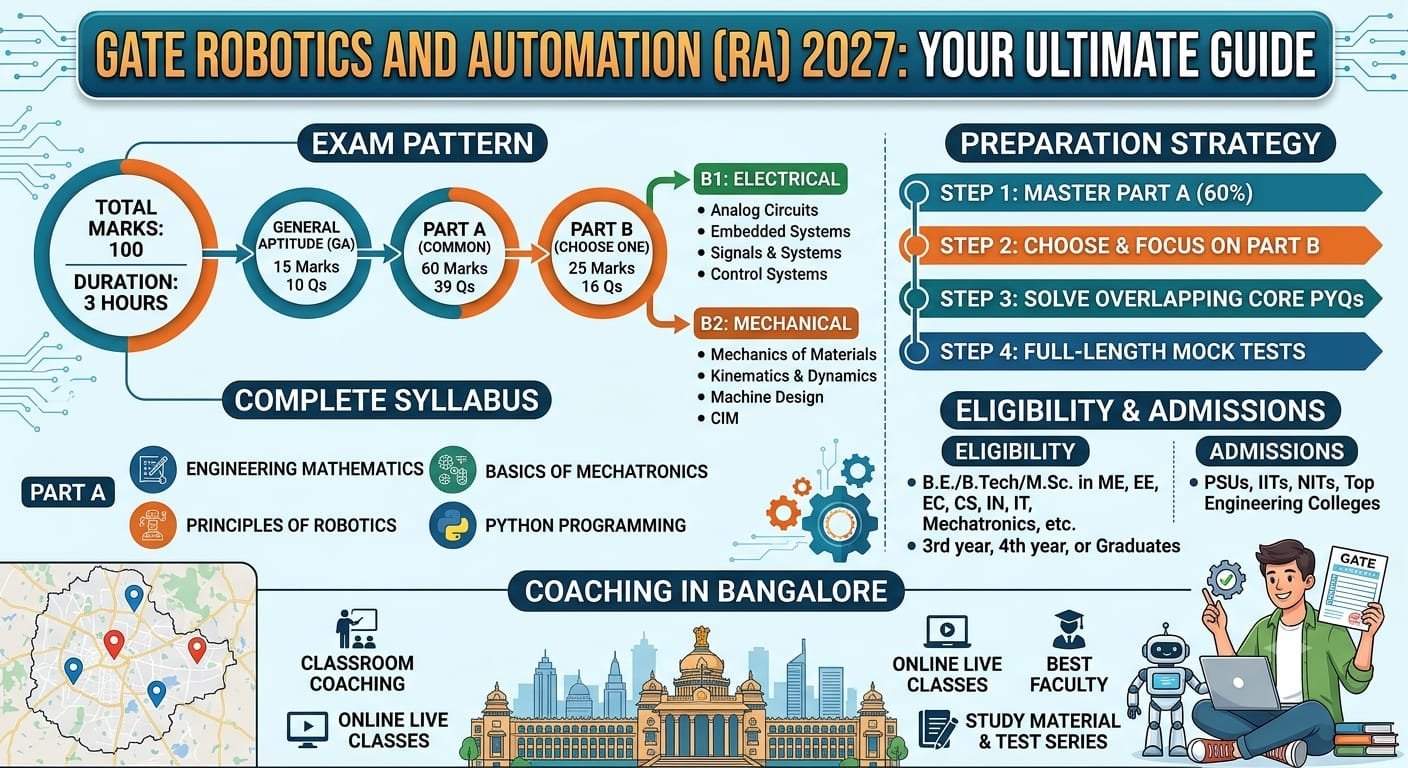
Introduction: Why GATE Robotics and Automation 2027 Is an Important Opportunity for Engineering Graduates
Robotics and Automation is emerging as one of the most influential engineering disciplines of the modern technology era. From industrial robots, autonomous vehicles and intelligent manufacturing systems to medical robotics, drones, smart factories, machine vision and artificial intelligence-powered machines, robotics is transforming the way industries, businesses and society operate.
As India continues to strengthen its position in advanced manufacturing, automation, defence technology, aerospace, healthcare, electronics, artificial intelligence and industrial innovation, the demand for engineers with interdisciplinary knowledge of robotics and automation is expected to grow.
Recognising the importance of this rapidly developing engineering field, the Graduate Aptitude Test in Engineering (GATE) 2027 has introduced a dedicated Robotics and Automation (RA) test paper.
This creates an important opportunity for eligible engineering and science graduates who want to pursue higher education, research, specialised postgraduate programmes and professional careers in robotics, automation, mechatronics, intelligent systems and related engineering areas.
GATE Robotics and Automation (RA) 2027 is particularly relevant for candidates who have studied Mechanical Engineering, Electrical Engineering, Electronics and Communication Engineering, Instrumentation Engineering, Mechatronics, Computer Science, Production Engineering and other interdisciplinary technical subjects.
However, candidates should understand that the RA paper has its own prescribed syllabus and examination structure. Preparing for it requires more than studying conventional engineering subjects independently. Students need a systematic understanding of engineering mathematics, mechatronics, electrical engineering fundamentals, mechanical engineering fundamentals, problem-solving techniques and examination-oriented applications.
This comprehensive guide by GATEIIT explains everything an aspirant needs to know about GATE Robotics and Automation 2027, including:
- Introduction to GATE RA and its importance.
- GATE 2027 conducting authority and examination schedule.
- Latest examination notifications and updates.
- Eligibility criteria and application-related information.
- GATE RA syllabus and subject-wise preparation.
- Examination pattern, marks distribution and question types.
- Computer-based examination format and marking scheme.
- Preparation strategies for beginners and working professionals.
- Self-study timetable for 30, 45, 60, 90 and 180 days.
- Recommended books, study resources and mock tests.
- Postgraduate admission opportunities and career prospects.
- GATE Robotics and Automation coaching in Bangalore.
- Online GATE RA classes throughout India.
- Long-term and short-term coaching programmes by GATEIIT.
- Personal mentorship, individual doubt-clearing and score improvement programmes.
- Scholarships and fee discounts of up to 95%, subject to scholarship test performance.
Whether you are beginning your GATE preparation from the fundamentals or looking for a focused revision and score-booster programme, this guide will help you understand the examination and plan your preparation effectively.
1. What Is GATE Robotics and Automation (RA)?
The Graduate Aptitude Test in Engineering, popularly known as GATE, is a national-level examination conducted jointly by the Indian Institute of Science (IISc) and the Indian Institutes of Technology (IITs), on behalf of the National Coordination Board (NCB-GATE), Department of Higher Education, Ministry of Education, Government of India.
GATE evaluates candidates’ understanding of undergraduate-level subjects in engineering, technology, science, architecture, commerce, arts and humanities.
GATE Robotics and Automation (RA) is a dedicated examination paper introduced for GATE 2027.
The paper is intended to assess the fundamental knowledge and analytical capabilities required in robotics and automation-related engineering disciplines.
The subject brings together important concepts from:
- Engineering Mathematics.
- Electrical Engineering.
- Mechanical Engineering.
- Fundamental engineering analysis.
- Interdisciplinary robotics and automation applications.
Unlike a conventional examination restricted to a single traditional engineering discipline, Robotics and Automation combines concepts from multiple technical areas.
This makes it particularly interesting for students who want to build careers in intelligent machines, industrial automation, autonomous systems, robotic design, motion control, manufacturing automation and advanced engineering research.
Why Has GATE Introduced a Separate Robotics and Automation Paper?
Robotics and automation technologies are becoming increasingly important in several sectors.
Some major developments driving this demand include:
- Industrial automation and smart manufacturing.
- Collaborative robots and industrial robotic arms.
- Autonomous mobile robots.
- Artificial intelligence-assisted robotic systems.
- Autonomous vehicles and intelligent transportation.
- Medical and surgical robotics.
- Defence and aerospace robotics.
- Agricultural robotics.
- Warehouse automation and logistics.
- Machine vision and intelligent inspection.
- Precision manufacturing.
- Internet of Things (IoT)-enabled industrial systems.
- Smart factories and Industry 4.0.
A specialised GATE paper provides an examination pathway for candidates interested in interdisciplinary higher education and research in this field.
2. GATE Robotics and Automation 2027: Important Examination Details
The following information summarises the officially announced GATE 2027 examination framework.
Examination Name: Graduate Aptitude Test in Engineering 2027
Paper Name: Robotics and Automation
Paper Code: RA
Organising Institute: Indian Institute of Technology Madras (IIT Madras)
Conducting Framework: IISc and IITs, on behalf of the National Coordination Board (NCB-GATE), Ministry of Education, Government of India.
Examination Mode: Computer-Based Test (CBT)
Question Paper Language: English
Examination Duration: 3 hours
Total Marks: 100
General Aptitude: 15 marks
Subject-Specific Portion: 85 marks
GATE 2027 Examination Dates: 6, 7, 13, 14, 20 and 21 February 2027. The exact date and session assigned to the RA paper must be checked in the official examination timetable.
GATE 2027 Result Date: 19 March 2027, as announced in the examination schedule.
GATE Score Validity: Three years from the date of announcement of results, subject to the applicable GATE rules.
Official Website: https://gate2027.iitm.ac.in/
Candidates should regularly check the official website for examination notifications, admit card announcements, updated information brochures, examination instructions and results.
3. Who Conducts GATE Robotics and Automation 2027?
GATE is conducted jointly by the Indian Institute of Science and the seven Indian Institutes of Technology.
These institutions are:
- Indian Institute of Science, Bengaluru.
- Indian Institute of Technology Bombay.
- Indian Institute of Technology Delhi.
- Indian Institute of Technology Guwahati.
- Indian Institute of Technology Kanpur.
- Indian Institute of Technology Kharagpur.
- Indian Institute of Technology Madras.
- Indian Institute of Technology Roorkee.
The organising responsibility rotates among the participating institutions.
For GATE 2027, IIT Madras is the Organising Institute.
The examination is conducted under the National Coordination Board (NCB-GATE), Department of Higher Education, Ministry of Education, Government of India.
The organising institute is responsible for coordinating the examination process, publishing the information brochure, releasing the syllabus, managing registration-related activities and announcing examination-related updates.
4. GATE 2027 Important Dates and Examination Schedule
Candidates planning to appear for GATE RA 2027 should understand the examination calendar and prepare accordingly.
The following are the announced important dates.
- GATE 2027 application portal opening: 2 September 2026.
- Regular registration closing date without late fee: 5 October 2026.
- Extended registration closing date with late fee: 12 October 2026.
- Special registration window with late fee: 15 October 2026, 10:30 AM to 16 October 2026, 10:29 AM.
- Application scrutiny and defect rectification period: 14 October to 31 October 2026.
- City allotment notification: 4 January 2027.
- Admit card download: To be announced on the official website.
- GATE examination dates: 6, 7, 13, 14, 20 and 21 February 2027.
- Result announcement: 19 March 2027.
Important: The dates above relate to the overall GATE 2027 examination. They do not establish the specific RA examination date or session. Candidates must refer to the final timetable and admit card.
The application registration period has already closed as per the published schedule. Candidates who have submitted applications should regularly check their GOAPS accounts and registered communication channels for scrutiny status, defects and further instructions.
The official website also states that the application rectification window is available for candidates whose applications have been marked defective.
5. Latest GATE Robotics and Automation 2027 Updates
The most important development for GATE RA aspirants is the introduction of Robotics and Automation as a new GATE test paper for 2027.
The official GATE 2027 website has listed RA among the 30 available test papers.
Important updates include:
A. New Robotics and Automation Paper
GATE 2027 introduces a separate paper with the code RA.
This gives candidates an examination option specifically associated with robotics and automation-related engineering fundamentals.
B. Revised GATE 2027 Syllabi
The organising institute has announced revisions to the syllabi of GATE 2027 test papers.
Candidates must use the 2027 syllabus rather than automatically depending on older GATE syllabus documents.
C. Computer-Based Examination
The examination will be conducted in computer-based mode at designated examination centres.
D. Three-Hour Examination
Candidates will have three hours to complete the paper.
E. New Opportunities for Interdisciplinary Candidates
The RA paper creates an additional examination pathway for eligible candidates interested in postgraduate education and research involving robotics, automation and related areas.
F. DigiLocker-Related Registration Instructions
The GATE 2027 website has issued specific instructions concerning DigiLocker accounts and application verification.
Candidates who have already registered should follow the instructions provided through their GOAPS account and official notifications.
Important Advice
Since GATE RA is a newly introduced paper, aspirants should not depend on assumptions based on other GATE branches. The official RA syllabus, examination pattern and updated information brochure should remain the primary references.
6. GATE Robotics and Automation 2027 Eligibility Criteria
One of the most frequently asked questions is:
Who can appear for GATE Robotics and Automation?
GATE eligibility is based primarily on the qualifying educational qualification and the year of study.
For GATE 2027, candidates who are currently studying in the third year or higher of an eligible undergraduate degree programme, or who have completed an approved qualifying degree, may apply subject to the official eligibility requirements.
Eligible qualification categories include recognised programmes in:
- Other qualifying programmes specified in the official brochure.
Candidates with higher qualifications are also permitted to appear, subject to the applicable rules.
Is a Mechanical Engineering Degree Mandatory for GATE RA?
No. A Mechanical Engineering degree is not a universal requirement for appearing in GATE.
Candidates from other eligible academic backgrounds can also consider the RA paper.
However, eligibility to write GATE and eligibility for admission to a particular postgraduate programme are two different matters.
An institute may prescribe specific qualifying degrees, minimum marks, subject prerequisites and other admission conditions.
Therefore, candidates should check the admission requirements of their preferred institutions before selecting a GATE paper.
Is There Any Age Limit for GATE RA?
There is no general upper age limit for appearing in GATE.
Can Final-Year Engineering Students Apply?
Yes, eligible students in the third year or higher of their undergraduate programme can apply, subject to the official qualifying-degree rules.
Can B.Sc. Students Appear for GATE RA?
Candidates holding or pursuing eligible science qualifications may be permitted to appear for GATE under the general examination eligibility rules.
However, admission to a specific M.Tech., MS or other programme may have additional academic prerequisites.
Can Candidates from Computer Science or Electronics Backgrounds Appear?
Candidates from eligible disciplines may select the RA paper if it aligns with their preparation and intended postgraduate admission pathway.
They should carefully evaluate the syllabus and the admission eligibility requirements of their target institutions.
7. GATE RA 2027 Application Fees
GATE examination fees are determined by the organising institute and depend on the candidate category and applicable registration period.
The applicable fee categories generally distinguish between:
- Female candidates.
- SC/ST/PwD candidates.
- Other candidates.
- Regular registration.
- Extended registration with late fee.
The fee is payable through the official application portal.
Candidates should consult the GATE 2027 Application Fees page and the latest information brochure for the exact amounts applicable to their category and registration period.
The examination application fee is separate from GATEIIT coaching fees.
Important: GATE application fees are generally non-refundable, except for duplicate transactions or other specific circumstances expressly recognised by the organising institute.
8. GATE Robotics and Automation 2027 Examination Pattern
Understanding the examination pattern is essential before starting preparation.
GATE RA is a three-hour computer-based examination carrying 100 marks.
The examination includes General Aptitude and subject-specific questions.
Overall Marks Distribution
General Aptitude: 15 marks.
Robotics and Automation subject-specific portion: 85 marks.
Total: 100 marks.
Question Types
GATE examinations generally use three types of questions:
- Multiple Choice Questions (MCQ).
- Multiple Select Questions (MSQ).
- Numerical Answer Type Questions (NAT).
MCQs contain multiple answer options, from which candidates must select the correct answer.
MSQs may have more than one correct answer. Candidates must select all the correct options to obtain the applicable marks.
NAT questions require candidates to enter a numerical answer using the computer interface.
Negative Marking
The standard GATE marking framework provides:
- For a 1-mark MCQ, one-third mark is deducted for an incorrect answer.
- For a 2-mark MCQ, two-thirds mark is deducted for an incorrect answer.
- No negative marking for incorrect MSQs.
- No negative marking for incorrect NAT questions.
- No partial marks for partially correct MSQ selections unless expressly specified in the applicable marking rules.
Candidates should refer to the official GATE 2027 question paper pattern and examination instructions for the final paper-specific rules.
Is There Negative Marking in GATE RA?
Negative marking applies to incorrect MCQ responses according to the applicable marking scheme. MSQ and NAT questions do not carry negative marking.
9. GATE RA 2027 Syllabus: Complete Preparation Overview
The GATE Robotics and Automation syllabus is the most important document for planning an effective preparation strategy.
Candidates should download the official GATE 2027 RA syllabus and use it as the master checklist.
The new RA paper should be approached as an interdisciplinary examination, with emphasis on Engineering Mathematics, Mechatronics and the prescribed Electrical and Mechanical engineering components.
The following preparation framework explains the subject areas and concepts candidates should study in accordance with the official syllabus.
PART A: Common Section
The common portion includes Engineering Mathematics and Basics of Mechatronics.
A. Engineering Mathematics
Engineering Mathematics is a foundational component of the paper.
Candidates should develop conceptual clarity and numerical problem-solving ability.
Important areas to prepare include:
- Linear Algebra.
- Matrices and determinants.
- Systems of linear equations.
- Eigenvalues and eigenvectors.
- Differential Calculus.
- Integral Calculus.
- Ordinary Differential Equations.
- Vector Calculus.
- Probability and Statistics.
- Numerical methods and mathematical techniques as prescribed.
Students should focus on both conceptual understanding and the application of mathematical tools to engineering problems.
For example, matrix operations and eigenvalue concepts are useful in engineering modelling, while differential equations help describe dynamic systems.
B. Basics of Mechatronics
Mechatronics combines mechanical systems, electronics, computing and control engineering.
It is particularly relevant to robotics because modern robotic devices require coordinated operation of mechanical structures, sensors, actuators and electronic controllers.
Important preparation areas include:
- Introduction to mechatronic systems.
- Mechanical and electrical subsystems.
- Sensors and transducers.
- Signal conditioning.
- Basic electronic circuits.
- Data acquisition.
- Microcontrollers and embedded systems.
- Basic control concepts.
- System integration.
- Measurement and instrumentation fundamentals.
Candidates should understand the relationship between a sensor, controller, actuator and mechanical output.
For example, a robotic arm uses sensors to obtain feedback, a controller to calculate the required response and actuators to generate the necessary movement.
PART B1: Electrical Engineering Section
Candidates should prepare the electrical engineering section according to the official RA syllabus.
Important preparation areas include the prescribed concepts of:
- Electrical circuit fundamentals.
- Circuit analysis.
- Network theorems.
- Electrical machines and relevant fundamentals.
- Electronic devices and circuits.
- Signals and systems.
- Control systems.
- Measurement and instrumentation.
- Electrical and electronic system behaviour.
The exact topic boundaries should be checked against the official GATE 2027 RA syllabus.
Electrical Circuits
Study circuit laws, network analysis, equivalent circuits and electrical response.
Important concepts include:
- Kirchhoff’s laws.
- Network theorems.
- Series and parallel circuits.
- Transient response.
- AC circuit fundamentals.
- Impedance and power.
Electronic Devices and Circuits
Understand semiconductor fundamentals and the operation of relevant electronic components.
Topics may include:
- Operational amplifiers.
- Basic electronic circuits.
- Amplifier fundamentals.
- Switching behaviour.
Signals and Systems
Develop a conceptual understanding of continuous-time and discrete-time signals and their mathematical representation.
Control Systems
Control engineering is especially important in robotics because a robot must respond accurately to commands and external disturbances.
Prepare:
- Open-loop and closed-loop systems.
- Transfer functions.
- Block diagrams.
- Feedback systems.
- Stability concepts.
- Time-domain response.
- Frequency-domain analysis.
- Basic controller concepts.
PART B2: Mechanical Engineering Section
Candidates choosing the mechanical component should prepare the corresponding topics prescribed in the official RA syllabus.
Important preparation areas include relevant concepts from:
- Engineering Mechanics.
- Strength of Materials.
- Theory of Machines.
- Mechanical system fundamentals.
- Kinematics and dynamics.
- Mechanical components and motion systems.
- Relevant mechanical engineering principles.
Engineering Mechanics
Understand forces, moments, equilibrium and motion.
Important concepts include:
- Force systems.
- Free-body diagrams.
- Work and energy.
- Linear and angular motion.
- Dynamics of particles and rigid bodies.
Strength of Materials
Prepare fundamental concepts relating to stress, strain and mechanical deformation.
Topics include:
- Stress and strain.
- Elastic constants.
- Axial loading.
- Shear force and bending moment.
- Basic mechanical behaviour of materials.
Theory of Machines
This area helps explain how mechanical motion is generated and transmitted.
Important concepts include:
- Kinematic links and pairs.
- Velocity and acceleration analysis.
- Gear trains.
- Cam mechanisms.
- Mechanical power transmission.
- Dynamics of mechanisms.
How Should Candidates Choose Between Electrical and Mechanical Preparation?
Candidates should not choose a section simply because it appears easier.
The decision should be based on:
- Undergraduate academic background.
- Existing subject knowledge.
- Familiarity with mathematics.
- Strength in electrical or mechanical fundamentals.
- Target postgraduate programmes.
- The final examination instructions.
A candidate with a Mechanical Engineering background may naturally prefer the mechanical section.
Similarly, candidates with Electrical, Electronics or Instrumentation backgrounds may find the electrical section more familiar.
However, interdisciplinary students should compare both sections against their existing knowledge before making a decision.
10. How to Prepare for GATE Robotics and Automation Without Coaching
Self-study can be an effective preparation method when students follow a structured plan.
The most common problem in GATE preparation is not a lack of study material. It is the absence of a clear sequence, consistent practice, regular revision and performance analysis.
Students preparing independently should follow these steps.
Step 1: Download the Official Syllabus
Begin by downloading the latest GATE 2027 RA syllabus.
Divide the syllabus into smaller topics.
Prepare a checklist and mark each topic as:
- Not started.
- Fundamentals completed.
- Problems practised.
- Revision completed.
- Test performance satisfactory.
Step 2: Understand the Examination Pattern
Learn the distinction between MCQ, MSQ and NAT questions.
Practise numerical calculations and time management.
Avoid treating every question as an MCQ because different question types require different approaches.
Step 3: Build Strong Mathematical Foundations
Engineering Mathematics is a critical foundation for interdisciplinary engineering examinations.
Students should solve numerical problems regularly rather than memorising formulae.
Step 4: Study One Subject at a Time
Avoid jumping randomly between topics.
Complete the fundamentals of one topic before moving to another.
Step 5: Maintain Short Notes
Prepare concise notes containing:
- Important formulae.
- Key derivations.
- Common mistakes.
- Important concepts.
- Shortcuts and problem-solving techniques.
These notes will become valuable during final revision.
Step 6: Practise Numerical Problems
GATE rewards conceptual understanding and the ability to apply knowledge.
Practise easy, moderate and difficult questions.
After solving a question, understand why the selected method works.
Step 7: Attempt Topic-Wise Tests
Do not wait until completing the entire syllabus to start testing.
Take tests after finishing individual subjects.
Step 8: Analyse Every Mock Test
Mock tests are useful only when students analyse their performance.
Identify:
- Weak subjects.
- Frequently repeated mistakes.
- Calculation errors.
- Conceptual gaps.
- Time-consuming questions.
- Unnecessary negative marking.
- Topics requiring revision.
Step 9: Revise Repeatedly
A single reading of a subject is insufficient.
Plan multiple revision cycles.
Step 10: Practise Full-Length Mock Examinations
Once the fundamentals are complete, begin taking three-hour examinations under realistic conditions.
11. GATE RA Preparation Timetable: 30, 45, 60 and 90 Days
Students have different preparation levels and available study time.
A student with a strong engineering foundation may require a focused revision programme, while a beginner may need more time for conceptual learning.
The following schedules are suggested frameworks, not guaranteed preparation durations.
30-Day Intensive GATE RA Crash Course
Suitable for students who have already studied the majority of the syllabus.
Days 1–5:
- Engineering Mathematics revision.
- Important formulae.
- Numerical practice.
Days 6–10:
- Basics of Mechatronics.
- Important concepts.
- Topic-wise tests.
Days 11–15:
- Electrical or Mechanical section fundamentals.
- Important numerical questions.
Days 16–20:
- Remaining weak topics.
- Mixed practice.
- Previous examination-style questions.
Days 21–25:
- Full-length mock tests.
- Detailed analysis.
- Error correction.
Days 26–30:
- Final revision.
- Formula revision.
- Time management.
- Score improvement strategy.
45-Day GATE RA Preparation Plan
Days 1–10: Engineering Mathematics and foundational concepts.
Days 11–18: Basics of Mechatronics and associated numerical problems.
Days 19–28: Electrical or Mechanical section preparation.
Days 29–35: Remaining syllabus and topic-wise practice.
Days 36–41: Mock examinations and performance analysis.
Days 42–45: Final revision and examination strategy.
60-Day GATE RA Preparation Plan
Days 1–15: Engineering Mathematics and fundamentals.
Days 16–25: Mechatronics and related concepts.
Days 26–40: Electrical or Mechanical section.
Days 41–48: Numerical problem-solving and topic tests.
Days 49–55: Full-length mock examinations.
Days 56–60: Revision and score improvement.
90-Day GATE RA Preparation Plan
Days 1–20: Engineering Mathematics and conceptual foundations.
Days 21–35: Mechatronics.
Days 36–60: Electrical or Mechanical subject preparation.
Days 61–70: Topic-wise tests and problem-solving.
Days 71–82: Full-length mock tests and analysis.
Days 83–90: Final revision and examination readiness.
Which Crash Course Duration Should You Choose?
- 30 days: For strong students requiring intensive revision.
- 45 days: For candidates with good fundamentals but some unfinished topics.
- 60 days: For students needing a balanced revision and practice programme.
- 90 days: For candidates requiring more structured subject coverage and problem-solving.
Students starting from the basics should consider a longer programme instead of assuming that a short crash course will be sufficient.
12. Recommended Books and Study Resources for GATE RA
Candidates should select reference books according to the official syllabus and their existing academic knowledge.
The following are useful subject-reference suggestions.
Engineering Mathematics
- Higher Engineering Mathematics by B.S. Grewal.
- Advanced Engineering Mathematics by Erwin Kreyszig.
- Engineering Mathematics by B.V. Ramana.
Engineering Mechanics
- Engineering Mechanics by S.S. Bhavikatti.
- Engineering Mechanics by R.C. Hibbeler.
Strength of Materials
- Mechanics of Materials by R.C. Hibbeler.
- Strength of Materials by R.K. Bansal.
Electrical Engineering Fundamentals
- Basic Electrical Engineering by D.P. Kothari and I.J. Nagrath.
- Engineering Circuit Analysis by Hayt, Kemmerly and Durbin.
Control Systems
- Modern Control Engineering by Katsuhiko Ogata.
- Control Systems Engineering by I.J. Nagrath and M. Gopal.
Mechatronics
- Mechatronics: Electronic Control Systems in Mechanical and Electrical Engineering by W. Bolton.
Theory of Machines
- Theory of Machines by R.S. Khurmi and J.K. Gupta.
- Theory of Machines and Mechanisms by John J. Uicker, Gordon R. Pennock and Joseph E. Shigley.
Important: These are supplementary references, not an official prescribed GATE RA booklist. Some chapters in these books may fall outside the examination syllabus. Students should study only the relevant portions.
13. How Difficult Is GATE Robotics and Automation?
Since GATE RA is a newly introduced paper in GATE 2027, its actual difficulty level, question distribution and scoring trends cannot be established using previous RA GATE examination statistics.
However, candidates should expect the examination to test conceptual understanding, mathematical ability and the application of engineering fundamentals.
The interdisciplinary nature of the paper may create challenges for students who are familiar with only one traditional engineering discipline.
For example:
- A Mechanical Engineering student may need to strengthen electrical fundamentals.
- An Electrical Engineering student may need to revise mechanical concepts.
- A Computer Science graduate may need to build stronger foundations in engineering mathematics and physical systems.
- An Electronics student may need additional practice in mechanical engineering fundamentals.
The best strategy is to identify weak areas early and allocate preparation time accordingly.
14. GATE Robotics and Automation Previous Year Question Papers
Since RA is newly introduced in GATE 2027, there are no earlier GATE RA papers from previous GATE examination years that can be used as authentic historical papers for this specific code.
This is an important distinction.
Candidates should avoid relying on websites that incorrectly label unrelated engineering question papers as previous-year GATE RA papers.
Instead, practise using:
- Official GATE sample or practice material, if released.
- Relevant Engineering Mathematics questions from earlier GATE papers.
- Relevant Mechanical Engineering questions.
- Relevant Electrical Engineering questions.
- Mechatronics and control systems problems.
- Topic-wise numerical exercises.
- Original mock tests designed around the official RA syllabus.
Previous-year questions from related GATE branches can help strengthen individual concepts, but they should not be treated as a substitute for RA-specific preparation.
15. GATE RA Mock Tests: Why Are They Important?
Mock tests are among the most important components of GATE preparation.
They help students evaluate their understanding under examination conditions.
A good mock test programme should include:
- Subject-wise tests.
- Topic-wise tests.
- Mixed-topic tests.
- Numerical answer practice.
- Full-length three-hour examinations.
- Performance reports.
- Accuracy analysis.
- Time management analysis.
- Question difficulty analysis.
- Weak-topic identification.
How Many Mock Tests Should a GATE RA Aspirant Take?
There is no universal ideal number.
The quality of test analysis matters more than simply counting the number of mock tests attempted.
Students should progressively increase their testing frequency as the examination approaches.
After every mock test, maintain an error notebook.
Classify mistakes into:
- Conceptual errors.
- Calculation errors.
- Formula errors.
- Misreading questions.
- Time-management mistakes.
- Unnecessary guessing.
Correcting these errors can improve examination performance more effectively than repeatedly attempting tests without analysis.
16. GATE Robotics and Automation Admission Opportunities
What can students do after qualifying GATE RA?
GATE scores are used by participating institutions and other eligible universities for admission to postgraduate and doctoral programmes, subject to the admission rules of each institution.
Potential academic pathways include:
- Tech. programmes.
- MS by Research programmes.
- Interdisciplinary engineering programmes.
- Robotics-related postgraduate specialisations.
- Automation and control-related programmes.
- Mechatronics-related programmes.
- Manufacturing and intelligent systems programmes.
- Doctoral research opportunities.
The actual programmes accepting GATE RA scores must be verified through the relevant institution’s admission notification.
Can GATE RA Help in Admission to IITs?
GATE qualification may provide an admission pathway to eligible postgraduate programmes at IITs.
However, each IIT department decides its own admission requirements.
These may include:
- Accepted GATE paper codes.
- Qualifying undergraduate disciplines.
- Minimum qualifying marks or CGPA.
- GATE score requirements.
- Written tests.
- Department-specific prerequisites.
- Additional selection criteria.
A candidate should never assume that every robotics-related programme will automatically accept the RA paper.
Can GATE RA Be Used for IISc Admissions?
Eligible IISc postgraduate programmes may use GATE scores as part of their admission process.
The applicable GATE paper codes, qualifying degree requirements and selection process are programme-specific.
Candidates should check the IISc admission brochure for the relevant academic year.
Can GATE RA Be Used for PSU Recruitment?
Some Public Sector Undertakings use GATE scores for recruitment.
However, the introduction of a new RA paper does not mean that PSUs will automatically recruit candidates through this paper.
Recruitment depends on the individual PSU’s official notification, accepted paper codes, educational qualifications and eligibility requirements.
Candidates should check recruitment announcements independently.
17. Career Opportunities After Robotics and Automation
Robotics and automation graduates can explore a wide range of engineering and technology careers.
Potential career areas include:
- Robotics Engineering.
- Automation Engineering.
- Mechatronics Engineering.
- Industrial Robotics.
- Autonomous Systems.
- Control Systems Engineering.
- Embedded Systems.
- Intelligent Manufacturing.
- Machine Vision.
- Robotic Process Development.
- Industrial IoT.
- Research and Development.
- Aerospace and Defence Systems.
- Medical Robotics.
- Agricultural Automation.
- Autonomous Mobility.
- Smart Manufacturing.
- Robotics Software and Hardware Integration.
Industries Hiring Robotics and Automation Professionals
Potential employment sectors include:
- Automotive manufacturing.
- Industrial automation.
- Healthcare technology.
- Electronics manufacturing.
- Semiconductor-related manufacturing.
- Warehousing and logistics.
- Agriculture technology.
- Research laboratories.
- Engineering design companies.
- Advanced manufacturing facilities.
- Technology research and development organisations.
Actual job opportunities depend on qualifications, practical skills, experience, specialisation and market conditions.
18. Why Start Preparing for GATE RA Early?
GATE preparation involves building strong fundamentals and practising a large number of technical problems.
Students who begin early have more time to:
- Understand the complete syllabus.
- Strengthen mathematical foundations.
- Study unfamiliar subjects.
- Practise numerical problems.
- Improve conceptual clarity.
- Attempt mock tests.
- Revise important topics.
- Identify weak areas.
- Develop examination confidence.
For students in the third year of engineering, beginning early can provide an advantage over candidates who start preparation only a few months before the examination.
A one-year preparation programme can also be particularly useful for students who are simultaneously managing college examinations, projects, internships and other academic responsibilities.
19. GATE Robotics and Automation Coaching Classes by GATEIIT, Bangalore
Preparing for a newly introduced interdisciplinary GATE paper can be challenging, particularly when students have different academic backgrounds.
Some candidates are comfortable with mathematics but require additional support in electrical engineering.
Others understand electrical circuits but need help with mechanical fundamentals and engineering mechanics.
Self-study is possible, but structured academic guidance can help students follow a systematic preparation plan.
GATEIIT offers GATE coaching and preparation support through online classes throughout India and offline classroom programmes at its JP Nagar, Bangalore centre.
GATEIIT focuses on structured learning, personal attention, concept development, problem-solving practice, regular testing and individual academic guidance.
The objective is to help students understand the syllabus, identify their academic strengths and weaknesses, and prepare according to their examination goals.
GATEIIT Robotics and Automation Coaching Features
- Online GATE RA coaching across India.
- Offline classroom coaching in JP Nagar, Bangalore.
- Long-term one-year preparation programmes.
- Short-term 30-day crash courses.
- 45-day intensive preparation programmes.
- 60-day revision and preparation programmes.
- 90-day crash courses.
- Regular weekday batches.
- Weekend batches.
- Personal mentorship programmes.
- One-to-one academic guidance.
- Small-group classes.
- Personalised learning plans.
- Customised subject-wise preparation.
- Individual doubt-clearing sessions.
- Topic-wise tests.
- Full-length mock examinations.
- Performance analysis.
- Score Booster Programmes.
- Online study material.
- Digital learning resources.
- Student application access, subject to programme inclusions.
- Revision sessions.
- Examination strategy guidance.
The availability of individual subjects, faculty allocation and class schedules should be confirmed with the academic counselling team.
20. GATEIIT Long-Term GATE RA Coaching: One-Year Programme
A long-term programme is suitable for students who want to prepare systematically rather than rush through the syllabus.
It is particularly useful for:
- Third-year engineering students.
- Final-year engineering students.
- Candidates beginning from basic concepts.
- Students changing their GATE paper focus.
- Candidates from interdisciplinary academic backgrounds.
- Working professionals preparing alongside their jobs.
- Students requiring individual academic support.
What Can a One-Year Programme Include?
A structured long-term programme may cover:
Phase 1: Foundation Building
- Engineering Mathematics.
- Basic engineering concepts.
- Fundamentals of Mechatronics.
- Diagnostic academic assessment.
Phase 2: Subject-Wise Preparation
- Electrical or Mechanical subject preparation.
- Conceptual lectures.
- Numerical problem-solving.
- Topic-wise practice.
Phase 3: Advanced Problem Solving
- Application-based problems.
- Mixed-topic questions.
- Examination-oriented techniques.
- Higher-level numerical practice.
Phase 4: Test Series and Assessment
- Topic-wise tests.
- Subject-wise tests.
- Full-length mock examinations.
- Performance analysis.
Phase 5: Final Revision
- Formula revision.
- Important concepts.
- Error correction.
- Examination strategy.
- Time management.
The programme can be customised depending on the student’s existing knowledge and academic schedule.
21. GATE RA Short-Term and Crash Courses by GATEIIT
Not every candidate requires a one-year programme.
Some students have already completed most of the syllabus and need focused revision, testing and examination preparation.
GATEIIT offers short-term GATE Robotics and Automation preparation options with different durations.
30-Day GATE RA Crash Course
Suitable for candidates with strong fundamentals who need intensive revision, numerical practice and test preparation.
45-Day GATE RA Crash Course
Designed for students who have completed a significant portion of the syllabus but require additional topic coverage and practice.
60-Day GATE RA Crash Course
A balanced option for candidates who need structured revision, concept reinforcement and mock examinations.
90-Day GATE RA Crash Course
Suitable for students requiring a longer preparation window for subject coverage, problem-solving and examination readiness.
Course Options
GATEIIT can offer different learning formats depending on student requirements:
- Regular weekday batches.
- Weekend batches.
- Personal mentorship.
- One-to-one coaching.
- Small-group coaching.
- Customised coaching.
- Subject-specific preparation.
- Score Booster Programmes.
- Intensive revision batches.
Students should select the programme based on their current preparation level, available study hours and subject knowledge.
22. GATE RA Coaching Fees at GATEIIT
GATEIIT offers short-term GATE Robotics and Automation preparation programmes with indicative crash course fees starting from ₹5,000 and extending up to ₹25,000, depending on the selected programme duration, teaching format and academic support.
Indicative course fee range:
- 30-Day Crash Course: From ₹5,000, subject to programme selection.
- 45-Day Crash Course: Fee based on selected programme.
- 60-Day Crash Course: Fee based on selected programme.
- 90-Day Crash Course: Up to ₹25,000, depending on the programme selected.
The exact fee should be confirmed before admission.
The final fee may depend on:
- Programme duration.
- Number of subjects.
- Class frequency.
- Personal mentorship requirements.
- One-to-one teaching.
- Small-group format.
- Test series inclusions.
- Additional academic support.
Scholarship Discounts of Up to 95%
GATEIIT offers scholarship-based fee discounts of up to 95%, depending on the student’s performance in the applicable scholarship test and the institute’s scholarship criteria.
This provides an opportunity for deserving and academically motivated students to access structured GATE preparation at a reduced fee.
The scholarship percentage is not automatic or guaranteed.
The actual discount depends on the scholarship test score, applicable terms, eligibility and availability.
Students are encouraged to enquire about the scholarship test before taking admission.
23. GATEIIT Personal Mentorship and One-to-One Coaching
One of the major difficulties in GATE preparation is that students have different levels of conceptual understanding.
A common classroom schedule may not always address every student’s individual learning requirements.
GATEIIT offers personalised and mentorship-based learning options, subject to batch availability and programme selection.
Personal Mentorship
Students receive academic guidance based on their preparation level and examination goals.
One-to-One Doubt Clearing
Individual doubts can be discussed and clarified through the available academic support arrangements.
Personalised Learning Plans
A study plan can be developed according to:
- Current subject knowledge.
- Available preparation time.
- Academic background.
- Target examination.
- Weak topics.
- Mock test performance.
Small-Group Classes
Small-group learning can provide students with more opportunities to interact with faculty and discuss difficult concepts.
Customised Preparation
Candidates can enquire about customised programmes for specific subjects, revision requirements and examination schedules.
24. GATEIIT Online GATE RA Coaching Across India
Students do not need to relocate to Bangalore to explore GATEIIT’s online coaching programmes.
Online classes are available for students across India, subject to batch schedules and course availability.
Online learning can be particularly useful for:
- Students living outside Bangalore.
- Working professionals.
- Final-year engineering students.
- Students attending colleges in other states.
- Candidates requiring flexible learning schedules.
Benefits of Online GATE RA Coaching
- Attend classes from home.
- Access structured academic instruction.
- Save travel and accommodation expenses.
- Participate in doubt-clearing sessions.
- Follow a planned preparation timetable.
- Access applicable online study material.
- Participate in tests and assessments.
Students should enquire about class recordings, app access, recording validity, test access and other digital facilities included in their selected programme.
25. GATE RA Offline Coaching at GATEIIT JP Nagar, Bangalore
Students who prefer classroom learning can enquire about offline coaching at the GATEIIT Bangalore centre.
GATEIIT’s classroom centre is located in JP Nagar, Bangalore.
Offline coaching can be useful for students who prefer direct interaction with faculty, structured classroom schedules and an academic learning environment.
GATEIIT Bangalore Centre Address
GATEIIT – Gate Indian Institute of Tutorials
3rd Floor, #1743, Sri Raghavendra Plaza, 17th Main Road, JP Nagar 2nd Phase, Bangalore – 560078, Karnataka.
Offline Coaching Features
- Classroom-based learning.
- Regular weekday batches.
- Weekend batches.
- Faculty interaction.
- Doubt-clearing support.
- Academic progress monitoring.
- Test-based assessment.
- Personal mentorship options, subject to availability.
Students should contact the institute to confirm the current RA batch schedule and seat availability.
26. GATEIIT Hybrid GATE Robotics and Automation Coaching
A hybrid programme combines the advantages of classroom and online learning.
Students may enquire about suitable hybrid arrangements depending on the programme and available facilities.
A hybrid learning approach can be particularly useful for students who:
- Prefer classroom instruction but need online flexibility.
- Travel frequently.
- Have college timetable constraints.
- Want additional revision support.
- Need individual doubt-clearing arrangements.
The exact delivery format should be confirmed at the time of admission.
27. GATEIIT Score Booster Programme for GATE RA
Students who have already completed their syllabus often require a different type of preparation.
At this stage, simply attending more theory classes may not be the most effective approach.
The GATEIIT Score Booster Programme is intended for candidates who want to strengthen examination performance through focused revision, problem-solving and test analysis.
The programme can focus on:
- Important syllabus topics.
- Frequently tested fundamental concepts.
- Numerical problem-solving.
- Formula revision.
- Time management.
- Accuracy improvement.
- Mock test analysis.
- Weak-topic correction.
- Examination strategy.
- Final revision planning.
The aim is to help candidates use their remaining preparation time more effectively.
28. Free and Additional Learning Support at GATEIIT
Depending on the programme selected, students may receive access to additional academic facilities.
These may include:
- Online test access.
- Topic-wise practice tests.
- Mock examination access.
- Digital study material.
- Learning application access.
- Formula sheets.
- Revision resources.
- Academic progress tracking.
- Doubt-clearing support.
- Performance analysis.
The exact inclusions may vary by course, batch and admission package.
Students should obtain confirmation of the facilities included in their selected programme before enrolment.
29. How to Select the Right GATE RA Coaching Programme
Before selecting a coaching programme, candidates should evaluate their preparation level honestly.
Ask yourself:
- Have I completed Engineering Mathematics?
- Am I comfortable with Mechatronics fundamentals?
- Do I understand the Electrical or Mechanical section?
- Can I solve numerical questions independently?
- Have I attempted topic-wise tests?
- Do I need complete subject teaching?
- Do I mainly need revision?
- Do I require individual doubt-clearing support?
Which Programme Is Suitable for Different Students?
Beginners: Consider a long-term programme with foundation building.
Third-year engineering students: A one-year preparation programme can help build fundamentals gradually.
Final-year students: Consider a structured long-term or intensive programme depending on the time available.
Students with completed syllabus: A 30-day or 45-day revision programme may be suitable.
Students with partial preparation: A 60-day or 90-day course may provide a more balanced approach.
Students requiring individual support: Enquire about personal mentorship or one-to-one learning.
Working professionals: Consider weekend and online programmes.
The most appropriate course is the one that matches your actual preparation level rather than the shortest or most intensive option.
30. Common Mistakes to Avoid While Preparing for GATE RA
Mistake 1: Studying Without Checking the Official Syllabus
Since RA is a new GATE paper, syllabus alignment is especially important.
Mistake 2: Ignoring Engineering Mathematics
Mathematics supports several important engineering applications and should not be neglected.
Mistake 3: Preparing Only Your Undergraduate Specialisation
Candidates must study the complete RA syllabus, including the chosen electrical or mechanical component.
Mistake 4: Memorising Formulae Without Understanding Them
Formulae are useful only when students understand their assumptions and applications.
Mistake 5: Avoiding Numerical Practice
GATE is not simply a theory examination. Consistent problem-solving is essential.
Mistake 6: Taking Mock Tests Without Analysis
A mock test should help identify weaknesses and guide further preparation.
Mistake 7: Ignoring Revision
Students who do not revise regularly often struggle to recall previously studied concepts.
Mistake 8: Depending on Unverified RA Previous-Year Papers
Since RA is new for GATE 2027, candidates should distinguish authentic official material from unrelated or incorrectly labelled papers.
Mistake 9: Selecting a Coaching Programme Only Based on Fees
Evaluate syllabus coverage, faculty support, teaching format, test access and individual attention before taking admission.
Mistake 10: Assuming GATE Qualification Guarantees Admission
Every institution has its own admission requirements and selection process.
31. Frequently Asked Questions About GATE Robotics and Automation (RA) 2027
1. What is GATE Robotics and Automation?
GATE Robotics and Automation is a new GATE examination paper introduced for 2027, with the paper code RA. It assesses interdisciplinary engineering knowledge relevant to robotics and automation.
2. Is Robotics and Automation a new GATE paper for 2027?
Yes. GATE 2027 introduces Robotics and Automation (RA) as a new test paper.
3. Who conducts GATE RA 2027?
IIT Madras is the organising institute for GATE 2027. The examination is conducted jointly by IISc and IITs on behalf of NCB-GATE, Ministry of Education.
4. What is the GATE RA paper code?
The paper code is RA.
5. What is the total duration of GATE RA?
The examination duration is three hours.
6. What is the total marks of GATE RA?
The examination carries 100 marks.
7. How many marks are allotted to General Aptitude?
General Aptitude carries 15 marks.
8. How many marks are allotted to the subject-specific portion?
The subject-specific portion carries 85 marks.
9. What is the examination mode?
GATE RA is conducted as a computer-based test.
10. What is the language of the examination?
The GATE question papers are in English.
11. What are the GATE 2027 examination dates?
The announced examination dates are 6, 7, 13, 14, 20 and 21 February 2027. The specific RA session must be checked in the final timetable.
12. When will GATE 2027 results be announced?
The announced result date is 19 March 2027.
13. Is there an age limit for GATE RA?
There is no general upper age limit for appearing in GATE.
14. Can Mechanical Engineering students appear for GATE RA?
Yes. Eligible Mechanical Engineering graduates and students can consider the RA paper.
15. Can Electrical Engineering students appear for GATE RA?
Yes. Eligible Electrical Engineering candidates can apply, subject to the general examination eligibility requirements.
16. Can Electronics and Communication students appear for GATE RA?
Yes. Eligible Electronics and Communication Engineering candidates can consider the paper.
17. Can Computer Science students appear for GATE RA?
Candidates from eligible academic backgrounds may appear for GATE RA. They should assess the syllabus and admission requirements carefully.
18. Can final-year students write GATE RA?
Eligible undergraduate students studying in the third year or higher may appear.
19. Can B.Sc. students write GATE RA?
Candidates from eligible science degree programmes may be permitted under the general GATE eligibility criteria. Programme-specific admission requirements must be checked separately.
20. Is Engineering Mathematics included in GATE RA?
Yes. Engineering Mathematics forms part of the common section.
21. Is Mechatronics included in GATE RA?
Yes. Basics of Mechatronics is an important component of the common section.
22. Does GATE RA include Electrical Engineering?
Yes. The examination includes an Electrical Engineering component.
23. Does GATE RA include Mechanical Engineering?
Yes. The examination includes a Mechanical Engineering component.
24. What question types are used in GATE RA?
The GATE examination framework includes MCQ, MSQ and NAT questions.
25. Is there negative marking in GATE RA?
Incorrect MCQ answers attract negative marking. MSQ and NAT questions do not carry negative marking.
26. Is there any previous-year GATE RA question paper?
There are no previous-year GATE RA examination papers because the paper is newly introduced in 2027. Students can use related subject questions for practice.
27. Can I prepare for GATE RA through self-study?
Yes. Self-study can be effective with a structured syllabus plan, suitable reference books, numerical practice, revision and mock tests.
28. How many months are required to prepare for GATE RA?
Preparation time depends on the student’s background and existing knowledge. A longer programme is advisable for beginners, while prepared candidates may benefit from shorter revision courses.
29. Is 30 days enough for GATE RA preparation?
Thirty days may be suitable for intensive revision if the candidate has already completed the syllabus. It may not be sufficient for beginners.
30. Is 90 days enough for GATE RA?
Ninety days can provide a useful preparation window for students with some existing fundamentals, provided they follow a disciplined timetable.
31. Which books are useful for GATE RA?
Books by B.S. Grewal, Erwin Kreyszig, W. Bolton, Ogata, R.C. Hibbeler and other standard engineering authors can support relevant subject preparation.
32. Can GATE RA help in M.Tech. admission?
Yes, where an institution and programme accept the RA paper and the candidate fulfils all admission requirements.
33. Can I get admission to IIT through GATE RA?
Potentially, subject to the accepted GATE paper code, qualifying degree, score and individual IIT department admission requirements.
34. Can I use GATE RA for IISc admission?
Potentially, for eligible programmes that accept RA, subject to IISc’s admission notification.
35. Does qualifying GATE RA guarantee a PSU job?
No. PSU recruitment depends on individual recruitment notifications and accepted GATE paper codes.
36. What are the career opportunities after Robotics and Automation?
Potential careers include robotics engineering, automation, mechatronics, industrial control, autonomous systems, research and intelligent manufacturing.
37. Does GATEIIT provide GATE RA coaching in Bangalore?
GATEIIT offers offline coaching enquiries and academic programmes at its JP Nagar centre in Bangalore, subject to batch availability.
38. Does GATEIIT provide online GATE RA coaching?
Yes. Students throughout India can enquire about online GATE RA preparation programmes.
39. What are the GATE RA crash course durations available at GATEIIT?
GATEIIT offers 30-day, 45-day, 60-day and 90-day short-term preparation options, subject to batch schedules.
40. What are the GATE RA crash course fees at GATEIIT?
The indicative fee range is ₹5,000 to ₹25,000, depending on the duration, programme and teaching format.
41. Does GATEIIT offer a one-year GATE RA programme?
Students can enquire about the one-year long-term preparation programme and its current schedule.
42. Does GATEIIT offer weekend classes?
Weekend learning options are available for enquiry, subject to the current batch schedule.
43. Does GATEIIT offer one-to-one GATE coaching?
Personal mentorship and one-to-one learning options can be discussed with the academic counselling team.
44. Does GATEIIT offer scholarships?
GATEIIT offers scholarship-based fee discounts of up to 95%, depending on scholarship test performance and applicable conditions.
45. Are study materials included in GATEIIT coaching?
Online study materials and other learning facilities may be included depending on the selected programme.
46. Does GATEIIT provide mock tests?
Students can enquire about subject-wise tests, mock examinations and test access included in their selected course.
47. Can working professionals join GATEIIT?
Yes. Working professionals can enquire about online, weekend and customised learning options.
48. Can students outside Karnataka join GATEIIT?
Yes. Online coaching options are available for enquiries from students throughout India.
49. Where is GATEIIT located in Bangalore?
GATEIIT is located at 3rd Floor, #1743, Sri Raghavendra Plaza, 17th Main Road, JP Nagar 2nd Phase, Bangalore – 560078.
50. How can I enquire about GATE Robotics and Automation coaching at GATEIIT?
Students can visit www.gateiit.com or contact 8884416154 / 8884416155 for course details, batch schedules, fees, scholarship tests and admission guidance.
32. Why Choose GATEIIT for GATE Robotics and Automation Preparation?
Choosing the right preparation programme can make a significant difference to a student’s learning experience.
GATEIIT focuses on providing structured academic support for competitive engineering examinations through different teaching formats.
Students can enquire about the following facilities:
- Long-term and short-term programmes.
- Online classes throughout India.
- Offline classroom coaching in Bangalore.
- Regular and weekend batches.
- Personal mentorship.
- Small-group learning.
- Individual doubt-clearing support.
- Personalised preparation plans.
- Customised learning options.
- Score Booster Programmes.
- Online tests and mock examinations.
- Study material and digital learning facilities.
- Scholarship-based fee concessions.
- Academic guidance and preparation planning.
The programme should be selected according to the student’s individual academic requirements.
GATEIIT encourages candidates to understand the syllabus, evaluate their current preparation level and choose a realistic course duration.
33. GATE RA 2027 Admissions Open – Enquire About Upcoming GATEIIT Batches
GATE Robotics and Automation is a new examination opportunity for candidates interested in the future of intelligent engineering and advanced technology.
With the GATE 2027 examination approaching, aspirants should focus on syllabus-based preparation, conceptual understanding, numerical problem-solving, regular testing and systematic revision.
GATEIIT invites interested students to enquire about its GATE Robotics and Automation preparation programmes.
Choose from:
- One-Year Long-Term Coaching.
- 90-Day Crash Course.
- 60-Day Crash Course.
- 45-Day Crash Course.
- 30-Day Intensive Crash Course.
- Regular Weekday Batches.
- Weekend Batches.
- Online Coaching Across India.
- Offline Coaching in Bangalore.
- Personal Mentorship.
- One-to-One Doubt Clearing.
- Small-Group Classes.
- Customised Coaching.
- Score Booster Programmes.
Scholarship Opportunities
Scholarship-based fee discounts of up to 95% are available based on scholarship test performance and applicable terms.
Contact GATEIIT for GATE RA Coaching and Admissions
GATEIIT – Gate Indian Institute of Tutorials
Address: 3rd Floor, #1743, Sri Raghavendra Plaza, 17th Main Road, JP Nagar 2nd Phase, Bangalore – 560078, Karnataka.
Call / WhatsApp: 8884416154 8884416155
Website: https://www.gateiit.com/
Google Maps Location: https://maps.app.goo.gl/MtzbVkqywCkwKcc4A
Online Coaching: Available for students throughout India.
Offline Coaching: Available at GATEIIT, JP Nagar, Bangalore, subject to batch availability.
Students are encouraged to contact GATEIIT for the latest batch schedules, course structure, scholarship test details, fees and admission availability.
Final Words: Prepare for the Future of Robotics and Automation with a Strong GATE Foundation
Robotics and Automation represents an exciting intersection of mechanical engineering, electrical engineering, electronics, mathematics and intelligent technology.
The introduction of GATE RA in 2027 creates an important opportunity for students who want to explore advanced engineering education and research in this rapidly developing field.
However, success in GATE requires consistent effort, a strong conceptual foundation, syllabus-oriented preparation, regular numerical practice, effective revision and continuous performance evaluation.
Students should begin by understanding the official syllabus and examination pattern. They should identify their strengths and weaknesses, prepare a realistic timetable and follow a disciplined approach.
Whether you choose independent preparation, a long-term programme or a focused crash course, the most important factor is consistent and meaningful learning.
GATEIIT aims to support aspirants through structured coaching, personal attention, online and offline learning options, mentorship, practice tests and customised preparation programmes.
Start your GATE Robotics and Automation preparation with a clear plan, the right learning resources and a commitment to improving every day.
GATEIIT – Supporting Your Journey Towards Higher Education and Engineering Excellence.
Website: www.gateiit.com
Contact: 8884416154 / 8884416155
Location: JP Nagar 2nd Phase, Bangalore, Karnataka.