
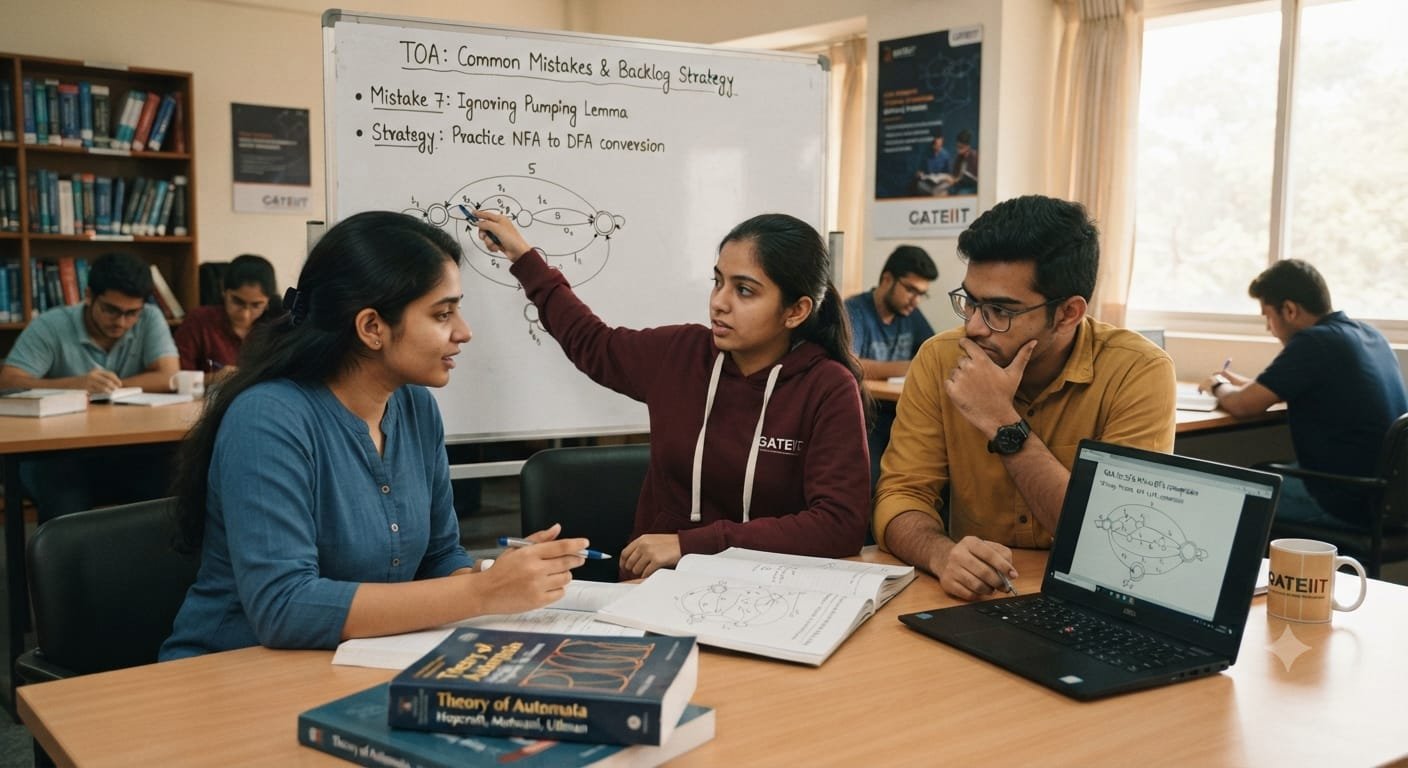
Theory of Automata is one of those Computer Science engineering subjects that many students find difficult even after attending regular classroom lectures. Some students understand the definitions but cannot construct finite automata correctly. Others can solve DFA and NFA problems but struggle with mathematical proofs, Regular Expressions, Context-Free Grammars, Pushdown Automata and Turing Machines.
For students who have already failed the subject once, the difficulty can become even more frustrating. They may prepare again, refer to different textbooks, watch online lectures and practise previous examination questions, yet still find it difficult to achieve the required marks.
The problem is not always a lack of studying. In many cases, students struggle because they have not identified the exact concepts, mathematical reasoning skills or problem-solving methods that are preventing them from answering examination questions correctly.
Theory of Automata requires more than remembering definitions and writing theoretical explanations. Students must understand how abstract computational models work, represent languages mathematically, construct state-transition diagrams, perform conversions and justify their answers logically.
This guide explains 12 common reasons engineering students struggle with Theory of Automata examinations and provides a practical preparation strategy for students who want to improve their understanding and clear pending TOA papers.
Whether you are studying BE, BTech, Computer Science Engineering, Information Science, Information Technology or a related engineering branch, understanding these mistakes can help you approach the subject more systematically.
1. Treating Theory of Automata as a Memorisation-Based Subject
One of the biggest mistakes students make is assuming that Theory of Automata can be completed by memorising textbook definitions, diagrams and theoretical explanations.
Students sometimes prepare definitions of:
- Finite Automata
- Deterministic Finite Automata
- Nondeterministic Finite Automata
- Regular Languages
- Regular Expressions
- Context-Free Grammars
- Pushdown Automata
- Turing Machines
However, examination questions frequently require students to apply these concepts rather than simply reproduce their definitions.
For example, a student may know what a DFA is but struggle when asked to construct a DFA accepting all binary strings ending with 01.
Similarly, memorising the definition of a Pushdown Automaton does not automatically help a student construct one for a given language.
How to overcome this problem
Instead of learning every topic through definitions alone:
- Understand the concept first.
- Study at least one simple example.
- Work through a moderately difficult problem.
- Attempt a problem independently.
- Explain why the answer is correct.
- Practise a variation of the same question.
A useful learning approach is to move from understanding to application and then to independent problem-solving.
2. Difficulty Constructing Deterministic Finite Automata (DFA)
DFA construction is one of the areas where students frequently lose confidence.
A question may ask students to construct a finite automaton that accepts:
- Binary strings ending with 01.
- Strings beginning with a particular symbol.
- Strings containing a specified substring.
- Strings having an even number of zeros.
- Strings having an odd number of ones.
- Strings satisfying a particular pattern.
- Strings that do not contain a specified sequence.
Students sometimes start drawing circles and arrows without first understanding what information each state must remember.
This leads to incorrect states, missing transitions and unsuitable accepting conditions.
Example: Constructing a DFA for binary strings ending with 01
Consider the language of all binary strings over the alphabet {0,1} that end with 01.
A student must understand that the automaton needs to track the relevant suffix of the input processed so far.
One possible state interpretation is:
- q0: No useful matching suffix has been established.
- q1: The most recent symbol is 0.
- q2: The processed string currently ends in 01.
The accepting state is q2.
The complete transition function must also account for every possible input symbol from every state.
Students should learn to derive the transition logic rather than memorising an existing diagram.
How to improve
Before drawing the DFA:
- Read the language condition carefully.
- Identify what information must be remembered.
- Decide what each state represents.
- Determine the transition for every input symbol.
- Identify the accepting state.
- Test the automaton using accepted and rejected strings.
This process reduces random state creation and helps students understand the purpose of each transition.
3. Confusing DFA, NFA and ε-NFA
Another common difficulty is understanding the differences between Deterministic Finite Automata, Nondeterministic Finite Automata and epsilon-NFAs.
Students may remember their definitions but become confused when solving conversion problems.
Some common mistakes include:
- Assuming that an NFA can have only one transition for an input symbol.
- Confusing missing transitions with epsilon transitions.
- Forgetting that epsilon transitions consume no input symbol.
- Incorrectly calculating epsilon closures.
- Missing combinations of states during NFA-to-DFA conversion.
- Incorrectly identifying accepting subsets.
What students should understand
DFA: For each state and input symbol, there is exactly one defined transition in the transition function.
NFA: A state and input symbol may lead to multiple possible next states or no next state.
ε-NFA: Transitions may also occur without consuming an input symbol.
These models have different transition rules, but they are equivalent in expressive power when recognising regular languages.
How to improve
Practise the following in sequence:
- Draw a simple DFA.
- Construct an NFA for a similar language.
- Understand epsilon transitions.
- Calculate epsilon closures.
- Perform subset construction.
- Verify the resulting DFA against sample strings.
Do not begin complicated conversion questions until the basic transition rules are clear.
4. Making Mistakes During NFA-to-DFA Conversion
Students sometimes understand the theory of subset construction but struggle to execute the procedure accurately.
The conversion requires tracking sets of states rather than individual states.
For example, a resulting DFA state may represent a subset such as:
{q0, q1}
Students must understand that this subset represents a combined configuration of the original NFA.
Common errors include:
- Missing reachable subsets.
- Incorrect union of transition results.
- Forgetting epsilon closure when applicable.
- Failing to identify accepting subsets.
- Including unnecessary unreachable states.
- Making mistakes while constructing the final transition table.
Preparation strategy
Practise conversions using a systematic table.
For each subset:
- Record the input symbol.
- Calculate all reachable states.
- Apply epsilon closure where required.
- Identify the resulting subset.
- Repeat until all reachable subsets have been processed.
Students should verify their final DFA using selected input strings.
5. Not Understanding Regular Expressions Properly
Regular Expressions can appear straightforward initially, but students often struggle when converting between expressions and automata or when representing a language using mathematical notation.
Common difficulties include:
- Confusing union and concatenation.
- Misunderstanding Kleene star.
- Incorrect operator precedence.
- Constructing expressions for specified string patterns.
- Converting automata into regular expressions.
- Identifying the language represented by an expression.
For example:
(0+1)*
represents all finite binary strings, including the empty string.
But students must understand why this is true rather than merely memorising the expression.
How to improve
Practise:
- Identifying the language of a given expression.
- Writing expressions for simple languages.
- Understanding union, concatenation and closure.
- Using parentheses correctly.
- Converting expressions into automata.
- Converting automata into regular expressions using the methods prescribed in the syllabus.
Regular Expression questions become easier when students repeatedly connect symbolic expressions with actual strings.
6. Finding the Pumping Lemma Difficult
The Pumping Lemma is among the most challenging topics for many students because it requires mathematical reasoning.
Students frequently memorise the statement but cannot apply it correctly.
Common mistakes include:
- Selecting an unsuitable string.
- Forgetting the decomposition conditions.
- Confusing the length requirement.
- Choosing a decomposition without considering the arbitrary nature of the split.
- Failing to identify a suitable pumping value.
- Presenting an incomplete contradiction.
- Applying the lemma incorrectly to prove that a language is regular.
Understanding the basic idea
The Pumping Lemma for regular languages states that sufficiently long strings in a regular language can be decomposed into three parts:
w = xyz
subject to the conditions:
- |xy| ≤ p
- |y| ≥ 1
- For every integer i ≥ 0, xyⁱz belongs to the language.
Here, p is the pumping length.
Students should understand that the lemma provides a necessary property of regular languages, not a general method for proving that every language is regular.
How to prepare
Practise proof-writing in stages:
- Identify the language.
- Assume it is regular.
- Introduce the pumping length.
- Select an appropriate string.
- Consider the permitted decomposition.
- Choose a pumping value.
- Demonstrate the contradiction.
- State the conclusion clearly.
Understanding the logic behind the proof is much more valuable than memorising a finished answer.
7. Difficulty Constructing Context-Free Grammars (CFG)
Context-Free Grammar problems can become confusing when students do not understand how production rules generate strings.
Students may know the definition of a grammar but struggle with questions involving:
- Strings with equal numbers of symbols.
- Balanced parentheses.
- Specific arrangements of symbols.
- Grammar derivations.
- Leftmost and rightmost derivations.
- Parse tree construction.
- Ambiguous grammars.
Example
Consider the language:
L = {aⁿbⁿ | n ≥ 0}
A possible grammar is:
S → aSb | ε
Students should understand how the recursive production adds one a at the beginning and one b at the end.
For n = 3:
S ⇒ aSb
⇒ aaSbb
⇒ aaabbb
This is the kind of step-by-step reasoning students should practise.
How to improve
Do not begin with complicated grammar-construction problems.
Start with:
- Simple recursive patterns.
- Equal-number symbol conditions.
- Balanced structures.
- Leftmost and rightmost derivations.
- Parse trees.
Then progress to more complicated grammars and conversions.
8. Confusing Pushdown Automata (PDA) with Finite Automata
Pushdown Automata introduces another important concept: the stack.
Students who understand finite automata sometimes struggle because PDA requires additional memory through stack operations.
Common difficulties include:
- Understanding stack symbols.
- Designing push and pop operations.
- Constructing transitions.
- Tracking the stack contents.
- Accepting by final state.
- Accepting by empty stack.
- Understanding the relationship between CFG and PDA.
Example
A language such as:
L = {aⁿbⁿ | n ≥ 0}
requires remembering the number of a symbols before processing the corresponding b symbols.
A stack can help maintain this information.
Students must understand how symbols are pushed while processing a’s and popped while processing b’s.
How to improve
Practise:
- Understanding stack operations.
- Drawing the PDA configuration.
- Tracing the input string.
- Tracking stack contents.
- Checking the final acceptance condition.
- Testing strings that should be rejected.
This visual and stepwise approach can make PDA problems easier to understand.
9. Struggling with Turing Machine Construction
Turing Machines are often difficult because students must understand a computational model involving a tape, read/write operations, head movement and state transitions.
Students may memorise the definition but struggle when asked to design a machine for a specific language or trace its computation.
Common mistakes include:
- Incorrect state transitions.
- Incorrect tape movement.
- Forgetting the symbol being overwritten.
- Confusing accepting and rejecting conditions.
- Incorrectly tracing successive configurations.
- Not understanding how the machine processes an input.
How to improve
Begin with simple transition sequences.
For each transition, identify:
- Current state.
- Symbol being read.
- Symbol being written.
- Direction of head movement.
- Next state.
Then practise tracing the machine configuration after each transition.
Students should gradually move from simple machines to more complex construction problems.
10. Ignoring Mathematical Foundations
Theory of Automata is not simply a programming subject.
It uses mathematical concepts such as:
- Mathematical induction.
- Logical statements.
- Proof by contradiction.
- Formal notation.
Students who have weak mathematical foundations may find several TOA topics difficult.
For example, understanding a language as a set of strings requires familiarity with set notation and mathematical reasoning.
Similarly, proving that a language is not regular requires logical arguments rather than only diagram construction.
How to improve
Before attempting difficult questions, revise the mathematical foundations needed for the relevant university syllabus.
Pay particular attention to:
- Set operations.
- Basic mathematical notation.
- String concatenation.
- Powers of alphabets.
- Relations and functions.
- Logical implications.
- Proof techniques.
Improving these foundations can make advanced topics easier to approach.
11. Solving Too Few University Examination Questions
Some students study the concepts but do not practise enough examination-oriented problems.
They may complete textbook examples and assume that they are prepared.
However, examination questions can present familiar concepts in unfamiliar forms.
For example, a student who has practised DFA construction for strings ending in 01 may struggle with a question involving strings containing a specific substring.
This happens because the student has memorised a particular solution instead of understanding the underlying method.
How to improve
After completing each topic:
- Solve textbook examples.
- Attempt questions without looking at solutions.
- Practise different variations.
- Review previous university question papers.
- Identify recurring mistakes.
- Reattempt questions that were solved incorrectly.
Previous examination papers are useful for understanding question patterns, but students should not depend exclusively on predictions or repeated questions.
12. Poor Time Management and Examination Answer Presentation
Some students understand the subject but fail to convert their knowledge into complete examination answers.
Common problems include:
- Spending too much time on one difficult question.
- Drawing incomplete automata diagrams.
- Missing transition-table entries.
- Writing long explanations without answering the question.
- Skipping intermediate steps.
- Incorrect mathematical notation.
- Failing to revise completed answers.
How to improve
Practise writing complete solutions under timed conditions.
For construction problems, show the necessary transition logic and final diagram.
For conversion problems, show intermediate calculations.
For mathematical proofs, present the assumptions, reasoning and conclusion.
For grammar questions, show the production rules and required derivations.
The exact answer format should follow the question requirements and applicable university examination guidelines.
HOW TO CLEAR A THEORY OF AUTOMATA BACKLOG: A PRACTICAL PREPARATION ROADMAP
If you have already failed TOA, the most important thing is not to repeat the same study routine without evaluating its effectiveness.
A more structured approach can help you identify what needs to change.
Step 1: Understand Your Previous Examination Performance
Start by answering these questions:
- Did you understand the classroom lectures?
- Were you able to solve DFA and NFA questions?
- Did you struggle with mathematical proofs?
- Did you leave questions unanswered?
- Did you run out of examination time?
- Did you prepare the entire syllabus?
- Did you practise previous examination papers?
- Were there particular modules you consistently found difficult?
If you have your previous question paper or evaluated answer script, review it.
Step 2: Obtain Your Exact University Syllabus
Do not assume that every engineering college follows an identical TOA syllabus.
Different universities and autonomous colleges may use different subject names, course codes, regulations and examination patterns.
For example, Theory of Computation under VTU’s 2022 scheme is identified as BCS503.
Students should verify their admission-year scheme and applicable syllabus before planning their preparation.
Step 3: Prepare a Topic-Wise Weakness List
Divide the syllabus into three categories.
Category A – Topics you understand
These require revision and examination practice.
Category B – Topics you partially understand
These require additional examples and problem-solving.
Category C – Topics you do not understand
These require concept rebuilding from the fundamentals.
This simple classification can help you allocate preparation time more intelligently.
Step 4: Practise Before Moving to the Next Topic
Do not consider a chapter completed merely because you have watched a lecture or read the notes.
You should be able to solve representative questions independently.
For example, after studying NFA-to-DFA conversion, attempt a new conversion problem without looking at the solution.
If you cannot solve it, revisit the method and identify where your reasoning went wrong.
Step 5: Maintain a TOA Mistake Notebook
This is particularly useful for students repeating the subject.
Record:
- Incorrect DFA transitions.
- Missing states.
- Incorrect accepting conditions.
- Mistakes in epsilon closures.
- Errors in subset construction.
- Regular Expression notation errors.
- Pumping Lemma proof mistakes.
- CFG production errors.
- PDA stack-tracing mistakes.
- Turing Machine transition errors.
Review these mistakes regularly.
The objective is not simply to solve more questions but to avoid repeating the same mistakes.
Step 6: Practise Previous-Year Question Papers
Use available university question papers to understand:
- The structure of the examination.
- Different types of questions.
- Expected mathematical working.
- Diagram-based questions.
- Repeated conceptual difficulties.
- Time management requirements.
Avoid relying on unofficial claims that particular questions are guaranteed to appear.
Step 7: Conduct a Final Revision
During the final preparation period:
- Revise definitions and essential concepts.
- Reconstruct important automata independently.
- Practise conversion problems.
- Review mathematical proofs.
- Revisit grammar and PDA questions.
- Solve selected Turing Machine problems.
- Attempt a timed practice paper where possible.
A 30-DAY THEORY OF AUTOMATA BACKLOG PREPARATION PLAN
The following is a sample study schedule for students who have already studied the subject at least once.
It is not a universal timetable. Students who are learning TOA from the beginning or have very weak foundations may require more time.
| Preparation period | Suggested focus |
| Days 1–3 | Review previous attempt, diagnostic assessment and mathematical foundations |
| Days 4–7 | DFA, NFA, ε-NFA and automata construction |
| Days 8–10 | NFA-to-DFA conversion, epsilon closures and minimisation |
| Days 11–13 | Regular Expressions and regular languages |
| Days 14–16 | Pumping Lemma and mathematical proofs |
| Days 17–20 | CFG, derivations, parse trees and normal forms |
| Days 21–23 | PDA construction and stack operations |
| Days 24–26 | Turing Machines and syllabus-dependent decidability topics |
| Days 27–28 | Previous university question-paper practice |
| Days 29–30 | Revision, timed practice and correction of weak areas |
Important: This is a planning example, not a replacement for the prescribed university syllabus. Students should adapt the schedule to their actual examination scheme and subject coverage.
HOW MANY HOURS SHOULD YOU STUDY TO CLEAR A TOA BACKLOG?
There is no fixed number of hours that guarantees success in Theory of Automata.
A student who has already understood most concepts may need only targeted revision and problem-solving sessions.
A student who has repeatedly failed the subject may need to rebuild the fundamentals before attempting advanced problems.
The following are illustrative preparation levels:
| Available preparation | Possible requirement |
| 10 hours | Selected-topic revision and doubt-solving |
| 20 hours | Focused preparation for identified weak areas |
| 30 hours | Structured short-term revision and practice |
| 45–50 hours | Extended topic-wise preparation |
| 60 hours | More comprehensive problem-solving |
| 90–100 hours | Extensive preparation for students requiring additional support |
The final teaching-hour requirement should be decided after reviewing the student’s knowledge, examination date and syllabus.
SHOULD YOU JOIN TOA BACKLOG TUITION OR PREPARE ON YOUR OWN?
Self-study can be effective for students who already understand the concepts and can solve problems independently.
However, additional academic guidance may be useful when:
- You repeatedly make the same mistakes.
- You cannot construct DFA or NFA independently.
- You struggle with mathematical proofs.
- You cannot understand conversion procedures.
- You have difficulty identifying why your answer is incorrect.
- You have limited time before the supplementary examination.
- You need individual explanations.
- You have failed the subject more than once.
A teacher can help identify errors, explain alternative approaches and provide structured practice.
The decision should depend on your actual learning difficulties rather than simply the fact that you have failed once.
HOW GATEIIT SUPPORTS STUDENTS PREPARING FOR TOA BACKLOG EXAMINATIONS
GATEIIT – Gate Indian Institute of Tutorials, located in JP Nagar 2nd Phase, Bangalore, provides academic support for engineering students preparing for challenging university subjects.
Students who have failed Theory of Automata, are repeating the subject or have an upcoming supplementary examination can enquire about personalised preparation programmes.
Our proposed TOA backlog preparation approach focuses on understanding the student’s previous difficulties rather than simply repeating the entire subject without assessment.
Academic support may include:
- Review of previous examination performance.
- Identification of weak concepts.
- Individual learning assessments.
- DFA and NFA problem-solving.
- Automata conversion practice.
- Regular Expression revision.
- Pumping Lemma proof-writing.
- CFG and PDA problem-solving.
- Turing Machine practice.
- University question-paper discussions.
- Examination-oriented revision.
- Individual doubt clarification.
- Short-term and extended preparation programmes.
Flexible TOA Backlog Tuition
Students can enquire about different preparation-hour options according to their requirements.
Available programme enquiries include:
- 10-hour selected-topic revision.
- 20-hour focused preparation.
- 30-hour short-term preparation.
- 45-hour extended preparation.
- 50-hour intensive preparation.
- 60-hour structured revision.
- 90-hour comprehensive preparation.
- 100-hour extended academic support.
One-to-one, small-group, online and offline arrangements can be discussed according to faculty availability.
TOA Backlog Tuition in JP Nagar, Bangalore
GATEIIT – Gate Indian Institute of Tutorials
3rd Floor, #1743, Sri Raghavendra Plaza,
17th Main Road, JP Nagar 2nd Phase,
Bangalore – 560078, Karnataka, India.
Call: 8884416155
WhatsApp: 8884416154
Website: https://www.gateiit.com/
Google Maps: https://maps.app.goo.gl/MtzbVkqywCkwKcc4A
Students from Bangalore and other locations can enquire about online learning options.
FREQUENTLY ASKED QUESTIONS ABOUT THEORY OF AUTOMATA BACKLOG PREPARATION
1. Why is Theory of Automata difficult for engineering students?
Theory of Automata requires mathematical reasoning, logical thinking, abstract problem-solving and the ability to construct computational models. Students who rely entirely on memorisation often find construction and proof-based questions difficult.
2. How can I pass Theory of Automata in BE/BTech?
Start by understanding your previous examination mistakes, obtaining the correct syllabus, identifying weak topics and practising representative university questions. Focus on independent problem-solving rather than memorising solutions.
3. Which topics should I practise more in Theory of Automata?
Students commonly require additional practice in DFA and NFA construction, epsilon closures, automata conversions, Regular Expressions, Pumping Lemma, CFG, PDA and Turing Machines. Your actual priorities should follow your university syllabus and individual weaknesses.
4. Can I clear my TOA backlog in 30 days?
It may be possible for students who have already studied the subject and need focused revision. However, students starting from the fundamentals or requiring extensive concept rebuilding may need additional preparation time.
5. How do I improve DFA construction skills?
Understand what each state represents, identify the language condition, construct transitions systematically and test your automaton with accepted and rejected strings.
6. Why do I keep making mistakes in NFA-to-DFA conversion?
Common reasons include incorrect subset construction, missing reachable states, mistakes in transition calculations and forgetting epsilon closures when required. Systematic tabular practice can help.
7. Is Pumping Lemma important for TOA examinations?
Pumping Lemma is an important concept in regular-language theory and appears in many Theory of Computation curricula. Students should understand its conditions and proof application according to their syllabus.
8. Can I study TOA without strong mathematical knowledge?
You can begin learning the subject, but basic mathematical foundations are important. Revising sets, functions, strings, notation and proof techniques can make several topics easier.
9. How many previous-year papers should I solve?
There is no fixed number. Practise as many relevant and available papers as your preparation schedule allows. More importantly, analyse your errors and learn to solve unfamiliar variations.
10. Can I get TOA backlog tuition in Bangalore?
Students can enquire about Theory of Automata backlog tuition at GATEIIT, JP Nagar 2nd Phase, Bangalore, subject to faculty and timetable availability.
11. Is online Theory of Automata backlog coaching available?
Students can enquire about online live teaching and individual doubt-solving arrangements at GATEIIT.
12. Can I join TOA tuition after failing the subject multiple times?
Yes. Students with multiple unsuccessful attempts can enquire about diagnostic assessments and customised academic preparation.
13. Can I join TOA tuition for only difficult chapters?
Selected-topic revision and doubt-solving can be discussed depending on faculty availability and the student’s requirements.
14. What is the difference between TOA and TOC?
Theory of Automata is an important area within the broader subject of Theory of Computation. Many engineering institutions use overlapping subject names and curricula, but exact syllabus coverage can vary.
15. Does GATEIIT guarantee that I will clear my backlog?
No coaching institute can legitimately guarantee a university examination result. GATEIIT provides academic teaching and preparation support, while the final result depends on the student’s understanding, effort and examination performance.
FINAL MESSAGE FOR ENGINEERING STUDENTS
Failing Theory of Automata can be discouraging, particularly when you have already spent time preparing for the subject.
However, repeating the same study method without identifying your weaknesses may not help.
Take time to understand where you are struggling. If DFA construction is difficult, practise state design. If mathematical proofs are the problem, work on the underlying logic. If you understand the subject but cannot complete examination questions, improve your timed practice and answer presentation.
A backlog should be approached with a clear academic plan, consistent practice and the willingness to correct earlier mistakes.
Your next TOA examination deserves a better preparation strategy than your previous attempt.
If you need additional academic guidance, enquire about Theory of Automata backlog tuition at GATEIIT, Bangalore.
GATEIIT – Gate Indian Institute of Tutorials
Call: 8884416155
WhatsApp: 8884416154
Website: https://www.gateiit.com/
Location: JP Nagar 2nd Phase, Bangalore.
Understand the concepts. Correct your mistakes. Prepare with purpose. Move forward with confidence.