
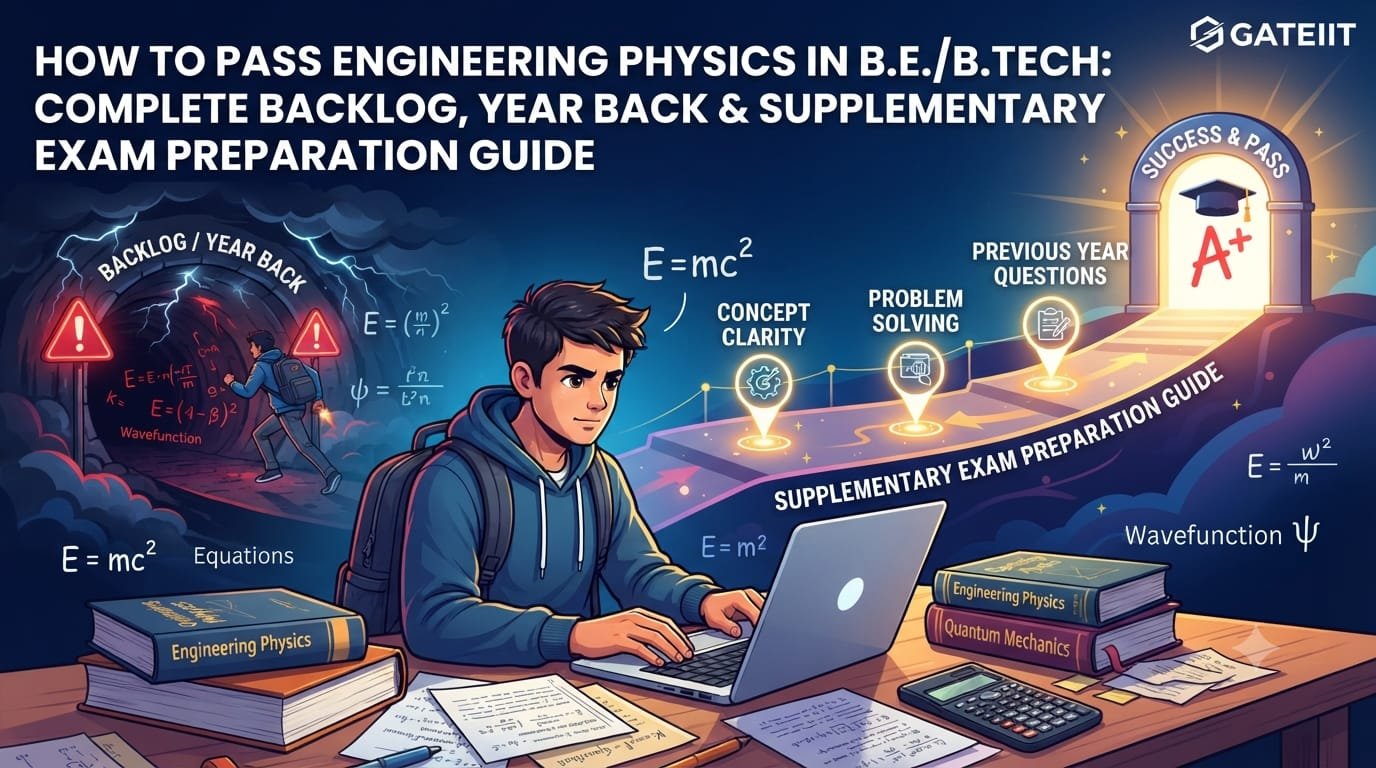
Engineering Physics Preparation Guide for VTU and Other Engineering University Students | GATEIIT Bangalore
Engineering Physics is one of the foundational subjects in many B.E. and B.Tech programmes. However, many engineering students struggle to clear this subject because of difficult mathematical derivations, unfamiliar scientific concepts, numerical problems and inadequate examination preparation.
If you have failed Engineering Physics, received a backlog, are facing a year back or are preparing for a supplementary examination, the right preparation strategy can make your next attempt more organised and productive.
The best way to pass Engineering Physics is to understand the prescribed university syllabus, strengthen the fundamental concepts, practise important derivations, solve numerical problems independently, revise systematically and attempt examination-oriented practice papers.
At GATEIIT – Gate Indian Institute of Tutorials, Bangalore, we help engineering students explore subject-focused academic support for Engineering Physics through personalised teaching, numerical problem-solving, derivation practice and examination-oriented preparation.
This comprehensive guide explains how to prepare for Engineering Physics, how to approach difficult topics, how to organise your revision schedule and how to improve your chances of clearing a pending Physics subject.
1. Why Do B.E. and B.Tech Students Find Engineering Physics Difficult?
Many students who performed reasonably well in Physics during PUC or Class 12 discover that Engineering Physics requires a different approach.
The subject involves understanding scientific principles and applying mathematical reasoning to engineering-related problems.
Some common difficulties include:
1.1 Weak Fundamentals in Physics
Students who have not properly understood basic concepts such as oscillations, waves, electromagnetic phenomena and modern Physics may find advanced university topics difficult.
1.2 Difficulty Understanding Mathematical Derivations
Engineering Physics frequently involves equations, mathematical expressions and step-by-step derivations.
Students who memorise derivations without understanding the underlying principles may struggle to reproduce them correctly during examinations.
1.3 Problems Solving Numerical Questions
Knowing a formula does not automatically mean that a student can solve a numerical problem.
Students must understand which formula applies, how to convert units, how to substitute values and how to interpret the final answer.
1.4 Inadequate Preparation for University Examinations
Some students spend considerable time reading textbooks but do not practise writing complete answers under examination conditions.
This can affect their ability to manage time and present solutions effectively.
1.5 Lack of a Structured Revision Plan
Students with multiple backlogs often find it difficult to allocate sufficient time to Engineering Physics.
Without a realistic preparation schedule, important topics may remain incomplete.
1.6 Studying Without Understanding the University Syllabus
Different universities, schemes and autonomous colleges may prescribe different Engineering Physics topics.
Studying notes from an unrelated syllabus can waste valuable preparation time.
Solution: Begin with the exact syllabus applicable to your examination, identify your weak areas and follow a structured preparation plan.
2. Understand Your Engineering Physics Syllabus Before Studying
The first step towards clearing Engineering Physics is identifying what your university actually expects you to study.
For example, Visvesvaraya Technological University (VTU) lists Engineering Physics under course code 21PHY12/22 in its 2021 scheme for common first- and second-semester B.E./B.Tech programmes.
The syllabus includes topics such as oscillations and waves, modern Physics and quantum mechanics, along with additional prescribed modules.
Students should refer to the official syllabus and model question papers rather than relying entirely on old notes or unofficial lists of important questions.
Official VTU syllabus:
https://vtu.ac.in/b-e-scheme-syllabus/
VTU model question papers:
https://vtu.ac.in/model-question-paper-b-e-b-tech-b-arch/
Important syllabus warning for backlog students
If you are studying under an older VTU scheme, do not automatically assume that your previous subject code and syllabus remain applicable.
VTU publishes subject-equivalence information for different schemes. Students should check the applicable equivalent subject and syllabus before preparing for their pending examination.
Official reference:
https://vtu.ac.in/en/course-subject-equivalences/
This is especially important for students who have carried a backlog across multiple academic years.
3. Important Engineering Physics Topics You Should Understand
The following topics are examples of commonly prescribed Engineering Physics concepts. Their actual relevance depends on your university and scheme.
Module 1: Oscillations and Waves
This module introduces the mathematical and physical principles of oscillatory motion.
Important concepts may include:
- Simple Harmonic Motion (SHM)
- Differential equation of SHM
- Free oscillations
- Natural frequency
- Damped oscillations
- Overdamping, underdamping and critical damping
- Quality factor
- Forced oscillations
- Resonance
- Sharpness of resonance
- Shock waves
- Mach number
- Applications of shock waves
Preparation tip: Understand the differential equation of SHM before studying damped and forced oscillations. Practise numerical problems involving frequency, amplitude and resonance.
Module 2: Modern Physics and Quantum Mechanics
Quantum mechanics is a challenging area for students who are encountering it for the first time.
Important concepts may include:
- Blackbody radiation
- Planck’s radiation law
- Wien’s displacement law
- Rayleigh-Jeans law
- Wave-particle duality
- de Broglie wavelength
- Heisenberg’s uncertainty principle
- Wave functions
- Probability density
- Normalisation
- Eigenvalues and eigenfunctions
- Schrödinger wave equation
- Particle in a one-dimensional box
Preparation tip: Start with wave-particle duality and the de Broglie hypothesis. Understand the physical meaning of the wave function before attempting more advanced quantum mechanical problems.
Module 3: Lasers and Optical Fibres
Depending on the syllabus, this section may include:
- Basic principles of laser action
- Spontaneous emission
- Stimulated emission
- Population inversion
- Properties of laser light
- Construction and working of lasers
- Semiconductor lasers
- Optical fibre principles
- Numerical aperture
- Acceptance angle
- Applications of optical fibres
Preparation tip: Understand the working principles and learn to draw and explain the relevant diagrams. Practise numerical problems involving optical fibre parameters where prescribed.
Module 4: Quantum Free Electron Theory and Electrical Properties
Possible topics include:
- Classical free electron theory
- Quantum free electron theory
- Fermi energy
- Density of states
- Energy distribution
- Electrical conductivity
- Hall effect
- Applications of Hall effect
Preparation tip: Understand the difference between classical and quantum approaches. Practise formula-based numerical problems and learn the significance of the Hall coefficient.
Module 5: Nanotechnology and Characterisation
Possible concepts include:
- Introduction to nanotechnology
- Nanomaterials
- Properties of nanomaterials
- Quantum confinement
- Nanoparticle applications
- X-ray diffraction (XRD)
- Electron microscopy
- Characterisation techniques
Preparation tip: Understand the principles, important diagrams, applications and differences between characterisation methods.
Remember: The above module arrangement is an illustrative guide based on topics found in the VTU 2021 Engineering Physics syllabus. Always follow your own prescribed syllabus, especially if you belong to another scheme or university.
4. How to Prepare Engineering Physics Derivations
Derivations are important because they test whether students understand how a mathematical expression is obtained.
Simply memorising the final equation may not be sufficient.
Follow this approach:
Step 1: Understand the physical principle.
Identify the scientific concept behind the derivation.
Step 2: Write the basic equation.
Begin with the fundamental equation or governing physical law.
Step 3: Understand each mathematical step.
Do not skip intermediate steps while learning.
Step 4: Identify assumptions.
Understand the conditions under which the equation is applicable.
Step 5: Practise independently.
Close your textbook and reproduce the derivation without referring to your notes.
Step 6: Verify the final expression.
Check the mathematical form, symbols and units.
Common derivation preparation mistakes
- Memorising equations without understanding them.
- Skipping mathematical steps.
- Confusing variables and symbols.
- Forgetting diagrams.
- Not practising derivations in writing.
- Learning derivations from a different university syllabus.
A useful technique is to maintain a separate derivation notebook containing the important derivations prescribed in your syllabus.
5. How to Solve Engineering Physics Numerical Problems
Numerical problems can become manageable when students follow a consistent approach.
Use the following eight-step method.
- Read the complete question carefully.
- Identify the given information.
- Write down the required quantity.
- Identify the relevant physical principle.
- Select the correct formula.
- Substitute the values with correct units.
- Perform the mathematical calculation.
- Write the final answer with the appropriate unit.
Example: de Broglie Wavelength
The de Broglie wavelength of a moving particle is given by:
λ = h/p
Where:
- λ = de Broglie wavelength
- h = Planck’s constant
- p = momentum
For a non-relativistic particle:
λ = h/mv
Suppose an electron has a speed of 2 × 10⁶ m/s.
Given:
- Planck’s constant, h = 6.626 × 10⁻³⁴ Js
- Electron mass, m = 9.11 × 10⁻³¹ kg
- Velocity, v = 2 × 10⁶ m/s
Substituting:
λ = (6.626 × 10⁻³⁴) / (9.11 × 10⁻³¹ × 2 × 10⁶)
Therefore:
λ ≈ 3.64 × 10⁻¹⁰ m
This example demonstrates how understanding the formula, identifying the given values and correctly substituting units helps solve numerical problems.
Students should practise different numerical variations instead of memorising only one solved example.
6. How to Study Engineering Physics Important Questions
Many students search for Engineering Physics important questions before university examinations.
However, depending entirely on predicted questions is risky.
A better preparation strategy combines:
- Official university model question papers.
- Previous examination papers.
- Questions covering all prescribed modules.
- Important derivations.
- Conceptual short-answer questions.
- Numerical problems.
- Diagram-based explanations.
- Application-oriented questions.
How to use previous-year question papers effectively
First: Collect available question papers relevant to your exact subject code and scheme.
Second: Identify the concepts tested in each paper.
Third: Classify questions module-wise.
Fourth: Practise solving questions without referring to notes.
Fifth: Identify concepts where you repeatedly make mistakes.
Sixth: Revise those concepts and attempt another practice paper.
Previous-year papers are useful for understanding question styles and examination expectations, but past questions do not guarantee future questions.
7. A Practical 30-Day Engineering Physics Preparation Timetable
Students preparing for a backlog or supplementary examination can use the following sample timetable.
This is a suggested study framework, not a guaranteed syllabus-completion schedule. Adjust it according to your university syllabus, available study hours and current understanding.
Days 1–5: Fundamentals and Syllabus Assessment
- Collect the latest applicable syllabus.
- Identify difficult topics.
- Revise basic Physics concepts.
- Begin the first module.
- Practise basic numerical problems.
- Prepare a formula notebook.
Days 6–10: Core Concept Preparation
- Study the next prescribed modules.
- Understand important scientific principles.
- Practise mathematical derivations.
- Solve representative numerical problems.
- Revise previously studied topics.
Days 11–15: Advanced Topics and Problem-Solving
- Complete additional prescribed topics.
- Practise quantum mechanics or other challenging concepts.
- Work through formula-based problems.
- Practise diagrams and derivations.
- Identify weak areas.
Days 16–20: Examination-Oriented Preparation
- Revise important concepts from each module.
- Solve university-style questions.
- Practise numerical problems independently.
- Write derivations without referring to notes.
- Review common mistakes.
Days 21–25: Previous-Paper Practice
- Attempt available model question papers.
- Solve previous examination questions.
- Practise writing complete answers.
- Improve calculation accuracy.
- Work on examination time management.
Days 26–30: Final Revision
- Revise formulae.
- Revisit difficult derivations.
- Practise selected numerical problems.
- Review diagrams and definitions.
- Attempt timed mock examinations.
- Concentrate on areas where mistakes continue.
Suggested daily study schedule
For students who can allocate approximately 3 hours daily:
| Activity | Suggested Time |
| Concept learning | 60 minutes |
| Numerical practice | 45 minutes |
| Derivations and diagrams | 35 minutes |
| Previous questions | 25 minutes |
| Revision | 15 minutes |
| Total | 180 minutes |
Students who have several pending subjects should adjust the schedule realistically rather than attempting an unsustainable study routine.
8. How to Prepare Engineering Physics in 15 Days
If your supplementary examination is approaching and you have only 15 days remaining, you need a focused preparation strategy.
Days 1–3: Assessment and Core Concepts
- Review the complete syllabus.
- Identify your weakest modules.
- Understand essential Physics principles.
- Prepare a list of important formulae.
Days 4–7: Derivations and Numerical Problems
- Practise the prescribed important derivations.
- Solve representative numerical questions.
- Revise difficult mathematical concepts.
- Understand diagrams and applications.
Days 8–11: Module-Wise Revision
- Cover remaining priority topics.
- Revise all completed modules.
- Practise short-answer and long-answer questions.
- Attempt selected previous-paper questions.
Days 12–15: Examination Practice
- Attempt timed mock papers.
- Revise important formulae.
- Revisit frequently misunderstood concepts.
- Practise writing complete solutions.
- Prepare for the examination calmly.
Important: A 15-day plan is most suitable for students who have already studied at least some of the syllabus. Students starting from zero may need a longer preparation period.
9. Common Mistakes That Engineering Physics Backlog Students Should Avoid
Students repeating Engineering Physics often make the same mistakes that affected their previous attempts.
Avoid the following:
Mistake 1: Studying Without Checking the Applicable Syllabus
Always confirm the correct scheme and subject code.
Mistake 2: Memorising Without Understanding
Understanding scientific principles makes it easier to solve unfamiliar problems.
Mistake 3: Ignoring Numerical Problems
Practise numerical questions throughout your preparation.
Mistake 4: Leaving Derivations Until the Last Day
Study and reproduce derivations regularly.
Mistake 5: Depending Entirely on Important Questions
Cover the prescribed syllabus systematically.
Mistake 6: Not Practising Written Answers
Reading solutions is not equivalent to solving questions independently.
Mistake 7: Ignoring Units and Diagrams
Correct units, labels and appropriate diagrams can improve the clarity of your answer.
Mistake 8: Studying Without a Revision Schedule
Reserve dedicated time for revision and practice examinations.
Mistake 9: Using Notes from the Wrong Scheme
Check whether your study materials match the subject code and examination requirements.
Mistake 10: Waiting Until the Last Few Days to Seek Help
If you repeatedly struggle with a particular concept, address the difficulty early.
10. What Should You Do If You Have Failed Engineering Physics More Than Once?
Repeatedly failing the same subject can be discouraging.
However, repeating the same study method without understanding why it failed may not improve your preparation.
Start by analysing your previous performance.
Ask yourself:
- Did I understand the fundamental concepts?
- Could I solve numerical problems independently?
- Did I know the important derivations?
- Was I able to complete the examination paper?
- Did I practise writing answers?
- Did I study the correct syllabus?
- Did I allocate enough time to Physics?
- Did I revise regularly?
Your preparation should address the actual reasons for your previous difficulty.
For example:
If you understand theory but cannot solve numerical problems: Concentrate on formula application and problem-solving practice.
If you cannot remember derivations: Focus on understanding the mathematical steps and practising them repeatedly.
If you have weak fundamentals: Rebuild the concepts before attempting advanced questions.
If you have limited preparation time: Create a realistic revision timetable and prioritise syllabus coverage.
If you are unable to study independently: Consider structured tuition and individual academic guidance.
The objective is not simply to study more hours but to study more effectively.
11. Can Engineering Physics Tuition Help Students Clear Backlogs?
Yes. Structured Engineering Physics tuition can help students who need additional academic guidance, particularly when they struggle with concepts, numerical problems, derivations or examination preparation.
Students may benefit from:
- Individual attention.
- Personalised concept explanations.
- Step-by-step numerical problem-solving.
- Derivation practice.
- Syllabus-based teaching.
- Doubt clarification.
- Previous-paper practice.
- Regular revision.
- Mock tests and performance feedback.
The right teaching arrangement depends on the student’s academic background, university syllabus, examination schedule and learning requirements.
12. Engineering Physics Backlog and Supplementary Tuition at GATEIIT, Bangalore
If you are struggling with Engineering Physics or have a pending B.E./B.Tech Physics subject, GATEIIT – Gate Indian Institute of Tutorials offers subject-focused academic support enquiries in Bangalore.
Our programmes are designed to address the academic difficulties students commonly experience while preparing for engineering university examinations.
Who Can Enquire?
- First-year B.E. students.
- First-year B.Tech students.
- Second-year engineering students studying Physics-related subjects.
- VTU Engineering Physics students.
- Students with Engineering Physics backlogs.
- Students preparing for supplementary examinations.
- Year-back and repeater students.
- Students who need individual attention.
- Students requiring numerical and derivation practice.
Learning Support Available
Depending on the student’s syllabus and faculty availability:
- Engineering Physics complete subject tuition.
- Backlog and supplementary preparation.
- Numerical problem-solving.
- Mathematical derivations.
- Module-wise revision.
- Short-term crash courses.
- One-to-one personalised tuition.
- Small-group coaching.
- Online and offline learning options.
Flexible Teaching Duration
Students can enquire about:
- 10-hour doubt-clearing programmes.
- 20-hour focused revision.
- 30-hour fast-track preparation.
- 50-hour intensive tuition.
- 100-hour comprehensive preparation.
The appropriate duration will depend on the syllabus, the student’s preparation level and the time available before the examination.
Indicative Engineering Physics Tuition Fees
| Duration | Indicative Small-Group Fee |
| 10 Hours | ₹3,000 |
| 20 Hours | ₹5,000 |
| 30 Hours | ₹7,000 |
| 50 Hours | ₹11,000 |
| 100 Hours | ₹19,000 |
These are indicative reference fees based on the GATEIIT engineering tuition framework. Actual Physics-specific fees, teaching mode and batch availability should be confirmed before enrolment. One-to-one tuition is quoted separately.
Why Enquire at GATEIIT?
- Subject-oriented academic support.
- Personalised learning approach.
- Flexible teaching hours.
- Conceptual and numerical problem-solving.
- Examination-oriented preparation.
- Online and classroom learning enquiries.
- Academic support across multiple engineering subjects.
We encourage students to share their university syllabus, subject code, semester and examination date so that a suitable preparation programme can be discussed.
13. Frequently Asked Questions About Engineering Physics Backlogs
Q1. How can I pass Engineering Physics in B.E. or B.Tech?
Start by identifying your prescribed syllabus, understanding the important concepts, practising derivations, solving numerical problems and attempting previous examination papers. Follow a realistic daily revision schedule and address your weak areas.
Q2. Is Engineering Physics difficult for first-year engineering students?
It can be challenging because it combines scientific concepts with mathematical applications. Students who develop strong fundamentals and practise numerical problems regularly can improve their understanding.
Q3. How many days are required to prepare for Engineering Physics?
The preparation time depends on your current knowledge, syllabus and examination date. Students who have already studied the subject may require 15–30 days of focused revision, while those starting from the beginning may need longer.
Q4. Can I clear Engineering Physics in 30 days?
Thirty days can provide a useful preparation period if you follow a structured schedule, cover the prescribed syllabus and practise examination questions consistently. However, clearing the examination cannot be guaranteed.
Q5. How should I prepare Engineering Physics numericals?
Understand the underlying principle, identify the given quantities, select the appropriate formula, substitute values with correct units and practise different numerical variations.
Q6. How can I remember Engineering Physics derivations?
Understand the fundamental equation and practise each mathematical step. Maintain a separate derivation notebook and reproduce important derivations without referring to your textbook.
Q7. Which topics are important in VTU Engineering Physics?
This depends on the applicable scheme and subject code. For the 2021 scheme, 21PHY12/22 includes topics such as oscillations and waves and modern Physics and quantum mechanics, along with other prescribed modules. Refer to the official VTU syllabus.
Q8. Can I clear my Engineering Physics backlog if I failed previously?
Yes, it is possible to improve your preparation for a subsequent attempt. Identify the reasons for your previous performance, correct your learning gaps and follow a structured preparation strategy.
Q9. Where can I get Engineering Physics backlog tuition in Bangalore?
GATEIIT – Gate Indian Institute of Tutorials in JP Nagar 2nd Phase, Bangalore, welcomes enquiries for Engineering Physics subject tuition, backlog preparation and supplementary examination coaching.
Q10. Does GATEIIT provide one-to-one Engineering Physics tuition?
Students can enquire about individual Physics tuition based on their syllabus, learning requirements, schedule and faculty availability.
Q11. Can students from autonomous engineering colleges join?
Yes. Students from autonomous engineering colleges and other universities can enquire by sharing their prescribed syllabus and subject code.
Q12. Can I get online Engineering Physics tuition?
Students can enquire about online learning arrangements. Availability depends on the required subject coverage and teaching schedule.
Q13. What if I have Engineering Physics and other backlogs?
You can enquire about subject-wise tuition for multiple engineering subjects and discuss a suitable preparation schedule with GATEIIT.
Q14. Does GATEIIT guarantee passing marks?
No. Examination results depend on individual understanding, preparation, attendance, practice and university evaluation. GATEIIT focuses on providing academic teaching and preparation support.
14. Final Advice for Engineering Physics Students
A backlog in Engineering Physics does not mean that you are incapable of completing your engineering degree.
It indicates that some concepts, mathematical applications or examination preparation strategies need improvement.
Instead of repeatedly studying the same notes without a clear plan, identify your weak areas, understand the prescribed syllabus, practise numerical problems, learn derivations systematically and revise regularly.
Start early, maintain consistency and seek academic guidance when you need it.
One difficult subject should not become a permanent obstacle to your engineering progress.
If you are preparing for an Engineering Physics supplementary examination, year-back examination or backlog clearance, GATEIIT can help you explore a structured tuition programme according to your academic requirements.
Get Engineering Physics Backlog Tuition in Bangalore
GATEIIT – Gate Indian Institute of Tutorials
Engineering Physics Tuition | B.E. & B.Tech Backlog Coaching | VTU Physics Tuition | Supplementary Examination Preparation | Numerical Problem-Solving | One-to-One Tuition
Centre Address:
3rd Floor, #1743, Sri Raghavendra Plaza,
17th Main Road, JP Nagar 2nd Phase,
Bangalore – 560078, Karnataka, India.
Call / WhatsApp: 8884416154 / 8884416155
Website: https://www.gateiit.com/
Google Maps: https://maps.app.goo.gl/MtzbVkqywCkwKcc4A
Explore Engineering Physics Tuition:
https://gateiit.com/engineering-physics-tuition-bangalore.html
Explore Engineering Semester & Backlog Coaching:
https://gateiit.com/engineering-semester-backlog-fast-track.html
Contact GATEIIT and share your engineering branch, university, Physics subject code, backlog status and examination date to discuss a suitable preparation programme.
REFERENCE RESOURCES
- VTU Official UG Scheme and Syllabus: https://vtu.ac.in/b-e-scheme-syllabus/
- VTU Official Engineering Physics Syllabus (2021 Scheme): https://vtu.ac.in/pdf/2021syll/21phy12.pdf
- VTU Model Question Papers: https://vtu.ac.in/model-question-paper-b-e-b-tech-b-arch/
- VTU Course and Subject Equivalences: https://vtu.ac.in/en/course-subject-equivalences/
Disclaimer: University syllabi, subject codes, examination schemes and regulations may change. Students must verify the syllabus applicable to their examination before preparing.