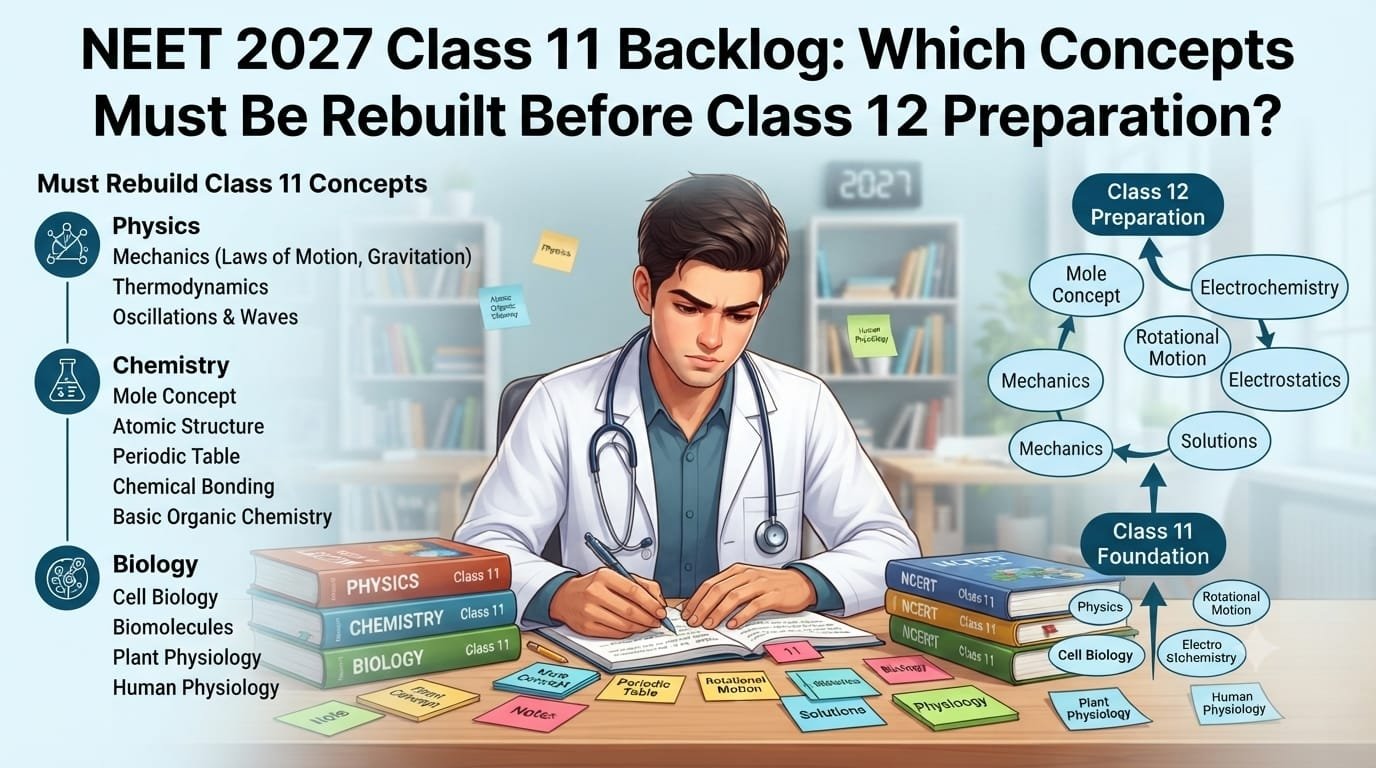
A practical subject-wise recovery guide for NEET aspirants entering Class 12, including Karnataka 2nd PUC students
Many students enter Class 12 with an uncomfortable realization: they have completed their Class 11 examinations, but their NEET preparation is far from complete. Some chapters were studied only for school examinations, some concepts were memorised without understanding, and others were left unfinished because of poor time management, frequent tests or difficulty with particular subjects.
The problem becomes more serious when Class 12 begins. New chapters start moving quickly, board examination responsibilities increase, and students are expected to solve NEET-level questions while revising their previous syllabus.
The solution is not to restart the entire Class 11 syllabus from the beginning. It is to identify the concepts that Class 12 depends on, rebuild those foundations first and gradually complete the remaining backlog alongside current studies.
For NEET 2027 aspirants, this distinction is important. A student who repairs the right concepts systematically can enter Class 12 with much greater confidence than someone who spends several months repeatedly reading entire textbooks without measuring actual improvement.
This guide explains which Class 11 concepts deserve immediate attention in Physics, Chemistry and Biology, how to identify learning gaps, and how to follow a practical 30-day recovery plan without neglecting Class 12 academics.
1. Why Class 11 Backlog Becomes a Serious Problem in Class 12
Class 11 is not simply the first half of the NEET syllabus. It establishes many of the scientific concepts, mathematical tools and biological foundations needed for understanding subsequent topics.
Consider a few examples:
- A student who has not understood vectors and basic mathematical operations may struggle with several Class 12 Physics problems.
- A student who has weak mole concept fundamentals may find later numerical Chemistry topics difficult.
- A student who memorises cell biology without understanding cellular structures may struggle to connect different biological processes.
- A student who has not developed the habit of reading Biology carefully may repeatedly confuse similar terms, processes and statements.
These problems do not necessarily appear immediately. A student may understand a classroom explanation but struggle when a question combines two or three concepts.
The important distinction is between three types of backlog:
Type 1: Untouched chapters
You have not studied the chapter properly or have only attended a few classes.
Type 2: Incomplete understanding
You have read the chapter and remember some definitions or formulas, but cannot independently solve questions.
Type 3: Revision backlog
You previously understood the chapter but have forgotten formulas, reactions, diagrams, terminology or important NCERT details.
Each type requires a different solution. Untouched chapters require structured learning, incomplete chapters require concept repair and practice, while revision backlog requires active recall and testing.
Treating all three categories identically wastes valuable preparation time.
2. Which Class 11 Physics Concepts Must Be Rebuilt First?
Physics is often the subject in which weak foundations become visible during Class 12.
Unlike a chapter that can sometimes be revised through direct reading, Physics requires students to understand relationships between physical quantities, mathematical expressions, graphs and real-world situations.
The following concept groups deserve priority.
A. Units, Dimensions and Basic Mathematical Tools
Before attempting advanced numerical problems, check your understanding of:
- SI units and derived units.
- Dimensional analysis.
- Significant figures and measurement errors.
- Scientific notation.
- Basic algebra and equation rearrangement.
- Ratios, proportions and powers.
- Graph interpretation and slopes.
- Basic trigonometry.
Why rebuild these concepts?
These tools are used repeatedly across Physics. Students who make frequent calculation mistakes often assume that their Physics concepts are weak when the actual problem is mathematical execution.
B. Vectors and Motion in One and Two Dimensions
Rebuild:
- Scalar and vector quantities.
- Vector addition and subtraction.
- Resolution of vectors into components.
- Position, displacement, velocity and acceleration.
- Distance-time and velocity-time graphs.
- Equations of uniformly accelerated motion.
- Relative motion.
- Projectile motion.
- Basic circular-motion concepts.
Why is this important?
Vector resolution, motion equations and graph interpretation provide the mathematical language for several later Physics topics.
A student who cannot resolve a vector into horizontal and vertical components may find force, electric field and magnetic force questions unnecessarily difficult.
C. Laws of Motion and Friction
Focus on:
- Newton’s three laws.
- Free-body diagrams.
- Normal reaction.
- Tension in strings.
- Friction and limiting friction.
- Connected-body problems.
- Inclined-plane problems.
- Equilibrium of forces.
Rebuild this before: studying advanced force-based applications and developing confidence in electric and magnetic force problems.
The ability to draw a correct free-body diagram is more important than memorising a large collection of solved examples.
D. Work, Energy and Power
Understand:
- Work done by constant and variable forces.
- Work-energy theorem.
- Kinetic and potential energy.
- Conservation of mechanical energy.
- Conservative and non-conservative forces.
- Energy-based problem solving.
Why prioritise it?
Energy concepts are useful in several areas of Physics. Students should be comfortable identifying when an energy-based approach is easier than solving equations of motion.
E. Circular Motion, Centre of Mass and Rotational Motion
These topics require special attention because students frequently memorise formulas without understanding their application.
Rebuild:
- Angular displacement and angular velocity.
- Centripetal acceleration and force.
- Banking of roads.
- Centre of mass.
- Angular momentum.
- Moment of inertia.
- Rotational kinetic energy.
- Rolling motion.
Do not attempt to master every difficult rotational-motion problem immediately. First establish the meaning of angular quantities, torque, moment of inertia and conservation principles.
F. Gravitation
Focus on:
- Universal law of gravitation.
- Gravitational field and potential.
- Acceleration due to gravity.
- Variation of gravitational acceleration.
- Escape velocity.
- Orbital velocity.
- Satellite energy.
Students should understand the relationship between gravitational force, field, potential and energy rather than learning these expressions independently.
G. Oscillations and Waves
Rebuild:
- Periodic motion.
- Simple harmonic motion.
- Displacement, velocity and acceleration in SHM.
- Time period and frequency.
- Energy in SHM.
- Wave motion.
- Wavelength, frequency and wave speed.
- Superposition and standing waves.
- Sound-wave fundamentals.
Class 11 Physics priority order
- Mathematical tools, units and dimensions.
- Vectors and kinematics.
- Laws of motion and friction.
- Work, energy and power.
- Circular motion and rotational motion.
- Oscillations and waves.
This is a conceptual recovery order, not an official chapter-weightage ranking. Students should also follow the latest applicable NEET syllabus when deciding what to study.
3. Which Class 11 Chemistry Concepts Must Be Rebuilt?
Chemistry backlog is slightly different from Physics backlog because it involves three interconnected learning approaches:
- Physical Chemistry: numerical understanding and mathematical relationships.
- Organic Chemistry: reaction mechanisms, electronic effects and logical connections.
- Inorganic Chemistry: periodic trends, chemical properties and accurate factual understanding.
A student may score reasonably well in one part while having serious gaps in another.
A. Mole Concept and Stoichiometry
Highest-priority foundational area.
Rebuild:
- Atomic mass and molecular mass.
- Mole and Avogadro constant.
- Molar mass.
- Percentage composition.
- Empirical and molecular formula.
- Balanced chemical equations.
- Limiting reagent.
- Stoichiometric calculations.
- Concentration terms.
Why is it essential?
Many numerical Chemistry questions depend on the ability to convert mass, moles, particles and concentration correctly.
If mole calculations are weak, students may struggle with later quantitative Chemistry topics.
B. Atomic Structure
Understand:
- Fundamental particles.
- Atomic models.
- Electromagnetic radiation.
- Bohr’s model.
- Energy levels.
- Quantum numbers.
- Electronic configuration.
- Aufbau principle.
- Pauli exclusion principle.
- Hund’s rule.
Students should be able to explain why electrons occupy particular orbitals instead of merely memorising configurations.
C. Classification of Elements and Periodicity
Rebuild:
- Modern periodic law.
- Electronic configuration and periodic position.
- Atomic and ionic radii.
- Ionisation enthalpy.
- Electron gain enthalpy.
- Periodic trends.
- Important exceptions.
This chapter provides the foundation for understanding chemical properties and bonding.
D. Chemical Bonding and Molecular Structure
One of the most important Chemistry foundations.
Focus on:
- Ionic and covalent bonding.
- Lewis structures.
- Octet rule and its limitations.
- Formal charge.
- VSEPR theory.
- Molecular shapes.
- Bond parameters.
- Dipole moment.
- Hydrogen bonding.
- Molecular orbital theory fundamentals, where included in the applicable syllabus.
Why is it important?
Chemical bonding connects several Chemistry topics. A student who understands molecular structure, bond polarity and hybridisation can approach unfamiliar questions more logically.
E. Thermodynamics and Equilibrium
Rebuild the following concepts:
Chemical thermodynamics
- System and surroundings.
- State functions.
- Internal energy.
- Heat and work.
- Hess’s law.
- Entropy and Gibbs energy.
Chemical and ionic equilibrium
- Law of mass action.
- Equilibrium constant.
- Reaction quotient.
- Le Chatelier’s principle.
- Acids and bases.
- Buffer solutions.
- Solubility product.
- Common-ion effect.
Do not rush into difficult equilibrium numericals before understanding the meaning of the equations.
F. Redox Reactions
Understand:
- Oxidation and reduction.
- Oxidation number.
- Identifying oxidising and reducing agents.
- Balancing redox reactions.
- Electron transfer.
These concepts are useful for building confidence in subsequent electrochemical and reaction-based Chemistry.
G. Organic Chemistry: The Most Important Foundational Repair
Students who struggle with Organic Chemistry often attempt to memorise individual reactions without understanding the underlying principles.
Rebuild these concepts first:
- IUPAC nomenclature.
- Structural isomerism.
- Electronic displacement effects.
- Inductive effect.
- Electromeric effect, where applicable.
- Homolytic and heterolytic bond cleavage.
- Electrophiles and nucleophiles.
- Carbocations and carbanions.
- Free radicals.
- Acidity and basicity.
- Reaction intermediates.
- Fundamental reaction types.
Why does this matter for Class 12?
Organic Chemistry becomes considerably harder when students cannot explain why a reaction takes place, where an electron-rich or electron-deficient centre is located, or why one intermediate is more stable than another.
A student with a strong understanding of General Organic Chemistry has a better foundation for studying later functional-group chemistry.
H. Hydrocarbons
Revise:
- Aromatic hydrocarbons.
- Basic nomenclature.
- Important reaction patterns.
- Addition and substitution reactions.
- Structural and reaction-based comparisons.
Prioritise reaction logic and the relationship between structure and chemical behaviour.
Class 11 Chemistry priority order
- Mole concept and stoichiometry.
- Atomic structure.
- Periodic classification.
- Chemical bonding.
- Redox reactions.
- General Organic Chemistry
The order can be adjusted according to the student’s current understanding and the latest official examination syllabus.
4. Which Class 11 Biology Concepts Should NEET Students Revise?
Biology is often treated as a memory-based subject. This is an incomplete approach.
NEET Biology requires careful reading, accurate recall, conceptual differentiation and the ability to understand relationships between structures and biological processes.
A student who simply reads a chapter repeatedly without testing recall may feel familiar with the material but still make avoidable mistakes in objective questions.
A. The Living World and Biological Classification
Rebuild:
- Characteristics of living organisms.
- Taxonomic categories.
- Taxonomic hierarchy.
- Binomial nomenclature.
- Major classification systems.
- Five-kingdom classification.
- Important features of different groups.
- Scientific terminology and examples.
Students should pay attention to differences between similar groups and the defining characteristics of each category.
B. Plant Kingdom
Focus on:
- Important life-cycle patterns.
- Dominant phases.
- Reproductive structures.
- Distinguishing characteristics.
Create comparison tables to distinguish groups rather than memorising isolated descriptions.
C. Animal Kingdom
This is an area where systematic NCERT revision is especially useful.
Rebuild:
- Basis of animal classification.
- Levels of organisation.
- Germ layers.
- Major non-chordate phyla.
- Chordate classification.
- Important examples and distinguishing characteristics.
Students should learn the diagnostic features of each group and practise identifying the group from a short description.
D. Morphology and Anatomy of Flowering Plants
Understand:
- Root systems.
- Stem modifications.
- Leaf structure and modifications.
- Flower structure.
- Fruit and seed.
- Plant tissues.
- Internal anatomy.
- Dicot and monocot differences.
Diagrams, labelled structures and comparative tables help improve understanding.
E. Cell: The Unit of Life
One of the most important Biology foundations.
Rebuild:
- Prokaryotic and eukaryotic cells.
- Plasma membrane.
- Cell wall.
- Endoplasmic reticulum.
- Golgi apparatus.
- Cell organelle functions.
Students must understand the relationship between an organelle’s structure and its function.
F. Biomolecules
Focus on:
- Nucleic acids.
- Amino acids.
- Enzyme action.
- Primary and secondary metabolites.
- Important biological bonds and structures.
The difference between similar terms should be revised through short questions and self-testing.
G. Cell Cycle and Cell Division
Understand:
- Cell-cycle phases.
- Chromosome behaviour.
- Significance of cell division.
- Differences between mitosis and meiosis.
This foundation is particularly useful when studying later topics involving inheritance, reproduction and cellular processes.
H. Plant Physiology
Students should assess their understanding of:
- Transport in plants.
- Water potential and osmosis.
- Mineral nutrition.
- Respiration in plants.
- Plant growth and development.
- Plant growth regulators.
Give special attention to the relationship between processes, conditions and outcomes rather than memorising individual statements.
I. Human Physiology
This area deserves significant attention because it includes several interconnected systems.
Rebuild:
Breathing and exchange of gases
- Respiratory organs.
- Mechanism of breathing.
- Exchange and transport of gases.
- Oxygen dissociation curve.
- Regulation of respiration.
Body fluids and circulation
- Blood components.
- Blood groups.
- Heart structure.
- Cardiac cycle.
- ECG fundamentals.
Excretory products and elimination
- Nephron structure.
- Urine formation.
- Counter-current mechanism.
Locomotion and movement
- Types of movement.
- Muscle structure.
- Sliding filament theory.
- Skeletal system.
Neural control and coordination
- Neuron structure.
- Nerve impulse.
- Central and peripheral nervous systems.
- Reflex action.
- Sense organs.
Chemical coordination and integration
- Endocrine glands.
- Mechanisms of hormonal action.
- Feedback regulation.
Class 11 Biology priority order
- Cell structure and cell cycle.
- Human physiology.
- Plant physiology.
- Animal kingdom.
- Plant kingdom.
- Morphology and anatomy.
- Living World and biological classification.
This order reflects conceptual dependencies and the importance of repairing difficult foundations. It should not be interpreted as a prediction of NEET question weightage.
5. The Class 11-to-Class 12 Concept Dependency Map
This is perhaps the most useful part of backlog recovery.
Students should not decide what to revise merely by counting unfinished chapters. They should identify which earlier concepts support their current Class 12 lessons.
The following table provides a practical dependency map.
| Class 11 foundation | Class 12 learning supported |
| Vectors and mathematical tools | Electric and magnetic vector applications |
| Laws of motion and force analysis | Understanding forces acting on charged particles |
| Work, energy and power | Energy-based Physics reasoning |
| Circular motion and gravitation | Further applications of force, motion and fields |
| Oscillations and waves | Wave optics and electromagnetic-wave concepts |
| Mole concept | Quantitative Chemistry and electrochemistry |
| Atomic structure | Electronic configuration and chemical behaviour |
| Periodicity | Understanding periodic and chemical properties |
| Chemical bonding | Coordination compounds and molecular structure |
| Equilibrium | Acid-base and ionic concepts in later Chemistry |
| General Organic Chemistry | Halo compounds, alcohols, carbonyl compounds and other organic families |
| Hydrocarbons | Understanding subsequent organic reaction patterns |
| Cell structure | Cell division, genetics and biotechnology |
| Biomolecules | Molecular biology and biological processes |
| Cell cycle and meiosis | Principles of inheritance |
| Plant physiology | Understanding plant-related biological processes |
| Human physiology | Reproductive and regulatory systems |
These are learning relationships, not claims that every later chapter directly requires every earlier chapter. Students should use the current official syllabus and their actual classroom sequence to decide the exact revision requirement.
The five foundations that deserve the earliest attention
If you have a large backlog and cannot revise everything simultaneously, begin with:
- Physics: vectors, kinematics and Newton’s laws.
- Chemistry: mole concept and chemical bonding.
- Chemistry: General Organic Chemistry.
- Biology: cell structure and biomolecules.
- Biology: cell division and major physiological concepts.
These areas provide useful starting points for rebuilding broader subject understanding.
6. How to Identify Which Chapters You Actually Need to Rebuild
Before beginning a new revision schedule, conduct a chapter-wise academic audit.
Do not depend only on your memory of classroom attendance or the number of pages you have read.
Use the following classification.
| Category | Your actual level | What to do |
| Green | Can explain concepts and solve standard questions independently | Continue with spaced revision |
| Yellow | Understand basic concepts but make frequent mistakes | Revise weak subtopics and practise questions |
| Red | Cannot explain the concepts or solve basic questions | Relearn the chapter systematically |
| Grey | Not studied properly or not covered | Schedule structured first-time learning |
The three-stage chapter diagnostic
For every important chapter, perform these three checks.
Stage 1: Concept explanation
Close your textbook and explain the main concepts in your own words.
If you cannot explain a concept without looking at the notes, it requires further revision.
Stage 2: Basic question solving
Attempt a small set of fundamental questions.
You should be able to identify:
- The concept being tested.
- The relevant formula, principle or biological fact.
- The steps required to reach the answer.
- The reason the other options are incorrect, wherever applicable.
Stage 3: NEET-level application
Attempt a short set of syllabus-aligned objective questions.
Check whether you can apply the concepts without repeatedly referring to the textbook.
A simple self-assessment score
For an initial diagnostic, try 20 carefully selected questions from a chapter.
- 16–20 correct: Strong starting point; maintain revision.
- 11–15 correct: Some concepts need reinforcement.
- 6–10 correct: Significant learning gaps; revisit the chapter.
- 0–5 correct: Rebuild the fundamentals before attempting difficult questions.
These are suggested study-management bands, not official NEET standards or guaranteed predictors of examination performance.
Also remember that a student who guesses answers correctly may have a weaker understanding than the score indicates. Review the reasoning behind every answer.
7. A Practical 30-Day Class 11 Backlog Recovery Plan for NEET 2027
A 30-day plan can provide a structured starting point for students who have accumulated unfinished Class 11 work.
It is not a promise that the entire Class 11 syllabus can be mastered in one month. The actual duration will depend on how much has been completed, the student’s current level and available study time.
The purpose is to repair essential foundations and create a manageable system for continuing revision during Class 12.
Week 1: Rebuild the essential foundations
Physics
- Units and dimensions.
- Mathematical tools
- Basic Newton’s laws.
Chemistry
- Mole concept.
- Atomic structure.
Biology
- Living World and classification.
- Cell structure.
Target: Understand basic concepts and identify the chapters that need more than one revision cycle.
Week 2: Strengthen conceptual understanding
Physics
- Laws of motion.
- Work, energy and power.
- Circular motion.
Chemistry
- Chemical bonding.
- Chemical equilibrium.
Biology
- Cell cycle and cell division.
- Plant Kingdom.
- Animal Kingdom.
Target: Solve standard questions without depending continuously on worked examples.
Week 3: Repair application-based topics
Physics
- Centre of mass.
- Rotational motion.
Chemistry
- Ionic equilibrium.
- Redox reactions.
- General Organic Chemistry.
Biology
- Plant physiology.
- Human physiology: breathing, circulation and excretion.
Target: Improve the ability to apply concepts in unfamiliar questions.
Week 4: Consolidate, test and correct mistakes
Physics
- Revision of difficult numerical topics.
- Mixed chapter-wise practice.
Chemistry
- Revision of physical and organic foundations.
- Reaction and formula practice.
Biology
- Remaining human physiology topics.
- Morphology and anatomy.
- NCERT-based factual revision.
Target: Identify remaining red and yellow chapters, conduct subject-wise tests and prepare the next month’s revision plan.
Suggested daily study allocation
For a student who has approximately four additional hours available for NEET backlog work:
| Activity | Suggested time |
| Physics concept repair and practice | 60 minutes |
| Chemistry concept repair and practice | 60 minutes |
| Biology NCERT revision and recall | 60 minutes |
| Mixed question practice | 30 minutes |
| Mistake analysis and short revision | 30 minutes |
| Total | 4 hours |
This is an illustrative additional-study allocation, not a compulsory timetable. Students must account for school or college hours, board preparation, travel, rest and their individual learning capacity.
If four additional hours are unrealistic, start with a shorter consistent schedule rather than creating a timetable that cannot be followed.
8. How Karnataka 2nd PUC Students Can Manage Class 11 Backlog Alongside Class 12
Karnataka students studying PCMB face a particular challenge.
They need to prepare for:
- Karnataka 2nd PUC board examinations.
- NEET UG.
- Practical examinations and internal academic requirements.
- Regular college assignments and attendance.
These objectives overlap in subject knowledge but differ in examination requirements.
Board examinations require appropriate descriptive answers, derivations, diagrams and presentation. NEET preparation requires conceptual application, objective question solving, accuracy and speed.
A student should therefore avoid maintaining two completely separate learning systems.
A coordinated study approach
During regular college days
- Complete the current 2nd PUC topic.
- Identify any Class 11 concept required to understand that topic.
- Revise that prerequisite for a short, focused period.
- Solve a few relevant NEET-level questions.
- Keep up with board-oriented written practice.
During weekends
- Complete one or two planned backlog topics.
- Revise Biology NCERT.
- Practise Physics numericals.
- Review Chemistry reactions and calculations.
- Attempt a short cumulative test.
Before board examinations
Board syllabus completion and written examination preparation should receive appropriate priority.
Continue maintaining short NEET revision sessions so that earlier concepts do not disappear from memory.
An important mistake to avoid
Do not postpone all Class 11 revision until after the 2nd PUC board examinations.
By then, students may have accumulated additional revision gaps and may need to spend considerable time rebuilding forgotten foundations.
A smaller, consistent revision routine during Class 12 is generally more manageable than attempting to recover everything at the end.
9. How to Study a Backlogged Chapter Without Wasting Time
A common mistake is to watch several hours of lectures, copy extensive notes and assume that the chapter has been completed.
Actual understanding must be tested.
Follow this five-step method.
Step 1: Check prerequisites
Identify the concepts needed before starting the chapter.
For example, before attempting advanced Organic Chemistry reactions, check your understanding of electronic effects, reaction intermediates and acidity/basicity.
Step 2: Learn the concept
Use NCERT, reliable teaching material or a structured explanation.
Avoid switching between multiple teachers and resources for the same topic unless there is a genuine learning need.
Step 3: Practise immediately
Solve basic questions after learning each concept.
For Physics and Physical Chemistry, write down the steps rather than jumping directly to the answer.
For Biology, practise recall and statement-based questions.
Step 4: Maintain an error notebook
Record mistakes under four headings:
- Concept not understood.
- Formula or fact forgotten.
- Calculation or interpretation mistake.
- Careless reading or incorrect option selection.
Step 5: Revisit the chapter
Revise after approximately one day, one week and two to three weeks, adjusting the intervals according to your retention.
The aim is to make the knowledge accessible when you encounter a question, not simply familiar when you reread the textbook.
10. How Many Class 11 Chapters Should You Revise Every Week?
There is no universally correct number.
A student who has already studied most chapters but needs revision may comfortably cover several chapters per week.
A student who has never understood rotational motion, equilibrium or human physiology may need substantially more time.
Use the following principle:
Prioritise the depth of understanding, not the number of completed chapter headings.
A useful weekly structure is:
- Two or three foundational topics requiring concept repair.
- Two or three smaller revision topics.
- Daily Biology recall.
- Regular numerical problem-solving.
- One cumulative assessment.
- One dedicated mistake-analysis session.
For particularly difficult chapters, split the work into smaller subtopics rather than attempting to finish everything in a single sitting.
11. How to Know Whether Your Class 11 Backlog Is Under Control
You do not need to achieve perfection before beginning Class 12 preparation.
However, you should be able to demonstrate measurable improvement.
Use these readiness indicators:
Physics readiness
- Can resolve vectors correctly.
- Can interpret basic motion graphs.
- Can draw free-body diagrams.
- Can select an appropriate formula or physical principle.
- Can solve standard numerical questions independently.
Chemistry readiness
- Can perform mole calculations.
- Can explain periodic trends.
- Can predict basic molecular shapes.
- Can understand chemical equilibrium.
- Can identify nucleophiles, electrophiles and basic reaction intermediates.
Biology readiness
- Can explain cell organelle functions.
- Can distinguish mitosis from meiosis.
- Can compare major plant and animal groups.
- Can recall important physiological processes.
- Can answer NCERT-based questions without relying on immediate textbook references.
The readiness test
At the end of your first recovery cycle:
- Attempt a mixed Class 11 Physics test.
- Attempt a mixed Class 11 Chemistry test.
- Attempt a mixed Class 11 Biology test.
- Analyse your errors.
- Compare your performance with your initial diagnostic.
Improvement in accuracy, reduced dependence on notes and better question-solving confidence are useful indicators of progress.
Do not judge your readiness using a single test score.
12. Common Class 11 Backlog Mistakes That NEET 2027 Students Should Avoid
Mistake 1: Trying to complete every chapter simultaneously
This creates fragmented learning. Work according to conceptual priority.
Mistake 2: Watching lectures without solving questions
A lecture provides instruction, not proof of understanding. Practise after every important concept.
Mistake 3: Ignoring NCERT Biology
Students should develop a systematic NCERT reading and active-recall habit, paying attention to terminology, examples, diagrams and differences between similar statements.
Mistake 4: Memorising Physics formulas without understanding
Learn the meaning, conditions and application of each formula.
Mistake 5: Memorising Organic Chemistry reactions without understanding GOC
Reaction mechanisms and electronic effects help explain why reactions occur.
Mistake 6: Taking tests but not analysing them
A test without error analysis gives incomplete feedback.
Mistake 7: Neglecting Class 12 because of Class 11 backlog
This is particularly damaging for students preparing alongside 2nd PUC board examinations.
Mistake 8: Comparing preparation speed with other students
A student who has attended coaching regularly may have a different starting level. Your schedule should be based on your own diagnostic assessment.
Mistake 9: Changing study material repeatedly
Use a limited, reliable set of resources and complete them properly.
Mistake 10: Sacrificing sleep to compensate for backlog
Consistent learning, adequate rest and regular revision are more sustainable than extreme study schedules.
13. Should You Join Coaching to Clear Your Class 11 NEET Backlog?
Not every student with a backlog needs a new coaching programme.
Some students can recover independently with NCERT, a suitable question bank, reliable explanations and a disciplined revision schedule.
However, additional academic guidance may be useful when:
- You repeatedly fail to understand the same concepts.
- You cannot decide which chapters to prioritise.
- Your Physics numerical problem-solving is weak.
- You have difficulty understanding Organic Chemistry.
- You read Biology but forget important details.
- Your school or college schedule leaves little time for structured revision.
- You need someone to monitor your progress.
- You require individual doubt-solving rather than another large collection of lectures.
What should a good backlog-recovery programme include?
Before joining any programme, ask whether it provides:
- An initial subject-wise academic assessment.
- Identification of missing prerequisite concepts.
- A personalised chapter-wise recovery plan.
- Concept teaching at the student’s current level.
- Immediate question practice.
- Regular chapter-wise assessments.
- Individual doubt clarification.
- Performance analysis and corrective revision.
- Coordination with ongoing Class 12 academics.
- A realistic schedule that does not unnecessarily overload the student.
A student with a serious backlog may benefit more from targeted personal attention than from simply attending additional general lectures.
How GATEIIT can support NEET 2027 aspirants
GATEIIT provides NEET academic coaching options for students at different preparation stages, including Class 11, Class 12 and repeaters.
For students entering Class 12 with unfinished Class 11 topics, the academic plan can be discussed around their actual requirements.
Depending on the selected programme and current faculty availability, students can enquire about:
- Subject-wise Physics, Chemistry and Biology support.
- Concept rebuilding and chapter-wise revision.
- Individual or one-to-one academic guidance.
- NEET-level objective question practice.
- NCERT-focused Biology preparation.
- Chapter-wise tests and performance analysis.
- Online, classroom and hybrid learning options.
- Coordinated academic support alongside Karnataka 2nd PUC preparation.
The first step should be an assessment of the student’s current level, not an assumption that everyone requires the same course duration.
Students and parents can discuss the required subjects, teaching hours, batch structure, available faculty and current fees before deciding on a programme.
14. Frequently Asked Questions About Class 11 Backlog and NEET 2027
1. Can I crack NEET 2027 if my Class 11 syllabus is incomplete?
Yes, an incomplete Class 11 syllabus does not automatically prevent you from preparing effectively for NEET 2027. However, you should identify important conceptual gaps, prioritise prerequisite topics and maintain consistent Class 12 preparation.
2. Which Class 11 chapters should I complete first for NEET 2027?
Begin with foundational topics such as vectors, kinematics, Newton’s laws, mole concept, chemical bonding, General Organic Chemistry, cell structure, biomolecules and cell division. Adjust the order according to your weak areas and current Class 12 lessons.
3. Can I complete my Class 11 NEET backlog in 30 days?
You can make meaningful progress in 30 days, especially if some chapters require only revision. Completing and mastering a substantial backlog within that period depends on its size, your starting level and available study time. Do not confuse rapid coverage with conceptual mastery.
4. Should I complete all Class 11 chapters before starting Class 12?
No. Continue your regular Class 12 learning while repairing the Class 11 concepts needed for it. Delaying all Class 12 preparation until the previous year’s backlog is complete can create another serious academic problem.
5. Is Class 11 Physics more important than Class 11 Chemistry and Biology?
All three subjects matter. Physics has significant mathematical and conceptual dependencies, Chemistry has interconnected foundational principles, and Biology requires strong conceptual understanding and factual recall. Your revision priority should reflect your individual weaknesses.
6. Which Chemistry topic should I revise first?
Start with the mole concept and stoichiometry. Then strengthen atomic structure, periodicity and chemical bonding. For Organic Chemistry, build a clear understanding of General Organic Chemistry before attempting to memorise large numbers of reactions.
7. Is NCERT sufficient for Class 11 Biology NEET preparation?
NCERT should be the central reference for Biology preparation. However, reading alone is insufficient. Students should practise relevant objective questions, recall important facts, understand diagrams and review mistakes.
8. How much time should I spend on Class 11 backlog every day in Class 12?
The required time depends on the backlog and your school schedule. Around one to two focused hours can be a reasonable starting point for students with moderate gaps, with additional time allocated when necessary. Avoid compromising current Class 12 lessons and board preparation.
9. Can Karnataka 2nd PUC students prepare for NEET 2027 alongside board examinations?
Yes. Many topics overlap between the academic subjects and NEET syllabus. However, students need additional objective-question practice, conceptual application and regular revision alongside board-oriented answer writing and practical requirements.
10. Should I study Class 11 NCERT again from the beginning?
Not necessarily. First identify what you remember and what you do not understand. Strong chapters need revision, partially understood chapters need targeted practice, and untouched chapters need structured learning.
11. How can I improve my Physics numerical-solving ability?
Start with basic examples, understand the physical principle involved, practise equation manipulation and gradually increase question difficulty. Analyse whether your mistakes arise from concept selection, mathematical execution or question interpretation.
12. Why do I forget Biology after completing a chapter?
Repeated passive reading can create familiarity without reliable recall. Use active recall, spaced revision, diagrams, comparison tables and chapter-wise testing to improve retention.
13. Is one-to-one coaching useful for the Class 11 backlog?
It can be useful for students who need individual explanations, personalised pacing, targeted doubt-solving and regular progress monitoring. Its value depends on teaching quality and whether the programme addresses the student’s actual learning gaps.
14. When should I start full-length NEET mock tests?
Begin with topic-wise and part-syllabus assessments while rebuilding foundations. Progress towards cumulative and full-length mock tests as your syllabus coverage and examination readiness improve.
15. Has the official NEET 2027 syllabus been released?
Students should check the National Testing Agency and National Medical Commission for the latest official syllabus and examination notifications. The latest detailed official syllabus available for reference at the time of this article is the NEET (UG) 2026 syllabus. Do not assume that unofficial predicted chapter lists are official NEET 2027 requirements.
Official websites:
15. Final Advice: Do Not Carry Your Class 11 Backlog Into Every Month of Class 12
A Class 11 backlog is a learning problem that needs a clear solution, not a reason to lose confidence.
The most effective approach is to identify the concepts that matter, understand why they are weak, repair them systematically and test whether the improvement is real.
Remember these five principles:
- Do not revise everything randomly.
- Repair foundational concepts before attempting difficult questions.
- Continue learning current Class 12 topics.
- Use NCERT, regular practice and error analysis consistently.
- Measure progress through understanding and question-solving ability, not simply completed chapters.
For NEET 2027 aspirants, the transition into Class 12 is an opportunity to correct earlier mistakes and develop a more organised preparation system.
You do not need to become perfect in Class 11 before moving forward. You need to become strong enough in its essential concepts to understand what comes next.
Need Help Rebuilding Your Class 11 Concepts for NEET 2027?
If you are entering Class 12 with unfinished Physics, Chemistry or Biology topics, GATEIIT can help you discuss an academic recovery plan based on your current preparation level.
Students can enquire about personalised guidance, subject-wise tuition, chapter-wise revision, NEET question practice and coordinated preparation alongside Karnataka 2nd PUC.
GATEIIT – Gate Indian Institute of Tutorials
- Location: 3rd Floor, #1743, Sri Raghavendra Plaza, 17th Main Road, JP Nagar 2nd Phase, Bangalore – 560078, Karnataka.
- Classroom, online and hybrid learning options.
- Website: https://www.gateiit.com/
- Call / WhatsApp: 8884416154 / 8884416155
Take the first step by identifying your actual learning gaps. A well-planned recovery strategy can make your Class 12 NEET preparation more confident and manageable.