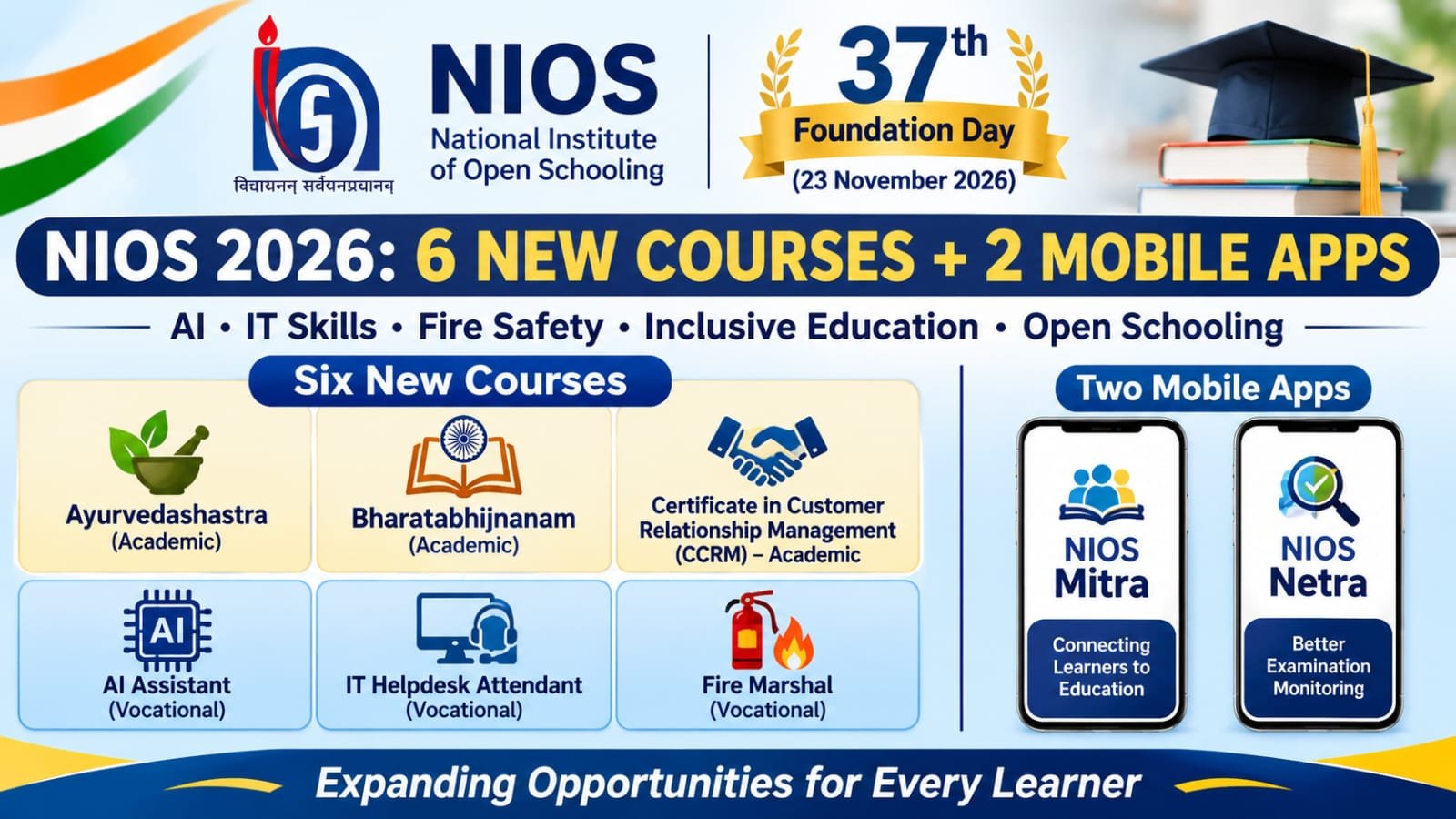
India’s open schooling system is expanding its focus on vocational education, technology skills and inclusive learning. On 23 November 2026, the National Institute of Open Schooling (NIOS) introduced six new academic and vocational courses and launched two mobile applications during its 37th Foundation Day celebrations.
The announcement brings together several areas of growing educational and employment relevance, including artificial intelligence, computer technical support, fire safety, Indian knowledge traditions, Ayurveda and customer relationship management.
For students who cannot continue their education through conventional schools, working individuals who want to acquire additional qualifications, and learners looking for flexible educational opportunities, these developments deserve attention.
However, an important question remains: Which of these programmes are suitable for school students, who can apply, what qualifications will they receive, and how are the new vocational courses different from the regular NIOS Class 10 and Class 12 programmes?
This guide explains the announcement, the six new courses, the two mobile applications and the practical considerations students and parents should understand before making an admission decision.
What Has NIOS Announced on Its 37th Foundation Day?
The National Institute of Open Schooling celebrated its 37th Foundation Day on 23 November 2026 with several initiatives intended to strengthen open and distance learning in India.
The major announcements include:
- Six newly introduced academic and vocational courses.
- Three vocational programmes covering artificial intelligence, IT support and fire safety.
- New academic learning opportunities involving Ayurveda, Indian knowledge traditions and customer relationship management.
- NIOS Mitra, a community-based educational outreach initiative.
- NIOS Netra, a digital application for examination-centre inspection and monitoring.
The broader objective is to make educational opportunities more accessible while giving learners exposure to practical skills and emerging areas of knowledge.
Complete List of the 6 New NIOS Courses in 2026
NIOS has introduced three academic programmes and three vocational programmes.
| Course | Category | Main Area |
| Ayurvedashastra | Academic | Ayurveda, health, nutrition and yoga |
| Bharatabhijnanam | Academic | Indian Knowledge Traditions |
| Certificate in Customer Relationship Management (CCRM) | Academic | Customer relationship skills |
| AI Assistant | Vocational | Artificial intelligence |
| IT Helpdesk Attendant | Vocational | Computer and technical support |
| Fire Marshal | Vocational | Fire prevention and emergency safety |
Let’s understand what each programme offers and which learners may find it useful.
1. Ayurvedashastra: Understanding Traditional Indian Health Knowledge
Ayurvedashastra is a new secondary-level academic course introducing learners to fundamental concepts of Ayurveda and traditional approaches to health and well-being.
The course covers areas such as:
- Basic principles of Ayurveda.
- Healthy living practices.
- Nutrition and dietary awareness.
- Yoga and physical well-being.
- Practical aspects of maintaining personal health.
Students interested in traditional Indian knowledge, wellness and healthy lifestyle practices may find this programme interesting.
It also provides an opportunity to explore how traditional health knowledge is presented within an academic learning framework.
Who should consider this course?
Students interested in Indian traditional knowledge, wellness education and learning about Ayurveda.
An important clarification is that studying Ayurvedashastra as an academic course does not qualify someone to practise as an Ayurvedic doctor or healthcare professional.
2. Bharatabhijnanam: Learning About India’s Knowledge Traditions
India has a long intellectual and cultural heritage covering mathematics, astronomy, philosophy, literature, architecture, traditional sciences and many other areas.
Bharatabhijnanam is a new academic course intended to introduce learners to Indian Knowledge Traditions.
Its learning approach includes:
- Reading and understanding traditional knowledge.
- Group discussions and educational activities.
- Documentation of local knowledge.
- Project-based learning.
- Field-based educational experiences.
Unlike a course focused exclusively on memorising historical information, this programme aims to encourage learners to explore, discuss and document knowledge traditions.
Who should consider Bharatabhijnanam?
Students interested in Indian heritage, traditional sciences, history, culture and knowledge systems.
It may also encourage learners to understand how historical knowledge connects with contemporary education and society.
3. Certificate in Customer Relationship Management (CCRM): An Important Inclusive Education Initiative
One of the particularly significant announcements is the introduction of a six-month Certificate in Customer Relationship Management (CCRM), specifically designed for deaf and hard-of-hearing learners.
Customer Relationship Management involves maintaining positive relationships between organisations and their customers.
It includes understanding customer requirements, responding to enquiries, providing assistance and helping resolve customer concerns.
The programme is relevant to service-oriented employment areas such as:
- Customer support.
- Retail and service operations.
- Customer relationship assistance.
- Business support services.
- Customer communication-related work.
The introduction of a dedicated programme for deaf and hard-of-hearing learners highlights the importance of making vocational and employment-oriented education more inclusive.
Why is this development important?
Many learners with hearing disabilities encounter accessibility challenges in conventional educational and professional training environments.
Programmes designed with their learning requirements in mind can help expand educational participation and improve access to skill development.
Students and parents should nevertheless verify the actual teaching arrangements, communication support, assessment facilities and practical training provisions before admission.
4. AI Assistant: Introducing Students to Artificial Intelligence
Artificial intelligence is changing the way people study, communicate, conduct research and perform professional tasks.
From educational assistance to business administration, AI-powered tools are becoming increasingly common.
NIOS has introduced the AI Assistant vocational course to provide learners with an introduction to this emerging field.
The programme covers:
- Fundamentals of artificial intelligence.
- Introduction to AI tools.
- Basic prompting techniques.
- Practical applications of AI.
- Responsible use of artificial intelligence.
What does prompting mean?
Prompting is the process of giving clear instructions to an AI tool so that it can generate a useful response.
For example, a student could use an AI tool to:
- Summarise a lengthy chapter.
- Explain a difficult scientific concept.
- Organise information into a table.
- Prepare presentation outlines.
- Generate ideas for a project.
- Draft and improve written communication.
Understanding how to use these tools responsibly is becoming an important digital skill.
Does the AI Assistant course make someone an AI engineer?
No. Students should understand this distinction.
An introductory vocational course in AI is not equivalent to a professional qualification in artificial intelligence engineering, machine learning, computer science or data science.
It can provide a starting point for learners who want to explore AI before progressing to more advanced technical education.
5. IT Helpdesk Attendant: Practical Computer and Technical Support Skills
Computers and digital networks are essential in schools, businesses, offices, hospitals and many other organisations.
However, these systems require people who can identify common technical problems and provide basic assistance to users.
The new IT Helpdesk Attendant vocational course focuses on developing foundational technical-support competencies.
The learning areas include:
- Computer hardware fundamentals.
- Software and operating systems.
- Basic networking.
- Identifying computer-related problems.
- Troubleshooting common technical issues.
- Providing assistance to computer users.
What employment opportunities may be relevant?
The skills introduced through this programme may be useful for exploring entry-level roles in:
- IT helpdesk support.
- Computer service centres.
- Office technical assistance.
- Basic computer maintenance.
- Technical-support departments.
Students who enjoy working with computers and solving technical problems may find this programme worth exploring.
The actual employment opportunities will depend on practical competency, additional training, employer requirements and the qualification’s occupational scope.
6. Fire Marshal: Learning Fire Safety and Emergency Management
Fire safety is an essential requirement in residential buildings, commercial establishments, educational institutions, industries and public facilities.
The new Fire Marshal vocational course introduces learners to important fire-prevention and emergency-response concepts.
The learning areas include:
- Basic fire-safety principles.
- Fire prevention techniques.
- Firefighting equipment.
- Emergency response procedures.
- Safe evacuation methods.
- Workplace safety responsibilities.
Where can these skills be useful?
The knowledge may be relevant to safety-support activities in:
- Commercial establishments.
- Office buildings.
- Educational institutions.
- Industrial workplaces.
- Facilities management.
Students should remember that a Fire Marshal course is not automatically equivalent to a professional fire-engineering qualification.
The specific qualification, practical training requirements and employment eligibility should be checked through the official course documentation.
NIOS Launches Two Mobile Apps: NIOS Mitra and NIOS Netra
Along with the six new courses, NIOS has introduced two digital initiatives intended to improve access to open schooling and strengthen examination administration.
Although both are mobile applications, they have different purposes.
7. NIOS Mitra App: Helping School Dropouts Return to Education
One of the biggest challenges in education is reaching people who have discontinued their schooling.
Some students leave school because of financial difficulties, family responsibilities, migration, relocation or other personal circumstances.
Others may not know that flexible open-schooling opportunities are available.
NIOS Mitra aims to address this problem through community-based educational outreach.
Under this initiative, trained volunteers known as NIOS Mitras will help:
- Identify prospective learners.
- Create awareness about NIOS programmes.
- Explain available educational opportunities.
- Provide guidance regarding admissions.
- Assist learners in understanding the online admission process.
- Connect educationally disadvantaged individuals with open schooling.
Who may benefit from NIOS Mitra?
The initiative particularly aims to reach:
- School dropouts.
- Migrant workers.
- First-generation learners.
- Individuals from disadvantaged communities.
- People who have been unable to access conventional schooling.
Example:
Imagine a student who discontinued Class 10 because the family had to relocate or because of financial difficulties.
After a gap of two or three years, the student may want to resume education but may not know how to proceed.
A NIOS Mitra volunteer can help explain the available educational pathways and guide the student towards the appropriate admission process.
This initiative could be particularly useful in communities where access to educational counselling is limited.
8. NIOS Netra App: Improving Examination Centre Monitoring
NIOS Netra has a different purpose from NIOS Mitra.
While Mitra focuses on educational outreach, Netra is designed to strengthen the inspection and monitoring of NIOS examination centres.
Through this application, inspecting officials can:
- Record the timing of examination-centre inspections.
- Record geographical locations of visits.
- Capture photographs and videos.
- Complete standardised inspection checklists.
- Report incidents in real time.
- Maintain digital records of inspection activities.
Why is this initiative important?
The credibility of any examination system depends on transparent administration and appropriate monitoring.
Digital documentation can help officials maintain better records of inspection activities and identify issues that require attention.
For example, when an inspection team identifies an irregularity at an examination centre, the details can be documented with supporting evidence.
This can improve accountability and help examination authorities respond more efficiently.
However, the effectiveness of the application will depend on its implementation, inspection procedures and follow-up action.
NIOS Academic Courses vs Vocational Courses: What Is the Difference?
Parents and students should understand that academic and vocational programmes serve different educational purposes.
Academic programmes generally focus on structured subject learning and knowledge development.
Vocational programmes concentrate more on occupational competencies and practical skills.
Here is a simple comparison:
| Particulars | Academic Programmes | Vocational Programmes |
| Main focus | Subject knowledge | Practical and occupational skills |
| Learning objective | Academic understanding | Skill development |
| Examples from new launch | Ayurvedashastra, Bharatabhijnanam, CCRM | AI Assistant, IT Helpdesk, Fire Marshal |
| Potential progression | Further academic learning | Further vocational learning and employment pathways |
The six newly announced programmes should not be confused with the complete NIOS Secondary and Senior Secondary certification pathways.
Are These Six New NIOS Courses Equivalent to Class 10 or Class 12?
This is one of the most important questions for parents.
No. Students should not assume that completing any of these six new programmes automatically provides a complete Class 10 or Class 12 qualification.
NIOS offers separate academic certification pathways:
NIOS Secondary Programme
This is the Class 10 equivalent pathway, subject to the prescribed subject, examination and certification requirements.
NIOS Senior Secondary Programme
This is the Class 12 equivalent pathway, subject to the prescribed eligibility, subject combination, examination and certification requirements.
The newly announced courses have their own programme structures and certification arrangements.
Students planning to pursue higher education must check the admission eligibility of their intended college, university or professional programme.
A vocational certificate may complement academic education, but it should not be treated as an automatic substitute for a recognised Secondary or Senior Secondary certificate.
Who Should Consider NIOS Education in 2026 and 2027?
NIOS provides an alternative educational pathway for learners who need flexibility or cannot continue through conventional schooling.
The following groups may benefit from exploring its programmes.
1. Students who discontinued regular schooling
Students who left school before completing Class 10 or Class 12 may explore the relevant NIOS academic programme, subject to admission eligibility.
2. Students who failed Class 10 or Class 12 examinations
Students who could not clear one or more subjects should understand the applicable NIOS admission and examination options before deciding how to continue.
Their eligibility and the applicable credit-transfer provisions must be checked individually.
3. Working individuals
People who are employed or have family responsibilities may prefer an educational pathway that offers greater flexibility than conventional full-time schooling.
4. Students who need an alternative learning arrangement
Learners facing relocation, scheduling difficulties or other educational challenges may explore open schooling.
5. Students interested in vocational education
Learners who want to develop additional skills in AI, IT support, fire safety or customer relationship management may explore the new programmes.
6. Students interested in additional academic learning
Ayurvedashastra and Bharatabhijnanam may appeal to students interested in traditional knowledge and academic exploration.
What Should Students Check Before Applying for the New NIOS Courses?
The announcement introduces exciting possibilities, but students should not make an admission decision based only on a news report.
Before applying, check the following details through the official NIOS notifications and individual course prospectuses:
- Minimum educational qualification.
- Minimum or maximum age, wherever applicable.
- Admission dates and registration procedure.
- Course duration.
- Registration and examination fees.
- Study mode and attendance requirements.
- Availability of practical training.
- Examination and assessment pattern.
- Exact certificate or qualification awarded.
- Recognition and further educational progression.
- Availability of authorised study or practical-training centres.
The six-month duration specifically reported for CCRM should not be assumed to apply to every new programme.
Similarly, students should verify the detailed qualification specifications and applicable NSQF or other recognition information for the vocational programmes.
Official announcements and individual prospectuses should take precedence over third-party news summaries.
How to Check NIOS Admission and Course Information
Students and parents can use the official NIOS website to find updated announcements, prospectuses, admission information and examination-related notifications.
Official NIOS website: https://nios.ac.in/
NIOS Student Admission Portal: https://sdmis.nios.ac.in/
Before submitting an application or making any payment, verify that the relevant course is officially available for admission and that the institution or study centre involved is authorised for the programme.
How GATEIIT Helps NIOS Students Prepare for Class 10 and Class 12 Examinations
Understanding the NIOS admission system is only one part of a student’s educational journey.
Once enrolled in the Secondary or Senior Secondary programme, students must develop subject knowledge, complete their syllabus, practise examination questions and prepare for the final examinations.
Some learners need additional academic support because they have experienced a long gap in education. Others may struggle with Mathematics, Science, Physics, Chemistry, Biology, Accountancy or other subjects.
GATEIIT provides NIOS academic coaching and tuition support for eligible Secondary and Senior Secondary students.
NIOS Class 10 Coaching
Academic support may include:
- Social Science.
- Other subjects, subject to faculty and batch availability.
NIOS Class 12 Coaching
Students can enquire about subject-specific academic support in:
- Business Studies.
- Computer Science.
- Humanities subjects, subject to availability.
Online and Offline NIOS Tuition
GATEIIT offers academic guidance through online and offline learning arrangements, subject to the selected course and batch availability.
Students can enquire about:
- Individual subject tuition.
- One-to-one academic guidance.
- Small-group teaching.
- Personalised study plans.
- Concept clarification.
- Assignment and question practice.
- Revision sessions.
- Mock tests and examination preparation.
Our approach is to understand the student’s existing academic level, identify difficult subjects and plan suitable preparation rather than assuming that every NIOS learner needs the same teaching schedule.
Explore GATEIIT NIOS Coaching:
https://gateiit.com/nios-coaching-bangalore.html
Students seeking academic assistance should understand that GATEIIT provides independent coaching support and is not claiming to be an authorised NIOS admission centre, examination centre or study centre.
Frequently Asked Questions About the New NIOS Courses and Apps 2026
1. How many new courses has NIOS introduced on its 37th Foundation Day?
NIOS introduced six new academic and vocational programmes on 23 November 2026.
2. What are the names of the six new NIOS courses?
The six courses are Ayurvedashastra, Bharatabhijnanam, Certificate in Customer Relationship Management (CCRM), AI Assistant, IT Helpdesk Attendant and Fire Marshal.
3. Which new NIOS course is related to artificial intelligence?
AI Assistant is the newly introduced vocational programme covering AI fundamentals, AI tools, basic prompting techniques and responsible AI usage.
4. Which new NIOS course is designed for deaf and hard-of-hearing learners?
The six-month Certificate in Customer Relationship Management (CCRM) is specifically designed for deaf and hard-of-hearing learners.
5. What is the NIOS Mitra mobile application?
NIOS Mitra is an educational outreach initiative intended to connect school dropouts, migrant workers, first-generation learners and other underserved individuals with open-schooling opportunities through trained volunteers.
6. What is the NIOS Netra application?
NIOS Netra is a digital application intended to improve examination-centre inspection and monitoring through digital records, photographs, videos, inspection checklists and incident reporting.
7. Are the new NIOS courses available to Class 10 pass students?
Eligibility varies by programme. Students should consult the relevant official prospectus to confirm educational qualifications and other admission conditions.
8. Can students complete these new courses online?
The exact mode of delivery, attendance requirements and practical-training arrangements should be confirmed from the individual official course notifications.
9. Does the NIOS AI Assistant course provide an engineering qualification?
No. It is an introductory vocational programme and should not be confused with a professional engineering or advanced AI qualification.
10. Are the new vocational courses equivalent to NIOS Class 10 or Class 12?
No. These programmes have separate course structures and qualifications. They do not automatically replace the NIOS Secondary or Senior Secondary certificates.
11. Where can students check official NIOS admission information?
Students can visit https://nios.ac.in/ and https://sdmis.nios.ac.in/ for official information.
12. Does GATEIIT provide NIOS Class 10 and Class 12 coaching?
Yes. GATEIIT offers academic tuition and examination-preparation support for NIOS Secondary and Senior Secondary students, with online and offline options subject to subject and batch availability.
Students can visit https://gateiit.com/nios-coaching-bangalore.html for details.
Final Thoughts: NIOS Is Expanding the Meaning of Flexible Education
The six new courses and two mobile applications announced on the 37th Foundation Day represent an important development in India’s open-schooling landscape.
The introduction of AI Assistant and IT Helpdesk Attendant reflects the growing importance of digital and technical skills. Fire Marshal introduces another practical vocational learning area, while CCRM highlights the need for more inclusive employment-oriented education.
Ayurvedashastra and Bharatabhijnanam add opportunities to explore traditional Indian knowledge within an academic framework.
At the same time, NIOS Mitra and NIOS Netra address two important institutional priorities: reaching learners who have been excluded from conventional education and improving the monitoring of examinations.
For students and parents, the best approach is to identify the right educational pathway first, understand the qualification being offered and verify the official admission requirements before enrolling.
Whether a student wants to complete Class 10, obtain a Class 12 qualification, resume education after a gap or explore additional vocational learning, understanding the available options is the first step towards making a sensible decision.
Need guidance for NIOS Class 10 or Class 12 preparation?
GATEIIT provides subject-wise academic tuition, online and offline coaching options and personalised examination guidance for NIOS students.
GATE Indian Institute of Tutorials (GATEIIT)
JP Nagar 2nd Phase, Bengaluru, Karnataka.
Call: 8884416154 / 8884416155
Website: https://www.gateiit.com/
NIOS Coaching: https://gateiit.com/nios-coaching-bangalore.html