
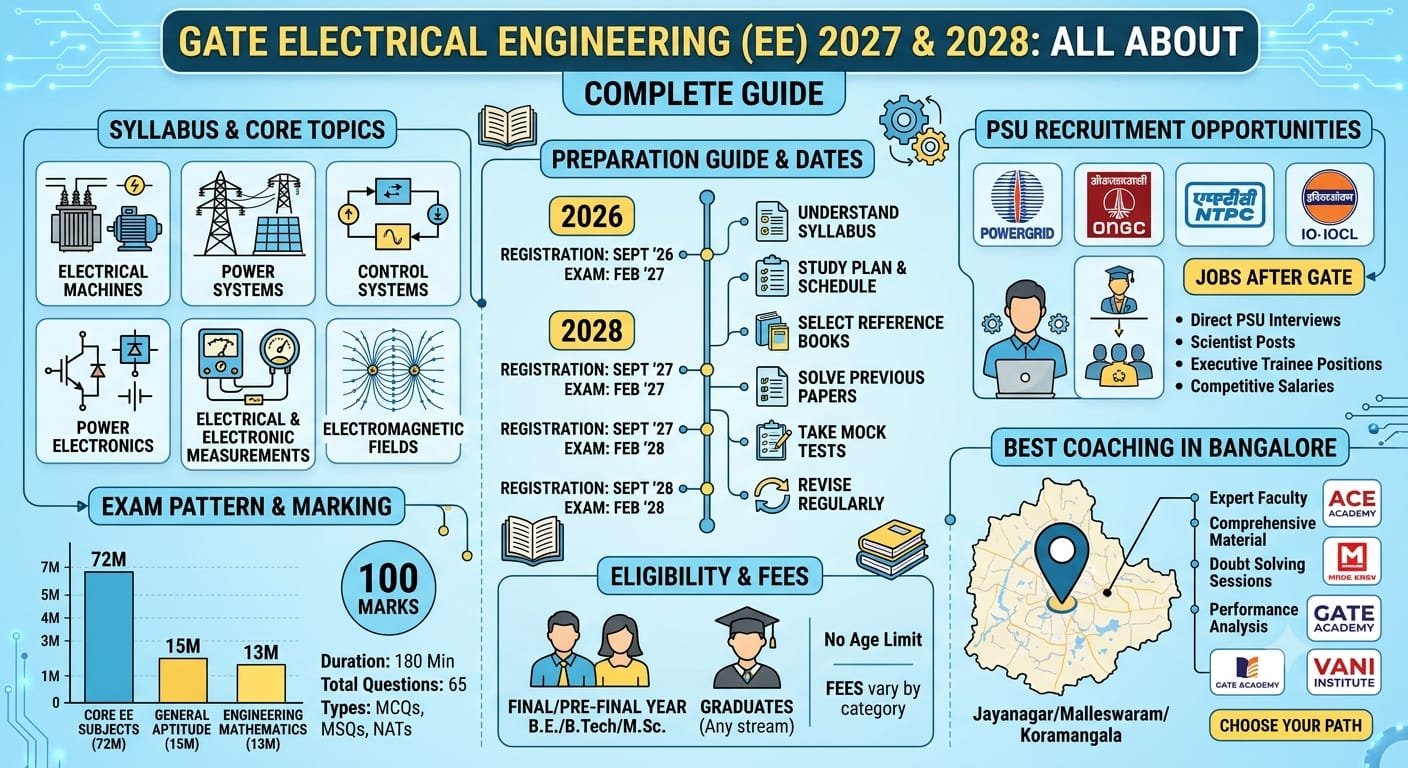
Prepare for GATE Electrical Engineering 2027 & 2028 with the right strategy, expert guidance, regular practice and personalised mentorship. Explore the complete GATE EE preparation guide, including the latest examination information, eligibility criteria, subject-wise syllabus, exam pattern, application fees, preparation strategy, previous-year questions, mock tests, IIT admissions, PSU opportunities and online/offline coaching programmes offered by GATEIIT.
GATE (Graduate Aptitude Test in Engineering) is one of India’s most important national-level competitive examinations for engineering graduates. For Electrical Engineering (EE) students, a good GATE score can open opportunities for postgraduate admissions at IITs, IISc, NITs and other reputed institutions, financial assistance for higher studies, and recruitment opportunities in several Public Sector Undertakings (PSUs).
GATEIIT offers comprehensive GATE Electrical Engineering coaching through online classes across India and offline classroom programmes at its JP Nagar, Bangalore centre. Students can choose regular preparation, personalised coaching, one-to-one learning, and short-term crash courses of 30, 45, 60 and 90 days.
Whether you are preparing for GATE 2027 or planning an early start for GATE 2028, this guide will help you understand the examination and develop an effective preparation strategy.
1. What Is GATE Electrical Engineering (EE)?
The Graduate Aptitude Test in Engineering (GATE) is a national-level examination that evaluates candidates’ understanding of undergraduate-level engineering, technology, science and other academic subjects.
GATE Electrical Engineering is conducted under the paper code EE. The examination tests candidates on fundamental and advanced concepts in electrical engineering, engineering mathematics and general aptitude.
The GATE EE paper evaluates:
- Engineering fundamentals and conceptual understanding.
- Mathematical and analytical problem-solving abilities.
- Electrical circuit analysis and network theory.
- Electrical machines and power systems.
- Control systems and signal processing fundamentals.
- Power electronics and electrical measurements.
- Application of engineering concepts to practical problems.
Why should you appear for GATE EE?
GATE Electrical Engineering qualification can help candidates pursue several academic and professional opportunities.
- Tech. and M.E. admissions at IITs, IISc and NITs.
- Postgraduate programmes at IIITs and other reputed universities.
- Financial assistance for eligible postgraduate students.
- Direct PhD and research opportunities, subject to institutional eligibility.
- PSU recruitment through GATE scores, wherever applicable.
- Opportunities in electrical power generation and transmission.
- Careers in power electronics, renewable energy and electrical automation.
- Research and development opportunities.
- Advanced studies in electrical machines, control systems and power systems.
- Stronger technical foundations for engineering careers.
GATE qualification does not automatically guarantee admission, a scholarship or a PSU job. Each institution and organisation has its own eligibility requirements, shortlisting criteria and selection procedures.
2. GATE 2027 Electrical Engineering Exam: Latest Official Details
The GATE 2027 examination is organised by the Indian Institute of Technology Madras (IIT Madras).
GATE is conducted jointly by IISc and the seven IITs on behalf of the National Coordination Board (NCB), Department of Higher Education, Ministry of Education, Government of India.
GATE EE 2027 examination overview
| Particulars | Details |
| Examination | Graduate Aptitude Test in Engineering |
| Subject | Electrical Engineering |
| Paper Code | EE |
| Examination Year | 2027 |
| Organising Institute | IIT Madras |
| Conducting Authority | IISc and IITs under NCB-GATE |
| Examination Mode | Computer-Based Test (CBT) |
| Examination Language | English |
| Examination Duration | 3 Hours |
| Total Questions | 65 |
| Maximum Marks | 100 |
| General Aptitude | 15 Marks |
| Engineering Mathematics | 13 Marks |
| Electrical Engineering Subjects | 72 Marks |
| Question Types | MCQ, MSQ and NAT |
| Number of Test Papers | 30 |
| GATE Score Validity | 3 Years |
The official GATE 2027 website is:
https://gate2027.iitm.ac.in/
Candidates should regularly check the official website for examination notifications, admit cards, application corrections and result announcements.
3. GATE 2027 Important Dates and Examination Schedule
The official GATE 2027 examination schedule has been published by IIT Madras.
| Examination Activity | Official Schedule |
| Registration portal opened | 2 September 2026 |
| Regular registration closing date | 5 October 2026 |
| Extended registration closing date | 12 October 2026 |
| Special registration window | 15–16 October 2026 |
| Application defect rectification | 14–31 October 2026 |
| Examination city notification | 4 January 2027 |
| Admit card availability | To be announced |
| GATE 2027 examinations | 6, 7, 13, 14, 20 and 21 February 2027 |
| GATE 2027 results | 19 March 2027 |
Important update: As of 30 October 2026, the GATE 2027 registration portal is closed. The application defect rectification window is scheduled to close on 31 October 2026. Candidates who have already registered should check their GOAPS account and registered email for application status and defect notifications.
The exact date, session and examination time for the EE paper should be checked through the official examination schedule and admit card.
The published examination dates are subject to official changes.
4. GATE 2028 Electrical Engineering: Early Preparation Guide
Students targeting GATE 2028 have an excellent opportunity to prepare systematically without the pressure of a short examination timeline.
As of October 2026, the official GATE 2028 notification, organising institute, examination dates, application schedule and application fees have not been announced.
Candidates should not assume that GATE 2027 dates or examination arrangements will automatically apply to GATE 2028.
However, aspirants can begin preparing using the established Electrical Engineering subject areas and strengthen their fundamentals well in advance.
Who should start GATE 2028 preparation now?
- First-year and second-year engineering students interested in long-term preparation.
- Third-year B.E./B.Tech. Electrical Engineering students.
- Final-year engineering students.
- Electrical Engineering graduates.
- Working professionals planning higher studies.
- Students preparing for PSU recruitment examinations.
- Candidates who want to improve their previous GATE scores.
An early start provides sufficient time for conceptual learning, problem-solving, revision, previous-year questions and multiple mock tests.
The official GATE 2028 syllabus should be checked when it is published.
5. GATE Electrical Engineering (EE) 2027 & 2028 Complete Syllabus
The GATE Electrical Engineering syllabus is divided into ten major sections, including Engineering Mathematics and nine core technical subject areas.
The official IIT Madras GATE 2027 EE syllabus should be treated as the primary reference for the 2027 examination.
Section 1: Engineering Mathematics
Engineering Mathematics is an important component of GATE Electrical Engineering and carries 13 marks.
Topics include:
Linear Algebra
- Matrix algebra.
- Systems of linear equations.
- Eigenvalues and eigenvectors.
Calculus
- Mean value theorems.
- Definite and improper integrals.
- Partial derivatives.
- Maxima and minima.
- Multiple integrals.
- Fourier series.
- Vector identities.
- Directional derivatives.
- Line, surface and volume integrals.
- Stokes’ theorem.
- Gauss’s theorem.
- Divergence theorem.
- Green’s theorem.
Differential Equations
- First-order differential equations.
- Higher-order linear differential equations.
- Variation of parameters.
- Cauchy’s equation.
- Euler’s equation.
- Initial and boundary value problems.
- Partial differential equations.
- Separation of variables.
Complex Variables
- Analytic functions.
- Cauchy’s integral theorem.
- Cauchy’s integral formula.
- Taylor series.
- Laurent series.
- Residue theorem.
Probability and Statistics
- Sampling theorems.
- Conditional probability.
- Mean, median and mode.
- Standard deviation.
- Random variables.
- Discrete and continuous distributions.
- Poisson distribution.
- Normal distribution.
- Binomial distribution.
- Correlation and regression analysis.
Section 2: Electric Circuits
Electric Circuits is a fundamental subject for Electrical Engineering aspirants.
Important topics include:
- Ideal voltage and current sources.
- Dependent sources.
- Resistors, inductors and capacitors.
- Mutual inductance.
- Kirchhoff’s Current Law (KCL).
- Kirchhoff’s Voltage Law (KVL).
- Nodal and mesh analysis.
- Thevenin’s theorem.
- Norton’s theorem.
- Superposition theorem.
- Maximum power transfer theorem.
- Transient response of DC and AC networks.
- Sinusoidal steady-state analysis.
- Two-port networks.
- Balanced three-phase circuits.
- Star-delta transformation.
- Complex power.
- Power factor.
Section 3: Electromagnetic Fields
Important topics include:
- Coulomb’s law.
- Electric field intensity.
- Electric flux density.
- Gauss’s law.
- Divergence and curl.
- Electric field and potential.
- Point, line, plane and spherical charge distributions.
- Dielectric media.
- Biot-Savart’s law.
- Ampere’s law.
- Faraday’s law.
- Lorentz force.
- Magnetomotive force.
- Magnetic circuits.
- Self and mutual inductance.
Section 4: Signals and Systems
Important topics include:
- Continuous-time signals.
- Discrete-time signals.
- Signal representation.
- Shifting and scaling properties.
- Linear time-invariant systems.
- Causal systems.
- Fourier series.
- Sampling theorem.
- Fourier transform.
- Laplace transform.
- Z-transform.
- RMS value.
- Average value of periodic waveforms.
Section 5: Electrical Machines
Electrical Machines is one of the most important technical areas for GATE EE.
Topics include:
Transformers
- Single-phase transformers.
- Equivalent circuits.
- Phasor diagrams.
- Open-circuit and short-circuit tests.
- Voltage regulation.
- Three-phase transformers.
- Transformer connections.
- Vector groups.
- Parallel operation.
DC Machines
- Electromechanical energy conversion.
- Separately excited DC machines.
- Series and shunt motors.
- Motoring and generating operations.
- Characteristics of DC machines.
- Speed control of DC motors.
Induction Machines
- Three-phase induction motors.
- Operating principles.
- Types of induction motors.
- Torque-speed characteristics.
- Equivalent circuits.
- No-load and blocked-rotor tests.
- Starting methods.
- Speed control.
- Single-phase induction motors.
Synchronous Machines
- Cylindrical rotor machines.
- Salient pole machines.
- Performance and characteristics.
- Voltage regulation.
- Parallel operation of generators.
- Starting of synchronous motors.
Additional Topics
- Losses in electrical machines.
- Efficiency calculations.
Section 6: Power Systems
Important topics include:
- Electrical power generation.
- AC and DC transmission.
- Transmission line models.
- Transmission line performance.
- Underground cables.
- Economic load dispatch.
- Transmission losses.
- Series compensation.
- Shunt compensation.
- Electric field distribution.
- Distribution systems.
- Per-unit system.
- Bus admittance matrix.
- Gauss-Seidel load flow method.
- Newton-Raphson load flow method.
- Voltage control.
- Frequency control.
- Power factor correction.
- Symmetrical components.
- Symmetrical faults.
- Unsymmetrical faults.
- Overcurrent protection.
- Differential protection.
- Directional protection.
- Distance protection.
- Circuit breakers.
- Power system stability.
- Equal area criterion.
Section 7: Control Systems
Important topics include:
- Mathematical modelling of systems.
- Transfer functions.
- Feedback principles.
- Block diagrams.
- Signal flow graphs.
- Transient response.
- Steady-state analysis.
- Linear time-invariant systems.
- Routh-Hurwitz stability criterion.
- Nyquist stability criterion.
- Bode plots.
- Root locus.
- Lag compensators.
- Lead compensators.
- Lead-lag compensators.
- P, PI and PID controllers.
- State-space models.
- State equations.
Section 8: Electrical and Electronic Measurements
Topics include:
- Bridges and potentiometers.
- Voltage measurement.
- Current measurement.
- Power measurement.
- Energy measurement.
- Power factor measurement.
- Instrument transformers.
- Digital voltmeters.
- Digital multimeters.
- Phase measurement.
- Time and frequency measurement.
- Measurement errors.
- Error analysis.
Section 9: Analog and Digital Electronics
Analog Electronics
- Diode circuits.
- Clipping circuits.
- Clamping circuits.
- Equivalent circuits.
- Frequency response.
- Feedback amplifiers.
- Operational amplifiers.
- Active filters.
- Sallen-Key filters.
- Butterworth filters.
- Voltage-controlled oscillators.
Digital Electronics
- Combinational logic circuits.
- Sequential logic circuits.
- Schmitt triggers.
- Sample and hold circuits.
- Analog-to-digital converters.
- Digital-to-analog converters.
Section 10: Power Electronics
Important topics include:
- Static V-I characteristics.
- Firing and gating circuits.
- Buck converters.
- Boost converters.
- Buck-Boost converters.
- Uncontrolled rectifiers.
- Single-phase rectifiers.
- Three-phase rectifiers.
- Thyristor-based converters.
- AC-to-DC converters.
- Line current harmonics.
- Power factor.
- Distortion factor.
- Single-phase inverters.
- Three-phase inverters.
- Voltage source inverters.
- Current source inverters.
- Sinusoidal pulse-width modulation (SPWM).
Note: This is a structured summary of the official GATE 2027 EE syllabus. Candidates should download the complete official PDF and verify every topic before finalising their study plan.
Official syllabus: https://gate2027.iitm.ac.in/exam_papers_and_syllabus
6. GATE EE 2027 Examination Pattern and Marking Scheme
Understanding the GATE EE examination pattern is essential for effective preparation.
| Particulars | Details |
| Examination Mode | Online Computer-Based Test |
| Duration | 180 Minutes |
| Total Questions | 65 |
| Maximum Marks | 100 |
| General Aptitude | 10 Questions – 15 Marks |
| Engineering Mathematics | Included in technical section – 13 Marks |
| Core Electrical Engineering | 72 Marks |
| Question Types | MCQ, MSQ and NAT |
| Language | English |
Types of questions
- Multiple Choice Questions (MCQs)
Candidates select one correct answer from the given options.
- Multiple Select Questions (MSQs)
Candidates must select all correct options. More than one option may be correct.
- Numerical Answer Type (NAT)
Candidates calculate the answer and enter the numerical value using the computer interface.
Negative marking
- One-mark MCQ: 1/3 mark deducted for an incorrect answer.
- Two-mark MCQ: 2/3 mark deducted for an incorrect answer.
- MSQ: No negative marking.
- NAT: No negative marking.
There is no partial marking for partially correct MSQ responses.
Candidates should develop the habit of solving numerical problems accurately rather than relying on guesswork.
7. GATE EE 2027 Eligibility Criteria
GATE 2027 allows candidates from several academic backgrounds to appear for the examination, subject to the prescribed qualification and year-of-study requirements.
According to the official eligibility criteria, candidates currently studying in the third or higher year of an eligible undergraduate degree programme, or those who have completed an approved qualifying degree, can apply.
Eligible academic qualifications include:
- E. and B.Tech.
- Pharm.
- Arch.
- Sc. (Research) and B.S.
- Sc.
- A.
- Integrated M.Tech.
- Integrated M.Sc.
- Other recognised engineering, technology, science, commerce, arts and humanities degrees.
- Recognised professional society qualifications equivalent to eligible engineering degrees.
For Electrical Engineering aspirants, B.E./B.Tech. in Electrical Engineering and related eligible disciplines are common qualifying backgrounds.
However, admission to a particular M.Tech. programme depends on that institution’s qualifying degree requirements.
Is there an age limit for GATE?
No. There is no upper age limit for GATE 2027.
How many times can a student appear for GATE?
There is no restriction on the number of attempts.
Can final-year students apply?
Yes. Eligible students currently in the third or higher year of their undergraduate degree programme can apply.
Is an Electrical Engineering degree compulsory for the GATE EE paper?
Not necessarily. Candidates satisfying the general GATE eligibility criteria may choose an appropriate paper. However, they must separately satisfy the admission or recruitment eligibility conditions of the institutions and organisations to which they apply.
8. GATE 2027 Application Fees
The official GATE 2027 application fee structure is as follows:
| Candidate Category | Regular Period – One Paper | Extended Period – One Paper |
| Female / SC / ST / PwD candidates | ₹1,000 | ₹1,500 |
| All other candidates, including foreign nationals | ₹2,000 | ₹2,500 |
For candidates appearing in two papers:
| Candidate Category | Regular Period | Extended Period |
| Female / SC / ST / PwD candidates | ₹2,000 | ₹2,500 |
| All other candidates | ₹4,000 | ₹4,500 |
Additional bank, payment gateway and processing charges may apply.
The application fee is non-refundable, except for eligible duplicate transactions as specified by the examination authority.
Important: GATE 2028 application fees have not yet been announced. Candidates should refer to the official GATE 2028 brochure when available.
9. Is There Any Exemption from the GATE Examination?
There is no general exemption from appearing in GATE for candidates seeking admission through GATE-based selection.
However, certain institutions may have separate admission routes, eligibility provisions or alternative selection procedures for specific programmes.
Similarly, PSU recruitment notifications may prescribe their own selection requirements.
Candidates should not assume that holding an M.Tech., M.E. or PhD degree automatically exempts them from GATE wherever a valid GATE score is required.
A GATE qualification is also not the same as an exemption from institutional admission tests, interviews or other selection requirements.
10. How to Prepare for GATE Electrical Engineering 2027: Complete Self-Study Strategy
A successful GATE preparation strategy requires conceptual understanding, consistent practice, repeated revision and effective time management.
Students preparing independently should follow a structured study plan rather than randomly selecting topics.
Step 1: Understand the complete syllabus
Download the official GATE EE syllabus and divide it into individual subjects and chapters.
Create a checklist to monitor your preparation.
Step 2: Strengthen Engineering Mathematics
Engineering Mathematics supports several electrical engineering concepts.
Give special attention to:
- Linear algebra.
- Differential equations.
- Probability and statistics.
- Complex variables.
Step 3: Build strong technical fundamentals
Study one subject at a time and complete the basic concepts before moving to advanced numerical problems.
Prioritise conceptual understanding in:
- Electric Circuits.
- Electrical Machines.
- Power Systems.
- Control Systems.
- Power Electronics.
Step 4: Solve previous-year questions
Previous-year GATE questions help candidates understand:
- Question difficulty.
- Frequently tested concepts.
- Numerical problem-solving approaches.
- Time requirements.
- Common mistakes.
Practise previous-year questions topic-wise and later solve complete previous-year papers.
Step 5: Prepare General Aptitude
General Aptitude carries 15 marks and should never be neglected.
Practise:
- Verbal ability.
- English comprehension.
- Numerical aptitude.
- Logical reasoning.
- Analytical reasoning.
- Quantitative problem-solving.
Step 6: Prepare short notes and formula sheets
Maintain separate revision notes for every subject.
Include:
- Important formulas.
- Frequently used derivations.
- Important concepts.
- Common numerical mistakes.
- Previous-year question references.
Step 7: Take regular mock tests
Mock examinations help improve accuracy, speed and confidence.
Start with topic-wise tests, progress to subject-wise tests and eventually attempt full-length GATE mock examinations.
Step 8: Analyse every mock test
Do not simply check your marks.
Identify:
- Incorrect answers.
- Unattempted easy questions.
- Time-consuming questions.
- Weak subjects.
- Calculation errors.
- Conceptual misunderstandings.
Revise the weak areas before attempting the next mock examination.
11. Suggested GATE EE 2027 Preparation Timetable
Students with approximately three to six months of preparation time can follow this structured plan, adjusting it according to their existing knowledge.
| Preparation Period | Main Focus |
| Month 1 | Engineering Mathematics, Electric Circuits and General Aptitude |
| Month 2 | Electrical Machines and Electromagnetic Fields |
| Month 3 | Power Systems and Control Systems |
| Month 4 | Signals and Systems, Measurements and Electronics |
| Month 5 | Power Electronics, PYQs and subject-wise revision |
| Month 6 | Full-length mock tests, revision and examination practice |
For candidates with only 30–90 days remaining, a crash course with a carefully prioritised syllabus, formula revision, PYQs and intensive mock tests can help organise preparation.
12. GATE EE 2028 Long-Term Preparation Strategy
Students targeting GATE 2028 should focus on building strong fundamentals rather than rushing through the syllabus.
A recommended long-term preparation structure is:
Foundation Stage
- Complete Engineering Mathematics.
- Understand basic electrical circuits.
- Build fundamentals in electrical machines.
- Develop numerical problem-solving skills.
Concept Development Stage
- Complete Power Systems.
- Study Control Systems.
- Learn Electromagnetic Fields.
- Cover Signals and Systems.
- Practise electronics and measurements.
Advanced Practice Stage
- Complete Power Electronics.
- Solve previous-year questions.
- Practise difficult numerical problems.
- Attempt subject-wise tests.
Revision and Testing Stage
- Revise the entire syllabus.
- Attempt full-length mock tests.
- Analyse performance.
- Improve time management.
- Focus on accuracy and examination strategy.
Students who begin early can benefit from regular mentoring, structured subject completion and multiple revision cycles.
13. GATE Electrical Engineering Previous-Year Question Papers (PYQs)
Previous-year question papers are among the most valuable resources for GATE preparation.
They help candidates understand the actual examination standard and develop familiarity with the question format.
Students should practise previous-year papers from multiple examination years.
Benefits of solving GATE EE PYQs
- Understand the examination pattern.
- Identify frequently tested concepts.
- Improve numerical problem-solving speed.
- Develop conceptual clarity.
- Identify weak topics.
- Improve accuracy.
- Learn question-selection strategies.
- Build examination confidence.
Candidates should maintain a separate notebook of incorrectly answered questions and revisit those questions during revision.
14. GATE EE Mock Tests and Test Series
Mock tests are essential for evaluating preparation levels.
A good GATE Electrical Engineering test series should include:
- Topic-wise practice tests.
- Chapter-wise tests.
- Subject-wise tests.
- Engineering Mathematics tests.
- General Aptitude tests.
- Full-length examination tests.
- Previous-year question practice.
- Performance reports.
- Detailed solutions.
- Time-management analysis.
Candidates should gradually increase the number of full-length tests as the examination approaches.
The objective is not simply to attempt more tests but to learn from every test and improve performance.
15. GATE Electrical Engineering Admissions: IITs, IISc, NITs and Other Institutions
A valid GATE EE score can be used to apply for postgraduate programmes at several reputed institutions.
Potential institutions include:
Indian Institute of Science (IISc), Bangalore
IISc offers advanced postgraduate and research opportunities in electrical engineering and related areas, subject to the specific programme requirements.
Indian Institutes of Technology (IITs)
Candidates can explore M.Tech. programmes at:
- IIT Madras.
- IIT Bombay.
- IIT Delhi.
- IIT Kanpur.
- IIT Kharagpur.
- IIT Roorkee.
- IIT Guwahati.
- IIT Hyderabad.
- Other participating IITs.
National Institutes of Technology (NITs)
Candidates can explore relevant M.Tech. programmes through the applicable CCMT admission process.
Other Institutions
Several IIITs, government engineering institutions and recognised universities also consider GATE scores for postgraduate admissions.
Popular postgraduate specialisations for Electrical Engineering graduates
- Power Systems.
- Power Electronics and Drives.
- Electrical Machines.
- Control Systems.
- Renewable Energy Systems.
- High Voltage Engineering.
- Electrical Energy Systems.
- Smart Grid Technology.
- Electric Vehicle Technology.
- Instrumentation and Control.
- Energy Engineering.
Admission depends on the GATE score, qualifying degree, category, seat availability, programme-specific requirements and selection procedures.
16. GATE EE PSU Recruitment Opportunities
GATE scores are used by several Public Sector Undertakings for recruitment in technical and engineering positions.
Electrical Engineering candidates may explore opportunities in organisations such as:
- NTPC – National Thermal Power Corporation.
- POWERGRID – Power Grid Corporation of India.
- BHEL – Bharat Heavy Electricals Limited.
- NPCIL – Nuclear Power Corporation of India Limited.
- NHPC – National Hydroelectric Power Corporation.
- ONGC – Oil and Natural Gas Corporation.
- IOCL – Indian Oil Corporation Limited.
- GAIL – Gas Authority of India Limited.
- NLC India Limited.
- Airports Authority of India.
- SAIL – Steel Authority of India Limited.
- DVC – Damodar Valley Corporation.
- GRID-INDIA.
Not every organisation recruits Electrical Engineering graduates through GATE every year. Some organisations may use different GATE papers, conduct additional examinations or prescribe separate eligibility conditions.
Candidates should always read the latest PSU recruitment notification before applying.
17. GATE Electrical Engineering Coaching by GATEIIT – Online, Offline and Hybrid Classes
GATEIIT offers structured coaching programmes for GATE Electrical Engineering aspirants preparing for GATE 2027 and GATE 2028.
Our objective is to help students develop strong technical fundamentals, improve numerical problem-solving skills, practise examination-level questions and prepare systematically for competitive examinations.
Students can choose online coaching from anywhere in India or attend classroom programmes at our Bangalore centre.
GATEIIT GATE EE Coaching Features
- Online GATE EE Coaching Across India
Students can attend live online classes from their homes, irrespective of their location.
Online programmes are suitable for:
- Engineering students.
- Final-year students.
- Working professionals.
- Students living outside Bangalore.
- Candidates preparing alongside college or employment.
- Offline Classroom Coaching in Bangalore
GATEIIT provides classroom coaching at its JP Nagar centre in Bangalore.
Our centre is located at:
3rd Floor, #1743, Sri Raghavendra Plaza, 17th Main Road, JP Nagar 2nd Phase, Bangalore – 560078, Karnataka.
- Hybrid GATE Preparation
Students can choose a combination of online and classroom learning, subject to the selected programme and batch availability.
- Personal Attention and Individual Mentorship
We understand that every student has a different academic background and preparation level.
Our personalised approach focuses on:
- Individual performance monitoring.
- Subject-wise progress evaluation.
- Identification of weak topics.
- Personalised study planning.
- Regular academic guidance.
- Mentorship and motivation.
- One-to-One Doubt-Clearing Sessions
Students can seek individual academic assistance to clarify difficult concepts, numerical problems and technical doubts.
- Customised Preparation Plans
Study plans can be structured according to the student’s preparation level, available time and examination target.
- Experienced Faculty and Concept-Based Teaching
Our teaching approach focuses on building conceptual clarity, understanding important formulas, solving numerical problems and developing examination-oriented problem-solving techniques.
- Regular Tests and Performance Analysis
Students can practise through topic-wise tests, subject-wise tests and full-length mock examinations.
- Online Study Material and Learning Resources
Depending on the selected programme, students can receive access to:
- Digital study material.
- Subject-wise notes.
- Formula sheets.
- Practice questions.
- Previous-year question discussions.
- Online learning resources.
- Recorded classes, where included in the programme.
- Additional Learning Support
Eligible programme inclusions may also provide:
- Online test series.
- Learning app access.
- Revision sessions.
- Doubt-clearing support.
- Performance reports.
- Additional practice assignments.
Specific facilities and access periods depend on the course selected.
18. GATE EE 2027 Short-Term Crash Courses: 30, 45, 60 and 90 Days
Students who have already completed some portion of the GATE syllabus can benefit from intensive revision and score improvement programmes.
GATEIIT offers short-term GATE Electrical Engineering crash courses in different durations.
| Course | Duration | Indicative Course Fees |
| GATE EE Revision Course | 30 Days | ₹5,000 onwards |
| GATE EE Crash Course | 45 Days | ₹7,000 onwards |
| GATE EE Intensive Course | 60 Days | ₹10,000 onwards |
| GATE EE Complete Revision Programme | 90 Days | Up to ₹20,000 |
The above fees represent indicative programme pricing. Actual fees depend on course duration, selected subjects, learning mode, batch structure and programme inclusions.
What is covered in the GATE EE crash course?
- Important syllabus revision.
- High-priority technical topics.
- Engineering Mathematics revision.
- General Aptitude practice.
- Important formulas and concepts.
- Previous-year GATE questions.
- Numerical problem-solving sessions.
- Topic-wise practice tests.
- Full-length mock tests.
- Individual doubt-clearing support.
- Examination strategy.
- Last-minute revision guidance.
Crash courses are particularly useful for students who have already studied the subjects and need structured revision and practice.
Students who are starting from zero should discuss their preparation level with the academic team before selecting a short-duration course.
19. GATEIIT Scholarship Test: Up to 90% Scholarship and Fee Discounts
GATEIIT provides scholarship and fee-discount opportunities for eligible students based on their scholarship test performance and applicable programme conditions.
Students can appear for the scholarship assessment to demonstrate their academic understanding and preparation level.
Scholarship benefits:
- Scholarships of up to 90%, subject to eligibility and scholarship test performance.
- Course fee concessions.
- Academic assessment.
- Guidance on selecting the appropriate programme.
- Opportunities to access quality preparation at reduced fees.
The actual scholarship percentage depends on the assessment score and applicable scholarship rules. The maximum scholarship is not guaranteed to every applicant.
Students are encouraged to enquire about the next scholarship test and applicable conditions before enrolling.
20. Who Should Join GATEIIT Electrical Engineering Coaching?
GATEIIT programmes are suitable for:
- E. Electrical Engineering students.
- Tech. Electrical Engineering students.
- Third-year engineering students.
- Final-year engineering students.
- Electrical Engineering graduates.
- Working professionals.
- GATE 2027 aspirants.
- GATE 2028 aspirants.
- Candidates preparing for PSU recruitment.
- Students targeting IIT and IISc postgraduate admissions.
- Candidates who have previously appeared for GATE but want to improve their scores.
- Students who require individual academic attention.
- Students who need short-term crash courses and revision support.
21. How to Choose the Right GATE EE Coaching Programme?
Before joining a coaching programme, students should consider the following factors:
- Does the programme cover the complete official syllabus?
- Are the faculty members experienced in teaching GATE-level subjects?
- Is individual doubt-clearing support available?
- Are regular tests conducted?
- Does the programme include previous-year questions?
- Is performance analysis provided?
- Are recorded classes available where required?
- Can the programme accommodate the student’s preparation level?
- Is the study material updated?
- Does the fee structure match the programme inclusions?
Students should select coaching based on academic requirements, not merely course duration or advertised discounts.
22. Frequently Asked Questions About GATE Electrical Engineering 2027 & 2028
Q1. What is GATE EE?
GATE EE is the Electrical Engineering paper of the Graduate Aptitude Test in Engineering. It evaluates candidates’ understanding of electrical engineering subjects, engineering mathematics and general aptitude.
Q2. What is the GATE 2027 Electrical Engineering paper code?
The paper code for Electrical Engineering is EE.
Q3. Who is conducting GATE 2027?
IIT Madras is the organising institute for GATE 2027. The examination is conducted jointly by IISc and the IITs under the National Coordination Board.
Q4. When will GATE 2027 be conducted?
The examination is scheduled on 6, 7, 13, 14, 20 and 21 February 2027. The individual EE paper session should be checked on the official schedule.
Q5. When will GATE 2027 results be announced?
The official result announcement date is 19 March 2027.
Q6. What is the duration of the GATE EE examination?
The examination duration is three hours.
Q7. How many questions are there in GATE EE?
There are 65 questions carrying a total of 100 marks.
Q8. How many marks are allocated to General Aptitude?
General Aptitude carries 15 marks.
Q9. How many marks are allocated to Engineering Mathematics?
Engineering Mathematics carries 13 marks in the GATE EE paper.
Q10. Is there negative marking in GATE EE?
Yes. Negative marking applies to incorrect MCQ answers. There is no negative marking for MSQ and NAT questions.
Q11. Is there an age limit for GATE?
No. There is no upper age limit.
Q12. Can third-year engineering students appear for GATE?
Yes. Eligible candidates studying in the third or higher year of their undergraduate programme can appear.
Q13. Can a final-year Electrical Engineering student apply?
Yes, provided the candidate satisfies the prescribed eligibility criteria.
Q14. How many attempts are allowed in GATE?
There is no restriction on the number of attempts.
Q15. What is the validity of a GATE score?
A GATE score is valid for three years from the date of announcement of results.
Q16. Can I get admission to IIT through GATE EE?
Yes. Eligible candidates can apply for relevant postgraduate programmes at IITs based on their GATE scores and institutional admission requirements.
Q17. Can GATE EE help in PSU recruitment?
Yes. Several PSUs use GATE scores for recruitment, subject to their individual recruitment notifications.
Q18. Is GATE Electrical Engineering difficult?
GATE EE is a competitive examination requiring conceptual clarity, mathematical ability, numerical problem-solving skills and consistent practice. A structured preparation plan can make the examination manageable.
Q19. Can I prepare for GATE EE without coaching?
Yes. Self-study is possible with the official syllabus, standard textbooks, previous-year questions, mock tests and consistent revision. Coaching can provide additional structure, guidance and doubt-clearing support.
Q20. Does GATEIIT offer online GATE EE coaching?
Yes. GATEIIT offers online coaching programmes for students across India.
Q21. Does GATEIIT provide offline Electrical Engineering coaching in Bangalore?
Yes. Offline classroom coaching is available at the GATEIIT JP Nagar 2nd Phase centre, subject to batch availability.
Q22. Does GATEIIT provide hybrid GATE coaching?
Yes. Hybrid learning options are available depending on the selected programme and batch.
Q23. What are the GATEIIT crash course durations?
GATEIIT offers 30-day, 45-day, 60-day and 90-day short-term revision and crash course options.
Q24. What are the fees for GATEIIT GATE EE crash courses?
Indicative fees range from ₹5,000 to ₹20,000, depending on the course duration and selected programme.
Q25. Can I get a scholarship for GATE coaching at GATEIIT?
Yes. Eligible students can receive scholarship fee discounts of up to 90%, based on scholarship test performance and applicable conditions.
Q26. Does GATEIIT provide one-to-one doubt-clearing sessions?
Yes. Individual doubt-clearing support and personalised academic guidance are available according to the selected programme.
Q27. Can working professionals join GATEIIT online coaching?
Yes. Online programmes are suitable for working professionals who need flexible learning arrangements.
Q28. Does GATEIIT provide mock tests and previous-year questions?
GATEIIT programmes include examination-oriented practice and test support, depending on the selected course.
Q29. Should I prepare for GATE 2027 or GATE 2028?
Students who have already covered a significant portion of the syllabus can target GATE 2027. Those requiring more time to build fundamentals may consider GATE 2028.
Q30. How can I enquire about GATEIIT GATE Electrical Engineering admission?
Students can contact GATEIIT by phone or visit the Bangalore centre to enquire about current batches, online programmes, offline classes, fees and scholarship opportunities.
23. Start Your GATE Electrical Engineering Preparation with GATEIIT
GATE Electrical Engineering is an important opportunity for engineering graduates who want to pursue higher education at premier institutions, explore PSU recruitment opportunities or strengthen their technical careers.
Success in GATE requires a combination of conceptual clarity, consistent practice, proper revision, previous-year question analysis and effective examination strategies.
GATEIIT supports students preparing for GATE EE 2027 and 2028 through online, offline and hybrid coaching programmes, personalised mentorship, individual doubt-clearing support, structured revision, mock tests and short-term crash courses.
Whether you are beginning your preparation or looking for an intensive revision programme, choose a learning plan that matches your academic background, preparation level and examination target.
Enrol in GATEIIT GATE Electrical Engineering Coaching – Online Classes Across India and Offline Classroom Coaching in Bangalore.
Contact GATEIIT – Admission Enquiries
GATEIIT – Gate Indian Institute of Tutorials
Website: https://www.gateiit.com/
Courses: GATE Electrical Engineering (EE) 2027 & 2028 Coaching
Learning Modes: Online | Offline | Hybrid | Personalised One-to-One Coaching
Crash Course Durations: 30 | 45 | 60 | 90 Days
Indicative Crash Course Fees: ₹5,000 – ₹20,000
Scholarship: Up to 90% fee discount based on scholarship test performance and applicable conditions.
Bangalore Centre:
3rd Floor, #1743, Sri Raghavendra Plaza, 17th Main Road, JP Nagar 2nd Phase, Bangalore – 560078, Karnataka.
Contact Numbers: 8884416154 | 8884416155
Website: www.gateiit.com
Prepare Smart. Practise Consistently. Improve Your GATE Score with GATEIIT.
Important Official Resources for GATE EE Aspirants
Candidates should refer to the official examination website for the latest notifications, syllabus, eligibility and application-related updates.
- GATE 2027 Official Website: https://gate2027.iitm.ac.in/
- GATE 2027 Electrical Engineering Syllabus: https://gate2027.iitm.ac.in/exam_papers_and_syllabus
- GATE 2027 Important Dates: https://gate2027.iitm.ac.in/important_dates
- GATE 2027 Eligibility Criteria: https://gate2027.iitm.ac.in/eligibility_criteria
- GATE 2027 Examination Pattern: https://gate2027.iitm.ac.in/question_paper_pattern
- GATE 2027 Application Fees: https://gate2027.iitm.ac.in/application_fees
- GATE 2027 Opportunities: https://gate2027.iitm.ac.in/opportunities
- GATE 2027 Notifications: https://gate2027.iitm.ac.in/notifications
Disclaimer: GATE examination information, dates, fees and eligibility conditions are based on the official GATE 2027 information available as of 30 October 2026. GATE 2028 details are subject to future official notification. Coaching fees, scholarships, course inclusions and batch availability are subject to GATEIIT’s applicable admission policies. GATE qualification does not guarantee admission, financial assistance or employment.