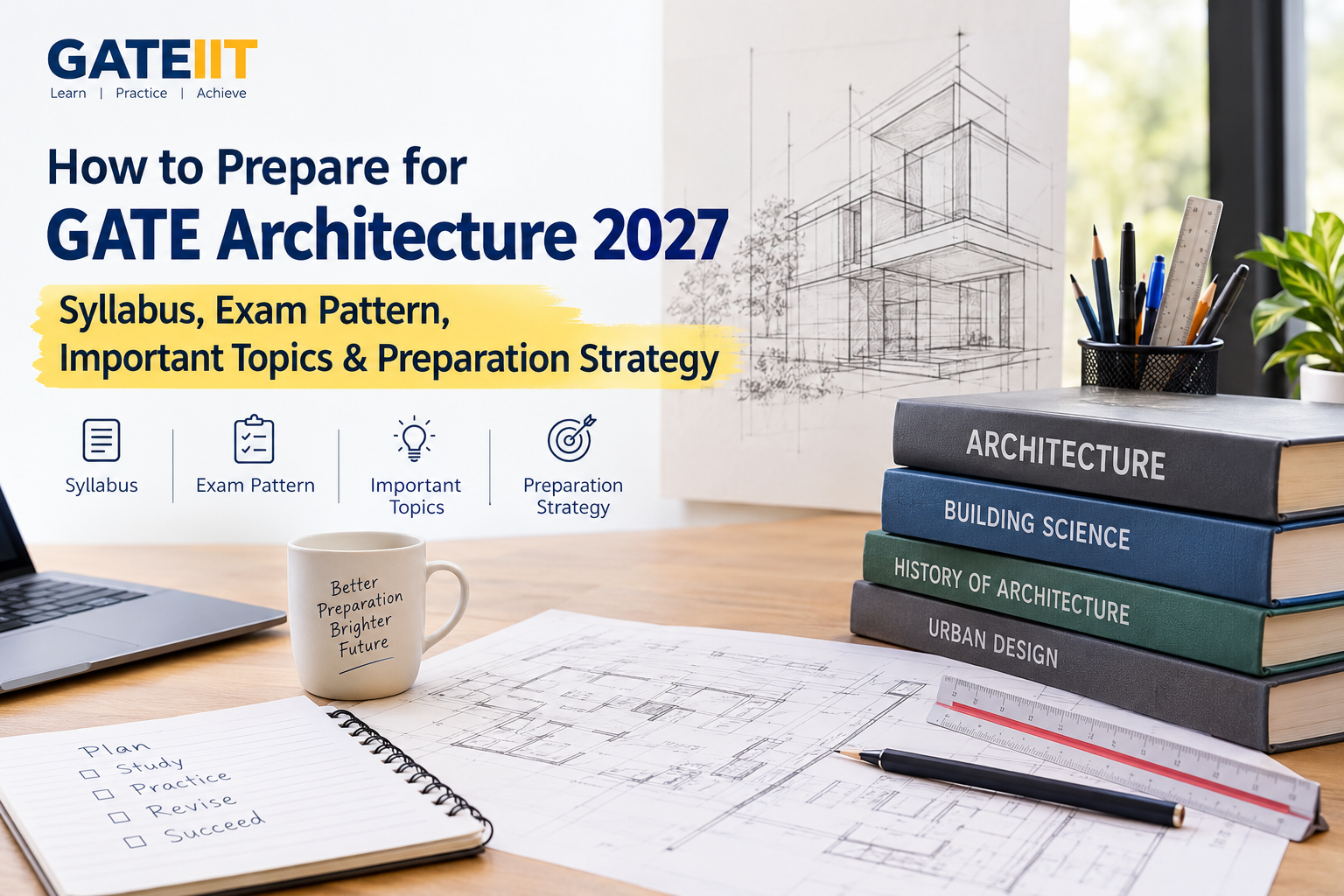
Preparing for GATE Architecture 2027 requires a clear understanding of architectural design, building construction, structural systems, environmental planning, urban development and the examination pattern. A structured preparation plan helps students cover the syllabus systematically, practise previous-year questions and improve their ability to solve conceptual and numerical problems.
The Graduate Aptitude Test in Engineering (GATE) includes Architecture and Planning (AR) as one of its test papers. For GATE 2027, IIT Madras is the organising institute, and the official AR syllabus has been revised. Therefore, students should begin their preparation with the latest syllabus rather than relying entirely on older notes or previous-year study material.
Whether you are pursuing B.Arch, studying engineering, or planning to pursue postgraduate studies in architecture or planning, this guide explains the GATE Architecture 2027 syllabus, exam pattern, important topics, preparation strategy, study resources and coaching options.
Quick Answer: How to Prepare for GATE Architecture 2027
To prepare effectively for GATE Architecture 2027, download the latest official AR syllabus, understand the examination pattern, divide the topics into manageable sections and follow a consistent study schedule. Practise architectural graphics, building construction, environmental design, architecture history and other syllabus-based subjects alongside General Aptitude. Solve previous-year question papers, revise regularly and take timed mock tests to identify areas that need improvement.
Key takeaways:
– Paper code: AR — Architecture and Planning.
– Exam mode: Computer-Based Test (CBT).
– Duration: 3 hours.
– Total marks: 100.
– General Aptitude: 15 marks.
– Architecture and Planning subject component: 85 marks.
– Question types: Multiple Choice Questions (MCQs), Multiple Select Questions (MSQs) and Numerical Answer Type (NAT) questions.
– Important preparation areas: Design and Graphics, Environmental Planning and Landscape, Urban Design and Conservation, History and Theory of Architecture, Building Construction, Building Services and Project Management.
– First step: Download the official GATE 2027 Architecture and Planning syllabus and build your preparation plan around it.
Official references:
– GATE 2027 syllabus: https://gate2027.iitm.ac.in/exam_papers_and_syllabus
– GATE 2027 exam pattern: https://gate2027.iitm.ac.in/question_paper_pattern
1.What Is GATE Architecture 2027?
GATE Architecture and Planning is a national-level examination that evaluates a candidate’s understanding of architecture, planning and related concepts. The paper code for this discipline is AR.
The examination assesses conceptual knowledge, comprehension, application and analytical ability. Candidates need to understand architectural principles and planning concepts while also developing accuracy in numerical problems and the interpretation of technical information.
A good GATE Architecture preparation strategy combines three essential elements:
- Conceptual understanding of the syllabus.
- Regular practice of examination-style questions.
- Revision and performance analysis.
Memorising facts alone is not sufficient. Students should understand why a design principle works, how a building system functions and how planning concepts apply to real situations.
Why prepare for GATE Architecture?
A valid GATE score may be considered for admission to eligible postgraduate and doctoral programmes, subject to the requirements of the individual institution. Some public-sector organisations also use GATE scores in their recruitment processes, depending on the discipline and recruitment notification.
However, qualifying in GATE does not automatically guarantee admission, financial assistance or employment. Candidates must check the eligibility and selection requirements of each institution or organisation.
2.GATE Architecture 2027 Eligibility Criteria
According to the official GATE 2027 eligibility criteria, candidates currently studying in the third year or a higher year of an eligible undergraduate degree programme, as well as candidates who have completed an eligible degree, can apply.
Eligible educational backgrounds include Engineering, Technology, Architecture, Science, Commerce, Arts and Humanities, subject to the official conditions.
For example, students pursuing B.Arch or B.Tech may be eligible to appear for GATE if they satisfy the applicable criteria.
However, eligibility to appear for GATE is different from eligibility for admission to a particular postgraduate programme. An institution may require a specific undergraduate qualification, a minimum academic score or additional selection requirements.
Before applying, check the official eligibility page:
https://gate2027.iitm.ac.in/eligibility_criteria
Students should also confirm whether the AR paper is suitable for their intended postgraduate programme.
3.GATE Architecture 2027 Exam Pattern
Understanding the GATE AR exam pattern helps students allocate preparation time according to the marks distribution and the nature of the questions.
The official GATE 2027 examination pattern specifies a three-hour computer-based test with 65 questions carrying a total of 100 marks.
GATE AR 2027 exam pattern at a glance
Particulars| Details
Examination| GATE 2027
Paper name| Architecture and Planning
Paper code| AR
Organising institute| IIT Madras
Mode| Computer-Based Test
Duration| 3 hours
Total questions| 65
Total marks| 100
General Aptitude| 15 marks
Common subject section (Part A)| 60 marks
Specialised section (Part B1 or B2)| 25 marks
Question types| MCQ, MSQ and NAT
Examination language| English
The AR paper is structured into General Aptitude, a common Architecture and Planning section, and a specialised section.
– Part A: Common section for Architecture and Planning.
– Part B1: Architecture.
– Part B2: Planning.
Candidates should refer to the official instructions to understand how the specialised section is selected and attempted.
Understanding the marking scheme
GATE questions generally carry either one or two marks.
For MCQs, negative marking applies:
– A wrong answer to a one-mark MCQ attracts a deduction of one-third of a mark.
– A wrong answer to a two-mark MCQ attracts a deduction of two-thirds of a mark.
There is no negative marking for incorrect MSQ or NAT answers. MSQs do not have partial marking.
This makes careful question selection important. Students should practise identifying questions they can solve confidently and avoid making unsupported guesses in MCQs.
Important: Always verify the latest official examination instructions before the examination, as the organising institute’s published information takes precedence over coaching notes or third-party summaries.
4.GATE Architecture 2027 Syllabus: Subject-Wise Overview
The GATE 2027 AR syllabus has been revised. Candidates should download the official syllabus and use it as the primary reference for preparation.
The examination includes a common section and two specialised streams: Architecture and Planning.
Part A: Common Section
Part A covers subjects shared by the Architecture and Planning streams.
A.1 Design and Graphics
This section focuses on spatial understanding, architectural representation and design principles.
Important topics include:
– Architectural graphics and visual composition.
– Two-dimensional and three-dimensional forms.
– Form and surface development.
– Anthropometrics and ergonomics.
– Ratio, proportion and scales in design.
– Organisation of space.
– Building plans, elevations and sections.
– Horizontal and vertical circulation.
– Universal design and barrier-free environments.
– Building bye-laws, codes and standards.
– Orthographic and isometric projections.
– One-point and two-point perspectives.
– Light, shade and shadow.
– Engineering curves.
Preparation tip: Practise graphics and projection-based problems regularly. Understanding the underlying principles is more useful than memorising isolated procedures.
A.2 Environmental Planning and Landscape
This section deals with the relationship between the built environment, natural systems and sustainable development.
Important topics include:
– Natural and man-made ecosystems.
– Environmental and ecological principles.
– Environmental pollution and control measures.
– Sustainable development goals and strategies.
– Climate change and the built environment.
– Urban ecosystems.
– Ecological footprint and carrying capacity.
– Resource management and life-cycle analysis.
– Circular economy principles.
– Environmental Impact Assessment.
– Carbon footprint and carbon credits.
– Urban Heat Island effect.
– Sustainable site planning.
– Contour and slope analysis.
– Landscape planning and design.
– Plant characteristics and planting design.
– Landscape conservation and historical gardens.
Preparation tip: Connect theoretical concepts with practical examples, such as climate-responsive buildings, water conservation, green spaces and sustainable site planning.
A.3 Urban Design and Conservation
This section examines the structure and character of urban spaces.
Important topics include:
– Historical and contemporary examples of urban design.
– Urban form, spaces, structure, pattern, fabric, texture and grain.
– Theories and principles of urban design.
– Urban design tools and techniques.
– Precincts and spatial character.
– Placemaking.
– Form-based codes.
– Sustainable urban development and transportation.
– Floor Area Ratio (FAR) and residential densities.
– Development controls and building bye-laws.
– Urban renewal.
– Heritage conservation.
– Historical and contemporary public spaces.
Preparation tip: Create short notes containing definitions, diagrams, important concepts and examples of urban spaces.
A.4 Town Planning, Housing and Real Estate Development
This section introduces the principles of town planning, housing and real estate.
Important topics include:
– Principles and concepts of town planning.
– Traditional and modern planned cities in India and abroad.
– Housing typologies.
– Housing need, demand, supply and shortage.
– Neighbourhood design.
– Residential densities.
– Affordable and incremental housing.
– Slums, informal settlements and housing challenges.
– Housing and community facility standards.
– Housing for special areas and needs.
– Real estate valuation.
– Feasibility studies and market analysis.
– Location decisions and economic analysis.
– Project phasing and construction phasing.
Preparation tip: Learn the definitions and relationships between planning concepts. Practise numerical questions wherever the syllabus and previous-year questions indicate quantitative application.
Part B1: Architecture
Students preparing for the Architecture specialisation should focus on the following syllabus areas.
B1.1 History and Theory of Architecture
Important topics include:
– Egyptian architecture.
– Greek and Roman classical architecture.
– Byzantine architecture.
– Gothic architecture.
– Renaissance architecture.
– Baroque and Rococo.
– Art Nouveau and Art Deco.
– International Style.
– Postmodernism and Deconstruction.
– Indian and Oriental architecture.
– Influence of modern art and design.
– Works of notable Indian and international architects.
– Principles of art, design and architecture.
Preparation tip: Prepare chronological timelines, architectural features, defining characteristics and architect–building associations. Use comparison tables to distinguish architectural movements.
B1.2 Climatology and Environmentally Responsive Design
Important topics include:
– Climatic factors and classification.
– Solar architecture.
– Microclimatic and macroclimatic considerations.
– Thermal comfort.
– Passive design principles.
– Building energy audits and management.
– Embodied energy and operational energy.
– Building energy performance simulation.
– Renewable and alternative energy sources.
– Building performance rating systems.
– Kinetic architecture.
– Sustainable building technologies.
Preparation tip: Understand how orientation, shading, ventilation and climate influence building performance. Link theory to practical building examples.
B1.3 Building Construction, Materials and Structural Systems
This section requires conceptual understanding of construction methods, building materials and structural behaviour.
Important topics include:
– Foundations and plinths.
– Masonry and masonry bonds.
– Doors, windows and other fenestration.
– Arches, scaffolding and formwork.
– Timber, RCC and steel-frame construction.
– Roofs and roof coverings.
– Lightweight and prefabricated construction.
– Modular coordination.
– Building materials and their applications.
– Finishes, repairs and retrofitting.
– Acoustic and insulation materials.
– Damp prevention.
– Structural systems and load resistance.
– Steel and reinforced concrete design concepts.
– Prestressing.
– High-rise, shell and space-frame structures.
– Long-span and suspension structures.
– Wind and seismic considerations.
– Disaster-resistant structures.
Preparation tip: Use labelled diagrams and comparison charts for construction systems and materials. For structural concepts, focus on understanding how loads travel through a structure and how different systems behave.
B1.4 Building Services
Building services support the safe, comfortable and efficient operation of buildings.
Important topics include:
– Natural and mechanical ventilation.
– HVAC principles and air-conditioning systems.
– Water supply and distribution.
– Rainwater harvesting.
– Water treatment, recycling and reuse.
– Stormwater drainage.
– Sewage and waste disposal.
– Plumbing systems and sanitary fixtures.
– Building electrification.
– Illumination and specialised lighting.
– Building acoustics.
– Vertical transportation systems.
– Building automation and management systems.
– Firefighting systems.
– Building safety and security.
– Services for specialised buildings.
Preparation tip: Make concise notes with system diagrams, functions, terminology and the principles behind each service.
B1.5 Computer Applications in Architecture
The revised GATE 2027 syllabus includes digital and computational aspects of architecture.
Important topics include:
– Computational methods.
– Pattern recognition, simulation and data analytics.
– Computer applications in building design.
– Building performance analysis.
– Three-dimensional modelling and Building Information Modelling (BIM).
– Rendering and architectural visualisation.
– Virtual Reality and Augmented Reality.
– Parametric and generative design.
– Shape grammar.
– Visual communication.
– User Interface and User Experience Design.
– Digital design and fabrication.
– Computer Numerical Control (CNC) and 3D printing.
– Artificial Intelligence applications in architecture.
Preparation tip: Understand the concepts, purposes and applications of the technologies listed in the syllabus. Do not assume that proficiency in a particular software package alone guarantees good performance in this section.
B1.6 Project Management and Professional Practice
Important topics include:
– Construction planning and equipment.
– Project management techniques such as PERT and CPM.
– Professional practice and ethics.
– Estimation, costing and specifications.
– Tendering and arbitration.
– Role of the Council of Architecture.
– Architecture journalism.
– Industrial architecture.
– Human sociology.
– Building economics.
– Interior design.
Preparation tip: Learn standard terminology and practise project-management calculations. Keep definitions and professional-practice concepts organised in a revision notebook.
Part B2: Planning
Part B2 is the Planning specialisation. Its subjects are different from the Architecture specialisation and should be studied according to the official syllabus.
The major sections are:
B2.1 Planning History, Theory and Techniques
– Origins and evolution of cities.
– Pre-industrial and post-industrial cities.
– Garden City, City Beautiful, Broadacre, Radial City and Linear City concepts.
– Urban planning theories and Ekistics.
– Urban sociology and urban geography.
– Regional delineation and settlement hierarchy.
– Urban growth models.
– Industrial location theories.
– Eco-City, Smart City, Network City and Global City concepts.
– Land-use classification and survey methods.
– Sampling, demography and population projections.
– Socio-economic analysis and planning indicators.
B2.2 Planning Policy and Practice
– Urbanisation and its trends.
– International planning charters.
– Constitutional and legal provisions for planning.
– Planning policies and programmes in India.
– Types and hierarchy of plans.
– Development norms and guidelines, including URDPFI.
– Land pooling, land readjustment and land acquisition.
– Urban governance and local self-government.
– Participatory planning and technology.
– Municipal and land information systems.
B2.3 Infrastructure, Services and Utilities
– Water sources, supply and distribution.
– Water treatment and quality.
– Water-sensitive urban planning.
– Sanitation and sewerage systems.
– Wastewater treatment and disposal.
– Stormwater drainage and flood protection.
– Rainwater harvesting.
– Solid waste management and recycling.
– Infrastructure planning and standards.
– Power transmission and distribution fundamentals.
B2.4 Urban Land Use and Transportation
– Land use, transportation and urban form.
– Urban structures and land-use patterns.
– Land economics, rent and land values.
– Transit-Oriented Development.
– Urban regeneration and brownfield redevelopment.
– Accessibility and location decisions.
– Transport demand modelling.
– Traffic engineering and management.
– Roads, intersections and parking.
– Road hierarchy and level of service.
– Public transport and non-motorised transport.
– Traffic surveys and intelligent transportation systems.
B2.5 Data Analysis, Remote Sensing and Geo-informatics
– Data sources and descriptive statistics.
– Statistical tests and regression.
– Hypothesis testing and ANOVA.
– Analytical Hierarchy Process and multi-criteria analysis.
– Satellite remote sensing and digital image processing.
– Aerial photography and photogrammetry.
– Geographic Information Systems (GIS).
– Georeferencing and spatial databases.
– Spatial analysis and modelling.
– Database management and SQL.
– Machine learning applications in urban planning.
– Smart-city applications, Python basics and urban analytics.
B2.6 Project Implementation and Financing
– Municipal finance and taxation.
– Municipal budgeting and fiscal indicators.
– Municipal bonds, loans and credit ratings.
– Pricing and recovery of infrastructure costs.
– Public–private partnership approaches and contracts.
– Financial viability and cost-benefit analysis.
– Project implementation, monitoring and evaluation.
– Asset management and operation.
– Maintenance and institutional capacity building.
Where can you download the official GATE AR 2027 syllabus?
Use the official GATE 2027 website:
https://gate2027.iitm.ac.in/exam_papers_and_syllabus
Select Architecture and Planning (AR) to download the official PDF. As the syllabus has been revised for 2027, compare your existing notes with the published document before deciding which topics need additional study.
5.Important Topics for GATE Architecture 2027
The entire official syllabus should guide your preparation. However, you can prioritise topics based on your current understanding, the time available and the nature of questions found in previous-year papers.
The following areas are useful starting points for revision and practice.
Subject area| Topics to prioritise
Design and Graphics| Projections, perspectives, spatial organisation, ergonomics and anthropometrics
Environmental Planning| Sustainability, climate change, ecosystems and environmental assessment
Urban Design| Urban form, placemaking, FAR and conservation
Housing and Planning| Housing typologies, densities, neighbourhood design and real estate
History of Architecture| Architectural movements, Indian architecture and notable architects
Climatology| Thermal comfort, passive design and building energy
Building Construction| Materials, construction systems, foundations and structural systems
Building Services| HVAC, plumbing, drainage, lighting and fire safety
Computer Applications| BIM, visualisation, computational design and digital fabrication
Project Management| PERT, CPM, estimation, costing and professional practice
General Aptitude| Verbal ability, numerical ability and reasoning
This is a preparation-priority list, not an official ranking of topics by weightage. The actual distribution of questions may vary. Avoid skipping a syllabus section simply because it seems less important in older papers.
6.How to Prepare for GATE Architecture 2027: Step-by-Step Strategy
An effective preparation plan should combine learning, practice, revision and performance evaluation.
Step 1: Understand the syllabus before starting
Download the official syllabus and divide it into manageable topics.
Create three categories:
– Strong: Topics you understand and can solve questions from.
– Needs practice: Topics you understand but cannot apply consistently.
– Needs learning: Topics that require fresh study.
This simple classification helps you spend more time where it is genuinely needed.
Step 2: Build strong conceptual foundations
Start with the fundamental concepts of each topic rather than immediately attempting difficult mock tests.
For example, while studying building construction, understand the purpose and characteristics of different systems before memorising their terminology.
While studying architectural history, understand the defining features of each movement and how it differs from other periods.
For design and graphics, solve problems step by step and identify the principle being tested.
Step 3: Study General Aptitude regularly
General Aptitude contributes 15 marks to the paper. It should be part of your weekly preparation rather than a subject left entirely to the final weeks.
Practise:
– Reading comprehension and verbal ability.
– Basic numerical calculations.
– Percentages, ratios and proportions.
– Data interpretation.
– Logical and analytical reasoning.
Track accuracy as well as speed. A smaller, consistent practice session is often more useful than occasional long sessions without revision.
Step 4: Practise questions after completing each topic
Do not wait until you finish the entire syllabus to begin question practice.
After studying a topic:
- Review your notes.
- Attempt relevant previous-year questions.
- Check the official or reliable answer key where available.
- Identify why any answer was incorrect.
- Revisit the underlying concept.
- Solve a similar question again.
This process helps you identify gaps before they become difficult to correct.
Step 5: Maintain short revision notes
Create concise notes for formulas, definitions, construction systems, architectural movements, planning concepts and frequently confused terms.
For visually oriented topics, use labelled sketches, flowcharts and comparison tables. For calculation-based topics, record the formula, the conditions for using it and a worked example.
Keep your revision material organised by syllabus section so you can revise specific topics quickly.
Step 6: Solve previous-year question papers
Previous-year papers are valuable for understanding how concepts are tested.
Use them to identify:
– Common question formats.
– Areas where conceptual understanding is essential.
– Numerical and application-based questions.
– Topics that require more practice.
– Mistakes caused by misreading the question.
Do not treat previous-year questions as a prediction of the next examination. The GATE 2027 syllabus has been revised, so older papers should be used alongside the latest syllabus, not instead of it.
Step 7: Take mock tests under timed conditions
Once you have covered a reasonable portion of the syllabus, begin taking full-length mock tests.
Simulate the three-hour examination environment as closely as possible.
After each test, review:
– Correct and incorrect answers.
– Questions left unanswered.
– Time spent on each section.
– Negative marks from incorrect MCQs.
– Topics where the same mistake occurs repeatedly.
A mock test is useful only when you analyse its results and act on what you learn.
Step 8: Revise and improve your strategy
Use your mock-test performance to update your weekly schedule.
If you consistently struggle with projections, for example, allocate additional practice time to design and graphics. If your accuracy is low in building services, revisit the relevant concepts before attempting more questions.
The objective is not simply to complete a large number of tests. It is to improve understanding, accuracy and time management.
7.GATE Architecture 2027 Study Plan
The right study plan depends on your starting level, college workload and available preparation time. The following is an illustrative 12-week plan that you can adjust to your needs.
Phase| Weeks| Main focus
Phase 1| Weeks 1–2| Review the syllabus, assess your strengths and study core design and graphics concepts
Phase 2| Weeks 3–5| Study environmental planning, urban design, housing and other common topics
Phase 3| Weeks 6–8| Cover the relevant Architecture or Planning specialisation
Phase 4| Weeks 9–10| Solve previous-year questions and revise completed topics
Phase 5| Week 11| Attempt full-length mock tests and analyse errors
Phase 6| Week 12| Consolidate revision notes, practise weaker topics and refine time management
This plan is a sample, not a guarantee that every candidate can complete the syllabus in 12 weeks. Students starting from scratch may need a longer preparation period.
Suggested daily study routine
A balanced routine might include:
– Concept study for your main subject.
– Practice questions related to the topic studied.
– A short General Aptitude session.
– Revision of previously covered material.
– Review of errors from practice questions or mock tests.
Allocate the time according to your needs rather than following a rigid timetable that does not fit your academic schedule.
8.Best Books and Resources for GATE Architecture 2027
There is no single book that replaces the official syllabus and regular question practice. Choose resources that explain concepts clearly and help you solve relevant problems.
Essential preparation resources
1.Official GATE 2027 syllabus
Use this as your master checklist. Confirm that your notes and study materials cover the revised syllabus.
2.Previous-year GATE AR question papers
Practise questions from previous examinations to understand the style and difficulty of the questions. Use answer keys and explanations to learn from mistakes.
3.Standard architecture textbooks
Use established textbooks for architectural history, building construction, materials, environmental design, structures and building services. Choose books that suit your current level rather than collecting several books covering the same material.
4.Planning and environmental references
Students preparing for the common section or Planning specialisation should consult suitable references on urban design, town planning, housing, infrastructure and environmental planning.
5.General Aptitude practice material
Use reliable quantitative aptitude, reasoning and verbal ability resources to practise the common 15-mark section.
6.Mock tests and revision notes
Select practice tests that follow the latest examination structure. Maintain a record of mistakes and revisit them during revision.
How should you choose a study resource?
Before using a book, course or online resource, ask:
– Does it cover the current official syllabus?
– Are the explanations clear?
– Does it include relevant practice questions?
– Are solutions provided for numerical problems?
– Can you revise the material efficiently?
– Does it distinguish confirmed syllabus content from optional supplementary material?
A smaller set of well-used resources is generally easier to manage than a large collection that remains unfinished.
9.Common Mistakes to Avoid During GATE Architecture Preparation
Even students who study consistently can lose valuable preparation time through avoidable mistakes.
Mistake 1: Studying from an outdated syllabus
The GATE 2027 AR syllabus has been revised. Using only older notes may leave gaps in your preparation.
Better approach: Use the official 2027 PDF as your checklist and map your existing resources against it.
Mistake 2: Ignoring General Aptitude
Students sometimes devote all their attention to subject topics and leave General Aptitude until the end.
Better approach: Practise aptitude throughout your preparation.
Mistake 3: Memorising without understanding
Memorisation can help with architectural movements, terminology and definitions, but it cannot replace conceptual understanding.
Better approach: Use diagrams, examples and application-based questions to strengthen your knowledge.
Mistake 4: Postponing question practice
Completing theory without attempting questions makes it difficult to assess whether you can apply what you have learnt.
Better approach: Solve relevant questions immediately after completing a topic.
Mistake 5: Taking mock tests without analysing them
A mock-test score alone does not explain what needs improvement.
Better approach: Review every test, classify mistakes and revise the relevant concepts.
Mistake 6: Collecting too many resources
Switching repeatedly between books, videos and notes can fragment your preparation.
Better approach: Choose a manageable set of reliable resources and use them consistently.
Mistake 7: Ignoring the revised syllabus in Planning or Architecture
Candidates sometimes study the wrong specialised section or overlook the difference between Part B1 and Part B2.
Better approach: Confirm whether your preparation is for Architecture or Planning and follow the correct section of the official syllabus.
Mistake 8: Guessing MCQs without considering negative marking
Incorrect MCQ answers can reduce your score.
Better approach: Practise elimination techniques and make informed decisions about uncertain questions.
10.Self-Study vs Online Coaching vs Classroom Coaching
The most suitable preparation method depends on your learning preferences, existing knowledge and ability to maintain a consistent schedule.
Preparation method| Advantages| Points to consider
Self-study| Flexible schedule and independent pace| Requires discipline and a clear study plan
Online coaching| Can support preparation without daily travel| Requires regular participation and self-management
Classroom coaching| Structured learning environment and in-person interaction| Travel time and batch timings may affect your routine
Hybrid learning| Combines online and in-person learning options| Check how the available format fits your needs
One-to-one learning| Individual attention to specific learning requirements| Confirm the available arrangements and course details
No preparation method guarantees a particular GATE score. The quality of learning, consistency of practice and suitability of the teaching format all matter.
Is online coaching suitable for GATE Architecture?
Online coaching may suit students who need flexibility because of college, internships or other commitments. It can also be useful when a student prefers to study from home.
However, students should maintain a regular timetable, practise questions independently and assess their understanding through tests.
Is classroom coaching better than self-study?
Classroom coaching may provide a structured learning routine and direct interaction. Self-study may be sufficient for candidates who already understand the syllabus and can plan their preparation effectively.
The important question is not which format is universally better, but which one helps you learn consistently and identify your weaknesses.
11.How GATEIIT Can Help with GATE Architecture Preparation
Students looking for structured preparation can explore the GATE Architecture course page offered by GATEIIT.
GATEIIT’s course page provides information about preparation options, including Online, Offline/Hybrid and One-to-One learning.
You can review the available options here:
https://gateiit.com/gate-architecture-online-and-offline-coaching.html
Before selecting a course, consider your current understanding, preferred learning format and preparation timeline.
Useful questions to ask during an enquiry include:
– Which learning formats are currently available?
– How is the preparation plan organised around the GATE 2027 AR syllabus?
– How are doubts and difficult concepts addressed?
– What practice and revision resources are included?
– How can the learning schedule fit around college commitments?
– What are the current batch timings, fees and admission requirements?
Confirm the details directly with GATEIIT before enrolling, as course arrangements and availability may change.
The purpose of coaching is to support your preparation. You will still need to study consistently, practise questions, revise important concepts and analyse your performance.
12.Admission and Enquiry Guidance for GATEIIT
If you are considering GATE Architecture coaching for 2027, begin by reviewing the available course options on the official GATEIIT website.
Course page: https://gateiit.com/gate-architecture-online-and-offline-coaching.html
Before enrolling, clarify the following:
- The currently available online and offline/hybrid formats.
- The availability and structure of one-to-one learning.
- The course schedule and preparation coverage.
- The study resources and practice arrangements currently included.
- The applicable fees and admission procedure.
Choose a course based on how well it fits your learning needs and preparation schedule. Do not rely solely on promotional claims or promises of a particular score.
If you are already preparing independently, you can also use the official syllabus and previous-year papers to identify where additional guidance may be helpful.
13.Frequently Asked Questions About GATE Architecture 2027
1.What is the paper code for GATE Architecture 2027?
The paper code is AR, which stands for Architecture and Planning.
2.What is the GATE Architecture 2027 exam pattern?
The AR paper is a three-hour computer-based examination carrying 100 marks. It includes 15 marks for General Aptitude, 60 marks for the common Part A and 25 marks for the selected specialised section.
3.How many questions are there in GATE AR 2027?
The official GATE 2027 pattern specifies 65 questions in total, including 10 General Aptitude questions and 55 subject questions.
4.What is the GATE Architecture 2027 syllabus?
The syllabus covers Design and Graphics, Environmental Planning and Landscape, Urban Design and Conservation, Town Planning, Housing and Real Estate Development, along with the specialised Architecture or Planning subjects. The Architecture section includes history, climatology, construction, materials, structures, services, computer applications and project management.
5.Has the GATE AR 2027 syllabus changed?
Yes. The official GATE 2027 website states that the test-paper syllabi have been revised. Candidates should download the latest AR syllabus and compare it with their existing preparation material.
6.Who can apply for GATE Architecture 2027?
Candidates who meet the official GATE 2027 educational eligibility criteria may apply. The criteria generally permit students in the third year or higher of eligible undergraduate programmes, as well as candidates who have completed eligible degrees. Refer to the official eligibility page for the complete requirements.
7.Can B.Tech students appear for GATE Architecture?
B.Tech students may be eligible to appear for GATE under the general examination eligibility criteria. However, appearing for the AR paper and qualifying for a specific postgraduate architecture programme are separate matters. Check the requirements of the intended institution.
8.Is B.Arch compulsory for the GATE AR paper?
B.Arch is not universally required simply to appear for GATE. The official eligibility rules cover several degree backgrounds. However, admission to individual architecture or planning programmes may require a particular qualifying degree.
9.Which topics should I study first for GATE Architecture?
Start by reviewing the official syllabus and your existing knowledge. Design and Graphics, environmental planning, urban design, architectural history, building construction and building services are useful areas to organise early in your preparation. Do not treat this list as an official topic-weightage ranking.
10.How many months are required to prepare for GATE Architecture?
The time required depends on your starting level, available study hours and familiarity with the syllabus. Students with strong foundations may need a different schedule from those starting from scratch. Create a realistic plan that includes theory, question practice, revision and mock tests.
11.Is General Aptitude important for GATE AR?
Yes. General Aptitude contributes 15 marks out of the total 100 marks. Regular practice in verbal ability, numerical reasoning and logical reasoning should be part of your preparation.
12.Are previous-year GATE Architecture papers useful?
Yes. They help you understand question formats, practise applying concepts and identify areas that require further study. Since the 2027 syllabus has been revised, use older papers alongside the current official syllabus.
13.Does GATE Architecture have negative marking?
Yes. Incorrect MCQ answers attract negative marking. There is no negative marking for incorrect MSQ or NAT answers. The official instructions specify the applicable deductions.
14.Should I choose Architecture or Planning for Part B?
Choose the specialised section that aligns with your academic background, strengths and intended postgraduate pathway. Review the official Part B1 Architecture and Part B2 Planning syllabi before deciding which section to prepare for.
15.Can I prepare for GATE Architecture through self-study?
Yes. Self-study can work well if you follow the official syllabus, use reliable resources, solve previous-year questions and revise consistently. If you struggle with planning, difficult concepts or maintaining a routine, structured coaching may be worth considering.
16.Is online coaching useful for GATE Architecture preparation?
Online coaching can provide a structured learning option for students who prefer flexibility. Its usefulness depends on the course structure, teaching approach, available support and the student’s own consistency. Check the current course details before enrolling.
17.Does GATEIIT offer online and offline GATE Architecture coaching?
GATEIIT’s official course page lists Online, Offline/Hybrid and One-to-One learning options. Contact the institute to confirm the current arrangements, batch timings, course coverage and fees.
Course page: https://gateiit.com/gate-architecture-online-and-offline-coaching.html
18.Does qualifying GATE guarantee admission to an IIT?
No. A GATE qualification or score does not guarantee admission. Institutions apply their own eligibility conditions, selection processes and admission requirements. Candidates should check the rules of each programme they intend to apply for.
19.How should I use mock tests during preparation?
Begin with topic-wise practice and progress to timed tests as your preparation develops. After each mock test, review incorrect answers, unanswered questions, time management and recurring conceptual gaps. Use the analysis to update your study plan.
20.Where can I find the official GATE Architecture 2027 syllabus?
The official syllabus is available on the GATE 2027 website:
https://gate2027.iitm.ac.in/exam_papers_and_syllabus
Select Architecture and Planning (AR) to access the current syllabus PDF.
Conclusion: Start Your GATE Architecture 2027 Preparation with a Clear Plan
Preparing for GATE Architecture 2027 becomes more manageable when you understand the examination pattern, follow the revised syllabus and divide your preparation into clear stages.
Begin with the official AR syllabus, strengthen your conceptual understanding, practise questions after each topic and revise regularly. Give General Aptitude consistent attention, use previous-year papers to understand question formats and analyse mock tests to identify where you need further improvement.
Most importantly, build a preparation routine that fits your current academic commitments and allows enough time for revision.
If you would like structured support, explore the GATEIIT Architecture course options, including Online, Offline/Hybrid and One-to-One learning, through the official course page.
Explore GATEIIT GATE Architecture Coaching:
https://gateiit.com/gate-architecture-online-and-offline-coaching.html
Start with the syllabus, stay consistent with your practice and make each revision session count.