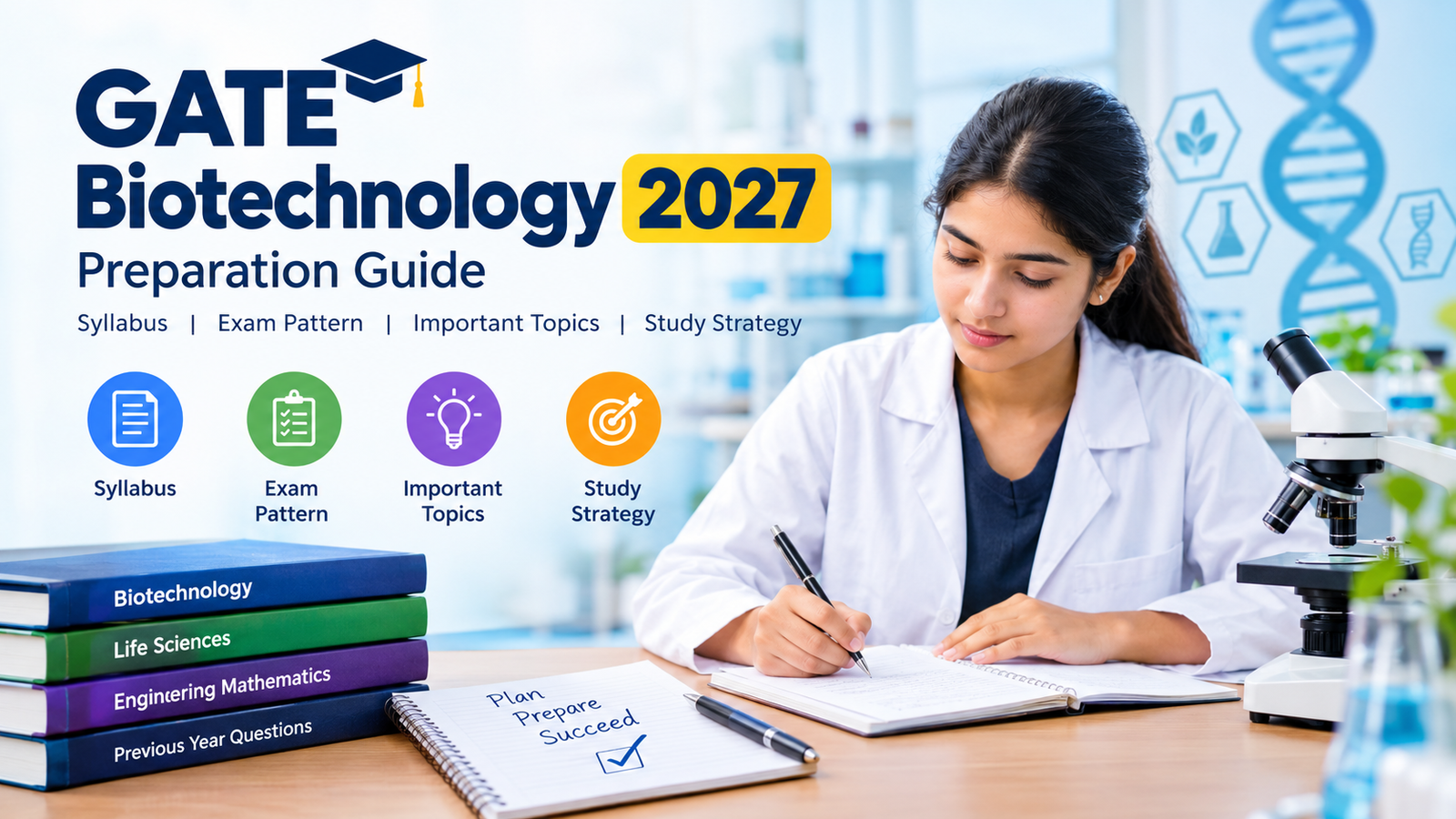
Preparing for GATE Biotechnology 2027 requires a clear understanding of the syllabus, strong conceptual knowledge, regular numerical practice and a well-planned revision strategy. For B.Tech Biotechnology students, engineering graduates and other eligible aspirants, the right preparation approach can make the extensive syllabus more manageable.
The Graduate Aptitude Test in Engineering (GATE) Biotechnology paper, also known as GATE BT, covers engineering mathematics, general biology, genetics, cellular and molecular biology, biological engineering, bioprocess engineering, biotechnology applications and molecular tools. The GATE 2027 Biotechnology syllabus has been revised, so students should use the latest official syllabus rather than relying entirely on previous-year preparation material.
In this guide, we explain how to prepare for GATE Biotechnology 2027 from the basics, understand the exam pattern, prioritise important topics, practise previous-year questions and develop an effective study plan. We also discuss self-study, online coaching, classroom coaching and one-to-one guidance to help you choose a preparation method that suits your learning needs.
Quick Answer: How to Prepare for GATE Biotechnology 2027
To prepare effectively for GATE BT 2027, start by downloading the revised official syllabus, assess your current subject knowledge and divide the syllabus into manageable sections. Study concepts systematically, practise numerical problems, solve previous-year GATE questions, take mock tests and revise regularly.
Key takeaways:
Understand the syllabus first: The official GATE 2027 Biotechnology syllabus contains six main sections.
Know the exam pattern: The paper carries 100 marks, with 15 marks for General Aptitude, 13 marks for Engineering Mathematics and 72 marks for the remaining subject questions.
Strengthen fundamentals: Focus on concepts in biochemistry, microbiology, genetics, molecular biology, biological engineering and biotechnology.
Practise regularly: Solve topic-wise questions before moving to full-length mock tests.
Revise consistently: Maintain short notes, formula sheets, diagrams and an error log.
Use previous-year papers wisely: They help you understand question styles, application-based problems and areas where you need more practice.
Choose the right learning method: Self-study, online classes, classroom coaching or one-to-one guidance can all be useful, depending on your needs.
Check official updates: Always refer to the GATE 2027 website for the revised syllabus, examination information and eligibility requirements.
Official syllabus: https://gate2027.iitm.ac.in/exam_papers_and_syllabus
- What Is GATE Biotechnology?
GATE Biotechnology is a subject-specific paper in the Graduate Aptitude Test in Engineering. Its paper code is BT.
The examination assesses a candidate’s understanding of biotechnology-related concepts and their ability to apply scientific and engineering principles to problems. Preparation involves more than memorising biological definitions; students must also understand mathematical relationships, experimental methods, reaction kinetics and process calculations.
A good GATE Biotechnology preparation plan balances four areas:
Conceptual understanding of biological sciences.
Quantitative and analytical problem-solving.
Knowledge of biological engineering and biotechnology processes.
Exam-oriented practice, revision and time management.
Why should you prepare for GATE Biotechnology?
Depending on the programme and institution, a GATE score may be considered for postgraduate admissions, financial assistance associated with eligible programmes, and certain recruitment opportunities.
However, qualifying for GATE does not automatically guarantee admission, a scholarship or employment. Each institution or recruiting organisation sets its own eligibility and selection requirements.
Students should therefore identify their intended postgraduate programmes or career pathways before deciding how to use their GATE score.
- GATE Biotechnology 2027 Exam Pattern
Understanding the exam pattern helps you plan your preparation and allocate study time appropriately.
According to the official GATE 2027 question paper pattern, the Biotechnology paper follows this structure.
Exam detail
GATE BT 2027
Paper name
Biotechnology
Paper code
BT
Examination mode
Computer-Based Test (CBT)
Examination language
English
Duration
3 hours
Total questions
65
Total marks
100
General Aptitude
15 marks
Engineering Mathematics
13 marks
Remaining subject questions
72 marks
Question types
MCQ, MSQ and NAT
Source: https://gate2027.iitm.ac.in/question_paper_pattern
Types of questions in GATE BT
The examination includes three question formats.
- Multiple Choice Questions (MCQs)
These questions provide multiple answer options, of which one is correct. Incorrect answers attract negative marking.
- Multiple Select Questions (MSQs)
These questions may have more than one correct option. There is no negative marking for an incorrect MSQ response, but there is no partial marking.
- Numerical Answer Type (NAT) questions
These questions require you to enter a numerical answer. There is no negative marking for an incorrect NAT response.
GATE BT negative marking
The official marking scheme specifies the following penalties for incorrect MCQ answers:
One-mark MCQ: one-third of a mark deducted.
Two-mark MCQ: two-thirds of a mark deducted.
MSQ and NAT: no negative marking.
Students should practise identifying when an MCQ can be answered confidently and when further calculation or elimination is necessary.
How should you allocate your preparation time?
The examination’s marks distribution offers a useful starting point for planning.
General Aptitude: Practise regularly throughout your preparation.
Engineering Mathematics: Build accuracy in formulas, calculations and problem-solving methods.
Biotechnology subjects: Give substantial preparation time to the technical syllabus, including theory, numerical questions and application-based problems.
Do not assume that a topic is unimportant simply because it appears difficult or takes longer to understand. Allocate time based on the official syllabus, your current proficiency and your performance in practice tests.
- GATE Biotechnology 2027 Syllabus: Section-Wise Breakdown
The GATE 2027 Biotechnology syllabus has been revised. The following overview summarises the six sections in the official syllabus. Use it as a planning guide and consult the official PDF for the complete topic list.
Official PDF: https://gate2027.iitm.ac.in/static/doc/GATE2027_Syllabus/BT_GATE2027_Syllabus.pdf
Section 1: Engineering Mathematics
Engineering Mathematics is important for quantitative problem-solving and understanding engineering concepts.
Major areas include:
Linear algebra
Matrices and determinants
Systems of linear equations
Eigenvalues and eigenvectors
Calculus and multivariable calculus
Partial derivatives, maxima and minima
Sequences, series and convergence
Ordinary differential equations
Laplace transforms
Probability and statistics
Probability distributions
Correlation and regression
Bayesian statistics
Numerical methods
Numerical integration and methods for differential equations
How to prepare: Learn the meaning and application of each formula before attempting advanced problems. Practise calculations regularly and maintain a separate formula notebook for quick revision.
Section 2: General Biology
General Biology includes important concepts from biochemistry, microbiology and immunology.
Biochemistry
Topics include:
Structure and function of biomolecules
Biological membranes, channels and pumps
Metabolism of carbohydrates, lipids, amino acids and nucleic acids
Glycolysis and the citric acid cycle
Fatty acid oxidation
Photosynthesis and cellular respiration
Electron transport chains
Enzyme classification and kinetics
Michaelis-Menten kinetics
Competitive, non-competitive and uncompetitive inhibition
Microbiology
Topics include:
History and classification of microorganisms
Bacterial diversity and cell wall structure
Gram-positive and Gram-negative bacteria
Archaea
Microbial growth and nutrition
Microbiological methods
Lac, Trp and Ara operons
Nitrogen fixation
Host-pathogen interactions
Antibiotics and antimicrobial resistance
Two-component systems and bacterial communication
Virus structure and classification
Immunology
Topics include:
Primary and secondary lymphoid organs
Innate and adaptive immunity
Inflammation, cytokines and chemokines
Complement systems
Cellular and humoral immune responses
Antibody diversity and function
T-cell and B-cell development
Major histocompatibility complex (MHC)
Antigen processing and presentation
Immune tolerance and hypersensitivity
Autoimmunity and immunodeficiency
Vaccines and immunisation
How to prepare: Connect biological pathways and mechanisms instead of memorising isolated facts. Draw pathway diagrams, compare related processes and practise questions that require you to interpret biological situations.
Section 3: Genetics, Cellular and Molecular Biology
This section develops your understanding of inheritance, cell function and molecular mechanisms.
Genetics and Evolutionary Biology
Mendelian inheritance
Gene interactions and complementation
Linkage, recombination and chromosome mapping
Extrachromosomal inheritance
Microbial genetics
Transformation, transduction and conjugation
Bacterial gene mapping
Horizontal gene transfer and transposable elements
Chromosomal variation and sex determination
Genetic disorders
Population genetics and epigenetics
Natural selection and evolutionary mechanisms
Genetic drift, species and speciation
Cell Biology
Eukaryotic cell structure
Cell cycle and growth control
Cell-cell communication
Cell signalling and signal transduction
Post-translational modifications
Protein trafficking
Cell death and autophagy
Extracellular matrix
Molecular Biology
Gene and chromosome structure
Mutations and mutagenesis
Gene expression regulation
DNA replication
Transcription and RNA splicing
Translation
Non-coding RNA and microRNA
RNA interference
DNA damage and repair
How to prepare: Focus on the sequence of events, the molecules involved and the consequences of each process. For genetics, solve numerical problems involving inheritance, recombination and mapping. For molecular biology, create comparison charts for replication, transcription and translation.
Section 4: Fundamentals of Biological Engineering
This section connects biology with engineering principles and process design.
Bioreaction Engineering
Reaction rates and rate laws
Zero-order and first-order kinetics
Enzyme reaction kinetics and inhibition
Batch, mixed-flow and plug-flow reactors
Enzyme immobilisation
Diffusion effects and effectiveness factors
Microbial growth kinetics
Substrate utilisation and product formation
Structured and unstructured models
Batch, fed-batch and continuous processes
Microbial and enzyme reactors
Process optimisation and scale-up
Upstream and Downstream Processing
Culture media formulation and optimisation
Sterilisation of air and media
Membrane filtration and ultrafiltration
Centrifugation
Cell disruption
Chromatography techniques
Extraction, adsorption and drying
Measurement devices and valves
First-order and second-order systems
Feedback and feed-forward control
Proportional, derivative and integral controllers
Controller tuning
How to prepare: This section requires consistent numerical practice. Understand the assumptions behind each equation, practise unit conversions and learn how operating conditions affect biological processes.
Section 5: Plant, Animal and Microbial Biotechnology
This section covers the use of biological systems for research, production and industrial applications.
Plant Biotechnology
Totipotency and plant regeneration
Direct and indirect organogenesis
Plant growth regulators and elicitors
Plant tissue culture and cell suspension culture
Growth kinetics and nutrient optimisation
Secondary metabolite production
Hairy root culture
Artificial seeds
Somaclonal variation
Protoplast fusion, somatic hybrids and cybrids
Transgenic plants and gene transfer methods
Selection markers and reporter genes
Plastid transformation
Animal Biotechnology
Animal cell culture media and growth conditions
Cell and tissue preservation
Anchorage-dependent and non-anchorage-dependent cultures
Cell growth kinetics
Microcarrier and macrocarrier culture
Hybridoma technology
Stem cell technology
Animal cloning
Transgenic animals
Knockout and knock-in animals
Microbial Biotechnology
Biomass production
Primary and secondary metabolites
Biofuels and bioplastics
Industrial enzymes and antibiotics
Large-scale production and purification of recombinant products
Clinical, food and industrial microbiology
Screening strategies for new products
How to prepare: Organise these topics by technique, application, advantages, limitations and expected outcome. Comparison tables can help you distinguish similar methods.
Section 6: Recombinant DNA Technology and Other Tools in Biotechnology
This section covers molecular techniques, analytical methods and computational tools used in biotechnology.
Recombinant DNA Technology
Restriction and modification enzymes
Plasmids, bacteriophage and viral vectors
Cosmids and artificial chromosomes
Expression vectors
cDNA and genomic DNA libraries
Gene isolation and cloning
Recombinant protein production
Transposons and gene targeting
Recombination-based gene cloning
Molecular Tools
Polymerase chain reaction (PCR)
DNA and RNA labelling
Sanger sequencing and next-generation sequencing
Southern and Northern blotting
In-situ hybridisation
DNA fingerprinting, RAPD and RFLP
Site-directed mutagenesis
CRISPR-Cas systems
Biosensors
DNA-protein and protein-protein interaction methods
Genomics and proteomics approaches
Analytical Tools
Light, electron, fluorescence and confocal microscopy
Spectroscopy techniques
Electrophoresis
Microarrays
Enzymatic assays
ELISA and radioimmunoassay
Immunohistochemistry and immunoblotting
Flow cytometry
Whole-genome and ChIP sequencing
Computational Tools
Bioinformatics resources and search tools
Sequence and structure databases
Sequence file formats and scoring matrices
Sequence alignment and phylogeny
Genomics, proteomics and metabolomics
Gene prediction and functional annotation
Protein structure prediction
Biochemical databases
Metagenomics
Metabolic engineering and systems biology
How to prepare: Understand the principle, purpose, workflow and interpretation of each technique. Practise distinguishing methods that answer different biological questions, such as Southern blotting, Northern blotting and immunoblotting.
- Important Topics for GATE Biotechnology 2027
Which topics should you study first for GATE BT 2027?
A practical approach is to begin with concepts that support multiple areas of the syllabus, then progress to more specialised topics. The following are useful starting priorities, not an official ranking of marks or a prediction of question frequency.
Topic area
Suggested preparation focus
Biochemistry
Metabolic pathways, enzyme kinetics and inhibition
Molecular Biology
Replication, transcription, translation and gene regulation
Genetics
Inheritance, linkage, recombination and gene mapping
Microbiology
Microbial growth, operons and microbial physiology
Cell Biology
Cell cycle, signalling and protein trafficking
Immunology
Immune responses, antibodies and antigen presentation
Engineering Mathematics
Linear algebra, calculus, probability and differential equations
Bioreaction Engineering
Growth kinetics, reactor models and enzyme immobilisation
Downstream Processing
Filtration, centrifugation and chromatography
Recombinant DNA Technology
Cloning, vectors, PCR and sequencing
Plant and Animal Biotechnology
Tissue culture, cell culture and transgenic systems
Bioinformatics
Sequence alignment, databases and functional annotation
General Aptitude
Quantitative aptitude, verbal ability and reasoning
How do you identify high-priority topics?
Use three criteria:
Syllabus coverage: Is the topic explicitly listed in the official GATE 2027 syllabus?
Your current proficiency: Do you understand it, or does it require foundational study?
Practice performance: Are you answering related questions accurately under timed conditions?
Review previous-year questions to understand how concepts are tested. However, do not assume that a topic will receive the same number of questions in GATE 2027 as it did in a previous year.
- Step-by-Step GATE Biotechnology Preparation Strategy
Step 1: Download the revised syllabus
Start with the official GATE 2027 Biotechnology syllabus PDF. Create a checklist of every section and topic.
Mark each topic as:
Not started
Currently studying
Completed
Needs revision
Ready for timed practice
This simple method helps you monitor progress and prevents you from overlooking smaller syllabus areas.
Step 2: Assess your fundamentals
Before following a detailed timetable, identify your strengths and weaknesses.
Ask yourself:
Can I explain the major biochemical pathways?
Can I solve basic probability and differential equation problems?
Do I understand gene expression and inheritance?
Can I calculate microbial growth rates?
Can I explain the principles of common biotechnology techniques?
Attempt a short diagnostic set of questions. Use the results to decide which topics need foundational study.
Step 3: Build concepts before memorising facts
GATE BT tests conceptual understanding and application, so memorisation alone is insufficient.
For each topic:
Read the concept from a reliable textbook or learning resource.
Write a short explanation in your own words.
Draw a diagram or process flow where relevant.
Solve basic questions.
Attempt previous-year questions on the same topic.
Record mistakes and revise them later.
For example, while studying enzyme kinetics, understand what the Michaelis-Menten equation represents, what the kinetic parameters mean and how different inhibitors affect the relationship.
Step 4: Practise numerical questions regularly
Engineering Mathematics and Biological Engineering require consistent problem-solving practice.
Practise questions involving:
Probability and statistical calculations
Differential equations
Numerical methods
Enzyme kinetics
Microbial growth
Reactor models
Process calculations
Write each step clearly and check units, assumptions and calculation accuracy. When you make a mistake, identify whether it resulted from a conceptual gap, an incorrect formula, a calculation error or misreading the question.
Step 5: Solve previous-year GATE questions
Previous-year question papers help you understand the style and level of questions asked in the examination.
Use them in two stages:
Topic-wise practice: Solve questions immediately after completing a topic.
Full-paper practice: Attempt a complete paper under timed conditions after covering a substantial portion of the syllabus.
Use official question papers and answer keys wherever available. Remember that previous-year questions are practice resources, not guarantees of what will appear in the next examination.
Step 6: Prepare General Aptitude alongside technical subjects
General Aptitude carries 15 marks in GATE BT 2027. Avoid leaving it until the final weeks.
Include regular practice of:
Quantitative aptitude
Verbal ability
Logical and analytical reasoning
Data interpretation, where relevant to the question set
Focus on accuracy first, then improve speed through timed practice.
Step 7: Take mock tests and analyse your performance
Mock tests help you practise time management and identify gaps in your preparation.
After every test, review:
Questions answered incorrectly
Questions left unanswered
Topics that consumed too much time
Calculation mistakes
Questions that could have been solved using a simpler method
Do not measure progress only by your mock-test score. Track whether you are making fewer repeated mistakes and improving your accuracy across different topics.
Step 8: Revise systematically
Use short notes, flashcards, diagrams, formula sheets and topic summaries.
A practical revision cycle is to revisit a topic after studying it, review it again after a few days and include it in a later cumulative revision session.
During the final phase, focus on the official syllabus, previously studied concepts, error logs and timed question practice rather than repeatedly collecting new study materials.
- GATE Biotechnology 2027 Study Plan
Your ideal timetable depends on your available time, academic workload and starting level. The following 12-week plan is an illustrative framework for students who already have some basic subject knowledge.
Students starting from scratch may need a longer preparation period.
Preparation period
Main focus
Expected progress
Weeks 1–2
Syllabus analysis, diagnostic test, Engineering Mathematics fundamentals
A clear study plan and stronger foundations
Weeks 3–4
Biochemistry, microbiology and immunology
Core biological concepts covered
Weeks 5–6
Genetics, Cell Biology and Molecular Biology
Major mechanisms and problem types practised
Weeks 7–8
Biological Engineering and process calculations
Reactor, kinetics and processing problems practised
Weeks 9–10
Plant, Animal and Microbial Biotechnology; molecular and analytical tools
Remaining technical topics revised
Week 11
General Aptitude, topic-wise revision and previous-year questions
Weak areas identified and addressed
Week 12
Full-length mock tests, error analysis and final revision
Exam readiness assessed
This is not a fixed syllabus timetable. Adjust it according to the revised official syllabus, your diagnostic results and the topics you have already studied.
Suggested daily timetable
If you can dedicate approximately four focused hours a day, you could divide your study time as follows:
Activity
Suggested time
Learn a new concept
90 minutes
Solve numerical or technical questions
60 minutes
Revise previous topics
30 minutes
Practise General Aptitude
30 minutes
Review mistakes and update notes
30 minutes
These are suggested allocations, not mandatory targets. If you have college classes, projects or examinations, use shorter study blocks and maintain a realistic weekly schedule.
Consistency matters more than following an unnecessarily demanding timetable for a few days and then abandoning it.
- Best Books and Study Resources for GATE BT 2027
A good resource strategy combines the official syllabus, standard textbooks, previous-year question papers and mock tests.
Avoid purchasing multiple books covering the same subject before deciding which concepts you need to study.
Recommended resource categories
- Official GATE resources
Start with the GATE 2027 website for the revised syllabus, examination pattern, official notifications and available question-paper resources.
Website: https://gate2027.iitm.ac.in/
- Standard biotechnology and life-science textbooks
Use established textbooks appropriate to your level for biochemistry, microbiology, genetics, molecular biology, immunology and biological engineering.
Choose books that explain concepts clearly and include relevant illustrations and numerical examples. The official syllabus should determine which chapters you need to study.
- Previous-year GATE question papers
Use these to understand the format of questions and practise applying concepts.
- Topic-wise question banks
Choose question banks that clearly identify the topics covered and provide reliable explanations for answers.
- Mock tests
Use mock tests to assess your progress, practise working within the examination time and improve question selection.
How should you use study materials?
For each topic, follow a simple sequence:
Learn the concept → solve basic questions → practise GATE-level questions → review mistakes → revise.
This is generally more effective than reading several resources without testing your understanding.
- Online Coaching vs Classroom Coaching vs Self-Study
There is no single preparation method that works best for every GATE Biotechnology aspirant. The right choice depends on your learning preferences, schedule, subject knowledge and need for guidance.
Preparation method
Advantages
Things to consider
Self-study
Flexible schedule and independent learning
Requires planning, consistency and self-assessment
Online coaching
Learn remotely and organise study around other commitments
Requires reliable internet access and regular participation
Classroom coaching
A structured learning environment and direct interaction
Travel time and fixed schedules may affect flexibility
One-to-one guidance
Individual attention to specific learning needs
Availability, course structure and fees should be confirmed before enrolling
Hybrid learning
Can combine online and in-person learning
Confirm which sessions and facilities are included
Is online coaching good for GATE Biotechnology?
Online coaching can be useful if you need structured learning but prefer studying from home or balancing preparation with college. It is important to check the teaching schedule, access arrangements, syllabus coverage and opportunities to ask questions before choosing a programme.
Is classroom coaching better than online coaching?
Not necessarily. Classroom coaching may suit students who benefit from face-to-face interaction and a fixed timetable. Online learning may be more convenient for students who need flexibility. The quality and suitability of the learning support matter more than the format alone.
Is self-study enough for GATE BT?
Self-study can work well if you can understand concepts independently, follow a syllabus-based plan, practise regularly and assess your progress honestly.
If you repeatedly struggle with difficult concepts, numerical problems or maintaining a study schedule, additional structured guidance may help.
- Common Mistakes to Avoid During GATE BT Preparation
Even students who study consistently can lose time through avoidable preparation mistakes.
Mistake 1: Following an outdated syllabus
The GATE 2027 Biotechnology syllabus has been revised. Always use the current official PDF and compare it with older notes before relying on them.
Mistake 2: Memorising without understanding
Memorising definitions and pathways without understanding their underlying mechanisms makes application-based questions harder to solve.
Mistake 3: Ignoring Engineering Mathematics
Mathematics and quantitative problem-solving require practice. Do not postpone them until the final revision period.
Mistake 4: Neglecting General Aptitude
General Aptitude carries 15 marks. Regular practice is more useful than trying to learn everything at the last minute.
Mistake 5: Reading without solving questions
Reading a chapter can create a sense of familiarity, but question practice reveals whether you can apply the concept independently.
Mistake 6: Taking mock tests without analysing them
A mock test is useful only when you review your mistakes and use the findings to improve.
Mistake 7: Collecting too many resources
Switching repeatedly between books, videos and question banks can interrupt progress. Choose a manageable set of reliable resources.
Mistake 8: Studying only perceived high-weightage topics
There is no guaranteed topic-wise question distribution. Prioritise sensibly, but make sure your preparation covers the official syllabus.
Mistake 9: Leaving revision until the end
Regular revision helps you retain concepts and reduces the amount of material you need to relearn later.
Mistake 10: Ignoring the examination instructions
Check the official website for updates on the syllabus, application requirements, examination schedule and permitted procedures.
- How GATEIIT Can Help with GATE Biotechnology Preparation
Students who prefer structured learning can explore the GATE Biotechnology preparation options offered by GATEIIT.
Depending on their learning requirements, aspirants can enquire about the available online, offline or hybrid learning options and one-to-one guidance.
These options may be worth considering if you want a more organised approach to learning biotechnology concepts alongside independent question practice and revision.
Before enrolling, students should confirm the current course structure, batch schedule, syllabus coverage, teaching format, learning support, fees and other relevant details directly with GATEIIT.
Who may benefit from structured guidance?
You may want to explore coaching if you:
Need help organising the GATE BT syllabus.
Find certain biotechnology concepts difficult to understand independently.
Want guidance while working through technical or numerical questions.
Prefer a structured learning routine alongside self-study.
Need to balance GATE preparation with B.Tech classes, laboratory work or other academic commitments.
Coaching should complement, not replace, independent practice. Students still need to solve questions, revise concepts, analyse mock tests and track their own progress.
Explore GATEIIT GATE Biotechnology preparation
For more information, visit the relevant GATEIIT page:
https://gateiit.com/how-to-start-gate-bt-preparation-from-scratch-tips-for-biotech-aspirants/
Use the page to enquire about the currently offered preparation options and confirm which format best matches your needs.
- Admission and Enquiry Guidance
If you are considering GATE Biotechnology coaching, gather the information you need before making a decision.
You can ask GATEIIT about:
Current online, offline and hybrid options.
Availability of one-to-one guidance.
Course duration and batch timings.
Topics and syllabus coverage.
The structure of classes and learning support.
Fees, enrolment requirements and available schedules.
The availability of specific batches and facilities should be confirmed directly with the institute. Do not assume that every feature is included in every course format.
If you are preparing independently, you can still use the official GATE 2027 syllabus and available question papers to build a structured preparation plan.
A sensible next step: Review your current level, list the subjects you find difficult and decide whether independent study or additional guidance would help you progress more effectively.
For GATEIIT course enquiries, visit:
https://gateiit.com/how-to-start-gate-bt-preparation-from-scratch-tips-for-biotech-aspirants/
- Frequently Asked Questions About GATE Biotechnology 2027
- How do I start preparing for GATE Biotechnology 2027 from scratch?
Begin with the revised official syllabus and identify your strengths and weaknesses. Build your fundamentals in mathematics and core biological subjects, practise questions after each topic, solve previous-year papers and revise consistently.
- Is GATE Biotechnology difficult?
The difficulty depends on your academic background, conceptual understanding and preparation. The syllabus combines biological sciences with mathematics and engineering applications, so students generally benefit from a balanced approach that includes both theory and numerical practice.
- What is the syllabus for GATE Biotechnology 2027?
The official syllabus has six main sections: Engineering Mathematics; General Biology; Genetics, Cellular and Molecular Biology; Fundamentals of Biological Engineering; Plant, Animal and Microbial Biotechnology; and Recombinant DNA Technology and Other Tools in Biotechnology. Consult the official PDF for the complete revised syllabus.
- What is the exam pattern for GATE BT 2027?
The paper is a three-hour computer-based examination with 65 questions carrying 100 marks. The distribution is 15 marks for General Aptitude, 13 marks for Engineering Mathematics and 72 marks for the remaining subject questions. Question formats include MCQ, MSQ and NAT.
- Is there negative marking in GATE Biotechnology?
Yes. Incorrect one-mark MCQs attract a deduction of one-third of a mark, and incorrect two-mark MCQs attract a deduction of two-thirds of a mark. There is no negative marking for MSQ or NAT questions.
- Can B.Tech Biotechnology students appear for GATE 2027?
Students currently in the third year or higher of an eligible government-approved undergraduate programme can appear, subject to the official eligibility criteria. Students should check the current GATE 2027 eligibility page and verify their programme details.
- Can students from other engineering branches choose GATE BT?
Candidates may choose an eligible GATE paper according to their interests and admission plans. However, they should check the eligibility requirements of their intended postgraduate programmes before selecting Biotechnology as their examination paper.
- Is there an age limit for GATE 2027?
The official GATE 2027 FAQ states that there is no age limit. Candidates should still check the applicable eligibility criteria and the requirements of their intended institutions.
- How many hours should I study daily for GATE BT?
There is no fixed number of hours that guarantees a particular result. Set a realistic timetable according to your current knowledge, available preparation time and academic responsibilities. Focus on consistent learning, question practice and revision rather than study hours alone.
- Can I prepare for GATE Biotechnology while studying in B.Tech?
Yes. You can begin by strengthening the subjects already covered in your degree, following the official GATE syllabus and setting aside regular time for practice. A weekly timetable can help you balance college work and exam preparation.
- Which topics should I prioritise for GATE Biotechnology?
Start with topics in which you need the strongest conceptual foundation, while paying attention to Engineering Mathematics, biochemistry, genetics, molecular biology, microbiology and biological engineering. Use the official syllabus and previous-year questions to guide your priorities rather than assuming a fixed topic-wise weightage.
- Are previous-year questions enough for GATE BT preparation?
Previous-year questions are valuable, but they should not be your only resource. Study the concepts behind the questions, practise additional problems, cover the official syllabus and use mock tests to assess your readiness.
- Can I prepare for GATE Biotechnology through self-study?
Yes. Self-study can be effective if you have a clear plan, reliable learning materials, regular question practice and a method for evaluating your progress. Additional guidance may help if you face persistent difficulties with concepts or planning.
- Should I choose online or offline GATE Biotechnology coaching?
Choose according to your learning preferences and schedule. Online coaching can offer flexibility, classroom coaching can provide a fixed learning environment, and one-to-one guidance may help with individual learning needs. Confirm the actual features, timetable and fees before enrolling.
- Is one-to-one guidance useful for GATE BT preparation?
One-to-one guidance may be helpful if you need focused support with particular subjects, difficult concepts or a preparation schedule. Its usefulness depends on the guidance provided and the effort you put into independent practice.
- Which books should I use for GATE Biotechnology 2027?
Use the official syllabus as your starting point, then select reliable textbooks for the subjects you need to study. Supplement them with previous-year question papers, topic-wise practice and mock tests. Avoid relying on outdated material without checking the revised syllabus.
- How important is General Aptitude in GATE BT?
General Aptitude carries 15 marks out of 100. Regular practice in quantitative aptitude, verbal ability and reasoning can help you become more comfortable with this section.
- Does qualifying for GATE guarantee admission to an IIT or another postgraduate institution?
No. Admission depends on the individual institution’s eligibility requirements, selection process, available programmes and other applicable criteria. Always check the admission requirements of the institution and programme you intend to apply to.
- Is the GATE 2027 Biotechnology syllabus the same as the previous year’s syllabus?
No candidate should assume that the syllabus is unchanged. The official GATE 2027 website explicitly states that the syllabi have been revised. Download and review the latest Biotechnology syllabus before planning your preparation.
- Where can I find GATEIIT’s GATE Biotechnology preparation options?
Visit the GATEIIT page at https://gateiit.com/how-to-start-gate-bt-preparation-from-scratch-tips-for-biotech-aspirants/ to explore the relevant preparation information and enquire about currently available online, offline, hybrid and one-to-one options.
Conclusion: Build a Clear Preparation Plan for GATE Biotechnology 2027
Preparing for GATE Biotechnology 2027 becomes more manageable when you divide the syllabus into smaller sections, understand the concepts thoroughly and practise applying them to examination-style questions.
Begin with the revised official syllabus. Strengthen your fundamentals in biological sciences, mathematics and biological engineering. Solve previous-year questions, practise General Aptitude, take mock tests and revise your mistakes regularly.
Most importantly, choose a preparation routine that you can maintain alongside your academic responsibilities. Self-study can be sufficient for some students, while others may benefit from online, classroom, hybrid or one-to-one guidance.
If you would like structured support for your preparation, explore the GATEIIT GATE Biotechnology page and enquire about the currently available options.
Start with a clear plan, practise consistently and keep improving your understanding one topic at a time.