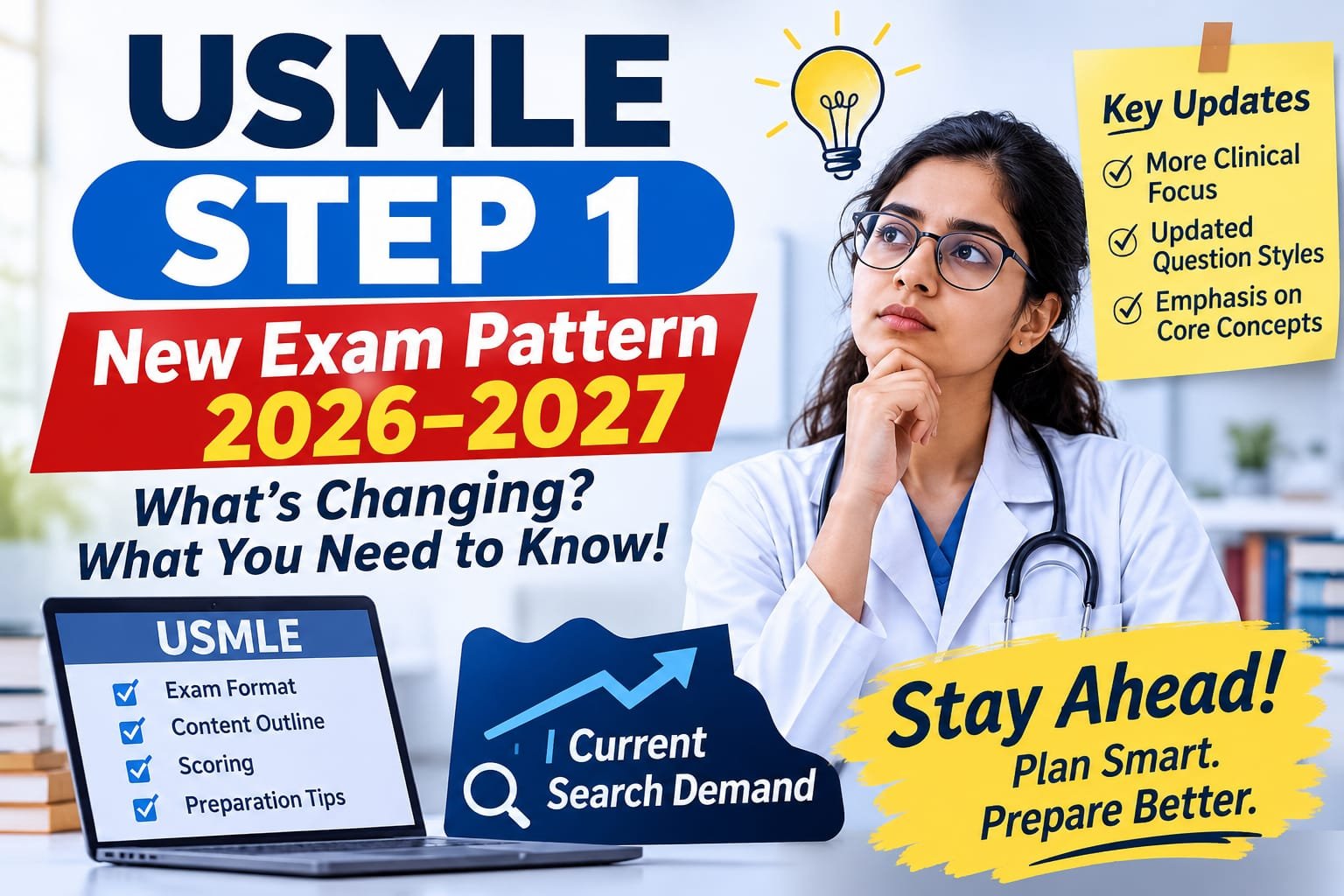
The USMLE Step 1 examination has a new testing format for candidates appearing on or after May 14, 2026. Instead of the previous seven 60-minute blocks, the examination now consists of 14 shorter blocks, each lasting 30 minutes, with a maximum of 20 questions per block. The overall examination remains an approximately eight-hour, one-day testing session, with a maximum of 280 questions.
This change is particularly important for Indian MBBS students, medical graduates and International Medical Graduates preparing for USMLE Step 1 in 2026–2027. Students must become familiar with the new examination interface, shorter question blocks, time management requirements and updated testing experience before appearing for the examination.
The examination’s total content, maximum number of questions and overall testing-session duration have not increased. However, the shorter blocks require students to adjust their question-solving approach, concentration, pacing and examination-day planning.
If you are planning to take USMLE Step 1 in 2026 or 2027, this guide explains the latest examination structure, question distribution, subject weightage, new software features, break arrangements, time-management strategy and preparation recommendations.
Quick Answer: What Is the New USMLE Step 1 Exam Pattern for 2026–2027?
The current USMLE Step 1 examination pattern for candidates appearing on or after May 14, 2026, is:
| Examination feature | Current format |
| Examination type | Computer-based examination |
| Examination days | One day |
| Total testing session | Approximately 8 hours |
| Maximum total questions | 280 |
| Number of blocks | 14 |
| Duration per block | 30 minutes |
| Maximum questions per block | 20 |
| Minimum break time | 55 minutes |
| Optional tutorial | 5 minutes |
| Question format | Primarily multiple-choice questions |
| Result reporting | Pass/Fail |
| Examination location | Authorised Prometric test centre |
Important: The number of questions in individual blocks may vary. Twenty questions is the maximum per block, not a guaranteed fixed number in every block.
The examination is designed to test the understanding and application of basic medical sciences in clinical situations.
For the latest official information, refer to the USMLE Step 1 examination page: https://www.usmle.org/step-exams/step-1
What Changed in the USMLE Step 1 Examination From May 14, 2026?
The USMLE programme introduced updated test-delivery software for Step examinations. The new Step 1 testing experience became effective on May 14, 2026.
The most important structural change is the division of the examination into more, shorter blocks.
Previously, candidates appeared for seven 60-minute blocks. Under the new format, candidates complete fourteen 30-minute blocks.
The total number of questions and overall testing-session length remain unchanged.
Old USMLE Step 1 Exam Pattern vs New 2026–2027 Exam Pattern
| Feature | Previous format | Current format |
| Implementation | Before May 14, 2026 | May 14, 2026 onwards |
| Number of blocks | 7 | 14 |
| Time per block | 60 minutes | 30 minutes |
| Maximum questions per block | 40 | 20 |
| Maximum total questions | 280 | 280 |
| Testing session | 8 hours | 8 hours |
| Minimum break allocation | 45 minutes | 55 minutes |
| Optional tutorial | 15 minutes | 5 minutes |
| Software | Previous interface | Updated interface |
| Overall exam content | Existing content outline | No change due to software transition |
The shorter-block arrangement changes how students experience the examination, but it does not mean that the examination has become twice as long or that the number of questions has doubled.
Why Did USMLE Introduce the New Testing Software?
The updated software aims to improve the examination experience through an updated interface, improved keyboard navigation and additional display controls.
The changes include:
- Updated examination interface.
- Improved keyboard navigation.
- A settings menu.
- Ability to adjust the contrast of individual images.
- New interactive testing experience.
- Shorter examination blocks.
- More frequent transitions between blocks.
These improvements are intended to provide a more consistent and familiar testing environment across the USMLE examinations and associated practice materials.
The official USMLE announcement confirms that the total examination content, maximum number of items and overall examination duration remain unchanged.
Official announcement: https://www.usmle.org/test-delivery-software-updates-place-step-1
How Many Questions Are There in USMLE Step 1 2026–2027?
The USMLE Step 1 examination contains a maximum of 280 questions.
These questions are distributed across 14 blocks.
Each block lasts 30 minutes and contains no more than 20 questions.
This means:
- Maximum questions per block: 20
- Total blocks: 14
- Maximum total questions: 280
- Time per block: 30 minutes
The actual number of questions in an examination form may vary.
Students should not assume that every block will necessarily contain exactly 20 questions.
How Much Time Do You Get Per Question?
If a block contains 20 questions and lasts 30 minutes, the average available time is:
30 minutes ÷ 20 questions = 1.5 minutes per question.
Therefore, candidates have an average of approximately 90 seconds per question when a block contains the maximum 20 questions.
However, this does not mean every question must be solved in exactly 90 seconds.
Some questions may be answered quickly, while longer clinical vignettes may require more time.
The objective is to maintain an effective average pace across the block.
Practical Question-Solving Time Allocation
| Question type | Suggested approach |
| Short factual or conceptual question | Answer efficiently |
| Moderate clinical vignette | Read carefully and identify the key clinical clues |
| Complex integrated question | Analyse the mechanism and eliminate incorrect options |
| Difficult question | Avoid spending excessive time on a single item |
| Uncertain question | Make the best informed choice and manage remaining time |
These are preparation recommendations, not official USMLE time limits for individual questions.
Students should practise different question lengths under timed conditions.
How Does the 8-Hour USMLE Step 1 Examination Work?
Although the examination contains 14 blocks of 30 minutes each, the complete testing session is approximately eight hours.
The overall schedule includes:
- Fourteen examination blocks.
- A minimum of 55 minutes of break time.
- A five-minute optional tutorial.
The total scheduled time is approximately:
- Examination blocks: 14 × 30 minutes = 420 minutes.
- Minimum break time: 55 minutes.
- Optional tutorial: 5 minutes.
- Total: 480 minutes or 8 hours.
The tutorial and break allocation form part of the overall testing session.
Understanding the USMLE Step 1 Break Schedule
The examination provides a minimum of 55 minutes of break time.
Students can use available break time for:
- Drinking water.
- Eating permitted food during authorised breaks.
- Using the restroom.
- Recovering concentration.
- Preparing mentally for the next examination block.
The available break time can increase when candidates finish examination blocks or the optional tutorial early.
However, candidates should understand the difference between the allocated break time and the time remaining in the overall testing session.
Time spent beyond the available break allocation may reduce the time available for completing the examination.
Candidates should also remember that once an examination block begins, they cannot leave the testing room for an ordinary break without affecting the examination clock.
Always review the latest USMLE examination-day instructions before your appointment.
How Should You Divide Your Break Time During 14 Blocks?
There is no compulsory fixed break schedule requiring candidates to take a break after a particular block.
You should plan breaks according to your concentration, fatigue, food requirements and personal examination strategy.
A sample break-planning approach could be:
| Examination stage | Suggested approach |
| Blocks 1–3 | Maintain concentration and assess your pace |
| After Block 3 | Consider a short recovery break |
| Blocks 4–6 | Continue with consistent question-solving |
| After Block 6 | Consider food, hydration or a longer break |
| Blocks 7–9 | Reset concentration and avoid rushing |
| After Block 9 | Consider another short break |
| Blocks 10–12 | Maintain timing and accuracy |
| After Block 12 | Take a brief recovery break if needed |
| Blocks 13–14 | Complete the examination with a consistent approach |
This is only an illustrative strategy. It is not an official USMLE break timetable.
Your available breaks depend on the actual time remaining and the rules governing the examination session.
What Is the New USMLE Step 1 Testing Software?
The updated USMLE examination software provides an improved testing interface for candidates taking Step 1 on or after May 14, 2026.
Students should become familiar with the interface before their examination.
Important features include:
1. Updated User Interface
The examination interface has been redesigned to improve the overall testing experience.
Candidates should become familiar with the layout and available functions before examination day.
2. Improved Keyboard Navigation
The new software includes improved keyboard navigation.
Students should practise navigating questions using the available interface controls rather than relying only on their previous examination experience.
3. Image Contrast Adjustment
The updated interface provides the ability to adjust contrast on individual images.
This may be particularly useful when examining certain medical images, histological slides, diagrams and other visual material.
However, image adjustment does not change the underlying medical information being tested.
4. Updated Settings Menu
The updated software includes a settings menu that allows candidates to access available interface options.
Students should explore these features through the official interactive testing experience.
5. New Interactive Testing Experience
USMLE provides an official interactive testing experience to help candidates understand the updated interface.
Candidates taking Step 1 under the new format should practise with the new version rather than relying entirely on older tutorial videos or screenshots.
Official practice resource:
https://www.usmle.org/exam-resources/step-1-materials/step-1-sample-test-questions
Why Should Indian MBBS Students Practise the New Software Before USMLE Step 1?
Many Indian medical students spend considerable time preparing medical subjects but may underestimate the importance of examination-interface familiarity.
The actual examination experience is different from ordinary textbook reading or classroom question practice.
Students should practise:
- Opening and navigating examination blocks.
- Reading clinical vignettes on a computer screen.
- Using the available keyboard controls.
- Understanding the image display.
- Managing the 30-minute block timer.
- Moving between questions within the current block.
- Reviewing available questions before closing the block.
- Understanding the transition between blocks.
The official USMLE instructions state that candidates cannot return to previous blocks after closing them.
Therefore, students should develop a habit of reviewing unanswered or uncertain questions within the current block before submitting or closing it.
Can You Return to Previous Questions in USMLE Step 1?
Candidates can navigate and review questions within the current block, subject to the examination software rules.
However, once a block is closed, candidates cannot return to it.
This is particularly important under the new 14-block examination format.
For example, if you are completing Block 4 and have marked a question for review, you should revisit it before closing Block 4.
You cannot assume that you will be able to return to that question during Block 5.
Recommended strategy: Before closing each 30-minute block, check whether any questions remain unanswered or require review.
Do not allow the block timer to expire without attempting the questions you can reasonably answer.
What Is the USMLE Step 1 Syllabus and Subject Distribution for 2026–2027?
The new examination software does not introduce a completely new syllabus.
USMLE Step 1 continues to assess the application of foundational medical sciences, with particular emphasis on the mechanisms underlying health, disease and therapy.
The examination follows an integrated content outline organised around organ systems and physician tasks and competencies.
Major subject areas include:
- Pathology
- Physiology
- Pharmacology
- Anatomy
- Embryology
- Microbiology
- Immunology
- Biochemistry
- Genetics
- Histology
- Cell Biology
- Behavioural Sciences
- Biostatistics
- Epidemiology
- Nutrition
- Communication and Interpersonal Skills
Official USMLE Step 1 Organ-System Weightage
The current official USMLE content specifications provide the following approximate percentage ranges:
| Organ system or area | Percentage range |
| Human Development | 1–3% |
| Blood and Lymphoreticular/Immune Systems | 9–13% |
| Behavioural Health and Nervous Systems/Special Senses | 10–14% |
| Musculoskeletal, Skin and Subcutaneous Tissue | 8–12% |
| Cardiovascular System | 7–11% |
| Respiratory and Renal/Urinary Systems | 11–15% |
| Gastrointestinal System | 6–10% |
| Reproductive and Endocrine Systems | 12–16% |
| Multisystem Processes and Disorders | 8–12% |
| Biostatistics and Epidemiology/Population Health | 4–6% |
| Social Sciences: Communication and Interpersonal Skills | 6–9% |
These are official content-specification ranges, not a guaranteed distribution of questions in an individual examination.
The actual examination form may vary.
Official USMLE Step 1 Physician Tasks and Competencies
The examination also assesses how candidates apply their knowledge.
| Competency | Percentage range |
| Medical Knowledge: Applying Foundational Science Concepts | 60–70% |
| Patient Care: Diagnosis | 20–25% |
| Communication and Interpersonal Skills | 6–9% |
| Practice-Based Learning and Improvement | 4–6% |
Official USMLE Step 1 Discipline Distribution
The current official discipline specifications include:
| Discipline | Percentage range |
| Pathology | 45–55% |
| Physiology | 30–40% |
| Nutrition | 15–20% |
| Gross Anatomy and Embryology | 10–20% |
| Microbiology | 10–20% |
| Pharmacology | 10–20% |
| Behavioural Sciences | 10–15% |
| Biochemistry | 5–15% |
| Histology and Cell Biology | 5–15% |
| Immunology | 5–15% |
| Genetics | 5–10% |
Important: The percentages represent official specification ranges and are not mutually exclusive. Many questions integrate more than one discipline. Therefore, the percentages should not be added together to estimate the number of questions.
The USMLE content specifications are subject to change.
Official source:
https://www.usmle.org/exam-resources/step-1-materials/step-1-content-outline-and-specifications
Does the New 2026–2027 USMLE Step 1 Pattern Change the Difficulty Level?
The new examination interface and block structure should not automatically be interpreted as an increase or decrease in examination difficulty.
The official USMLE announcement confirms that the overall examination content, maximum number of items and testing-session duration remain unchanged as a result of the software transition.
The shorter blocks may feel different because candidates experience more frequent block transitions.
Some students may find shorter blocks easier to manage because they can focus on smaller groups of questions.
Other students may need additional practice because they are accustomed to solving questions in longer continuous sessions.
The important point is that the change is primarily in examination delivery and structure, not a replacement of the Step 1 academic foundation.
Does the New USMLE Step 1 Pattern Affect Pass/Fail Reporting?
No. The change to 14 shorter blocks does not itself change Step 1’s Pass/Fail reporting system.
USMLE Step 1 has been reported as Pass/Fail for examinations taken on or after January 26, 2022.
Candidates receive a Pass or Fail outcome rather than the former three-digit numerical score.
However, Pass/Fail does not mean that students can prepare casually.
They must still demonstrate the required understanding and application of foundational medical sciences.
Students should focus on:
- Strong basic-science knowledge.
- Clinical reasoning.
- Integrated subject understanding.
- Question interpretation.
- Regular practice.
- Self-assessment.
- Examination readiness.
How Should You Prepare for the New 14-Block USMLE Step 1 Examination?
The new format makes timed practice particularly important.
A student who has excellent theoretical knowledge but cannot manage the 30-minute blocks may struggle to demonstrate that knowledge effectively during the examination.
A balanced preparation strategy should combine academic learning with examination-specific practice.
Step 1: Understand the Updated Examination Format
Start by understanding:
- Fourteen blocks.
- Thirty minutes per block.
- Maximum 20 questions per block.
- Maximum 280 questions overall.
- Minimum 55 minutes of break time.
- Five-minute optional tutorial.
- Updated testing software.
Do not prepare using outdated examination-pattern descriptions.
Step 2: Strengthen Your Basic Medical Sciences
Build your foundation in:
Students should understand the underlying mechanisms rather than memorising isolated facts.
Step 3: Develop Integrated Clinical Understanding
USMLE Step 1 questions frequently connect different subjects.
For example:
A patient presents with a particular clinical condition. The question may require you to identify the underlying physiological mechanism, pathological change, biochemical pathway or pharmacological action.
Your preparation should therefore connect:
Basic Science → Pathophysiology → Clinical Presentation → Diagnostic Reasoning.
Step 4: Practise 30-Minute Question Blocks
Do not restrict all question practice to long, untimed sessions.
Include timed practice with up to 20 questions in 30 minutes.
Gradually develop the ability to:
- Read questions efficiently.
- Identify important clinical clues.
- Recognise the tested concept.
- Eliminate incorrect options.
- Manage difficult questions.
- Review answers within the block.
- Complete the block without unnecessary delays.
Step 5: Maintain an Error Analysis Notebook
After completing each practice block, classify your mistakes.
| Mistake | What to improve |
| Lack of knowledge | Revise the underlying concept |
| Poor clinical reasoning | Practise integrated questions |
| Misreading questions | Improve reading and interpretation |
| Incorrect elimination | Understand why alternatives are wrong |
| Time pressure | Practise timed blocks |
| Forgetting previously studied topics | Use active recall and spaced revision |
Step 6: Practise Multiple Blocks in One Study Session
A student who can complete one 30-minute block comfortably may still struggle when completing several blocks consecutively.
Gradually practise longer examination-style sessions.
For example:
- Initial stage: One timed block.
- Intermediate stage: Two to three consecutive blocks.
- Advanced stage: Four to six consecutive blocks.
- Final preparation: Longer mock sessions with planned breaks.
These are suggested training stages, not mandatory official preparation requirements.
The objective is to develop concentration and consistency over an extended examination session.
Step 7: Use Official USMLE Sample Questions
The official USMLE provides sample Step 1 questions and an interactive testing experience.
Use these materials to understand:
- Question presentation.
- Clinical vignette format.
- Image-based questions.
- Software functions.
- Examination interface.
Official resource:
https://www.usmle.org/exam-resources/step-1-materials/step-1-sample-test-questions
Step 8: Assess Your Readiness
Do not decide your examination date only because you have completed a particular textbook or question bank.
Consider:
- Your performance in NBME CBSSA assessments.
- Your ability to interpret clinical vignettes.
- Your consistency across practice assessments.
- Your knowledge gaps.
- Your time management.
- Your ability to concentrate over several blocks.
NBME assessments provide useful readiness information, but their predictions are not guarantees of passing.
How Should Indian MBBS Students Prepare for USMLE Step 1 2026–2027?
Indian medical students may need to balance USMLE preparation with university examinations, practical examinations, clinical postings and internship responsibilities.
The new examination pattern should be included in their preparation timetable.
First-Year MBBS Students
Focus on establishing a strong foundation in basic medical sciences.
Develop a habit of understanding mechanisms and connecting concepts rather than relying exclusively on memorisation.
Second-Year MBBS Students
Strengthen pathology, pharmacology and microbiology.
Begin familiarising yourself with USMLE-style clinical questions and integrated learning.
Third-Year and Clinical-Year Students
Connect basic sciences with clinical subjects.
Develop clinical vignette interpretation skills and maintain regular revision.
Final-Year MBBS Students
Consolidate foundational knowledge and begin more structured question practice.
Plan your preparation around university responsibilities.
MBBS Interns
Use a realistic study timetable that accounts for clinical duties and available study hours.
Focus on consistent revision, question practice and identification of weak subjects.
Medical Graduates and IMGs
If you have been away from basic sciences for a long time, begin with a diagnostic assessment.
Rebuild your foundational knowledge before attempting to complete an intensive examination schedule.
Important: Examination eligibility and ECFMG Certification requirements are separate from coaching admission. Indian medical students and graduates should verify their applicable eligibility through official USMLE and ECFMG information before registering.
Sample 30-Minute USMLE Step 1 Question Practice Strategy
Students should develop a systematic approach to completing each block.
Consider an illustrative practice block containing 20 questions.
| Stage | Suggested time |
| Initial question reading and solving | 20 minutes |
| Revisit uncertain questions | 5 minutes |
| Final review of unanswered questions | 3 minutes |
| Buffer for final decisions | 2 minutes |
| Total | 30 minutes |
This is an optional practice strategy, not an official time allocation.
The ideal method may differ depending on your reading speed, question difficulty and familiarity with the subject.
For example, a student may need additional time for longer clinical vignettes and less time for straightforward questions.
The most important principle is to avoid spending a disproportionate amount of time on one difficult question.
What Are the Best Time-Management Strategies for the New USMLE Step 1 Pattern?
1. Avoid Spending Too Long on One Question
If a question is particularly difficult, identify what is being tested, eliminate options where possible and make a reasoned decision.
2. Read the Actual Question Carefully
Do not spend excessive time reading every clinical detail without understanding what the question asks.
Identify the key clinical clues and the actual task.
3. Practise Under Timed Conditions
Untimed practice is useful for learning concepts, but timed practice is essential for developing examination readiness.
4. Review Questions Within the Current Block
Remember that you cannot return to a previously closed block.
Use the available time to review uncertain and unanswered questions before closing the current block.
5. Avoid Unnecessary Changes to Answers
If you are considering changing an answer, identify a specific reason.
Do not change an answer simply because you feel uncertain.
6. Develop Concentration and Stamina
Fourteen blocks require consistent attention.
Practise longer study sessions that gradually build your ability to concentrate.
7. Plan Your Breaks
Use breaks to recover physically and mentally.
Avoid spending too much time thinking about questions from previous blocks after they have been completed.
What Are the Best Resources to Understand the New USMLE Step 1 Pattern?
Candidates should use official resources before relying on coaching websites, social media posts or older examination videos.
1. Official USMLE Step 1 Examination Information
https://www.usmle.org/step-exams/step-1
Use this page to understand the current format, duration and examination requirements.
2. Official USMLE Step 1 Content Outline
https://www.usmle.org/exam-resources/step-1-materials/step-1-content-outline-and-specifications
Use the content outline to organise your subject preparation.
3. Official USMLE Sample Test Questions
https://www.usmle.org/exam-resources/step-1-materials/step-1-sample-test-questions
Use the available sample questions and interactive testing experience.
4. USMLE Test Delivery Software Update
https://www.usmle.org/test-delivery-software-updates-place-step-1
Read the official announcement explaining the software transition.
5. USMLE Bulletin of Information
https://www.usmle.org/bulletin-information/prepare-usmle
Review the applicable examination policies and instructions.
6. NBME Self-Assessments
Explore official NBME assessment resources for preparation and readiness evaluation.
How Can GATEIIT Help You Prepare for the New USMLE Step 1 Examination?
Understanding the examination pattern is only the first stage of preparation.
Students must also develop the academic foundation, clinical reasoning ability, question-solving speed and examination confidence required to perform under the new testing format.
GATEIIT provides USMLE Step 1 preparation through its published online, offline and hybrid coaching programme.
The programme is designed to support students who need structured academic teaching, conceptual clarity, regular practice and personalised preparation guidance.
USMLE Step 1 Academic Preparation at GATEIIT
The published programme covers major foundational medical science subjects, including:
- Behavioural Sciences.
- Integrated medical science concepts.
How GATEIIT’s Teaching Approach Can Support the New Examination Format
Concept-Based Learning
Understand the mechanisms underlying diseases, physiological processes and pharmacological actions.
Integrated Medical Science Teaching
Connect anatomy, physiology, pathology, pharmacology and other subjects to improve clinical application.
USMLE-Style Question Practice
Develop familiarity with clinical vignettes, multiple-choice questions and application-based learning.
Timed Question-Solving Practice
Practise managing shorter question blocks and improve examination pacing.
Regular Academic Assessment
Identify knowledge gaps and monitor progress through appropriate assessments.
Personalised Academic Guidance
Students who require additional support can discuss their learning needs, weak subjects and preparation schedules.
Online and Offline Learning
Students can enquire about available online live classes, offline classroom sessions and hybrid learning options.
Flexible Preparation Support
Students balancing MBBS, internship or other academic responsibilities can discuss an appropriate learning schedule.
Who Can Benefit From GATEIIT USMLE Step 1 Coaching?
The programme may be relevant to:
- Indian MBBS students.
- Final-year medical students.
- MBBS interns.
- Medical graduates.
- International Medical Graduates.
- Students returning to basic-science preparation after a study gap.
- Students who require help with foundational medical sciences.
- Students who need structured question practice and academic mentoring.
The appropriate programme and duration depend on the student’s academic background and preparation requirements.
USMLE Step 1 Coaching Fees and Preparation Costs
Students should distinguish between official USMLE examination expenses and the fees charged by a coaching provider.
USMLE registration and examination charges are separate from GATEIIT tuition fees. These official charges may change and should be checked through the applicable registration portal before payment.
Similarly, GATEIIT coaching fees depend on the selected programme, duration, class format and academic support requirements.
Before admission, request a written fee quotation covering:
| Fee component | What to confirm |
| Course tuition | Total programme fee |
| Course duration | Number of weeks or months |
| Online classes | Whether included |
| Offline classes | Whether available and included |
| Hybrid learning | Applicable fee and arrangements |
| Recorded lectures | Access duration and conditions |
| Study materials | Included resources |
| Assessments | Number and format |
| Personalised mentoring | Availability and frequency |
| Additional support | Any separate charges |
There is no single coaching fee that applies to every USMLE student. Confirm the current GATEIIT fees and available batches directly before enrolment.
Common Mistakes Students Should Avoid Under the New USMLE Step 1 Pattern
- Preparing Using Outdated Exam Information:Always verify that your preparation materials describe the post-May 14, 2026 format.
- Ignoring the 30-Minute Block Structure:Practise completing questions within the current time limit.
- Assuming Every Block Has Exactly 20 Questions:Twenty is the maximum, not a guaranteed number.
- Not Practising the New Interface:Use the official interactive testing experience.
- Spending Too Much Time on Difficult Questions:Maintain a practical question-solving pace.
- Forgetting That Previous Blocks Cannot Be Reopened:Review the current block before closing it.
- Ignoring Break Management:Plan your break time and avoid unnecessary delays.
- Studying Only Through Memorisation:Focus on conceptual understanding and clinical application.
- Ignoring Integrated Subjects:Connect pathology, physiology, pharmacology and other disciplines.
- Not Assessing Examination Readiness:Use appropriate self-assessment tools and review your weaknesses.
- Relying on Unofficial Pattern Information:Use the official USMLE website for examination policies and specifications.
- Assuming Pass/Fail Means Less Preparation:Maintain the same seriousness toward foundational knowledge and examination readiness.
Frequently Asked Questions About the USMLE Step 1 New Exam Pattern 2026–2027
1. What is the latest USMLE Step 1 exam pattern for 2026–2027?
USMLE Step 1 now consists of 14 blocks of 30 minutes each, with a maximum of 20 questions per block and 280 questions overall. The examination is administered in an approximately eight-hour, one-day testing session.
2. When did the new USMLE Step 1 examination pattern start?
The updated Step 1 testing software and 14-block format became effective for examinations administered on or after May 14, 2026.
3. How many blocks are there in USMLE Step 1 2027?
There are 14 examination blocks, each lasting 30 minutes, under the current format.
4. How many questions are there in each USMLE Step 1 block?
Each block contains no more than 20 questions. The actual number may vary between blocks.
5. How many total questions are there in USMLE Step 1?
The examination contains a maximum of 280 questions across 14 blocks.
6. How much time is given for each USMLE Step 1 block?
Each block is 30 minutes long.
7. How much time is available for each question in USMLE Step 1?
When a block contains 20 questions, the average available time is 90 seconds per question. However, actual time allocation depends on question length and difficulty.
8. How long is the complete USMLE Step 1 examination?
The examination is administered in an approximately eight-hour testing session, including the examination blocks, minimum break allocation and optional tutorial.
9. How much break time is provided in USMLE Step 1 2026–2027?
Candidates receive a minimum of 55 minutes of break time. Additional break time may be available if they finish examination blocks or the optional tutorial early.
10. How long is the USMLE Step 1 tutorial?
The optional tutorial is five minutes under the current examination format.
11. Is the USMLE Step 1 syllabus changing in 2026–2027?
The software transition implemented on May 14, 2026, did not change the overall examination content. Students should continue following the current official USMLE content outline, which is subject to future updates.
12. Is USMLE Step 1 becoming more difficult because of the 14-block format?
The shorter blocks change the examination experience, but the official software transition did not increase the overall examination content or maximum question count. Students should practise timed blocks to become comfortable with the new structure.
13. Can I return to previous questions in USMLE Step 1?
You can review questions within the current block according to the examination interface rules. Once you close a block, you cannot return to its questions.
14. What is the new USMLE Step 1 software?
It is the updated examination delivery software introduced on May 14, 2026. It includes an updated interface, improved keyboard navigation, a settings menu and image-contrast adjustment features.
15. Is the new USMLE Step 1 software different from the old software?
Yes. It has an updated interface, improved navigation and additional functionality. Candidates should practise using the new official interactive testing experience.
16. Where can I practise the new USMLE Step 1 examination interface?
You can use the official USMLE interactive testing experience and sample questions available at https://www.usmle.org/exam-resources/step-1-materials/step-1-sample-test-questions.
17. Is USMLE Step 1 still Pass/Fail in 2027?
Yes. Under the current policy, Step 1 is reported as Pass/Fail rather than through a three-digit numerical score.
18. Has the total duration of USMLE Step 1 increased in 2026?
No. The overall testing session remains approximately eight hours. The examination has been divided into more, shorter blocks.
19. What subjects are tested in USMLE Step 1?
Subjects include pathology, physiology, pharmacology, anatomy, microbiology, biochemistry, immunology, genetics, behavioural sciences, epidemiology, biostatistics and integrated organ-system topics.
20. Which subject has the highest official discipline weightage in USMLE Step 1?
Pathology has an official specification range of 45–55%. However, questions are often integrated with other disciplines, and the actual distribution can vary.
21. Is biostatistics important for USMLE Step 1?
Yes. Biostatistics and epidemiology/population health are included in the official Step 1 content specifications. Students should prepare for research interpretation, study designs and statistical concepts.
22. How should I prepare for the 14-block USMLE Step 1 format?
Practise timed 30-minute blocks, develop clinical reasoning, review incorrect answers, familiarise yourself with the updated interface and gradually build concentration for longer examination sessions.
23. Should Indian MBBS students change their preparation strategy for the new USMLE format?
Indian MBBS students should continue building a strong basic-science foundation while adding timed 30-minute question-block practice and familiarity with the new testing software.
24. Can I prepare for USMLE Step 1 during MBBS internship?
Yes, eligible students can plan preparation during internship, provided they manage clinical responsibilities, study hours and revision realistically. Eligibility and registration requirements should be checked separately.
25. Is coaching necessary for the new USMLE Step 1 examination?
Coaching is not compulsory. However, students who need structured teaching, conceptual clarification, question practice, academic mentoring or regular assessment may benefit from an appropriate coaching programme.
26. Does GATEIIT provide USMLE Step 1 online coaching?
GATEIIT’s published USMLE programme describes online live classes, offline classroom coaching and hybrid learning options. Confirm the currently available batches and programme details directly.
27. Does GATEIIT provide personal mentoring for USMLE Step 1 students?
GATEIIT’s published programme information describes personalised study planning, academic guidance, progress reviews and doubt-clearing support. Confirm the precise mentoring arrangements before admission.
28. How many practice questions should I solve daily for USMLE Step 1?
There is no universal daily target. The number should depend on your preparation stage, question-review time and other responsibilities. Understanding explanations is more important than completing an arbitrary number of questions.
29. Should I take NBME assessments before USMLE Step 1?
NBME CBSSA assessments can help evaluate preparation and identify areas requiring improvement. Their probability estimates are not guarantees of examination outcomes.
30. Where can I find the official USMLE Step 1 examination pattern?
The official USMLE Step 1 page is https://www.usmle.org/step-exams/step-1. It provides the current examination format, duration and other important information.
Important Official Resources for USMLE Step 1 Candidates
For accurate and updated information, candidates should refer to the following official websites:
USMLE Step 1 Examination Information
https://www.usmle.org/step-exams/step-1
USMLE Step 1 Content Outline and Specifications
https://www.usmle.org/exam-resources/step-1-materials/step-1-content-outline-and-specifications
USMLE Sample Questions and Interactive Testing Experience
https://www.usmle.org/exam-resources/step-1-materials/step-1-sample-test-questions
USMLE Software Update Announcement
https://www.usmle.org/test-delivery-software-updates-place-step-1
USMLE Bulletin of Information
https://www.usmle.org/bulletin-information/prepare-usmle
National Board of Medical Examiners (NBME)
Educational Commission for Foreign Medical Graduates (ECFMG)
Candidates should check official sources regularly because examination policies, registration requirements, content specifications and other procedures may change.
Get Structured USMLE Step 1 Preparation Guidance at GATEIIT
Are you preparing for USMLE Step 1 in 2026 or 2027 and looking for structured academic support?
GATEIIT offers USMLE Step 1 coaching through online, offline and hybrid learning options, as described on its current programme page.
Students can enquire about:
- Foundation-level medical science teaching.
- Integrated subject preparation.
- Clinical concept understanding.
- USMLE-style question practice.
- Timed examination practice.
- Regular assessments.
- Revision and doubt-clearing.
- Personalised academic guidance.
- Flexible learning arrangements.
Whether you are an Indian MBBS student, an intern, a medical graduate or an International Medical Graduate, you can discuss your existing preparation level and academic requirements before choosing a programme.
Contact GATEIIT for current USMLE Step 1 batch schedules, available course formats, fees and admission details.
Website: www.gateiit.com
Location: 3rd Floor, #1743, Sri Raghavendra Plaza, 17th Main Road, JP Nagar 2nd Phase, Bengaluru – 560078, Karnataka, India.
Phone: 8884416154 / 8884416155
Final Conclusion: Prepare for the New USMLE Step 1 Format With the Right Strategy
The USMLE Step 1 examination format introduced on May 14, 2026, represents an important change in how candidates experience the examination.
The transition from seven 60-minute blocks to fourteen 30-minute blocks requires students to become comfortable with shorter examination sessions, more frequent block transitions, updated software and effective time management.
However, the maximum number of questions remains 280, the overall testing session remains approximately eight hours, and the examination continues to assess foundational medical sciences and their application to clinical situations.
For students appearing in 2026–2027, the best preparation approach is to combine strong conceptual understanding, integrated medical science learning, regular question practice, timed blocks, self-assessment and familiarity with the official examination interface.
Indian MBBS students and IMGs should avoid relying on outdated examination descriptions and should always verify current requirements through official USMLE resources.
At GATEIIT, students can enquire about structured USMLE Step 1 preparation, including online, offline and hybrid learning options, academic support and personalised guidance.
Understand the concepts. Practice the questions. Master the new examination format. Prepare with confidence.