Prepare for IIT JAM Mathematics 2027 with a structured preparation strategy, complete syllabus coverage, previous-year question analysis, mock tests, expert guidance and personalised mentorship. Explore IIT JAM Mathematics coaching at GATEIIT, Bangalore, with online classes available throughout India and offline classroom programmes at our JP Nagar centre.
Are you preparing for IIT JAM Mathematics 2027 and aspiring to pursue an M.Sc. Mathematics, Joint M.Sc.-Ph.D., or another postgraduate programme at one of India’s premier institutions?
The Joint Admission Test for Masters (IIT JAM) is one of the most important national-level entrance examinations for students who wish to build an advanced academic foundation in Mathematics and related disciplines. A good JAM Mathematics score can open opportunities to study at prestigious Indian Institutes of Technology (IITs), the Indian Institute of Science (IISc), and other participating institutions offering programmes through their respective admission processes.
However, preparing for IIT JAM Mathematics requires more than remembering formulas or solving standard textbook exercises. The examination tests conceptual understanding, mathematical reasoning, analytical ability, accuracy, speed and the ability to solve unfamiliar problems under time constraints.
For students pursuing B.Sc. Mathematics, B.Sc. Physics, B.Sc. Statistics, or other eligible undergraduate degrees, a systematic preparation strategy can make a significant difference.
GATEIIT offers IIT JAM Mathematics coaching through online, offline and hybrid learning programmes designed for different preparation levels. Students can choose one-year long-term coaching, regular classroom programmes, weekend classes, or intensive short-term and crash courses of 30, 45, 60 and 90 days.
With personalised attention, one-to-one doubt-clearing sessions, structured study material, mock examinations, performance analysis and individual mentorship, GATEIIT aims to help students prepare more confidently and systematically for IIT JAM Mathematics.
This comprehensive guide explains everything an aspirant needs to know about IIT JAM Mathematics 2027, including:
- IIT JAM Mathematics 2027 examination details.
- Conducting institute and important examination dates.
- Complete IIT JAM Mathematics syllabus.
- Section-wise examination pattern and marking scheme.
- Eligibility criteria and qualifying degree requirements.
- Application fees and registration process.
- IIT JAM Mathematics preparation strategy.
- Topic-wise study plan and recommended resources.
- Previous-year question papers and mock test strategy.
- IIT JAM Mathematics admission process.
- Participating institutions and postgraduate opportunities.
- Online, offline and hybrid coaching options.
- GATEIIT one-year and short-term crash courses.
- Course fees, scholarships and special preparation programmes.
- Frequently asked questions about IIT JAM Mathematics.
Whether you are beginning your preparation from the fundamentals or looking for an intensive score-improvement programme, this guide will help you understand the examination and plan your preparation effectively.
1. What Is IIT JAM Mathematics?
IIT JAM stands for Joint Admission Test for Masters. It is a national-level entrance examination conducted by the Indian Institutes of Technology on a rotational basis for admission to postgraduate science programmes offered by participating institutions.
The Mathematics paper, identified by the subject code MA, is designed to evaluate a candidate’s understanding of undergraduate-level mathematical concepts.
The examination covers important areas such as:
- Real Analysis.
- Multivariable Calculus.
- Differential Equations.
- Linear Algebra.
- Abstract Algebra.
- Vector Calculus.
The syllabus requires students to understand definitions, theorems, mathematical properties, computational techniques and logical applications.
Unlike many conventional undergraduate examinations, IIT JAM Mathematics frequently tests whether a student can apply mathematical concepts to unfamiliar situations.
A candidate may know a theorem but still struggle to identify when and how to apply it in a particular problem. This is why conceptual preparation, regular problem-solving and examination-oriented practice are essential.
Why Should You Prepare for IIT JAM Mathematics?
IIT JAM Mathematics can be an important pathway for students interested in:
- Higher education in pure mathematics.
- Applied mathematics.
- Mathematical research.
- Academic and teaching careers.
- Computational mathematics.
- Scientific computing.
- Quantitative research.
- Data science and mathematical modelling.
- D. and integrated postgraduate research pathways, subject to programme eligibility.
A postgraduate qualification from a reputed institution can also provide a foundation for pursuing research, specialised technical roles and competitive academic opportunities.
2. IIT JAM Mathematics 2027: Complete Examination Details
IIT JAM 2027 is being organised by the Indian Institute of Technology Kharagpur.
The examination is conducted as a Computer-Based Test (CBT) at designated examination centres across India.
IIT JAM Mathematics 2027: Important Information
Examination Name: Joint Admission Test for Masters 2027
Popular Name: IIT JAM 2027
Subject: Mathematics
Subject Code: MA
Academic Admission Session: 2027–28
Organising Institute: Indian Institute of Technology Kharagpur
Examination Level: National Level
Examination Mode: Computer-Based Test (CBT)
Question Paper Language: English
Duration: 3 Hours
Maximum Marks: 100
Total Questions: 60
Total Sections: Three
Sections: MCQ, MSQ and NAT
Examination Date: 14 February 2027
Mathematics Examination Session: Forenoon Session
Mathematics Examination Timing: 9:30 AM to 12:30 PM
Official Website: https://jam.iitkgp.ac.in/
Application Portal: Available through the official JAM website.
Admission Session: 2027–28.
The information above is based on the JAM 2027 official examination website. Candidates should check the latest announcements and examination instructions before taking any action.
Who Conducts IIT JAM?
IIT JAM is conducted by the Indian Institutes of Technology on a rotational basis.
For the 2027 examination, IIT Kharagpur is the organising institute.
The organising institute is responsible for coordinating the examination, application process, examination schedule, official notifications, results and other central examination-related activities.
Admission decisions are subsequently handled through the applicable admission processes and by the individual admitting institutions.
3. IIT JAM Mathematics 2027: Important Dates and Examination Schedule
Candidates should carefully follow the official examination calendar.
Important Dates
Information Brochure: Released on 22 August 2026.
Registration Commencement: 11 September 2026.
Application Closing Date: 24 October 2026, following extension.
IIT JAM Mathematics Examination: 14 February 2027.
Result Announcement: 18 March 2027.
The official website should be checked for any subsequent notification concerning admit cards, answer keys, scorecards, admission applications and counselling.
IIT JAM 2027 Examination Schedule
The seven JAM test papers are divided between two examination sessions.
Forenoon Session: 9:30 AM to 12:30 PM
- Chemistry (CY)
- Geology (GG)
- Mathematics (MA)
Afternoon Session: 2:30 PM to 5:30 PM
- Biotechnology (BT)
- Economics (EN)
- Mathematical Statistics (MS)
- Physics (PH)
The Mathematics paper is conducted in the forenoon session.
Candidates may choose one or two test papers, provided the selected combination satisfies the official session-wise restrictions.
Is the IIT JAM 2027 Application Window Still Open?
The official JAM 2027 portal announced that the closing date for applications was extended to 24 October 2026.
As of 31 October 2026, the announced application deadline has passed.
Candidates who have already applied should regularly monitor the official portal for application scrutiny, defect correction, admit card and examination announcements.
Candidates who have not applied should not assume that a new registration opportunity will be provided unless an official notification announces one.
4. IIT JAM Mathematics 2027: Complete Syllabus
The IIT JAM Mathematics syllabus is primarily based on undergraduate-level mathematical concepts.
Students should study every topic systematically, with particular attention to definitions, mathematical properties, theorem applications, standard results and problem-solving techniques.
The complete Mathematics syllabus is divided into six major sections.
UNIT 1: Real Analysis
Real Analysis is one of the most fundamental components of IIT JAM Mathematics.
It develops the theoretical foundation required for understanding mathematical functions, limits, continuity, differentiability, sequences and series.
Important topics include:
Sequences of Real Numbers
- Convergence of sequences.
- Divergence of sequences.
- Bounded sequences.
- Monotonic sequences.
- Cauchy sequences.
- Convergence properties.
- Monotone convergence theorem.
Series of Real Numbers
- Infinite series.
- Convergence and divergence.
- Absolute convergence.
- Conditional convergence.
- Comparison tests.
- Ratio test.
- Root test.
- Alternating series.
- Standard convergence criteria.
Limits and Continuity
- Limits of functions.
- Continuity at a point.
- Continuity on an interval.
- Algebra of continuous functions.
- Properties of continuous functions.
- Intermediate Value Theorem.
- Extreme Value Theorem.
- Uniform continuity.
Differentiability
- Differentiability of functions.
- Relationship between continuity and differentiability.
- Rolle’s theorem.
- Lagrange Mean Value Theorem.
- Taylor’s theorem.
- Applications of derivatives.
Important Preparation Advice:
Do not prepare Real Analysis by memorising theorem statements alone. Understand the assumptions of every theorem and practise identifying whether those assumptions are satisfied in a given problem.
Pay special attention to sequences, series, continuity, differentiability and the applications of standard theorems.
UNIT 2: Multivariable Calculus
Multivariable Calculus examines functions involving two or more independent variables.
It is essential for understanding mathematical modelling, optimisation, geometry and advanced calculus.
Important topics include:
Functions of Several Variables
- Functions of two variables.
- Functions of three variables.
- Limits of functions of two variables.
- Continuity of multivariable functions.
- Partial derivatives.
- Higher-order partial derivatives.
Differentiation
- Total derivatives.
- Chain rule.
- Directional derivatives.
- Taylor’s theorem for multivariable functions.
Maxima and Minima
- Local maxima.
- Local minima.
- Saddle points.
- Critical points.
- Second derivative test.
- Unconstrained optimisation.
Multiple Integrals
- Double integrals.
- Triple integrals.
- Change of order of integration.
- Change of variables.
- Jacobian transformations.
- Applications of multiple integration.
Preparation Advice:
Practise partial differentiation, Jacobians, constrained and unconstrained optimisation concepts, and multiple integration.
Students should also develop the ability to interpret mathematical expressions geometrically.
UNIT 3: Differential Equations
Differential Equations form an important part of the Mathematics syllabus.
Students should understand how differential equations are formed, classified and solved using standard methods.
Important topics include:
Ordinary Differential Equations
- First-order differential equations.
- First-order linear differential equations.
- Separable differential equations.
- Homogeneous differential equations.
- Exact differential equations.
- Integrating factor method.
Higher-Order Differential Equations
- Linear differential equations with constant coefficients.
- Homogeneous linear differential equations.
- Non-homogeneous linear differential equations.
- Complementary functions.
- Particular integrals.
- Initial value problems.
Applications and Standard Methods
- Formation of differential equations.
- Solution techniques.
- General solutions.
- Particular solutions.
- Initial conditions.
Preparation Advice:
Learn to recognise the type of differential equation before selecting a solution method.
Practise problems involving integrating factors, constant-coefficient equations and initial conditions.
UNIT 4: Linear Algebra
Linear Algebra is a highly important subject for IIT JAM Mathematics preparation.
It provides the foundation for many advanced mathematical topics and has applications in computer science, statistics, optimisation, physics and data analysis.
Important topics include:
Matrices
- Types of matrices.
- Matrix operations.
- Matrix multiplication.
- Transpose of matrices.
- Inverse of matrices.
- Rank of a matrix.
- Elementary row operations.
Determinants
- Properties of determinants.
- Evaluation of determinants.
- Inverse using determinants.
Systems of Linear Equations
- Homogeneous systems.
- Non-homogeneous systems.
- Consistency of linear systems.
- Gaussian elimination.
- Rank and solution spaces.
Vector Spaces
- Vector spaces over real and complex fields, as applicable.
- Linear combinations.
- Linear dependence.
- Linear independence.
Linear Transformations
- Definition of linear transformations.
- Kernel and image.
- Rank-nullity theorem.
- Matrix representation.
- Composition of transformations.
- Invertible transformations.
Eigenvalues and Eigenvectors
- Characteristic polynomial.
- Algebraic and geometric multiplicity.
- Cayley-Hamilton theorem.
Inner Product Spaces
- Inner products.
- Orthogonal projections.
- Gram-Schmidt orthogonalisation.
- Orthogonal and symmetric matrices.
Preparation Advice:
Students should develop strong conceptual clarity in vector spaces, linear transformations, eigenvalues and eigenvectors.
Practise matrix calculations without becoming overly dependent on mechanical computation.
UNIT 5: Abstract Algebra
Abstract Algebra examines mathematical structures such as groups, rings and fields.
It requires strong logical reasoning and the ability to understand abstract definitions and mathematical properties.
Important topics include:
Groups
- Binary operations.
- Definition of groups.
- Abelian groups.
- Cyclic groups.
- Permutation groups.
- Order of an element.
- Lagrange’s theorem.
- Normal subgroups.
- Quotient groups.
- Group homomorphisms.
- Group isomorphisms.
Rings
- Definition of rings.
- Commutative rings.
- Rings with identity.
- Integral domains.
- Zero divisors.
- Ring homomorphisms.
Fields
- Definition of fields.
- Basic field properties.
- Field extensions, where relevant to the prescribed syllabus.
Preparation Advice:
Abstract Algebra is not a subject where memorising definitions alone is sufficient.
Students should practise examples and counterexamples, subgroup tests, cyclic group properties, homomorphisms and applications of Lagrange’s theorem.
Understanding why a mathematical structure satisfies or fails a particular definition is especially important.
UNIT 6: Vector Calculus
Vector Calculus combines differentiation and integration with vector-valued functions and vector fields.
Important topics include:
Vector Functions
- Vector-valued functions.
- Limits of vector functions.
- Differentiation of vector functions.
- Integration of vector functions.
Vector Differential Operators
- Directional derivatives.
- Laplacian, where included in the prescribed syllabus.
Line and Surface Integrals
- Line integrals.
- Surface integrals.
- Work done by a vector field.
Integral Theorems
- Green’s theorem.
- Gauss divergence theorem.
- Stokes’ theorem.
Preparation Advice:
Understand the geometrical meaning of gradient, divergence and curl.
Practise selecting the correct integral theorem based on the geometry of the problem and the properties of the vector field.
How to Prepare the Complete Syllabus
A good preparation strategy should include:
- Conceptual learning.
- Theorem understanding.
- Formula revision.
- Standard problem-solving.
- Previous-year question practice.
- Topic-wise tests.
- Full-length mock examinations.
- Error analysis.
- Timed practice.
- Regular revision.
Students should also refer to the official JAM 2027 Mathematics syllabus PDF rather than relying exclusively on coaching notes or older syllabus summaries.
5. IIT JAM Mathematics 2027: Examination Pattern
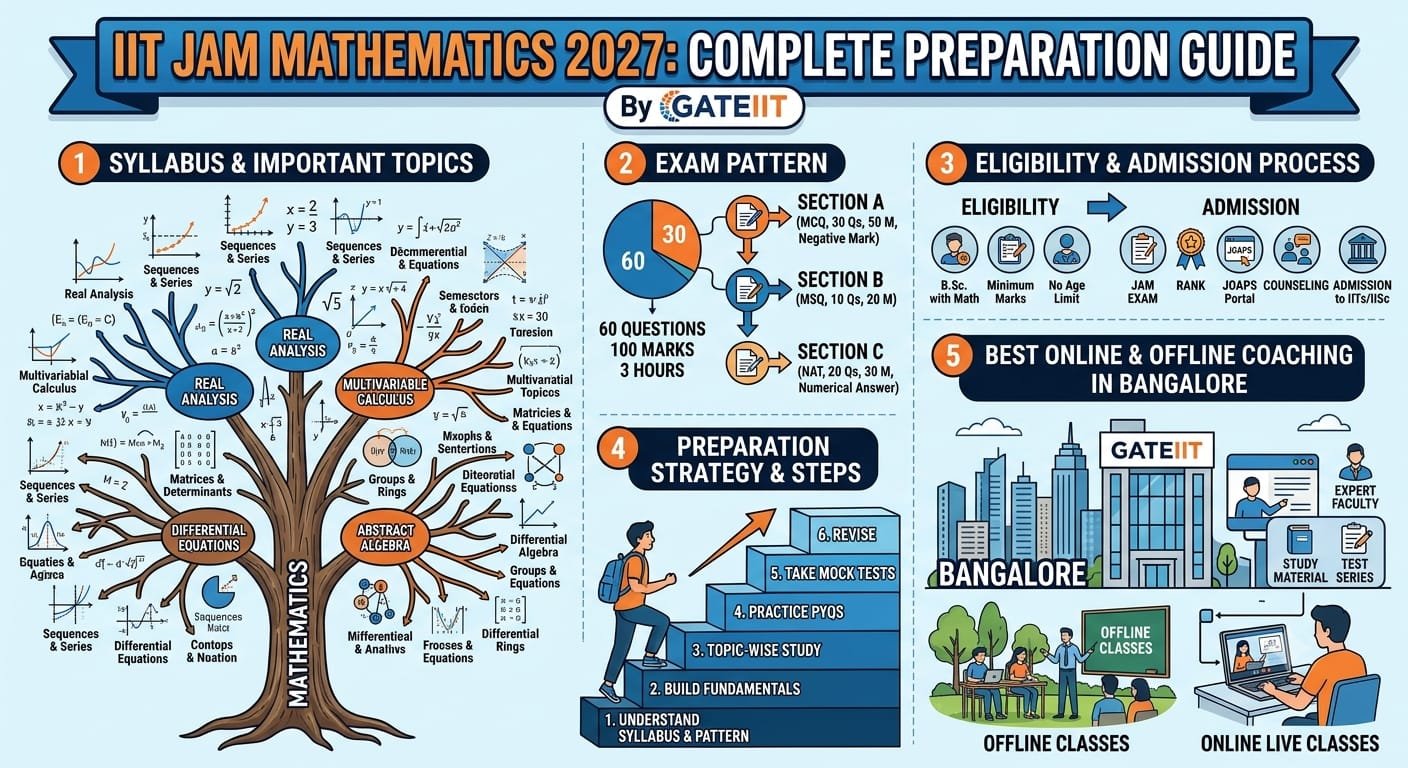
The IIT JAM Mathematics examination is a three-hour Computer-Based Test consisting of 60 questions carrying 100 marks.
The question paper contains three sections.
Section A: Multiple Choice Questions (MCQ)
- Number of questions: 30.
- Questions 1–10: One mark each.
- Questions 11–30: Two marks each.
- Total marks: 50.
- Negative marking: Applicable.
For one-mark MCQs, one-third of a mark is deducted for an incorrect answer.
For two-mark MCQs, two-thirds of a mark is deducted for an incorrect answer.
Each MCQ has one correct option.
Section B: Multiple Select Questions (MSQ)
- Number of questions: 10.
- Each question carries two marks.
- Total marks: 20.
- Negative marking: Not applicable.
One or more options may be correct.
Candidates must select all the correct options to receive marks. There is no negative marking for an incorrect response, but partial marking is not awarded.
Section C: Numerical Answer Type (NAT)
- Number of questions: 20.
- Questions 1–10: One mark each.
- Questions 11–20: Two marks each.
- Total marks: 30.
- Negative marking: Not applicable.
Candidates must enter the numerical answer using the virtual numerical keyboard.
Overall IIT JAM Mathematics Paper Structure
MCQ: 30 questions, 50 marks.
MSQ: 10 questions, 20 marks.
NAT: 20 questions, 30 marks.
Total: 60 questions, 100 marks.
Duration: 180 minutes.
Important Examination Instructions
- The examination is computer-based.
- A virtual calculator is provided.
- Candidates must carry the prescribed admit card and valid photo identification.
- Electronic devices and unauthorised materials are prohibited.
- Candidates must follow the examination-centre instructions.
- The official examination interface and instructions should be reviewed before the examination.
How Should You Approach the Three Sections?
MCQ Strategy: Avoid blind guessing. Since negative marking applies, accuracy is important.
MSQ Strategy: Read every option carefully. A question may contain more than one correct statement.
NAT Strategy: Practise numerical calculations, algebraic simplification and accurate answer entry.
A good candidate should develop a balanced approach rather than concentrating exclusively on one question type.
6. IIT JAM Mathematics Eligibility Criteria 2027
Candidates should check the official eligibility conditions before applying.
Who Can Apply for IIT JAM Mathematics?
Candidates who have completed an undergraduate degree or are appearing in the final examination of their qualifying undergraduate degree in 2027 can apply for JAM 2027.
The examination is open to candidates from different academic backgrounds, subject to the admission requirements of the individual programme and institution.
Is B.Sc. Mathematics Compulsory?
No. A B.Sc. Mathematics degree is not a universal prerequisite for appearing in the JAM Mathematics examination.
However, candidates must independently satisfy the Mathematics programme’s admission requirements.
For example, a particular M.Sc. Mathematics programme may require Mathematics as a subject for a prescribed number of semesters or years.
Therefore, appearing for the examination and qualifying for admission are two different matters.
Is There Any Minimum Percentage Requirement?
There is no universal minimum percentage requirement for appearing in JAM 2027.
However, individual admitting institutions may prescribe their own minimum academic requirements for admission.
Is There Any Age Limit?
There is no age restriction for appearing in JAM 2027.
Is There Any Attempt Limit?
There is no restriction on the number of attempts.
Can Final-Year Students Apply?
Yes. Students appearing in their final undergraduate examination in 2027 may apply, subject to the prescribed conditions.
Can Students with Backlogs Apply?
Yes. Candidates with backlogs are eligible to appear for the examination.
However, they must complete the qualifying degree and satisfy the admitting institute’s requirements within the specified admission timeline.
Can Foreign Nationals Apply?
Yes. JAM 2027 is open to foreign nationals, subject to the applicable examination and admission requirements.
Important: Programme-Specific Eligibility
Candidates should not assume that qualifying JAM Mathematics makes them eligible for every postgraduate programme.
Before selecting an institute, verify:
- Minimum Educational Qualification (MEQ).
- Required undergraduate subjects.
- Minimum duration of Mathematics study, if specified.
- Qualifying degree requirements.
- Required academic documents.
- Category-specific admission provisions.
- Programme-specific admission rules.
7. IIT JAM 2027 Application Fees
The official JAM 2027 application fee structure is as follows.
Female / SC / ST / PwD Candidates
One Test Paper: ₹1,000.
Two Test Papers: ₹1,350.
All Other Candidates
One Test Paper: ₹2,000.
Two Test Papers: ₹2,700.
The application fee is non-refundable and non-transferable.
Additional fees may apply for permitted application changes, such as changing the examination city, test paper, category, gender or date of birth, as prescribed by the official portal.
Payment is accepted through the payment methods specified by JOAPS.
Candidates should verify the fee structure and applicable payment charges on the official website before making any payment.
8. How to Apply for IIT JAM Mathematics
The JAM application process is conducted online through the JAM Online Application Processing System (JOAPS).
The general application process involves:
Step 1: Visit the official IIT JAM website.
Step 2: Open the JOAPS application portal.
Step 3: Complete candidate registration.
Step 4: Enter personal and academic details.
Step 5: Select the Mathematics (MA) test paper.
Step 6: Select the examination city preferences.
Step 7: Upload the prescribed photograph, signature and supporting documents.
Step 8: Review the application carefully.
Step 9: Pay the applicable examination fee.
Step 10: Submit the application and download the confirmation.
Candidates should keep their registration details and application confirmation safely for future reference.
9. IIT JAM Mathematics Admission Process 2027
Qualifying the IIT JAM examination is an important first step. However, candidates must complete the separate admission process to secure a postgraduate seat.
Step 1: Appear for JAM Mathematics
Candidates must appear for the Mathematics paper and obtain a valid examination score.
Step 2: Check the Result
The result is announced by the organising institute.
Candidates should download their scorecard and verify the examination details.
Step 3: Check Admission Eligibility
Shortlist postgraduate programmes based on the prescribed eligibility criteria.
Step 4: Submit the Admission Application
Apply through the relevant official admission portal or admission process applicable to the programme.
Candidates should not assume that merely appearing for JAM automatically completes their admission application.
Step 5: Institute-Wise Selection
Institutions prepare their admission lists based on applicable JAM scores, eligibility conditions, seat availability, category rules and other prescribed criteria.
Step 6: Offer and Document Verification
Candidates who receive admission offers must complete the required formalities within the prescribed timeline.
Step 7: Confirm Admission
Complete fee payment, document verification and any other admission requirements.
Is JAM Qualification Enough to Get Admission?
No.
JAM qualification alone does not guarantee admission, scholarship or employment.
Admission depends on the candidate’s JAM performance, the programme’s eligibility requirements, seat availability and the applicable selection procedure.
10. Postgraduate Courses Available Through IIT JAM
JAM scores are used for admission to various postgraduate programmes offered by participating institutions.
Depending on the institute and the current admission brochure, opportunities may include:
- Sc. Mathematics.
- Sc. Applied Mathematics.
- Joint M.Sc.-Ph.D. programmes.
- Other postgraduate programmes accepting the Mathematics paper.
- Selected interdisciplinary science programmes.
The actual programmes available through the Mathematics paper can vary by institute and admission year.
Candidates should consult the JAM 2027 admission brochure and programme-wise admission tables before preparing their institute preference list.
Which Institutions Participate in JAM 2027?
The JAM 2027 examination website lists 23 participating IITs for the 2027–28 admission cycle.
The participating IITs include:
- IIT Bhilai.
- IIT Bhubaneswar.
- IIT (BHU) Varanasi.
- IIT Bombay.
- IIT Delhi.
- IIT Dharwad.
- IIT Gandhinagar.
- IIT Goa.
- IIT Guwahati.
- IIT Hyderabad.
- IIT Indore.
- IIT (ISM) Dhanbad.
- IIT Jammu.
- IIT Jodhpur.
- IIT Kanpur.
- IIT Kharagpur.
- IIT Madras.
- IIT Mandi.
- IIT Palakkad.
- IIT Patna.
- IIT Roorkee.
- IIT Ropar.
- IIT Tirupati.
The Indian Institute of Science, Bengaluru, is also associated with JAM-based postgraduate admission opportunities. Its programme-wise admission eligibility and process should be checked separately.
The number and type of programmes available through JAM may differ from one institution to another.
11. IIT JAM Mathematics Preparation: Complete Self-Study Guide
Can you crack IIT JAM Mathematics through self-study?
Yes. It is possible to prepare for IIT JAM Mathematics through self-study with a disciplined timetable, appropriate books, previous-year questions, regular mock examinations and consistent revision.
However, self-study requires planning and the ability to identify conceptual gaps independently.
Students who lack a structured preparation approach may spend too much time studying theory without developing sufficient examination-oriented problem-solving ability.
The following preparation framework can help.
Phase 1: Understand the Syllabus
Start by downloading the official JAM Mathematics syllabus.
Divide it into six major units:
- Real Analysis.
- Multivariable Calculus.
- Differential Equations.
- Linear Algebra.
- Abstract Algebra.
- Vector Calculus.
Prepare a topic checklist and identify your current understanding of every chapter.
Phase 2: Build Strong Fundamentals
Begin with undergraduate-level textbooks and classroom notes.
Do not rush through the fundamentals.
For every topic, understand:
- Important theorems.
- Conditions and assumptions.
- Standard examples.
- Common problem-solving methods.
Phase 3: Solve Standard Problems
After completing a topic, solve progressively difficult problems.
Start with basic questions and move towards examination-level questions.
Avoid immediately looking at solutions.
Try to solve problems independently before checking the answer.
Phase 4: Practise Previous-Year Questions
Previous-year questions are essential for understanding the actual examination standard.
They help candidates identify:
- Frequently tested concepts.
- Important mathematical techniques.
- Typical MCQ structures.
- MSQ reasoning requirements.
- NAT calculation patterns.
- Time-consuming topics.
- Common conceptual mistakes.
Practise previous-year questions topic-wise before attempting complete papers.
Phase 5: Take Regular Mock Tests
Mock tests should become an integral part of preparation.
Begin with topic-wise tests.
Progress to unit-wise examinations.
Finally, attempt complete three-hour mock tests under examination conditions.
Phase 6: Analyse Every Test
Taking a mock test without analysing it provides limited value.
After each test, identify:
- Incorrect answers.
- Questions left unanswered.
- Conceptual gaps.
- Calculation errors.
- Time-management problems.
- Incorrect assumptions.
- Topics requiring revision.
Maintain a mistake notebook and revise it regularly.
Phase 7: Revision and Score Improvement
During the final preparation period, focus on:
- Theorem revision.
- Formula revision.
- Important definitions.
- Previous-year questions.
- Difficult concepts.
- Mock test analysis.
- Accuracy and speed.
Avoid beginning too many new resources during the final weeks.
12. IIT JAM Mathematics: Recommended Books and Study Resources
Selecting appropriate books is important, but collecting too many books can create unnecessary confusion.
Students should select a limited number of standard resources and complete them thoroughly.
The following are commonly used undergraduate-level references for the relevant mathematical subjects. They are supplementary learning resources, not a substitute for the official JAM syllabus.
Real Analysis
- Principles of Mathematical Analysis – Walter Rudin.
- Mathematical Analysis – S.C. Malik and Savita Arora.
- Introduction to Real Analysis – Robert G. Bartle and Donald R. Sherbert.
Linear Algebra
- Linear Algebra and Its Applications – Gilbert Strang.
- Introduction to Linear Algebra – Serge Lang.
- Linear Algebra – K. Hoffman and R. Kunze.
Abstract Algebra
- Contemporary Abstract Algebra – Joseph A. Gallian.
- Topics in Algebra – I.N. Herstein.
- A First Course in Abstract Algebra – John B. Fraleigh.
Differential Equations
- Elementary Differential Equations – William E. Boyce and Richard C. DiPrima.
- Differential Equations – M.D. Raisinghania.
Multivariable Calculus
- Calculus – James Stewart.
- Advanced Engineering Mathematics – Erwin Kreyszig.
- Calculus – Tom M. Apostol.
Vector Calculus
- Calculus – James Stewart.
- Vector Analysis – Murray R. Spiegel.
Additional Study Material
Candidates should also use:
- Official IIT JAM previous-year question papers.
- Official answer keys.
- Official mock test interface, when available.
- Topic-wise practice worksheets.
- Chapter-wise revision notes.
- Formula sheets.
- Full-length mock examinations.
A student does not need to complete every reference book listed above. The objective is to master the prescribed syllabus and develop examination-level problem-solving skills.
13. IIT JAM Mathematics: 12-Month Preparation Strategy
A one-year preparation programme is suitable for students who want to develop their mathematical foundations gradually while balancing undergraduate studies.
Months 1 and 2: Foundation Building
Focus on:
- Basic mathematical reasoning.
- Functions and limits.
- Sequences and series.
- Fundamental calculus.
- Matrices and determinants.
- Undergraduate mathematical definitions.
Target: Establish a strong foundation.
Months 3 and 4: Linear Algebra
Focus on:
- Vector spaces.
- Basis and dimension.
- Linear transformations.
- Rank and nullity.
- Eigenvalues and eigenvectors.
Target: Complete the core Linear Algebra topics and begin topic-wise testing.
Months 5 and 6: Real Analysis
Focus on:
- Mean Value Theorems.
- Taylor’s theorem.
Target: Improve theoretical understanding and theorem-based problem-solving.
Months 7 and 8: Abstract Algebra
Focus on:
- Cyclic groups.
- Permutation groups.
- Normal subgroups.
- Rings and fields.
Target: Develop logical reasoning and conceptual clarity.
Months 9 and 10: Remaining Syllabus
Focus on:
- Multivariable Calculus.
- Differential Equations.
- Vector Calculus.
Target: Complete the syllabus and begin comprehensive revision.
Month 11: Previous-Year Papers and Mock Tests
- Solve previous-year papers.
- Attempt full-length mock tests.
- Identify weak areas.
- Revise important theorems.
- Improve accuracy and speed.
Month 12: Final Examination Preparation
- Complete multiple revision cycles.
- Practise full-length papers.
- Analyse mock examinations.
- Improve question selection.
- Revise the mistake notebook.
- Maintain a consistent examination routine.
The exact schedule should be adjusted according to the student’s existing mathematical knowledge and the time remaining before the examination.
14. IIT JAM Mathematics: 90-Day Preparation Strategy
A 90-day programme is appropriate for students who already possess reasonable undergraduate-level mathematical fundamentals.
Days 1–15: Linear Algebra
- Matrices and determinants.
- Vector spaces.
- Linear transformations.
- Rank and nullity.
- Eigenvalues and eigenvectors.
Days 16–30: Real Analysis
- Sequences and series.
- Mean Value Theorems.
Days 31–45: Abstract Algebra
- Cyclic groups.
- Normal subgroups.
- Rings and fields.
Days 46–60: Calculus and Differential Equations
- Multivariable functions.
- Partial derivatives.
- Maxima and minima.
- Multiple integrals.
- Ordinary differential equations.
Days 61–70: Vector Calculus and Remaining Topics
- Line integrals.
- Surface integrals.
- Integral theorems.
Days 71–80: Previous-Year Questions
- Topic-wise question practice.
- Mixed-topic assignments.
- MCQ, MSQ and NAT practice.
- Weak-area improvement.
Days 81–90: Final Revision
- Full-length mock tests.
- Time management.
- Accuracy improvement.
- Formula revision.
- Theorem revision.
- Final performance analysis.
This is an intensive schedule. Students with weak fundamentals should consider a longer preparation period rather than attempting to complete the entire syllabus superficially.
15. IIT JAM Mathematics: 60-Day Crash Preparation Plan
A 60-day crash course is suitable for students who have already studied most of the syllabus and need structured revision and examination-oriented practice.
Suggested distribution:
Days 1–10: Linear Algebra.
Days 11–20: Real Analysis.
Days 21–30: Abstract Algebra.
Days 31–40: Multivariable Calculus and Differential Equations.
Days 41–45: Vector Calculus.
Days 46–52: Previous-year questions and mixed-topic practice.
Days 53–60: Mock tests, revision and performance improvement.
Students should complete diagnostic assessments before joining an intensive programme so that the teaching schedule can be adjusted to their actual preparation level.
16. IIT JAM Mathematics: 45-Day Revision Programme
A 45-day programme is designed for candidates who have already completed a significant portion of the syllabus.
The primary objectives are:
- Strengthening important concepts.
- Revising mathematical theorems.
- Improving problem-solving speed.
- Practising previous-year questions.
- Improving MCQ accuracy.
- Understanding MSQ logic.
- Improving NAT calculation accuracy.
- Taking regular mock examinations.
The programme should prioritise high-impact topics based on the student’s diagnostic performance rather than assuming that every candidate has identical weaknesses.
17. IIT JAM Mathematics: 30-Day Intensive Score Booster Programme
A 30-day intensive programme is suitable for students who have completed their syllabus and need focused revision.
It should not be considered a substitute for a complete one-year foundation course.
The programme can include:
- Intensive concept revision.
- Important theorem discussions.
- Formula revision.
- Selected previous-year questions.
- Topic-wise practice.
- Mixed-question assignments.
- Full-length mock examinations.
- One-to-one doubt-clearing support.
- Individual performance analysis.
The objective is to help students reduce avoidable mistakes, improve examination confidence and make better use of their remaining preparation time.
18. IIT JAM Mathematics Coaching in Bangalore by GATEIIT
Looking for IIT JAM Mathematics coaching in Bangalore with personalised attention, expert academic guidance and flexible learning options?
GATEIIT offers structured IIT JAM Mathematics preparation programmes for undergraduate students, graduates, repeat aspirants and candidates targeting postgraduate admission at IITs and other participating institutions.
Located in JP Nagar, Bangalore, GATEIIT provides offline classroom coaching at its Bangalore centre and online classes for students throughout India.
Students can choose a suitable learning programme according to their academic background, preparation level, schedule and target examination.
Why Choose GATEIIT for IIT JAM Mathematics Preparation?
IIT JAM Mathematics requires a strong understanding of mathematical concepts, consistent practice and a structured examination strategy.
GATEIIT’s preparation approach focuses on the following areas:
- Concept-Based Teaching
Mathematical concepts are explained systematically, with attention to definitions, theorems, properties and their applications.
- Personal Attention
Students receive focused academic attention to help identify conceptual difficulties and improve their understanding.
- Personal Mentorship
Individual academic guidance helps students plan their preparation and monitor progress.
- Personalised and Customised Learning
The course schedule can be adapted according to the student’s existing knowledge, target examination and remaining preparation time.
- One-to-One Doubt Clearing
Students can receive individual doubt-clearing support to address difficult concepts and problem-solving issues.
- Previous-Year Question Practice
Previous-year questions help students understand examination-level difficulty and improve familiarity with different question formats.
- Regular Mock Tests
Practice examinations help students improve time management, accuracy and examination readiness.
- Performance Analysis
Students can review their performance and identify areas requiring additional attention.
- Online Study Resources
Digital learning resources and study material support preparation outside classroom hours.
- Flexible Learning Options
Students can choose regular, weekend, online, offline or hybrid learning arrangements, depending on batch availability.
19. GATEIIT IIT JAM Mathematics Courses: Long-Term and Short-Term Programmes
GATEIIT offers different IIT JAM Mathematics preparation options to accommodate students with different preparation timelines.
A. One-Year IIT JAM Mathematics Coaching Programme
<PRIVATE_PERSON>Designed for students who want to build their mathematical fundamentals and prepare systematically over a longer period.
The one-year programme can cover:
- Complete syllabus coverage.
- Conceptual foundation building.
- Detailed topic-wise teaching.
- Mathematical theorem understanding.
- Regular assignments.
- Previous-year question practice.
- Topic-wise tests.
- Unit-wise assessments.
- Full-length mock examinations.
- Revision sessions.
- Personal mentorship.
- Doubt-clearing support.
This programme is particularly suitable for students beginning their preparation early.
B. 90-Day IIT JAM Mathematics Crash Course
Suitable for candidates who have some prior knowledge of the syllabus and need structured preparation.
Features may include:
- Intensive syllabus revision.
- Important concepts.
- Selected theorem discussions.
- Topic-wise problem-solving.
- Previous-year question practice.
- Mock tests.
- Performance analysis.
- Individual doubt-clearing support.
C. 60-Day IIT JAM Mathematics Crash Course
Designed for students who need a shorter and more intensive preparation programme.
The course focuses on essential concept revision, question-solving techniques, practice examinations and score improvement.
D. 45-Day IIT JAM Mathematics Crash Course
A focused revision programme for students who have already studied most of the syllabus.
E. 30-Day IIT JAM Mathematics Crash Course
An intensive last-mile preparation programme focusing on revision, selected practice questions, mock examinations and individual doubt clearing.
Available Course Durations
- 1-Year Regular Preparation Programme.
- 90-Day Crash Course.
- 60-Day Crash Course.
- 45-Day Crash Course.
- 30-Day Crash Course.
Course commencement dates and batch availability should be confirmed with the GATEIIT academic team.
20. IIT JAM Mathematics Coaching: Online, Offline and Hybrid Classes
GATEIIT provides flexible learning options for students from Bangalore and other parts of India.
Online IIT JAM Mathematics Coaching Across India
Students from different cities and states can join online IIT JAM Mathematics preparation programmes.
Online classes can provide:
- Live teaching sessions.
- Digital study material.
- Online practice tests.
- Doubt-clearing support.
- Recorded class access, where included in the selected programme.
- Online academic guidance.
- Flexible learning arrangements.
Students do not need to relocate to Bangalore to access GATEIIT’s online learning programmes.
Offline IIT JAM Mathematics Coaching in Bangalore
Students who prefer classroom learning can attend offline classes at the GATEIIT Bangalore centre.
The centre provides a learning environment where students can interact directly with faculty, discuss problems and seek academic guidance.
GATEIIT Bangalore Centre Address:
GATEIIT – Gate Indian Institute of Tutorials
3rd Floor, #1743, Sri Raghavendra Plaza,
17th Main Road, JP Nagar 2nd Phase,
Bangalore – 560078, Karnataka, India.
Hybrid IIT JAM Mathematics Coaching
Students can explore hybrid learning options combining classroom teaching and online learning resources, subject to the selected programme.
This is useful for students who require flexibility because of college schedules, travel or other academic commitments.
21. Regular and Weekend IIT JAM Mathematics Batches
Students may have different academic and personal schedules.
To accommodate these requirements, GATEIIT offers regular and weekend learning options, subject to batch availability.
Regular Batches
Suitable for students who can attend classes consistently during weekdays.
Weekend Batches
Suitable for undergraduate students who have college commitments during the week.
Flexible Personal Mentorship
Students requiring a customised schedule can enquire about individual learning arrangements.
The availability of specific batch timings, class frequency and teaching modes should be confirmed before enrolment.
22. IIT JAM Mathematics Coaching Fees at GATEIIT
GATEIIT offers short-term IIT JAM Mathematics crash course options with indicative programme fees starting from ₹5,000 and extending up to ₹20,000, depending on the selected course duration and programme structure.
Indicative Crash Course Fee Structure
30-Day Crash Course: ₹5,000 onwards.
45-Day Crash Course: As per selected programme.
60-Day Crash Course: As per selected programme.
90-Day Crash Course: Up to ₹20,000, depending on programme selection.
The final fee depends on the course duration, learning mode, class structure, mentorship requirements and applicable offers.
One-year regular coaching fees are communicated separately based on the selected programme.
Important: The above is an indicative fee range for short-term programmes, not a guaranteed fixed price for every batch or learning option. Confirm the current fee, inclusions and payment terms directly with GATEIIT.
23. IIT JAM Mathematics Scholarship: Up to 100% Fee Discount
GATEIIT provides scholarship opportunities for eligible students through its scholarship assessment process.
Students can qualify for fee discounts of up to 100%, depending on their scholarship test performance and applicable scholarship conditions.
How Does the Scholarship Work?
- Register for the GATEIIT scholarship assessment.
- Attend the prescribed scholarship test.
- Obtain the assessment result.
- Check the applicable scholarship percentage.
- Select the eligible IIT JAM Mathematics programme.
- Complete admission formalities.
Who Can Apply?
Students interested in IIT JAM Mathematics preparation can enquire about scholarship eligibility.
The scholarship percentage depends on the assessment score and applicable conditions.
A 100% scholarship is the maximum advertised possible fee discount, not an automatic entitlement for every applicant.
Candidates should request written confirmation of the scholarship amount, validity, applicable course and any exclusions before making payment.
24. GATEIIT Score Booster Programme for IIT JAM Mathematics
A good examination score requires more than syllabus completion.
Students must understand how to apply concepts accurately, manage examination time and select questions strategically.
GATEIIT’s Score Booster Programme is designed to provide focused examination-oriented preparation.
What Does the Score Booster Programme Include?
- Important concept revision.
- Topic-wise question practice.
- Previous-year question discussions.
- MCQ-solving strategies.
- MSQ analytical practice.
- NAT numerical problem-solving.
- Mock examination practice.
- Mistake analysis.
- Speed and accuracy improvement.
- Personalised academic guidance.
- Individual doubt-clearing support.
Who Should Join?
The programme can be useful for:
- Students who have completed most of the syllabus.
- Students preparing for a second attempt.
- Students who are unable to convert their conceptual knowledge into examination marks.
- Candidates who need structured revision.
- Students looking to improve accuracy and time management.
The programme should be customised according to the candidate’s diagnostic performance rather than relying on unrealistic score guarantees.
25. Additional Learning Benefits and Free Add-Ons
Depending on the selected GATEIIT programme and current batch inclusions, students may receive additional academic resources.
These may include:
- Online learning application access.
- Digital study material.
- Practice worksheets.
- Topic-wise assignments.
- Previous-year question collections.
- Online tests.
- Mock examination access.
- Formula revision resources.
- Recorded class access, where applicable.
- Academic progress guidance.
- Doubt-clearing support.
- Revision sessions.
- Selected supplementary learning resources.
The exact complimentary benefits and their duration should be confirmed before enrolment.
26. How to Select the Right IIT JAM Mathematics Coaching Programme
Choosing the correct course duration is important.
A student beginning preparation during the first or second year of undergraduate study may benefit from a one-year programme or a longer structured learning plan.
A student who has already studied the syllabus may require a 90-day or 60-day crash course.
A candidate who has completed the syllabus and needs only revision may benefit from a 45-day or 30-day score booster programme.
Suggested Course Selection
For Beginners: One-year long-term preparation.
For Students with Basic Knowledge: 90-day structured crash course.
For Students with Substantial Syllabus Coverage: 60-day intensive programme.
For Students Requiring Revision: 45-day revision programme.
For Students Preparing for the Final Examination: 30-day score booster programme.
Before joining, students should assess their current preparation level, remaining syllabus, available study hours and individual learning requirements.
27. Common Mistakes to Avoid in IIT JAM Mathematics Preparation
Many students work hard but fail to achieve their expected examination performance because of avoidable mistakes.
Mistake 1: Memorising Without Understanding
Mathematics requires conceptual understanding. Memorising formulas without understanding their applications creates difficulties when questions are presented differently.
Mistake 2: Ignoring Theorems
Real Analysis and Abstract Algebra require a clear understanding of mathematical theorems and their assumptions.
Mistake 3: Studying Too Many Books
Collecting multiple books without completing any of them is inefficient.
Choose a limited number of reliable resources.
Mistake 4: Avoiding Previous-Year Questions
Previous-year questions provide valuable information about examination standards.
Start practising them after completing the relevant concepts.
Mistake 5: Ignoring MSQ Questions
Students should develop the ability to evaluate every option independently.
Mistake 6: Poor Time Management
Spending too much time on one difficult problem can affect the overall paper.
Mistake 7: Not Analysing Mock Tests
Mock tests should be followed by detailed analysis.
Mistake 8: Ignoring Revision
Mathematical concepts and techniques need repeated practice.
Mistake 9: Blind Guessing in MCQs
Negative marking makes random guessing risky.
Mistake 10: Ignoring Admission Eligibility
A good JAM rank does not automatically make a candidate eligible for every M.Sc. programme.
Always verify programme-specific requirements.
28. IIT JAM Mathematics: Career Opportunities After M.Sc.
An M.Sc. Mathematics qualification can open several academic, research and professional pathways, depending on the institution, curriculum, skills and additional qualifications.
Academic and Research Careers
- Mathematics research.
- D. programmes.
- Research assistant positions.
- Academic teaching.
- Scientific research.
- Mathematical modelling.
Technical and Analytical Careers
- Quantitative analysis.
- Data analytics.
- Scientific computing.
- Mathematical modelling.
- Operations research.
- Computational mathematics.
- Financial mathematics.
- Statistical and analytical roles, subject to relevant additional skills.
Government and Competitive Opportunities
Postgraduate mathematics students may also explore eligible examinations and recruitment opportunities in teaching, research and government organisations.
Eligibility depends on the specific examination and recruitment notification.
Is M.Sc. Mathematics Useful for Data Science?
Yes, mathematical foundations can be valuable for data science, machine learning and quantitative computing.
However, candidates should also develop practical skills in programming, statistics, probability, algorithms and relevant software tools.
An M.Sc. Mathematics degree by itself does not guarantee a data science job.
29. Why Start IIT JAM Mathematics Preparation Early?
Starting early provides several advantages.
Students get sufficient time to understand mathematical fundamentals and practise difficult concepts.
A longer preparation period also allows candidates to balance their undergraduate coursework with competitive examination preparation.
Early preparation helps with:
- Better syllabus coverage.
- Stronger conceptual understanding.
- More revision cycles.
- Extensive question practice.
- Improved problem-solving ability.
- Better mock test performance.
- Reduced last-minute pressure.
Students who begin early should not rush through the syllabus. A consistent preparation routine is more useful than irregular periods of intensive study.
30. Enrol for IIT JAM Mathematics Coaching at GATEIIT, Bangalore
Are you looking for IIT JAM Mathematics coaching with online classes across India and offline classroom learning in Bangalore?
GATEIIT offers flexible preparation options for students targeting IIT JAM Mathematics 2027 and future examination cycles.
Choose from:
- One-year long-term coaching.
- 90-day crash course.
- 60-day crash course.
- 45-day crash course.
- 30-day crash course.
- Regular weekday classes.
- Weekend batches.
- Online coaching throughout India.
- Offline coaching at the Bangalore centre.
- Hybrid learning programmes.
- Personal mentorship.
- One-to-one doubt clearing.
- Score Booster Programme.
- Scholarship opportunities up to 100% fee discount.
Why Enquire Early?
The examination requires consistent preparation and a well-planned revision schedule.
Joining an appropriate programme early can help students organise their preparation, identify weak areas and receive structured academic support.
Students should enquire about available batches, course duration, class schedules, fees, scholarship opportunities and learning resources before enrolling.
Contact GATEIIT
GATEIIT – Gate Indian Institute of Tutorials
Address:
3rd Floor, #1743, Sri Raghavendra Plaza,
17th Main Road, JP Nagar 2nd Phase,
Bangalore – 560078, Karnataka, India.
Phone: 8884416154 / 8884416155
Website: https://www.gateiit.com/
Google Maps / Location:
https://maps.app.goo.gl/MtzbVkqywCkwKcc4A
Enquire Today for IIT JAM Mathematics 2027 Coaching, Crash Courses and Scholarship Opportunities.
31. Frequently Asked Questions (FAQs) About IIT JAM Mathematics 2027
1. What is IIT JAM Mathematics?
IIT JAM Mathematics is a national-level postgraduate entrance examination conducted for admission to eligible M.Sc. and other postgraduate programmes offered by participating institutions.
2. What is the subject code for IIT JAM Mathematics?
The subject code for Mathematics is MA.
3. Who is conducting IIT JAM 2027?
IIT JAM 2027 is organised by the Indian Institute of Technology Kharagpur.
4. When will IIT JAM Mathematics 2027 be conducted?
The examination is scheduled for 14 February 2027.
5. What is the examination timing for IIT JAM Mathematics 2027?
The Mathematics paper is scheduled from 9:30 AM to 12:30 PM in the forenoon session.
6. What is the duration of IIT JAM Mathematics?
The examination duration is three hours.
7. What is the maximum mark for IIT JAM Mathematics?
The Mathematics paper carries 100 marks.
8. How many questions are there in IIT JAM Mathematics?
There are 60 questions divided into three sections: MCQ, MSQ and NAT.
9. Is IIT JAM Mathematics conducted online or offline?
It is conducted as a Computer-Based Test at designated examination centres.
10. What are the subjects included in the IIT JAM Mathematics syllabus?
The six major syllabus areas are Real Analysis, Multivariable Calculus, Differential Equations, Linear Algebra, Abstract Algebra and Vector Calculus.
11. Is Real Analysis important for IIT JAM Mathematics?
Yes. Real Analysis is an important part of the syllabus and requires a strong understanding of sequences, series, limits, continuity and differentiability.
12. Is Linear Algebra important for IIT JAM Mathematics?
Yes. Candidates should prepare matrices, vector spaces, linear transformations, eigenvalues, eigenvectors and related concepts thoroughly.
13. Is Abstract Algebra included in IIT JAM Mathematics?
Yes. The syllabus includes groups, subgroups, cyclic groups, homomorphisms, rings and fields.
14. Is there negative marking in IIT JAM Mathematics?
Yes. Negative marking applies to incorrect MCQ answers. There is no negative marking for MSQ and NAT questions.
15. Is there negative marking for MSQ questions?
No. MSQ questions do not carry negative marking. However, partial marking is not awarded.
16. Is there negative marking for NAT questions?
No. NAT questions do not carry negative marking.
17. Is a calculator allowed in IIT JAM Mathematics?
A virtual calculator is provided in the computer-based examination interface. Personal calculators are not permitted.
18. Can B.Sc. Mathematics students apply for IIT JAM?
Yes. B.Sc. Mathematics students can apply, subject to the general examination requirements.
19. Can B.Sc. Physics students apply for IIT JAM Mathematics?
They may appear for the Mathematics paper if they satisfy the general eligibility conditions. However, admission eligibility depends on the Mathematics requirements of the individual postgraduate programme.
20. Can B.Sc. Statistics students apply for IIT JAM Mathematics?
Yes, they may apply for the examination subject to the general requirements. They must separately verify the admission eligibility of their target programmes.
21. Is there any minimum percentage required for IIT JAM 2027?
There is no universal minimum percentage requirement for appearing in JAM 2027. Individual institutes may prescribe their own admission requirements.
22. Is there an age limit for IIT JAM Mathematics?
No. There is no age limit for appearing in JAM 2027.
23. How many attempts are allowed in IIT JAM?
There is no restriction on the number of attempts.
24. Can final-year students apply for IIT JAM 2027?
Yes. Candidates appearing in their final qualifying degree examination in 2027 may apply, subject to the official conditions.
25. Can candidates with backlogs appear for IIT JAM?
Yes. Candidates with backlogs can appear for JAM. They must fulfil the qualifying degree requirements by the relevant admission deadline.
26. What is the application fee for IIT JAM 2027?
The fee is ₹1,000 for one paper and ₹1,350 for two papers for Female/SC/ST/PwD candidates. For all other candidates, it is ₹2,000 for one paper and ₹2,700 for two papers.
27. When did IIT JAM 2027 registration close?
The official portal announced 24 October 2026 as the extended final application deadline.
28. When will the IIT JAM 2027 result be announced?
The announced result date is 18 March 2027.
29. Does qualifying IIT JAM guarantee admission to an IIT?
No. Admission depends on the JAM score, programme-specific eligibility, seat availability and the applicable admission procedure.
30. How many IITs are participating in JAM 2027?
The JAM 2027 official website lists 23 participating IITs for the 2027–28 academic session.
31. Can I get admission to IISc through IIT JAM Mathematics?
IISc offers certain postgraduate admission opportunities associated with JAM. Candidates must check the specific programme’s admission requirements and the applicable 2027 admission process.
32. Is IIT JAM Mathematics difficult?
The examination can be challenging because it tests conceptual understanding, analytical reasoning and mathematical problem-solving. Difficulty varies with the candidate’s preparation and mathematical background.
33. Can I crack IIT JAM Mathematics through self-study?
Yes. Self-study can be effective with a complete syllabus plan, standard textbooks, previous-year papers, mock tests and regular revision.
34. How many months are required to prepare for IIT JAM Mathematics?
Preparation time varies. Students with strong mathematical fundamentals may prepare in three to six months, while beginners may benefit from a one-year or longer preparation schedule.
35. Which books are best for IIT JAM Mathematics?
Commonly used references include books by Walter Rudin, Bartle and Sherbert, Gilbert Strang, Hoffman and Kunze, Gallian, Herstein and Boyce and DiPrima. Students should select books according to the official syllabus.
36. Are previous-year questions important for IIT JAM Mathematics?
Yes. They help students understand the examination standard, question formats and application of concepts.
37. Are mock tests necessary for IIT JAM Mathematics?
Yes. Mock tests help candidates improve time management, question selection, accuracy and examination confidence.
38. Can I prepare for IIT JAM Mathematics while studying B.Sc.?
Yes. A structured long-term preparation programme can help students balance their undergraduate curriculum with JAM preparation.
39. Does GATEIIT provide IIT JAM Mathematics coaching in Bangalore?
Yes. GATEIIT offers offline IIT JAM Mathematics coaching at its JP Nagar 2nd Phase centre in Bangalore, subject to batch availability.
40. Does GATEIIT provide online IIT JAM Mathematics coaching throughout India?
Yes. Students from different parts of India can enquire about GATEIIT’s online learning programmes.
41. Does GATEIIT offer a one-year IIT JAM Mathematics course?
Yes. A one-year long-term preparation programme is available for students seeking structured syllabus coverage and extended preparation.
42. Does GATEIIT offer IIT JAM Mathematics crash courses?
Yes. GATEIIT offers short-term preparation options of 30, 45, 60 and 90 days, subject to batch availability.
43. What is the fee for IIT JAM Mathematics crash courses at GATEIIT?
The advertised indicative fee range starts from ₹5,000 and extends up to ₹20,000, depending on the course duration and selected programme.
44. Does GATEIIT provide weekend IIT JAM Mathematics classes?
Weekend learning options are available, subject to batch schedules and availability.
45. Does GATEIIT provide personal mentorship?
Yes. Personal mentorship and individual academic guidance are among the learning support options offered through selected programmes.
46. Does GATEIIT provide one-to-one doubt-clearing sessions?
One-to-one doubt-clearing support can be explored according to the selected programme and its academic arrangements.
47. Does GATEIIT offer scholarships for IIT JAM Mathematics coaching?
Yes. Students can enquire about scholarship opportunities offering fee discounts of up to 100%, depending on their scholarship assessment performance and applicable conditions.
48. What is the GATEIIT Score Booster Programme?
It is an examination-oriented preparation option focusing on concept revision, previous-year questions, mock tests, performance analysis and improvement of accuracy and speed.
49. Does GATEIIT provide online study material and test access?
Selected programmes may include digital study material, application access, practice tests and other supplementary learning resources. Confirm the inclusions before admission.
50. How can I join GATEIIT IIT JAM Mathematics coaching?
You can contact GATEIIT at 8884416154 or 8884416155, visit the JP Nagar 2nd Phase centre in Bangalore, or enquire through https://www.gateiit.com/ for information about available online and offline batches.
Final Words: Prepare Smartly for IIT JAM Mathematics 2027 with GATEIIT
IIT JAM Mathematics is an important opportunity for students who want to pursue advanced mathematical education at India’s premier institutions.
Success requires a combination of conceptual clarity, systematic syllabus coverage, regular problem-solving, previous-year question practice, mock examinations and consistent revision.
Students should avoid depending entirely on memorisation or last-minute preparation. Instead, they should develop a structured learning routine that addresses both mathematical fundamentals and examination-specific requirements.
Whether you are looking for a one-year preparation programme, a 90-day crash course, a 60-day intensive revision programme, a 45-day revision course or a 30-day score booster programme, selecting the right learning approach can make your preparation more organised.
GATEIIT welcomes IIT JAM Mathematics aspirants from Bangalore and across India through its offline, online and hybrid learning programmes.
With personalised academic attention, mentorship, customised preparation options, doubt-clearing support, practice tests and scholarship opportunities, GATEIIT aims to support students throughout their IIT JAM Mathematics preparation journey.
Start your IIT JAM Mathematics 2027 preparation with a clear plan, consistent practice and the right academic guidance.
GATEIIT – Gate Indian Institute of Tutorials
JP Nagar 2nd Phase, Bangalore – 560078.
Contact: 8884416154 / 8884416155
Website: www.gateiit.com
Google Maps: https://maps.app.goo.gl/MtzbVkqywCkwKcc4A
Enquire Now for IIT JAM Mathematics 2027 Long-Term Coaching, Crash Courses, Online Classes, Offline Batches and Scholarship Opportunities.
Official External Reference Links
IIT JAM 2027 Official Website: https://jam.iitkgp.ac.in/
IIT JAM 2027 Syllabus and Test Pattern: https://jam.iitkgp.ac.in/syllabus.html
IIT JAM 2027 Eligibility: https://jam.iitkgp.ac.in/exam-eligibilityreq.html
IIT JAM 2027 Examination Schedule: https://jam.iitkgp.ac.in/test-schedule.html
IIT JAM 2027 Application Fees: https://jam.iitkgp.ac.in/appfees.html
IIT JAM 2027 Frequently Asked Questions: https://jam.iitkgp.ac.in/faq.html
IIT JAM 2027 Admission and Programme Information: Check the latest official admission brochure and institute-specific admission portals.
Content accuracy note: Official dates, fees, syllabus, admission requirements and course availability should be reviewed whenever the relevant authority publishes a new notification. GATEIIT course fees and scholarship conditions should also be reconfirmed before publishing any promotional offer.