Are you preparing for IIT JAM Physics 2027 and looking for a structured preparation strategy, complete syllabus, reliable study material, previous-year question papers, mock tests and expert guidance to secure admission to an IIT or another reputed institution?
The Joint Admission Test for Masters (IIT JAM) is one of India’s important national-level entrance examinations for students aspiring to pursue postgraduate education in Physics and other science disciplines. A good JAM Physics score can open opportunities to study M.Sc., Joint M.Sc.-Ph.D. and other postgraduate programmes offered by participating IITs and institutions accepting JAM scores.
Preparing for IIT JAM Physics requires considerably more than memorising formulas. Students must develop conceptual clarity, mathematical problem-solving ability, numerical accuracy, analytical thinking and the ability to apply undergraduate Physics concepts to unfamiliar problems.
This comprehensive guide covers everything an IIT JAM Physics aspirant should know, including:
- IIT JAM Physics 2027 examination details and latest updates.
- Conducting institute, important dates and examination schedule.
- Eligibility criteria and application fees.
- Complete IIT JAM Physics syllabus.
- Section-wise examination pattern and marking scheme.
- Topic-wise preparation strategy.
- Best books and recommended study resources.
- Previous-year question paper analysis and mock-test strategy.
- 12-month, 6-month, 3-month and 30-day preparation plans.
- IIT JAM Physics admission process and participating institutes.
- Career opportunities after M.Sc. Physics.
- Online and offline IIT JAM Physics coaching by GATEIIT.
- One-year long-term courses and 30, 45, 60 and 90-day crash courses.
- Personal mentorship, one-to-one doubt clearing, score booster programmes and scholarship opportunities.
- 50 important frequently asked questions.
Whether you are a B.Sc. Physics student, a final-year undergraduate, a graduate preparing for postgraduate admissions, or a repeater looking to improve your previous performance, this guide will help you understand the examination and plan your preparation effectively.
1. WHAT IS IIT JAM PHYSICS?
IIT JAM stands for Joint Admission Test for Masters. It is a national-level entrance examination conducted by one of the Indian Institutes of Technology on behalf of participating institutions.
The Physics paper, commonly identified by the paper code PH, evaluates a candidate’s understanding of fundamental and advanced undergraduate-level Physics.
The examination is intended for students seeking admission to postgraduate science programmes through JAM scores.
The Physics paper covers major undergraduate subjects such as:
- Mathematical Physics.
- Mechanics and General Properties of Matter.
- Oscillations, Waves and Optics.
- Electricity and Magnetism.
- Kinetic Theory and Thermodynamics.
- Modern Physics.
- Solid State Physics, Devices and Electronics.
The examination tests the candidate’s ability to understand physical principles, interpret mathematical expressions, solve numerical problems and apply concepts logically.
Why is IIT JAM Physics important?
- It provides an admission pathway to postgraduate programmes at participating IITs.
- JAM scores are also accepted by certain other institutions for specified programmes.
- It offers opportunities to pursue advanced studies and research in Physics.
- It provides a foundation for careers in scientific research, teaching, technology and interdisciplinary sciences.
- It helps students develop the academic background needed for future research examinations and doctoral programmes.
Qualifying in JAM does not automatically guarantee admission. Admission depends on the programme-specific eligibility requirements, merit, seat availability, reservation policies and the applicable admission process.
2. IIT JAM PHYSICS 2027 – LATEST EXAMINATION DETAILS
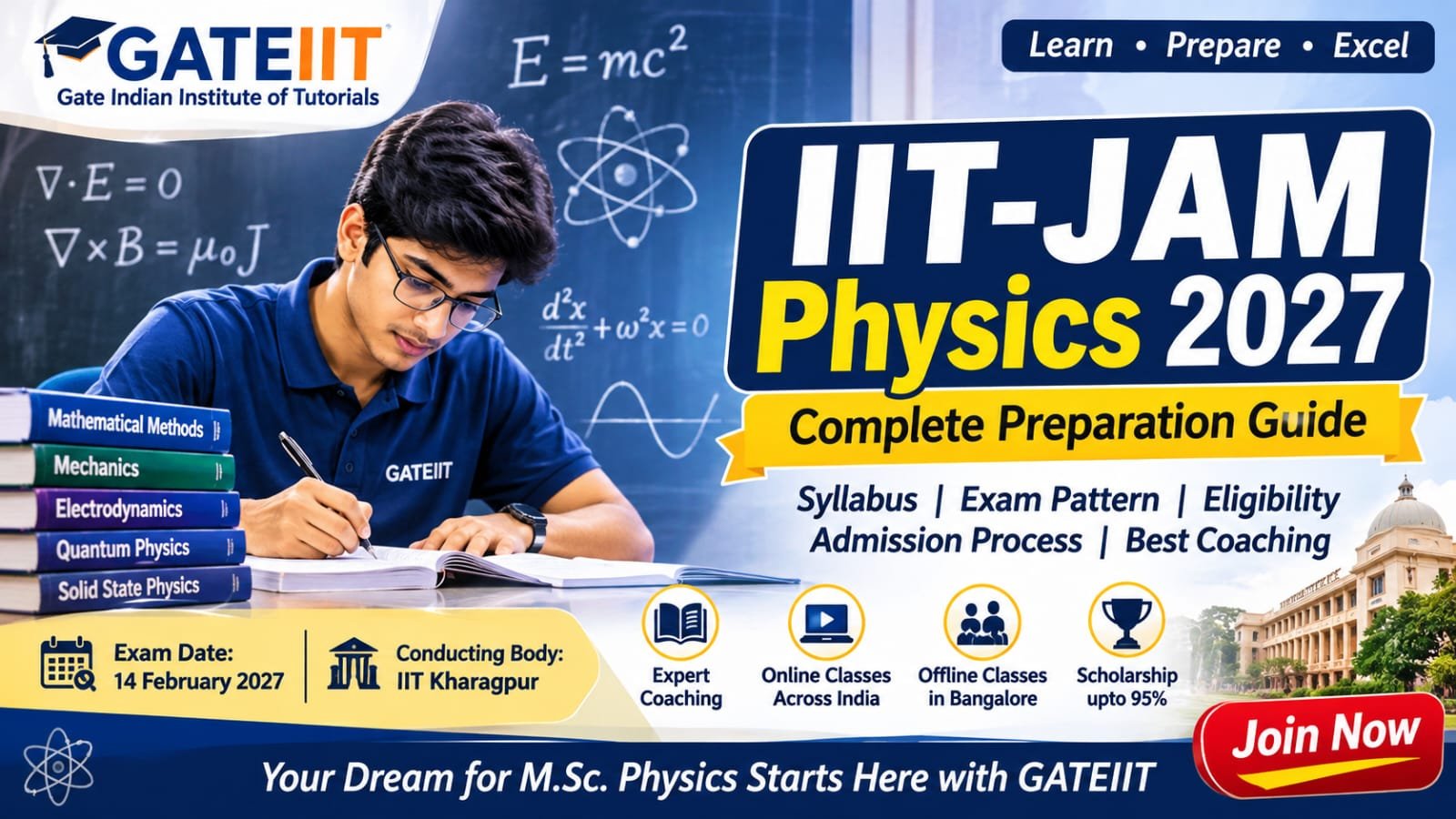
IIT JAM 2027 is being organised by the Indian Institute of Technology Kharagpur (IIT Kharagpur).
The examination will be conducted as a Computer-Based Test (CBT).
Official examination website: https://jam.iitkgp.ac.in/
The JAM Physics paper code is PH.
IIT JAM 2027 important information
- Examination: Joint Admission Test for Masters.
- Examination year: 2027.
- Organising institute: IIT Kharagpur.
- Examination level: National.
- Examination mode: Computer-Based Test.
- Physics paper code: PH.
- Examination date: 14 February 2027.
- Physics examination session: Afternoon.
- Examination time: 2:30 PM to 5:30 PM.
- Duration: 3 hours.
- Total questions: 60.
- Maximum marks: 100.
- Question types: MCQ, MSQ and NAT.
- Examination medium: English.
- Registration portal: JOAPS.
- Result date: 18 March 2027 (scheduled).
The dates and examination arrangements should always be checked against the latest official notifications.
IIT JAM 2027 examination schedule
The examination is scheduled for Sunday, 14 February 2027, in two sessions.
Forenoon session: 9:30 AM to 12:30 PM – Chemistry, Geology and Mathematics.
Afternoon session: 2:30 PM to 5:30 PM – Biotechnology, Economics, Mathematical Statistics and Physics.
Candidates appearing for Physics must attend the afternoon session.
A candidate can select one or two test papers, provided that the selected papers are scheduled in different sessions and the applicable eligibility conditions are satisfied.
Important: The IIT JAM 2027 application deadline was extended to 24 October 2026. As of 31 October 2026, the regular application deadline has passed. Candidates who have already registered should monitor the official portal for examination-related announcements, correction facilities, admit cards and subsequent admission notifications. Candidates who have not applied should not assume that fresh applications are still being accepted.
Official examination schedule: https://www.jam.iitkgp.ac.in/test-schedule.html
Official application fee details: https://www.jam.iitkgp.ac.in/appfees.html
Official syllabus and test pattern: https://www.jam.iitkgp.ac.in/syllabus.html
3. IIT JAM PHYSICS 2027 ELIGIBILITY CRITERIA
One of the most important things candidates should understand before preparing for IIT JAM is the difference between eligibility to appear for the examination and eligibility for admission to a particular postgraduate programme.
The JAM examination eligibility is relatively broad. However, individual IITs and participating institutions may prescribe specific undergraduate subject requirements.
Who is eligible for IIT JAM Physics?
The following candidates can apply:
- Students who have completed a recognised undergraduate degree.
- Students appearing for their final undergraduate examinations in 2027.
- Sc. Physics students.
- Sc. Physics and Mathematics students.
- Students pursuing B.Sc. programmes with Physics as a major or prescribed subject.
- Eligible students from other undergraduate disciplines, subject to the admission requirements of their preferred postgraduate programme.
- Candidates with backlogs, subject to completing their qualifying degree within the prescribed admission timeline.
- Foreign nationals, subject to applicable admission requirements.
Is there an age limit for IIT JAM 2027?
No. There is no age limit for appearing in IIT JAM 2027.
Is there a minimum percentage requirement?
No minimum percentage is prescribed for appearing in JAM 2027.
However, this does not mean that every candidate automatically qualifies for every M.Sc. Physics programme. Individual institutions may require specific subjects, minimum academic qualifications and other conditions.
Can final-year B.Sc. students apply?
Yes. Students appearing for their final undergraduate examinations in 2027 can apply.
They must complete their qualifying degree before the admission date prescribed by the admitting institute and submit the required proof within the stipulated deadline.
Can engineering graduates apply for IIT JAM Physics?
Candidates with engineering degrees may be eligible to appear for JAM. Their eligibility for individual M.Sc. Physics programmes must be checked separately.
Some institutions explicitly permit engineering graduates, while others prescribe particular undergraduate subject combinations.
Is there any restriction on the number of attempts?
No. There is no restriction on the number of attempts for JAM 2027.
Are there any exemptions from the IIT JAM examination?
There is no general exemption from the JAM examination for candidates holding a B.Sc., B.Tech., M.Sc. or another degree. Candidates seeking admission through the JAM route must qualify through the applicable examination and admission procedure.
Also, qualifying JAM does not exempt candidates from programme-specific educational requirements.
Important distinction: The examination does not prescribe a minimum percentage for appearing, but admission eligibility is determined by the individual admitting institution.
Official eligibility information: https://www.jam.iitkgp.ac.in/exam-eligibilityreq.html
4. IIT JAM PHYSICS 2027 APPLICATION FEES
The IIT JAM 2027 application fee depends on the candidate’s category and the number of test papers selected.
One test paper:
- Female candidates: ₹1,000.
- SC candidates: ₹1,000.
- ST candidates: ₹1,000.
- PwD candidates: ₹1,000.
- All other candidates: ₹2,000.
Two test papers:
- Female candidates: ₹1,350.
- SC candidates: ₹1,350.
- ST candidates: ₹1,350.
- PwD candidates: ₹1,350.
- All other candidates: ₹2,700.
The examination application fee is non-refundable and non-transferable.
Additional charges may apply for certain permitted application modifications. For JAM 2027, the published fee for changing the examination city, test paper, category, gender or date of birth is ₹300, plus any applicable difference in the application fee.
Payment methods include UPI, debit cards, credit cards, net banking and other payment methods made available through the official portal.
Candidates should always verify the final amount shown in JOAPS before making payment.
5. IIT JAM PHYSICS 2027 EXAMINATION PATTERN
Understanding the examination pattern is essential for developing an effective preparation strategy.
IIT JAM Physics is a three-hour Computer-Based Test consisting of 60 questions carrying 100 marks.
The examination has three compulsory sections:
- Section A – Multiple Choice Questions (MCQ).
- Section B – Multiple Select Questions (MSQ).
- Section C – Numerical Answer Type (NAT).
Section-wise examination pattern
Section A:
- Question type: MCQ.
- Number of questions: 30.
- Total marks: 50.
- 10 questions carry 1 mark each.
- 20 questions carry 2 marks each.
- Each question has four options.
- Only one option is correct.
Negative marking applies:
- 1-mark question: 1/3 mark deducted for an incorrect answer.
- 2-mark question: 2/3 mark deducted for an incorrect answer.
Section B:
- Question type: MSQ.
- Number of questions: 10.
- Total marks: 20.
- Each question carries 2 marks.
- One or more options may be correct.
- All correct options must be selected.
- No incorrect option should be selected.
- No negative marking applies.
- No partial marks are awarded for an incomplete or incorrect selection.
Section C:
- Question type: NAT.
- Number of questions: 20.
- Total marks: 30.
- 10 questions carry 1 mark each.
- 10 questions carry 2 marks each.
- Candidates enter numerical answers using the virtual keyboard.
- No answer choices are displayed.
- There is no negative marking.
Additional examination features
- Examination duration: 180 minutes.
- Examination language: English.
- Online virtual calculator: Provided.
- Rough work: As per examination-centre instructions.
- All three sections are compulsory.
- Candidates must follow the official instructions for the examination.
How should students prepare for MCQ, MSQ and NAT questions differently?
For MCQs: Practise conceptual questions, formula application, elimination techniques and time-efficient calculations.
For MSQs: Develop a strong understanding of definitions, limiting cases, physical assumptions, mathematical conditions and related concepts. Evaluate each option independently.
For NAT questions: Practise solving problems without answer choices. Develop numerical accuracy, dimensional analysis, approximation techniques and confidence in entering signed numerical answers.
A student who prepares only through conventional MCQ practice may struggle with MSQ and NAT questions. Therefore, integrated preparation covering all three question formats is essential.
6. COMPLETE IIT JAM PHYSICS 2027 SYLLABUS
The IIT JAM Physics syllabus is based on undergraduate-level Physics and Mathematics.
The seven broad syllabus areas are:
- Mathematical Methods.
- Mechanics and General Properties of Matter.
- Oscillations, Waves and Optics.
- Electricity and Magnetism.
- Kinetic Theory and Thermodynamics.
- Modern Physics.
- Solid State Physics, Devices and Electronics.
The following is a detailed topic-wise preparation checklist. Students should use the official JAM 2027 Physics syllabus PDF as the final authority for the prescribed scope of each topic.
UNIT 1: MATHEMATICAL METHODS
Mathematical Methods is one of the most important foundations of IIT JAM Physics. Students require mathematical proficiency to understand and solve problems in almost every other unit.
- Vector Algebra
- Scalars and vectors.
- Vector addition and subtraction.
- Scalar product.
- Vector product.
- Scalar triple product.
- Vector triple product.
- Position vectors.
- Direction cosines.
- Orthogonal vectors.
- Applications of vectors in Physics.
- Vector Calculus
- Scalar and vector fields.
- Gradient of a scalar function.
- Divergence of a vector function.
- Curl of a vector function.
- Directional derivatives.
- Line integrals.
- Surface integrals.
- Volume integrals.
- Gauss divergence theorem.
- Green’s theorem.
- Stokes’ theorem.
- Applications of vector calculus in electromagnetism.
- Differential Equations
- First-order differential equations.
- Linear differential equations.
- Second-order differential equations.
- Homogeneous differential equations.
- Non-homogeneous differential equations.
- Constant coefficient differential equations.
- Applications to oscillatory and physical systems.
- Matrices and Determinants
- Matrix operations.
- Inverse of a matrix.
- Rank of matrices.
- Characteristic equations.
- Applications of matrices.
- Complex Numbers
- Complex number representation.
- Modulus and argument.
- Polar representation.
- Euler’s formula.
- Complex conjugates.
- Complex algebra.
- Roots of complex numbers.
- Fourier Series and Basic Mathematical Techniques
- Periodic functions.
- Fourier series.
- Fourier coefficients.
- Even and odd functions.
- Basic integration techniques.
- Multiple integrals.
- Partial differentiation.
- Taylor and Maclaurin expansions.
- Basic functions and their properties.
- Probability and Statistical Fundamentals
- Basic probability concepts.
- Mean and variance.
- Standard distributions where relevant to the prescribed syllabus.
- Elementary applications of statistical methods.
Preparation advice: Students should not treat Mathematical Methods as an isolated chapter. Regularly apply vector calculus, differentiation, integration and differential equations while solving Mechanics, Electromagnetism, Waves and Quantum Mechanics problems.
UNIT 2: MECHANICS AND GENERAL PROPERTIES OF MATTER
Mechanics is a fundamental component of undergraduate Physics and requires a combination of physical understanding and mathematical problem-solving.
- Newtonian Mechanics
- Newton’s laws of motion.
- Inertial and non-inertial frames.
- Force and acceleration.
- Linear momentum.
- Conservation of momentum.
- Work and energy.
- Work-energy theorem.
- Conservation of mechanical energy.
- Conservative and non-conservative forces.
- Motion under variable forces.
- Kinematics
- Position, velocity and acceleration.
- Motion in one dimension.
- Motion in two dimensions.
- Projectile motion.
- Relative motion.
- Motion in Cartesian coordinates.
- Motion in rotating frames.
- Centripetal and centrifugal acceleration.
- Coriolis force.
- Central Force Motion
- Central forces.
- Gravitational force.
- Gravitational potential.
- Angular momentum conservation.
- Effective potential.
- Kepler’s laws.
- Orbital motion.
- Escape velocity.
- Satellite motion.
- Rotational Dynamics
- Rigid body motion.
- Angular velocity.
- Angular acceleration.
- Angular momentum.
- Moment of inertia.
- Radius of gyration.
- Parallel axis theorem.
- Perpendicular axis theorem.
- Principal axes and moments of inertia.
- Fixed-axis rotation.
- Rolling motion.
- Combined rotational and translational motion.
- Collisions
- Elastic collisions.
- Inelastic collisions.
- Conservation of momentum.
- Coefficient of restitution.
- Centre of mass.
- Collision in one and two dimensions.
- General Properties of Matter
- Stress and strain.
- Elastic moduli.
- Young’s modulus.
- Bulk modulus.
- Shear modulus.
- Surface tension.
- Fluid statics.
- Fluid dynamics.
- Equation of continuity.
- Euler’s equation.
- Bernoulli’s theorem.
- Kinematics of moving fluids.
Preparation advice: Focus on free-body diagrams, conservation laws, coordinate transformations, rotational mechanics and the physical interpretation of equations. Solve problems that combine more than one principle.
UNIT 3: OSCILLATIONS, WAVES AND OPTICS
This unit combines classical mechanics, differential equations and wave physics.
- Simple Harmonic Motion
- Simple harmonic oscillator.
- Differential equation of SHM.
- Displacement, velocity and acceleration.
- Energy of an oscillator.
- Phase and amplitude.
- Superposition of SHMs.
- Combination of oscillations.
- Lissajous figures.
- Damped and Forced Oscillations
- Damped harmonic oscillations.
- Under-damped systems.
- Over-damped systems.
- Critically damped systems.
- Forced oscillations.
- Quality factor.
- Phase relationships.
- Energy dissipation.
- Wave Motion
- Wave equation.
- Travelling waves.
- Standing waves.
- Wave propagation.
- Superposition principle.
- Phase velocity.
- Group velocity.
- Energy transmission.
- Energy density.
- Wave intensity.
- Sound Waves
- Propagation of sound.
- Sound waves in different media.
- Frequency and wavelength.
- Doppler effect.
- Acoustic properties.
- Geometrical Optics
- Fermat’s principle.
- General theory of image formation.
- Thin lenses.
- Thick lenses.
- Lens combinations.
- Optical path length.
- Optical instruments and image formation.
- Interference
- Coherent sources.
- Interference of light.
- Young’s double-slit experiment.
- Fringe width.
- Optical path difference.
- Phase difference.
- Interference in thin films.
- Diffraction
- Fraunhofer diffraction.
- Single-slit diffraction.
- Diffraction gratings.
- Rayleigh criterion.
- Resolving power.
- Angular separation.
- Polarisation
- Linear polarisation.
- Circular polarisation.
- Elliptical polarisation.
- Double refraction.
- Optical rotation.
- Polarisation-related phenomena.
Preparation advice: Students should practise the mathematical derivation and physical interpretation of wave equations, resonance conditions, interference patterns and diffraction problems.
UNIT 4: ELECTRICITY AND MAGNETISM
Electricity and Magnetism is a major conceptual and numerical area in JAM Physics.
- Electrostatics
- Coulomb’s law.
- Electric field.
- Electric potential.
- Electric dipole.
- Electric flux.
- Gauss’s law.
- Applications of Gauss’s law.
- Electrostatic boundary conditions.
- Conductors in electrostatic equilibrium.
- Electrostatic energy.
- Electric Potential and Laplace’s Equation
- Potential due to charge distributions.
- Potential gradients.
- Laplace’s equation.
- Solutions of Laplace’s equation in simple cases.
- Boundary-value problems.
- Capacitors and Dielectrics
- Parallel-plate capacitors.
- Spherical capacitors.
- Cylindrical capacitors.
- Capacitors in series and parallel.
- Dielectric materials.
- Dielectric polarisation.
- Bound surface charges.
- Bound volume charges.
- Energy stored in capacitors.
- Magnetostatics
- Magnetic field.
- Biot-Savart law.
- Ampere’s circuital law.
- Magnetic field due to current distributions.
- Magnetic dipoles.
- Lorentz force.
- Motion of charged particles in magnetic fields.
- Electromagnetic Induction
- Faraday’s law.
- Lenz’s law.
- Electromotive force.
- Self-inductance.
- Mutual inductance.
- Magnetic energy.
- Induced currents.
- Alternating Current
- AC circuits.
- Phase difference.
- Series RLC circuits.
- Resonance in AC circuits.
- Maxwell’s Equations and Electromagnetic Waves
- Displacement current.
- Maxwell’s equations.
- Electromagnetic wave propagation.
- Plane electromagnetic waves.
- Poynting vector.
- Poynting theorem.
- Energy flow in electromagnetic fields.
- Reflection and refraction at dielectric interfaces.
- Transmission and reflection coefficients at normal incidence.
Preparation advice: Practise applying Gauss’s law to symmetric charge distributions, solving capacitor combinations, analysing AC circuits and understanding Maxwell’s equations through their physical meaning.
UNIT 5: KINETIC THEORY AND THERMODYNAMICS
This unit examines the microscopic and macroscopic descriptions of matter and thermal systems.
- Kinetic Theory of Gases
- Molecular motion.
- Ideal gas model.
- Pressure of an ideal gas.
- Kinetic energy of gas molecules.
- Maxwell velocity distribution.
- Equipartition of energy.
- Degrees of freedom.
- Specific heat of monoatomic gases.
- Specific heat of diatomic gases.
- Specific heat of triatomic gases.
- Mean free path.
- Van der Waals equation of state.
- Laws of Thermodynamics
- Zeroth law of thermodynamics.
- Thermal equilibrium.
- First law of thermodynamics.
- Internal energy.
- Heat and work.
- Isothermal processes.
- Adiabatic processes.
- Isobaric processes.
- Isochoric processes.
- Reversible processes.
- Irreversible processes.
- Quasi-static processes.
- Second Law and Entropy
- Second law of thermodynamics.
- Entropy changes.
- Carnot cycle.
- Heat engines.
- Refrigerator and heat pump.
- Thermodynamic efficiency.
- Thermodynamic Relations
- Maxwell’s thermodynamic relations.
- Thermodynamic potentials.
- Helmholtz free energy.
- Gibbs free energy.
- Applications of thermodynamic potentials.
- Phase transitions.
- Clausius-Clapeyron equation.
- Statistical Physics
- Basic ideas of ensembles.
- Maxwell-Boltzmann distribution.
- Fermi-Dirac distribution.
- Bose-Einstein distribution.
- Classical and quantum statistical behaviour.
Preparation advice: Develop the ability to interpret P-V diagrams, calculate work and heat, apply the laws of thermodynamics and distinguish between different statistical distributions.
UNIT 6: MODERN PHYSICS
Modern Physics is an important area because it introduces concepts that form the foundation of quantum mechanics, atomic physics and nuclear physics.
- Special Theory of Relativity
- Inertial reference frames.
- Galilean invariance.
- Postulates of special relativity.
- Lorentz transformations.
- Length contraction.
- Time dilation.
- Relativistic velocity addition.
- Mass-energy equivalence.
- Quantum Physics
- Blackbody radiation.
- Photoelectric effect.
- Compton effect.
- Wave-particle duality.
- de Broglie wavelength.
- Heisenberg uncertainty principle.
- Superposition principle.
- Expectation values.
- Schrödinger equation.
- Wave functions.
- Probability interpretation.
- Atomic Physics
- Bohr’s atomic model.
- Hydrogen atom.
- Atomic energy levels.
- X-rays.
- Atomic transitions.
- Basic quantum-mechanical applications.
- Quantum Mechanics Applications
- One-dimensional potential problems.
- Particle in a one-dimensional box.
- Particle in two-dimensional boxes.
- Particle in three-dimensional boxes.
- One-dimensional harmonic oscillator.
- Step potential.
- Reflection and transmission.
- Pauli exclusion principle.
- Nuclear Physics
- Structure of the atomic nucleus.
- Nuclear mass.
- Mass defect.
- Binding energy.
- Radioactive decay laws.
- Half-life.
- Mean life.
- Applications of radioactivity.
Preparation advice: Students should understand the physical interpretation of wave functions, energy eigenvalues, expectation values and quantum boundary conditions. Merely memorising standard results is insufficient.
UNIT 7: SOLID STATE PHYSICS, DEVICES AND ELECTRONICS
This unit covers the fundamentals of crystals, semiconductor devices and basic electronic circuits.
- Crystal Structure
- Crystal lattices.
- Bravais lattices.
- Unit cells.
- Miller indices.
- Crystal planes.
- X-ray diffraction.
- Bragg’s law.
- Semiconductor Physics
- Intrinsic semiconductors.
- Extrinsic semiconductors.
- n-type semiconductors.
- p-type semiconductors.
- Fermi level.
- Charge carriers.
- Temperature dependence of resistivity.
- Semiconductor conductivity.
- Semiconductor Devices
- p-n junction diode.
- Diode characteristics.
- Forward bias.
- Reverse bias.
- Zener diode.
- Zener diode applications.
- Bipolar junction transistors.
- Common base configuration.
- Common emitter configuration.
- Common collector configuration.
- Transistor characteristics.
- Amplifiers and Oscillators
- Single-stage amplifiers.
- Two-stage RC-coupled amplifiers.
- Voltage gain.
- Amplifier characteristics.
- Barkhausen criterion.
- Sinusoidal oscillators.
- Operational Amplifiers
- Ideal operational amplifier.
- Inverting amplifier.
- Non-inverting amplifier.
- Basic OPAMP applications.
- Digital Electronics
- Binary number system.
- Decimal-to-binary conversion.
- Binary addition.
- Binary subtraction.
- Boolean algebra.
- Logic gates.
- AND gate.
- OR gate.
- NOT gate.
- NAND gate.
- NOR gate.
- Exclusive OR gate.
- Truth tables.
- Combination of logic gates.
- De Morgan’s theorem.
Preparation advice: Focus on semiconductor characteristics, transistor configurations, operational amplifier circuits, logic gates and truth-table problems. Practise circuit analysis instead of depending only on theoretical notes.
How to use the IIT JAM Physics syllabus effectively
The syllabus should be converted into a measurable preparation checklist.
For every topic, students should classify their preparation into four levels:
- Not started.
- Concepts completed.
- Numerical practice completed.
- Previous-year questions and mock-test performance satisfactory.
This method helps students identify their actual preparation status instead of assuming that attending lectures means completing a chapter.
Students should also maintain a separate formula notebook, a conceptual-error notebook and a numerical-problem practice record.
Official syllabus portal: https://www.jam.iitkgp.ac.in/syllabus.html
7. WHICH ARE THE MOST IMPORTANT TOPICS IN IIT JAM PHYSICS?
Although students should prepare the complete prescribed syllabus, certain areas are especially important because they form the conceptual foundation of multiple chapters.
The following is a practical preparation-priority list, not an official topic-wise weightage prediction.
Mathematical Methods:
- Vector calculus.
- Differential equations.
- Multiple integration.
Mechanics:
- Rotational dynamics.
- Central forces.
- Conservation laws.
Waves and Optics:
- Damped oscillations.
Electricity and Magnetism:
- Gauss’s law.
- Electromagnetic induction.
- Maxwell’s equations.
Thermodynamics:
- Laws of thermodynamics.
- Carnot cycle.
- Statistical distributions.
Modern Physics:
- Quantum mechanics.
- Schrödinger equation.
- Atomic physics.
- Nuclear physics.
Solid State and Electronics:
- Crystal structure.
- OPAMP and digital logic.
Do not completely skip a unit based on assumptions about previous-year weightage. The distribution can vary between examination cycles.
8. IIT JAM PHYSICS SELF-PREPARATION GUIDE – HOW TO PREPARE WITHOUT COACHING
Can you crack IIT JAM Physics through self-study? Yes. A disciplined student with good conceptual understanding, consistent numerical practice and a carefully structured revision plan can prepare independently.
However, self-preparation requires more than collecting books and watching online lectures. Students must follow a systematic approach that includes syllabus coverage, conceptual learning, problem-solving, previous-year questions, mock examinations and performance analysis.
Step 1: Understand the complete syllabus
Download the official JAM Physics syllabus and divide it into seven major units.
Prepare a chapter-wise checklist and identify:
- Topics you already understand.
- Topics requiring conceptual revision.
- Topics you have never studied properly.
- Topics where you can solve basic problems but struggle with advanced applications.
- Topics requiring additional numerical practice.
Step 2: Strengthen mathematical fundamentals
Mathematical Methods should receive attention from the beginning.
Students should become comfortable with:
- Differentiation and integration.
- Partial derivatives.
- Differential equations.
- Vector algebra.
- Vector calculus.
- Matrices and determinants.
- Complex numbers.
- Multiple integration.
- Series expansions.
A weak mathematical foundation can affect performance across several Physics units.
Step 3: Complete conceptual learning
For every chapter:
- Understand the underlying physical principle.
- Study the mathematical derivation.
- Identify assumptions and limitations.
- Learn the standard equations.
- Solve basic examples.
- Practise application-based problems.
- Attempt JAM-level questions.
Avoid memorising formulas without understanding where and why they apply.
Step 4: Solve previous-year question papers
Previous-year question papers are among the most valuable resources for IIT JAM preparation.
Students should solve papers from multiple examination years and classify mistakes into:
- Conceptual mistakes.
- Mathematical mistakes.
- Calculation mistakes.
- Incorrect formula selection.
- Misinterpretation of questions.
- Time-management errors.
- Guesswork and negative-marking losses.
Do not simply check the final score. Understanding why an answer is wrong is more important than the number of questions attempted.
Step 5: Prepare a formula and revision notebook
Maintain one consolidated notebook containing:
- Important equations.
- Standard mathematical identities.
- Physical constants.
- Important derivations.
- Special cases.
- Frequently used approximations.
- Common mistakes.
- Short conceptual explanations.
The notebook should be revised regularly, particularly during the final 30 days.
Step 6: Practise all three question formats
Students should not restrict their preparation to MCQs.
Practise:
- Single-correct-answer problems.
- Multiple-correct-answer problems.
- Numerical problems without options.
MSQs require conceptual precision, while NAT questions require calculation accuracy.
Step 7: Take regular mock examinations
Mock tests help students understand their performance under examination conditions.
A useful mock-test analysis should measure:
- Total marks.
- Accuracy percentage.
- Questions attempted.
- Questions left unanswered.
- Negative marks.
- Section-wise performance.
- Time spent per question.
- Strong and weak chapters.
- Repeated conceptual errors.
Step 8: Revise systematically
A practical revision cycle is:
- First revision: Immediately after completing the chapter.
- Second revision: Within one week.
- Third revision: Within one month.
- Final revision: During the last few weeks before the examination.
This approach improves retention and reduces the need to relearn entire chapters before the examination.
9. BEST BOOKS FOR IIT JAM PHYSICS PREPARATION
Selecting the right books is important, but collecting too many books can waste valuable preparation time.
Students should select a limited number of standard textbooks and use them consistently.
Recommended books:
- Mathematical Methods for Physicists – Arfken, Weber and Harris.
- Mathematical Physics – H. K. Dass.
- Classical Mechanics – J. C. Upadhyaya.
- An Introduction to Mechanics – Kleppner and Kolenkow.
- The Physics of Vibrations and Waves – H. J. Pain.
- Optics – Ajoy Ghatak.
- Introduction to Electrodynamics – David J. Griffiths.
- Electricity and Magnetism – D. C. Tayal.
- Thermal Physics – Charles Kittel and Herbert Kroemer.
- Concepts of Modern Physics – Arthur Beiser.
- Introduction to Quantum Mechanics – David J. Griffiths.
- Introduction to Solid State Physics – Charles Kittel.
- Electronic Devices and Circuit Theory – Boylestad and Nashelsky.
Which book should beginners choose?
Students with weaker undergraduate fundamentals should initially use clear introductory textbooks and lecture notes before moving to advanced reference books.
Students who already understand the basics can use standard textbooks for conceptual depth and additional numerical practice.
Should students buy all these books?
No.
A sensible combination is:
- One standard reference for Mathematical Methods.
- One good undergraduate Physics textbook or set of notes for each major subject.
- One reliable collection of IIT JAM previous-year papers.
- A structured question bank.
- A mock-test series.
The objective is to solve problems and understand concepts, not accumulate reading material.
10. IIT JAM PHYSICS PREVIOUS-YEAR QUESTION PAPERS
Previous-year papers help students understand the actual examination standard and identify recurring conceptual themes.
Students should use previous-year questions at three stages.
During chapter preparation: Solve topic-wise questions after completing each chapter.
After syllabus completion: Attempt complete papers to identify weak areas and improve speed.
During final revision: Solve full-length papers in the actual three-hour examination format.
How to analyse previous-year papers
Maintain a record of:
- Year of the question paper.
- Subject and chapter.
- Question format.
- Difficulty level.
- Time required.
- Correct or incorrect response.
- Reason for the mistake.
An aspirant should aim to improve accuracy and consistency with every successive test.
Are previous-year questions enough?
No. Previous-year questions are essential, but students should not assume that the same questions will be repeated.
The better approach is to understand the underlying concepts and practise new problems based on similar principles.
11. IIT JAM PHYSICS 12-MONTH PREPARATION STRATEGY
A one-year preparation programme is particularly suitable for B.Sc. students who want to develop strong fundamentals without rushing through the syllabus.
Phase 1: Foundation building – Months 1 to 3
Focus on:
- Mathematical Methods.
- Basic oscillations.
- Fundamental mathematical techniques.
Objectives:
- Develop mathematical proficiency.
- Understand undergraduate Physics fundamentals.
- Start solving basic numerical problems.
- Prepare formula notebooks.
Phase 2: Core syllabus completion – Months 4 to 6
Focus on:
- Electricity and Magnetism.
- Waves and Optics.
- Statistical Physics.
Objectives:
- Complete major conceptual units.
- Solve intermediate and advanced problems.
- Start chapter-wise JAM question practice.
- Conduct regular topic tests.
Phase 3: Advanced preparation – Months 7 to 9
Focus on:
- Modern Physics.
- Quantum Mechanics.
- Solid State Physics.
- Devices and Electronics.
- Remaining syllabus topics.
Objectives:
- Complete the entire syllabus.
- Solve previous-year questions.
- Improve numerical accuracy.
- Attempt mixed-topic examinations.
Phase 4: Examination-oriented preparation – Months 10 to 12
Focus on:
- Full-length mock examinations.
- Revision of all seven units.
- Advanced problem-solving.
- Weak-topic improvement.
- Time management.
Objectives:
- Attempt regular full-length mock tests.
- Analyse performance after each examination.
- Improve question selection.
- Strengthen the final revision strategy.
12. IIT JAM PHYSICS 6-MONTH PREPARATION STRATEGY
Students with six months available should follow a more intensive preparation programme.
Month 1: Mathematical Methods and Mechanics.
Month 2: Waves, Oscillations and Optics.
Month 3: Electricity and Magnetism.
Month 4: Thermodynamics and Modern Physics.
Month 5: Quantum Mechanics, Solid State and Electronics; syllabus completion.
Month 6: Previous-year papers, mock tests and complete revision.
A six-month plan should include regular problem-solving from the beginning. Students should not postpone numerical practice until the entire syllabus is completed.
13. IIT JAM PHYSICS 3-MONTH PREPARATION STRATEGY
A 90-day crash preparation programme is useful for students who already have undergraduate Physics fundamentals and need structured examination-oriented training.
Days 1–30: Concept consolidation.
- Mathematical Methods.
- Oscillations and Waves.
Days 31–60: Remaining syllabus.
- Electricity and Magnetism.
- Modern Physics.
- Solid State Physics.
Days 61–75: Problem-solving phase.
- Previous-year papers.
- Topic-wise tests.
- Numerical practice.
- MSQ practice.
- Weak-topic improvement.
Days 76–90: Final score improvement.
- Full-length mock examinations.
- Formula revision.
- Error analysis.
- Time management.
- Rapid revision of all seven units.
Students with substantial syllabus gaps may require a longer programme than 90 days.
14. IIT JAM PHYSICS 30-DAY FINAL REVISION STRATEGY
A 30-day programme should be treated as an intensive revision and score-improvement programme, not as a substitute for a complete foundation course.
Suggested approach:
- Days 1–5: Mathematical Methods and Mechanics.
- Days 6–9: Waves, Oscillations and Optics.
- Days 10–14: Electricity and Magnetism.
- Days 15–18: Thermodynamics.
- Days 19–23: Modern Physics.
- Days 24–25: Solid State Physics and Electronics.
- Days 26–28: Previous-year papers and mock examinations.
- Days 29–30: Formula revision, error correction and examination strategy.
Students should modify this schedule according to their actual strengths and weaknesses.
15. DAILY STUDY TIMETABLE FOR IIT JAM PHYSICS
A daily timetable should be realistic and sustainable.
Here is a suggested schedule for a student who can devote approximately 6–8 hours to preparation.
- Mathematical Methods practice: 60 minutes.
- Conceptual Physics study: 90 minutes.
- Numerical problem-solving: 120 minutes.
- Previous-year question practice: 60 minutes.
- Revision and formula notebook: 45 minutes.
- Topic test or mock analysis: 45–60 minutes.
Students attending regular college classes may divide the preparation into morning and evening sessions.
The important factor is consistency rather than studying for unusually long hours on a few days.
16. HOW TO IMPROVE YOUR IIT JAM PHYSICS SCORE?
A high score requires a combination of knowledge, accuracy, speed and intelligent examination management.
- Strengthen conceptual understanding. A candidate should understand the physical meaning of equations instead of relying exclusively on memorisation.
- Develop numerical problem-solving ability. Solve different types of problems based on the same principle.
- Improve mathematical accuracy. Practise differentiation, integration, algebraic manipulation, approximations and numerical calculations.
- Avoid unnecessary negative marking. Since MCQs carry negative marking, students should develop a disciplined approach to uncertain questions.
- Master MSQ questions. Read every option carefully. Evaluate each statement independently rather than assuming that only one option can be correct.
- Improve NAT accuracy. Practise entering answers correctly, including signs and numerical precision.
- Attempt mock tests under examination conditions. A mock test is useful only when it is followed by detailed analysis.
- Identify weak chapters early. Do not spend all your preparation time studying subjects you already know well.
- Revise regularly. Repeated revision is necessary to retain mathematical techniques and Physics concepts.
- Follow a performance-based preparation plan. Change your study priorities according to test results rather than following a rigid timetable irrespective of performance.
17. IIT JAM PHYSICS ADMISSION PROCESS 2027
Qualifying in IIT JAM is the first stage of the admission journey. Candidates must subsequently complete the relevant admission application process.
Stage 1: Appear for IIT JAM Physics
Candidates must appear for the PH examination and obtain a valid score.
Stage 2: Check the result
IIT JAM 2027 results are scheduled for 18 March 2027.
Candidates should check their marks, qualifying status and All India Rank through the official portal.
Stage 3: Review the admission brochure
Candidates should carefully examine:
- Participating institutions.
- Available postgraduate programmes.
- Programme-specific eligibility.
- Minimum Educational Qualifications (MEQs).
- Seat matrix.
- Reservation requirements.
- Admission application procedure.
Stage 4: Apply through the applicable admission process
For participating IIT programmes, candidates must follow the JAM 2027 admission application procedure and submit their programme preferences as instructed.
The admission process is separate from the examination application. Paying the examination fee does not automatically register a candidate for institute admission.
Stage 5: Understand merit and seat allocation
Admission is based on the applicable merit and allocation rules, including:
- JAM rank.
- Programme preferences.
- Available seats.
- Category and reservation rules.
- Programme-specific eligibility.
- Admission-round procedures.
Stage 6: Accept the allotted seat
Candidates receiving an offer must complete the acceptance, document verification and fee-payment requirements within the prescribed deadlines.
Failure to complete the required formalities can result in the loss of the allotted seat.
Does qualifying in JAM guarantee admission?
No. Qualifying in JAM does not guarantee admission, a scholarship or employment. Candidates must satisfy the requirements of their selected programmes.
Official admission information: https://jam.iitkgp.ac.in/
18. IIT JAM PHYSICS PARTICIPATING INSTITUTES AND M.Sc. ADMISSION OPPORTUNITIES
IIT JAM scores are used for admission to postgraduate programmes offered by participating institutions.
For the 2027–28 academic year, the official JAM 2027 website indicates 89 postgraduate programmes across 23 IITs and approximately 3,000 seats.
Participating IITs include:
- IIT Bhilai.
- IIT Bhubaneswar.
- IIT (BHU) Varanasi.
- IIT Bombay.
- IIT Delhi.
- IIT Dharwad.
- IIT Gandhinagar.
- IIT Goa.
- IIT Guwahati.
- IIT Hyderabad.
- IIT Indore.
- IIT Jammu.
- IIT Jodhpur.
- IIT Kanpur.
- IIT Kharagpur.
- IIT Madras.
- IIT Mandi.
- IIT Palakkad.
- IIT Patna.
- IIT (ISM) Dhanbad.
- IIT Roorkee.
- IIT Ropar.
- IIT Tirupati.
IISc Bangalore and other institutions may also offer admission opportunities through JAM scores or related admission arrangements, subject to the applicable programme and admission notification.
Important: Not every participating institute offers M.Sc. Physics. Students must examine the programme-wise seat matrix and eligibility criteria rather than assuming that every IIT offers the same course.
What postgraduate programmes can students pursue?
Depending on the institution and admission eligibility, JAM scores may be used for programmes such as:
- Sc. Physics.
- Joint M.Sc.-Ph.D. programmes.
- Integrated Ph.D. programmes.
- Sc. Applied Physics.
- Interdisciplinary postgraduate programmes.
- Other specified science and research programmes.
The exact programme availability and eligibility must be checked in the JAM 2027 admission brochure.
Is IIT JAM useful for admission to IISc Bangalore?
JAM scores are used by IISc and other institutions for specified programmes where applicable. However, IISc admission routes and eligibility requirements must be checked independently. Candidates should not assume that every IISc Physics programme uses the same selection procedure as an IIT M.Sc. Physics programme.
Can JAM scores be used for NIT admissions?
Certain participating non-IIT institutions use JAM scores through the applicable Centralised Counselling for M.Sc. and other postgraduate programmes (CCMN) or their own admission arrangements.
Students should check the relevant year’s CCMN and institutional admission information to understand programme availability.
19. DIFFERENCE BETWEEN IIT JAM PHYSICS AND OTHER PHYSICS ENTRANCE EXAMINATIONS
Students preparing for postgraduate Physics admissions often consider multiple examinations.
The most appropriate examination depends on their academic objectives.
- IIT JAM Physics: Postgraduate science admissions through participating institutions.
- CUET-PG Physics: Postgraduate admissions to participating universities.
- JEST: Admissions and research opportunities in specified Physics and related programmes, subject to the current notification.
- TIFR GS: Admissions to specified graduate science and research programmes.
- GATE Physics: Postgraduate and research-related opportunities at institutions accepting GATE scores.
- CSIR-UGC NET Physical Sciences: Junior Research Fellowship, Assistant Professor eligibility and related research pathways under applicable rules.
These examinations have different syllabi, eligibility requirements, question patterns and admission objectives.
Students interested in research should understand the differences before deciding which examinations to prepare for.
20. CAREER OPPORTUNITIES AFTER M.SC. PHYSICS THROUGH IIT JAM
An M.Sc. Physics degree can provide opportunities across research, education, technology and scientific industries.
- Research Scientist: Work in scientific research laboratories, universities and research institutions.
- D. and Academic Research: Pursue doctoral studies in theoretical Physics, experimental Physics, Astrophysics, Condensed Matter Physics, Quantum Physics and other specialisations.
- Lecturer and Teaching Careers: Pursue teaching opportunities after meeting the required qualifications and recruitment conditions.
- Scientific Institutions: Explore eligible opportunities in scientific organisations and laboratories.
- Semiconductor and Electronics Industry: Develop expertise in semiconductor physics, electronic materials, device physics and related technological applications.
- Data Science and Computational Research: Build additional skills in programming, mathematical modelling, numerical simulations and data analysis.
- Materials Science: Explore careers involving advanced materials, nanotechnology, materials characterisation and solid-state research.
- Computational Physics: Work with scientific computing, simulations, numerical techniques and computational modelling.
- Medical Physics and Applied Physics: Pursue further specialisation and the additional qualifications required for specific professional roles.
- Higher Education Abroad: Use a strong academic foundation and relevant research experience to explore international postgraduate and doctoral opportunities.
An M.Sc. degree alone does not guarantee any particular job or salary. Career progression depends on specialisation, practical skills, further qualifications, research experience and recruitment requirements.
21. IIT JAM PHYSICS COACHING IN BANGALORE – GATEIIT
Preparing for IIT JAM Physics requires a combination of strong fundamentals, expert teaching, systematic numerical practice, continuous assessment and individual academic attention.
Students often face difficulties such as:
- Weak mathematical fundamentals.
- Incomplete understanding of undergraduate Physics.
- Difficulty solving numerical questions.
- Confusion between similar physical concepts.
- Inability to handle MSQ questions.
- Lack of a structured preparation timetable.
- Limited exposure to examination-level questions.
- Difficulty managing time during mock examinations.
- Lack of individual doubt-clearing support.
- Inadequate revision and performance analysis.
GATEIIT (Gate Indian Institute of Tutorials) offers IIT JAM Physics coaching programmes designed to address these preparation challenges through structured learning and personalised academic support.
GATEIIT provides:
- Online IIT JAM Physics coaching throughout India.
- Offline IIT JAM Physics coaching at its Bangalore centre.
- Live online interactive classes.
- Regular weekday batches.
- Weekend batches.
- One-year long-term preparation programmes.
- Short-term intensive programmes.
- 30-day crash courses.
- 45-day crash courses.
- 60-day crash courses.
- 90-day crash courses.
- Personal mentorship programmes.
- One-to-one doubt-clearing sessions.
- Small-group learning options.
- Personalised and customised learning plans.
- Score Booster Programmes.
- Mock examinations and practice tests.
- Study materials and revision support.
The objective is to help students build conceptual clarity, improve problem-solving ability and prepare confidently for IIT JAM Physics.
Why choose GATEIIT for IIT JAM Physics preparation?
A good coaching programme should not simply deliver lectures. It should help students identify their weaknesses, improve their understanding and measure their preparation through regular assessments.
GATEIIT focuses on a structured academic approach involving:
- Concept-oriented teaching: Physics concepts are taught with emphasis on their mathematical foundations, physical interpretation and application to numerical problems.
- Systematic syllabus coverage: Preparation is organised around the prescribed IIT JAM Physics syllabus, ensuring that all seven major units receive attention.
- Personal attention: Students can benefit from individual academic guidance and opportunities to discuss their specific learning difficulties.
- Personal mentorship: Mentorship can help students establish realistic preparation targets, monitor progress and maintain consistency.
- One-to-one doubt clearing: Students can seek individual clarification on difficult derivations, numerical problems, conceptual doubts and examination questions.
- Small-group learning: Students who prefer a more interactive learning environment can explore small-group programmes, subject to batch availability.
- Flexible course durations: Students can select a programme based on their academic level, available preparation time and examination target.
- Online and offline flexibility: Students from different parts of India can participate in online classes, while Bangalore-based students can explore classroom programmes.
- Regular assessments: Tests help students understand their progress and identify the chapters requiring further work.
- Examination-oriented preparation: The programme incorporates MCQs, MSQs, NAT questions, previous-year questions and mock examinations.
22. GATEIIT IIT JAM PHYSICS COURSES – ONE-YEAR LONG-TERM AND SHORT-TERM PROGRAMMES
GATEIIT offers different preparation formats to accommodate students with different academic backgrounds and preparation requirements.
A. IIT JAM Physics One-Year Long-Term Course
The one-year programme is suitable for students who want to prepare systematically while continuing their undergraduate studies.
It is particularly useful for:
- First-year B.Sc. students planning ahead.
- Second-year B.Sc. students.
- Students with weak undergraduate fundamentals.
- Students who need additional time for Mathematics.
- Students preparing alongside college examinations.
- Repeaters who want to rebuild their conceptual understanding.
Proposed learning structure:
Phase 1 – Foundation:
- Mathematical Methods.
- Fundamental Mechanics.
- Basic mathematical tools.
- Introductory Physics problem-solving.
Phase 2 – Core Physics:
- Oscillations and Waves.
- Electricity and Magnetism.
Phase 3 – Advanced Physics:
- Modern Physics.
- Quantum Mechanics.
- Solid State Physics.
Phase 4 – Examination Preparation:
- Previous-year questions.
- Advanced numerical problems.
- Full-length mock tests.
- Revision sessions.
- Individual performance analysis.
The one-year programme provides adequate time for learning, practice, revision and improvement.
B. IIT JAM Physics 90-Day Crash Course
The 90-day programme is suitable for students who already have some undergraduate Physics preparation and need structured examination-oriented training.
The programme can focus on:
- Rapid syllabus coverage.
- Important concepts.
- Advanced numerical practice.
- Previous-year questions.
- MCQ, MSQ and NAT preparation.
- Mock examinations.
- Score improvement.
- Revision and doubt clearing.
C. IIT JAM Physics 60-Day Crash Course
The 60-day programme is intended for students who have completed a substantial portion of the syllabus and require intensive revision.
Suggested focus:
- Important topics from all seven units.
- Formula revision.
- Conceptual clarification.
- Previous-year question solving.
- Topic-wise tests.
- Full-length mock examinations.
- Individual weak-area improvement.
D. IIT JAM Physics 45-Day Crash Course
The 45-day programme is suitable for candidates who already possess reasonable subject knowledge and need a focused examination-oriented revision schedule.
The programme may include:
- High-priority topic revision.
- Advanced numerical questions.
- Important derivations.
- MSQ and NAT practice.
- Mock-test analysis.
- Final examination strategy.
E. IIT JAM Physics 30-Day Crash Course
The 30-day programme is an intensive score-booster and final revision option.
It is suitable for students who have already completed most of the syllabus.
The focus is on:
- Rapid revision.
- Important formulas.
- Frequently tested concepts.
- Previous-year question practice.
- Mock examinations.
- Time management.
- Accuracy improvement.
- Doubt resolution.
A 30-day course should not be considered a substitute for learning the entire undergraduate Physics syllabus from scratch.
23. IIT JAM PHYSICS COACHING FEES AT GATEIIT
GATEIIT offers flexible course-duration options with indicative crash-course fees ranging from ₹5,000 to ₹20,000, depending on the selected programme, course duration and learning format.
Indicative IIT JAM Physics crash-course fee structure:
- 30-day crash course: ₹5,000 onwards.
- 45-day crash course: ₹5,000–₹10,000.
- 60-day crash course: ₹8,000–₹15,000.
- 90-day crash course: ₹10,000–₹20,000.
The above is an indicative fee presentation within the specified ₹5,000–₹20,000 course range, not a confirmed fixed quotation for every batch or learning format. Confirm the applicable fee, inclusions and batch availability with GATEIIT before admission.
What determines the course fee?
The actual course fee may depend on:
- Course duration.
- Number of teaching hours.
- Online or offline learning format.
- Personal mentorship requirements.
- One-to-one teaching requirements.
- Small-group or regular batch selection.
- Additional academic support.
- Specialised score-booster arrangements.
Does GATEIIT offer one-to-one IIT JAM Physics coaching?
Students can enquire about individual teaching and personalised mentorship options.
One-to-one programmes are particularly useful for students who require:
- Individual attention.
- A customised timetable.
- Additional numerical practice.
- Personal doubt-clearing sessions.
- Flexible class scheduling.
- Special attention to weak chapters.
The availability and fees of individual programmes can differ from regular batch courses.
24. GATEIIT SCHOLARSHIP TEST – UP TO 95% SCHOLARSHIP FEE DISCOUNT
GATEIIT offers scholarship-based fee discounts of up to 95%, subject to performance in its scholarship test and applicable scholarship terms.
The objective is to make quality academic preparation more accessible to deserving students.
How does the scholarship opportunity work?
Students interested in IIT JAM Physics coaching can enquire about the scholarship assessment.
The scholarship may be determined based on:
- Scholarship test performance.
- Academic assessment.
- Applicable eligibility conditions.
- Programme availability.
- Scholarship policy for the relevant admission cycle.
Benefits of the GATEIIT scholarship opportunity
- Opportunity to receive a substantial course-fee discount.
- Recognition of academic ability.
- Reduced financial burden for eligible students.
- Access to suitable preparation programmes.
- Encouragement for deserving and motivated candidates.
Important: A scholarship of up to 95% is the maximum advertised potential discount, not an automatic entitlement. The actual discount depends on the test result and applicable terms. Students should obtain written confirmation of the scholarship amount, final payable fee and validity before admission.
25. GATEIIT SCORE BOOSTER PROGRAMME FOR IIT JAM PHYSICS
A good score-booster programme should focus on improving examination performance rather than simply increasing the number of lectures.
GATEIIT’s Score Booster Programme can be structured around the specific requirements of students who have already completed their syllabus or need additional examination practice.
Key components
- Conceptual revision: Revisit important Physics concepts and mathematical techniques.
- Formula-based problem solving: Practise the correct selection and application of formulas.
- Advanced numerical questions: Develop speed and accuracy through challenging numerical problems.
- MCQ accuracy training: Understand how to approach single-correct-answer questions while avoiding unnecessary negative marking.
- MSQ problem-solving: Learn to evaluate multiple options logically and independently.
- NAT practice: Improve numerical accuracy without depending on answer choices.
- Mock-test series: Attempt examination-style tests under timed conditions.
- Performance analysis: Identify weak chapters, repeated mistakes and avoidable score losses.
- Personal doubt clearing: Resolve difficult problems through individual academic support.
- Final revision: Use concise notes, formula sheets and chapter-wise revision targets.
Who should consider the Score Booster Programme?
- Students who have completed the syllabus.
- Students who have attempted previous JAM examinations.
- Repeaters looking to improve their scores.
- Students with good conceptual knowledge but low mock-test scores.
- Students who struggle with time management.
- Candidates who need additional MSQ and NAT practice.
26. PERSONALISED IIT JAM PHYSICS COACHING – FLEXIBLE LEARNING OPTIONS AT GATEIIT
Different students have different academic requirements. A student with strong undergraduate fundamentals may require advanced problem-solving, whereas another student may need to rebuild basic concepts.
GATEIIT provides different learning options to address these requirements.
Option 1: Regular Classroom Coaching
Suitable for students who prefer structured classroom learning.
Features may include:
- Scheduled lectures.
- Conceptual teaching.
- Numerical practice.
- Regular assessments.
- Classroom doubt clarification.
- Revision sessions.
Option 2: Online IIT JAM Physics Coaching
Suitable for students from anywhere in India.
Benefits include:
- Attend classes from home.
- Interactive online teaching.
- Access to digital learning resources.
- Reduced travel requirements.
- Online assessments.
- Flexible access to academic support, as per programme arrangements.
Option 3: Weekend IIT JAM Physics Classes
Suitable for students attending regular undergraduate college classes or working professionals who need a more flexible timetable.
Option 4: Personal Mentorship Programme
Suitable for students requiring an individual preparation roadmap.
The programme may involve:
- Personal academic assessment.
- Preparation timetable.
- Chapter-wise targets.
- Progress monitoring.
- Regular feedback.
- Weak-area identification.
- Individual revision planning.
Option 5: One-to-One Personal Tuition
Students who prefer individual teaching can enquire about customised one-to-one classes.
This option can be particularly helpful for students who:
- Have substantial conceptual gaps.
- Need individual numerical problem-solving support.
- Prefer personalised teaching speed.
- Require flexible scheduling.
- Need intensive examination preparation.
Option 6: Small-Group Coaching
Students can explore small-group learning options for a more interactive academic environment.
Option 7: Customised Preparation Programme
Students may request a customised programme based on:
- Current academic level.
- Available preparation time.
- Target examination.
- Completed syllabus.
- Weak subjects.
- Preferred learning format.
- Personal academic goals.
27. FREE ACADEMIC ADD-ONS AND LEARNING SUPPORT AT GATEIIT
Apart from regular classes, GATEIIT’s course offerings can include additional learning resources and academic support, subject to the selected programme.
Potential academic add-ons include:
- Online study material.
- Chapter-wise notes.
- Formula sheets.
- Previous-year question collections.
- Topic-wise practice questions.
- Online test-series access.
- Mock examinations.
- Chapter-wise assessments.
- Online learning app access.
- Recorded lecture access, where included.
- Revision sessions.
- Doubt-clearing support.
- Performance feedback.
- Preparation timetable.
- Scholarship-test opportunities.
The exact inclusions should be confirmed for the selected course. Students should ask whether a particular add-on is included in the course fee or available separately.
Why are these add-ons useful?
A structured learning ecosystem helps students continue studying outside scheduled classes.
For example, a student can attend a lecture on Electromagnetism, revise the relevant notes, solve topic-wise questions, attempt an assessment and discuss mistakes during a doubt-clearing session.
This creates a complete learning cycle:
LEARN → PRACTISE → TEST → ANALYSE → IMPROVE → REVISE.
28. ONLINE IIT JAM PHYSICS COACHING ACROSS INDIA
GATEIIT offers online coaching opportunities for IIT JAM Physics aspirants throughout India.
Students do not need to relocate to Bangalore to explore the available online programmes.
Online classes can be suitable for students from:
- Other cities and towns across India.
Benefits of online JAM Physics coaching
- Attend classes without relocating.
- Save commuting time.
- Access structured academic teaching.
- Participate in interactive doubt sessions.
- Follow a planned study schedule.
- Practise through online tests.
- Receive academic guidance.
- Choose suitable course durations.
Online coaching can be especially helpful for students studying in colleges where specialised IIT JAM preparation is not available.
29. OFFLINE IIT JAM PHYSICS COACHING AT GATEIIT BANGALORE CENTRE
Students residing in Bangalore can enquire about offline classroom coaching at the GATEIIT centre.
GATEIIT – Gate Indian Institute of Tutorials
3rd Floor, #1743, Sri Raghavendra Plaza,
17th Main Road, JP Nagar 2nd Phase,
Bangalore – 560078, Karnataka, India.
Why consider offline coaching?
- Direct interaction with faculty.
- Classroom-based learning.
- In-person doubt clarification.
- A structured academic environment.
- Peer interaction.
- Regular academic monitoring.
Students should contact GATEIIT to confirm current batch schedules, classroom availability and admission requirements.
Who can join the Bangalore centre?
- Sc. Physics students.
- Sc. final-year students.
- Physics graduates.
- IIT JAM repeaters.
- Students preparing for M.Sc. Physics admissions.
- Students looking for short-term or long-term Physics coaching.
30. REGULAR AND WEEKEND IIT JAM PHYSICS BATCHES
GATEIIT offers regular and weekend course options to accommodate different student schedules.
Regular batches: Suitable for students who can attend classes on weekdays and follow a continuous academic timetable.
Weekend batches: Suitable for students who attend undergraduate college during weekdays or have other academic commitments.
Flexible batch arrangements: Students may enquire about suitable timings, online participation and personalised arrangements, depending on availability.
31. HOW TO CHOOSE THE RIGHT IIT JAM PHYSICS COURSE AT GATEIIT?
- First- or second-year B.Sc. student: One-year long-term course.
- Student with weak fundamentals: Long-term structured course.
- Student with 6–9 months available: Extended preparation programme.
- Student with 90 days available: 90-day crash course.
- Student with 60 days available: 60-day revision programme.
- Student with 45 days available: 45-day intensive revision.
- Student with 30 days available: 30-day score booster.
- Student who needs individual attention: Personal mentorship.
- Student with specific conceptual gaps: One-to-one coaching.
- Student outside Bangalore: Online coaching.
- Student residing in Bangalore: Offline or online coaching.
This is a general recommendation. GATEIIT can help students identify a suitable course after assessing their preparation level.
32. HOW TO TAKE ADMISSION FOR IIT JAM PHYSICS COACHING AT GATEIIT?
Step 1: Enquire about the programme.
Contact GATEIIT and express your interest in IIT JAM Physics coaching.
Step 2: Discuss your academic background.
Share your undergraduate qualification, current year of study and preparation status.
Step 3: Select the course duration.
Explore one-year, 90-day, 60-day, 45-day and 30-day options.
Step 4: Select your preferred learning format.
Choose online classes, offline classes, regular batches, weekend batches, small groups or individual teaching options.
Step 5: Enquire about scholarship opportunities.
Ask about the scholarship test and the possibility of receiving a fee discount of up to 95%.
Step 6: Confirm the course fee.
Obtain details of the applicable fee, payment terms and course inclusions.
Step 7: Complete admission formalities.
Complete the registration and admission process as instructed by the institute.
Step 8: Start your preparation.
Follow the academic schedule, attend classes, practise questions and participate in assessments.
GATEIIT Contact Details
Institute: GATEIIT – Gate Indian Institute of Tutorials.
Website: www.gateiit.com
Phone: 8884416154 / 8884416155
Offline centre: JP Nagar 2nd Phase, Bangalore.
Online classes: Available for students throughout India.
Google Maps / Directions: https://maps.app.goo.gl/MtzbVkqywCkwKcc4A
For course information, batch availability, scholarship assessment, fee details and admission guidance, students can contact the GATEIIT academic team.
33. TOP 50 SEO KEYWORDS FOR IIT JAM PHYSICS COACHING AND PREPARATION
These are recommended keyword targets, not a verified ranking of search volumes. Use them naturally across the website title, H1, H2 headings, paragraphs, image alt text, FAQs and internal links.
- IIT JAM Physics 2027.
- IIT JAM Physics Coaching.
- IIT JAM Physics Coaching in Bangalore.
- IIT JAM Physics Online Coaching.
- IIT JAM Physics Offline Coaching.
- IIT JAM Physics Crash Course.
- IIT JAM Physics Crash Course in Bangalore.
- IIT JAM Physics Online Classes.
- IIT JAM Physics Preparation.
- IIT JAM Physics Preparation Strategy.
- IIT JAM Physics Syllabus 2027.
- IIT JAM Physics Exam Pattern 2027.
- IIT JAM Physics Eligibility Criteria.
- IIT JAM Physics Exam Date 2027.
- IIT JAM Physics Application Form.
- IIT JAM Physics Admission 2027.
- IIT JAM Physics Study Material.
- IIT JAM Physics Best Books.
- IIT JAM Physics Previous Year Question Papers.
- IIT JAM Physics Mock Test.
- IIT JAM Physics Test Series.
- IIT JAM Physics Important Questions.
- IIT JAM Physics Short Term Course.
- IIT JAM Physics 30 Days Crash Course.
- IIT JAM Physics 45 Days Crash Course.
- IIT JAM Physics 60 Days Crash Course.
- IIT JAM Physics 90 Days Crash Course.
- IIT JAM Physics One Year Coaching.
- IIT JAM Physics Weekend Classes.
- IIT JAM Physics Personal Coaching.
- IIT JAM Physics One to One Classes.
- IIT JAM Physics Personal Mentorship.
- IIT JAM Physics Scholarship.
- IIT JAM Physics Coaching Fees.
- Best IIT JAM Physics Coaching Institute.
- Best Online Coaching for IIT JAM Physics.
- Sc. Physics Entrance Coaching.
- Sc. Physics Entrance Exam Preparation.
- IIT JAM Physics Mathematics Preparation.
- IIT JAM Physics Numerical Problems.
- IIT JAM Physics MCQ Practice.
- IIT JAM Physics MSQ Practice.
- IIT JAM Physics NAT Questions.
- IIT JAM Physics Formula Sheet.
- IIT JAM Physics Study Plan.
- IIT JAM Physics Coaching in JP Nagar.
- IIT JAM Physics Coaching in Karnataka.
- IIT JAM Physics Coaching for B.Sc. Students.
- IIT JAM Physics Coaching for Repeaters.
- GATEIIT IIT JAM Physics Coaching.
Recommended supporting long-tail search phrases
- How to prepare for IIT JAM Physics from zero?
- How to crack IIT JAM Physics in 6 months?
- How to score high in IIT JAM Physics?
- Is IIT JAM Physics difficult?
- Which IIT is best for M.Sc. Physics?
- Can B.Sc. students appear for IIT JAM?
- Is coaching necessary for IIT JAM Physics?
- How to prepare for IIT JAM Physics without coaching?
- What are the most important topics in IIT JAM Physics?
- What is the fee for IIT JAM Physics coaching in Bangalore?
34. FREQUENTLY ASKED QUESTIONS ABOUT IIT JAM PHYSICS 2027
Q1. What is IIT JAM Physics?
IIT JAM Physics is a national-level entrance examination conducted for admission to specified postgraduate programmes in Physics and related disciplines at participating institutions.
Q2. Who conducts IIT JAM 2027?
IIT Kharagpur is the organising institute for IIT JAM 2027.
Q3. When is IIT JAM Physics 2027?
The examination is scheduled for 14 February 2027, from 2:30 PM to 5:30 PM.
Q4. What is the IIT JAM Physics paper code?
The Physics paper code is PH.
Q5. What is the duration of IIT JAM Physics?
The examination duration is three hours.
Q6. How many questions are there in IIT JAM Physics?
There are 60 questions carrying a total of 100 marks.
Q7. What is the IIT JAM Physics syllabus?
The syllabus consists of Mathematical Methods, Mechanics and General Properties of Matter, Oscillations, Waves and Optics, Electricity and Magnetism, Kinetic Theory and Thermodynamics, Modern Physics, and Solid State Physics, Devices and Electronics.
Q8. Is there negative marking in IIT JAM Physics?
Yes. Negative marking applies to incorrect answers in Section A (MCQs). There is no negative marking in Sections B and C.
Q9. What is the eligibility for IIT JAM Physics?
Candidates who have completed their undergraduate degree or are appearing for their final undergraduate examination in 2027 can apply, subject to the official eligibility rules.
Q10. Is B.Sc. Physics compulsory for IIT JAM?
Not necessarily for appearing in the examination. However, individual postgraduate programmes may prescribe Physics and Mathematics subject requirements for admission.
Q11. Is there an age limit for IIT JAM 2027?
No. There is no age limit for appearing in JAM 2027.
Q12. Is there any minimum percentage required for IIT JAM 2027?
There is no minimum percentage requirement for appearing in the examination. Individual institutions may prescribe minimum academic requirements for admission.
Q13. Can final-year B.Sc. students appear for IIT JAM?
Yes. Final-year undergraduate students appearing for their qualifying degree examinations in 2027 can apply.
Q14. Can students with backlogs appear for IIT JAM?
Yes. Candidates with backlogs can apply, but they must satisfy the qualifying-degree completion and programme-specific admission requirements.
Q15. How many times can I attempt IIT JAM?
There is no restriction on the number of attempts.
Q16. What is the IIT JAM 2027 application fee?
For one paper, the fee is ₹1,000 for female, SC, ST and PwD candidates and ₹2,000 for all other candidates. For two papers, it is ₹1,350 and ₹2,700 respectively.
Q17. Has IIT JAM 2027 registration closed?
Yes. The last date was extended to 24 October 2026. As of 31 October 2026, the application deadline has passed.
Q18. What are the three sections in IIT JAM Physics?
Section A consists of MCQs, Section B consists of MSQs and Section C consists of NAT questions.
Q19. Is a calculator allowed in IIT JAM Physics?
Candidates are provided with an online virtual calculator. Personal electronic calculators are not permitted.
Q20. Can I prepare for IIT JAM Physics without coaching?
Yes. Self-preparation is possible with a structured study plan, standard textbooks, previous-year papers, mock tests and consistent revision.
Q21. Is coaching necessary for IIT JAM Physics?
Coaching is not compulsory. However, structured coaching can help students strengthen concepts, improve problem-solving skills, clarify doubts and maintain a consistent preparation schedule.
Q22. How many months are required to prepare for IIT JAM Physics?
The required preparation time depends on the student’s undergraduate fundamentals, mathematical ability and available study hours. A 6–12-month preparation period is useful for many students, while shorter programmes are more suitable for those with strong fundamentals.
Q23. Can I crack IIT JAM Physics in 90 days?
Yes, it may be possible for students who already have good undergraduate fundamentals and have completed a substantial part of the syllabus. Students starting from scratch may require considerably more time.
Q24. Can I prepare for IIT JAM Physics in 30 days?
Thirty days can be useful for final revision and score improvement. It is generally not sufficient to build the entire Physics foundation from scratch.
Q25. Which are the most important subjects in IIT JAM Physics?
Mathematical Methods, Mechanics, Electricity and Magnetism, Modern Physics, Oscillations and Waves, and Thermodynamics deserve systematic attention.
Q26. Which are the best books for IIT JAM Physics?
Useful books include Griffiths’ Introduction to Electrodynamics, Beiser’s Concepts of Modern Physics, Kittel’s Introduction to Solid State Physics, Pain’s Physics of Vibrations and Waves, and Arfken’s Mathematical Methods for Physicists.
Q27. Are IIT JAM previous-year papers important?
Yes. They help students understand the question format, difficulty level, conceptual requirements and examination trends.
Q28. Is IIT JAM Physics tougher than CUET-PG Physics?
The difficulty depends on the examination cycle and the candidate’s strengths. The examinations have different syllabi, question structures and admission objectives.
Q29. What is the difference between MCQ, MSQ and NAT?
MCQs have one correct option, MSQs may have multiple correct options, and NAT questions require candidates to enter a numerical answer without selecting from options.
Q30. How many IITs participate in JAM 2027?
The official JAM 2027 website lists 23 participating IITs offering 89 postgraduate programmes.
Q31. Does qualifying IIT JAM guarantee admission to an IIT?
No. Admission depends on rank, programme eligibility, seat availability, reservation rules and the applicable allocation process.
Q32. Can I get admission to M.Sc. Physics through IIT JAM?
Yes. Several participating institutions offer M.Sc. Physics or related programmes through JAM, subject to their programme-specific eligibility requirements.
Q33. Can I get admission to IISc through IIT JAM?
Certain IISc programmes use JAM scores for admission. Candidates must check the current IISc programme-specific admission notification and requirements.
Q34. Can engineering graduates apply for IIT JAM Physics?
They may apply for the examination, but admission eligibility depends on the individual institution’s prescribed qualifying-degree requirements.
Q35. What is the best strategy to improve my IIT JAM Physics score?
Develop conceptual understanding, practise numerical problems, solve previous-year questions, attempt mock tests and analyse mistakes systematically.
Q36. Does IIT JAM Physics have a scholarship?
JAM itself is an entrance examination and does not guarantee a scholarship. Financial assistance and scholarships depend on the relevant institution and applicable rules.
Q37. Does GATEIIT offer IIT JAM Physics online coaching?
Yes. GATEIIT offers online IIT JAM Physics coaching for students throughout India.
Q38. Does GATEIIT offer offline IIT JAM Physics coaching in Bangalore?
Yes. Students can enquire about classroom coaching at the GATEIIT centre in JP Nagar 2nd Phase, Bangalore.
Q39. What are the IIT JAM Physics coaching fees at GATEIIT?
The advertised crash-course fee range is ₹5,000–₹20,000, depending on duration and programme format.
Q40. Does GATEIIT offer a 30-day IIT JAM Physics crash course?
Yes. GATEIIT offers a 30-day intensive preparation option for students requiring final revision and examination-oriented preparation.
Q41. Does GATEIIT offer a 45-day IIT JAM Physics course?
Yes. Students can enquire about the 45-day short-term preparation programme.
Q42. Does GATEIIT offer a 60-day IIT JAM Physics course?
Yes. A 60-day intensive preparation programme is available as a short-term course option.
Q43. Does GATEIIT offer a 90-day IIT JAM Physics crash course?
Yes. Students can enquire about the 90-day structured crash-course programme.
Q44. Does GATEIIT offer one-year IIT JAM Physics coaching?
Yes. GATEIIT offers a one-year long-term preparation option for students seeking systematic syllabus coverage and continuous academic guidance.
Q45. Are weekend IIT JAM Physics classes available?
GATEIIT offers regular and weekend learning options. Students should confirm the current batch timetable.
Q46. Does GATEIIT offer one-to-one IIT JAM Physics tuition?
Students can enquire about personalised one-to-one coaching and individual doubt-clearing arrangements.
Q47. Does GATEIIT offer personal mentorship for IIT JAM Physics?
Yes. Personal mentorship options are available for students requiring individual preparation guidance.
Q48. Can I get a scholarship for GATEIIT IIT JAM Physics coaching?
GATEIIT advertises scholarship fee discounts of up to 95%, depending on the scholarship test score and applicable conditions.
Q49. What additional facilities are available with GATEIIT coaching?
Depending on the selected programme, students can enquire about online study material, tests, learning app access, revision support, doubt clearing and other academic resources.
Q50. How can I join IIT JAM Physics coaching at GATEIIT?
Visit www.gateiit.com or contact 8884416154 / 8884416155 to enquire about the available courses, fees, scholarships and admission procedure.
35. WHY START YOUR IIT JAM PHYSICS PREPARATION WITH GATEIIT?
Success in IIT JAM Physics requires a strong understanding of fundamentals, consistent problem-solving and a clear examination strategy.
A student should not wait until the final few months to identify conceptual weaknesses or begin solving examination-level questions.
Starting early provides more time to understand difficult concepts, strengthen Mathematics, practise numerical problems and develop examination confidence.
At GATEIIT, students can explore different preparation pathways according to their academic requirements.
Whether you need a one-year foundation programme, a 90-day crash course, a 60-day intensive programme, a 45-day revision course, a 30-day score booster or personalised one-to-one teaching, you can enquire about the available options.
Your IIT JAM Physics preparation journey starts with the right plan.
LEARN CONCEPTS DEEPLY. PRACTISE INTELLIGENTLY. ANALYSE MISTAKES. REVISE CONSISTENTLY. IMPROVE CONTINUOUSLY.
Choose a preparation programme that matches your current academic level and available time.
JOIN GATEIIT FOR IIT JAM PHYSICS ONLINE & OFFLINE COACHING
GATEIIT – Gate Indian Institute of Tutorials
- IIT JAM Physics One-Year Long-Term Coaching.
- 30, 45, 60 and 90-Day Crash Courses.
- Online Classes Throughout India.
- Offline Classroom Coaching in Bangalore.
- Regular and Weekend Batches.
- Personal Mentorship.
- One-to-One Doubt Clearing.
- Small-Group and Personalised Learning.
- Score Booster Programmes.
- Scholarship Fee Discounts up to 95%, subject to eligibility and test performance.
Website: www.gateiit.com
Contact: 8884416154 / 8884416155
Bangalore Centre: 3rd Floor, #1743, Sri Raghavendra Plaza, 17th Main Road, JP Nagar 2nd Phase, Bangalore – 560078, Karnataka.
Google Maps: https://maps.app.goo.gl/MtzbVkqywCkwKcc4A
Enquire today about IIT JAM Physics coaching, available batches, course fees and scholarship opportunities.
IMPORTANT OFFICIAL REFERENCES FOR STUDENTS
For accurate examination information, students should refer to the following official resources:
- IIT JAM 2027 Official Website: https://jam.iitkgp.ac.in/
- IIT JAM 2027 Eligibility: https://www.jam.iitkgp.ac.in/exam-eligibilityreq.html
- IIT JAM 2027 Syllabus and Pattern: https://www.jam.iitkgp.ac.in/syllabus.html
- IIT JAM 2027 Examination Schedule: https://www.jam.iitkgp.ac.in/test-schedule.html
- IIT JAM 2027 Application Fees: https://www.jam.iitkgp.ac.in/appfees.html
- IIT JAM 2027 Frequently Asked Questions: https://www.jam.iitkgp.ac.in/faq.html
- JAM Online Application Processing System: https://joaps.iitkgp.ac.in/
Examination dates, admission requirements, application procedures and other official details are subject to notifications from the organising institute and admitting institutions. Candidates should verify the latest information before making academic or admission decisions.
EDITORIAL NOTE FOR PUBLISHING:
This article is designed as a comprehensive educational and course-information resource. Before publishing, retain the distinction between official IIT JAM examination information and GATEIIT’s independently offered coaching services. Verify actual batch schedules, course inclusions, scholarship terms and fee quotations with the institute. This improves accuracy and student trust.