
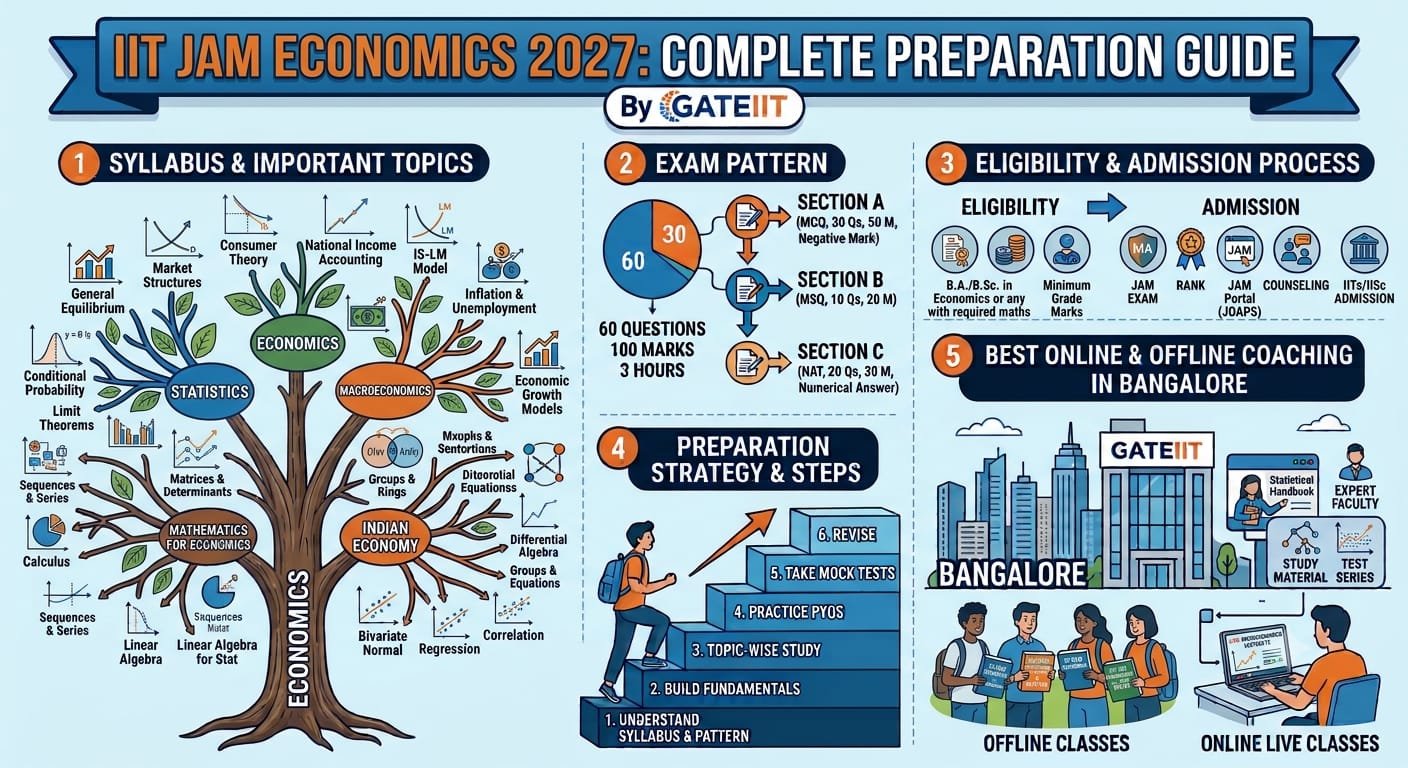
Prepare for IIT JAM Economics 2027 with GATEIIT – Complete Self-Study Guidance, Expert Coaching, Personal Mentorship, Mock Tests and Score Booster Programmes
Are you preparing for IIT JAM Economics 2027 and looking for the right preparation strategy, updated syllabus, best books, previous-year question papers, mock tests, coaching classes and admission guidance? The Joint Admission Test for Masters (JAM) is one of India’s important national-level entrance examinations for students aspiring to pursue postgraduate programmes at the Indian Institutes of Technology (IITs) and other participating institutions.
The IIT JAM Economics examination, identified by the paper code EN, evaluates a candidate’s understanding of economic theory, mathematical methods, statistics, quantitative reasoning, analytical thinking and the Indian economy. Unlike examinations that primarily test descriptive knowledge, JAM Economics requires students to understand concepts, interpret economic relationships, solve numerical problems and apply mathematical and statistical techniques to economic situations.
A strong preparation strategy must therefore combine conceptual clarity, mathematical proficiency, statistical understanding, regular problem-solving practice, previous-year question analysis and full-length mock examinations.
GATEIIT (Gate Indian Institute of Tutorials) offers structured IIT JAM Economics coaching through online classes for students across India and offline classroom programmes at its Bangalore centre. Students can choose long-term one-year programmes, regular courses, weekend batches, personalised mentorship and intensive 30-day, 45-day, 60-day and 90-day crash courses.
Whether you are beginning your preparation from the fundamentals, revising the complete syllabus or looking to improve your examination score through intensive practice, this guide explains the IIT JAM Economics examination and the preparation opportunities available through GATEIIT.
1. What Is IIT JAM Economics?
IIT JAM stands for Joint Admission Test for Masters. It is a national-level entrance examination conducted for admission to postgraduate programmes offered by participating IITs and other institutions accepting JAM scores.
Economics is one of the seven test papers in JAM 2027. Its paper code is EN.
The examination is designed to assess whether candidates possess the mathematical, statistical and economic foundations necessary for postgraduate-level study.
The JAM Economics syllabus covers five broad areas:
- Mathematics for Economics
- Statistics for Economics
- Microeconomics
- Macroeconomics
- Indian Economy
These areas are interconnected. For example, mathematical optimisation is required to understand consumer and producer behaviour, probability and statistical inference are important for econometrics, and macroeconomic models require mathematical reasoning.
Consequently, students should not approach the examination as a theory-only economics test. Mathematics and statistics are essential components of successful preparation.
2. IIT JAM Economics 2027: Latest Examination Details
The following information summarises the official JAM 2027 examination schedule and important details available as of 31 October 2026.
Examination Name: Joint Admission Test for Masters 2027
Subject: Economics
Test Paper Code: EN
Organising Institute: Indian Institute of Technology Kharagpur
Examination Level: National Level
Examination Year: 2027
Academic Admission Session: 2027–2028
Examination Date: 14 February 2027
Economics Examination Timing: 2:30 PM to 5:30 PM
Examination Duration: 3 Hours
Examination Mode: Computer-Based Test (CBT)
Maximum Marks: 100
Total Questions: 60
Question Types: MCQ, MSQ and NAT
Number of Test Papers: Seven
Maximum Papers a Candidate Can Choose: Two, subject to the permitted session combinations
Official Website: https://jam.iitkgp.ac.in/
Official Application Portal: https://joaps.iitkgp.ac.in/
Result Date Announced: 18 March 2027
Important application update: JAM 2027 registration began on 11 September 2026. The official application deadline was extended to 24 October 2026. As of 31 October 2026, the application deadline has passed. Candidates who have already registered should monitor the official portal for application scrutiny, correction-related notices, admit cards and other announcements. Students planning for the next examination cycle should begin their preparation early rather than waiting for the next registration announcement.
3. Which IIT Conducts JAM Economics 2027?
The organising institute for IIT JAM 2027 is:
Indian Institute of Technology Kharagpur (IIT Kharagpur).
Every year, one of the participating IITs is assigned responsibility for organising the examination. The organising institute coordinates the application process, examination arrangements, publication of results and the centralised admission process for participating admitting institutes.
IIT JAM 2027 includes seven examination subjects:
- Biotechnology (BT)
- Chemistry (CY)
- Economics (EN)
- Geology (GG)
- Mathematics (MA)
- Mathematical Statistics (MS)
- Physics (PH)
Candidates interested in postgraduate Economics programmes should select the Economics (EN) paper.
4. IIT JAM Economics 2027 Examination Schedule
The official examination schedule is as follows:
Examination Date: Sunday, 14 February 2027.
Forenoon Session: 9:30 AM to 12:30 PM Subjects: Chemistry, Geology and Mathematics.
Afternoon Session: 2:30 PM to 5:30 PM Subjects: Biotechnology, Economics, Mathematical Statistics and Physics.
Economics candidates must report according to the instructions printed on their admit cards.
The examination is conducted through a computer-based testing system at designated examination centres.
Candidates should regularly check the official website for admit card availability, examination-centre information and any subsequent changes.
5. IIT JAM Economics 2027 Eligibility Criteria
One of the most frequently asked questions is whether students from different undergraduate backgrounds can appear for IIT JAM Economics.
The general JAM 2027 examination eligibility allows candidates who have completed an undergraduate degree or are appearing in the final examination of their qualifying undergraduate degree in 2027 to apply.
There is no general age restriction for appearing in JAM 2027.
However, appearing for the examination and qualifying for admission to a particular postgraduate programme are two different matters.
Each admitting institute specifies its own Minimum Educational Qualification (MEQ) and other admission requirements.
Who can prepare for IIT JAM Economics?
Depending on the specific admitting institute’s eligibility requirements, candidates from the following backgrounds may find Economics an appropriate postgraduate pathway:
- BA Economics
- BA Mathematics
- BA Statistics
- BSc Mathematics
- BSc Statistics
- BSc Economics
- BCom
- BCom Honours
- BBA
- BTech
- BE
- BStat
- BMath
- Other recognised bachelor’s degree programmes.
Candidates should not assume that every undergraduate qualification is accepted by every IIT. They must verify the exact programme-specific requirements in the applicable admission brochure.
Is Mathematics compulsory for IIT JAM Economics?
The answer depends on the admission requirements of the institute and programme being targeted.
Mathematical preparation is extremely important for the Economics paper itself. Students without a strong mathematics background may need additional preparation in calculus, linear algebra, functions, probability, statistics and optimisation.
For admission, some institutes prescribe specific mathematics or other subject requirements, whereas others permit a wider range of undergraduate degrees.
Can final-year students apply?
Yes. Candidates appearing in the final examination of their qualifying undergraduate degree in 2027 are eligible to appear for JAM 2027, subject to the examination rules.
However, they must complete the qualifying degree and satisfy the respective admitting institute’s requirements before admission.
Is there a minimum percentage requirement for appearing in JAM 2027?
The JAM examination eligibility rules do not prescribe a general minimum undergraduate percentage for appearing in the examination.
Nevertheless, individual postgraduate programmes may prescribe minimum marks, CGPA or other eligibility conditions.
Is there an age limit?
No general age limit is prescribed for appearing in IIT JAM 2027.
Can students from engineering backgrounds appear?
Yes. Students with recognised engineering degrees can apply for JAM, subject to the general examination requirements. They must separately verify the eligibility requirements of the Economics programmes to which they intend to apply.
Can students from commerce backgrounds apply?
Students with BCom and related qualifications may be eligible for certain Economics programmes. However, they must check whether the particular IIT requires Mathematics, Statistics or other essential undergraduate subjects.
6. IIT JAM Economics 2027 Application Fees
The official JAM 2027 examination application fee is:
Female / SC / ST / PwD candidates:
- One test paper: ₹1,000
- Two test papers: ₹1,350
All other candidates:
- One test paper: ₹2,000
- Two test papers: ₹2,700
PwD refers to Persons with Benchmark Disabilities.
The application fee is non-refundable and non-transferable.
An additional fee may apply for permitted changes to examination city, test paper, category, gender or date of birth, as specified by the official application portal.
These are examination registration fees payable to the organising institute. They are separate from coaching fees charged by educational institutions.
7. IIT JAM Economics 2027 Examination Pattern
Understanding the examination pattern is essential before beginning serious preparation.
The Economics paper consists of three compulsory sections.
Total Questions: 60
Maximum Marks: 100
Examination Duration: 3 Hours
Examination Mode: Computer-Based Test.
Section A – Multiple Choice Questions (MCQ)
Number of Questions: 30
Total Marks: 50
Question format: Four options are generally provided, with one correct answer.
Mark distribution:
Questions 1–10: One mark each.
Questions 11–30: Two marks each.
Negative marking applies to incorrect answers.
For an incorrect one-mark MCQ, one-third of a mark is deducted.
For an incorrect two-mark MCQ, two-thirds of a mark is deducted.
Unattempted questions receive zero marks.
Section B – Multiple Select Questions (MSQ)
Number of Questions: 10
Total Marks: 20
Each question carries two marks.
One or more options may be correct.
There is no negative marking.
There is no partial marking for an incomplete or incorrect selection.
Students must carefully identify all correct options. Selecting only one correct option when additional correct options exist will not earn partial marks.
Section C – Numerical Answer Type (NAT)
Number of Questions: 20
Total Marks: 30
Questions 41–50: One mark each.
Questions 51–60: Two marks each.
Candidates must calculate and enter the numerical answer using the virtual keyboard provided on the computer screen.
There is no negative marking for incorrect NAT answers.
Summary of the examination pattern
Section A: 30 questions, 50 marks, MCQ, negative marking.
Section B: 10 questions, 20 marks, MSQ, no negative marking.
Section C: 20 questions, 30 marks, NAT, no negative marking.
Total: 60 questions, 100 marks.
Important examination instructions
- The examination is conducted through CBT.
- Candidates are provided with an online virtual calculator.
- Personal calculators and electronic devices are not permitted.
- Candidates must carry the prescribed admit card and valid photo identification.
- All examination-centre instructions must be followed.
- Candidates should practise numerical calculations using the virtual calculator before the examination.
8. Complete IIT JAM Economics 2027 Syllabus
The IIT JAM Economics syllabus is significantly more quantitative than many students initially expect.
The official 2027 syllabus contains five major units. The following is a detailed, organised explanation of the syllabus to help students plan their preparation systematically.
UNIT 1: MATHEMATICS FOR ECONOMICS
Mathematics is one of the most important foundations of the Economics paper.
Students should develop the ability to understand functions, differentiate economic expressions, solve optimisation problems, work with matrices and interpret mathematical results in economic contexts.
- Preliminaries and Functions
- Set theory and number systems.
- Inverse functions.
- Elementary functions.
- Quadratic functions.
- Polynomial functions.
- Power functions.
- Exponential functions.
- Logarithmic functions.
- Properties of logarithms.
- Elasticities and log-derivative interpretation.
- Functions of several variables.
- Graphs and level curves.
- Convex sets.
- Concave functions.
- Quasi-concave functions.
- Convex functions.
- Quasi-convex functions.
- Sequences and series.
- Convergence of sequences.
- Algebraic properties of sequences.
- Geometric series.
- Basic limits of sequences.
- Differential Calculus
- Mean Value Theorems.
- Taylor’s Theorem.
- Partial differentiation.
- Chain rule.
- Second-order derivatives.
- Higher-order derivatives.
- Properties and applications of derivatives.
- Hessian matrices.
- Implicit Function Theorem.
- Comparative statics.
- Homogeneous functions.
- Homothetic functions.
- Characterisation and applications of homogeneous and homothetic functions.
- Integral Calculus
- Definite integrals.
- Fundamental Theorems of Calculus.
- Indefinite integrals.
- Applications of integration.
- Economic applications of integral calculus.
- Differential Equations and Difference Equations
- First-order ordinary differential equations.
- Applications of differential equations.
- Steady-state analysis.
- Basic stability analysis.
- Simple phase-diagram intuition.
- Difference equations and their economic applications.
- Linear Algebra
- Matrix representations.
- Elementary matrix operations.
- Systems of linear equations.
- Properties of solutions.
- Linear independence.
- Linear dependence.
- Rank of a matrix.
- Matrix inverse.
- Conditions for invertibility.
- Square matrices, particularly 2 × 2 matrices.
- Basic diagonalisation.
- Symmetric matrices.
- Quadratic forms.
- Positive definiteness.
- Negative definiteness.
- Positive semidefiniteness.
- Negative semidefiniteness.
- Interpretation of definiteness and stability.
- Optimisation
- Local optima.
- Global optima.
- Geometric characterisation of optima.
- Calculus-based optimisation.
- Multivariable optimisation.
- Quadratic forms.
- Hessians in optimisation.
- Constrained optimisation.
- Equality constraints.
- Lagrange multiplier method.
- Inequality constraints.
- Karush-Kuhn-Tucker (KKT) conditions.
- Complementary slackness.
- Second-order conditions.
- Definiteness and optimality.
- Value functions.
- Envelope Theorem.
- Economic applications of optimisation.
- Linear programming.
- Graphical solutions.
- Matrix formulation.
- Economic interpretation of duality.
Preparation advice: Students should give particular attention to differentiation, partial derivatives, constrained optimisation, matrices, eigenvalues, concavity, convexity, Lagrange multipliers and KKT conditions. These topics provide the mathematical foundation for several other parts of the Economics syllabus.
UNIT 2: STATISTICS FOR ECONOMICS
Statistics is essential for understanding economic data, probability distributions, estimation, hypothesis testing and regression analysis.
- Descriptive Statistics
- Different types of charts.
- Statistical diagrams.
- Frequency distributions.
- Measures of central tendency.
- Arithmetic mean.
- Measures of dispersion.
- Standard deviation.
- Index numbers.
- Probability Theory
- Random experiments.
- Sample spaces.
- Classical definition of probability.
- Axiomatic definition of probability.
- Probability theorems.
- Repeated trials.
- Sampling with replacement.
- Sampling without replacement.
- Conditional probability.
- Independent events.
- Bayes’ Theorem.
- Random variables.
- Probability distributions.
- Markov’s Inequality.
- Chebyshev’s Inequality.
- Mathematical expectation.
- Higher-order moments.
- Moment Generating Functions.
- Bernoulli trials.
- Binomial distribution.
- Poisson distribution.
- Hypergeometric distribution.
- Uniform distribution.
- Normal distribution.
- Probability Mass Functions.
- Probability Density Functions.
- Chi-square distribution.
- Student’s t-distribution.
- F-distribution.
- Relationships among Normal, Chi-square, t and F distributions.
- Joint distributions.
- Conditional distributions.
- Properties of joint and conditional distributions.
- Mathematical Statistics
- Random sampling.
- Different types of sampling.
- Sampling distributions.
- Estimation methods.
- Estimator and estimate.
- Point estimation.
- Interval estimation.
- Confidence intervals.
- Law of Large Numbers.
- Central Limit Theorem.
- Hypothesis Testing
- Parameters and statistics.
- Null hypothesis.
- Alternative hypothesis.
- Test statistics.
- Sampling distributions of test statistics.
- p-values.
- Type I errors.
- Type II errors.
- Probability of Type I and Type II errors.
- Size of a test.
- Power of a test.
- Comparison of two population characteristics using random samples.
- Correlation and Regression
- Types of correlation.
- Regression analysis.
- Ordinary Least Squares (OLS).
- Method of Moments.
- Maximum Likelihood Estimation.
- Classical Linear Regression Model assumptions.
- Statistical properties of OLS estimators.
- Hypothesis testing in regression.
- Gauss-Markov Theorem.
- Best Linear Unbiased Estimator (BLUE).
- Goodness of fit.
- Interpretation of regression results.
Preparation advice: Probability distributions, conditional probability, Bayes’ Theorem, expectation, variance, sampling distributions, estimation, hypothesis testing, correlation and OLS regression deserve consistent numerical practice.
UNIT 3: MICROECONOMICS
Microeconomics examines the decisions of consumers and producers, market structures, equilibrium and welfare.
- Consumer Theory
- Rational preferences.
- Utility representation theorem.
- Budget constraints.
- Consumer choice.
- Utility maximisation.
- Ordinary demand.
- Compensated demand.
- Demand elasticities.
- Slutsky Equation.
- Revealed preference axioms.
- Theory of Production and Cost
- Production technology.
- Short-run production.
- Long-run production.
- Production functions.
- Single-input production.
- Multiple-input production.
- Marginal Rate of Technical Substitution.
- Returns to scale.
- Short-run costs.
- Long-run costs.
- Cost curves.
- Economic interpretation of production and cost functions.
- Perfect Competition and Partial Equilibrium
- Profit maximisation.
- Individual supply.
- Market supply.
- Market equilibrium.
- Consumer surplus.
- Producer surplus.
- Commodity taxes.
- Minimum Support Price (MSP).
- Price ceilings.
- Price floors.
- Government intervention in competitive markets.
- General Equilibrium and Welfare Economics
- Pure exchange.
- Equilibrium in exchange economies.
- Production economies.
- Pareto efficiency.
- First Welfare Theorem.
- Second Welfare Theorem.
- Economic interpretation of welfare results.
- Introductory Game Theory
- Strategic-form games.
- Dominant strategies.
- Dominated strategies.
- Iterated elimination of dominated strategies.
- Best responses.
- Pure-strategy Nash equilibrium.
- Mixed-strategy Nash equilibrium.
- Sequential-move games.
- Finite-horizon games.
- Backward induction.
- Subgame perfect equilibrium.
- Imperfect Competition and Market Structure
- Profit maximisation under monopoly.
- Pricing with market power.
- First-degree price discrimination.
- Second-degree price discrimination.
- Third-degree price discrimination.
- Monopolistic competition.
- Cournot model.
- Bertrand model.
- Stackelberg model.
- Market Failure and Government Policy
- Positive externalities.
- Negative externalities.
- Pigouvian taxes.
- Pigouvian subsidies.
- Public goods.
- Samuelson condition.
- Lindahl pricing.
- Asymmetric information.
- Adverse selection.
- Moral hazard.
Preparation advice: Consumer equilibrium, elasticity, Slutsky equation, production functions, cost minimisation, perfect competition, monopoly, game theory and welfare economics should be studied with graphical interpretation and numerical applications.
UNIT 4: MACROECONOMICS
Macroeconomics studies the economy as a whole, including national income, inflation, unemployment, money, monetary policy, fiscal policy, economic growth and international trade.
- National Income Accounting
- National income concepts.
- Measurement of national income.
- Circular flow of income.
- Closed economy.
- Open economy.
- Nominal GDP.
- Real GDP.
- GDP deflator.
- GDP and economic welfare.
- Consumption and Saving
- Keynesian consumption function.
- Short-run consumption.
- Long-run consumption.
- Absolute Income Hypothesis.
- Permanent Income Hypothesis.
- Life-Cycle Hypothesis.
- Two-period consumption model.
- Saving behaviour.
- Production Function
- Cobb-Douglas production function.
- Total Factor Productivity.
- Technological progress.
- Returns to scale.
- Cost functions.
- Labour Demand, Labour Supply and Investment
- Profit maximisation under perfect competition.
- Labour demand.
- Capital demand.
- Labour supply.
- Consumption-leisure framework.
- Structural unemployment.
- Frictional unemployment.
- Search unemployment.
- Unemployment rate.
- Aggregate Supply.
- Lucas Supply Curve.
- Unemployment and Inflation
- Consumer Price Index.
- Cost of Living Index.
- Inflation rate.
- Causes of inflation.
- Costs of inflation.
- Aggregate Supply.
- Lucas Supply Curve.
- Phillips Curve.
- Money Supply and Money Demand
- Definition of money.
- Functions of money.
- Monetary base.
- Fiat money.
- Commodity money.
- Fractional reserve banking.
- Central bank balance sheet.
- Commercial bank balance sheet.
- Money supply.
- Deposit creation.
- Money multiplier.
- Open Market Operations.
- Reserve requirements.
- Discount rate.
- Quantity Theory of Money.
- Keynesian Liquidity Preference Theory.
- Baumol-Tobin Model.
- Tobin’s speculative demand for money.
- Optimal monetary policy.
- Rules versus discretion.
- Asset Pricing
- Stock pricing.
- Gordon Growth Model.
- Tobin’s q.
- Risk structure of interest rates.
- Term structure of interest rates.
- Yield curve.
- Fiscal Policy
- Two-period models.
- Government budget constraint.
- Government revenue.
- Government expenditure.
- Fiscal deficits.
- Distortionary taxation.
- Non-distortionary taxation.
- Laffer Curve.
- Ricardian Equivalence.
- Income Determination and Short-Run Economic Policy
- Goods market equilibrium.
- Money market equilibrium.
- IS-LM model.
- Classical model.
- Keynesian model.
- Aggregate Demand.
- Fiscal multipliers.
- Monetary multipliers.
- Liquidity trap.
- Zero Lower Bound.
- Fisher equation.
- Real interest rate.
- Taylor Rule.
- Taylor Principle.
- Dynamic AD-AS.
- Stability analysis.
- Long-Run Economic Growth
- Stylised facts of economic growth.
- Kaldor facts.
- Harrod-Domar model.
- Solow model.
- Population growth.
- Technological progress.
- Economic convergence.
- Conditional convergence.
- Absolute convergence.
- Golden Rule.
- Dynamic inefficiency.
- Growth accounting.
- Solow residual.
- Endogenous growth.
- AK model.
- Poverty trap.
- Open Economy Macroeconomics
- Gross National Product.
- Balance of Payments.
- Trade balance.
- Current account.
- Financial account.
- Intertemporal current account.
- Two-period open-economy framework.
- Nominal exchange rates.
- Real exchange rates.
- Fixed exchange rates.
- Flexible exchange rates.
- Dirty floating.
- Interest parity.
- Capital market integration.
- Impossible Trinity.
- Purchasing Power Parity.
- Big Mac Index.
- PPP-adjusted exchange rates.
- Mundell-Fleming model.
Preparation advice: IS-LM, national income determination, consumption theories, money demand, money supply, fiscal and monetary multipliers, growth models and open-economy macroeconomics require repeated conceptual and numerical practice.
UNIT 5: INDIAN ECONOMY
Indian Economy is an important component of the JAM Economics syllabus. Students must understand the structure, development, policy changes and contemporary economic challenges of India.
- Introduction and Features of the Indian Economy
- Changing structure of the Indian economy.
- Economic development strategies.
- Changing development paradigms.
- Economic reforms.
- Structural transformation.
- Poverty, Inequality, Inflation and Unemployment
- Concepts of poverty.
- Estimates of poverty.
- Income inequality.
- Economic growth.
- Poverty and employment.
- Inclusive growth.
- Human development.
- Sustainable Development Goals.
- Decent employment.
- Poverty reduction.
- Reduction in inequality.
- Inflation targeting.
- Monetary policy.
- Fiscal policy.
- Demographic Issues
- Demographic trends.
- Population size.
- Population structure.
- Skill development.
- Demographic challenges.
- Demographic dividend.
- Human capital.
- Sustainable Development Goals.
- Human well-being.
- Agriculture, Industry and Services
- Agricultural growth.
- Food security.
- Industrial investment.
- Industrial growth.
- Service sector.
- Contribution of services to India’s growth.
- Structural changes in the economy.
- External Sector and Indian Public Finance
- Foreign trade.
- Trade policy.
- Foreign exchange reserves.
- Exchange-rate management.
- Indian Union Budget.
- Public expenditure.
- Fiscal policy.
- Public finance.
Preparation advice: Focus on conceptual understanding of economic reforms, poverty, inequality, demographic transition, agriculture, industrial development, the service sector, external trade and public finance. Use reliable official statistical publications to understand the concepts, but do not confuse general current-affairs preparation with the prescribed examination syllabus.
9. How to Prepare for IIT JAM Economics 2027?
A successful JAM Economics preparation strategy must balance five components:
- Indian Economy.
The biggest mistake many students make is spending too much time reading theoretical material while neglecting numerical questions and analytical applications.
JAM Economics is not simply a test of how many definitions a candidate remembers. It evaluates how effectively a candidate can use economic and mathematical concepts to solve unfamiliar problems.
Step 1: Understand the complete syllabus
Download the official JAM 2027 Economics syllabus and divide it into individual topics.
Prepare a topic-wise checklist and identify:
- Topics you already understand.
- Topics requiring revision.
- Topics that are completely new.
- Topics requiring mathematical practice.
- Topics where you consistently make mistakes.
Step 2: Assess your mathematical foundation
Students should begin with functions, limits, differentiation, partial differentiation, integration, matrices and optimisation.
A candidate who is weak in mathematics may find microeconomics, macroeconomics and statistics more difficult.
Do not postpone mathematics until the end of preparation.
Step 3: Develop strong conceptual understanding
Understand why an economic model works instead of merely memorising its conclusions.
For example, when studying consumer theory, understand:
- Why consumers maximise utility.
- How budget constraints influence choices.
- How price changes affect demand.
- Why substitution and income effects arise.
- How the Slutsky equation connects these effects.
The same principle applies to macroeconomic models, game theory and statistical inference.
Step 4: Practise numerical questions
Every major mathematical and statistical topic should be followed by numerical exercises.
Practise:
- Differentiation and optimisation.
- Matrix operations.
- Probability calculations.
- Distribution-based problems.
- Estimation and hypothesis testing.
- Consumer and producer equilibrium.
- Monopoly and oligopoly models.
- National income determination.
- Growth models.
- Open-economy models.
Step 5: Solve previous-year question papers
Previous-year papers are among the most valuable resources for understanding the examination’s actual question style.
Use them to identify:
- Frequently tested concepts.
- Mathematical difficulty.
- Question interpretation patterns.
- Numerical problem types.
- Time-consuming questions.
- Common conceptual traps.
Solve papers under timed conditions rather than simply reading their solutions.
Step 6: Maintain a formula notebook
Prepare a separate notebook for:
- Mathematical formulas.
- Statistical distributions.
- Probability rules.
- Matrix operations.
- Optimisation conditions.
- Consumer equilibrium.
- Production and cost functions.
- Macroeconomic equations.
- Growth models.
- Regression formulas.
Revise this notebook frequently.
Step 7: Take regular mock examinations
Mock tests help students understand their examination performance under time pressure.
After every test, analyse:
- Total marks.
- Incorrect MCQs.
- Unattempted questions.
- Time spent per question.
- Conceptual weaknesses.
- Calculation mistakes.
- Section-wise performance.
Taking a mock test without analysing it is an incomplete preparation activity.
Step 8: Improve examination strategy
Students should develop a question-selection strategy.
Attempt questions where the concept is clear and the expected time is reasonable.
Avoid spending excessive time on a single difficult question.
Since MCQs carry negative marking, random guessing can reduce the final score.
MSQs require careful evaluation of every option. NAT questions require accurate calculation and answer entry.
10. IIT JAM Economics 2027: Six-Month and Three-Month Preparation Strategies
Six-Month Preparation Strategy
A six-month plan is suitable for students who have adequate preparation time and need to build their conceptual foundation.
Month 1: Mathematical foundations, functions, limits, calculus and linear algebra.
Month 2: Optimisation, statistics, probability and probability distributions.
Month 3: Mathematical statistics, estimation, hypothesis testing, correlation and regression.
Month 4: Microeconomics, consumer theory, production, market structures and game theory.
Month 5: Macroeconomics, national income, monetary and fiscal policy, growth and open economy.
Month 6: Indian Economy, revision, previous-year papers, mock examinations and score improvement.
Three-Month Preparation Strategy
A three-month programme requires greater discipline and a structured timetable.
Month 1:
- Complete essential mathematics.
- Revise statistics and probability.
- Cover major microeconomics topics.
- Solve topic-wise questions.
Month 2:
- Complete macroeconomics.
- Cover Indian Economy.
- Practise previous-year questions.
- Revise mathematical and statistical concepts.
Month 3:
- Complete full syllabus revision.
- Attempt full-length mock tests.
- Analyse mistakes.
- Revise formula notebooks.
- Improve speed and accuracy.
- Practise examination simulations.
Thirty-Day Intensive Revision Strategy
A 30-day crash course should be considered a revision and score-improvement programme rather than a substitute for a full foundational course.
Days 1–7: Mathematics and Statistics.
Days 8–13: Microeconomics.
Days 14–20: Macroeconomics.
Days 21–23: Indian Economy.
Days 24–27: Previous-year papers and mock tests.
Days 28–30: Formula revision, weak-topic improvement and final examination strategy.
Students with significant gaps in mathematics or economics should consider a longer programme.
11. Best Books for IIT JAM Economics Preparation
Choosing the right books is important. Students should avoid collecting too many resources without completing them.
The following are useful standard references. They should be used selectively according to the official syllabus.
Mathematics for Economics
- Mathematics for Economists – Carl P. Simon and Lawrence Blume.
- Fundamental Methods of Mathematical Economics – Alpha C. Chiang and Kevin Wainwright.
- Essential Mathematics for Economic Analysis – Knut Sydsaeter and Peter Hammond.
Statistics and Probability
- Statistics for Business and Economics – Paul Newbold, William Carlson and Betty Thorne.
- Introduction to Mathematical Statistics – Robert V. Hogg, Joseph McKean and Allen Craig.
- A First Course in Probability – Sheldon Ross.
Microeconomics
- Microeconomics – Robert S. Pindyck and Daniel L. Rubinfeld.
- Intermediate Microeconomics – Hal R. Varian.
- Microeconomic Theory – Andreu Mas-Colell, Michael D. Whinston and Jerry R. Green (for advanced reference).
Macroeconomics
- Macroeconomics – N. Gregory Mankiw.
- Macroeconomics – Olivier Blanchard.
- Macroeconomics – Andrew B. Abel, Ben S. Bernanke and Dean Croushore.
- Macroeconomics – Richard T. Froyen.
Indian Economy
- Indian Economy – Ramesh Singh.
- Indian Economy – Uma Kapila.
- Indian Economy – Mishra and Puri.
Students should prioritise the official syllabus and previous-year JAM questions over reading every chapter of every reference book.
12. Best Online Resources for IIT JAM Economics
Students can supplement their preparation using:
- Official IIT JAM website.
- Official JAM Economics syllabus.
- Previous-year JAM question papers.
- Official answer keys.
- Standard university economics textbooks.
- Mathematics and statistics lecture resources.
- Reputed open educational resources.
- Government economic reports.
- Economic Survey of India.
- Reserve Bank of India publications.
- Ministry of Statistics and Programme Implementation publications.
Always verify that online notes and question banks are relevant to the current syllabus.
13. Common Mistakes Students Should Avoid
- Starting preparation without reading the official syllabus.
- Ignoring mathematics.
- Neglecting statistics.
- Memorising economics definitions without understanding applications.
- Avoiding numerical problems.
- Using too many books simultaneously.
- Ignoring previous-year papers.
- Practising only familiar questions.
- Taking mock tests without analysing performance.
- Ignoring MSQ and NAT formats.
- Guessing excessively in negative-marking MCQs.
- Postponing revision.
- Studying without a realistic timetable.
- Ignoring time management.
- Preparing Indian Economy without understanding its syllabus boundaries.
The best strategy is consistent preparation, structured revision and measurable improvement.
14. IIT JAM Economics Admission Process 2027
Qualifying in IIT JAM is an important achievement, but it does not automatically guarantee admission to a particular IIT.
Admission depends on several factors:
- JAM All India Rank.
- Programme-specific eligibility.
- Minimum Educational Qualifications.
- Category and reservation rules.
- Seat availability.
- Admission preferences.
- Applicable admission procedures.
Step 1: Appear for JAM Economics
Candidates must appear for the Economics (EN) examination.
Step 2: Check the result
The JAM 2027 result is scheduled for 18 March 2027.
Candidates should download their scorecard and check their All India Rank.
Step 3: Check admission eligibility
Read the latest admission brochure and verify the programme-specific educational requirements.
Step 4: Apply through the admission portal
Eligible candidates should submit their programme preferences through the prescribed JAM admission process.
Step 5: Participate in the admission rounds
Candidates are considered according to their rank, preferences, eligibility and seat availability.
Step 6: Complete institute admission formalities
Selected candidates must complete document verification, fee payment and other formalities within the prescribed deadlines.
Important distinction
JAM admission and institute-specific programme eligibility are separate requirements. A candidate may qualify in the EN examination but still be ineligible for a particular programme if the prescribed educational qualifications are not satisfied.
15. IITs Offering Economics Programmes Through JAM
The exact list of Economics programmes, seat matrix, eligibility conditions and participating institutes must be checked in the JAM 2027 admission brochure.
In the previous JAM admission cycle, prominent IIT Economics admission options included:
- Indian Institute of Technology Delhi – M.Sc. Economics.
- Indian Institute of Technology Kanpur – M.Sc. Economics.
- Indian Institute of Technology Roorkee – M.Sc. Economics.
These are useful previous-cycle reference points, not a substitute for the final 2027 programme and seat list. Candidates should verify the 2027 admission brochure before making their choices.
Why pursue an M.Sc. in Economics from an IIT?
An IIT postgraduate Economics programme can provide:
- Advanced economic theory.
- Quantitative economics.
- Mathematical economics.
- Research methodology.
- Data-oriented economic analysis.
- Exposure to interdisciplinary research.
- Academic and professional development.
Career possibilities after postgraduate Economics may include:
- Economic research.
- Financial analysis.
- Policy research.
- Data analysis.
- Economic consulting.
- Market research.
- Government and public policy-related work.
- Academic research.
- Teaching and doctoral studies.
Career opportunities depend on the candidate’s skills, academic performance, experience and the requirements of employers.
16. Is IIT JAM Economics Difficult?
IIT JAM Economics is competitive because it combines different areas of knowledge.
A student who is strong in economic theory but weak in mathematics may struggle with optimisation and numerical questions.
Similarly, a mathematics-oriented student may need additional work in economic interpretation, Indian Economy and macroeconomic models.
The difficulty is not necessarily that every topic is individually advanced. It is the combination of conceptual understanding, mathematical reasoning, statistical interpretation and time-bound examination performance that makes preparation demanding.
Students should therefore identify their individual weaknesses early.
17. Why Is Professional Coaching Helpful for IIT JAM Economics?
Self-study can be effective, particularly for students with strong foundations and disciplined study habits.
However, many students face challenges such as:
- Difficulty understanding mathematical economics.
- Incomplete knowledge of the syllabus.
- Lack of structured study material.
- Difficulty connecting theory with numerical problems.
- Insufficient examination practice.
- Uncertainty about preparation priorities.
- Lack of individual doubt clarification.
- Poor time management.
- Difficulty identifying weak areas.
A structured coaching programme can help organise preparation, provide academic guidance, improve conceptual clarity and introduce regular performance evaluation.
The objective of coaching should not be merely to complete the syllabus. It should help students become independent problem-solvers.
18. IIT JAM Economics Coaching in Bangalore – GATEIIT
GATEIIT – Gate Indian Institute of Tutorials provides specialised coaching and academic preparation programmes for competitive entrance examinations, including IIT JAM.
GATEIIT offers IIT JAM Economics preparation through:
- Online coaching for students across India.
- Offline classroom coaching at its Bangalore centre.
- Hybrid learning options, subject to batch availability.
- Long-term one-year preparation programmes.
- Short-term intensive courses.
- Crash courses.
- Personal mentorship.
- One-to-one doubt-clearing support.
- Score Booster programmes.
- Regular and weekend batches.
The objective is to provide structured academic support to students at different stages of their preparation.
Whether you are a beginner, a final-year undergraduate student, a graduate or a repeater, you can discuss your preparation level and choose a programme suited to your requirements.
GATEIIT Bangalore Centre
GATEIIT – Gate Indian Institute of Tutorials
3rd Floor, #1743, Sri Raghavendra Plaza, 17th Main Road, JP Nagar 2nd Phase, Bangalore – 560078, Karnataka, India.
Website: www.gateiit.com
Contact: 8884416154 / 8884416155
Google Maps: https://maps.app.goo.gl/MtzbVkqywCkwKcc4A
Students from JP Nagar, Jayanagar, Banashankari, BTM Layout, Bannerghatta Road, Electronic City, HSR Layout, Basavanagudi and other parts of Bengaluru can enquire about offline classroom availability.
Students from other cities and states can enquire about online learning options.
19. GATEIIT IIT JAM Economics Courses – Long-Term and Short-Term Programmes
GATEIIT offers multiple preparation options so that students can choose according to their academic background, available time and examination objectives.
A. One-Year IIT JAM Economics Coaching Programme
<PRIVATE_DATE> – Long-Term Preparation.
The one-year programme is designed for students who want to develop a strong foundation and complete the syllabus systematically.
It is suitable for:
- Undergraduate students beginning preparation early.
- Students from non-economics backgrounds.
- Students with weak mathematics foundations.
- Students preparing alongside their graduation.
- Candidates who prefer a gradual and structured learning approach.
The programme can include:
- Complete syllabus coverage.
- Foundation-level mathematics.
- Mathematical economics.
- Statistics and probability.
- Indian Economy.
- Topic-wise assignments.
- Previous-year questions.
- Regular tests.
- Mock examinations.
- Revision sessions.
- Personal academic guidance.
B. Ninety-Day IIT JAM Economics Crash Course
The 90-day course is suitable for students who have some prior knowledge and require systematic syllabus completion, intensive practice and revision.
Proposed coverage:
- Mathematics for Economics.
- Statistics for Economics.
- Indian Economy.
- Previous-year questions.
- Topic-wise tests.
- Full-length mock examinations.
- Revision and performance analysis.
C. Sixty-Day IIT JAM Economics Crash Course
The 60-day programme is designed for students who need focused preparation and structured revision.
The course emphasises:
- Important concepts.
- Formula revision.
- Core mathematical techniques.
- High-priority statistical topics.
- Microeconomic models.
- Macroeconomic models.
- Indian Economy.
- Numerical problem-solving.
- Mock-test practice.
D. Forty-Five-Day IIT JAM Economics Crash Course
The 45-day programme is an intensive preparation option for students who have already studied a substantial part of the syllabus.
It focuses on:
- Rapid topic revision.
- Important concepts.
- Frequently tested problem types.
- Previous-year questions.
- Mathematical and statistical practice.
- Mock examinations.
- Time management.
- Accuracy improvement.
E. Thirty-Day IIT JAM Economics Crash Course
The 30-day programme is suitable for students who need a short-duration intensive revision programme.
It focuses on:
- Essential formula revision.
- Important mathematical concepts.
- Statistics problem-solving.
- Microeconomics revision.
- Macroeconomics revision.
- Indian Economy revision.
- Previous-year questions.
- Mock tests.
- Examination strategy.
Students with major conceptual gaps should consider a longer preparation programme rather than relying exclusively on a 30-day course.
20. GATEIIT IIT JAM Economics Coaching Fees
GATEIIT offers affordable short-term preparation options.
Indicative crash-course fee range:
₹5,000 to ₹16,000, depending on the selected programme duration, course structure and learning support.
Indicative programme options:
30 Days: Starting from ₹5,000.
45 Days: Fee based on selected batch and programme.
60 Days: Fee based on selected batch and programme.
90 Days: Fee based on selected batch and programme.
One-Year Programme: Fees communicated separately according to the programme structure.
The exact fee should be confirmed with GATEIIT before enrolment.
Students can enquire about:
- Online coaching fees.
- Offline Bangalore classroom fees.
- Weekend batch fees.
- Personal mentorship fees.
- One-to-one coaching fees.
- Small-group coaching fees.
- Customised preparation programmes.
- Score Booster programmes.
Scholarship and Fee Discounts – Up to 100%
GATEIIT provides scholarship opportunities and fee discounts of up to 100%, based on the student’s performance in the applicable scholarship test and the terms of the scholarship programme.
The scholarship percentage is not automatic or guaranteed. It depends on the test score, eligibility, assessment criteria and applicable scholarship conditions.
Students interested in scholarships should enquire about the next available scholarship test.
21. GATEIIT Online IIT JAM Economics Coaching – Available Throughout India
Students do not need to relocate to Bangalore to access GATEIIT’s online learning programmes.
Online IIT JAM Economics classes are available for students from different parts of India, subject to batch schedules and availability.
Online learning is suitable for:
- BA Economics students.
- BSc students.
- BCom students.
- Engineering graduates.
- Final-year undergraduate students.
- Students preparing from home.
- Students living outside Bangalore.
- Working graduates seeking flexible study options.
Online programmes may include:
- Live online classes.
- Interactive teaching.
- Recorded-session access, where included in the selected programme.
- Digital study material.
- Practice assignments.
- Online tests.
- Doubt-clearing support.
- Academic mentoring.
- Progress evaluation.
Students should confirm the exact facilities included in their selected batch before admission.
22. GATEIIT Offline IIT JAM Economics Coaching in Bangalore
Students who prefer face-to-face teaching can enquire about offline coaching at the GATEIIT JP Nagar centre in Bangalore.
Offline programmes are designed to provide structured classroom learning and direct interaction with faculty.
Possible academic features include:
- Classroom teaching.
- Concept-based explanations.
- Mathematical problem-solving.
- Interactive discussions.
- Doubt-clearing sessions.
- Periodic assessments.
- Revision support.
- Academic progress monitoring.
Offline batch schedules and subject-specific faculty availability should be confirmed before enrolment.
23. Regular Batches, Weekend Batches and Flexible Learning
Students have different academic commitments. Some attend undergraduate college regularly, while others may be preparing full-time.
GATEIIT offers regular and weekend learning options, subject to batch availability.
Regular batches are appropriate for students who can attend scheduled weekday classes.
Weekend batches are useful for students who have college, employment or other academic commitments during weekdays.
Flexible and customised programmes may also be discussed with students who require a different timetable.
24. Personal Mentorship and One-to-One IIT JAM Economics Coaching
Not every student learns at the same pace.
Some candidates need additional mathematics support, while others may require intensive statistics practice or conceptual revision in microeconomics and macroeconomics.
GATEIIT offers personalised learning options, subject to faculty and timetable availability.
These may include:
Personal Mentorship
Students receive academic guidance to help organise preparation, identify weaknesses and follow a realistic study schedule.
One-to-One Coaching
Individual sessions can provide focused attention to difficult topics and specific academic requirements.
Small-Group Coaching
Small-group learning offers an opportunity to discuss concepts, solve problems and interact academically.
Customised Preparation
A personalised programme may be designed around the student’s:
- Existing academic background.
- Mathematics proficiency.
- Economics knowledge.
- Preparation duration.
- Target examination.
- Weak areas.
- Available study hours.
Individual Doubt Clearing
Students can seek clarification on difficult concepts and numerical problems through the doubt-clearing facilities included in their selected programme.
25. GATEIIT IIT JAM Economics Score Booster Programme
The Score Booster Programme is intended for candidates who have already completed a significant portion of the syllabus and want to improve their examination performance.
The programme focuses on identifying the difference between knowing a concept and applying it accurately under examination conditions.
Possible components include:
- Diagnostic assessment.
- Topic-wise performance evaluation.
- Identification of weak concepts.
- Mathematics revision.
- Statistics revision.
- Economic model revision.
- Previous-year question practice.
- Timed numerical exercises.
- MCQ practice.
- MSQ practice.
- NAT practice.
- Mock examinations.
- Mistake analysis.
- Time-management improvement.
- Final revision planning.
The emphasis is on improving conceptual accuracy, speed and confidence.
26. Additional Learning Benefits and Free Add-ons at GATEIIT
Depending on the selected course and enrolment terms, students may receive additional learning support without a separate charge.
Possible inclusions:
- Online practice tests.
- Topic-wise assessments.
- Previous-year question collections.
- Digital study material.
- Formula sheets.
- Revision notes.
- Online learning app access.
- Practice assignments.
- Mock examinations.
- Performance feedback.
- Doubt-clearing sessions.
- Revision support.
- Academic progress tracking.
The exact facilities and duration of access should be confirmed for the chosen programme.
27. Who Should Join GATEIIT IIT JAM Economics Coaching?
The programmes may be suitable for:
BA Economics Students: Candidates who want to prepare for postgraduate Economics admission and strengthen quantitative foundations.
BSc Mathematics Students: Candidates who have strong mathematical skills and want to develop their economic understanding.
BSc Statistics Students: Candidates who want to use their statistical foundation while developing economic theory and mathematical economics.
BCom Students: Candidates interested in advanced Economics and postgraduate study, subject to programme-specific admission eligibility.
BTech and BE Students: Engineering graduates interested in mathematical economics, quantitative economics and postgraduate Economics programmes, subject to the target IIT’s eligibility rules.
Final-Year Students: Undergraduate candidates who want to begin structured preparation before graduation.
Repeaters: Students who appeared in an earlier examination and want to improve their score and rank.
Working Graduates: Candidates who need weekend, online or customised preparation options.
28. How to Choose the Right IIT JAM Economics Course?
Choosing the right course duration is an important decision.
A student who is beginning from zero should not automatically select the shortest crash course.
A candidate with strong mathematical and economic foundations may benefit from a shorter revision programme.
The following guide can help:
One-Year Course: Best suited to students who need complete foundational development and gradual syllabus coverage.
90-Day Course: Suitable for systematic preparation and intensive completion of the syllabus.
60-Day Course: Suitable for students with some prior preparation who require structured revision and problem-solving.
45-Day Course: Suitable for candidates with substantial syllabus familiarity.
30-Day Course: Suitable mainly for final revision, important concepts and examination practice.
Score Booster Programme: Suitable for candidates seeking performance improvement after completing most of the syllabus.
Students can discuss their academic background and preparation status with GATEIIT before choosing a programme.
29. IIT JAM Economics 2027: Preparation Timetable for Daily Study
A consistent daily timetable is more effective than studying for long hours without direction.
A suggested daily timetable for a full-time aspirant is:
Morning – 2 Hours: Mathematics and mathematical economics.
Late Morning – 1.5 Hours: Statistics and probability.
Afternoon – 2 Hours: Microeconomics or macroeconomics.
Evening – 1 Hour: Numerical practice and previous-year questions.
Night – 30 Minutes: Formula revision and error notebook.
Total: Approximately 7 hours.
Students attending college can follow a shorter timetable:
Mathematics: 45 minutes.
Statistics: 45 minutes.
Economics: 60 minutes.
Question practice: 30 minutes.
Revision: 15 minutes.
Total: Approximately 3 hours 15 minutes.
The timetable should be adjusted according to the student’s background, learning speed and examination schedule.
30. How to Improve Your IIT JAM Economics Score?
The following techniques can help improve examination performance:
- Develop a strong foundation in mathematics.
- Understand the logic behind economic models.
- Practise probability and statistical distributions.
- Solve numerical questions regularly.
- Learn to interpret mathematical results.
- Revise important formulas.
- Solve previous-year papers.
- Practise all three question formats.
- Avoid careless MCQ guessing.
- Improve calculation accuracy.
- Attempt mock examinations under timed conditions.
- Maintain a mistake notebook.
- Revisit weak topics.
- Analyse every mock examination.
- Practise using a virtual calculator.
The aim should be measurable improvement rather than merely increasing the number of study hours.
31. Frequently Asked Questions About IIT JAM Economics 2027
1. What is IIT JAM Economics?
IIT JAM Economics is a national-level entrance examination paper conducted under the Joint Admission Test for Masters. Its paper code is EN and it is used for admission to eligible postgraduate programmes.
2. What is the full form of IIT JAM?
JAM stands for Joint Admission Test for Masters.
3. What is the paper code for Economics in IIT JAM?
The Economics paper code is EN.
4. Who conducts IIT JAM Economics 2027?
IIT Kharagpur is the organising institute for JAM 2027.
5. When is IIT JAM Economics 2027?
The examination is scheduled for 14 February 2027.
6. What is the examination timing for IIT JAM Economics 2027?
The Economics paper is scheduled from 2:30 PM to 5:30 PM.
7. What is the duration of IIT JAM Economics?
The examination duration is three hours.
8. What is the total marks for IIT JAM Economics?
The examination carries 100 marks.
9. How many questions are there in IIT JAM Economics?
There are 60 questions divided into three sections.
10. What are the three sections in IIT JAM Economics?
Section A contains MCQs, Section B contains MSQs and Section C contains NAT questions.
11. Is there negative marking in IIT JAM Economics?
Yes. Negative marking applies to incorrect MCQs in Section A. There is no negative marking in MSQs and NAT questions.
12. Is mathematics compulsory for IIT JAM Economics preparation?
Mathematics is an important component of the examination syllabus. Students should prepare calculus, linear algebra, functions and optimisation.
13. What is the syllabus of IIT JAM Economics 2027?
The five major areas are Mathematics for Economics, Statistics for Economics, Microeconomics, Macroeconomics and Indian Economy.
14. Can BCom students appear for IIT JAM Economics?
BCom graduates may be eligible for certain programmes. The precise admission requirements must be checked for each institute.
15. Can BTech students appear for IIT JAM Economics?
Yes, candidates with recognised undergraduate engineering qualifications can apply for JAM, subject to the general examination requirements and programme-specific admission eligibility.
16. Can BA Economics students apply?
Yes. BA Economics graduates are among the natural candidates for postgraduate Economics programmes, subject to the relevant admission requirements.
17. Can final-year undergraduate students apply?
Yes. Candidates appearing for their final undergraduate examinations in 2027 can apply, subject to the examination rules.
18. Is there an age limit for IIT JAM Economics?
There is no general age limit for appearing in JAM 2027.
19. Is there a minimum percentage requirement for appearing in JAM?
There is no general minimum percentage requirement for appearing in JAM 2027. However, individual admitting institutes may prescribe their own academic eligibility conditions.
20. What is the application fee for IIT JAM Economics 2027?
The fee for one paper is ₹1,000 for Female/SC/ST/PwD candidates and ₹2,000 for all other candidates.
21. What was the last date to apply for JAM 2027?
The application deadline was extended to 24 October 2026. It has passed as of 31 October 2026.
22. Can I apply for two JAM papers?
Yes. Candidates may select up to two test papers, provided the selected papers are scheduled in different examination sessions.
23. Which IITs offer M.Sc. Economics through JAM?
The programme list must be checked in the current admission brochure. IIT Delhi, IIT Kanpur and IIT Roorkee were prominent Economics options in the previous admission cycle.
24. Does qualifying in IIT JAM guarantee admission?
No. Admission depends on rank, programme eligibility, reservation rules, seat availability and the admission process.
25. Is IIT JAM Economics difficult?
It is a competitive examination requiring mathematical, statistical and economic understanding. Preparation quality and regular practice make a significant difference.
26. How many months are required to prepare for IIT JAM Economics?
Depending on the student’s background, preparation may require several months. A six-month or one-year preparation plan provides more time for foundation building and revision.
27. Can I prepare for IIT JAM Economics in three months?
Yes, a three-month intensive preparation plan may work for students with an adequate foundation and sufficient daily study time.
28. Can I prepare for IIT JAM Economics in 30 days?
A 30-day programme is more suitable for revision and score improvement than complete beginner-level preparation.
29. What are the best books for IIT JAM Economics?
Useful books include Mathematics for Economists by Simon and Blume, Intermediate Microeconomics by Varian, Macroeconomics by Mankiw, and standard probability and statistics textbooks.
30. Are previous-year question papers important?
Yes. They help candidates understand question patterns, difficulty levels, topic applications and time management.
31. Is coaching necessary for IIT JAM Economics?
Coaching is not compulsory. Students can prepare through self-study, but structured coaching may help with difficult mathematical concepts, doubt clarification and examination practice.
32. Does GATEIIT provide IIT JAM Economics coaching in Bangalore?
GATEIIT offers offline coaching at its JP Nagar, Bangalore centre, subject to the availability of the relevant batch.
33. Does GATEIIT provide online IIT JAM Economics classes?
Yes. Online coaching options are available for students across India, subject to batch availability.
34. What is the fee for IIT JAM Economics coaching at GATEIIT?
GATEIIT’s indicative crash-course fee range is ₹5,000 to ₹16,000, depending on course duration and programme structure.
35. Does GATEIIT offer a 30-day IIT JAM Economics crash course?
Yes. A 30-day intensive preparation and revision option is available, subject to batch availability.
36. Does GATEIIT offer a 45-day IIT JAM Economics crash course?
Yes. Students can enquire about the 45-day programme.
37. Does GATEIIT offer a 60-day IIT JAM Economics crash course?
Yes. A 60-day preparation option is available, subject to batch availability.
38. Does GATEIIT offer a 90-day IIT JAM Economics crash course?
Yes. Students can enquire about the 90-day programme.
39. Does GATEIIT offer one-year IIT JAM Economics coaching?
Yes. Long-term preparation options can be discussed with GATEIIT.
40. Are weekend IIT JAM Economics classes available?
Weekend batch options are offered subject to scheduling and availability.
41. Does GATEIIT offer personal mentorship?
Yes. Personal mentorship and customised academic support options are available.
42. Can I join one-to-one IIT JAM Economics classes?
Students can enquire about individual coaching and one-to-one doubt-clearing arrangements.
43. Does GATEIIT offer scholarships?
GATEIIT offers scholarship and fee-discount opportunities of up to 100%, based on the applicable scholarship test performance and conditions.
44. Are mock tests included in GATEIIT coaching?
Practice tests and assessment support may be included according to the selected programme.
45. Does GATEIIT provide study material?
Digital study material and other learning resources may be provided as part of the selected course.
46. Can students from outside Bangalore join GATEIIT?
Yes. Students from different cities and states can enquire about online coaching.
47. Is online coaching suitable for IIT JAM Economics?
Online coaching can be suitable for disciplined students who attend classes, practise regularly and use the available doubt-clearing and assessment support.
48. What is the GATEIIT Bangalore address?
GATEIIT is located on the 3rd Floor, #1743, Sri Raghavendra Plaza, 17th Main Road, JP Nagar 2nd Phase, Bangalore – 560078.
49. How can I contact GATEIIT for IIT JAM Economics admission?
Call 8884416154 or 8884416155, or visit www.gateiit.com.
50. Which subject should I study first for IIT JAM Economics?
Students should begin by assessing their mathematics foundation. Functions, calculus, linear algebra and optimisation are important foundations for several other syllabus areas.
51. Is statistics important for IIT JAM Economics?
Yes. Probability, distributions, estimation, hypothesis testing, correlation and regression form a substantial part of the syllabus.
52. Is econometrics included in IIT JAM Economics?
The syllabus includes correlation, regression, OLS, statistical properties of estimators and related hypothesis-testing concepts. Students should prepare these prescribed topics carefully.
53. Is Indian Economy included in IIT JAM Economics?
Yes. Indian Economy is one of the five main syllabus units.
54. Is current affairs important for JAM Economics?
The primary focus should remain on the prescribed syllabus. Students should understand relevant economic developments where they help explain the prescribed concepts, but should not replace syllabus preparation with general current-affairs study.
55. Which topics are important in Mathematics for Economics?
Calculus, partial differentiation, matrices, constrained optimisation, Lagrange multipliers, KKT conditions and convexity are important areas.
56. Which topics are important in Microeconomics?
Consumer theory, production, costs, perfect competition, monopoly, oligopoly, game theory and welfare economics deserve careful preparation.
57. Which topics are important in Macroeconomics?
National income, consumption, investment, money, inflation, unemployment, IS-LM, fiscal policy, monetary policy, economic growth and open-economy models are important.
58. Can I use a calculator in IIT JAM?
Candidates are provided with an online virtual calculator. Personal calculators are not permitted.
59. When will IIT JAM 2027 results be announced?
The official schedule lists 18 March 2027 as the result date.
60. What should I do after qualifying IIT JAM Economics?
Check your rank, download your scorecard, verify programme eligibility and participate in the prescribed admission process.
61. What is the best way to improve accuracy in JAM Economics?
Practise numerical problems, maintain an error notebook, revise mathematical methods and analyse mock-test mistakes.
62. Should I prepare Mathematics and Economics together?
Yes. Studying mathematical methods alongside economics helps students understand the applications of differentiation, optimisation, matrices and statistical methods.
63. Is IIT JAM Economics suitable for students without an Economics degree?
Students from other undergraduate disciplines can appear for the examination, subject to general eligibility. They must develop the required economics knowledge and verify the programme-specific admission criteria.
64. Can I prepare for JAM Economics while attending college?
Yes. A structured timetable, regular weekend study and consistent practice can help students balance college and examination preparation.
65. Is a crash course enough for IIT JAM Economics?
It depends on the student’s existing knowledge. Crash courses are generally more effective for candidates who have already studied the syllabus.
66. How many mock tests should I take?
Students should take regular topic-wise tests and progressively increase full-length mock examinations as the examination approaches. Test analysis is more important than simply increasing the number of tests.
67. What is the difference between MCQ, MSQ and NAT?
MCQ has one correct option, MSQ may have multiple correct options, and NAT requires a numerical answer without options.
68. Are MSQs difficult in JAM Economics?
MSQs can be challenging because candidates must evaluate all the options correctly. Conceptual clarity is essential.
69. How should I prepare for NAT questions?
Develop calculation accuracy, understand formulas and practise numerical problems without depending on multiple-choice options.
70. Can I join GATEIIT for only mathematics preparation?
Students can enquire about customised academic support for mathematical foundations and specific weak areas, subject to faculty availability.
71. Does GATEIIT provide a Score Booster programme?
Yes. Score Booster preparation options focus on revision, problem-solving, assessments and performance improvement.
72. Are recorded online classes available?
Recorded-class access depends on the selected batch and course terms. Students should confirm this before enrolment.
73. Can I change my coaching batch?
Batch changes are subject to GATEIIT’s applicable policies and seat availability.
74. Is personal attention important for JAM Economics?
Personal attention can help students identify conceptual gaps, particularly in mathematics, statistics and numerical problem-solving.
75. What is the best preparation strategy for a repeater?
A repeater should begin with a diagnostic test, analyse earlier mistakes, identify weak topics and follow a focused revision and mock-test plan.
76. Should I study all five syllabus units equally?
All five units should be covered. The time allocated to each unit can be adjusted according to the student’s preparation level and performance.
77. What is the importance of previous-year JAM papers?
They help students understand the actual examination style and practise applying concepts under time constraints.
78. How can I improve my speed in Mathematics for Economics?
Practise standard derivatives, matrix calculations, optimisation procedures and numerical exercises regularly.
79. What is the role of formula revision?
Regular formula revision improves recall and reduces avoidable calculation mistakes.
80. What is the best time to start IIT JAM Economics preparation?
The earlier the better. Students who start during the initial years of undergraduate study can develop stronger mathematical and economic foundations.
81. Can I prepare for JAM Economics through self-study?
Yes. Self-study can work when students follow the official syllabus, use standard resources, solve previous-year questions and take regular mock tests.
82. Why should I choose offline coaching in Bangalore?
Offline classes can provide direct classroom interaction, immediate clarification and a structured learning environment.
83. Why should I choose online coaching?
Online learning can provide flexibility and allow students from different locations to access teaching without relocating.
84. Are scholarships available for economically weaker students?
Students can enquire about GATEIIT’s scholarship test and applicable fee concessions. The award depends on the scholarship terms and assessment.
85. Does IIT JAM have any attempt limit?
There is no restriction on the number of attempts for JAM 2027.
86. Can foreign nationals appear for JAM?
Yes. JAM 2027 is open to foreign nationals, subject to the applicable examination and admission regulations.
87. Does a JAM score guarantee a job?
No. JAM is an admission examination. Career opportunities depend on subsequent qualifications, skills, experience and employer requirements.
88. Is an M.Sc. Economics from an IIT useful for research?
Yes. It can provide a foundation for advanced economic research and further academic study, subject to the programme’s curriculum and the student’s performance.
89. What should I do if I am weak in Statistics?
Start with descriptive statistics and probability fundamentals, then progress to distributions, estimation, hypothesis testing and regression.
90. What should I do if I am weak in Microeconomics?
Begin with preferences, utility, budget constraints, consumer equilibrium, production and costs before moving to market structures and welfare economics.
91. How important is time management in JAM?
It is essential because candidates must solve 60 questions in three hours while maintaining accuracy.
92. Should I attempt every question?
No. Students should use a sensible question-selection strategy, particularly because MCQs have negative marking.
93. What should I revise in the final week?
Revise formulas, important economic models, statistical concepts, previously incorrect questions and key numerical methods. Avoid starting too many completely new resources.
94. Does GATEIIT provide regular tests?
Assessment and test facilities may be included according to the selected course.
95. Can GATEIIT customise a course for my academic background?
Students can enquire about customised programmes based on their preparation level, available time and academic requirements.
96. What is the difference between a 30-day and 90-day JAM Economics course?
A 30-day course focuses primarily on intensive revision and examination practice. A 90-day course provides more time for topic coverage, practice and revision.
97. Is the GATEIIT coaching fee the same for all programmes?
No. Fees depend on duration, programme structure and the selected learning option.
98. How can I apply for the GATEIIT scholarship?
Enquire about the available scholarship test, registration procedure and applicable conditions through GATEIIT.
99. Where can I find the official IIT JAM Economics syllabus?
The syllabus is available on the official JAM website at https://jam.iitkgp.ac.in/.
100. How can I enrol for IIT JAM Economics coaching at GATEIIT?
Visit www.gateiit.com or contact 8884416154 / 8884416155 for course details, batch availability, fees, scholarship opportunities and admission guidance.
32. Why Choose GATEIIT for IIT JAM Economics Preparation?
Choosing the right preparation programme is an important step in a student’s academic journey.
GATEIIT aims to provide students with structured academic support, flexible learning options and focused examination preparation.
Key programme features include:
- Online classes for students throughout India.
- Offline classroom options in Bangalore.
- One-year long-term preparation.
- 30-day intensive revision.
- 45-day crash course.
- 60-day crash course.
- 90-day crash course.
- Regular batches.
- Weekend batches.
- Personal mentorship.
- One-to-one coaching options.
- Small-group learning.
- Customised programmes.
- One-to-one doubt-clearing support.
- Score Booster programmes.
- Practice tests.
- Digital study material.
- Online learning support.
- Scholarship opportunities up to 100%, subject to applicable conditions.
Our focus is to help students develop conceptual clarity, quantitative aptitude, problem-solving ability and examination confidence.
A student’s preparation journey should be guided by their academic background, strengths, weaknesses and available time. The most suitable programme is the one that helps the student make consistent and measurable progress.
33. Begin Your IIT JAM Economics 2027 Preparation with GATEIIT
Are you looking for IIT JAM Economics coaching in Bangalore?
Do you need online IIT JAM Economics classes anywhere in India?
Are you searching for a 30-day, 45-day, 60-day or 90-day IIT JAM Economics crash course?
Do you need one-year coaching, personal mentorship, individual doubt clearing or a customised preparation plan?
GATEIIT offers multiple preparation options to support students at different stages of their JAM Economics journey.
Whether you are a beginner, an undergraduate student, a graduate or a repeater, the first step is to understand your present preparation level and choose a realistic academic plan.
Start preparing with a clear strategy. Strengthen your mathematics. Master economic concepts. Practise numerical problems. Analyse your performance. Work towards your postgraduate academic goals.
Enquire About IIT JAM Economics Coaching and Admissions
GATEIIT – Gate Indian Institute of Tutorials
Online Coaching: Available for students across India.
Offline Coaching: Bangalore Centre.
Courses: One-Year, 90 Days, 60 Days, 45 Days and 30 Days.
Learning Options: Regular, Weekend, Personal Mentorship, Small Groups and Customised Programmes.
Crash Course Fees: ₹5,000 to ₹16,000, depending on duration and programme.
Scholarships: Fee discounts up to 100%, subject to scholarship test performance and applicable conditions.
Call: 8884416154 / 8884416155
Website: www.gateiit.com
Bangalore Centre: 3rd Floor, #1743, Sri Raghavendra Plaza, 17th Main Road, JP Nagar 2nd Phase, Bangalore – 560078, Karnataka.
Google Maps: https://maps.app.goo.gl/MtzbVkqywCkwKcc4A
Take the first step towards your IIT JAM Economics preparation with GATEIIT.
- IIT JAM Economics
- IIT JAM Economics 2027
- IIT JAM Economics syllabus
- IIT JAM Economics coaching
- IIT JAM Economics preparation
- IIT JAM Economics exam date
- IIT JAM Economics eligibility
- IIT JAM Economics exam pattern
- IIT JAM Economics admission
- IIT JAM Economics online coaching
- IIT JAM Economics coaching in Bangalore
- IIT JAM Economics crash course
- IIT JAM Economics classes
- IIT JAM Economics study material
- IIT JAM Economics previous year question papers
- IIT JAM Economics mock test
- IIT JAM Economics preparation strategy
- IIT JAM Economics best books
- IIT JAM Economics fees
- IIT JAM Economics online classes
- IIT JAM Economics offline classes
- IIT JAM Economics 2027 preparation
- IIT JAM Economics 2027 syllabus
- IIT JAM Economics 2027 exam pattern
- IIT JAM Economics 2027 eligibility criteria
- IIT JAM Economics 2027 coaching
- IIT JAM Economics coaching fees
- Best coaching for IIT JAM Economics
- Best IIT JAM Economics coaching in Bangalore
- Best online coaching for IIT JAM Economics
- Economics entrance exam coaching
- Sc. Economics entrance coaching
- IIT M.Sc. Economics entrance exam
- IIT Economics entrance preparation
- IIT JAM EN preparation
- JAM Economics EN syllabus
- JAM Economics coaching
- JAM Economics online classes
- JAM Economics crash course
- JAM Economics study plan
- Mathematics for Economics JAM
- Statistics for Economics JAM
- Microeconomics IIT JAM
- Macroeconomics IIT JAM
- Indian Economy IIT JAM
- Mathematical Economics preparation
- Probability and Statistics IIT JAM
- Econometrics preparation for JAM
- IIT JAM Economics numerical questions
- IIT JAM Economics MCQ practice
- IIT JAM Economics MSQ questions
- IIT JAM Economics NAT questions
- IIT JAM Economics formula sheet
- IIT JAM Economics important topics
- IIT JAM Economics previous papers with solutions
- IIT JAM Economics question bank
- IIT JAM Economics online test series
- IIT JAM Economics revision course
- IIT JAM Economics one year coaching
- IIT JAM Economics 90 days crash course
- IIT JAM Economics 60 days crash course
- IIT JAM Economics 45 days crash course
- IIT JAM Economics 30 days crash course
- IIT JAM Economics weekend classes
- IIT JAM Economics personal mentorship
- IIT JAM Economics one to one coaching
- IIT JAM Economics small batch coaching
- IIT JAM Economics scholarship
- IIT JAM Economics scholarship test
- IIT JAM Economics score booster
- IIT JAM Economics coaching for beginners
- IIT JAM Economics coaching for repeaters
- IIT JAM Economics coaching for BA students
- IIT JAM Economics coaching for BCom students
- IIT JAM Economics coaching for BSc students
- IIT JAM Economics coaching for engineering graduates
- IIT JAM Economics coaching near JP Nagar
- IIT JAM Economics coaching in JP Nagar Bangalore
- IIT JAM Economics coaching in Bengaluru
- Online Economics entrance coaching India
- IIT JAM Economics faculty
- IIT JAM Economics admission process 2027
- IIT JAM Economics participating IITs
- IIT JAM M.Sc. Economics admission
- IIT JAM Economics rank preparation
- IIT JAM Economics exam preparation online
- IIT JAM Economics self study guide
- How to crack IIT JAM Economics
- How to prepare for IIT JAM Economics
- How difficult is IIT JAM Economics
- IIT JAM Economics study timetable
- IIT JAM Economics six month study plan
- IIT JAM Economics three month study plan
- IIT JAM Economics 2027 latest updates
- IIT JAM Economics registration
- IIT JAM Economics result
- IIT JAM Economics cutoff
- IIT JAM Economics admission counselling
- GATEIIT IIT JAM Economics coaching
- GATEIIT Economics entrance coaching Bangalore
Suggested Image Alt Text
IIT JAM Economics 2027 coaching in Bangalore and online across India by GATEIIT – Complete syllabus, preparation, admission and crash courses.
Suggested Image File Name
iit-jam-economics-2027-coaching-bangalore-gateiit.jpg
Suggested Image Caption
Prepare for IIT JAM Economics 2027 with GATEIIT. Online classes across India and offline coaching in Bangalore, with long-term programmes, crash courses, personal mentorship and scholarship opportunities.
Suggested Internal Linking Strategy for www.gateiit.com
Where relevant pages exist, link this blog naturally to:
- GATEIIT Home Page.
- IIT JAM Coaching Page.
- IIT JAM Mathematics Coaching.
- IIT JAM Mathematical Statistics Coaching.
- IIT JAM Physics Coaching.
- IIT JAM Chemistry Coaching.
- IIT JAM Biotechnology Coaching.
- Online Coaching Programmes.
- Offline Coaching in Bangalore.
- Crash Courses and Short-Term Programmes.
- Scholarship and Admission Enquiry Page.
Use descriptive anchor text rather than generic phrases such as “click here”.
Suggested External Authoritative Links
- Official IIT JAM 2027 Website: https://jam.iitkgp.ac.in/
- Official JAM Application Portal: https://joaps.iitkgp.ac.in/
- Official JAM 2027 Economics Syllabus: https://www.jam.iitkgp.ac.in/docs/en_2027_syllabus.pdf
- Reserve Bank of India: https://www.rbi.org.in/
- Ministry of Statistics and Programme Implementation: https://www.mospi.gov.in/
- Government of India Economic Survey: https://www.indiabudget.gov.in/economicsurvey/
Important accuracy note: Examination dates, application deadlines, official syllabus, examination fees and eligibility are based on the published JAM 2027 information available on 31 October 2026. The 2027 admission brochure and institute-specific seat matrix should be checked when published. GATEIIT course prices, batch schedules, scholarship conditions and additional facilities should be confirmed with the institute before publication or enrolment.