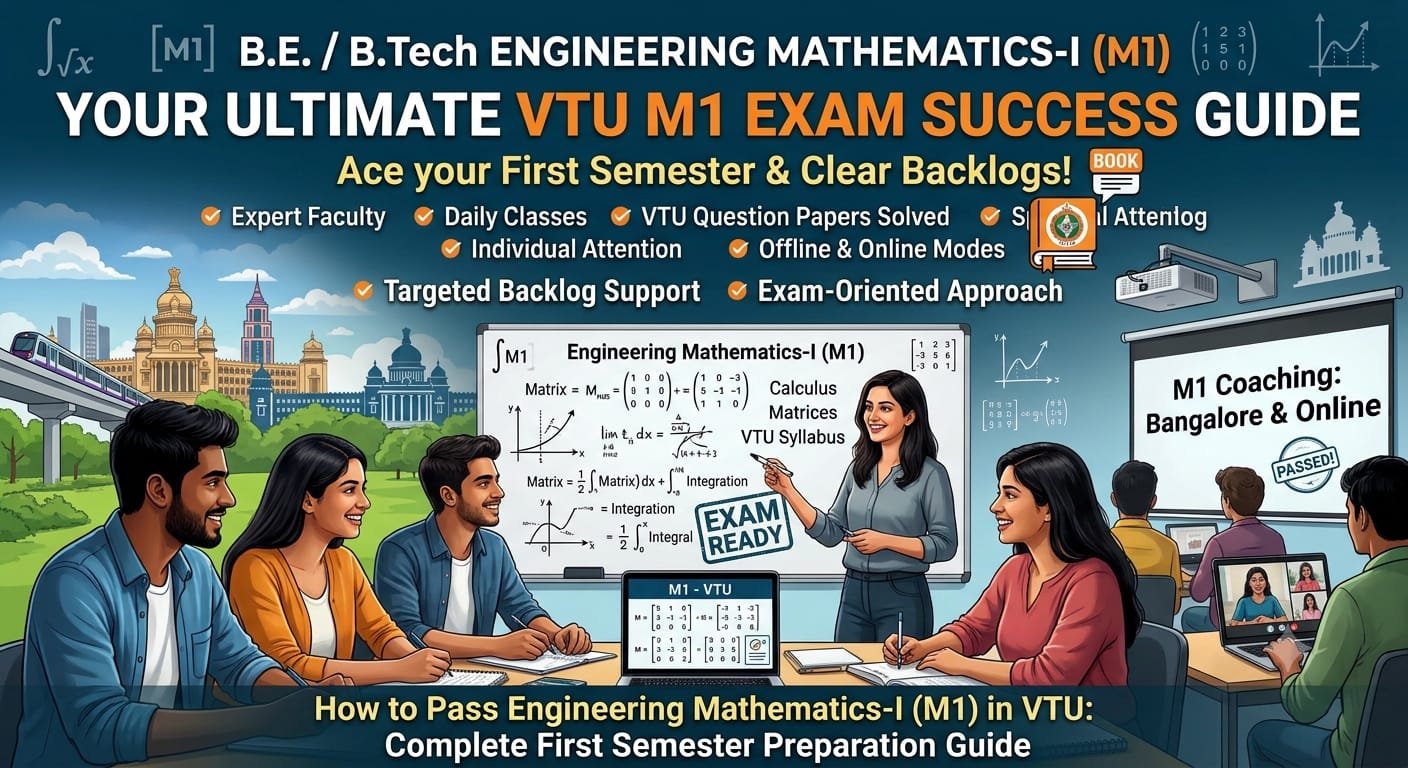
How to Pass Engineering Mathematics-I (M1) in VTU: Complete First Semester Preparation Guide
Are you a first-year B.E. or B.Tech student finding Engineering Mathematics-I difficult? Are you worried about passing your first-semester VTU Maths examination because you cannot solve numerical problems, understand mathematical concepts or remember the correct steps?
You are not alone. Engineering Mathematics-I, commonly called M1 or Engineering Maths 1, is one of the subjects in which many first-year engineering students struggle during their transition from PUC or Class 12 mathematics to university-level engineering mathematics.
The good news is that you do not need to be exceptionally good at mathematics to pass M1. What you need is a clear understanding of your VTU syllabus, systematic preparation, regular numerical practice, correct problem-solving methods and sufficient examination practice.
This guide explains how to prepare Engineering Mathematics-I for VTU first-semester examinations, how to approach the modules, how to prepare when you have limited time, and how to avoid the mistakes that commonly lead to poor marks.
Whether you are studying Computer Science Engineering, Electronics and Communication Engineering, Electrical Engineering, Mechanical Engineering or Civil Engineering, this guide will help you develop a practical preparation strategy.
At GATEIIT, we believe that students should not simply memorise mathematical formulas. They should understand how to apply them, recognise different problem patterns and develop the confidence to solve examination questions independently.
1. Why do many first-year engineering students find M1 difficult?
For many students, the difficulty begins immediately after entering engineering college.
In PUC, students may have studied mathematics with a particular examination pattern. However, engineering mathematics introduces more advanced concepts, different applications and a greater emphasis on mathematical problem-solving.
Some common difficulties include:
- Weak mathematical fundamentals
Students who are not comfortable with differentiation, integration, algebra, trigonometry, logarithms and basic mathematical identities may struggle to understand advanced topics.
- Difficulty understanding mathematical concepts
Students sometimes memorise formulas without understanding when or why they should be used. When the question is presented differently in the examination, they become confused.
- Inability to solve numerical problems independently
Understanding a solved example is not the same as solving a new problem. Many students can follow a teacher’s explanation but cannot reproduce the solution without assistance.
- Lack of regular practice
Mathematics requires continuous practice. Studying for several hours only a few days before the examination is rarely an effective preparation strategy.
- Confusion about the VTU syllabus
Students sometimes follow old question papers, outdated notes or YouTube lectures belonging to a different VTU scheme.
- Examination fear
Some students understand the subject but lose confidence when they see lengthy numerical questions or unfamiliar problem variations.
The solution is not to study everything randomly. It is to prepare the correct syllabus systematically and practise questions according to your university’s examination requirements.
2. First understand your VTU Engineering Mathematics-I syllabus
Before beginning your preparation, identify your applicable VTU scheme, semester, engineering stream and subject code.
This is particularly important because VTU introduced the common 2025 scheme for first-year engineering programmes from the academic year 2025–26, with stream-specific Mathematics-I subjects.
For example:
| Engineering stream | Subject code under 2025 scheme |
| Computer Science Engineering | 1BMATS101 |
| Electrical and Electronics Engineering | 1BMATE101 |
| Mechanical Engineering | 1BMATM101 |
| Civil Engineering | 1BMATC101 |
The course titles and topics are not identical across streams.
For example, the CSE syllabus includes Calculus and Linear Algebra, Vector Calculus, Systems of Linear Equations, Eigenvalues and Eigenvectors, Vector Spaces and Linear Transformations.
The EEE and Mechanical streams have different topic combinations involving differential calculus, differential equations and linear algebra.
Therefore, do not blindly follow an M1 syllabus uploaded several years ago.
Important: Always download the latest applicable syllabus and detailed syllabus restrictions from the official VTU website.
Official syllabus reference:
https://vtu.ac.in/en/b-e-scheme-syllabus/
3. How to prepare each module of Engineering Mathematics-I
There is no single universal list of five M1 modules that applies to every engineering branch. The correct module-wise preparation must be based on your subject code.
The following are examples of how students should approach the major topic groups.
A. Calculus and Partial Differentiation
Depending on your stream, this area may include:
- Partial differentiation.
- Total derivatives.
- Differentiation of composite functions.
- Taylor’s and Maclaurin’s series.
- Maxima and minima of functions of two variables.
- Polar curves and curvature in applicable streams.
How to prepare:
- Revise basic differentiation rules.
- Understand the difference between ordinary and partial differentiation.
- Practise identifying the variables and dependent functions.
- Learn the correct procedure for evaluating Jacobians.
- Solve different types of maxima and minima problems.
- Practise series expansion problems using the prescribed syllabus.
Do not simply memorise the final formulas. Understand how the solution progresses from one step to the next.
B. Vector Calculus
This topic is particularly important in streams where vector calculus is prescribed.
Depending on your syllabus, it may include:
- Scalar and vector fields.
- Directional derivatives.
- Solenoidal vector fields.
- Irrotational vector fields.
- Scalar potential.
How to prepare:
Start with vector algebra and partial differentiation. Then understand the physical and geometrical meaning of gradient, divergence and curl.
Practise identifying which mathematical operation is required in a given question.
For example, do not confuse divergence with curl. Although both involve differentiation, their applications and solution methods are different.
C. Matrices, Rank, Eigenvalues and Eigenvectors
This is an important area of linear algebra.
Depending on the stream, the syllabus may include:
- Elementary row transformations.
- Echelon form.
- Rank of a matrix.
- Consistency of linear equations.
- Gauss elimination method.
- Gauss-Jordan method.
- Eigenvalues and eigenvectors.
- Rayleigh’s power method.
- Applications of matrices.
How to prepare:
Begin with basic matrix operations. Practise row transformations carefully and understand how to reduce a matrix into the required form.
For eigenvalues and eigenvectors, learn the characteristic equation and practise the complete procedure.
Pay particular attention to arithmetic accuracy. A small calculation mistake in the middle of a solution can affect the remaining steps.
D. Vector Spaces and Linear Transformations
These topics are particularly relevant to the 2025 CSE Mathematics-I syllabus.
Students should understand:
- Vector spaces.
- Linear combinations.
- Linear span.
- Linear independence and dependence.
- Basis and dimension.
- Row space and column space.
- Inner products and orthogonality.
- Linear transformations.
- Rank and nullity.
- Rank-Nullity Theorem.
How to prepare:
These topics require conceptual understanding rather than memorisation alone.
Start with simple examples of vectors and linear combinations. Understand what makes a set linearly independent and how a basis is determined.
Practise identifying whether a transformation is linear and learn the relationship between rank and nullity.
E. Differential Equations
For streams where ordinary differential equations are included, prepare the prescribed first-order and higher-order methods.
Depending on the applicable syllabus, topics can include:
- Linear differential equations.
- Bernoulli’s differential equation.
- Exact differential equations.
- Integrating factors.
- Orthogonal trajectories.
- Higher-order differential equations.
- Variation of parameters.
- Cauchy-Euler equations.
- Engineering circuit applications.
How to prepare:
The first task is to identify the type of differential equation.
Do not begin applying formulas without checking whether the equation is linear, Bernoulli, exact or another prescribed type.
Make a separate formula and identification sheet for each method. Practise questions in which you must first identify the correct approach.
Remember: These are topic-group explanations, not a replacement for the exact five-module syllabus applicable to your branch.
4. What is the best strategy to pass VTU M1?
A successful M1 preparation strategy should combine concept learning, numerical practice, revision and examination simulation.
Here is a practical approach.
Step 1: Collect the correct study material
Before studying, collect:
- Latest VTU syllabus.
- Official detailed or blown-up syllabus.
- Applicable model question paper.
- Previous examination question papers belonging to your scheme.
- Class notes.
- A reliable engineering mathematics textbook.
- A separate formula notebook.
Avoid collecting dozens of different PDFs and books. Too much study material often creates confusion.
Step 2: Divide every module into smaller topics
Do not write “Complete Module 1” in your daily timetable.
Instead, divide the module into individual concepts and problem types.
For example:
- Understand the concept.
- Learn the formula.
- Study two solved examples.
- Solve five basic problems.
- Solve five examination-level problems.
- Revise the mistakes.
This makes preparation measurable.
Step 3: Learn the method before memorising the formula
For every topic, understand:
- What type of question is being asked?
- Which formula or theorem is applicable?
- What are the initial steps?
- How should intermediate calculations be performed?
- What is the expected final answer?
Students who understand the solution method are generally better prepared for unfamiliar numerical variations.
Step 4: Practise by writing solutions
Watching a two-hour mathematics lecture does not mean that you have completed two hours of mathematics practice.
Keep a notebook and solve questions independently.
Whenever you get stuck, identify the exact step you do not understand.
Step 5: Revise every module regularly
Do not finish a module and forget it until the final week.
Keep at least one revision session for previously completed topics every week.
Step 6: Solve examination-style papers
After completing the prescribed syllabus, solve applicable model papers and previous papers under timed conditions.
Check whether you can:
- Identify the correct method.
- Complete numerical calculations.
- Manage the examination duration.
- Present the solution neatly.
- Attempt questions from all required modules.
5. How to prepare M1 in 30 days
If you have approximately one month before the examination, you can follow this suggested timetable.
| Preparation period | Main objective |
| Days 1–5 | Understand the syllabus and cover the first set of topics |
| Days 6–10 | Complete the next set of topics and practise numerical problems |
| Days 11–15 | Cover the remaining topics systematically |
| Days 16–20 | Complete pending topics and solve module-wise questions |
| Days 21–25 | Revise formulas and practise examination-style papers |
| Days 26–30 | Attempt mock examinations, correct mistakes and revise |
This is a flexible study plan, not a claim that every student’s five modules require exactly the same number of days.
Students with weak fundamentals may need additional time for basic mathematical concepts.
Suggested daily study routine:
- 30 minutes: Revise previously learned formulas.
- 60 minutes: Learn a new concept.
- 60 minutes: Solve numerical problems.
- 30 minutes: Review mistakes and revise.
Total: Approximately three hours per day.
Consistency is more valuable than studying for ten hours on one day and doing nothing for the next four days.
6. How to prepare M1 in 15 days
Are you starting your preparation late?
Do not panic. First identify the topics you have already studied and the topics that remain.
A suggested 15-day plan:
| Days | Preparation activity |
| 1–3 | Cover the first priority topics from the applicable syllabus |
| 4–6 | Study the next set of topics and practise standard problems |
| 7–9 | Cover the remaining priority topics |
| 10–11 | Practise module-wise examination questions |
| 12–13 | Attempt timed model papers |
| 14–15 | Formula revision and correction of common mistakes |
Do not spend the entire 15 days watching lectures.
Your preparation should include substantial independent problem-solving.
Also, do not skip an entire module without checking the applicable examination pattern and question requirements.
7. How to prepare M1 in the last 7 days
If you have only seven days left, your strategy must change.
At this stage, concentrate on topics you can realistically learn and practise properly.
Day 1: Review the syllabus and identify your strongest and weakest topics.
Day 2: Revise the first group of important problem types and solve questions.
Day 3: Practise the next group of topics.
Day 4: Cover the remaining prescribed topics and revise essential formulas.
Day 5: Solve a model paper under examination conditions.
Day 6: Correct mistakes and practise questions that you could not solve independently.
Day 7: Revise formulas, standard methods and previously solved problems.
Do not start several new textbooks or attempt to learn every difficult concept from scratch on the last day.
Your objective should be to maximise your understanding and accuracy in the time available.
8. How to score marks in VTU Engineering Mathematics-I
Knowing mathematics and presenting mathematics in an examination are two different skills.
A student may understand a concept but lose marks because the solution is incomplete or poorly presented.
Follow these examination-writing practices.
- Write the relevant formula
Before substituting values, write the applicable mathematical formula wherever appropriate.
- Show intermediate steps
Avoid jumping directly from the question to the final answer.
- Maintain mathematical accuracy
Check signs, brackets, powers, differentiation and matrix calculations.
- Present matrices neatly
Keep rows and columns aligned. Clearly show elementary row operations.
- Draw diagrams where relevant
For topics involving curves, vectors or geometrical interpretations, use clear diagrams when required.
- Do not leave questions blank unnecessarily
If you understand part of a problem, write the valid steps you know. However, do not assume that incomplete or incorrect work automatically receives marks.
- Manage your time
Do not spend an excessive amount of time on one difficult question while leaving other questions unfinished.
Always follow the current VTU examination instructions and the applicable question-paper pattern.
9. Common mistakes that cause students to fail M1
Students often repeat the same mistakes throughout the semester.
Here are some of the most important ones to avoid.
| Common mistake | Better approach |
| Studying without checking the latest syllabus | Confirm your subject code and scheme |
| Memorising formulas without understanding | Learn the application of each formula |
| Watching lectures without solving problems | Practise independently after every concept |
| Ignoring difficult modules | Prepare all prescribed modules systematically |
| Studying only the night before the examination | Follow a regular study timetable |
| Depending entirely on previous question papers | Use them alongside the current syllabus |
| Avoiding basic mathematics revision | Strengthen differentiation, algebra and other prerequisites |
| Not attempting mock papers | Practise under examination conditions |
| Ignoring mistakes in calculations | Maintain a separate error notebook |
One of the biggest mistakes is believing that reading a solved answer means you know how to solve the problem.
Close the book and attempt the same problem independently. That is the real test of your preparation.
10. Can students with weak PUC Mathematics pass Engineering Mathematics-I?
Yes. Students with weak mathematics fundamentals can improve significantly with systematic guidance and regular practice.
However, they should not directly jump into advanced engineering mathematics without revising the necessary basics.
Start with:
- Algebraic simplification.
- Basic trigonometric identities.
- Logarithmic and exponential functions.
- Matrices and determinants.
- Basic functions and graphs.
The time required for this revision depends on the student’s existing understanding.
A student who has forgotten differentiation may need a few focused sessions before beginning advanced calculus. Another student may need more extensive support.
The important thing is to identify the learning gap rather than repeatedly attempting problems without understanding the underlying concepts.
11. What should you do if you have already failed VTU M1?
Failing Engineering Mathematics-I in the first semester does not mean that you cannot succeed in engineering.
However, repeating the same preparation method may produce the same result.
Before preparing for the next examination, identify why you could not pass.
Ask yourself:
- Did I understand the mathematical concepts?
- Did I complete all prescribed modules?
- Was I unable to solve numerical questions independently?
- Did I run out of time during the examination?
- Did I make calculation mistakes?
- Did I prepare using an outdated syllabus?
- Did I practise enough model questions?
If you cannot identify the reason, a structured academic assessment can help determine your weak areas.
A personalised study plan can then be created based on your current mathematical knowledge, remaining preparation time and applicable VTU syllabus.
Students who have failed M1, have a first-semester backlog or are preparing for a supplementary examination should focus on correcting the underlying learning gaps instead of simply collecting more notes.
12. How can personal attention help you prepare for M1?
Engineering Mathematics is a subject in which individual learning difficulties matter.
Two students studying the same module may have completely different problems.
One student may understand differentiation but struggle with integration. Another may understand the concepts but make errors in calculations. A third student may have difficulty understanding the language of mathematical questions.
A structured one-to-one or small-group teaching approach can help address these differences.
A good M1 tuition programme should include:
- Assessment of existing mathematical fundamentals.
- Explanation of concepts from the basics.
- Topic-wise numerical problem-solving.
- Step-by-step explanation of difficult problems.
- Practice questions based on the applicable VTU scheme.
- Regular revision and tests.
- Identification of individual weaknesses.
- Doubt-clearing sessions.
- Examination-oriented preparation.
Students should receive opportunities to solve problems independently instead of merely copying solutions from the board.
13. Engineering Mathematics-I tuition in Bangalore and online
If you are struggling with M1 despite attending regular college classes, additional academic support may help you understand the subject more effectively.
GATEIIT – Gate Indian Institute of Tutorials provides academic coaching and personalised learning support for engineering mathematics and other engineering subjects.
Students can enquire about Engineering Mathematics-I tuition through online classes or classroom learning at the GATEIIT centre in JP Nagar, Bengaluru.
The academic support can be planned according to:
- VTU first-semester M1 syllabus.
- Applicable engineering stream and subject code.
- Student’s mathematical fundamentals.
- Topics requiring additional attention.
- Internal assessment and semester examination preparation.
- Backlog and supplementary examination requirements.
Who can benefit from GATEIIT M1 tuition?
- First-semester B.E. students.
- First-semester B.Tech students.
- Students struggling with Engineering Mathematics-I.
- Students who have weak PUC mathematics fundamentals.
- Students preparing for VTU semester examinations.
- Students who have failed M1 and need backlog preparation.
- Students looking for online engineering mathematics tuition.
- Students looking for Engineering Mathematics tuition in Bangalore.
Why consider GATEIIT?
- Individual academic attention.
- Concept-based mathematics teaching.
- Personalised learning support.
- Online and classroom learning options.
- Flexible academic planning, subject to availability.
- Regular numerical practice.
- Doubt-clearing and revision support.
- Preparation based on the student’s applicable syllabus.
The objective is not just to help students complete the syllabus. It is to help them understand the subject and become confident in solving mathematical problems independently.
GATEIIT contact details
GATEIIT – Gate Indian Institute of Tutorials
3rd Floor, #1743, Sri Raghavendra Plaza,
17th Main Road, JP Nagar 2nd Phase,
Bengaluru – 560078, Karnataka.
Call / WhatsApp: 8884416154 / 8884416155
Website: https://www.gateiit.com
Students and parents can contact GATEIIT to discuss the applicable VTU M1 syllabus, available batches, class schedules and course fees.
14. Frequently Asked Questions about VTU Engineering Mathematics-I (M1)
1. Is Engineering Mathematics-I difficult for first-year engineering students?
Engineering Mathematics-I can be challenging because it introduces new concepts and advanced problem-solving methods. Students with weak mathematical fundamentals may initially struggle. Regular practice and concept-based learning can make the subject easier to understand.
2. How can I pass M1 in VTU?
Start by understanding your applicable VTU syllabus. Divide the modules into smaller topics, revise the mathematical basics, learn the problem-solving methods and practise examination-style questions. Attempt timed mock papers before the examination.
3. How many hours should I study M1 daily?
Approximately two to three focused hours per day can be a useful starting point for students who have sufficient preparation time. Students with weak fundamentals or pending topics may need additional study time.
4. Can I pass Engineering Mathematics-I in 15 days?
It may be possible depending on your existing preparation, mathematical fundamentals and the amount of syllabus remaining. Focused revision and systematic numerical practice are essential. No fixed preparation duration can guarantee a pass.
5. Can I pass VTU M1 in seven days?
Students with some existing preparation can use the final seven days for targeted revision, practice and mock examinations. Students starting from zero should understand that seven days may not be sufficient to master the complete syllabus.
6. Which topics should I study first for M1?
There is no universal priority list for every VTU engineering stream. Check your subject code, prescribed modules, detailed syllabus restrictions and current model question paper before deciding which topics to study first.
7. Are previous-year question papers sufficient for VTU M1?
Previous question papers are useful for understanding examination style and practising problem types. However, they should not replace the current syllabus, especially when VTU has introduced a new scheme or revised syllabus.
8. Is the M1 syllabus the same for CSE, ECE, EEE and Mechanical Engineering?
No. Under the VTU 2025 scheme, Mathematics-I is stream-specific. Students must follow the applicable subject code and syllabus.
9. Can students with weak PUC Mathematics pass M1?
Yes. They can improve through revision of prerequisite mathematical concepts, systematic teaching and regular numerical practice. The preparation plan should address their individual learning gaps.
10. Where can I get Engineering Mathematics-I tuition in Bangalore?
Students can enquire with GATEIIT for Engineering Mathematics-I academic support in JP Nagar, Bangalore, and online learning options. Availability, schedules and fees can be confirmed directly with the institute.
11. Does GATEIIT provide online M1 tuition?
Students can enquire about online Engineering Mathematics-I tuition, personalised teaching and available batch schedules through GATEIIT.
12. Does GATEIIT help students who have failed M1?
GATEIIT can discuss individual academic support for students preparing for M1 backlog or supplementary examinations, subject to the applicable syllabus and batch availability.
15. Final advice: Do not wait until the examination to understand M1
Engineering Mathematics-I should not be treated as a subject that can be completed by memorising a few formulas immediately before the examination.
The right preparation begins with understanding your syllabus, strengthening your basics, learning concepts step by step and practising numerical problems regularly.
If you are finding M1 difficult, do not lose confidence. Identify the topics you cannot understand, seek help when necessary and follow a realistic study timetable.
A student who is currently struggling with mathematics can make meaningful progress with the right guidance and consistent effort.
Need help with VTU Engineering Mathematics-I?
If you are a first-semester B.E./B.Tech student looking for M1 tuition in Bangalore or online, contact GATEIIT to discuss your syllabus, weak topics and preparation requirements.
GATEIIT – Gate Indian Institute of Tutorials
JP Nagar 2nd Phase, Bengaluru.
Call / WhatsApp: 8884416154 / 8884416155
Website: www.gateiit.com
Understand the concepts. Practise the problems. Prepare with confidence.
Important official academic reference
VTU – UG Scheme and Syllabus:
https://vtu.ac.in/en/b-e-scheme-syllabus/
Students should always refer to the latest syllabus applicable to their academic year and engineering stream.