
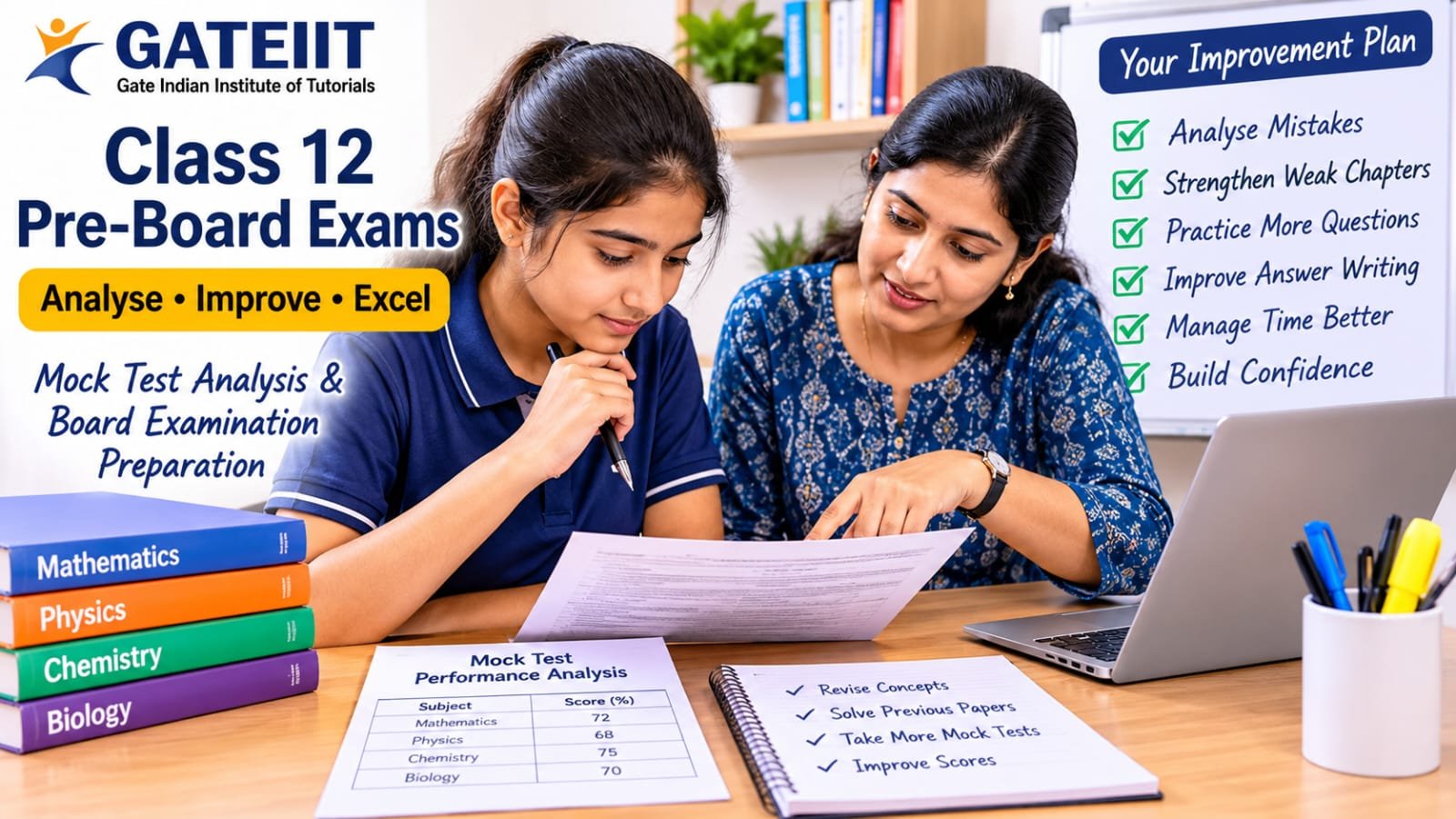
A low score in a Class 12 pre-board examination does not necessarily mean that a student will perform poorly in the final board examination. Similarly, scoring well in a school mock test does not guarantee an equally good result in the actual examination.
What matters most is what students do after receiving their pre-board results.
Pre-board examinations and mock tests provide an opportunity to identify conceptual weaknesses, improve answer-writing skills, understand examination time management and develop a more effective revision strategy before the final board examinations.
Students studying under CBSE, ICSE, ISC, Karnataka 2nd PUC, IGCSE, IB and other applicable Class 12 curricula can benefit from a structured assessment and improvement programme.
However, simply attempting more question papers is not enough. Students must learn how to interpret their performance, understand why they lost marks and convert that information into measurable academic improvement.
This guide explains how Class 12 students can use pre-board examinations and mock-test assessments more effectively.
1. Why Are Class 12 Pre-Board Examinations Important?
Pre-board examinations are generally conducted by schools before the final board examinations. They provide students with an opportunity to experience a more formal examination environment and assess their preparation.
Unlike regular classroom tests, pre-board examinations usually require students to demonstrate their understanding across a larger portion of the syllabus.
They help students evaluate several important aspects of examination readiness.
Conceptual understanding: Can the student explain and apply concepts rather than simply memorising definitions and formulas?
Syllabus completion: Are all important chapters sufficiently prepared?
Answer-writing ability: Can the student present answers clearly, logically and according to the requirements of the question?
Time management: Can the student complete the examination within the prescribed duration?
Accuracy: Are avoidable calculation errors, incorrect units, incomplete answers and presentation mistakes reducing marks?
Examination confidence: Can the student handle a complete examination paper independently?
The real purpose of a pre-board examination is not merely to produce a percentage. It is to identify the specific improvements required before the final examination.
2. Why Do Students Sometimes Score Less in Pre-Board Examinations?
Students and parents often become concerned when pre-board marks are lower than expected.
Before deciding that additional tuition or extensive revision is necessary, it is important to understand the actual reasons behind the performance.
The following are common causes.
A. Incomplete understanding of fundamental concepts
Students sometimes memorise important answers without understanding the underlying principles.
This approach may work for straightforward questions but becomes difficult when an examination asks students to apply concepts in unfamiliar situations.
For example, a student may remember a Physics formula but struggle to identify which formula is appropriate for a numerical problem.
The solution is to strengthen conceptual understanding and practise application-based questions.
B. Inadequate chapter-wise preparation
A student may prepare selected chapters thoroughly while leaving other chapters insufficiently revised.
This creates difficulty when the examination requires knowledge from different portions of the syllabus.
Students should maintain a chapter-wise preparation record rather than depending entirely on their overall examination score.
C. Poor answer presentation
Knowing an answer and communicating it effectively are two different skills.
Students may lose marks because of:
- Missing steps in mathematical calculations.
- Incomplete explanations.
- Poorly labelled diagrams.
- Incorrect scientific terminology.
- Missing units in numerical answers.
- Unclear presentation of derivations.
- Failure to address all parts of a question.
Answer presentation should be practised alongside conceptual learning.
D. Incorrect time allocation
Some students spend too much time on difficult questions and leave easier questions incomplete.
Others write lengthy answers where concise explanations would be sufficient.
Students must learn to allocate time according to the examination duration, question requirements and applicable marking scheme.
E. Examination anxiety and lack of practice
Students who are accustomed to studying chapters individually may find it difficult to concentrate throughout a complete examination.
Regular timed mock examinations can help them become more comfortable with examination conditions.
3. How Should Students Analyse Their Pre-Board Examination Results?
One of the most important academic activities after a pre-board examination is analysing the evaluated answer script.
Simply looking at the total marks does not explain why a student lost marks.
A more useful approach is to examine each incorrect, incomplete or unanswered question.
Students can classify their mistakes into the following categories.
| Mistake category | What it indicates | Recommended improvement |
| Conceptual error | The underlying concept is not understood | Relearn the concept |
| Memory error | Formula, definition or fact forgotten | Structured revision |
| Application error | Unable to apply knowledge | Solve varied questions |
| Calculation error | Incorrect mathematical steps | Practise calculations |
| Question interpretation | Misunderstood what was asked | Analyse command words |
| Presentation error | Incomplete or unclear answers | Practise answer writing |
| Time-management error | Unable to complete the paper | Timed mock tests |
| Careless error | Avoidable mistakes | Improve checking habits |
This classification helps students distinguish between a knowledge problem and an examination-performance problem.
For example, if a student knows a mathematical method but repeatedly makes arithmetic mistakes, revising the entire chapter may not be the most effective solution.
The student may benefit more from targeted calculation practice and systematic checking.
A practical example of mock-test analysis
Consider a hypothetical student who scores 62 out of 80 in a subject examination.
The total score alone does not explain the areas requiring attention.
Suppose the teacher’s assessment identifies the following approximate pattern of lost marks:
| Area of improvement | Marks lost |
| Conceptual misunderstandings | 6 |
| Calculation mistakes | 4 |
| Incomplete answers | 3 |
| Time-management problems | 3 |
| Other avoidable errors | 2 |
| Total marks lost | 18 |
This is an illustrative diagnostic breakdown, not a prescribed board marking formula.
The student should not automatically spend equal time on every category.
Instead, the teacher should identify the most frequent and academically significant mistakes and prepare a focused improvement plan.
4. How to Identify Weak Chapters Before the Final Board Examination
A subject-wise score may hide significant differences in chapter-level preparation.
For example, a student may perform well in Physics overall but remain weak in particular numerical topics or derivations.
Similarly, a student may score reasonably well in Mathematics while struggling with selected problem-solving chapters.
A chapter-wise analysis makes revision more precise.
Students can use the following simple classification.
| Preparation status | Meaning | Action |
| Strong | Concepts understood and questions solved independently | Periodic revision |
| Moderate | Basic understanding but inconsistent performance | Additional practice |
| Weak | Frequent conceptual or application mistakes | Focused teaching and practice |
| Not prepared | Significant syllabus portion remains incomplete | Prioritised preparation |
Students should update this classification after each mock examination.
It is also important to distinguish between a chapter that has never been properly studied and one that has been studied but needs revision.
The teaching approach for these two situations should be different.
5. How to Improve Answer-Writing Skills for Class 12 Board Examinations
Answer writing plays an important role in demonstrating subject knowledge.
Students should practise presenting answers according to the nature of the question rather than following the same writing style for every subject.
Mathematics
Students should focus on:
- Writing appropriate formulas.
- Showing essential calculation steps.
- Maintaining logical progression.
- Avoiding unexplained jumps in solutions.
- Checking signs, substitutions and final answers.
Physics
Students should practise:
- Writing relevant principles and laws.
- Identifying the correct equations.
- Showing numerical calculations.
- Drawing clear and labelled diagrams wherever required.
- Including appropriate units.
Chemistry
Students should pay attention to:
- Balanced chemical equations.
- Correct chemical notation.
- Reaction conditions where required.
- Proper explanation of concepts.
- Accurate numerical calculations.
Biology
Students should develop the ability to:
- Use correct biological terminology.
- Explain processes in logical sequences.
- Draw clear and labelled diagrams.
- Present differences and classifications systematically.
- Write answers according to the question’s requirements.
Commerce and Humanities
Students should practise:
- Structuring long answers logically.
- Using appropriate terminology.
- Presenting calculations and accounting formats correctly.
- Explaining concepts with relevant examples.
- Maintaining clarity in case-based and application-oriented answers.
These are general preparation suggestions. Students must follow the prescribed syllabus, current examination pattern and marking scheme applicable to their particular board and subject.
6. How Many Mock Tests Should Class 12 Students Attempt?
There is no universal number of mock examinations that guarantees a particular board examination score.
The appropriate number depends on:
- The student’s syllabus completion.
- Previous academic performance.
- Remaining preparation time.
- Subject difficulty.
- Examination schedule.
- Ability to analyse and correct mistakes.
Attempting ten question papers without reviewing mistakes may be less useful than attempting fewer papers with proper evaluation and improvement.
A meaningful mock-test cycle should contain four stages.
Stage 1: Attempt the examination
Complete the paper under the prescribed time limit without unnecessary assistance.
Stage 2: Evaluate the answers
Identify correct answers, incomplete answers, conceptual errors and presentation problems.
Stage 3: Discuss the mistakes
Understand why marks were lost and clarify the underlying concepts.
Stage 4: Reattempt similar questions
Practise questions involving the same concepts to check whether the mistake has been corrected.
This final stage is particularly important. Improvement should be demonstrated through subsequent performance, not simply through an explanation of the earlier mistake.
7. A Practical 30-Day Pre-Board to Board Examination Improvement Plan
Students who have approximately one month remaining before their final examinations can use the following framework.
The plan should be adapted according to the actual board examination timetable, syllabus completion and subject requirements.
Days 1–5: Performance diagnosis
- Collect the evaluated pre-board answer scripts.
- Identify weak chapters in every subject.
- Classify conceptual and examination-related mistakes.
- Identify incomplete syllabus portions.
- Prepare a subject-wise priority list.
Expected outcome: A clear understanding of what needs improvement.
Days 6–12: Focused academic improvement
- Revise weak concepts.
- Rework incorrectly answered questions.
- Practise important numerical problems.
- Improve derivations and diagrams.
- Complete pending syllabus portions according to priority.
Expected outcome: Better conceptual understanding and reduced repeated mistakes.
Days 13–19: Subject-wise examination practice
- Solve board-pattern questions.
- Practise previous-year questions where appropriate.
- Attempt selected timed sections.
- Practise long-answer and application-based questions.
- Review answers against relevant marking criteria.
Expected outcome: Improved question-solving and answer presentation.
Days 20–25: Full-length mock examinations
- Attempt complete subject-wise mock papers.
- Follow the applicable examination duration.
- Avoid interruptions during the test.
- Evaluate the completed answer scripts.
- Compare performance with earlier assessments.
Expected outcome: Improved examination readiness and time management.
Days 26–30: Final revision
- Revise important formulas and definitions.
- Review frequently repeated mistakes.
- Practise weak topics briefly.
- Revise diagrams, equations and important concepts.
- Maintain a balanced study and rest schedule.
Expected outcome: Better organisation and confidence before the final examination.
Students should adjust this schedule when their actual board examination dates are closer or when substantial syllabus portions remain incomplete.
8. How Parents Can Help Students After Pre-Board Results
Pre-board results can create unnecessary pressure at home, particularly when parents expect higher marks.
However, comparing students with classmates or repeatedly criticising their performance rarely helps them understand their academic weaknesses.
Parents can provide more meaningful support by following a constructive approach.
Discuss the performance, not just the marks.
Ask which chapters were difficult and why certain questions could not be completed.
Encourage a realistic improvement target.
Set achievable academic goals based on the student’s current preparation.
Monitor consistency rather than study hours alone.
The quality of revision and question-solving practice is more important than simply recording the number of hours spent studying.
Encourage independent problem-solving.
Students should first attempt questions themselves before looking at solutions.
Seek academic assistance when necessary.
If a student repeatedly struggles with particular concepts, individual academic attention or subject-specific guidance may help.
The objective should be to create a supportive learning environment in which students can identify their weaknesses and work towards improving them.
9. Why Personalised Assessment and Academic Mentoring Can Make a Difference
Not every Class 12 student requires the same type of academic support.
A student who understands concepts but loses marks because of poor time management needs a different preparation strategy from a student who has not understood fundamental concepts.
Similarly, a student who has completed the syllabus but struggles with application-based questions may require more practice rather than extensive theory revision.
A personalized assessment approach can help identify these differences.
An effective academic assessment programme should consider:
- Existing subject knowledge.
- Chapter-wise preparation.
- Accuracy in solving questions.
- Answer-writing quality.
- Time utilisation.
- Repeated examination mistakes.
- Progress across successive assessments.
This makes academic support more focused and reduces unnecessary repetition of already-understood topics.
10. Class 12 Pre-Board and Mock Test Preparation at GATEIIT Bangalore
GATEIIT provides academic tuition and examination preparation support for students studying in different school boards and curricula.
Students preparing for Class 12 examinations can explore subject-wise tuition, revision support, test and discussion programmes and academic guidance according to their requirements and batch availability.
The existing GATEIIT Class XI, XII and PUC tuition programme covers applicable subjects across different curricula.
Academic support areas
Subject-wise preparation
Academic support in subjects such as Mathematics, Physics, Chemistry, Biology, Statistics, English, Economics, Accountancy and other applicable subjects, subject to faculty availability.
Concept clarification
Focus on understanding fundamental concepts and resolving subject-specific academic difficulties.
Examination-oriented practice
Practice of relevant questions, numerical problems, derivations, diagrams and structured answers.
Mock tests and assessments
Examination practice through topic-wise, unit-wise and subject-wise assessments, according to the applicable programme.
Test discussions
Review of mistakes and clarification of difficult questions.
Revision and performance improvement
Identification of weak topics and focused revision before the final examinations.
Boards and curricula covered
GATEIIT’s school and PUC tuition offerings include academic support for students following applicable:
- CBSE curriculum.
- ICSE curriculum.
- ISC curriculum.
- Karnataka State Board / 1st and 2nd PUC.
- IGCSE curriculum.
- IB curriculum.
- Other applicable school curricula, subject to subject and faculty availability.
Students and parents should confirm the current subject offerings, curriculum compatibility, examination schedules and batch availability before enrolment.
Classroom and individual academic support
GATEIIT is located in JP Nagar 2nd Phase, Bangalore.
Students and parents can enquire about suitable classroom, online or individual teaching arrangements depending on the subject, programme and available faculty.
Who can enquire?
- Class 12 students preparing for pre-board examinations.
- Students require additional revision before final board examinations.
- Students struggling with selected subjects or chapters.
- Students seeking structured mock-test practice.
- Parents looking for subject-specific academic support.
For programme details and current availability, contact GATEIIT directly.
GATEIIT – Gate Indian Institute of Tutorials
Address: 3rd Floor, #1743, Sri Raghavendra Plaza, 17th Main Road, JP Nagar 2nd Phase, Bangalore – 560078, Karnataka, India.
Website: https://www.gateiit.com/
Phone: 8884416154 / 8884416155
Existing Class XI, XII and PUC tuition programme:
11. Frequently Asked Questions About Class 12 Pre-Board Examinations and Mock Tests
1. Are pre-board examination marks an accurate prediction of final board examination results?
Pre-board marks provide an indication of a student’s current preparation but cannot accurately predict the final result. Differences in question papers, evaluation, preparation and examination performance can influence the final marks.
Students should use pre-board results to identify areas requiring improvement rather than treating them as a final assessment of their academic ability.
2. What should students do if they score poorly in Class 12 pre-board examinations?
Students should first analyse their evaluated answer scripts. They should identify weak chapters, conceptual mistakes, incomplete answers and time-management problems.
After identifying these issues, they should prepare a focused revision plan and attempt additional practice questions to check whether their performance improves.
3. How many full-length mock tests should a Class 12 student attempt before board examinations?
There is no fixed number suitable for every student. The number depends on syllabus completion, examination dates and individual preparation levels.
Students should prioritise properly timed examinations followed by detailed evaluation and correction of mistakes.
4. Are previous-year question papers sufficient for Class 12 board examination preparation?
Previous-year question papers are useful for understanding question styles and practising examination questions. However, they should be combined with complete syllabus revision, textbook learning, current sample papers and other relevant practice materials.
Students should not depend entirely on memorising previous-year answers.
5. How can students improve their answer-writing skills before board examinations?
Students should practise writing answers under timed conditions, follow the question requirements, include essential steps and explanations, use correct terminology and present diagrams clearly wherever required.
Reviewing evaluated answers can help identify repeated presentation mistakes.
6. What is the difference between a pre-board examination and a mock test?
A pre-board examination is generally conducted by a school as preparation for the final board examination. A mock test is a practice assessment designed to simulate some or all aspects of the actual examination.
Mock tests can be conducted at different stages of preparation, whereas pre-board examinations are usually part of the school’s pre-final examination schedule.
7. Should students revise weak chapters or attempt more mock tests?
Students should first understand why they are performing poorly. If the problem is conceptual understanding, focused chapter revision is necessary. If they understand the concepts but struggle with examination execution, additional timed practice may be more beneficial.
A balanced combination of revision and assessment is generally more useful than concentrating on only one activity.
8. Can students from CBSE, ICSE, ISC and Karnataka 2nd PUC follow the same mock-test preparation strategy?
The broad principles of preparation, assessment, error analysis and revision are useful across boards. However, question-paper formats, syllabuses, marking schemes and subject requirements differ.
Students should use examination papers and preparation materials appropriate to their own board and current academic year.
9. When should Class 12 students start pre-board and final board examination preparation?
Preparation should ideally begin well before the pre-board examinations, with regular syllabus coverage and revision throughout the academic year.
After the pre-board examination, students should use the available time to correct identified weaknesses and practise according to their actual examination timetable.
10. Does GATEIIT provide Class 12 tuition and mock-test preparation in Bangalore?
GATEIIT offers Class XI, XII and PUC tuition across applicable school curricula and subjects, along with test and discussion programmes. Students and parents can contact the JP Nagar, Bangalore centre to enquire about current Class 12 subject-wise tuition, assessment programmes and available batches.
Conclusion: Use Pre-Board Results as a Roadmap for Improvement
Class 12 pre-board examinations should not be viewed merely as another set of marks.
They provide valuable information about a student’s understanding, revision, accuracy, answer presentation and examination readiness.
Students who analyse their mistakes, revise weak chapters systematically and practise under realistic examination conditions can make better use of the time available before their final board examinations.
The most effective approach is not simply to attempt more papers. It is to learn from every paper, correct repeated mistakes and demonstrate improvement in subsequent assessments.
For students who need additional subject-wise academic support, GATEIIT offers tuition and examination preparation programmes in JP Nagar, Bangalore.
Understand your mistakes, improve your preparation and approach your final Class 12 board examinations with greater confidence.
Contact GATEIIT: 8884416154 / 8884416155
Website: www.gateiit.com