
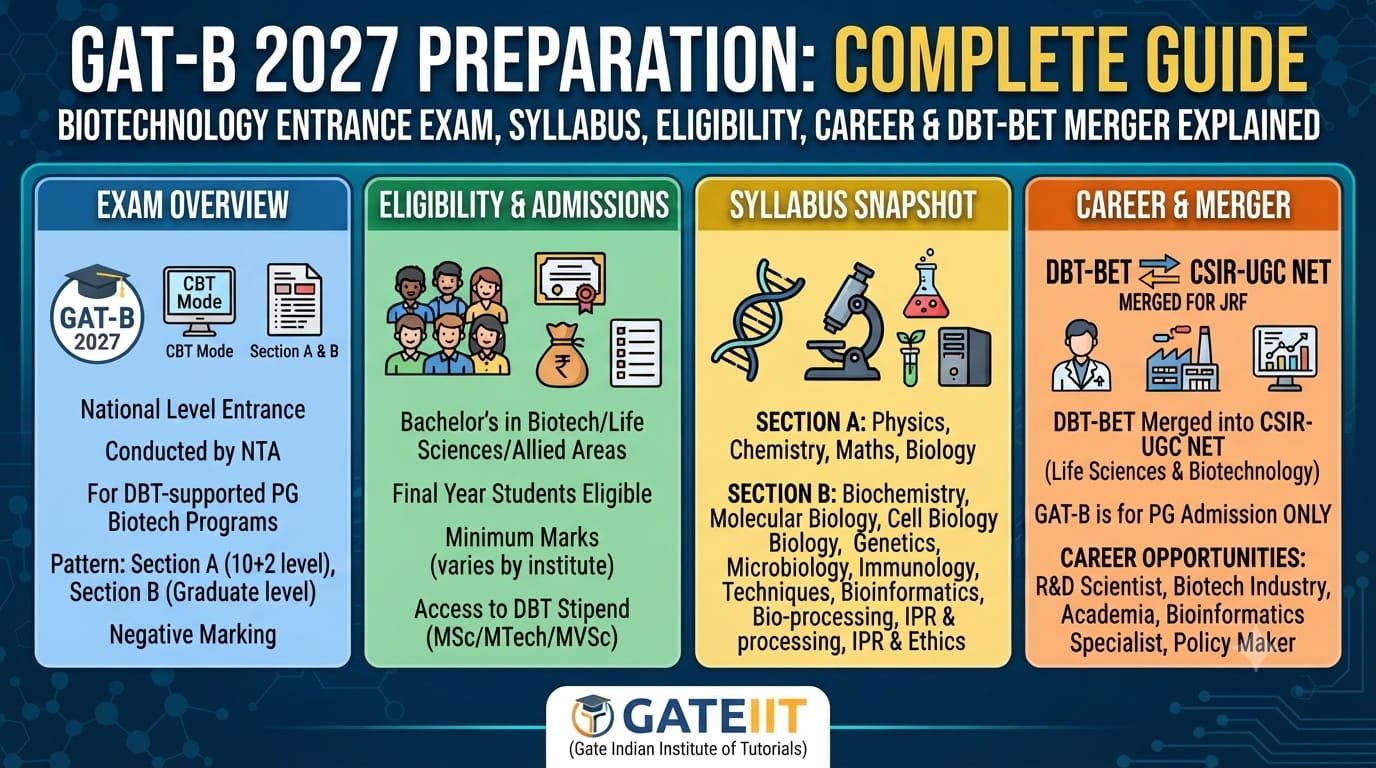
Are you a Biotechnology graduate planning to pursue an MSc or another postgraduate programme in Biotechnology through GAT-B 2027? Understanding the examination, participating institutions, syllabus and preparation requirements is the first step towards choosing the right postgraduate pathway.
The Graduate Aptitude Test – Biotechnology (GAT-B) is a national-level entrance examination for admission to Department of Biotechnology (DBT)-supported postgraduate programmes in Biotechnology and allied disciplines at participating Indian institutions.
For Biotechnology graduates, Microbiology students, Biochemistry aspirants, Genetics students and other Life Sciences graduates, GAT-B offers an important route towards advanced education in modern biological sciences.
However, there is an important examination update that 2027 aspirants must understand.
DBT-BET has been merged with CSIR-UGC NET Life Sciences from the December 2026 examination cycle. Consequently, students interested in DBT-supported postgraduate admission through GAT-B and those targeting research fellowships through the former BET route must now understand the distinction between these examination pathways.
At GATEIIT (Gate Indian Institute of Tutorials), we provide academic guidance and competitive examination preparation programmes for students from Biotechnology and allied Life Sciences backgrounds.
This guide explains the GAT-B 2027 preparation strategy, examination structure, academic subjects, career opportunities and the latest developments affecting Biotechnology aspirants.
1. What Is GAT-B 2027?
GAT-B stands for Graduate Aptitude Test – Biotechnology.
It is an all-India entrance examination conducted by the National Testing Agency (NTA) on behalf of the Regional Centre for Biotechnology (RCB), under the Department of Biotechnology, Government of India.
The examination evaluates candidates seeking admission to DBT-supported postgraduate programmes in Biotechnology and allied areas.
These programmes are offered through participating universities and institutions across India.
Depending on the participating institution, available programmes may include:
- MSc Biotechnology
- MSc Agricultural Biotechnology
- MSc Medical Biotechnology and allied specialisations
- MSc in other Biotechnology-related disciplines
- MTech Biotechnology and allied areas
- MVSc Animal Biotechnology
The actual programme availability and admission requirements vary between institutions.
Candidates should examine the official participating-institution list and programme-specific eligibility conditions before applying.
2. Important 2027 Update: DBT-BET and GAT-B Are No Longer the Same Examination Route
One of the most important developments for Biotechnology aspirants is the merger of DBT-BET with CSIR-UGC NET Life Sciences.
Previously, students commonly prepared for two separate examinations:
GAT-B – Graduate Admission
The examination provides an admission route to DBT-supported postgraduate programmes in Biotechnology and allied areas.
BET – Research Fellowship
The Biotechnology Eligibility Test was conducted for selection for DBT-Junior Research Fellowship opportunities.
What changed in 2026?
The Government-approved Joint CSIR–UGC–DBT JRF-NET framework was introduced from the December 2026 examination cycle.
Under the new arrangement:
- CSIR-UGC NET Life Sciences and DBT-BET have been brought together under a common examination framework.
- A revised subject titled Life Sciences and Bio-Technology (LS-BT) has been introduced.
- Biotechnology and traditional Life Sciences concepts are integrated into the revised syllabus.
- Candidates targeting relevant research fellowship opportunities must follow the new examination framework and its eligibility rules.
This means that candidates planning their 2027 preparation should not automatically follow older standalone DBT-BET examination schedules, question patterns or application announcements.
The practical distinction for 2027 aspirants:
| Your academic objective | Examination pathway to follow |
| MSc Biotechnology admission | GAT-B, subject to programme eligibility |
| DBT-supported postgraduate admission | GAT-B |
| Biotechnology research fellowship | Joint CSIR–UGC–DBT JRF-NET |
| Life Sciences JRF | Joint CSIR–UGC–DBT JRF-NET |
| PhD admission through the applicable research eligibility route | Joint examination and institutional admission rules |
Always verify the current official notification before selecting your examination.
3. GAT-B 2027 Examination Pattern
As the official GAT-B 2027 information bulletin has not yet been released, the following pattern is based on the latest available official 2026 examination bulletin.
| Particulars | GAT-B 2026 reference |
| Examination mode | Computer-Based Test |
| Duration | 3 hours |
| Medium | English |
| Question format | Multiple Choice Questions |
| Total questions | 160 |
| Questions to attempt | 120 |
| Maximum marks | 240 |
Section A – 10+2 Level Science
| Particulars | Details |
| Total questions | 60 |
| Questions to attempt | 60 |
| Subjects | Physics, Chemistry, Mathematics and Biology |
| Marks | 60 |
| Marking | +1 for correct answers; -0.5 for incorrect answers |
This section tests the fundamental scientific understanding developed during Class 11 and Class 12.
Students from Biotechnology and Life Sciences backgrounds should not underestimate this section.
Section B – Undergraduate-Level Biotechnology and Life Sciences
| Particulars | Details |
| Total questions | 100 |
| Questions to attempt | 60 |
| Subject areas | Basic Biology, Life Sciences, Biotechnology and allied areas |
| Marks | 180 |
| Marking | +3 for correct answers; -1 for incorrect answers |
Section B carries 75% of the total examination marks.
Consequently, undergraduate-level conceptual understanding, interdisciplinary knowledge and question selection play an important role in preparation.
Preparation recommendation: Students should aim to develop accuracy before attempting questions simply to increase their attempt count. Negative marking makes unnecessary guessing costly.
The 2027 examination pattern, marking scheme and syllabus must be checked against the official notification when published.
4. GAT-B 2027 Syllabus: What Should Biotechnology Students Study?
A strong GAT-B preparation strategy requires a combination of fundamental science, biological concepts and advanced Biotechnology knowledge.
The following subject groups provide a practical framework for organising preparation. The final topic list must be mapped against the official GAT-B syllabus applicable to 2027.
A. Molecular Biology
Molecular Biology is one of the most important foundations for Biotechnology education.
Important areas include:
- DNA structure and replication
- RNA synthesis and processing
- Transcription and translation
- Gene regulation
- Genetic code
- Mutations and DNA repair
- Molecular mechanisms of gene expression
- Recombinant DNA technology
Students should understand the underlying molecular mechanisms rather than rely exclusively on memorisation.
B. Cell Biology
Important topics include:
- Cell structure and organisation
- Cell membrane and transport
- Cell organelles
- Cell cycle and regulation
- Mitosis and meiosis
- Cellular communication
- Cell signalling
- Apoptosis
- Cytoskeletal organisation
Understanding the relationship between cellular structures and their functions is essential.
C. Biochemistry
Students should develop a strong foundation in:
- Carbohydrates
- Proteins and amino acids
- Lipids
- Nucleic acids
- Enzymes and enzyme kinetics
- Metabolism
- Glycolysis
- TCA cycle
- Oxidative phosphorylation
- Photosynthesis
- Bioenergetics
Enzyme kinetics, metabolic pathways and biochemical calculations deserve regular practice.
D. Genetics
Important concepts include:
- Mendelian inheritance
- Chromosomal genetics
- Linkage and crossing over
- Population genetics
- Gene mapping
- Quantitative genetics
- Mutations
- Molecular genetics
- Genetic variation
Students should practise numerical and analytical questions wherever applicable.
E. Microbiology
Microbiology is particularly important for candidates coming from Biotechnology, Microbiology and related backgrounds.
Study areas include:
- Bacterial structure and classification
- Microbial growth
- Microbial metabolism
- Microbial genetics
- Viruses and bacteriophages
- Sterilisation techniques
- Microbial culture methods
- Host-pathogen interactions
- Industrial microorganisms
F. Immunology
Important areas include:
- Innate immunity
- Adaptive immunity
- Antigens and antibodies
- Immunoglobulin structure
- B-cell and T-cell responses
- Major Histocompatibility Complex
- Antigen presentation
- Complement system
- Vaccines
- Immunological techniques
G. Recombinant DNA Technology and Genetic Engineering
This is a core area for Biotechnology aspirants.
Topics include:
- Restriction enzymes
- DNA ligases
- Cloning vectors
- Gene cloning
- PCR and its applications
- Gel electrophoresis
- DNA sequencing
- Gene libraries
- Expression systems
- Genetic transformation
- Genome editing
- CRISPR-Cas systems
Students should understand both the principles and applications of these technologies.
H. Plant and Animal Biotechnology
Plant Biotechnology:
- Plant tissue culture
- Micropropagation
- Somatic embryogenesis
- Plant transformation
- Transgenic plants
- Molecular plant breeding
Animal Biotechnology:
- Animal cell culture
- Mammalian expression systems
- Stem cells
- Transgenic animals
- Monoclonal antibodies
- Therapeutic proteins
I. Bioinformatics and Computational Biology
Modern Biotechnology increasingly depends on computational tools.
Preparation areas include:
- Biological databases
- Sequence alignment
- BLAST principles
- Genomics
- Proteomics
- Molecular phylogeny
- Structural bioinformatics
- Computational analysis of biological data
Students should understand the scientific principles behind these tools.
J. Biotechnology Applications
Important interdisciplinary areas include:
- Medical Biotechnology
- Agricultural Biotechnology
- Environmental Biotechnology
- Industrial Biotechnology
- Pharmaceutical Biotechnology
- Food Biotechnology
- Bioprocess technology
- Diagnostic Biotechnology
These topics help students connect theoretical biological concepts with real-world applications.
K. Physics, Chemistry and Mathematics
Section A requires a separate preparation strategy.
Candidates should revise:
Physics: Mechanics, electricity, magnetism, optics, heat and thermodynamics, and other relevant higher-secondary concepts.
Chemistry: Chemical bonding, atomic structure, equilibrium, organic chemistry, physical chemistry and basic chemical principles.
Mathematics: Algebra, calculus, probability, statistics and other relevant higher-secondary mathematical concepts.
Biology: Cell structure, genetics, physiology, evolution, diversity and fundamental biological processes.
The precise scope should be checked against the official syllabus.
5. How Should BSc Biotechnology Students Prepare for GAT-B 2027?
Students pursuing BSc Biotechnology often have an advantage because several examination topics overlap with their undergraduate curriculum.
However, completing university examinations and preparing for a competitive entrance examination are two different academic tasks.
A more effective strategy involves five stages.
Stage 1: Evaluate your undergraduate knowledge
Identify your strengths and weaknesses in:
- Molecular Biology
- Biochemistry
- Cell Biology
- Genetics
- Microbiology
- Immunology
- Genetic Engineering
Stage 2: Strengthen fundamental concepts
Do not begin with advanced MCQs if the basic concepts are unclear.
Understand biological mechanisms, important pathways, experimental techniques and their applications.
Stage 3: Integrate interdisciplinary subjects
Biotechnology questions can involve multiple subjects.
For example, a question on recombinant protein production may require knowledge of molecular biology, genetics, microbial physiology and bioprocess technology.
Practise connecting related concepts.
Stage 4: Solve previous-year questions
Previous-year papers help students understand question framing, conceptual depth and the distribution of topics.
Analyse incorrect answers instead of simply checking the correct option.
Stage 5: Attempt regular mock tests
Use mock examinations to evaluate:
- Accuracy
- Time management
- Subject-wise performance
- Question selection
- Negative marking impact
- Weak areas requiring revision
A mock test is useful only when followed by a proper performance review.
6. GAT-B 2027 Preparation Strategy for Different Academic Backgrounds
Not all Biotechnology aspirants need the same preparation plan.
BSc Biotechnology Students
Focus on strengthening Molecular Biology, Biochemistry, Genetics, Cell Biology, Microbiology and Biotechnology applications.
Also revise Class 11 and 12 science subjects.
BSc Microbiology Students
Pay particular attention to molecular biology, biochemistry, genetics, immunology, plant and animal biotechnology and genetic engineering.
BSc Biochemistry Students
Strengthen cell biology, microbiology, genetics, molecular biology and recombinant DNA technology alongside your existing biochemical foundation.
BSc Zoology Students
Focus on molecular biology, genetics, immunology, biochemistry, microbiology and Biotechnology applications.
BSc Botany Students
Give additional attention to molecular biology, microbial biotechnology, animal biotechnology, biochemistry and genetic engineering.
BSc Genetics and Molecular Biology Students
Build on your existing understanding of gene expression and inheritance while strengthening other biological sciences and biotechnology application areas.
These are suggested preparation priorities, not official eligibility classifications. Eligibility for each participating programme must be checked separately.
7. GAT-B 2027: A Practical Six-Month Preparation Roadmap
Students beginning their preparation early can benefit from a structured study schedule.
The following is an illustrative six-month plan, which can be adjusted according to the official examination date and the candidate’s starting level.
| Preparation period | Academic focus |
| Month 1 | Biochemistry, Cell Biology and Molecular Biology |
| Month 2 | Genetics, Microbiology and Immunology |
| Month 3 | Recombinant DNA Technology and Biotechnology applications |
| Month 4 | Plant Biotechnology, Animal Biotechnology and Bioinformatics |
| Month 5 | Physics, Chemistry, Mathematics and Biology revision; previous-year questions |
| Month 6 | Full-length mock tests, weak-topic revision and examination practice |
Suggested Daily Study Allocation
For a student able to devote approximately six hours per day:
| Activity | Suggested time |
| Conceptual study | 2 hours |
| Advanced subject preparation | 1 hour |
| MCQ practice | 1 hour |
| Class 11–12 science revision | 1 hour |
| Revision and error analysis | 1 hour |
This is a suggested schedule, not a compulsory routine. Students with college examinations or other commitments may require a different timetable.
8. What Is the New Joint CSIR–UGC–DBT NET for Former BET Aspirants?
Candidates who previously planned to write DBT-BET for JRF opportunities should understand the new examination framework.
The Joint CSIR–UGC–DBT JRF-NET integrates Life Sciences and Biotechnology into a common examination discipline called Life Sciences and Bio-Technology (LS-BT).
The revised syllabus includes both traditional Life Sciences and specialised Biotechnology areas.
Important subject areas include:
- Biomolecules
- Cellular organisation
- Fundamental processes
- Cell communication and signalling
- Developmental biology
- Plant physiology
- Animal physiology
- Inheritance biology
- Evolution and diversity
- Ecology and behavioural biology
- Bioinformatics and computational biology
- Biochemical engineering
- Industrial Biotechnology
- Advances in Biotechnology
The revised framework contains 14 major syllabus units.
Why Is This Important for Biotechnology Students?
Earlier, students could prepare for DBT-BET independently.
Now, aspirants must understand the combined examination structure and revised syllabus.
For example:
A Biotechnology postgraduate who is confident in molecular biology, recombinant DNA technology and bioprocess engineering may need additional preparation in traditional Life Sciences topics.
Similarly, a Zoology or Botany postgraduate may need to strengthen Biotechnology, computational biology and biochemical engineering.
GATEIIT encourages students to evaluate these differences before choosing an appropriate preparation programme.
9. GAT-B or Joint CSIR–UGC–DBT NET: Which Should You Prepare For?
The answer depends on your academic objective.
| Your goal | Appropriate examination |
| MSc Biotechnology admission | GAT-B |
| DBT-supported postgraduate programme | GAT-B |
| Research fellowship in Biotechnology | Joint CSIR–UGC–DBT JRF-NET |
| Life Sciences research fellowship | Joint CSIR–UGC–DBT JRF-NET |
| Research-oriented PhD pathway | Relevant JRF-NET qualification and institutional requirements |
Some students may have an interest in both postgraduate admission and research fellowships.
They should plan their preparation according to the separate examination requirements rather than assume that one examination automatically provides eligibility for the other.
10. GAT-B 2027: Career Opportunities After Postgraduate Biotechnology Education
Biotechnology is an interdisciplinary field connecting biology, medicine, agriculture, engineering, pharmaceuticals and computational sciences.
A postgraduate qualification can help students explore several career directions.
Research and Development
Opportunities in:
- Molecular Biology laboratories
- Cell Biology research
- Genetics and Genomics
- Immunology research
- Drug discovery
- Biomedical research
Pharmaceutical and Biotechnology Industries
Potential roles include:
- Research Associate
- Quality Control Analyst
- Quality Assurance Executive
- Bioprocess Associate
- Production Executive
- Analytical Research Associate
Agricultural Biotechnology
Possible areas include:
- Plant tissue culture
- Crop improvement
- Molecular breeding
- Plant genetics
- Agricultural research
Bioinformatics and Computational Biology
Students with relevant additional skills can explore:
- Biological data analysis
- Genomics
- Proteomics
- Computational biology
- Molecular modelling
Higher Education and Research
Students interested in academic research may consider:
- PhD programmes
- Research fellowships
- Project research positions
- Research scientist pathways
- Academic and teaching careers, subject to applicable qualifications
Career opportunities depend on the programme, institution, technical skills, research experience and employer requirements. An MSc qualification alone does not guarantee a particular position.
11. Biotechnology Entrance Examination Preparation at GATEIIT
Preparing for Biotechnology examinations requires more than memorising biological terminology.
Students need to understand scientific mechanisms, interpret experimental results, solve analytical questions and apply concepts across different areas of Biotechnology.
At GATEIIT – Gate Indian Institute of Tutorials, our academic approach focuses on structured preparation and individual learning requirements.
Students from Biotechnology and allied disciplines can enquire about suitable preparation programmes.
Academic Preparation Support
Depending on the selected programme and available batch, preparation can include:
- Concept-Based Teaching
Develop a strong foundation in Molecular Biology, Biochemistry, Genetics, Cell Biology, Microbiology and other relevant subjects.
- Personalised One-to-One Classes
Students who require individual academic attention can enquire about customised one-to-one sessions.
- Small-Group Classes
Interactive learning through subject discussions, problem-solving and doubt clarification.
- Previous-Year Question Practice
Practise relevant examination questions and understand the approach required to solve different question types.
- Topic-Wise Tests
Assess understanding after completing important topics.
- Mock Examinations
Develop examination discipline, accuracy and time management.
- Individual Performance Analysis
Identify weaker subjects and adjust the preparation plan accordingly.
- Flexible Learning Formats
Students can enquire about online, offline and hybrid learning options.
Biotechnology and Allied Examination Preparation
Students can also enquire about other related academic programmes at GATEIIT, including:
- GATE Biotechnology (BT)
- IIT JAM Biotechnology
- Joint CSIR–UGC–DBT NET Life Sciences and Biotechnology
- Integrated Life Sciences and Biotechnology preparation
- Relevant postgraduate and research entrance examination preparation
Explore the relevant course information:
GATE Biotechnology Coaching: https://gateiit.com/gate-biotechnology-online-and-offline-coaching.html
IIT JAM Biotechnology Coaching: https://gateiit.com/iit-jam-biotechnology-coaching-html
Joint CSIR–UGC–DBT NET Life Sciences and Biotechnology Coaching: https://gateiit.com/joint-csir-ugc-dbt-net-life-sciences-biotechnology-coaching.html
12. Online GAT-B and Biotechnology Coaching Across India
Students preparing from outside Bangalore can enquire about online academic programmes at GATEIIT.
Online learning can be useful for:
- BSc final-year students
- MSc students
- Biotechnology graduates
- Working professionals
- Students preparing alongside university examinations
- Candidates requiring individual subject support
Depending on the programme, students can enquire about live interactive classes, personalised tuition, small-group learning, topic-wise assessments and academic mentoring.
The objective is to provide flexible preparation without compromising conceptual understanding.
13. Offline Biotechnology Coaching in JP Nagar, Bangalore
Students who prefer classroom-based learning can visit GATEIIT’s centre in JP Nagar 2nd Phase, Bangalore.
Our location is accessible to students from:
- JP Nagar
- Jayanagar
- Banashankari
- BTM Layout
- Bannerghatta Road
- Kumaraswamy Layout
- Arekere
- Basavanagudi
- Other parts of Bangalore
Students can discuss their academic background, examination target and preferred class schedule with our academic team.
GATEIIT – Gate Indian Institute of Tutorials
3rd Floor, #1743, Sri Raghavendra Plaza,
17th Main Road, JP Nagar 2nd Phase,
Bangalore – 560078, Karnataka, India.
14. GAT-B and Biotechnology Coaching Fees
The cost of Biotechnology entrance examination coaching depends on the programme structure, teaching hours, course duration and learning format.
For planning purposes, students may compare the following indicative market-level coaching budgets. These are illustrative estimates, not confirmed GATEIIT fees.
| Programme | Indicative market fee |
| Short-term subject revision | ₹3,000–₹6,000 |
| 30-day intensive preparation | ₹5,000–₹9,000 |
| 60-day preparation | ₹8,000–₹14,000 |
| 90-day structured preparation | ₹12,000–₹20,000 |
| 6-month comprehensive preparation | ₹15,000–₹30,000 |
| One-to-one personalised tuition | Based on teaching hours and faculty requirements |
Actual fees vary considerably across coaching providers and programme facilities.
Contact GATEIIT to confirm the current course options, batch schedules and applicable fees.
Students should choose a programme based on their academic requirements rather than selecting a course solely on the basis of its price.
15. Frequently Asked Questions – GAT-B 2027
1. What is GAT-B 2027?
GAT-B 2027 is the proposed 2027 cycle of the Graduate Aptitude Test – Biotechnology, a national-level entrance examination for admission to DBT-supported postgraduate programmes in Biotechnology and allied areas at participating institutions.
2. Who conducts GAT-B?
The National Testing Agency conducts GAT-B on behalf of the Regional Centre for Biotechnology and the Department of Biotechnology, Government of India.
3. Is GAT-B 2027 notification released?
As of 23 November 2026, the official GAT-B 2027 notification has not been located. Candidates should monitor the NTA and RCB official websites for announcements.
4. Is DBT-BET still a separate examination in 2027?
DBT-BET has been merged with CSIR-UGC NET Life Sciences under the Joint CSIR–UGC–DBT JRF-NET framework, implemented from the December 2026 cycle. Candidates targeting the former DBT-BET research fellowship route should prepare according to the revised LS-BT framework.
5. What is the difference between GAT-B and BET?
Historically, GAT-B was used for admission to DBT-supported postgraduate programmes, while BET was used for selecting candidates for DBT-Junior Research Fellowships.
From December 2026, the former BET fellowship route is integrated into the Joint CSIR–UGC–DBT JRF-NET framework. GAT-B remains a separate postgraduate admission examination in the latest available official information.
6. What is the GAT-B 2027 syllabus?
The syllabus covers higher-secondary-level Physics, Chemistry, Mathematics and Biology, along with undergraduate-level Basic Biology, Life Sciences, Biotechnology and allied subjects.
Candidates should follow the official 2027 syllabus when published.
7. What is the GAT-B examination pattern?
The latest available 2026 pattern contains 160 questions, of which 120 must be attempted, for 240 marks over three hours. Section A contains 60 compulsory questions, while Section B contains 100 questions from which 60 are attempted. The 2027 pattern is subject to official confirmation.
8. Can BSc Biotechnology students apply for GAT-B?
Candidates with relevant undergraduate qualifications may be eligible for certain programmes. However, eligibility requirements differ across participating institutions and postgraduate courses. Always verify the relevant programme’s admission conditions.
9. Can BSc Microbiology students prepare for GAT-B?
Yes. Microbiology graduates can prepare for relevant GAT-B programmes if they satisfy the participating institution’s eligibility requirements. They should strengthen Molecular Biology, Genetics, Biochemistry, Cell Biology and Biotechnology applications.
10. Is GAT-B suitable for BSc Biochemistry students?
It can be a suitable postgraduate entrance pathway where the selected programme accepts the candidate’s qualification. Students should check individual programme eligibility.
11. Is GAT-B difficult?
The difficulty depends on the candidate’s undergraduate preparation, understanding of biological concepts, familiarity with the examination pattern and question-solving ability.
A systematic preparation plan and regular assessment can help students improve their performance.
12. How many months are required to prepare for GAT-B?
Students with strong undergraduate fundamentals may benefit from three to four months of focused preparation. Candidates requiring comprehensive subject revision may need six months or longer.
The actual duration depends on the student’s academic background and the official examination schedule.
13. Should I prepare for GAT-B and Joint CSIR–UGC–DBT NET together?
Students interested in both postgraduate admission and research fellowships can identify overlapping topics and prepare strategically. However, the two examinations have different objectives, syllabi and requirements, so dedicated examination-specific preparation is necessary.
14. Does GATEIIT offer Biotechnology coaching in Bangalore?
GATEIIT provides competitive examination preparation in Biotechnology and allied Life Sciences areas. Students can enquire about suitable GAT-B-oriented academic support, available faculty, batch schedules and course formats.
15. Does GATEIIT offer online Biotechnology coaching?
Students can enquire about online learning, individual tuition, small-group classes and customised academic programmes, subject to current availability.
16. Does GATEIIT offer one-to-one Biotechnology tuition?
Students can enquire about personalised one-to-one academic sessions based on their subject requirements, preparation level and available teaching schedules.
17. Can I prepare for GAT-B while pursuing my final-year BSc?
Students who meet the applicable appearing-candidate eligibility conditions may be able to apply. The specific rules must be checked in the official notification and the selected programme’s admission criteria.
18. What is the career scope after MSc Biotechnology?
Graduates can explore opportunities in pharmaceutical industries, biotechnology companies, research laboratories, agricultural biotechnology, bioinformatics, quality control, bioprocessing and higher education.
19. Where can I find the official GAT-B syllabus?
The official GAT-B syllabus and examination information are available through the Regional Centre for Biotechnology and the NTA examination portal. Refer to the latest applicable documents rather than relying exclusively on older coaching material.
20. How can I join GATEIIT for Biotechnology coaching?
Contact GATEIIT at 8884416154 or 8884416155. Students can discuss their academic background, preparation requirements and available online or classroom programmes.
16. Official Websites and Resources for GAT-B 2027 Aspirants
Candidates should rely on official government and examination-authority announcements for application dates, eligibility, syllabus, examination pattern and admission updates.
- National Testing Agency – GAT-B/BET
https://exams.nta.nic.in/gat-bet/
- Regional Centre for Biotechnology – GAT-B
- Department of Biotechnology – Postgraduate Programmes
- Joint CSIR–UGC NET Examination Portal
- CSIR Human Resource Development Group
- Department of Biotechnology, Government of India
Important: The official GAT-B 2027 notification, syllabus, eligibility criteria, examination dates and information bulletin should take precedence over previous-year information.
Prepare for GAT-B 2027 and Build Your Future in Biotechnology
Biotechnology is a rapidly developing scientific discipline with applications in healthcare, pharmaceuticals, agriculture, genetics, molecular diagnostics, industrial production and advanced biological research.
For students who want to pursue postgraduate education or enter research-oriented academic pathways, selecting the right examination and developing a strong conceptual foundation are important decisions.
GAT-B and the newly integrated Joint CSIR–UGC–DBT JRF-NET offer different opportunities for students with different academic objectives.
At GATEIIT – Gate Indian Institute of Tutorials, we encourage students to understand these examination differences, evaluate their academic strengths and follow a preparation plan suited to their goals.
Whether you are a BSc Biotechnology student, Microbiology graduate, Biochemistry aspirant, Genetics student, Life Sciences postgraduate or research aspirant, you can contact our academic team to explore appropriate preparation options.
GATEIIT – Gate Indian Institute of Tutorials
Online | Offline | Hybrid | One-to-One | Small-Group Coaching
Address:
3rd Floor, #1743, Sri Raghavendra Plaza,
17th Main Road, JP Nagar 2nd Phase,
Bangalore – 560078, Karnataka, India.
Call / WhatsApp: 8884416154 / 8884416155
Official Website: https://www.gateiit.com/
Google Maps: https://maps.app.goo.gl/MtzbVkqywCkwKcc4A
Explore Biotechnology, Life Sciences and competitive examination preparation programmes at GATEIIT.
GATEIIT is an independent educational coaching institute and is not affiliated with NTA, RCB, DBT, CSIR or UGC. Coaching does not guarantee examination qualification, admission or fellowship selection.