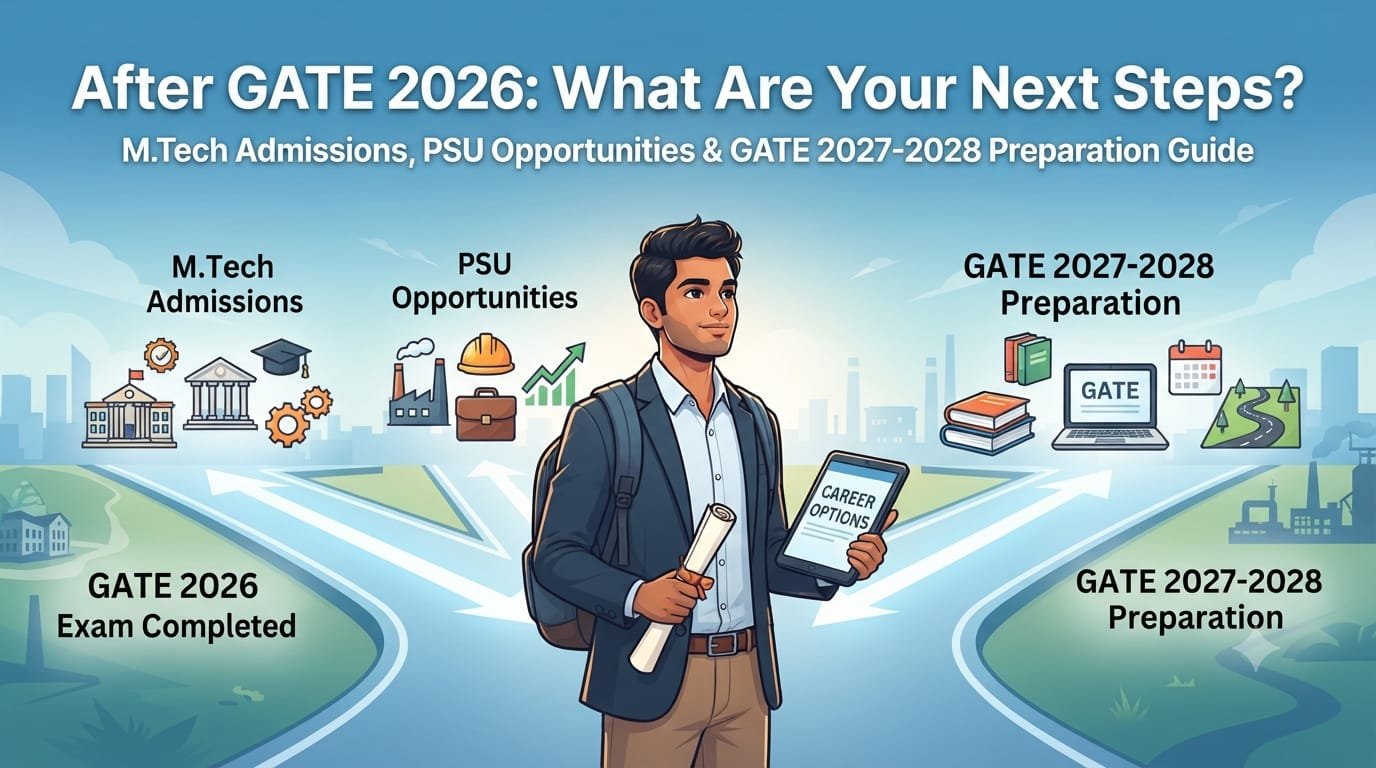
Your GATE examination is not the end of your journey. It is the beginning of an important career decision. Whether you have secured a competitive score, are waiting for admission opportunities, or are planning another attempt, the right next step can make a significant difference to your academic and professional future.
Every year, thousands of engineering and science graduates appear for GATE with different ambitions. Some aim for M.Tech admission at IITs and NITs, some target PSU recruitment, while others wish to pursue research, specialised postgraduate programmes or international opportunities.
However, one important question remains after the examination:
What should you do after GATE?
The answer depends on your GATE score, qualifying discipline, academic eligibility, career interests and long-term goals.
This guide explains the opportunities available after GATE 2026, how to approach postgraduate admissions, what to consider if your score is not as expected, and how to prepare strategically for GATE 2027 and GATE 2028.
1. What Are Your Options After GATE 2026?
A GATE score can be useful for several academic and professional pathways. You should not restrict your decision to just IIT admissions or PSU jobs.
Here are the major opportunities worth exploring.
A. M.Tech and M.E. Admissions in IITs
The Indian Institutes of Technology offer postgraduate programmes across engineering, technology, science and interdisciplinary specialisations.
Depending on your GATE paper, qualifying degree, score and institute-specific eligibility, you may explore programmes in:
- Computer Science and Engineering
- Artificial Intelligence and Data Science
- Electronics and Communication Engineering
- Electrical Engineering
- Mechanical Engineering
- Civil Engineering
- Chemical Engineering
- Biotechnology
- Aerospace Engineering
- Engineering Design
- Materials Science
- Energy and interdisciplinary technologies
Important: A qualifying GATE score does not automatically guarantee admission. Each institute and department applies its own eligibility requirements, shortlisting criteria and selection procedures.
IIT M.Tech admission applications and offers are generally coordinated through the Common Offer Acceptance Portal (COAP), alongside the respective institute application process.
B. M.Tech Admissions Through NITs, IIITs and Other Institutes
Students who wish to pursue postgraduate education should also consider NITs, IIITs, IIEST and other participating institutions.
CCMT (Centralized Counselling for M.Tech./M.Arch./M.Plan. Admissions) provides a common admission platform for participating institutions.
Candidates should carefully check:
- GATE paper eligibility
- Qualifying degree requirements
- Programme-specific restrictions
- Institute preferences
- Available seats
- Previous admission trends
- Counselling deadlines and rounds
Do not select a college based on its name alone. Compare the programme curriculum, faculty, research facilities, placements, location and total expenditure.
C. PSU Recruitment Through GATE
Public Sector Undertakings periodically recruit engineering graduates using GATE scores.
Depending on the recruitment notification, relevant disciplines may include:
- Mechanical Engineering
- Electrical Engineering
- Civil Engineering
- Electronics and Communication
- Chemical Engineering
- Computer Science
- Instrumentation
- Petroleum Engineering
Organisations that have used GATE scores in recruitment processes include BHEL, NTPC, IOCL, ONGC, GAIL, HPCL, Power Grid and other public-sector organisations.
However, recruitment is not guaranteed through a GATE qualification. Every PSU independently announces vacancies, accepted GATE papers, eligibility conditions, age limits, shortlisting requirements and selection procedures.
Practical advice: Follow individual PSU recruitment notifications instead of assuming that every organisation will recruit through the same GATE examination cycle.
D. MS by Research, PhD and Research Careers
If you enjoy technical research, innovation and specialised academic work, consider research-oriented postgraduate programmes.
Depending on the institute and programme, opportunities may include:
- MS by Research
- Direct PhD
- Integrated PhD
- PhD in Engineering and Sciences
- Research assistantships
- Sponsored research projects
Students interested in Artificial Intelligence, semiconductor technologies, biotechnology, computational sciences, robotics, renewable energy and advanced materials can explore research-oriented programmes.
GATE may be one component of the admission process, but research interests, academic records, interviews and other selection criteria can also matter.
E. Explore Other Higher Education Opportunities
Some universities and international institutions may accept GATE scores for specific programmes.
Before applying, verify whether the particular university and course accept your GATE paper and score for that admission cycle.
Do not assume that GATE qualification provides universal admission eligibility.
2. What If Your GATE Score Is Not as Expected?
This is one of the most important questions for GATE aspirants.
A lower-than-expected score does not mean that your engineering career has reached a dead end.
Instead of making a hurried decision, evaluate your performance objectively.
Start by identifying:
- Which subjects contributed most to your marks?
- Which subjects caused the greatest score loss?
- Were your mistakes conceptual or calculation-related?
- Did you lose marks due to negative marking?
- Was time management a major issue?
- Did you complete the syllabus and sufficient revision?
- How did you perform in mock tests compared with the actual examination?
Based on this assessment, consider the following options.
Option 1: Apply to Suitable Institutions
Check the eligibility and admission requirements of IITs, NITs, IIITs, central universities and other institutions.
Do not limit yourself to a few highly competitive institutes. Build a realistic preference list based on your score and eligibility.
Option 2: Prepare for the Next GATE Examination
If your target is a top IIT, a PSU opportunity or a highly competitive postgraduate programme, another attempt may be worth considering.
But repeating GATE without changing your preparation strategy is rarely a good decision.
Your next preparation cycle should include:
- Detailed performance analysis
- Stronger conceptual understanding
- Subject-wise improvement targets
- Structured revision
- Previous-year question practice
- Regular mock examinations
- Time-management training
- Individual doubt-clearing support
Option 3: Consider Other Relevant Examinations
Depending on your academic background and career objective, you may also explore:
- UPSC Engineering Services Examination (ESE)
- State engineering recruitment examinations
- Technical government recruitment
- Research entrance examinations
- Specialised postgraduate entrance examinations
- Industry-oriented technical certifications
Choose an alternative based on your actual career interests rather than simply accumulating examination attempts.
3. Should You Repeat GATE? How to Make the Right Decision
Repeating GATE is a serious academic and career decision. It should be based on your goals and preparation potential.
| Your present situation | Suggested approach |
| Good score but missed preferred IIT | Explore admissions and compare another attempt |
| Qualified but not shortlisted | Check other eligible programmes and recruitment options |
| Score below expectations | Analyse mistakes and identify improvement areas |
| Final-year student with incomplete preparation | Consider a structured next-cycle plan |
| Working professional | Explore weekend and flexible online batches |
| Repeater with weak fundamentals | Rebuild subject concepts before intensive testing |
| Strong fundamentals but poor test performance | Focus on mock tests, accuracy and examination strategy |
Is one year enough to improve your GATE rank?
Yes, a year can provide a meaningful preparation window, provided you use it systematically.
The important factors are not simply the number of hours spent studying, but the quality of learning, revision, practice, consistency and performance evaluation.
A student who understands their weaknesses and follows a realistic study plan can make substantial progress.
4. When Should You Start Preparing for GATE 2027 or GATE 2028?
The best time to prepare is before examination pressure begins.
If you are targeting GATE 2027, your preparation must be aligned with the remaining time and your existing subject knowledge.
If you are targeting GATE 2028, starting earlier gives you the advantage of building fundamentals, completing the syllabus systematically and revising without unnecessary pressure.
GATE 2027 Aspirants
This category includes:
- Students who have already completed part of their preparation.
- GATE 2026 repeaters.
- Final-year engineering students.
- Graduates preparing alongside employment.
- Students seeking focused revision or subject-wise improvement.
A suitable preparation plan should prioritise syllabus completion, high-value topics, previous-year questions, revision and mock examinations.
GATE 2028 Aspirants
Starting early is particularly useful for second-year and third-year engineering students.
A longer preparation cycle allows you to:
- Develop strong subject fundamentals.
- Understand the complete GATE syllabus.
- Practise numerical and conceptual problems.
- Connect undergraduate subjects with GATE-level applications.
- Complete multiple revision cycles.
- Build examination confidence gradually.
Our recommendation: Do not wait until your final year to understand the GATE examination pattern and syllabus.
5. Which GATE Branch Should You Prepare For?
Selecting the correct paper is an important part of preparation.
GATE offers multiple engineering, technology, science and interdisciplinary papers.
Some major options include:
| Academic discipline | Relevant GATE paper |
| Computer Science | CS |
| Data Science and Artificial Intelligence | DA |
| Electronics and Communication | EC |
| Electrical Engineering | EE |
| Mechanical Engineering | ME |
| Civil Engineering | CE |
| Biotechnology | BT |
| Chemical Engineering | CH |
| Chemistry | CY |
| Physics | PH |
| Mathematics | MA |
| Life Sciences | XL |
| Geology and Geophysics | GG |
| Aerospace Engineering | AE |
| Biomedical Engineering | BM |
| Engineering Sciences | XE |
| Instrumentation Engineering | IN |
| Petroleum Engineering | PE |
| Architecture and Planning | AR |
| Robotics and Automation | RA |
Other GATE papers include Agricultural Engineering, Ecology and Evolution, Environmental Science and Engineering, Humanities and Social Sciences, Naval Architecture and Marine Engineering, Mining, Metallurgical Engineering, Production and Industrial Engineering, Statistics and Textile Engineering.
The correct paper depends on your academic background, examination eligibility and intended postgraduate programme.
Candidates considering two GATE papers should also verify the officially permitted paper combinations.
6. How to Prepare for GATE Differently in Your Next Attempt
A common mistake among repeaters is following the same timetable and study material without analysing why the previous attempt did not produce the expected result.
Your next attempt should be more targeted.
Step 1: Conduct a Subject-Wise Performance Audit
Divide your subjects into three categories:
- Strong subjects: Focus on accuracy and advanced problem-solving.
- Average subjects: Improve conceptual clarity and numerical practice.
- Weak subjects: Relearn fundamentals and solve graded questions.
Step 2: Follow a Structured Learning Schedule
Do not study every subject randomly.
Create a realistic timetable with specific targets for concept learning, problem-solving, revision and testing.
Step 3: Master Previous-Year Questions
Previous-year questions help you understand the depth of concepts, common question patterns and application-based problem-solving.
Practise them chapter-wise before attempting complete papers.
Step 4: Take Regular Mock Tests
Mock tests should be treated as diagnostic tools, not merely as marks-based assessments.
Evaluate:
- Accuracy
- Time utilisation
- Question selection
- Conceptual mistakes
- Unnecessary attempts
- Subject-wise performance
Step 5: Seek Individual Guidance Where Required
If you repeatedly struggle with particular subjects, personal academic guidance can help you identify and resolve the underlying problems.
A structured mentoring system can also improve consistency and accountability.
7. GATE Coaching and Upcoming Batches at GATEIIT, Bangalore
Whether you are planning your first GATE attempt or preparing for another attempt after GATE 2026, the right academic support can help you prepare with greater clarity.
GATEIIT (Gate Indian Institute of Tutorials), Bangalore, offers structured GATE preparation programmes for engineering and science graduates, final-year students and working professionals.
Our programmes are designed to support students with different levels of preparation and different career objectives.
GATEIIT Learning Options
- Regular GATE Coaching
Suitable for students who require complete syllabus coverage, concept development, regular assignments and systematic preparation.
- GATE Repeaters Programme
Designed for candidates who have already appeared for GATE and want to improve their performance through subject-wise analysis, conceptual strengthening and structured revision.
- GATE Crash Courses
Short-duration programmes for students who have completed much of the syllabus and require focused revision, previous-year question practice and mock examinations.
- GATE Weekend Batches
Suitable for working professionals and college students who need a flexible preparation schedule.
- Live Online GATE Coaching
Attend interactive classes from anywhere in India with faculty interaction, doubt resolution and access to class recordings, as applicable to the programme.
- Classroom and Hybrid GATE Coaching
Students who prefer face-to-face learning can attend classroom sessions at our JP Nagar, Bangalore centre or explore available hybrid learning arrangements.
What Makes GATEIIT’s Academic Approach Different?
Our learning approach emphasises:
- Experienced subject-specialist faculty.
- Personalised academic guidance.
- Small-group learning and individual attention.
- Concept-based teaching.
- Chapter-wise assignments.
- Previous-year GATE questions.
- Regular assessments and mock examinations.
- Performance analysis.
- Doubt-clearing sessions.
- Revision planning.
- Flexible online and offline learning options.
The objective is to help students understand their subjects deeply rather than depend entirely on memorisation or examination shortcuts.
GATE Preparation for Multiple Disciplines
GATEIIT provides coaching across engineering and science disciplines, including GATE CS, DA, EC, EE, ME, CE, BT, CH, CY, MA, PH, XL, GG, AE, BM, XE, RA and other relevant papers.
Students should confirm the current availability of their selected paper, faculty and batch schedule before admission.
8. GATE Coaching Fees: What Should Students Budget?
GATE coaching fees vary according to the branch, duration, teaching mode, faculty support, batch size and study resources.
The following are indicative market-planning ranges, not a confirmed GATEIIT fee quotation.
| Programme | Indicative fee range |
| 1-month revision/crash course | ₹5,000–₹12,000 |
| 3-month focused preparation | ₹12,000–₹25,000 |
| 6-month preparation | ₹20,000–₹40,000 |
| 1-year comprehensive coaching | ₹30,000–₹70,000 |
| Online test series | ₹2,000–₹8,000 |
| Individual one-to-one tutoring | ₹500–₹1,500 per hour |
Actual fees can vary significantly by subject and programme.
At GATEIIT, students can enquire about suitable course durations, available batch formats, subject coverage and applicable fee concessions.
Before enrolling, compare the academic support, teaching hours, faculty access, study material, test series and doubt-clearing arrangements—not just the advertised course fee.
9. How to Select the Right GATE Coaching Institute
Before enrolling in any coaching programme, ask the following questions:
- Does the institute offer coaching for my specific GATE paper?
- Are the faculty experienced in teaching my subject?
- Is the complete syllabus covered?
- Are previous-year questions discussed in detail?
- Are regular tests and mock examinations conducted?
- Will I receive individual doubt-clearing support?
- Are class recordings available?
- Can I attend weekend or online classes?
- Is my academic progress monitored?
- Are the fees and course inclusions explained transparently?
A good coaching programme should provide more than classroom lectures. It should help you maintain a consistent preparation routine and identify areas that need improvement.
10. GATE 2027 and GATE 2028: Start Preparing for Your Next Opportunity
GATE 2027 is organised by IIT Madras. According to the official examination website, the examination is scheduled for February 2027, with results scheduled for 19 March 2027. Candidates should regularly check official notifications for any changes.
For students considering GATE 2028, the coming months offer an opportunity to establish a strong academic foundation before the next examination cycle.
Rather than waiting for the next examination notification, start by understanding your chosen paper, checking the syllabus and building a realistic preparation schedule.
Your preparation should be based on your current academic level—not somebody else’s timetable.
11. Frequently Asked Questions About Life After GATE
Q1. What should I do immediately after the GATE examination?
Evaluate your performance using the official answer key and response sheet when available. Check your result, scorecard and eligibility for postgraduate admissions or recruitment opportunities. Prepare a list of institutions and organisations relevant to your discipline.
Q2. Can I get admission into IIT after qualifying GATE?
Yes, eligible candidates can apply for postgraduate programmes at participating IITs. However, admission depends on the programme’s eligibility criteria, GATE score, departmental shortlisting and selection procedure.
Q3. What is the difference between COAP and CCMT?
COAP is the Common Offer Acceptance Portal used for coordinating participating IIT admission offers. CCMT is the centralised counselling platform for participating NITs, IIEST and other listed institutions. Candidates must follow the respective application and admission instructions.
Q4. Can I get a PSU job through GATE?
Several PSUs have used GATE scores for recruitment. However, recruitment depends on individual notifications, eligible papers, vacancies, age limits and selection procedures. GATE qualification alone does not guarantee employment.
Q5. Should I repeat GATE if I did not get my desired rank?
You can consider another attempt if your career objective requires a higher score or a more competitive admission opportunity. Analyse your previous performance and improve your preparation strategy before enrolling in another programme.
Q6. When should I start preparing for GATE 2028?
Starting early, ideally during the second or third year of engineering, provides more time for concept development, syllabus completion, problem-solving and revision.
Q7. Can working professionals prepare for GATE?
Yes. Working professionals can prepare through structured weekend, live online, recorded and flexible learning programmes, depending on the availability of suitable batches.
Q8. Does GATEIIT provide online and classroom GATE coaching?
GATEIIT offers online, classroom and hybrid learning options. Students can enquire about available courses, schedules and delivery formats for their selected GATE paper.
Q9. Does GATEIIT provide coaching for GATE repeaters?
GATEIIT offers preparation options suitable for repeaters, including structured learning, revision, practice, assessments and academic guidance. The recommended programme depends on the student’s current preparation level.
Q10. How can I enquire about the next GATE coaching batch at GATEIIT?
You can contact GATEIIT directly to discuss your GATE paper, preparation level, preferred learning mode, course duration, available batches and applicable fees.
12. Your Next GATE Attempt Deserves a Better Strategy
A GATE result should not define your entire career.
If you have secured a good score, explore the right postgraduate admission and recruitment opportunities. If you are still aiming for a better rank, use your previous attempt as a learning experience and prepare with a more focused strategy.
For future aspirants, beginning early can provide a valuable advantage.
At GATEIIT, we believe every serious aspirant deserves structured learning, personal academic attention and the right preparation strategy.
Take the next step towards your academic and professional goals.
Enquire About Upcoming GATE Coaching Batches at GATEIIT
GATEIIT – Gate Indian Institute of Tutorials
- Classroom Coaching: JP Nagar 2nd Phase, Bangalore
- Live Online | Offline | Hybrid Learning
- Personalised Mentorship
- Engineering and Science GATE Papers
- Regular and Fast-Track Preparation Options
Call / WhatsApp: 8884416154 / 8884416155
Website: https://www.gateiit.com/
Address: 3rd Floor, #1743, Sri Raghavendra Plaza, 17th Main Road, JP Nagar 2nd Phase, Bangalore – 560078, Karnataka.
Speak with our academic team to identify the right GATE preparation programme for your next attempt.
Note: Admission rules, counselling schedules, PSU recruitment requirements, GATE paper combinations and course availability are subject to the relevant official notifications and institutional updates. Students should verify the latest information before applying.