If you are studying in Class 12 or 2nd PUC in Karnataka and planning to pursue engineering in 2027, preparing for just one entrance examination may unnecessarily limit your college options.
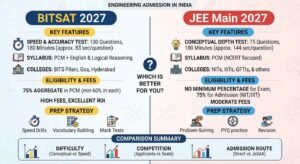
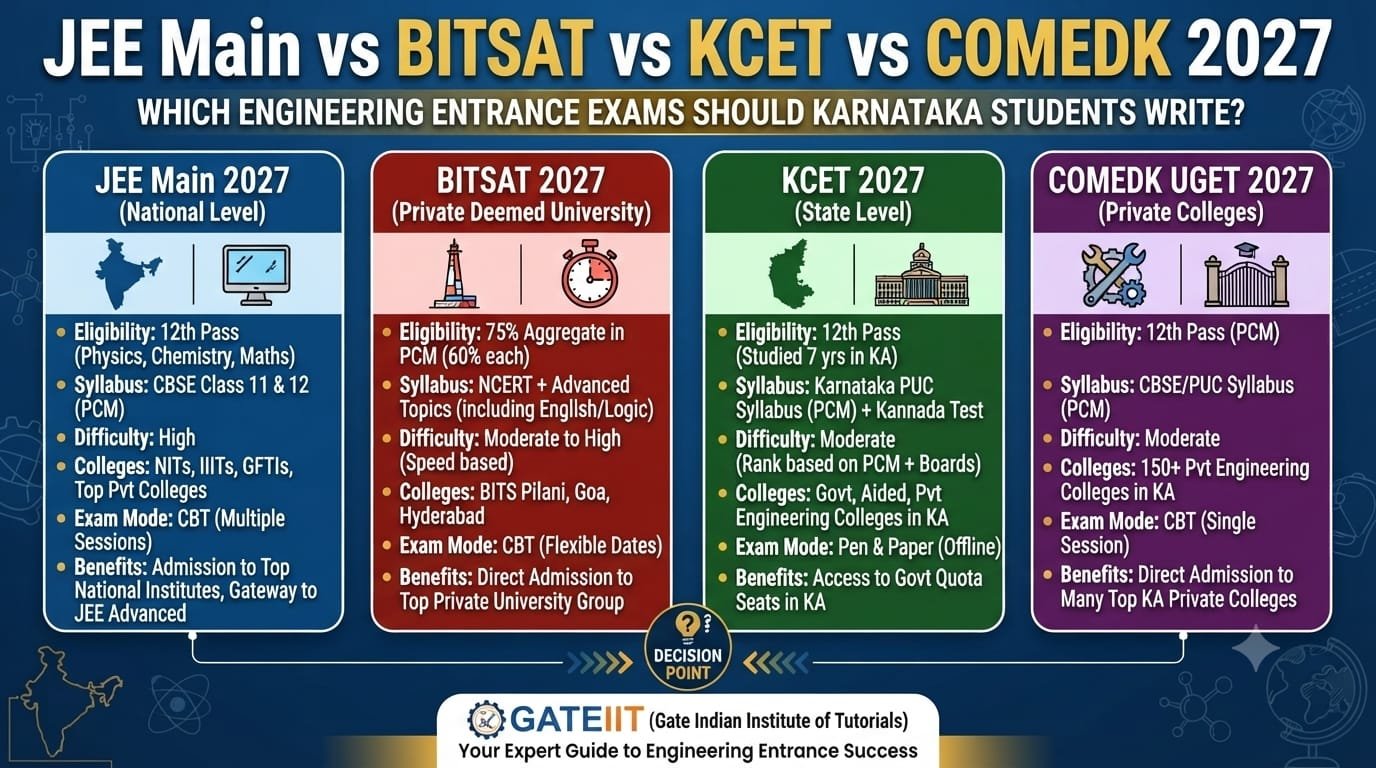
JEE Main, BITSAT, KCET and COMEDK offer different routes to engineering admissions. While JEE Main opens opportunities at NITs, IIITs and other participating institutions, BITSAT is the primary admission examination for BITS campuses. KCET provides access to eligible Karnataka engineering seats through KEA counselling, while COMEDK offers another important route to participating private engineering colleges in Karnataka.
For many Karnataka students, preparing strategically for all four examinations can provide a wider range of college and engineering branch choices.
However, these examinations are not interchangeable. Their eligibility requirements, examination patterns, admission systems and preparation priorities differ.
This guide explains the differences and helps students and parents decide which examinations to prioritise for the 2027 engineering admission cycle.
1. JEE Main vs BITSAT vs KCET vs COMEDK: Quick Comparison
| Particulars | JEE Main | BITSAT | KCET | COMEDK |
| Conducting authority | NTA | BITS Pilani | KEA | COMEDK |
| Examination level | National | National | Karnataka state | National |
| Main admission destination | NITs, IIITs and participating institutions | BITS campuses | Eligible Karnataka engineering colleges | Participating private engineering colleges in Karnataka |
| Examination mode | Computer-based | Computer-based | Offline / OMR | Computer-based |
| Main subjects | PCM | PCM + English + Logical Reasoning | PCM | PCM |
| Board marks in entrance rank | Not used in JEE Main percentile | Not used in BITSAT score | Included in KCET engineering ranking under the applicable rules | Not used in COMEDK entrance test rank |
| Negative marking | Yes | As specified in the current brochure | No, under the recent pattern | No, under the recent pattern |
| Number of attempts | Multiple sessions, subject to annual rules | As notified in the annual brochure | Generally once annually | Generally once annually |
| Counselling | JoSAA / CSAB and other applicable processes | BITS admission process | KEA counselling | COMEDK counselling |
| Best suited for | Students targeting NITs, IIITs and other JEE-accepting institutions | Students targeting BITS | Students seeking eligible Karnataka seats | Students seeking participating private engineering colleges in Karnataka |
Important: The table summarises the established examination structures. Students must check the official 2027 brochures for final eligibility, examination rules, dates and admission conditions.
2. JEE Main 2027: Who Should Choose This Examination?
JEE Main is one of India’s major engineering entrance examinations, conducted by the National Testing Agency (NTA).
Students appearing for JEE Main Paper 1 (B.E./B.Tech) can compete for admission to participating institutions such as:
- National Institutes of Technology (NITs).
- Indian Institutes of Information Technology (IIITs).
- Other participating centrally funded technical institutions.
- Other universities and colleges accepting JEE Main scores.
JEE Main also serves as the qualifying examination for JEE Advanced, subject to the prescribed eligibility and shortlisting conditions.
JEE Main examination structure
The 2027 Paper 1 structure includes:
| Subject | Questions | Marks |
| Physics | 25 | 100 |
| Chemistry | 25 | 100 |
| Mathematics | 25 | 100 |
| Total | 75 | 300 |
The examination is conducted online.
The current 2027 scheme specifies +4 marks for a correct answer and -1 for an incorrect answer.
Which Karnataka students should prioritise JEE Main?
JEE Main should be a priority if you:
- Want to pursue engineering at NITs or IIITs.
- Are interested in national-level engineering institutions.
- Want to qualify for JEE Advanced and pursue IIT admission.
- Are comfortable with application-oriented Physics, Chemistry and Mathematics.
- Want to retain options beyond Karnataka-based engineering admissions.
Important consideration
JEE Main preparation requires strong conceptual understanding and the ability to solve application-oriented problems. Students should not restrict their preparation to memorising formulas or practising only straightforward textbook questions.
Official website: https://jeemain.nta.nic.in/
3. BITSAT 2027: Is It Worth Preparing Alongside JEE Main?
BITSAT is the entrance examination for admission to undergraduate programmes at Birla Institute of Technology and Science (BITS).
The major BITS campuses include:
- BITS Pilani.
- BITS Goa.
- BITS Hyderabad.
BITSAT offers a different admission opportunity from JEE Main. Students who are interested in BITS should understand its examination pattern and academic eligibility requirements separately.
BITSAT examination subjects
BITSAT preparation covers:
- Mathematics or Biology, depending on the intended programme.
- English Proficiency.
- Logical Reasoning.
What makes BITSAT different from JEE Main?
The most important difference is that BITSAT includes English Proficiency and Logical Reasoning in addition to the science subjects.
The examination also places significant emphasis on efficient question selection, time management and accuracy.
Students who prepare only for JEE Main may have good PCM knowledge but still require additional BITSAT-specific practice.
BITSAT eligibility: An important board-mark consideration
For the standard B.E. programmes, the published eligibility framework requires:
- At least 75% aggregate marks in Physics, Chemistry and Mathematics in Class 12.
- At least 60% marks individually in Physics, Chemistry and Mathematics.
- The prescribed qualifying examination and year-of-passing conditions.
The applicable requirements must be checked against the 2027 admission brochure.
Students should not assume that appearing for BITSAT automatically makes them eligible for admission.
Who should consider BITSAT?
BITSAT is worth considering if you:
- Are interested in BITS Pilani, Goa or Hyderabad.
- Have a strong PCM foundation.
- Can prepare separately for English and Logical Reasoning.
- Want another national-level engineering admission opportunity.
- Meet the academic eligibility requirements.
Preparation advice: JEE Main and BITSAT have considerable PCM syllabus overlap. Students can build a common conceptual foundation and then allocate additional preparation time to BITSAT-specific speed, English and Logical Reasoning.
Official website: https://www.bitsadmission.com/
4. KCET 2027: Why Is It Particularly Important for Karnataka Students?
KCET, also known as UGCET, is conducted by the Karnataka Examinations Authority (KEA).
For students who have studied in Karnataka and satisfy the applicable eligibility clauses, KCET can be an important route to engineering admission through Karnataka’s government-seat counselling system.
KCET is particularly important because engineering rank preparation involves both entrance examination performance and qualifying examination marks under the applicable ranking rules.
KCET engineering examination structure
The recent examination structure includes:
| Subject | Questions | Marks |
| Physics | 60 | 60 |
| Chemistry | 60 | 60 |
| Mathematics | 60 | 60 |
| Total | 180 | 180 |
Each subject paper has a separate time allocation. The recent pattern provides 80 minutes per subject.
KCET is conducted in offline OMR-based mode.
There is no negative marking under the recent examination pattern.
The biggest difference: 2nd PUC marks matter
For engineering admissions, the recent KCET ranking framework gives:
- 50% weightage to KCET PCM marks.
- 50% weightage to qualifying examination PCM marks.
The final 2027 ranking formula and applicable rules must be verified in the KEA information bulletin.
This is a significant consideration for Karnataka students.
Consider two students who achieve similar KCET marks. Their final engineering ranks can differ because their qualifying examination marks may also differ.
Therefore, students should not neglect their 2nd PUC Physics, Chemistry and Mathematics examinations while preparing for KCET.
Who should prioritise KCET?
KCET deserves particular attention if you:
- Are studying in Karnataka.
- Meet the applicable KEA eligibility requirements.
- Want to compete for Karnataka government-seat opportunities.
- Are targeting engineering colleges participating in KEA counselling.
- Want to make use of both board examination preparation and entrance examination preparation.
Does studying in Karnataka automatically make you eligible for a KCET government seat?
No.
Students must distinguish between appearing for an examination and qualifying for a particular admission category.
KEA has multiple eligibility clauses involving qualifying conditions, study history, documents and other prescribed requirements.
Simply attending a coaching centre or residing in Bengaluru does not automatically establish eligibility for a Karnataka government seat.
Students from outside Karnataka should carefully check the applicable eligibility clauses before making admission plans.
Official website: https://cetonline.karnataka.gov.in/kea/
5. COMEDK UGET 2027: An Important Alternative for Karnataka Engineering Admissions
COMEDK UGET is conducted by the Consortium of Medical, Engineering and Dental Colleges of Karnataka.
It provides another important engineering admission route for students interested in participating private engineering colleges in Karnataka.
Unlike KCET, COMEDK is open to eligible candidates from across India.
This makes it especially relevant for:
- Karnataka students seeking additional college options.
- Students from other Indian states interested in engineering colleges in Bengaluru.
- Students who want another entrance examination apart from JEE Main and KCET.
- Students seeking admission opportunities through participating COMEDK institutions.
COMEDK examination structure
The recent UGET engineering examination pattern includes:
| Subject | Questions | Marks |
| Physics | 60 | 60 |
| Chemistry | 60 | 60 |
| Mathematics | 60 | 60 |
| Total | 180 | 180 |
The examination is computer-based and conducted over three hours under the recent pattern.
There is no negative marking under the recent scheme.
COMEDK eligibility
The published 2026 engineering eligibility framework specifies Physics and Mathematics as compulsory subjects, along with the prescribed additional subject and English requirements.
The qualifying examination and minimum aggregate requirements also apply.
For the 2026 cycle, the general merit requirement was 45% aggregate in the specified PCM subjects, with the prescribed relaxation for eligible Karnataka SC, ST and OBC candidates.
Students must check the final 2027 eligibility brochure rather than assuming that previous-year conditions will remain unchanged.
Why should Karnataka students write COMEDK?
COMEDK provides an additional admission opportunity beyond KCET.
For a student who wants to keep multiple Karnataka engineering college options open, writing both examinations can be a practical strategy.
However, students must compare the participating colleges, branches, tuition fees, hostel expenses, placements and counselling conditions before selecting a seat.
Official website: https://www.comedk.org/
6. KCET vs COMEDK: Which Is Better for Karnataka Engineering Admissions?
This is one of the most important questions asked by students and parents in Bengaluru and other Karnataka cities.
Neither examination is universally better. The right choice depends on the student’s eligibility, academic performance, preferred engineering college, branch and budget.
| Factor | KCET | COMEDK |
| Main admission route | Eligible Karnataka seats through KEA | Participating COMEDK institutions |
| Candidate pool | Candidates satisfying applicable eligibility conditions | Eligible candidates across India |
| Exam mode | Offline | Online |
| Board marks | Included in engineering rank under recent rules | Not included in entrance test rank |
| Negative marking | No, under recent rules | No, under recent rules |
| Preparation focus | PUC syllabus, speed and accuracy | PCM concepts, speed and accuracy |
| Counselling | KEA | COMEDK |
When should KCET be your priority?
KCET should be a major priority if you satisfy the relevant KEA eligibility requirements and are interested in government-seat opportunities.
When should COMEDK be your priority?
COMEDK deserves attention if you want to compete for participating private engineering colleges in Karnataka, particularly if you are also considering colleges in Bengaluru.
Should students write both?
For students eligible for both examinations, writing both can increase the range of available admission opportunities.
The syllabus overlap also makes combined preparation practical.
However, KCET and COMEDK require their own examination-specific practice. Students should not assume that preparation for one automatically ensures good performance in the other.
7. Which Engineering Colleges Can You Target Through These Examinations?
The college admission route matters as much as the entrance examination itself.
The following examples help students understand the different admission pathways.
| Institution | Relevant admission route to investigate |
| NITK Surathkal | JEE Main through JoSAA / applicable counselling |
| NIT Warangal | JEE Main through JoSAA / applicable counselling |
| IIIT Bangalore | Its notified admission routes, including applicable JEE Main-based pathways |
| BITS Pilani | BITSAT |
| BITS Goa | BITSAT |
| BITS Hyderabad | BITSAT |
| RV College of Engineering, Bengaluru | KCET and COMEDK, subject to applicable seats and rules |
| BMS College of Engineering, Bengaluru | KCET and COMEDK, subject to applicable seats and rules |
| Ramaiah Institute of Technology, Bengaluru | KCET and COMEDK, subject to applicable seats and rules |
| Dayananda Sagar College of Engineering, Bengaluru | Applicable KCET / COMEDK admission routes |
| Other participating Karnataka engineering colleges | KEA / COMEDK, depending on institutional participation and seat category |
Important: The admission route, number of seats, branch availability and counselling rules can differ between institutions and academic years. Students must check the official participating-college lists and seat matrices before making a choice.
Do not select an examination solely because a particular college accepts its score. Also compare the branch you want, fee structure, academic environment, accreditation, placements and location.
8. Should Karnataka Students Write All Four Examinations in 2027?
For many students, yes. However, the decision should be based on their academic goals and eligibility rather than simply registering for every examination.
Here is a practical decision guide.
Student Category A: Class 11 Student Targeting Top Engineering Colleges
Recommended examinations to consider:
- JEE Main.
Start with strong PCM fundamentals and gradually introduce examination-specific practice.
Students have sufficient time to develop conceptual clarity, improve problem-solving ability and build speed.
Student Category B: Class 12 / 2nd PUC Student in Karnataka
A practical strategy is to prepare for:
- JEE Main.
- BITSAT, if interested and academically eligible.
Board examination preparation should remain an important priority, especially because of the KCET ranking framework.
Students should avoid a preparation timetable that sacrifices board examination performance.
Student Category C: Student Primarily Targeting Bengaluru Engineering Colleges
Prioritise:
- KCET, if eligible for the desired admission category.
- JEE Main as an additional national-level opportunity.
- BITSAT if interested in BITS campuses.
Student Category D: Student Targeting NITs, IIITs or IITs
Prioritise:
- JEE Main.
- JEE Advanced, if eligible.
- BITSAT as an additional opportunity.
- KCET and COMEDK as alternative admission routes, where eligible.
Student Category E: Student from Outside Karnataka
Consider:
- JEE Main.
KCET participation and access to particular Karnataka seat categories must be assessed separately under KEA eligibility rules.
9. How Much of the Syllabus Is Common Between JEE, BITSAT, KCET and COMEDK?
One major advantage of integrated entrance preparation is that students do not need four completely separate teaching programmes for the overlapping PCM syllabus.
The foundation of Physics, Chemistry and Mathematics is shared across these examinations.
However, the level of application, question style, examination duration, marking scheme and additional subjects differ.
Physics
Common areas include:
- Laws of Motion.
- Work, Energy and Power.
- Rotational Motion.
- Oscillations and Waves.
- Current Electricity.
- Electromagnetic Induction.
- Modern Physics.
Chemistry
Common areas include:
- Atomic Structure.
- Chemical Bonding.
- Periodic Classification.
- Chemical Equilibrium.
- Chemical Kinetics.
- Organic Chemistry.
- Coordination Compounds.
- General and Inorganic Chemistry.
Mathematics
Common areas include:
- Coordinate Geometry.
- Differential Calculus.
- Integral Calculus.
- Differential Equations.
- Three-Dimensional Geometry.
The exact syllabus coverage and deleted or modified topics must be checked against the individual 2027 examination syllabi.
What requires additional preparation?
| Examination | Additional preparation priority |
| JEE Main | Application-based PCM questions, accuracy and negative-marking strategy |
| BITSAT | English Proficiency, Logical Reasoning, speed and computer-based practice |
| KCET | PUC syllabus alignment, board preparation and OMR-based timed practice |
| COMEDK | Fast PCM question-solving, computer-based timed tests and accuracy |
This is why an integrated preparation programme should contain both common subject teaching and separate examination-oriented practice.
10. Can You Prepare for JEE, BITSAT, KCET and COMEDK Together?
Yes. In fact, students with a well-planned timetable can prepare for these examinations together without unnecessarily duplicating their study efforts.
The most practical approach is to divide preparation into three layers.
Layer 1: Common PCM Foundation
Build conceptual understanding in Physics, Chemistry and Mathematics.
This is the foundation for all four examinations.
Students should complete their chapters systematically rather than switching between different books and coaching materials for every examination.
Layer 2: Examination-Specific Preparation
Once the common topics are covered, introduce individual examination requirements.
For example:
- JEE Main: Application-oriented problems and negative-marking strategy.
- BITSAT: English, Logical Reasoning and rapid question-solving.
- KCET: Karnataka PUC alignment and OMR-based practice.
- COMEDK: Timed computer-based question practice.
Layer 3: Separate Mock Tests and Performance Analysis
Students should attempt individual mock examinations for each target entrance test.
After every test, analyse:
- Incorrect answers.
- Unattempted questions.
- Time spent on each section.
- Accuracy by subject.
- Weak chapters.
- Questions solved correctly but inefficiently.
A student who scores well in one examination should not automatically assume the same performance in another.
Each examination requires a separate test strategy.
11. A Practical 6-Month Integrated Preparation Plan for Karnataka Students
Students beginning structured preparation approximately six months before their examinations can use the following framework.
| Preparation period | Main focus |
| Month 1 | Assess PCM fundamentals and identify weak chapters |
| Month 2 | Strengthen Physics, Chemistry and Mathematics concepts |
| Month 3 | Complete pending syllabus and introduce examination-specific MCQs |
| Month 4 | Intensive practice for JEE Main, KCET, COMEDK and BITSAT |
| Month 5 | Sectional tests, full-length mocks and performance analysis |
| Month 6 | Final revision, formula practice, examination strategy and timed mock tests |
This is a suggested framework, not a fixed timetable for every student.
Students with incomplete Class 11 topics may need more foundation work, while students who have already completed their syllabus may need a greater emphasis on tests and revision.
Suggested weekly study allocation
A balanced weekly plan could include:
- Physics: Concept revision and numerical practice.
- Chemistry: Theory, reactions and problem-solving.
- Mathematics: Daily problem-solving.
- BITSAT-specific English and Logical Reasoning practice.
- KCET and COMEDK examination-oriented practice.
- JEE Main-level application questions.
- One or more timed sectional tests.
- Review of previous mistakes.
The timetable should also accommodate school or 2nd PUC classes, practical examinations, board preparation and adequate rest.
12. Common Mistakes Students Make While Preparing for Multiple Entrance Examinations
Mistake 1: Preparing only for JEE Main
JEE Main preparation develops a useful PCM foundation, but it does not automatically cover every requirement of BITSAT, KCET and COMEDK.
Mistake 2: Ignoring 2nd PUC Board Marks
Karnataka students should remember that qualifying examination marks have an important role in the recent KCET engineering ranking framework.
Mistake 3: Treating KCET and COMEDK as Identical
Their admission systems, examination modes and eligibility rules differ.
Students need separate OMR-based and computer-based practice.
Mistake 4: Ignoring English and Logical Reasoning
These are important components of BITSAT preparation and should not be left until the final weeks.
Mistake 5: Not Checking Admission Eligibility
Students sometimes prepare for an examination without checking whether they satisfy the academic, category, domicile or other admission conditions.
Mistake 6: Choosing Colleges Only by Reputation
A good college decision requires more than a popular name.
Compare:
- Desired engineering branch.
- Previous closing ranks.
- Total tuition fees.
- Hostel and living expenses.
- Placement outcomes.
- Faculty and laboratory facilities.
- Internship opportunities.
- Location and travel requirements.
- Accreditation and academic regulations.
Mistake 7: Taking Too Many Mock Tests Without Analysing Them
Attempting tests is only one part of preparation. Understanding why questions were answered incorrectly is equally important.
13. How Should Parents Help Their Children Choose the Right Engineering Entrance Examinations?
Parents often ask whether their children should concentrate on one examination or prepare for multiple admission opportunities.
There is no universal answer.
The decision should be based on:
- The student’s interest in engineering.
- Current academic performance.
- Strength in Physics, Chemistry and Mathematics.
- Class 11 and 2nd PUC preparation level.
- Preferred engineering colleges.
- Financial considerations.
- Eligibility for Karnataka admission categories.
- Available preparation time.
For example, a student interested in NITK Surathkal may prioritise JEE Main, while a student looking at RVCE or BMS College of Engineering may consider both KCET and COMEDK, subject to the applicable admission routes.
A student interested in BITS Pilani should prepare specifically for BITSAT.
Parents should also discuss branch preferences with their children. Choosing Computer Science, Electronics, Mechanical, Civil, Chemical or another engineering discipline should involve the student’s interests and an understanding of the course and career opportunities.
14. Integrated JEE + BITSAT + KCET + COMEDK Coaching at GATEIIT, JP Nagar, Bangalore
Preparing for four engineering entrance examinations requires a structured approach rather than simply increasing the number of study hours.
At GATEIIT – Gate Indian Institute of Tutorials, JP Nagar 2nd Phase, Bengaluru, students can enquire about integrated engineering entrance preparation covering common PCM concepts and examination-specific practice.
The preparation approach can be organised around the student’s academic level, target examinations and available preparation time.
What can students enquire about?
- Common PCM Concept Preparation
Structured Physics, Chemistry and Mathematics teaching that develops a common foundation for multiple engineering entrance examinations.
- JEE Main Preparation
Application-oriented problem-solving, topic-wise practice, mock tests and examination strategy.
- BITSAT-Specific Preparation
Additional support for English Proficiency, Logical Reasoning, speed, accuracy and BITSAT-style practice.
- KCET-Specific Preparation
Karnataka PUC-aligned syllabus preparation, OMR-based practice and attention to the relationship between board performance and KCET ranking.
- COMEDK-Specific Preparation
Computer-based examination practice, timed PCM question-solving and mock test analysis.
- Personal Mentorship
Students can enquire about individual academic assessment, personalised learning plans, subject-wise coaching and doubt-solving support.
- Flexible Learning Formats
Depending on the programme and batch availability, students can enquire about:
- Classroom coaching in JP Nagar, Bengaluru.
- Live online coaching across Karnataka and India.
- Hybrid learning.
- Weekday and weekend batches.
- One-to-one personal coaching.
- Small-group classes.
- Short-term and crash courses.
- Long-term integrated preparation.
Who can enquire?
- Class 11 students targeting 2028 engineering admissions.
- Class 12 and 2nd PUC students targeting 2027 admissions.
- Students who have completed 2nd PUC.
- Droppers and repeaters.
- Students preparing for JEE Main and BITSAT together.
- Karnataka students preparing for KCET and COMEDK.
- Students who want individual Physics, Chemistry or Mathematics coaching.
Why consider integrated preparation?
A well-organised programme can help students avoid repeating the same PCM concepts unnecessarily.
Instead, the common syllabus is covered systematically, while separate time is allocated to each examination’s unique requirements.
Students should select a course based on their present preparation level rather than choosing a programme solely by its duration.
GATEIIT Bangalore Centre
GATEIIT – Gate Indian Institute of Tutorials
3rd Floor, #1743, Sri Raghavendra Plaza,
17th Main Road, JP Nagar 2nd Phase,
Bengaluru – 560078, Karnataka, India.
Call / WhatsApp: 8884416154 / 8884416155
Official Website: https://www.gateiit.com/
Google Maps: https://maps.app.goo.gl/MtzbVkqywCkwKcc4A
Students from Mysuru, Mangaluru, Hubballi, Belagavi, Tumakuru, Davanagere and other parts of Karnataka can also enquire about suitable online preparation options.
15. Frequently Asked Questions: JEE vs BITSAT vs KCET vs COMEDK 2027
1. Which is the best engineering entrance examination for Karnataka students in 2027?
There is no single best examination for everyone. KCET is important for eligible Karnataka government-seat opportunities, COMEDK offers access to participating private engineering colleges in Karnataka, JEE Main opens national-level admission opportunities and BITSAT is the primary entrance route for BITS campuses.
2. Should Karnataka students write JEE Main, KCET and COMEDK together?
Students who meet the respective eligibility requirements can consider all three. Their PCM syllabus has considerable overlap, making integrated preparation practical.
3. Is BITSAT easier than JEE Main?
Difficulty is subjective. JEE Main and BITSAT assess different examination skills. BITSAT places additional emphasis on English, Logical Reasoning and speed, while JEE Main has its own application-oriented problem-solving demands.
4. Can I prepare for KCET and COMEDK using the same syllabus?
Much of the Physics, Chemistry and Mathematics foundation overlaps. However, students should practise each examination separately because their modes, question structures and admission requirements differ.
5. Do 2nd PUC marks count in KCET engineering ranking?
Under the recent engineering ranking framework, 50% weightage is given to KCET PCM marks and 50% to qualifying examination PCM marks. Students must verify the final 2027 KEA rules.
6. Do 2nd PUC marks count in COMEDK ranking?
COMEDK entrance test rank is based on the entrance examination performance, not a combined KCET-style 50:50 board and entrance formula. Qualifying examination marks and subject requirements still apply for admission eligibility.
7. Can students from outside Karnataka write COMEDK?
Yes. COMEDK UGET is open to eligible candidates from across India. However, applicable category benefits and admission eligibility must be checked separately.
8. Can students from outside Karnataka write KCET?
Examination participation and eligibility for particular Karnataka admission seat categories are different matters. Candidates should check the relevant KEA eligibility clauses and documentation requirements.
9. Is JEE Main enough to get admission to IITs?
No. Students must qualify for JEE Advanced and satisfy its eligibility and admission requirements for IIT admission.
10. Can I get admission to BITS Pilani through JEE Main?
The standard domestic B.E. admission route is BITSAT, subject to the institute’s eligibility and admission rules. Students should consult the official admission portal for any separately notified admission schemes.
11. Which examinations should a student targeting RVCE or BMS College of Engineering write?
Students should investigate both KCET and COMEDK admission routes, subject to the applicable institution, seat category, eligibility and counselling rules.
12. Is KCET important for students studying in Bengaluru?
Yes, KCET can be important for students who satisfy the relevant KEA eligibility clauses and want to compete for eligible Karnataka engineering seats.
13. Does BITSAT include English and Logical Reasoning?
Yes. These are important components of BITSAT preparation and should be included in the study timetable.
14. Which exam has negative marking?
JEE Main has negative marking under its current scheme. KCET and COMEDK have had no negative marking under their recent patterns. BITSAT marking rules should be checked in the relevant annual brochure.
15. Can I prepare for all four examinations in six months?
Yes, depending on your existing PCM preparation level. Students with a strong foundation can focus on revision, question practice, examination-specific preparation and mock tests. Students with major syllabus gaps may require a longer preparation period.
16. Should I focus on board examinations or entrance examinations?
Both matter. Board examination performance is important for qualifying eligibility and is particularly relevant to KCET engineering ranking under the recent framework. Students should maintain a balanced timetable.
17. Is integrated coaching useful for multiple entrance examinations?
It can be useful because the common PCM concepts can be taught systematically, while separate examination-specific practice addresses differences in question patterns and requirements.
18. Does GATEIIT offer combined JEE, BITSAT, KCET and COMEDK coaching?
Students can enquire about integrated preparation options at GATEIIT in JP Nagar, Bengaluru, including common PCM teaching and separate examination-oriented practice. Current course structure and batch availability should be confirmed with the admissions team.
19. Does GATEIIT provide online coaching for Karnataka students?
Students from across Karnataka and other parts of India can enquire about live online and other available learning formats.
20. How can I enquire about JEE, BITSAT, KCET and COMEDK coaching at GATEIIT?
Call or WhatsApp 8884416154 or 8884416155. You can also visit www.gateiit.com or the JP Nagar 2nd Phase centre in Bengaluru.
Final Advice: Keep More Engineering Admission Options Open
The biggest mistake a student can make is choosing an entrance examination without understanding the college admission opportunities it provides.
JEE Main, BITSAT, KCET and COMEDK serve different purposes. For Karnataka students, a sensible strategy is to build a strong common PCM foundation, protect 2nd PUC academic performance, understand the eligibility requirements and practise each target examination separately.
You do not need four completely different preparation strategies. You need one strong academic foundation supported by four appropriately differentiated examination strategies.
Plan early, prepare intelligently and make informed engineering admission decisions for 2027.
Start your integrated engineering entrance preparation with GATEIIT, JP Nagar, Bengaluru.
Call / WhatsApp: 8884416154 | 8884416155
Website: www.gateiit.com
Official Information and Reference Links
Students should use the following official websites to verify examination notifications, eligibility, syllabi and admission procedures:
- JEE Main – National Testing Agency: https://jeemain.nta.nic.in/
- BITS Admissions: https://www.bitsadmission.com/
- Karnataka Examinations Authority: https://cetonline.karnataka.gov.in/kea/
- COMEDK: https://www.comedk.org/
- JoSAA: https://josaa.nic.in/
Editorial and admission disclaimer: This article is an independent educational guide prepared by GATEIIT. GATEIIT is not affiliated with or endorsed by NTA, KEA, COMEDK, BITS Pilani, JoSAA or the institutions discussed. Examination patterns, admission criteria, seat allocation, cut-offs, dates and eligibility conditions may change. The official 2027 notifications and brochures will prevail over previous-year information. Admission, rank and score are not guaranteed through coaching.