
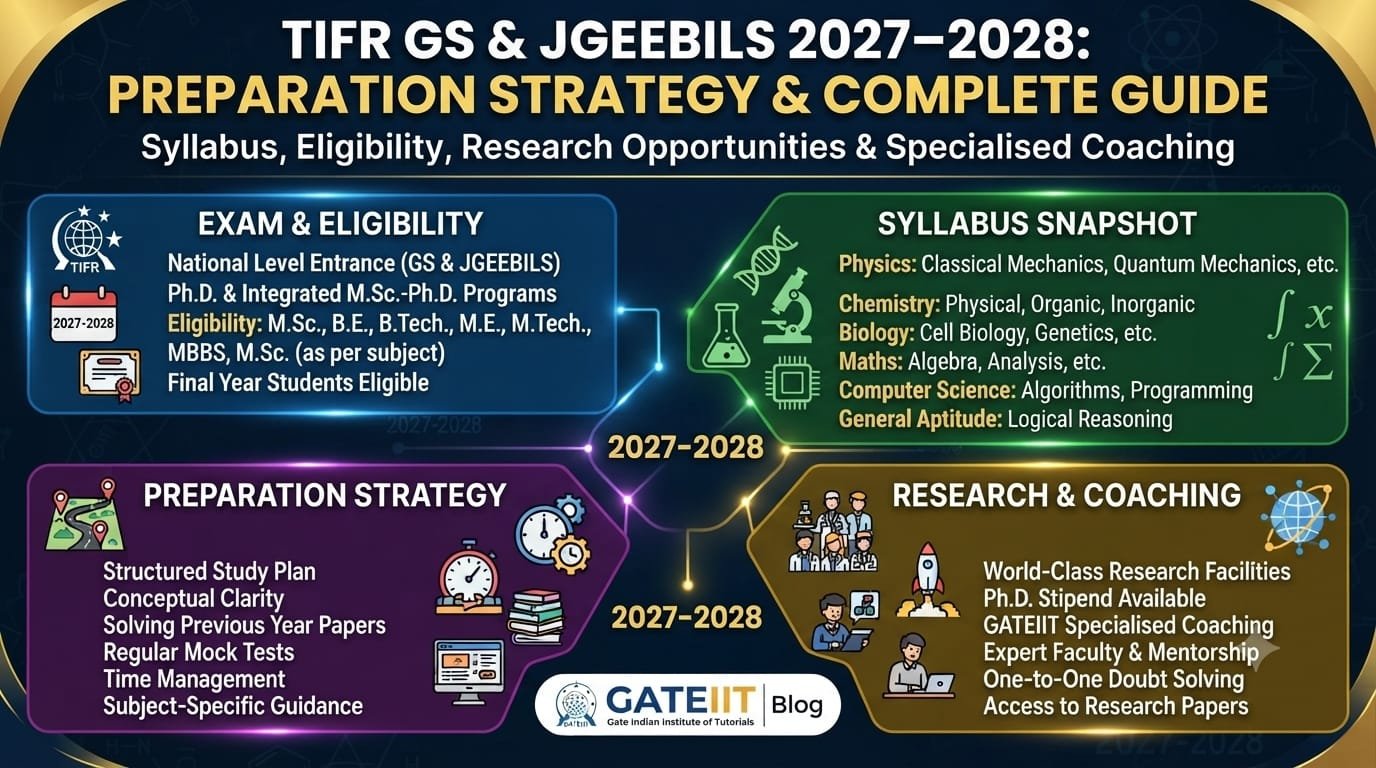
Are you planning to pursue an Integrated PhD, PhD or advanced research career in Biology, Life Sciences or other fundamental sciences? TIFR GS and JGEEBILS are important entrance examination pathways to explore if you aspire to work in an academic research environment.
Admission to research programmes at premier institutions requires more than remembering textbook information. Students must develop a strong understanding of scientific fundamentals, interpret unfamiliar experimental situations, connect concepts across disciplines and approach complex questions logically.
At GATEIIT – Gate Indian Institute of Tutorials, we offer specialised academic preparation and personalised mentorship for students aspiring to enter advanced science and research programmes.
Our preparation approach is suitable for students from:
- BSc and MSc Life Sciences
- Biotechnology
- Biochemistry
- Microbiology
- Zoology and Botany
- Molecular Biology and Genetics
- Biomedical Sciences
- Physics and Chemistry
- Mathematics and interdisciplinary science backgrounds
Students can explore online coaching across India and offline or hybrid learning options at our JP Nagar, Bangalore centre.
Preparation for the 2027 and 2028 admission cycles is available through customised academic programmes, subject to batch and faculty availability.
1. What Are TIFR GS and JGEEBILS?
The Tata Institute of Fundamental Research (TIFR) conducts its Graduate School admission process for students interested in advanced academic and research programmes.
These programmes include PhD, Integrated MSc-PhD and certain MSc pathways, depending on the subject and participating centre.
The TIFR Graduate School entrance examination covers different scientific disciplines, including:
- Biology (JGEEBILS)
- Physics
- Chemistry
- Mathematics
- Computer Science and Learning, Information and Data Sciences
- Science Education
JGEEBILS stands for Joint Graduate Entrance Examination for Biology and Interdisciplinary Life Sciences.
It is particularly relevant to students interested in biological research, interdisciplinary life sciences and associated graduate programmes.
An important distinction: JGEEBILS is the Biology examination within the TIFR graduate admission framework. TIFR GS is not a single common subject examination. Candidates must identify the appropriate subject examination and programme eligibility before applying.
2. Why Should Biology and Life Sciences Students Consider JGEEBILS?
Many students complete their BSc or MSc in Life Sciences, Biotechnology, Zoology, Botany or Biochemistry without having a clear understanding of the different research opportunities available in India.
Some consider only CSIR NET, GATE or conventional postgraduate admissions.
However, students interested in fundamental biological research should also explore JGEEBILS and the participating research institutions.
Research opportunities may involve:
- Molecular and cellular biology
- Genetics and genomics
- Developmental biology
- Neuroscience
- Structural biology
- Biochemistry
- Microbiology
- Immunology
- Ecology and evolution
- Computational biology
- Quantitative and interdisciplinary life sciences
These areas provide opportunities to investigate biological questions through experimental research, computational methods and interdisciplinary scientific approaches.
The right programme depends on the institution, research group, eligibility requirements and admission procedure.
3. Which Research Institutions Can JGEEBILS Aspirants Explore?
JGEEBILS is associated with a network of participating institutions and research centres.
Depending on the current admission cycle and individual institutional requirements, students may explore institutions such as:
- Tata Institute of Fundamental Research (TIFR), Mumbai
Known for fundamental research in biological sciences and interdisciplinary scientific disciplines.
- National Centre for Biological Sciences (NCBS), Bengaluru
An important destination for students interested in molecular biology, cellular biology, ecology, evolution, neuroscience and interdisciplinary biological research.
- TIFR Hyderabad
Offers research opportunities in biological and other fundamental science disciplines.
- Other participating research institutions
Candidates should examine the current JGEEBILS participating-institution list and individual admission notifications to identify the programmes accepting the examination score.
Important: Appearing for JGEEBILS does not automatically guarantee admission to every participating institution. Each institution may have separate application requirements, shortlisting procedures, interviews and selection criteria. Candidates should apply separately wherever required.
4. TIFR GS and JGEEBILS 2027 Important Dates
For the 2027 admission cycle, TIFR has published the following examination schedule.
| Event | Official schedule |
| Application portal opened | 26 September 2026 |
| Fee waiver application deadline | 11 October 2026 |
| Registration deadline | 25 October 2026 |
| Hall ticket availability | Mid-November 2026 |
| TIFR GS/JGEEBILS examination | 13 December 2026 |
| Programme commencement | 1 August 2027 |
The Biology (JGEEBILS) examination is scheduled in the afternoon session, from 2 PM to 5 PM.
The registration window for GS-2027 has closed. Students who have already registered should concentrate on examination preparation and official examination instructions.
Students planning their next admission cycle should begin their preparation early rather than waiting for the next application notification.
Official information: https://www.tifr.res.in/academics/gs_advertisement.php
5. JGEEBILS Examination Pattern and Question Structure
JGEEBILS evaluates students across fundamental scientific disciplines.
The examination includes:
- General Science
- Physics
- Chemistry
- Biology
The 2027 examination instructions describe a three-hour assessment comprising multiple-choice questions and subjective assessment questions.
Multiple-choice examination
The MCQ section contains 60 questions divided into four subject areas.
| Subject | Areas assessed |
| General | Fundamental scientific reasoning |
| Physics | Basic physics concepts |
| Chemistry | Fundamental chemistry |
| Biology | Biological concepts and applications |
Each subject area contains Part A and Part B questions.
- Part A questions carry 1 mark each.
- Part B questions carry 2 marks each.
- Incorrect MCQ responses attract negative marking.
- Unanswered questions are not awarded marks.
Subjective assessment
The examination also includes subjective assessment questions.
According to the GS-2027 examination instructions:
- Questions 61–63: Answer exactly one of the three questions.
- Questions 64 and 65: Both are compulsory.
- Each answer has a maximum word limit of 200 words.
These responses are not included in the MCQ-based JGEEBILS score. However, they may be used for subsequent screening.
This is an important preparation consideration. Students should not concentrate exclusively on objective questions while ignoring scientific explanation and written reasoning.
Candidates must follow the current official examination instructions for the precise marking scheme and answer requirements.
6. What Should You Study for JGEEBILS?
JGEEBILS is designed around fundamental scientific understanding rather than simply testing advanced specialisation in one biological subject.
Students should build a balanced foundation across four broad areas.
A. Biology
Biology is particularly important for students aspiring to enter interdisciplinary life sciences programmes.
Suggested preparation areas include:
Cell Biology
- Cell structure and organisation
- Membrane transport
- Cell cycle
- Cell division
- Organelles and their functions
- Cellular communication
Molecular Biology
- DNA replication
- Transcription
- Translation
- Gene regulation
- DNA repair
- Molecular mechanisms of inheritance
Genetics
- Mendelian genetics
- Linkage and recombination
- Chromosomal inheritance
- Population genetics
- Genetic variation
- Molecular genetics
Biochemistry
- Proteins and enzymes
- Carbohydrates
- Lipids
- Nucleic acids
- Metabolism
- Enzyme kinetics
- Bioenergetics
Developmental Biology
- Fertilisation
- Embryonic development
- Cell differentiation
- Developmental signalling
- Morphogenesis
Physiology
- Plant physiology
- Animal physiology
- Nervous system
- Endocrine regulation
- Homeostasis
- Organ system functions
Evolution and Ecology
- Natural selection
- Evolutionary mechanisms
- Population ecology
- Ecosystem interactions
- Biodiversity
- Adaptation
B. Chemistry
Chemistry is essential for understanding the molecular basis of biological processes.
Recommended areas include:
- Atomic structure
- Chemical bonding
- Chemical equilibrium
- Acids and bases
- Thermodynamics
- Chemical kinetics
- Organic chemistry fundamentals
- Functional groups
- Biomolecular chemistry
- Chemical interactions
Students should understand the relationship between chemical principles and biological systems.
C. Physics
Physics helps students understand the quantitative and physical principles underlying biological processes.
Important areas include:
- Mechanics
- Work, energy and power
- Electricity and magnetism
- Optics
- Waves
- Thermodynamics
- Fluid mechanics
- Basic modern physics
Students should practise applying these principles to unfamiliar scientific situations.
D. Mathematics and General Scientific Reasoning
Mathematical reasoning is useful across all scientific disciplines.
Preparation should include:
- Basic algebra
- Ratios and proportions
- Logarithms
- Graph interpretation
- Probability
- Elementary statistics
- Data interpretation
- Quantitative problem-solving
- Logical reasoning
The objective is to understand how mathematical concepts are applied to scientific problems.
Note: This is a preparation-oriented topic guide, not a replacement for the official examination syllabus and instructions.
7. Five Types of Students Who Should Consider Specialised TIFR GS and JGEEBILS Preparation
Students enter research examinations with different academic strengths. A common preparation strategy may not address everyone’s requirements.
We recommend identifying the student’s academic background before developing an individual preparation plan.
1. BSc Life Sciences and Biotechnology Students
Students completing their undergraduate studies may have studied several biological disciplines but may not have sufficient depth in interdisciplinary scientific problem-solving.
Their preparation should focus on:
- Strengthening core biology
- Building chemistry and physics fundamentals
- Understanding molecular mechanisms
- Developing quantitative reasoning
- Practising application-based questions
2. MSc Biotechnology and Biochemistry Students
These students may have good knowledge of molecular biology, enzymes, genetics and laboratory techniques.
However, they may need additional preparation in:
- Fundamental physics
- Mathematical reasoning
- Classical genetics
- Ecology and evolution
- Developmental biology
- Interdisciplinary scientific concepts
3. MSc Zoology and Botany Students
Students from traditional biological science backgrounds often have strong subject-specific knowledge.
Their preparation may require additional attention to:
- Molecular biology
- Cell signalling
- Biochemistry
- Genetics
- Biophysics
- Quantitative biology
4. MSc Microbiology, Genetics and Molecular Biology Students
These students may already have a strong understanding of specialised biological concepts.
However, they should ensure that their preparation covers the broader biological foundations and other scientific disciplines assessed in JGEEBILS.
Particular attention should be given to:
- General biology
- Fundamental chemistry
- Physics
- Experimental interpretation
- Scientific reasoning
- Data analysis
5. Students Planning Integrated PhD and Long-Term Research Careers
Students who wish to enter research immediately after their bachelor’s degree should understand the difference between Integrated PhD and conventional postgraduate pathways.
Their preparation should include:
- Core undergraduate science
- Interdisciplinary problem-solving
- Research-oriented thinking
- Experimental logic
- Scientific communication
- Programme-specific eligibility assessment
The exact qualifying degree and eligibility requirements vary between programmes. Students should verify these directly with the respective institutions.
8. TIFR GS Preparation for Physics, Chemistry, Mathematics and Computer Science Aspirants
Although JGEEBILS is relevant to biological research aspirants, TIFR GS also provides examination pathways for other scientific disciplines.
Students interested in fundamental science research should identify the appropriate subject-specific examination.
TIFR Physics
Suitable for students interested in:
- Theoretical physics
- Experimental physics
- Quantum mechanics
- Condensed matter physics
- Statistical mechanics
- Mathematical physics
TIFR Chemistry
Preparation areas include:
- Organic chemistry
- Inorganic chemistry
- Physical chemistry
- Chemical thermodynamics
- Spectroscopy
- Chemical kinetics
- Molecular structure
TIFR Mathematics
Students should develop strong mathematical foundations in areas such as:
- Linear algebra
- Real analysis
- Abstract algebra
- Calculus
- Differential equations
- Mathematical reasoning
Computer Science and Learning, Information and Data Sciences
Students should explore the relevant programme-specific examination requirements and strengthen their fundamentals in:
- Programming
- Algorithms
- Data structures
- Discrete mathematics
- Probability and statistics
- Computer science fundamentals
- Data analysis
The exact syllabus and accepted qualifications must be checked through the official TIFR programme and admission information.
9. How Is TIFR GS Preparation Different from CSIR NET, GATE BT and IIT-JAM?
Students sometimes assume that preparing for one national-level examination is sufficient for another.
Although there is considerable conceptual overlap, their objectives and assessment approaches differ.
| Examination | Primary focus |
| TIFR GS | Admission to subject-specific graduate and research programmes |
| JGEEBILS | Biology and interdisciplinary life sciences graduate admissions |
| CSIR–UGC–DBT NET | JRF, Assistant Professor eligibility and PhD admission categories |
| GATE Biotechnology | Postgraduate admissions and other opportunities under participating institutions and applicable criteria |
| IIT-JAM Biotechnology | Postgraduate science admissions through participating institutions |
Can CSIR NET preparation help with JGEEBILS?
Yes. Several fundamental concepts overlap, particularly:
- Cell biology
- Molecular biology
- Genetics
- Biochemistry
- Developmental biology
- Physiology
However, JGEEBILS requires a different preparation balance because students must also revise basic physics, chemistry, mathematics and general scientific reasoning.
Can GATE Biotechnology preparation help?
Yes. GATE Biotechnology preparation can strengthen biological sciences, chemistry, mathematics and analytical problem-solving.
Nevertheless, candidates should not assume that the GATE syllabus and JGEEBILS examination requirements are identical.
Can IIT-JAM Biotechnology preparation help?
Yes. IIT-JAM preparation can provide a useful foundation in several undergraduate biological and interdisciplinary science concepts.
Students should supplement it with JGEEBILS-specific practice and examination familiarisation.
10. How to Prepare for TIFR GS and JGEEBILS: A Practical Study Strategy
A good preparation plan should be based on the student’s current academic level and the time available before the examination.
We recommend the following five-stage approach.
Stage 1: Assess Your Fundamentals
Start by evaluating your knowledge of Biology, Chemistry, Physics and Mathematics.
Identify which areas are strong and which require additional attention.
Stage 2: Strengthen Conceptual Understanding
Avoid studying every topic through memorisation.
Understand the underlying principles, mechanisms, equations and scientific relationships.
Stage 3: Practise Application-Based Questions
Solve problems that require connecting multiple concepts.
For example, questions involving enzyme kinetics may require understanding both biochemical principles and mathematical relationships.
Stage 4: Develop Scientific Reasoning
Practise:
- Graph interpretation
- Experimental observations
- Data analysis
- Hypothesis evaluation
- Logical deduction
- Scientific explanations
Stage 5: Mock Tests and Revision
Take timed practice tests and analyse your performance.
Identify whether incorrect responses arise from conceptual gaps, calculation errors, misinterpretation or unnecessary guessing.
For the subjective assessment component, practise writing concise scientific answers within the prescribed word limit.
11. A Suggested Six-Month JGEEBILS Preparation Roadmap
Students planning for the next admission cycle can use the following framework.
| Preparation period | Main focus |
| Month 1 | Fundamental Biology and Chemistry |
| Month 2 | Cell Biology, Molecular Biology and Genetics |
| Month 3 | Biochemistry, Physiology and Developmental Biology |
| Month 4 | Physics, Mathematics and Scientific Reasoning |
| Month 5 | Interdisciplinary questions, previous papers and sectional tests |
| Month 6 | Full-length mock tests, revision and examination strategy |
This is an indicative preparation framework, not an official TIFR schedule.
Students with strong fundamentals may require a shorter programme, while students from specialised or non-biological backgrounds may need additional time.
12. Specialised TIFR GS and JGEEBILS Coaching at GATEIIT
Preparing for a research entrance examination requires a different approach from conventional tuition.
Students need to understand concepts, solve unfamiliar problems and connect ideas across different scientific subjects.
GATEIIT offers customised academic preparation for research-oriented entrance examinations through different learning arrangements.
Programme 1: Complete JGEEBILS Preparation
Suitable for students beginning their preparation.
Coverage includes:
- Biology fundamentals
- Physics fundamentals
- Chemistry fundamentals
- Mathematical reasoning
- Scientific aptitude
- Conceptual problem-solving
- Examination-oriented question practice
- Mock assessments
Programme 2: JGEEBILS Biology Foundation and Advanced Concept Programme
Designed for students who need stronger biological foundations.
Focus areas:
- Cell biology
- Molecular biology
- Genetics
- Biochemistry
- Developmental biology
- Physiology
- Ecology and evolution
Programme 3: Interdisciplinary Science Bridging Programme
Suitable for students whose undergraduate or postgraduate education has focused heavily on one discipline.
Additional support may be arranged for:
- Physics for biology students
- Chemistry for biology students
- Mathematics for life sciences students
- Biology fundamentals for students from other science backgrounds
- Quantitative scientific reasoning
Programme 4: TIFR GS Subject-Specific Preparation
Students interested in Physics, Chemistry, Mathematics and Computer Science can enquire about customised subject-specific academic preparation.
The study plan will depend on the examination syllabus, available faculty and the student’s academic background.
Programme 5: Personalised One-to-One Research Entrance Mentorship
Individual sessions can be particularly useful for:
- Students with weak fundamentals
- Repeat examination candidates
- Students balancing MSc coursework
- Research aspirants with limited preparation time
- Students requiring support in selected subjects
The programme can focus on individual learning gaps, problem-solving, doubt clarification and preparation monitoring.
13. TIFR GS and JGEEBILS Coaching Fees: Indicative Course Structure
Research entrance preparation requirements vary significantly according to the student’s academic background.
The following are indicative planning ranges for specialised entrance coaching in the Indian education market. They are not confirmed GATEIIT fees.
| Course type | Suggested duration | Indicative fee |
| Foundation course | 3 months | ₹12,000–₹18,000 |
| Comprehensive preparation | 6 months | ₹20,000–₹32,000 |
| Intensive preparation | 45 days | ₹8,000–₹12,000 |
| Short-term revision | 30 days | ₹5,000–₹8,000 |
| One-to-one classes | 10 hours | ₹8,000–₹15,000 |
| One-to-one classes | 25 hours | ₹18,000–₹30,000 |
| One-to-one classes | 50 hours | ₹35,000–₹55,000 |
Actual fees depend on faculty allocation, teaching hours, batch size, course coverage and learning mode.
Students can enquire about customised GATEIIT programmes, available fee concessions and scholarship opportunities.
14. Why Choose GATEIIT for Research Entrance Preparation?
Research entrance examinations demand individual attention and a strong academic foundation.
At GATEIIT, our preparation approach emphasises:
Personalised Academic Planning
Preparation is planned according to the student’s previous education, subject knowledge and examination goals.
One-to-One Teaching
Individual sessions are available for students who prefer focused academic interaction.
Small-Group Learning
Where batches are available, small-group sessions encourage discussion, concept clarification and problem-solving.
Interdisciplinary Concept Development
Students can strengthen their understanding across Biology, Chemistry, Physics and Mathematics.
Flexible Learning Options
Online, offline and hybrid learning arrangements can be explored according to availability.
Performance Monitoring
Regular assessments and academic reviews help identify areas requiring improvement.
Flexible Timings
Students can enquire about morning, afternoon, evening and weekend arrangements.
We believe that serious research preparation begins with understanding science rather than simply memorising examination answers.
15. Online TIFR GS and JGEEBILS Coaching Across India
Students do not need to relocate to Bangalore to enquire about GATEIIT’s academic programmes.
Online learning options are available for students from different parts of India, subject to the selected course and batch arrangements.
Online preparation may include:
- Live interactive classes
- Individual online teaching
- Small-group classes
- Topic-wise sessions
- Doubt clarification
- Online practice assessments
- Performance reviews
Students can discuss their academic requirements and preferred schedule before enrolling.
16. Offline TIFR and JGEEBILS Preparation in JP Nagar, Bangalore
Students who prefer direct interaction with faculty can enquire about offline academic programmes at GATEIIT.
GATEIIT – Gate Indian Institute of Tutorials
3rd Floor, #1743, Sri Raghavendra Plaza,
17th Main Road, JP Nagar 2nd Phase,
Bangalore – 560078, Karnataka, India.
Students from nearby locations can enquire about classroom learning and personalised preparation arrangements.
17. Research Career Opportunities After TIFR GS and JGEEBILS
Qualifying through an appropriate research admission pathway can open opportunities to pursue advanced academic training.
Depending on the programme and institution, students may explore:
- Integrated MSc-PhD programmes
- PhD programmes
- Fundamental science research
- Molecular biology research
- Biotechnology research
- Biomedical research
- Computational biology
- Neuroscience
- Genetics and genomics
- Ecology and evolutionary biology
- Academic and scientific careers
A research degree can also provide a foundation for careers in:
- Universities
- Research laboratories
- Scientific institutions
- Biotechnology companies
- Pharmaceutical research
- Biomedical organisations
- Scientific data analysis
- Higher education and teaching
However, research admission is only the beginning. A successful research career also requires curiosity, scientific integrity, persistence, communication skills and the ability to investigate unanswered questions.
Frequently Asked Questions – TIFR GS and JGEEBILS
1. What is the difference between TIFR GS and JGEEBILS?
TIFR GS refers to the broader Graduate School admission framework covering multiple scientific subjects. JGEEBILS is the Biology and Interdisciplinary Life Sciences examination associated with the TIFR graduate admission process.
2. Who can apply for JGEEBILS?
Eligibility depends on the specific programme and institution. Students with relevant bachelor’s or master’s degrees in biological and related scientific disciplines may be eligible for different programmes. Always check the latest official eligibility table.
3. Can BSc students apply for JGEEBILS?
Students with relevant undergraduate qualifications may be eligible for certain Integrated PhD programmes. Eligibility differs across participating institutions.
4. Can MSc Biotechnology students apply?
Yes, MSc Biotechnology students may be eligible for relevant Biology PhD programmes, subject to the specific institution’s requirements.
5. Is JGEEBILS only for Biology students?
No. Its examination covers General Science, Physics, Chemistry and Biology. It is particularly relevant to students interested in interdisciplinary life sciences.
6. Does JGEEBILS include Physics and Chemistry?
Yes. Both Physics and Chemistry are included alongside General Science and Biology.
7. Is Mathematics important for JGEEBILS?
Yes. Mathematical reasoning, quantitative problem-solving and interpretation of scientific data are useful preparation areas.
8. Is there negative marking in JGEEBILS?
Yes. The MCQ section has negative marking for incorrect answers. The exact marking scheme is published in the relevant examination instructions.
9. Does JGEEBILS have subjective questions?
Yes. The GS-2027 instructions include subjective assessment questions. These responses are used for further screening rather than calculating the MCQ-based examination score.
10. Can CSIR NET Life Sciences preparation help with JGEEBILS?
Yes. Several biological concepts overlap, but students should separately prepare fundamental Physics, Chemistry, Mathematics and scientific reasoning.
11. Can I prepare for CSIR NET and JGEEBILS together?
Yes. A combined preparation strategy is possible because of overlapping biological concepts. However, separate examination-specific practice is essential.
12. Is JGEEBILS difficult?
The level of difficulty depends on the student’s academic foundation and ability to apply concepts. Students should focus on scientific fundamentals, analytical reasoning and interdisciplinary problem-solving.
13. Are all JGEEBILS participating institutions identical in their admission process?
No. Institutions may have separate application procedures, eligibility requirements, interviews and selection criteria. Candidates should verify each institution’s current admission notification.
14. Is JGEEBILS conducted in Bangalore?
The examination is conducted at designated centres across India. Candidates should consult the official notification for the available examination cities and their allotted centre.
15. When will JGEEBILS 2027 be conducted?
The JGEEBILS examination for the GS-2027 admission cycle is scheduled for 13 December 2026.
16. Can I start preparing for JGEEBILS 2028 now?
Yes. Beginning early provides sufficient time to strengthen fundamental sciences, practise interdisciplinary questions and develop scientific reasoning.
17. Does GATEIIT provide online JGEEBILS coaching?
Students can enquire about online personalised and small-group preparation options, subject to available faculty and batch arrangements.
18. Does GATEIIT provide JGEEBILS coaching in Bangalore?
GATEIIT offers academic coaching options at its JP Nagar 2nd Phase centre in Bangalore. Students can enquire about subject coverage and current batch availability.
19. Is one-to-one TIFR GS preparation available?
Students can enquire about individual academic sessions and customised preparation plans based on their subject requirements.
20. How can I join GATEIIT’s TIFR GS and JGEEBILS preparation programme?
Contact GATEIIT at 8884416154 or 8884416155. Share your academic qualification, preferred subject, preparation level and target admission cycle to discuss the most appropriate programme.
Begin Your Research Entrance Preparation with GATEIIT
A career in scientific research begins with a strong foundation in fundamental science and the willingness to explore questions beyond conventional textbooks.
Whether you are a BSc student planning an Integrated PhD, an MSc Biotechnology graduate aspiring for advanced research, or a Life Sciences student preparing for JGEEBILS, the right academic guidance can help you organise your preparation effectively.
GATEIIT offers customized preparation through online, offline, hybrid, one-to-one and small-group learning arrangements, depending on programme availability.
Enquire about TIFR GS and JGEEBILS Specialised Preparation 2027–2028.
GATEIIT – Gate Indian Institute of Tutorials
Address:
3rd Floor, #1743, Sri Raghavendra Plaza,
17th Main Road, JP Nagar 2nd Phase,
Bangalore – 560078, Karnataka, India.
Call / WhatsApp: 8884416154 / 8884416155
Official Website: https://www.gateiit.com/
Google Maps:
https://maps.app.goo.gl/MtzbVkqywCkwKcc4A
Online Coaching | Offline Coaching | Hybrid Classes | Personalised One-to-One Mentorship