
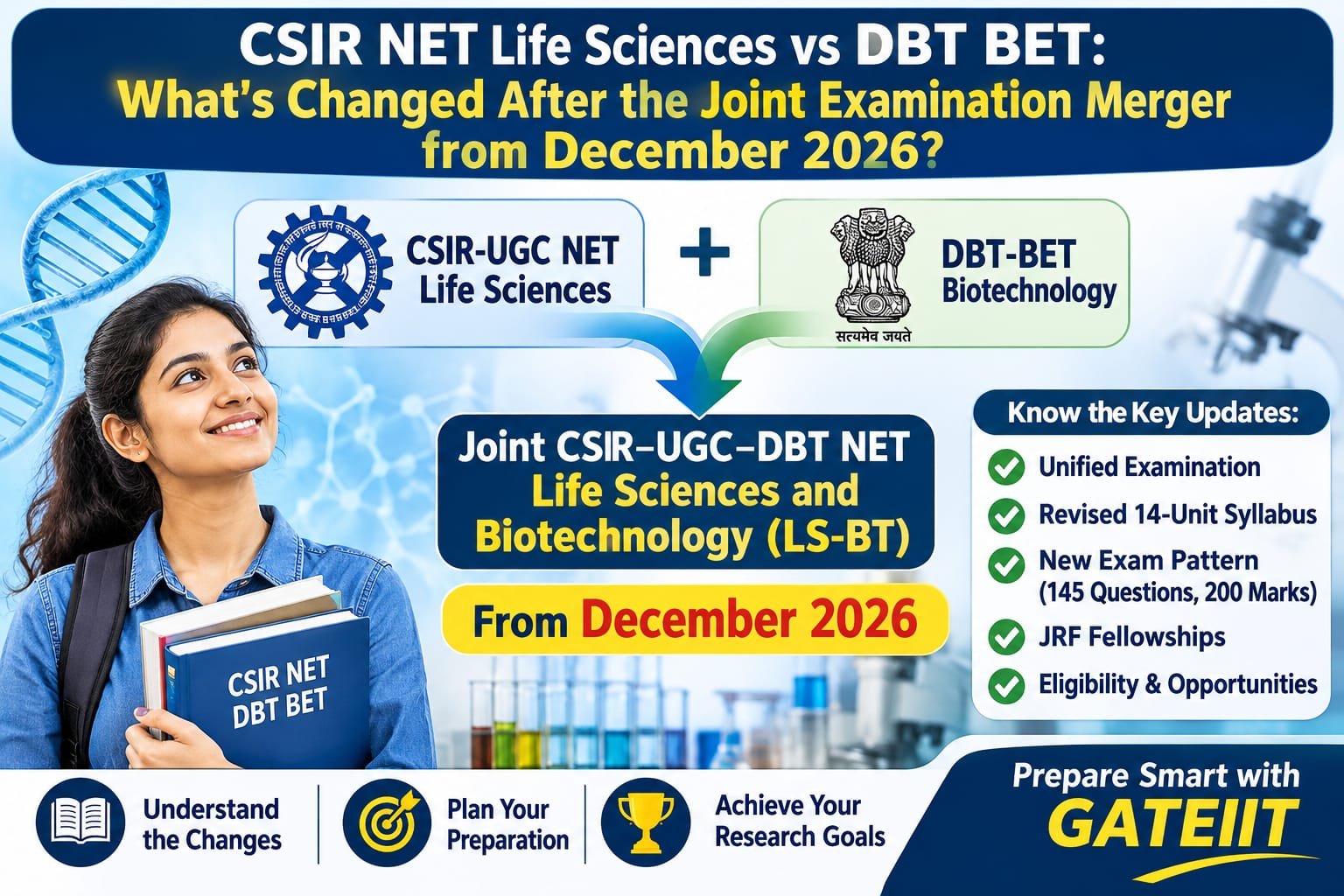
Complete Guide to the New Life Sciences and Biotechnology Examination, Revised Syllabus, Exam Pattern, JRF Fellowships, Eligibility and Preparation Strategy
The landscape of Life Sciences and Biotechnology competitive examinations in India has undergone an important change.
The Council of Scientific and Industrial Research (CSIR), the Department of Biotechnology (DBT) and the University Grants Commission (UGC) have introduced a unified examination framework by integrating the CSIR-UGC NET Life Sciences examination and the DBT Biotechnology Eligibility Test (DBT-BET).
The new examination is called the Joint CSIR–UGC–DBT JRF-NET, with the combined subject known as Life Sciences and Biotechnology (LS-BT).
The merger is effective from the December 2026 examination cycle.
This development is particularly important for students who were previously preparing separately for CSIR NET Life Sciences and DBT-BET. Candidates now need to understand the revised syllabus, common examination structure, fellowship arrangements and new qualification opportunities.
If you are a Life Sciences postgraduate, Biotechnology student, Biochemistry graduate, Microbiology student, Zoology or Botany aspirant, or a research-oriented student planning to pursue a PhD, this article explains what has changed and how you should prepare.
At GATEIIT, we recommend that students carefully understand the revised examination framework before choosing their study materials and preparation strategy.
1. What Is the Joint CSIR–UGC–DBT NET Merger?
Previously, students interested in research fellowships and academic opportunities in biological sciences had two major examination pathways:
- CSIR-UGC NET Life Sciences.
- DBT Biotechnology Eligibility Test (DBT-BET).
These examinations were conducted under different administrative frameworks, although several subjects and concepts overlapped.
To integrate the two examination pathways, CSIR and DBT approved a unified examination with a combined syllabus.
The new discipline is called:
Life Sciences and Biotechnology (LS-BT).
The unified Joint CSIR–UGC–DBT JRF-NET examination is intended to:
- Integrate the Life Sciences and Biotechnology examination pathways.
- Reduce duplication in examinations.
- Create a common national-level assessment framework.
- Encourage interdisciplinary research.
- Assess fundamental scientific knowledge and analytical ability.
- Provide a common examination route for relevant JRF and academic eligibility categories.
The merger is effective from the December 2026 examination cycle.
The official CSIR clarification was issued on 13 January 2026, and the revised combined syllabus was published on 21 January 2026. The NTA subsequently included the combined Life Sciences and Biotechnology discipline in its December 2026 Information Bulletin.
2. CSIR NET Life Sciences vs DBT-BET: What Was the Difference Earlier?
Before the merger, CSIR NET Life Sciences and DBT-BET were separate examinations.
Although both examinations assessed biological sciences and research aptitude, their administrative arrangements, examination frameworks and fellowship pathways were different.
Comparison of the Earlier Examinations
| Particulars | CSIR NET Life Sciences | DBT-BET |
| Full name | CSIR-UGC National Eligibility Test | Biotechnology Eligibility Test |
| Main organisation | CSIR | Department of Biotechnology |
| Administrative framework | CSIR-HRDG and NTA | DBT and its designated implementing agency |
| Main subject area | Life Sciences | Biotechnology and allied biological sciences |
| Syllabus | CSIR Life Sciences syllabus | DBT-BET syllabus |
| Main objective | JRF and academic eligibility | Biotechnology research fellowship selection |
| Examination pathway | Separate CSIR NET examination | Separate DBT-BET examination |
| Fellowship administration | CSIR/UGC framework | DBT-JRF framework |
| Examination structure | Three-part objective paper | Separate DBT-BET examination structure |
Why were two separate examinations conducted?
Life Sciences and Biotechnology have considerable academic overlap.
For example, students from both disciplines study:
- Molecular Biology.
- Cell Biology
- Molecular Genetics.
- Developmental Biology.
- Recombinant DNA Technology.
However, Biotechnology also includes specialised areas such as bioprocess engineering, industrial biotechnology, genetic engineering and applied biotechnology.
Similarly, traditional Life Sciences encompasses areas such as plant physiology, animal physiology, ecology, evolution, biodiversity and developmental biology.
The merger brings these overlapping and complementary areas under one combined examination framework.
3. What Has Changed from December 2026?
The following are the major changes candidates should understand.
Change 1: Two Separate Examinations Become One Combined Examination
Earlier, candidates generally applied for CSIR NET Life Sciences or DBT-BET depending on their academic and career objectives.
From the December 2026 cycle, the combined Life Sciences and Biotechnology discipline is included in the Joint CSIR-UGC NET examination.
Candidates will appear for the new combined LS-BT subject rather than separate CSIR Life Sciences and DBT-BET examinations.
Change 2: A Revised Combined Syllabus Has Been Introduced
The earlier CSIR NET Life Sciences syllabus and DBT-BET syllabus have been integrated into a revised 14-unit syllabus.
The new syllabus includes traditional biological sciences as well as biotechnology-oriented and interdisciplinary subjects.
Some important areas include:
- Biochemical Engineering.
- Industrial Biotechnology.
- Bioinformatics and Computational Biology.
- Advances in Biotechnology.
- Recombinant DNA Technology.
- Experimental Methods in Biology.
Traditional Life Sciences subjects such as plant physiology, animal physiology, developmental biology, ecology and evolution also remain important.
Change 3: Biotechnology Candidates Gain Access to the Common NET Qualification Categories
One of the most significant changes concerns the eligibility outcomes available through the unified examination.
According to the official CSIR clarification, candidates qualifying from Biotechnology backgrounds will also be eligible for all three applicable qualification categories under the new examination framework, subject to the prescribed rules.
These categories are:
- Award of JRF and appointment as Assistant Professor.
- Appointment as Assistant Professor and admission to PhD.
- Admission to PhD only.
This provides Biotechnology candidates with access to the common examination’s broader academic eligibility framework.
Change 4: A Common Examination Framework Is Introduced
The December 2026 NTA Information Bulletin includes Life Sciences and Biotechnology as subject code 703.
The examination is conducted through a Computer Based Test (CBT).
The subject has a defined question distribution across Parts A, B and C.
Change 5: Fellowship Funding and Administration Remain Important Distinctions
A common examination does not mean that CSIR and DBT have become one fellowship-funding organisation.
The December 2026 Information Bulletin specifically clarifies that:
- CSIR and UGC provide research fellowships under their applicable framework.
- DBT continues to support the DBT-Junior Research Fellowship programme.
- DBT-funded fellowships under the combined LS-BT subject will continue to be administered by DBT.
- CSIR has no financial liability under the DBT-funded fellowship programme.
Therefore, students should distinguish between the common examination and the organisation administering the fellowship.
4. What Is the New Joint CSIR–UGC–DBT NET Examination Pattern?
The NTA Information Bulletin for December 2026 provides the examination pattern for Life Sciences and Biotechnology (subject code 703).
The examination is conducted in Computer Based Test mode.
The paper consists of three sections: Part A, Part B and Part C.
Official Examination Pattern for Life Sciences and Biotechnology (703)
| Particulars | Part A | Part B | Part C | Total |
| Total questions | 20 | 50 | 75 | 145 |
| Maximum questions to attempt | 15 | 35 | 25 | 75 |
| Marks per correct answer | 2 | 2 | 4 | — |
| Maximum marks | 30 | 70 | 100 | 200 |
| Negative marking | 0.5 | 0.5 | 1 | — |
Important examination details:
- Examination duration: 3 hours.
- Examination mode: Computer Based Test.
- Question type: Objective Multiple Choice Questions.
- Maximum marks: 200.
- Total questions displayed: 145.
- Maximum questions to be attempted: 75.
- Negative marking: 25% for incorrect answers in all three sections.
Part A: General Aptitude
Part A is common to the examination subjects and tests general aptitude.
Topics include:
- Logical reasoning.
- Quantitative aptitude.
- Numerical ability.
- Graphical analysis.
- Data interpretation.
- Analytical reasoning.
- Quantitative comparison.
- Series formation.
- Research aptitude.
Part B: Subject Knowledge
Part B contains conventional subject-related multiple-choice questions.
Candidates are expected to demonstrate their understanding of the prescribed Life Sciences and Biotechnology syllabus.
Part C: Higher-Order Analytical Questions
Part C tests the ability to apply scientific knowledge to solve problems.
Questions may involve:
- Experimental data interpretation.
- Graph-based analysis.
- Scientific reasoning.
- Numerical calculations.
- Biological mechanisms.
- Research-based situations.
- Application of scientific concepts.
Students should therefore develop conceptual clarity and problem-solving ability rather than depending only on memorisation.
Is there a separate question paper for Life Sciences and Biotechnology?
The December 2026 Information Bulletin lists a single combined subject, Life Sciences and Biotechnology (703), with one common examination structure.
CSIR’s January 2026 clarification also states that the merged examination would feature adequate optional questions covering both traditional Life Sciences and Biotechnology domains, with the intention of providing opportunities to candidates from diverse academic backgrounds.
Candidates should refer to the applicable official question paper and examination instructions for the exact question-selection rules.
5. What Is the New Joint CSIR–UGC–DBT NET Syllabus?
The revised combined syllabus contains 14 units.
This is one of the most important changes for students preparing for the December 2026 examination and subsequent 2027 cycles.
Complete List of the 14 Units
| Unit | Subject |
| 1 | Structure and Function of Biomolecules |
| 2 | Cellular Organization |
| 3 | Fundamental Processes |
| 4 | Cell Communication and Cell Signaling |
| 5 | Developmental Biology |
| 6 | System Physiology – Plant |
| 7 | System Physiology – Animal |
| 8 | Inheritance Biology |
| 9 | Evolution and Diversity of Life Forms |
| 10 | Ecology and Behavioural Biology |
| 11 | Bioinformatics and Computational Biology |
| 12 | Biochemical Engineering and Industrial Biotechnology |
| 13 | Advances in Biotechnology |
| 14 | Methods in Biology |
Which topics are particularly important for Life Sciences students?
Candidates from traditional Life Sciences backgrounds should strengthen their preparation in:
- Biochemical Engineering.
- Industrial Biotechnology.
- Computational Biology.
- Advanced Biotechnology.
- Recombinant DNA Technology.
- Bioprocess Engineering.
Which topics should Biotechnology students strengthen?
Biotechnology students should also develop a strong foundation in:
- Plant Physiology.
- Animal Physiology.
- Developmental Biology.
- Classical Genetics.
- Fundamental biological processes.
The revised syllabus is intended to provide a combined interdisciplinary assessment. Students should not assume that they can prepare only their previous specialisation.
For a detailed explanation of all 14 units and their topics, read our related guide:
Joint CSIR–UGC–DBT NET 2027 Syllabus: Complete Unit-Wise Topics, Exam Pattern, Important Topics & Preparation Strategy.
[INTERNAL LINK: Insert the GATEIIT 14-unit syllabus blog URL here.]
6. Will the Number of JRF Fellowships Decrease After the Merger?
This was one of the major concerns raised by students during the merger consultation process.
Life Sciences candidates were concerned that combining two examinations might reduce the total number of fellowships.
Biotechnology candidates were concerned that the common examination might increase competition for available research fellowships.
The official CSIR clarification dated 13 January 2026 addresses this concern.
It states that the total number of fellowships will not be affected on account of the syllabus merger.
CSIR and DBT will continue providing fellowships according to their respective existing processes, while selection will take place through the common examination.
This distinction is important.
The examination is unified, but fellowship funding and administration continue under the respective organisational frameworks.
Candidates should consult the applicable fellowship notification and selection rules for details of fellowship availability and allocation.
7. What Are the Three Qualification Categories Under the New Examination?
The unified Joint CSIR-UGC NET examination provides three qualification categories.
These categories determine the academic opportunities available to qualified candidates.
Category 1: JRF and Assistant Professor
Candidates qualifying under Category 1 are eligible for:
- Award of Junior Research Fellowship.
- Appointment as Assistant Professor.
- Admission to PhD programmes, subject to institutional admission procedures.
This category is particularly relevant to candidates interested in pursuing research while retaining academic career opportunities.
Category 2: Assistant Professor and PhD Admission
Candidates qualifying under Category 2 are eligible for:
- Appointment as Assistant Professor.
- Admission to PhD programmes.
This category does not provide JRF eligibility.
Category 3: PhD Admission Only
Candidates qualifying under Category 3 are eligible for PhD admission only.
This category does not provide JRF or Assistant Professor eligibility.
For Categories 2 and 3, the December 2026 NTA Information Bulletin specifies that the NET score is valid for PhD admission for one year from the result declaration.
The written examination carries 70% weightage and the university interview or viva voce carries 30% weightage in the PhD admission process under these categories, subject to the applicable regulations.
Students should understand which qualification category aligns with their academic and research goals.
8. Who Should Prepare for the Joint CSIR–UGC–DBT NET?
The combined examination is relevant to students from a broad range of biological science and biotechnology disciplines.
Academic backgrounds may include:
- Life Sciences.
- Molecular Biology.
- Biomedical Sciences.
- Biological Sciences.
- Plant Science.
- Animal Science.
- Related interdisciplinary subjects.
However, the academic qualification and eligibility requirements must be checked against the official examination bulletin.
Can MSc Biotechnology students apply?
Eligible postgraduate students in Biotechnology and related subjects can apply, subject to the prescribed educational qualification and other conditions.
Can MSc Life Sciences students apply?
Yes. Eligible postgraduate students from Life Sciences and related disciplines can apply for the combined LS-BT examination.
Can Biochemistry and Microbiology students apply?
Candidates from these backgrounds may be eligible depending on their qualifying degree, marks and applicable subject-equivalence provisions.
The official information bulletin should be consulted before applying.
9. How Should CSIR NET Life Sciences Students Prepare After the Merger?
Students who were previously preparing for CSIR NET Life Sciences should not discard their earlier preparation.
Many fundamental concepts remain relevant.
However, they must now systematically cover the revised syllabus.
Recommended preparation approach
Step 1: Revise your existing Life Sciences foundation
Begin with:
- Cell Biology.
- Molecular Biology.
- Cell Signalling.
- Plant Physiology.
- Animal Physiology.
Step 2: Identify the additional Biotechnology topics
Allocate additional time to:
- Bioprocess Engineering.
- Industrial Biotechnology.
- Recombinant DNA Technology.
- Computational Biology.
- Advanced Biotechnology.
Step 3: Practise analytical questions
Give particular attention to:
- Experimental interpretation.
- Numerical problems.
- Molecular biology applications.
- Enzyme kinetics.
- Statistical analysis.
Step 4: Practise the new examination structure
Solve questions according to the 145-question, 200-mark framework and practise selecting the permitted number of questions in each section.
Step 5: Take regular mock examinations
Mock tests should be followed by detailed analysis of incorrect answers, weak concepts and time management.
10. How Should DBT-BET Aspirants Prepare for the New Combined Examination?
Students who previously concentrated on DBT-BET should also modify their preparation strategy.
Their Biotechnology foundation will remain useful, but they should not overlook the wider Life Sciences syllabus.
Recommended preparation areas
- Strengthen traditional Life Sciences
Prepare:
- Plant Physiology.
- Animal Physiology.
- Developmental Biology.
- Revise fundamental biological concepts
Ensure strong understanding of:
- Molecular Biology.
- Cell Biology.
- Cellular Signalling.
- Continue advanced Biotechnology preparation
Maintain preparation in:
- Genetic Engineering.
- Recombinant DNA Technology.
- Bioprocess Engineering.
- Industrial Biotechnology.
- Molecular Diagnostics.
- Medical Biotechnology.
- Develop analytical and research aptitude
Part C requires students to apply concepts to scientific problems.
Practise interpreting experimental results, graphs, numerical data and biological mechanisms.
- Practise relevant previous-year papers
Previous DBT-BET and CSIR NET question papers can be useful for subject preparation.
However, students must remember that the old examinations had separate syllabi and examination structures. The new examination should be prepared for using the revised LS-BT syllabus and the December 2026 NTA examination pattern.
11. Should You Use Old CSIR NET and DBT-BET Study Materials?
Yes, but selectively.
Old study materials are still valuable because several fundamental biological concepts remain relevant.
However, students should not depend entirely on the old syllabi.
Which old CSIR NET materials are useful?
- Cell Biology.
- Molecular Biology.
- Plant Physiology.
- Animal Physiology.
- Developmental Biology.
Which old DBT-BET materials are useful?
- Recombinant DNA Technology.
- Genetic Engineering.
- Bioprocess Engineering.
- Molecular Diagnostics.
- Industrial Biotechnology.
- Advanced Molecular Biology.
- Applied Biotechnology.
What should students avoid?
Avoid using an old syllabus as the sole preparation checklist.
Always compare your study material with the revised official 14-unit LS-BT syllabus.
12. Is the New Joint CSIR–UGC–DBT NET More Difficult Than the Earlier Examinations?
It is not appropriate to conclude that the new examination is automatically more difficult or easier.
The merger has changed the syllabus and the examination framework.
Students from both backgrounds may encounter topics outside their previous areas of specialisation.
For example:
A traditional Life Sciences student may need to study industrial biotechnology and bioprocess engineering.
A Biotechnology student may need to strengthen ecology, evolution, developmental biology and traditional plant and animal physiology.
The difficulty experienced by an individual candidate will depend on their academic background, conceptual understanding, preparation time and familiarity with the revised syllabus.
The best strategy is to prepare systematically rather than speculate about the difficulty level.
13. Important Official Updates for the December 2026 Examination
The National Testing Agency has published the Information Bulletin for Joint CSIR-UGC NET December 2026.
Important dates stated in the bulletin include:
| Particulars | Official schedule |
| Online application begins | 7 October 2026 |
| Regular application deadline | 5 November 2026 |
| Late application window | 6–9 November 2026 |
| Application correction window | 10–12 November 2026 |
| Examination dates | 19, 22 and 27 December 2026 |
| Examination mode | Computer Based Test |
The above dates relate specifically to the December 2026 examination cycle. Candidates should check the NTA portal for subsequent notices or revised schedules.
Official examination portal:
https://csirnet.nta.nic.in/
Official CSIR-HRDG website:
https://csirhrdg.res.in/
14. Why Start Preparing Early for Joint CSIR–UGC–DBT NET 2027?
The revised syllabus covers a wide range of subjects.
Students preparing for the 2027 examination should not wait until the final few months to begin studying the additional topics.
Early preparation allows candidates to:
- Complete all 14 units systematically.
- Strengthen fundamental concepts.
- Cover interdisciplinary topics.
- Practise previous-year questions.
- Improve analytical problem-solving.
- Revise multiple times.
- Take sufficient mock examinations.
- Identify and address weak areas.
A structured six-month or twelve-month preparation plan can be useful depending on the student’s existing academic foundation and available study time.
15. Joint CSIR–UGC–DBT NET Coaching 2027 at GATEIIT
The integration of CSIR NET Life Sciences and DBT-BET makes systematic preparation particularly important.
Students now need to prepare for a wider combined syllabus that includes both fundamental Life Sciences and advanced Biotechnology topics.
At GATEIIT – Gate Indian Institute of Tutorials, students can enquire about academic preparation programmes for Joint CSIR–UGC–DBT NET Life Sciences and Biotechnology.
Different Learning Options at GATEIIT
- Personal Mentorship Programme
One-to-one academic support for students who prefer individual attention, customised preparation and focused doubt clarification.
- Small Group Classes
Interactive learning arrangements with opportunities for discussion, problem-solving and personalised academic support.
- Online Coaching
Online learning options for students from Bangalore and other parts of India.
- Offline Classroom Coaching
Students who prefer classroom learning can enquire about available offline batches at the GATEIIT centre in JP Nagar 2nd Phase, Bangalore.
- Hybrid Learning
A combination of online and offline learning options, depending on batch availability.
- Crash Course and Short-Term Preparation
Focused revision, important concept discussions, previous-year question practice and examination-oriented preparation for students who have already covered a significant portion of the syllabus.
- Long-Term Preparation
Systematic syllabus coverage and conceptual preparation for students planning ahead for the 2027 examination cycle.
What Can Students Enquire About?
Depending on the selected course and batch availability:
- Complete revised LS-BT syllabus coverage.
- Life Sciences and Biotechnology subject preparation.
- Conceptual classroom teaching.
- Part A aptitude preparation.
- Part B subject-based practice.
- Part C analytical problem-solving.
- Previous-year question discussions.
- Topic-wise tests.
- Mock examinations.
- Doubt-solving sessions.
- Revision and academic guidance.
- Individual preparation planning.
Why Consider GATEIIT?
GATEIIT provides competitive examination preparation and different learning arrangements for students with varied academic requirements.
Whether you are preparing for your first attempt, transitioning from the old CSIR NET syllabus or moving from DBT-BET preparation to the combined examination, you can enquire about a suitable learning arrangement.
GATEIIT – Gate Indian Institute of Tutorials
Joint CSIR–UGC–DBT NET Life Sciences and Biotechnology Coaching 2027
Location: JP Nagar 2nd Phase, Bangalore.
Online | Offline | Hybrid | Small Groups | Personal Mentorship
Website: https://www.gateiit.com/
Call: 8884416155
WhatsApp: 8884416154
Contact GATEIIT to enquire about current batches, course schedules, faculty availability and personalised preparation options.
16. Frequently Asked Questions: CSIR NET Life Sciences vs DBT-BET Merger
Q1. Is DBT-BET merged with CSIR NET Life Sciences?
Yes. CSIR and DBT have integrated CSIR-NET Life Sciences and DBT-BET into a unified Joint CSIR–UGC–DBT JRF-NET framework, effective from the December 2026 examination cycle.
Q2. From which year is the CSIR NET and DBT-BET merger applicable?
The merger is effective from the December 2026 examination cycle. The combined examination is called Life Sciences and Biotechnology (LS-BT).
Q3. What is the new name of the combined examination?
The combined examination is called Joint CSIR–UGC–DBT JRF-NET, and the combined subject is Life Sciences and Biotechnology.
Q4. Will there be a separate DBT-BET examination after December 2026?
The announced merger integrates the DBT-BET examination with CSIR NET Life Sciences from the December 2026 cycle. Candidates should follow the official NTA and DBT notifications for any subsequent administrative updates.
Q5. What is the new subject code for Life Sciences and Biotechnology?
The December 2026 NTA Information Bulletin lists Life Sciences and Biotechnology as subject code 703.
Q6. How many units are included in the new LS-BT syllabus?
The revised syllabus contains 14 units, including Biochemical Engineering, Industrial Biotechnology, Bioinformatics, Advances in Biotechnology and Methods in Biology.
Q7. Is the CSIR NET Life Sciences syllabus changed after the merger?
Yes. A revised combined Life Sciences and Biotechnology syllabus has been introduced. Candidates should prepare according to the official 14-unit syllabus.
Q8. Can MSc Biotechnology students apply for the new examination?
Eligible postgraduate students from Biotechnology and related disciplines can apply, subject to the educational qualification, minimum marks and other conditions specified in the official information bulletin.
Q9. Can MSc Life Sciences students apply?
Yes. Eligible Life Sciences postgraduate students can apply for the combined examination.
Q10. Will Biotechnology students be eligible for JRF after the merger?
Yes. According to the official CSIR clarification, Biotechnology candidates qualifying through the joint examination will be eligible for the applicable JRF qualification category, subject to the prescribed conditions.
Q11. Will Biotechnology candidates also become eligible for Assistant Professor qualification?
Yes. The official CSIR clarification states that qualified Biotechnology candidates will be eligible for all three applicable qualification categories under the common examination framework, subject to the relevant rules.
Q12. Will the number of JRF fellowships decrease after the merger?
The official CSIR clarification states that the total number of fellowships will not be affected on account of the syllabus merger. CSIR and DBT will continue providing fellowships under their respective processes.
Q13. Who will provide the DBT-JRF fellowship after the merger?
DBT-funded fellowships will continue to be administered by DBT. The December 2026 NTA Information Bulletin specifically explains the respective fellowship responsibilities.
Q14. What is the examination pattern of Joint CSIR–UGC–DBT NET?
For Life Sciences and Biotechnology, the December 2026 examination consists of 145 questions across Parts A, B and C, with a maximum of 75 questions to be attempted and 200 total marks.
Q15. Is there negative marking in the new examination?
Yes. The December 2026 examination scheme specifies 25% negative marking for incorrect answers in Parts A, B and C.
Q16. Can old CSIR NET and DBT-BET question papers be used for preparation?
Yes. Old question papers are useful for learning relevant concepts and developing analytical ability. However, students should prepare according to the revised syllabus and new examination framework.
Q17. Is the new examination suitable for students from Microbiology and Biochemistry backgrounds?
Students from Microbiology, Biochemistry and other related biological science backgrounds may be eligible, depending on their qualifying degree and applicable eligibility conditions.
Q18. Where can I download the new Joint CSIR–UGC–DBT NET syllabus?
The revised syllabus is available through the official CSIR-HRDG website. Candidates should use the latest published 14-unit Life Sciences and Biotechnology syllabus.
Q19. Where can I prepare for Joint CSIR–UGC–DBT NET in Bangalore?
Students can enquire about Life Sciences and Biotechnology coaching at GATEIIT, JP Nagar 2nd Phase, Bangalore, including online, offline, hybrid and personalised learning options.
Q20. Does GATEIIT offer personal mentorship for Joint CSIR–UGC–DBT NET?
Students can enquire about one-to-one personal mentorship, small-group classes and other customised preparation arrangements, subject to faculty and batch availability.
Final Advice: Prepare for the New Examination, Not the Old Syllabus Alone
The integration of CSIR NET Life Sciences and DBT-BET is an important development for biological science and biotechnology research aspirants in India.
Students from both backgrounds now have a common examination pathway, a revised combined syllabus and a unified framework for relevant academic qualification categories.
The most important thing candidates should understand is that the examination has changed, but the fundamentals of biological science remain essential.
Life Sciences students should strengthen their Biotechnology knowledge.
Biotechnology students should strengthen their traditional Life Sciences foundation.
Both groups should develop analytical ability, research aptitude and conceptual understanding.
If you are planning to appear for Joint CSIR–UGC–DBT NET 2027, start preparing with the revised 14-unit syllabus and follow a structured study plan.
Your research career begins with the right preparation.
Explore Joint CSIR–UGC–DBT NET Life Sciences and Biotechnology Coaching at GATEIIT.
GATEIIT – Gate Indian Institute of Tutorials
JP Nagar 2nd Phase, Bangalore.
Website: www.gateiit.com
Call: 8884416155
WhatsApp: 8884416154
OFFICIAL EXTERNAL REFERENCE LINKS
Use these authoritative sources to support the article.
- Official CSIR merger clarification dated 13 January 2026
https://csirhrdg.res.in/SiteContent/ManagedContent/ATContent/Introduction_of_the_Joint_CSIR_UGC_DBT_JRF_NET_Examination__to_be_implemented_from_20260114144343584.pdf
- Official revised 14-unit LS-BT syllabus
https://csirhrdg.res.in/SiteContent/ManagedContent/ContentFiles/20260121115025355Merged_Syllabus_CSIR-DBT_21Jan2026.pdf
- NTA Joint CSIR-UGC NET official website
https://csirnet.nta.nic.in/
- Official December 2026 Information Bulletin
https://cdnbbsr.s3waas.gov.in/s3efdf562ce2fb0ad460fd8e9d33e57f57/uploads/2026/10/202610071407707951.pdf
- Department of Biotechnology
https://dbtindia.gov.in/