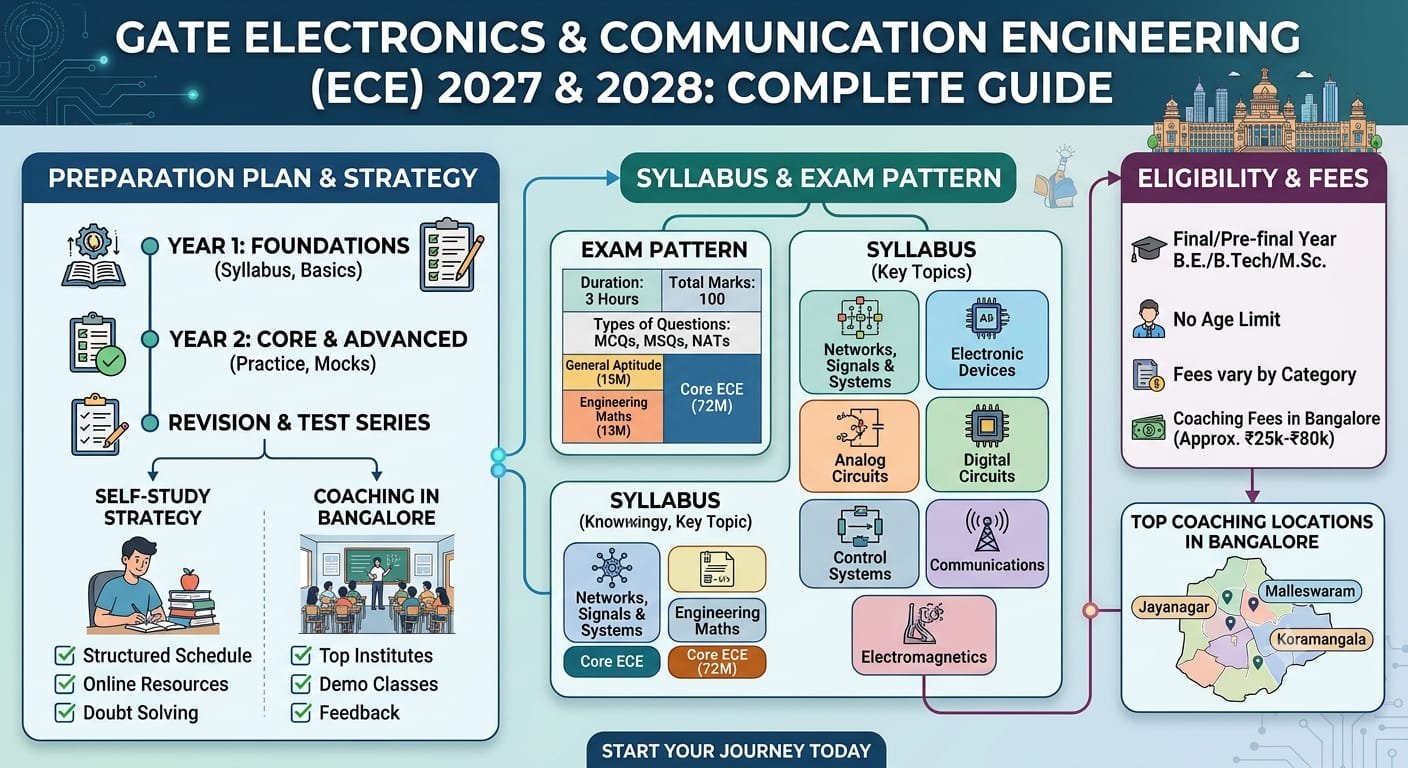
GATE ECE 2027 and 2028 – Complete Guide to Examination, Updated Syllabus, Eligibility, Application Process, Exam Pattern, Preparation Strategy, Previous Year Questions, Mock Tests, M.Tech Admissions, PSU Opportunities and Online & Offline Coaching by GATEIIT.
The Graduate Aptitude Test in Engineering (GATE) is one of India’s most important national-level competitive examinations for engineering graduates and undergraduate students aspiring to pursue postgraduate education, research and technical careers. GATE Electronics and Communication Engineering (ECE), with paper code EC, offers opportunities to pursue M.Tech, M.E., MS and PhD programmes at prestigious institutions such as IITs, IISc, NITs and other participating universities.
Whether you are preparing for GATE ECE 2027 or planning your preparation for GATE ECE 2028, a well-structured study plan, strong conceptual understanding, regular numerical practice, previous-year question analysis and full-length mock examinations are essential for achieving a competitive score.
Electronics and Communication Engineering is a broad technical discipline covering semiconductor devices, electronic circuits, digital systems, communication networks, signal processing, control systems and electromagnetic theory. GATE evaluates candidates on their understanding of these subjects and their ability to apply engineering concepts to complex problems.
GATEIIT – Gate Indian Institute of Tutorials offers GATE Electronics and Communication Engineering coaching through online, offline and hybrid programmes. Students across India can access online coaching, while candidates in Bengaluru can attend classroom programmes at the GATEIIT JP Nagar centre.
GATEIIT also offers specialised 30-day, 45-day, 60-day and 90-day crash courses, score booster programmes, personalised academic mentoring, one-to-one doubt-clearing support, practice tests, online study materials and scholarship-based fee discounts of up to 90%, subject to applicable conditions.
This comprehensive guide explains everything students need to know about GATE ECE 2027 and 2028, including the examination schedule, eligibility, syllabus, preparation methods, career opportunities, postgraduate admissions and coaching options.
1. What Is GATE Electronics and Communication Engineering (ECE)?
The Graduate Aptitude Test in Engineering (GATE) is a national-level examination conducted jointly by the Indian Institute of Science (IISc) and the Indian Institutes of Technology (IITs), on behalf of the National Coordination Board (NCB), Department of Higher Education, Ministry of Education, Government of India.
Electronics and Communication Engineering is one of the GATE examination papers, identified by the paper code EC.
The examination evaluates a candidate’s understanding of undergraduate-level engineering subjects, mathematical ability, analytical thinking, conceptual knowledge and numerical problem-solving skills.
The GATE ECE syllabus covers the following major subjects:
- Engineering Mathematics
- Network Theory
- Signals and Systems
- Electronic Devices
- Analog Electronics
- Digital Electronics
- Control Systems
- Communication Systems
- Electromagnetic Theory
- General Aptitude
GATE ECE is not simply a test of memorised formulas. Candidates must understand engineering fundamentals, interpret technical problems, apply mathematical methods and solve numerical questions accurately within the examination duration.
2. Why Should You Appear for GATE ECE 2027 or 2028?
A good GATE ECE score can create opportunities for higher education, technical specialisation, research and selected government-sector recruitment.
Some of the important opportunities after qualifying GATE include:
- Tech admission at Indian Institutes of Technology.
- E. and M.Tech admission at National Institutes of Technology.
- Postgraduate programmes at IISc Bengaluru.
- Selected postgraduate programmes at IIITs.
- Admission to participating government and private universities.
- Direct PhD and integrated doctoral programmes, subject to institutional eligibility.
- Research and development opportunities.
- PSU recruitment through GATE-based selection processes, wherever applicable.
- Specialisation in VLSI and semiconductor technology.
- Career opportunities in telecommunications, embedded systems, electronics and signal processing.
Higher education opportunities
GATE-qualified candidates can apply for postgraduate programmes in areas such as:
- VLSI Design.
- Communication Systems.
- Signal Processing.
- Embedded Systems.
- Electronic Systems.
- Wireless Communication.
- RF and Microwave Engineering.
- Control and Instrumentation.
- Semiconductor Technology.
- Computer Engineering.
- Integrated Circuits and Systems.
Eligible students admitted to approved postgraduate programmes may receive financial assistance under applicable government and institutional regulations.
However, qualifying GATE does not automatically guarantee admission, a scholarship or employment. Each institution and organisation follows its own selection procedure.
3. GATE ECE 2027 Examination Details
IIT Madras is the organising institute for GATE 2027. The examination is conducted jointly by IISc and the seven IITs on behalf of the National Coordination Board.
The GATE 2027 examination includes 30 test papers, including Electronics and Communication Engineering (EC).
GATE 2027 examination overview
| Particular | Details |
| Examination name | Graduate Aptitude Test in Engineering |
| Examination year | 2027 |
| Engineering branch | Electronics and Communication Engineering |
| Paper code | EC |
| Organising institute | IIT Madras |
| Conducting institutions | IISc and IITs |
| Examination level | National |
| Examination mode | Computer Based Test (CBT) |
| Question paper language | English |
| Examination duration | 3 hours |
| Total questions | 65 |
| Total marks | 100 |
| General Aptitude | 15 marks |
| Engineering Mathematics | 13 marks |
| Core ECE subjects | 72 marks |
| GATE score validity | 3 years |
GATE 2027 important dates and examination schedule
The official GATE 2027 registration schedule and examination dates are as follows:
| Event | Official date |
| Online application started | 2 September 2026 |
| Regular registration closing date | 5 October 2026 |
| Extended registration closing date | 12 October 2026 |
| Special registration window | 15–16 October 2026 |
| Application scrutiny and defect rectification | 14–31 October 2026 |
| City allotment notification | 4 January 2027 |
| Admit card download | To be announced |
| GATE 2027 examination | 6, 7, 13, 14, 20 and 21 February 2027 |
| Result announcement | 19 March 2027 |
Important update for candidates: As of 30 October 2026, the GATE 2027 application registration portal is closed. Candidates who have already applied should check their GOAPS account and registered DigiLocker account for application scrutiny and defect notifications. The announced scrutiny defect-rectification window closes on 31 October 2026.
The exact date and session allotted for the EC paper should be checked in the official examination schedule and admit card.
Official website: https://gate2027.iitm.ac.in/
4. GATE ECE 2028 Examination Details
Students planning to appear for GATE 2028 should begin preparation early rather than waiting for the official application notification.
As of October 2026, the official GATE 2028 organising institute, examination schedule, application dates, eligibility notification, application fees and final syllabus have not been announced.
The following information is a tentative planning reference only.
| Particular | GATE 2028 |
| Examination | GATE 2028 |
| Paper | Electronics and Communication Engineering |
| Paper code | EC |
| Organising institute | To be announced |
| Conducting institutions | To be officially confirmed |
| Examination mode | Expected computer-based test |
| Examination language | Expected English |
| Examination duration | Expected 3 hours |
| Total marks | Expected 100 |
| Examination period | Tentatively February 2028 |
| Application dates | To be announced |
| Application fees | To be announced |
| Syllabus | To be officially announced |
Candidates should refer to the official GATE 2028 notification once published. GATE 2027 dates, fees and syllabus should not automatically be treated as confirmed GATE 2028 information.
Who should start preparing for GATE 2028?
- First-year and second-year engineering students who want to strengthen their fundamentals.
- Third-year B.E. and B.Tech students.
- Final-year ECE students.
- Engineering graduates.
- Working professionals planning postgraduate education.
- Candidates who appeared for GATE 2027 and want to improve their score.
- Students targeting IITs, IISc and NITs.
- Candidates interested in semiconductor, VLSI and communication technology.
Starting early provides enough time for complete syllabus coverage, multiple revisions, numerical practice and mock examinations.
5. GATE ECE 2027 and 2028 Eligibility Criteria
Candidates from different academic backgrounds can appear for GATE if they satisfy the eligibility conditions prescribed in the official examination brochure.
For GATE 2027, candidates currently studying in the third year or higher of an eligible undergraduate degree programme, or those who have completed an eligible government-approved degree programme, can apply.
Eligible qualifications
| Degree or programme | Eligibility |
| B.E. / B.Tech. / B.Pharm. | Third year or higher, or completed |
| B.Arch. | Third year or higher, or completed |
| B.Sc. (Research) / B.S. | Third year or higher, or completed |
| B.Sc. / B.A. / B.Com. / BCA | Third year or higher, or completed |
| M.Sc. / M.A. / MCA | First year or higher, or completed |
| Integrated M.Tech. | As prescribed for the relevant programme |
| Integrated M.Sc. | Third year or higher, or completed |
| Other recognised qualifications | According to the official eligibility rules |
Candidates from disciplines other than ECE may also select the EC paper if they satisfy the general GATE eligibility conditions.
However, qualifying GATE EC does not automatically make a candidate eligible for every ECE postgraduate programme. Individual institutions specify their accepted qualifying degrees and GATE paper codes.
Important eligibility conditions
- There is no upper age limit for GATE.
- There is no restriction on the number of attempts.
- Candidates must satisfy the prescribed educational qualification requirements.
- International candidates must follow the applicable eligibility rules.
- Candidates should verify the admission eligibility of their target institutions separately.
6. Is There Any Exemption from GATE ECE?
There is no general exemption from GATE based solely on having completed B.E., B.Tech., M.E. or M.Tech. in Electronics and Communication Engineering.
Similarly, candidates with excellent undergraduate academic records or postgraduate qualifications are not automatically exempted from the examination.
Certain institutions may have their own admission routes for sponsored candidates, institute-funded candidates or other eligible categories. These are institution-specific provisions and should not be confused with a general GATE examination exemption.
7. GATE ECE 2027 Application Fees
The GATE application fee depends on the candidate’s category and registration period.
Official GATE 2027 application fees
| Candidate category | Regular period – one paper | Extended period – one paper |
| Female candidates | ₹1,000 | ₹1,500 |
| SC candidates | ₹1,000 | ₹1,500 |
| ST candidates | ₹1,000 | ₹1,500 |
| PwD candidates | ₹1,000 | ₹1,500 |
| All other candidates, including foreign nationals | ₹2,000 | ₹2,500 |
Application fees for two papers
| Candidate category | Regular period | Extended period |
| Female / SC / ST / PwD candidates | ₹2,000 | ₹2,500 |
| All other candidates | ₹4,000 | ₹4,500 |
These are GATE 2027 examination application fees, not coaching fees. The examination application fee is generally non-refundable, except in specified duplicate-transaction cases.
GATE 2028 application fees will be announced separately.
8. GATE ECE 2027 Examination Pattern
Understanding the examination pattern is essential for preparing an effective GATE strategy.
The GATE ECE paper is conducted as a three-hour computer-based examination containing 65 questions for 100 marks.
Section-wise marks distribution
| Section | Marks |
| General Aptitude | 15 |
| Engineering Mathematics | 13 |
| Core Electronics and Communication Engineering | 72 |
| Total | 100 |
Question distribution
- General Aptitude: 10 questions.
- Technical section, including Engineering Mathematics: 55 questions.
- Total: 65 questions.
Types of questions
- Multiple Choice Questions (MCQ)
Candidates select one correct answer from the given options.
- Multiple Select Questions (MSQ)
Candidates select one or more correct options. Partial marking is not available.
- Numerical Answer Type (NAT)
Candidates calculate the answer and enter the numerical value using the virtual numerical keypad.
GATE marking scheme
| Question type | Correct answer | Incorrect answer |
| 1-mark MCQ | +1 | -1/3 |
| 2-mark MCQ | +2 | -2/3 |
| MSQ | Marks awarded for the correct selection | No negative marking |
| NAT | Marks awarded for the correct answer | No negative marking |
Negative marking applies only to incorrect MCQs. There is no negative marking for incorrect MSQ and NAT responses.
Skills evaluated in GATE ECE
GATE assesses four important abilities:
- Recall of fundamental concepts.
- Comprehension of technical principles.
- Application of engineering knowledge.
- Analysis and synthesis of complex problems.
Students should practise all three question formats during preparation.
9. Complete GATE Electronics and Communication Engineering Syllabus 2027
The GATE ECE syllabus is divided into major technical subjects and General Aptitude.
The syllabus covers mathematical concepts, circuit analysis, semiconductor devices, analog and digital electronics, signals, systems, communication technology and electromagnetic theory.
Important: IIT Madras has announced revisions to the GATE 2027 test-paper syllabi. Candidates must download the official EC syllabus PDF and use it as the final reference for topic-wise preparation.
Subject 1: Engineering Mathematics
Engineering Mathematics is an important scoring area in GATE ECE. Mathematical fundamentals are also required for solving technical problems across several other subjects.
- Linear Algebra
- Vector spaces.
- Basis and dimension.
- Linear dependence and independence.
- Matrix algebra.
- Rank of a matrix.
- Eigenvalues and eigenvectors.
- Solution of linear equations.
- Existence and uniqueness of solutions.
- Calculus
- Mean value theorems.
- Integral calculus.
- Definite and improper integrals.
- Partial derivatives.
- Maxima and minima.
- Multiple integrals.
- Line, surface and volume integrals.
- Taylor series.
- Differential Equations
- Linear differential equations.
- Euler-Cauchy equations.
- Homogeneous and non-homogeneous equations.
- Complementary functions.
- Particular integrals.
- Variation of parameters.
- Partial differential equations.
- Variable separable method.
- Initial and boundary value problems.
- Vector Analysis
- Vector operations.
- Gauss divergence theorem.
- Green’s theorem.
- Stokes’ theorem.
- Complex Analysis
- Analytic functions.
- Cauchy’s integral theorem.
- Cauchy’s integral formula.
- Sequences and series.
- Convergence tests.
- Taylor series.
- Laurent series.
- Residue theorem.
- Probability and Statistics
- Mean, median and mode.
- Standard deviation.
- Probability distributions.
- Binomial distribution.
- Poisson distribution.
- Exponential distribution.
- Normal distribution.
- Conditional probability.
- Joint probability.
- Correlation and regression analysis.
Subject 2: Networks, Signals and Systems
Networks, Signals and Systems is one of the fundamental subjects of Electronics and Communication Engineering.
- Network Theory
- Basic electrical circuit concepts.
- Kirchhoff’s Current Law.
- Kirchhoff’s Voltage Law.
- Node analysis.
- Mesh analysis.
- Superposition theorem.
- Thevenin’s theorem.
- Norton’s theorem.
- Reciprocity theorem.
- Maximum power transfer theorem.
- Network transformations.
- Two-port networks.
- Network parameters.
- Sinusoidal Steady-State Analysis
- Phasor representation.
- Impedance and admittance.
- Complex power.
- Active and reactive power.
- Power factor.
- Series and parallel circuits.
- Transient Circuit Analysis
- RC circuits.
- RL circuits.
- RLC circuits.
- Initial and final conditions.
- Transient response.
- Steady-state response.
- Laplace transforms.
- Network equations.
- Continuous-Time Signals and Systems
- Basic signal classification.
- Periodic and aperiodic signals.
- Energy and power signals.
- Linear time-invariant systems.
- Impulse response.
- Fourier series.
- Fourier transforms.
- Sampling theorem.
- Discrete-Time Signals and Systems
- Discrete-time signals.
- Discrete-time Fourier transform.
- Discrete Fourier transform.
- Z-transform.
- Difference equations.
- FIR filters.
- IIR filters.
- Digital filter concepts.
Subject 3: Electronic Devices
Electronic Devices covers semiconductor physics and the operating principles of electronic components.
Important topics include:
- Energy bands in solids.
- Intrinsic semiconductors.
- Extrinsic semiconductors.
- Direct and indirect band-gap semiconductors.
- Carrier concentration.
- Electron and hole mobility.
- Drift current.
- Diffusion current.
- Generation and recombination.
- Poisson equation.
- Continuity equation.
- P-N junction diode.
- Zener diode.
- Bipolar Junction Transistor.
- MOS capacitor.
- MOSFET scaling.
- Light Emitting Diode.
- Solar cell.
Students should concentrate on semiconductor fundamentals, device characteristics, operating regions and numerical problem-solving.
Subject 4: Analog Electronics
Analog Electronics is an important technical subject for GATE ECE. It requires a clear understanding of electronic circuits and their applications.
- Diode Circuits
- Diode characteristics.
- Voltage regulation.
- Transistor Circuits
- BJT characteristics.
- MOSFET characteristics.
- Transistor biasing.
- Small-signal models.
- Frequency response.
- Current mirrors.
- Differential amplifiers.
- Operational Amplifiers
- Ideal and practical op-amps.
- Inverting amplifiers.
- Non-inverting amplifiers.
- Summing amplifiers.
- Active filters.
- Schmitt triggers.
- Frequency compensation.
- Miller compensation.
- Phase margin.
Subject 5: Digital Circuits
Digital Electronics is particularly relevant for candidates interested in VLSI design, semiconductor technology, digital systems and hardware engineering.
- Number Systems
- Binary number system.
- Decimal number system.
- Octal and hexadecimal systems.
- Signed number representation.
- Integer representation.
- Floating-point representation.
- Boolean Algebra and Logic Gates
- Boolean identities.
- Logic gates.
- Karnaugh maps.
- Combinational logic.
- Static CMOS implementation.
- Combinational Circuits
- Code converters.
- Sequential Circuits
- Flip-flops.
- Shift registers.
- Finite state machines.
- Setup time.
- Hold time.
- Propagation delay.
- Critical path delay.
- Data Converters and Memories
- Sample and hold circuits.
- Analog-to-Digital Converters.
- Digital-to-Analog Converters.
- Computer Organisation
- Machine instructions.
- Addressing modes.
- Arithmetic Logic Unit.
- Control unit.
- Instruction pipelining.
Subject 6: Control Systems
Control Systems evaluates a student’s understanding of feedback systems, system stability and mathematical modelling.
Important topics include:
- Basic control system components.
- Open-loop systems.
- Closed-loop systems.
- Feedback principles.
- Transfer functions.
- Block diagrams.
- Signal flow graphs.
- Transient response.
- Steady-state analysis.
- Linear time-invariant systems.
- Frequency response.
- Routh-Hurwitz stability criterion.
- Nyquist stability criterion.
- Bode plots.
- Root locus.
- PID controllers.
- State variable models.
- State equations of LTI systems.
Students should practise stability analysis, system response, block diagram reduction and frequency-domain problems.
Subject 7: Communications
Communication Systems is one of the most important core areas of Electronics and Communication Engineering.
- Random Processes
- Random variables.
- Random processes.
- Power spectral density.
- White noise.
- Properties of random noise.
- Filtering of random signals through LTI systems.
- Analog Communication
- Amplitude modulation.
- Amplitude demodulation.
- Frequency modulation.
- Phase modulation.
- Spectra of AM and FM.
- Superheterodyne receivers.
- Information Theory
- Information and entropy.
- Source coding.
- Mutual information.
- Channel capacity theorem.
- Digital Communication
- Pulse Code Modulation.
- Differential PCM.
- Amplitude Shift Keying.
- Frequency Shift Keying.
- Phase Shift Keying.
- Quadrature Amplitude Modulation.
- Inter-symbol interference.
- MAP detection.
- Maximum Likelihood detection.
- Matched filter receivers.
- Signal-to-Noise Ratio.
- Bit Error Rate.
- Error correction fundamentals.
- Hamming codes.
- Cyclic Redundancy Check.
Subject 8: Electromagnetics
Electromagnetic Theory is important for understanding electromagnetic waves, antennas, transmission lines and microwave engineering.
- Maxwell’s Equations
- Maxwell’s equations in differential form.
- Maxwell’s equations in integral form.
- Physical interpretation.
- Electromagnetic boundary conditions.
- Wave equation.
- Poynting vector.
- Electromagnetic Waves
- Plane waves.
- Reflection and refraction.
- Phase velocity.
- Group velocity.
- Propagation through different media.
- Skin depth.
- Transmission Lines
- Transmission line equations.
- Characteristic impedance.
- Impedance matching.
- Impedance transformation.
- S-parameters.
- Smith chart.
- Waveguides and Antennas
- Rectangular waveguides.
- Circular waveguides.
- Optical fibre propagation.
- Dipole antennas.
- Monopole antennas.
- Linear antenna arrays.
Subject 9: General Aptitude
General Aptitude carries 15 marks and is common to all GATE papers.
It evaluates language skills, numerical ability and analytical reasoning.
Important topics include:
Verbal Ability
- English grammar.
- Sentence completion.
- Reading comprehension.
- Sentence correction.
- Verbal reasoning.
Numerical Ability
- Ratios and proportions.
- Profit and loss.
- Time and work.
- Speed, distance and time.
- Number systems.
- Basic statistics.
- Data interpretation.
Analytical Ability
- Logical reasoning.
- Numerical reasoning.
- Data analysis.
- Pattern recognition.
- Problem-solving.
General Aptitude should be practised throughout the preparation period rather than postponed until the final weeks.
10. Important GATE ECE Subjects and Preparation Priorities
Students frequently ask which GATE ECE subjects should be completed first.
A good strategy is to begin with fundamental subjects and gradually progress towards advanced technical applications.
| Subject | Recommended preparation priority |
| Engineering Mathematics | Very high |
| Network Theory | Very high |
| Signals and Systems | Very high |
| Analog Electronics | Very high |
| Digital Electronics | Very high |
| Electronic Devices | High |
| Communication Systems | Very high |
| Control Systems | High |
| Electromagnetics | High |
| General Aptitude | Very high |
These are suggested preparation priorities, not officially predicted marks distributions.
Candidates should cover the entire official syllabus because questions can be asked from any prescribed topic.
11. How to Prepare for GATE ECE 2027 Through Self-Study
Self-preparation is possible for GATE ECE if students follow a disciplined study timetable, use reliable reference materials and practise questions consistently.
Simply watching lectures or reading textbooks is not sufficient. Candidates must develop the ability to solve unfamiliar problems accurately within a limited time.
Step 1: Understand the complete syllabus
Download the official GATE EC syllabus and divide it into individual subjects and topics.
Prepare a checklist with five stages:
- Not started.
- Currently studying.
- Revision required.
- Strong command achieved.
This helps students monitor their preparation and avoid overlooking important topics.
Step 2: Build conceptual clarity
Begin with fundamental engineering concepts.
Understand:
- Mathematical relationships.
- Engineering applications.
- Common numerical problem formats.
Avoid memorising formulas without understanding their meaning.
Step 3: Use standard textbooks and quality study material
Some recommended reference books are:
| Subject | Recommended books |
| Engineering Mathematics | B.S. Grewal; Erwin Kreyszig |
| Network Theory | Van Valkenburg; Alexander and Sadiku |
| Signals and Systems | Oppenheim and Willsky |
| Electronic Devices | Ben G. Streetman; Neamen |
| Analog Electronics | Sedra and Smith |
| Digital Electronics | Morris Mano |
| Control Systems | Norman S. Nise; Ogata |
| Communication Systems | Simon Haykin |
| Electromagnetic Theory | Matthew N.O. Sadiku |
Candidates do not need to read every book completely. Select appropriate reference books and supplement them with examination-oriented study material.
Step 4: Solve previous-year question papers
Previous-year questions (PYQs) are among the most useful resources for GATE preparation.
Practise questions from multiple examination years and analyse:
- Frequently tested concepts.
- Common numerical problem formats.
- Application-based questions.
- Repeated conceptual difficulties.
- Time-consuming questions.
- Areas where negative marking can be avoided.
Do not simply check whether an answer is correct. Understand the complete solution and alternative approaches.
Step 5: Maintain a formula notebook
Prepare a separate notebook containing:
- Engineering Mathematics formulas.
- Circuit analysis equations.
- Semiconductor device characteristics.
- Signal transformation properties.
- Digital logic identities.
- Control system equations.
- Communication formulas.
- Electromagnetic relationships.
Revise this notebook regularly, particularly during the final month.
Step 6: Practise numerical questions daily
Allocate fixed study hours to numerical problem-solving.
Practise MCQs, MSQs and NAT questions. NAT questions are especially useful for improving independent calculation and numerical accuracy.
Step 7: Take regular mock tests
Start with subject-wise tests after completing individual topics. Gradually progress to full-length examinations.
After each mock test, analyse:
- Correct answers.
- Incorrect answers.
- Unattempted questions.
- Time spent per question.
- Subject-wise accuracy.
- Negative marks.
- Weak topics requiring revision.
Mock-test analysis is as important as taking the test itself.
12. Recommended Six-Month GATE ECE Preparation Plan
Candidates who have approximately six months available can follow the suggested timetable below.
| Month | Preparation focus |
| Month 1 | Engineering Mathematics and Network Theory |
| Month 2 | Signals and Systems and Electronic Devices |
| Month 3 | Analog Electronics and Digital Electronics |
| Month 4 | Control Systems and Communication Systems |
| Month 5 | Electromagnetics, General Aptitude and PYQs |
| Month 6 | Complete revision, sectional tests and full-length mock examinations |
Suggested daily study timetable
| Activity | Suggested duration |
| Concept learning | 2 hours |
| Numerical problem practice | 2 hours |
| Previous-year questions | 1 hour |
| Formula revision | 30 minutes |
| Mock test or sectional test | 1 hour |
| Test analysis | 30 minutes |
This is a suggested schedule for serious aspirants. College students and working professionals can distribute the study hours across mornings, evenings and weekends.
13. GATE ECE 30, 45, 60 and 90-Day Crash Course Preparation
Candidates with limited preparation time can consider a structured crash course or score booster programme.
A short-term programme should focus on important technical concepts, revision, previous-year questions, numerical practice and mock-test performance.
30-Day GATE ECE Crash Course
The 30-day crash course is suitable for candidates who have already completed most of the syllabus and need intensive revision.
Preparation areas:
- Important formulas and concepts.
- High-priority numerical questions.
- Previous-year question practice.
- Subject-wise revision.
- Full-length mock examinations.
- Time management.
- Accuracy improvement.
45-Day GATE ECE Crash Course
The 45-day programme is suitable for students with reasonable subject knowledge who need a structured revision schedule.
Preparation areas:
- Important technical concepts.
- Weak-topic identification.
- Formula-based problem-solving.
- PYQ analysis.
- Sectional examinations.
- Full-length mock tests.
- Personalised revision guidance.
60-Day GATE ECE Crash Course
The 60-day course is suitable for candidates who have completed a significant portion of the syllabus but require additional conceptual revision.
Preparation areas:
- Subject-wise revision.
- Concept reinforcement.
- Numerical practice.
- Previous-year questions.
- Sectional tests.
- Mock-test analysis.
- Score improvement strategy.
90-Day GATE ECE Crash Course
The 90-day programme is suitable for candidates who require more comprehensive revision and guided preparation.
Preparation areas:
- Structured technical subject revision.
- Important topic coverage.
- Conceptual problem-solving.
- Engineering Mathematics.
- General Aptitude.
- Previous-year questions.
- Sectional and full-length tests.
- Personal mentoring.
- Individual doubt clearing.
The exact syllabus coverage, class timetable and delivery mode depend on the selected batch.
14. GATE ECE Admissions After the Examination
A valid GATE ECE score can be used to apply for eligible postgraduate programmes at premier institutions.
Important institutions include:
- Indian Institute of Science (IISc Bengaluru).
- Indian Institutes of Technology (IITs).
- National Institutes of Technology (NITs).
- Indian Institutes of Information Technology (IIITs).
- Other centrally funded technical institutions.
- Participating government and private universities.
How to get M.Tech admission through GATE ECE
Step 1: Appear for GATE ECE.
Step 2: Download the official scorecard after results are announced.
Step 3: Identify suitable M.Tech, M.E. and research programmes.
Step 4: Verify the qualifying degree and accepted GATE paper code.
Step 5: Apply through the relevant admission portal.
Step 6: Participate in counselling or institute-specific selection.
Step 7: Attend interviews or written tests, wherever required.
Step 8: Complete document verification and admission formalities.
For participating IIT postgraduate admissions, candidates should monitor the Common Offer Acceptance Portal (COAP), wherever applicable.
For participating NITs and other institutions, candidates should monitor the Centralised Counselling for M.Tech/M.Arch/M.Plan admissions (CCMT).
Some institutions conduct their own admission procedures.
GATE qualification does not guarantee admission. Selection depends on the institution’s eligibility rules, GATE score, programme requirements, category, available seats and selection process.
15. PSU Recruitment Opportunities Through GATE ECE
Several Public Sector Undertakings have used GATE scores as part of their recruitment processes.
Examples of organisations that candidates may monitor include:
- Bharat Heavy Electricals Limited (BHEL).
- Bharat Sanchar Nigam Limited (BSNL).
- Electronics Corporation of India Limited (ECIL).
- Hindustan Aeronautics Limited (HAL).
- Indian Oil Corporation Limited (IOCL).
- National Thermal Power Corporation (NTPC).
- Oil and Natural Gas Corporation (ONGC).
- Power Grid Corporation of India Limited (POWERGRID).
- GAIL (India) Limited.
- Nuclear Power Corporation of India Limited (NPCIL).
However, PSU recruitment through GATE is not guaranteed every year for every engineering discipline.
Candidates must check individual recruitment notifications for the accepted GATE paper, qualifying degree, age requirements, category conditions and selection procedure.
16. Career Opportunities After GATE ECE
Electronics and Communication Engineering graduates have opportunities across several technology sectors.
VLSI and Semiconductor Technology
- VLSI Design Engineer.
- RTL Design Engineer.
- Physical Design Engineer.
- Verification Engineer.
- Semiconductor Testing Engineer.
- Integrated Circuit Design Engineer.
Telecommunications and Networking
- Communication Systems Engineer.
- RF Engineer.
- Network Engineer.
- Wireless Communication Engineer.
- 5G Technology Specialist.
- Telecommunications Research Engineer.
Embedded Systems and Electronics
- Embedded Systems Engineer.
- Firmware Engineer.
- Hardware Design Engineer.
- Electronics Testing Engineer.
- IoT Engineer.
- Microcontroller Engineer.
Research and Development
- Research Engineer.
- Signal Processing Specialist.
- Electronics Research Associate.
- Communication Systems Researcher.
- Doctoral Researcher.
A good GATE score combined with postgraduate education, technical skills, practical projects and industry experience can improve access to specialised opportunities.
17. GATE ECE 2027 and 2028 Coaching by GATEIIT – Online, Offline and Hybrid Programmes
GATEIIT – Gate Indian Institute of Tutorials offers structured coaching for Electronics and Communication Engineering candidates preparing for GATE 2027 and GATE 2028.
The programmes are designed for engineering students, final-year B.E./B.Tech candidates, graduates, repeat aspirants and working professionals.
Students can choose online coaching from anywhere in India or enquire about offline classroom programmes at the GATEIIT JP Nagar centre in Bengaluru.
A. Online GATE ECE Coaching Across India
Online coaching is suitable for candidates who cannot attend classroom programmes in Bangalore.
The online learning programmes may include:
- Structured online classes.
- Live interactive teaching.
- Technical subject-wise coverage.
- Online study material.
- Recorded learning support, as applicable to the batch.
- Practice questions.
- Previous-year question discussions.
- Online tests and mock examinations.
- Doubt-clearing sessions.
- Personal mentoring.
- Progress monitoring.
Students can learn from their homes while following a structured preparation schedule.
B. Offline GATE ECE Coaching in Bangalore
Students searching for classroom-based GATE ECE coaching in Bangalore can enquire about available batches at the GATEIIT JP Nagar 2nd Phase centre.
Classroom learning supports direct interaction with faculty, structured academic schedules, regular assessments and individual academic guidance.
GATEIIT Bangalore Centre
3rd Floor, #1743, Sri Raghavendra Plaza, 17th Main Road, JP Nagar 2nd Phase, Bangalore – 560078, Karnataka.
C. Hybrid GATE ECE Coaching
Hybrid coaching combines classroom-based and online learning support, depending on the selected programme.
Features may include:
- Classroom learning where available.
- Online learning support.
- Flexible study schedules.
- Subject-wise revision.
- Online practice tests.
- Digital study resources.
- Individual doubt-clearing support.
- Academic mentoring.
The actual classroom attendance and online learning arrangements should be confirmed before admission.
18. GATEIIT GATE ECE Crash Course Fees and Scholarship Discounts
GATEIIT offers short-term GATE ECE preparation programmes with indicative course fees ranging from ₹5,000 to ₹20,000, depending on the course duration, selected programme and batch.
GATE ECE Crash Course Fees
| Course duration | Indicative course fees |
| 30-day crash course | ₹5,000–₹8,000 |
| 45-day crash course | ₹7,000–₹12,000 |
| 60-day crash course | ₹9,000–₹15,000 |
| 90-day crash course | ₹12,000–₹20,000 |
These are indicative fee ranges. The actual fee depends on the selected programme and current batch arrangements. Students should confirm the applicable fee and included facilities before admission.
Scholarship Test and Fee Discounts up to 90%
GATEIIT provides scholarship-based fee concessions for eligible students through its scholarship assessment.
Depending on scholarship test performance and applicable terms, candidates may receive course fee discounts of up to 90%.
Scholarship benefits depend on eligibility, assessment performance, available offers and institute policies. The maximum discount is not guaranteed to every candidate.
Students interested in scholarship opportunities can contact GATEIIT for information about the next scholarship assessment and admission procedure.
19. Special Features of GATEIIT GATE ECE Coaching
GATEIIT focuses on structured preparation, academic support and individual performance improvement.
1. Personal Attention
Students receive academic guidance to identify their strengths, weak subjects and topics requiring additional practice.
2. Personal Mentorship
Mentoring helps candidates maintain a realistic study timetable and remain consistent throughout their preparation.
3. Personalised and Customised Learning
Preparation support can be adjusted according to the student’s academic background, available study time and target examination.
4. One-to-One Doubt Clearing
Students can seek individual clarification for difficult technical concepts, numerical problems and previous-year questions through the applicable doubt-clearing arrangements.
5. Regular Mock Tests
Mock tests help candidates understand the examination format, improve accuracy and develop time-management skills.
6. Previous-Year Question Practice
Students practise GATE questions to understand the examination’s conceptual and numerical approach.
7. Individual Performance Analysis
Regular assessments help identify weak subjects and topics that require revision.
8. Revision Programmes
Structured revision sessions help students revisit important formulas, concepts and problem-solving techniques.
9. Online Study Materials
Digital learning resources support preparation outside regular classes.
10. App and Learning Portal Access
Eligible batches may include access to the institute’s learning application or online portal, subject to the selected programme.
11. Additional Academic Support
Depending on the batch and applicable offer, additional learning support may include:
- Online practice tests.
- Subject-wise test series.
- Previous-year question collections.
- Digital study materials.
- Formula sheets.
- Revision resources.
- Learning app access.
- Recorded classes, where available.
- Additional doubt-clearing support.
Students should confirm the facilities included in their selected programme before enrolment.
20. Who Should Join GATEIIT GATE ECE Coaching?
GATEIIT’s GATE Electronics and Communication Engineering programmes may be suitable for:
- E. Electronics and Communication Engineering students.
- Tech ECE students.
- Third-year engineering students.
- Final-year engineering students.
- ECE graduates.
- GATE repeat candidates.
- Working professionals.
- Candidates targeting IITs and IISc.
- Students interested in VLSI and semiconductor postgraduate programmes.
- Candidates preparing for PSU recruitment opportunities.
Both beginners and students with previous GATE preparation experience can enquire about an appropriate programme.
21. How to Choose the Right GATE ECE Coaching Programme?
Selecting the appropriate coaching programme is an important decision.
Before joining any coaching institute, students should consider the following factors:
Faculty and subject coverage: Ensure that the programme covers all prescribed subjects and provides adequate conceptual teaching.
Study material: Check whether the study material follows the latest official syllabus.
Previous-year questions: Verify whether the programme includes detailed PYQ discussions.
Mock tests: Look for subject-wise tests, sectional tests and full-length examinations.
Personal attention: Individual academic guidance can help identify weak areas and improve preparation.
Doubt clearing: Confirm how students can ask questions and receive individual support.
Flexible learning: Online, offline and hybrid options can help candidates balance preparation with college or employment.
Course fees: Compare the fee with the actual academic facilities included.
GATEIIT offers online, offline and hybrid learning options with short-term programmes, personalised mentoring and scholarship-based concessions, subject to batch availability.
22. Frequently Asked Questions – GATE ECE 2027 and 2028
1. What is GATE ECE?
GATE ECE is the Electronics and Communication Engineering paper of the Graduate Aptitude Test in Engineering. It evaluates undergraduate-level knowledge of electronics, communication systems, engineering mathematics and related subjects.
2. What is the paper code for GATE Electronics and Communication Engineering?
The official paper code is EC.
3. Who is conducting GATE 2027?
IIT Madras is the organising institute for GATE 2027. The examination is conducted jointly by IISc and the IITs on behalf of the National Coordination Board.
4. When will GATE ECE 2027 be conducted?
GATE 2027 examinations are scheduled for 6, 7, 13, 14, 20 and 21 February 2027. Candidates should check the official schedule and admit card for their exact EC examination session.
5. When will GATE 2028 be conducted?
The official GATE 2028 examination schedule has not yet been announced. February 2028 is only a tentative planning reference.
6. What is the eligibility for GATE ECE 2027?
Candidates studying in the third year or higher of an eligible undergraduate degree programme, or those who have completed an eligible recognised degree, can apply according to the official eligibility rules.
7. Is there any age limit for GATE ECE?
No. There is no upper age limit for GATE 2027.
8. How many attempts are allowed in GATE?
There is no restriction on the number of GATE attempts.
9. Is GATE ECE difficult?
GATE ECE is competitive because it requires conceptual understanding, mathematical accuracy, analytical skills and extensive numerical practice. Consistent preparation can improve performance.
10. What is the examination duration?
The GATE ECE examination duration is three hours.
11. How many questions are asked in GATE ECE?
The examination contains 65 questions carrying a total of 100 marks.
12. How many marks are allocated to General Aptitude?
General Aptitude carries 15 marks.
13. How many marks are allocated to Engineering Mathematics?
Engineering Mathematics carries 13 marks in the GATE EC paper.
14. Is there negative marking in GATE ECE?
Yes. Negative marking applies to incorrect MCQs. There is no negative marking for incorrect MSQ and NAT answers.
15. Can non-ECE students appear for GATE ECE?
Candidates from other eligible academic disciplines can select the EC paper, subject to GATE eligibility rules. They should also verify the admission eligibility requirements of their target institutions.
16. Can I prepare for GATE ECE without coaching?
Yes. Self-preparation is possible with standard textbooks, quality study materials, PYQs, mock tests and a disciplined timetable. Coaching can provide additional structure, mentoring and doubt-clearing support.
17. Which subjects are important for GATE ECE?
Engineering Mathematics, Network Theory, Signals and Systems, Analog Electronics, Digital Electronics, Electronic Devices, Communication Systems, Control Systems and Electromagnetics are the major subjects.
18. Is six months sufficient for GATE ECE preparation?
Six months can be sufficient for candidates who follow a structured preparation plan, maintain consistency and practise numerical questions regularly. The required duration depends on the student’s existing fundamentals.
19. Does GATEIIT provide online GATE ECE coaching outside Bangalore?
Yes. GATEIIT offers online coaching programmes for students across India, subject to batch availability.
20. Does GATEIIT provide offline GATE ECE coaching in Bangalore?
Yes. Candidates can enquire about classroom coaching at the GATEIIT JP Nagar 2nd Phase, Bengaluru centre.
21. Does GATEIIT offer hybrid GATE ECE coaching?
Yes. Hybrid learning options combine classroom and online learning, depending on the selected programme.
22. What is the duration of GATEIIT ECE crash courses?
Short-term programmes are available in 30-day, 45-day, 60-day and 90-day formats, subject to batch availability.
23. What are the GATEIIT ECE crash course fees?
The indicative fees range from ₹5,000 to ₹20,000, depending on the duration and selected programme.
24. Can I get a scholarship for GATEIIT coaching?
Yes. Eligible candidates can appear for the institute’s scholarship assessment. Fee discounts of up to 90% may be available based on scholarship test performance and applicable conditions.
25. Does GATEIIT provide personal mentoring and doubt clearing?
GATEIIT offers personal mentoring, individual academic guidance, customised preparation support and one-to-one doubt-clearing arrangements, depending on the selected programme.
26. Are mock tests included in GATEIIT coaching?
Practice tests and mock examinations are available as part of the applicable programme and academic support arrangements.
27. Can working professionals join GATE ECE coaching?
Yes. Working professionals can enquire about suitable online or hybrid programmes and available short-term revision batches.
28. Is the GATE score valid for three years?
Yes. A GATE score is valid for three years from the date of announcement of results.
29. Does qualifying GATE guarantee IIT admission?
No. Admission depends on the institute’s eligibility conditions, programme requirements, available seats, GATE score and selection procedure.
30. Can GATE ECE help me get a PSU job?
Some PSUs recruit through GATE scores. However, recruitment depends on the individual organisation’s notification and selection criteria.
23. Start Your GATE ECE 2027 and 2028 Preparation with GATEIIT Bangalore
Prepare for GATE Electronics and Communication Engineering with structured academic guidance, personalised mentoring, regular practice and performance-based improvement.
GATEIIT welcomes enquiries from students seeking GATE ECE coaching through online, offline and hybrid learning programmes.
GATEIIT GATE ECE Coaching Programmes
- GATE ECE 2027 regular preparation.
- GATE ECE 2028 long-term preparation.
- 30-day intensive crash course.
- 45-day revision programme.
- 60-day score booster course.
- 90-day comprehensive crash course.
- Online coaching across India.
- Offline classroom coaching in Bangalore.
- Hybrid coaching programmes.
- Personalised academic guidance.
- One-to-one doubt-clearing support.
- Subject-wise practice tests.
- Previous-year question practice.
- Online study materials.
- Learning app and portal access for eligible batches.
- Scholarship test and eligible fee concessions up to 90%.
GATEIIT – Gate Indian Institute of Tutorials
Bangalore Centre Address:
3rd Floor, #1743, Sri Raghavendra Plaza, 17th Main Road, JP Nagar 2nd Phase, Bangalore – 560078, Karnataka.
Contact Numbers: 8884416154 / 8884416155
Official Website: https://www.gateiit.com/
GATE Electronics and Communication Engineering Coaching Page:
Google Maps Location:
https://maps.app.goo.gl/MtzbVkqywCkwKcc4A
Contact GATEIIT to enquire about current batch schedules, online and offline learning options, crash course fees, scholarship tests, course facilities and admission offers.
Conclusion: Prepare for GATE ECE 2027 and 2028 with the Right Strategy
GATE Electronics and Communication Engineering is an important national-level examination for engineering graduates who aspire to pursue postgraduate education, research and specialised technical careers.
A successful GATE preparation strategy requires more than completing the syllabus. Candidates must understand engineering fundamentals, practise numerical problems, solve previous-year questions, revise regularly and evaluate their performance through mock examinations.
Students preparing for GATE ECE 2027 should concentrate on focused revision, examination practice, time management and accuracy improvement.
Students targeting GATE ECE 2028 should begin early, strengthen their mathematical and technical fundamentals, complete the syllabus systematically and allow sufficient time for multiple revisions.
Whether you are a beginner, a final-year engineering student, a graduate, a working professional or a repeat GATE aspirant, choosing the right preparation strategy can make a meaningful difference.
GATEIIT provides online, offline and hybrid GATE ECE coaching, personalised academic support, one-to-one doubt clearing, short-term crash courses and scholarship-based fee concessions to support candidates throughout their preparation.
Prepare Smart. Practise Consistently. Improve Every Day. Build Your Future with GATEIIT.
OFFICIAL GATE 2027 REFERENCES
For the latest examination notifications, candidates should refer to the official GATE 2027 website and information brochure.
- GATE 2027 Official Website: https://gate2027.iitm.ac.in/
- GATE 2027 Test Papers and Syllabus: https://gate2027.iitm.ac.in/exam_papers_and_syllabus
- GATE 2027 Examination Pattern: https://gate2027.iitm.ac.in/question_paper_pattern
- GATE 2027 Eligibility Criteria: https://gate2027.iitm.ac.in/eligibility_criteria
- GATE 2027 Application Fees: https://gate2027.iitm.ac.in/application_fees
- GATE 2027 Important Dates: https://gate2027.iitm.ac.in/important_dates
- GATE 2027 Notifications: https://gate2027.iitm.ac.in/notifications
- GATE 2027 Opportunities: https://gate2027.iitm.ac.in/opportunities
Examination information disclaimer: Examination dates, eligibility, fees, syllabus, admission procedures and recruitment opportunities are subject to official notifications and revisions. Candidates should verify the latest information before applying or making admission decisions.