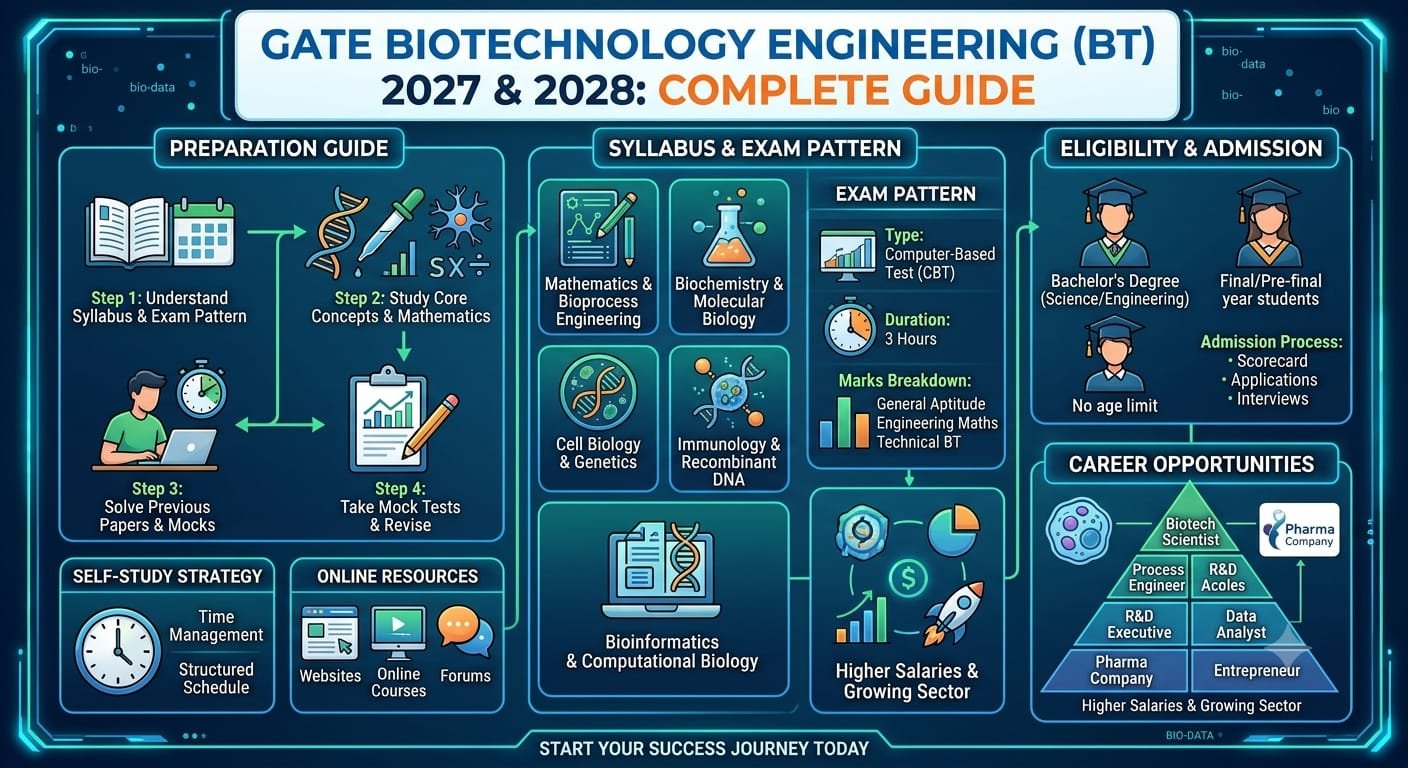
Are you preparing for GATE Biotechnology (BT) 2027 or 2028? This comprehensive guide covers everything you need to know about the GATE Biotechnology examination, including the latest examination updates, complete syllabus, eligibility criteria, application fees, examination pattern, subject-wise preparation strategy, recommended books, previous-year questions, mock tests, postgraduate admission opportunities and career prospects.
Whether you are a B.Tech Biotechnology, B.E. Biotechnology, B.Sc. Biotechnology, M.Sc. Biotechnology, Microbiology, Biochemistry, Genetics, Bioinformatics or Life Sciences student, this guide will help you plan your GATE preparation effectively.
GATEIIT (Gate Indian Institute of Tutorials) offers GATE Biotechnology coaching through online classes across India and offline classroom programmes at its JP Nagar, Bangalore centre. Students can choose regular coaching, hybrid programmes, personalised preparation, one-to-one mentorship, small-group coaching and intensive crash courses ranging from 30 to 120 days.
GATEIIT also offers coaching fee concessions of up to 95% through its scholarship test, depending on the student’s performance and applicable scholarship conditions.
1. What Is GATE Biotechnology Engineering (BT)?
The Graduate Aptitude Test in Engineering (GATE) is a national-level competitive examination conducted jointly by the Indian Institute of Science (IISc) and the Indian Institutes of Technology (IITs), on behalf of the National Coordination Board (NCB), Department of Higher Education, Ministry of Education, Government of India.
GATE Biotechnology, identified by the paper code BT, evaluates candidates’ understanding of fundamental and advanced concepts in biotechnology, biological sciences and engineering.
The examination tests knowledge in the following areas:
- General Aptitude
- Engineering Mathematics
- Biochemistry
- Microbiology
- Molecular Biology
- Genetics
- Cell Biology
- Immunology
- Recombinant DNA Technology
- Bioprocess Engineering
- Plant Biotechnology
- Animal Biotechnology
- Industrial Biotechnology
- Bioinformatics
- Analytical and molecular biology techniques
A good GATE BT score can help candidates explore postgraduate admissions, research opportunities, doctoral programmes, financial assistance and selected recruitment opportunities.
Why Should You Appear for GATE Biotechnology?
GATE Biotechnology is particularly valuable for students interested in developing careers in biotechnology research, pharmaceutical biotechnology, genetic engineering, bioprocess development, industrial microbiology, bioinformatics, molecular diagnostics and interdisciplinary biological sciences.
Important opportunities include:
- Tech and relevant postgraduate programmes at IITs.
- Postgraduate and research programmes at IISc.
- Relevant postgraduate programmes at NITs and other participating institutions.
- Research-oriented programmes in biotechnology and biological sciences.
- PhD and direct doctoral programmes where GATE is accepted.
- Government-supported postgraduate financial assistance, subject to applicable rules.
- Selected PSU and other recruitment opportunities where GATE BT is an accepted paper.
Qualifying GATE does not automatically guarantee admission, scholarship or employment. Each institution and recruiter has its own eligibility requirements and selection procedures.
2. GATE Biotechnology (BT) 2027: Latest Official Examination Details
The organising institute for GATE 2027 is the Indian Institute of Technology Madras (IIT Madras).
GATE 2027 is conducted jointly by IISc and IITs under the National Coordination Board.
GATE BT 2027 Examination Overview
| Particular | Details |
| Examination | Graduate Aptitude Test in Engineering |
| Subject | Biotechnology |
| Paper Code | BT |
| Organising Institute | IIT Madras |
| Conducting Framework | IISc and IITs |
| Authority | NCB, Ministry of Education |
| Examination Mode | Computer-Based Test |
| Examination Language | English |
| Examination Duration | 3 Hours |
| Total Marks | 100 |
| Question Types | MCQ, MSQ and NAT |
| General Aptitude | 15 Marks |
| Engineering Mathematics | 13 Marks |
| Biotechnology Subject | 72 Marks |
| GATE Score Validity | 3 Years |
| Examination Year | 2027 |
GATE 2027 Important Dates and Schedule
The official GATE 2027 examination calendar has been announced.
| Event | Official Date |
| Registration Commenced | 2 September 2026 |
| Regular Registration Deadline | 5 October 2026 |
| Extended Registration Deadline with Late Fee | 12 October 2026 |
| Special Registration Window | 15–16 October 2026 |
| Application Defect Rectification | 14–31 October 2026 |
| City Allotment Notification | 4 January 2027 |
| Admit Card Download | To Be Announced |
| Examination | 6, 7, 13, 14, 20 and 21 February 2027 |
| Result Announcement | 19 March 2027 |
The examination is conducted over multiple days and sessions. The exact date and session for the BT paper should be confirmed through the official examination schedule and admit card.
Candidates who have already registered should regularly check their GOAPS account and registered communication channels. The application scrutiny and defect-rectification process is particularly important.
Official website: https://gate2027.iitm.ac.in/
Important Dates: https://gate2027.iitm.ac.in/important_dates
Latest Notifications: https://gate2027.iitm.ac.in/notifications
3. GATE Biotechnology (BT) 2027: Complete Syllabus
The GATE 2027 Biotechnology syllabus has been revised by IIT Madras. Students preparing for the 2027 examination should download and follow the latest official syllabus rather than relying entirely on older GATE BT books or coaching materials.
The syllabus includes the following major subject areas.
Section 1: Engineering Mathematics
Engineering Mathematics is an important component of GATE Biotechnology. It requires conceptual understanding, mathematical accuracy and regular numerical practice.
- Linear Algebra
- Matrices and determinants
- Systems of linear equations
- Eigenvalues and eigenvectors
- Calculus
- Multivariable calculus
- Limits, continuity and differentiability
- Partial derivatives
- Maxima and minima
- Sequences and series
- Tests for convergence
- Gradient, divergence and curl
- Applications in fluid mechanics and transport processes
- Differential Equations
- Linear and nonlinear first-order ordinary differential equations
- Higher-order differential equations with constant coefficients
- Cauchy’s and Euler’s equations
- Laplace transforms
- Probability and Statistics
- Mean, median and mode
- Standard deviation
- Random variables
- Poisson distribution
- Normal distribution
- Binomial distribution
- Correlation and regression analysis
- Bayesian statistics
- Numerical Methods
- Solutions of linear and nonlinear algebraic equations
- Numerical integration using the trapezoidal rule
- Simpson’s rule
- Single-step methods for differential equations
Preparation Tip: Do not postpone Engineering Mathematics until the final months. Practise mathematical problems regularly, particularly probability, statistics, calculus, differential equations and numerical methods.
Section 2: General Biology
General Biology tests the fundamental biological concepts required to understand biotechnology applications.
- Biochemistry
- Structure and functions of biomolecules
- Carbohydrates, proteins, lipids and nucleic acids
- Biological membranes
- Membrane channels and pumps
- Molecular motors
- Action potential
- Biological transport processes
- Regulation of carbohydrate metabolism
- Lipid metabolism
- Amino acid metabolism
- Nucleic acid metabolism
- Glycolysis
- Citric acid cycle
- Fatty acid oxidation
- Photosynthesis
- Cellular respiration
- Electron transport chain
- Enzyme classification
- Catalytic and regulatory strategies
- Michaelis-Menten enzyme kinetics
- Competitive inhibition
- Non-competitive inhibition
- Uncompetitive inhibition
- Microbiology
- History of microbiology
- Bacterial classification and diversity
- Bacterial cell wall composition
- Gram-positive and Gram-negative bacteria
- Archaea
- Microbiological methods
- Microbial growth and nutrition
- Lac, Trp and Ara operons
- Nitrogen fixation
- Microbial diseases
- Host-pathogen interactions
- Antibiotics
- Antimicrobial resistance
- Two-component systems
- Bacterial communication
- Viruses: structure and classification
- Immunology
- Primary and secondary lymphoid organs
- Innate immunity
- Inflammation
- Cytokines and chemokines
- Complement system
- Cellular immunity
- Humoral immunity
- Antibody diversity and function
- Polyclonal and monoclonal antibodies
- T-cell and B-cell development
- Immunological memory
- Major Histocompatibility Complex (MHC)
- Antigen processing and presentation
- Regulation of immune responses
- Immune tolerance
- Hypersensitivity
- Autoimmunity
- Immunodeficiency
- Graft-versus-host disease
- Immunisation and vaccines
Section 3: Genetics, Cellular and Molecular Biology
This is one of the fundamental knowledge areas for biotechnology students. It connects biological concepts with molecular mechanisms and genetic engineering.
- Genetics and Evolutionary Biology
- Mendelian inheritance
- Gene interactions
- Complementation
- Linkage and recombination
- Chromosome mapping
- Extrachromosomal inheritance
- Microbial genetics
- Transformation, transduction and conjugation
- Bacterial gene mapping
- Horizontal gene transfer
- Transposable elements
- Chromosomal variations
- Sex determination
- Genetic disorders
- Population genetics
- Epigenetics
- Selection and inheritance
- Adaptive and neutral evolution
- Genetic drift
- Species and speciation
- Cell Biology
- Eukaryotic cell structure
- Cell cycle
- Cell growth control
- Cell-cell communication
- Cell signalling
- Signal transduction
- Non-cell-autonomous signalling
- Post-translational modifications
- Protein trafficking
- Cell death
- Autophagy
- Extracellular matrix
- Molecular Biology
- Molecular structure of genes and chromosomes
- Mutations and mutagenesis
- Regulation of gene expression
- DNA replication
- Transcription
- RNA splicing
- Translation
- Regulatory mechanisms
- Non-coding RNA
- MicroRNA
- RNA interference
- DNA damage and repair
Preparation Tip: Understand the mechanisms rather than memorising definitions. Draw diagrams for DNA replication, transcription, translation, cell signalling and gene regulation. Practise questions that test experimental interpretation.
Section 4: Fundamentals of Biological Engineering
This section is particularly important for students from Biotechnology and Biochemical Engineering backgrounds.
- Bioreaction Engineering
- Rate laws
- Zero-order and first-order kinetics
- Advanced kinetic models
- Michaelis-Menten kinetics
- Enzyme inhibition kinetics
- Ideal reactors
- Batch reactors
- Mixed-flow reactors
- Plug-flow reactors
- Enzyme immobilisation
- Diffusion effects
- Thiele modulus
- Effectiveness factor
- Damköhler number
- Kinetics of cell growth
- Substrate utilisation
- Product formation
- Structured and unstructured models
- Batch processes
- Fed-batch processes
- Continuous processes
- Microbial reactors
- Enzyme reactors
- Optimisation and scale-up
- Fermentation reactor design and operation
- Industrial applications of microbial reactors
- Upstream and Downstream Processing
- Media formulation and optimisation
- Sterilisation of air and media
- Membrane filtration
- Ultrafiltration
- Centrifugation
- High-speed centrifugation
- Ultracentrifugation
- Cell disruption
- Chromatography principles
- Ion-exchange chromatography
- Gel filtration
- Hydrophobic interaction chromatography
- Affinity chromatography
- Gas chromatography
- HPLC
- FPLC
- Extraction
- Adsorption
- Drying
- Process Instrumentation and Control
- Measurement devices
- Valves
- First-order and second-order systems
- Feedback control
- Feed-forward control
- Proportional control
- Integral control
- Derivative control
- Controller tuning
Preparation Tip: Give special attention to reactor design, material balances, microbial growth kinetics, enzyme kinetics, fermentation and downstream processing. Practise numerical problems instead of restricting preparation to theory.
Section 5: Plant, Animal and Microbial Biotechnology
- Plant Biotechnology
- Totipotency
- Cell fate transition
- Direct and indirect organogenesis
- Plant regeneration
- Plant growth regulators
- Elicitors
- Plant tissue culture
- Cell suspension culture
- Growth kinetics
- Nutrient optimisation
- Production of secondary metabolites
- Hairy root culture
- Industrially important plant products
- Artificial seeds
- Somaclonal variation
- Protoplast technology
- Protoplast fusion
- Somatic hybrids and cybrids
- Transgenic plants
- Direct and indirect gene transfer
- Selection markers
- Reporter genes
- Plastid transformation
- Animal Biotechnology
- Animal cell culture media
- Growth conditions
- Cell and tissue preservation
- Anchorage-dependent cell culture
- Non-anchorage-dependent cell culture
- Cell growth kinetics
- Microcarrier and macrocarrier culture
- Hybridoma technology
- Stem cell technology
- Animal cloning
- Transgenic animals
- Knockout animals
- Knock-in animals
- Microbial Biotechnology
- Biomass production
- Primary metabolites
- Secondary metabolites
- Biofuels
- Bioplastics
- Industrial enzymes
- Antibiotics
- Large-scale production
- Purification of recombinant proteins
- Production of recombinant metabolites
- Clinical microbiology
- Food microbiology
- Industrial microbiology
- Screening strategies for new products
Section 6: Recombinant DNA Technology and Other Tools in Biotechnology
- Recombinant DNA Technology
- Restriction enzymes
- Modification enzymes
- Plasmid vectors
- Bacteriophage vectors
- Viral vectors
- Cosmids
- Ti plasmids
- Bacterial artificial chromosomes
- Yeast artificial chromosomes
- Expression vectors
- cDNA libraries
- Genomic DNA libraries
- Gene isolation
- Gene cloning strategies
- Recombinant protein production
- Transposons
- Gene targeting
- Recombination-based gene cloning
- Molecular Tools
- Polymerase Chain Reaction (PCR)
- DNA and RNA labelling
- Sanger sequencing
- Next-generation sequencing
- Southern blotting
- Northern blotting
- In-situ hybridisation
- DNA fingerprinting
- RAPD
- RFLP
- Site-directed mutagenesis
- CRISPR-Cas technology
- Biosensors
- DNA-protein interaction tools
- Protein-protein interaction tools
- Genomics
- Proteomics
- Analytical Tools
- Light microscopy
- Electron microscopy
- Fluorescence microscopy
- Confocal microscopy
- UV-visible spectroscopy
- Fluorescence spectroscopy
- Circular dichroism
- Infrared spectroscopy
- FT-IR
- Mass spectrometry
- NMR
- Electrophoresis
- Microarrays
- Enzymatic assays
- ELISA
- RIA
- Immunohistochemistry
- Immunoblotting
- Flow cytometry
- Whole-genome sequencing
- ChIP sequencing
- Computational Tools and Bioinformatics
- Bioinformatics resources and search tools
- Sequence databases
- Structure databases
- Sequence file formats
- Scoring matrices
- Sequence alignment
- Phylogenetic analysis
- Genomics
- Proteomics
- Metabolomics
- Gene prediction
- Functional annotation
- Secondary structure prediction
- Three-dimensional structure prediction
- Biochemical databases
- Metagenomics
- Metabolic engineering
- Systems biology
Official syllabus PDF: https://gate2027.iitm.ac.in/static/doc/GATE2027_Syllabus/BT_GATE2027_Syllabus.pdf
Important for GATE 2028 aspirants: The above is the official 2027 syllabus. It is a useful preparation foundation for 2028, but candidates must check the GATE 2028 syllabus when officially published.
4. GATE Biotechnology 2027 Examination Pattern: Marks, Questions and Negative Marking
Understanding the examination pattern is essential for developing a successful preparation strategy.
GATE BT 2027 will be a three-hour computer-based examination with 65 questions carrying a total of 100 marks.
Section-Wise Marks Distribution
| Section | Marks |
| General Aptitude | 15 |
| Engineering Mathematics | 13 |
| Biotechnology Subject | 72 |
| Total | 100 |
General Aptitude
General Aptitude is common to all GATE examination papers.
It includes:
- Verbal aptitude
- English grammar
- Vocabulary
- Sentence completion
- Reading comprehension
- Numerical aptitude
- Quantitative reasoning
- Data interpretation
- Logical reasoning
- Analytical ability
There are 10 General Aptitude questions carrying 15 marks.
Types of Questions
- Multiple Choice Questions (MCQ)
Candidates select one correct answer from the available choices.
- Multiple Select Questions (MSQ)
Candidates may need to select more than one correct option. There is no negative marking, but there is no partial marking either.
- Numerical Answer Type (NAT)
Candidates enter the numerical answer using the virtual keypad. These questions do not carry negative marking.
Negative Marking Rules
| Question | Negative Marking for Incorrect Answer |
| 1-mark MCQ | 1/3 mark |
| 2-mark MCQ | 2/3 mark |
| MSQ | No negative marking |
| NAT | No negative marking |
There is no negative marking for unanswered questions.
How Should You Manage Three Hours?
A sensible examination strategy is:
- First 10–15 minutes: Quickly assess the paper.
- Next 90–100 minutes: Attempt familiar and relatively straightforward subject questions.
- Next 35–40 minutes: Solve challenging numerical and conceptual questions.
- Next 15–20 minutes: Complete General Aptitude and remaining questions, as appropriate.
- Final 5–10 minutes: Review marked questions and check unanswered questions.
This is a suggested practice strategy, not an official examination sequence. Candidates should adjust their approach according to their strengths and mock-test performance.
Official examination pattern: https://gate2027.iitm.ac.in/question_paper_pattern
5. GATE Biotechnology 2027 Eligibility Criteria: Who Can Apply?
One of the most common questions among students is whether their degree is eligible for GATE Biotechnology.
GATE 2027 has broad educational eligibility. Candidates from several engineering, technology, science and related academic backgrounds can appear for the examination.
According to the official eligibility guidelines, candidates currently studying in the third or higher year of an eligible undergraduate programme, or those who have completed a government-approved qualifying degree, can appear for GATE.
Courses and Academic Backgrounds That May Be Eligible
Depending on the candidate’s qualifying degree and the official eligibility conditions, eligible applicants can include students from:
- Tech Biotechnology
- E. Biotechnology
- Tech Biochemical Engineering
- Tech Biomedical Engineering
- Tech Genetic Engineering
- Tech Industrial Biotechnology
- Sc. Biotechnology
- Sc. Microbiology
- Sc. Biochemistry
- Sc. Life Sciences
- Sc. Botany
- Sc. Zoology
- Sc. Genetics
- Sc. Molecular Biology
- Sc. Bioinformatics
- Pharm
- Sc. Agriculture and related eligible programmes
- Sc. Biotechnology
- Sc. Microbiology
- Sc. Biochemistry
- Sc. Life Sciences
- Sc. Genetics
- Other recognised engineering, science and relevant higher-degree qualifications
The list is indicative, not a separate degree-wise admission guarantee for the BT paper. The official GATE eligibility criteria and the admitting institution’s programme-specific requirements must both be checked.
Can B.Sc. Students Apply for GATE BT?
Yes. Candidates pursuing the third year of a recognised three-year B.Sc. degree or who have completed it can meet the general GATE eligibility requirement.
This is particularly useful for students from Biotechnology, Microbiology, Biochemistry, Life Sciences and other science disciplines.
Can M.Sc. Students Apply for GATE Biotechnology?
Yes. Candidates pursuing or holding eligible master’s qualifications can appear for GATE, subject to the published eligibility rules.
Is There an Age Limit for GATE 2027?
There is no upper age limit specified for GATE 2027.
How Many Attempts Are Allowed?
There is no prescribed restriction on the number of GATE attempts. Eligible candidates may appear in different examination years.
Can Final-Year Students Apply?
Yes, students who satisfy the prescribed year-of-study requirements can apply.
Is a Minimum Percentage Required?
GATE eligibility itself does not prescribe a universal minimum qualifying percentage in the qualifying degree. However, individual postgraduate institutions may impose minimum marks, CGPA or other admission requirements.
Official eligibility criteria: https://gate2027.iitm.ac.in/eligibility_criteria
6. GATE Biotechnology 2027: Exemptions, Relaxations and Important Rules
Students often confuse GATE examination eligibility, category concessions, admission exemptions and scholarship eligibility.
These are different matters.
Is There Any Exemption from Appearing in GATE?
There is no general exemption from the GATE examination simply because a candidate holds an M.Sc., M.Tech, PhD or another higher qualification.
If a particular institution has an alternative admission route, it must be confirmed directly through that institution’s admission notification.
Is There an Age Relaxation?
There is no upper age limit for appearing in GATE 2027.
Is There Any Attempt Restriction?
No prescribed attempt limit applies.
Is There a Qualifying Percentage Relaxation?
GATE does not prescribe a universal qualifying-degree percentage for examination eligibility. Individual institutions may have their own admission rules.
Are There Fee Concessions?
Yes. Female candidates and candidates belonging to SC, ST and PwD categories receive the prescribed application-fee concession, subject to applicable documentation and rules.
Are There Examination Accommodations for PwD Candidates?
The official guidelines provide compensatory-time provisions for specified disabilities, subject to the prescribed certificate and conditions. Candidates should read the relevant appendix in the information brochure.
Does GATE Qualification Guarantee an IIT Admission?
No. Admission depends on the institution, programme eligibility, GATE score, shortlisting criteria, interview or other selection procedures, and seat availability.
7. GATE BT 2027 Application Fees and Registration Details
The GATE 2027 application fees published by IIT Madras are as follows.
Official Application Fee Structure
| Category | Regular Period – One Paper | Extended Period – One Paper |
| Female / SC / ST / PwD | ₹1,000 | ₹1,500 |
| All Other Candidates, Including Foreign Nationals | ₹2,000 | ₹2,500 |
For candidates applying for two papers, the corresponding fees are:
| Category | Regular Period | Extended Period |
| Female / SC / ST / PwD | ₹2,000 | ₹2,500 |
| All Other Candidates | ₹4,000 | ₹4,500 |
Bank charges, payment gateway charges and applicable service charges may be additional.
Important Registration Update for GATE 2027
The regular and extended application periods, including the special registration window, have closed as of 30 October 2026.
The official website has announced an application scrutiny and defect-rectification window from 14 October to 31 October 2026.
Candidates who have already applied should:
- Log in to their GOAPS account.
- Check their application status.
- Review emails and notifications.
- Correct application defects within the specified window if instructed.
- Retain access to the DigiLocker account used during registration.
- Check the official website for further correction-window notifications.
DigiLocker Update: IIT Madras made DigiLocker registration mandatory for Indian nationals. Candidates who used an unverified DigiLocker account were subject to additional scrutiny and document verification requirements.
The GATE 2027 application fee is non-refundable, except for eligible duplicate transactions supported by valid proof.
Official application fees: https://gate2027.iitm.ac.in/application_fees
8. GATE Biotechnology 2028: Early Preparation Guide and Expected Timeline
Students targeting GATE 2028 have an important advantage: they can begin preparing before the official notification and avoid the pressure of completing the syllabus in a few months.
As of 30 October 2026, the official GATE 2028 organising institute, examination dates, application schedule, fees and detailed syllabus have not been announced.
The following is an indicative planning calendar, not an official GATE 2028 schedule.
| Preparation Milestone | Indicative Period |
| Start fundamental preparation | Late 2026 |
| Complete core biology | Early 2027 |
| Complete engineering mathematics | Early to mid-2027 |
| Complete biological engineering | Mid-2027 |
| Complete biotechnology tools and applications | Mid-2027 |
| Previous-year question practice | Throughout preparation |
| Full-length mock tests | Final 3–4 months |
| Official notification monitoring | As announced |
| Final revision | Before the 2028 examination |
Why Should You Start GATE 2028 Preparation Early?
A longer preparation period offers several advantages:
- Better understanding of fundamental biological concepts.
- More time to master engineering mathematics.
- Sufficient practice in numerical questions.
- Multiple revisions of difficult topics.
- More previous-year question practice.
- Time to identify and correct weak areas.
- Better mock-test performance.
- Reduced examination pressure.
Students who start early can prepare systematically rather than depending on last-minute memorisation.
9. How to Prepare for GATE Biotechnology 2027 Through Self-Study
Can you crack GATE Biotechnology through self-study without joining a coaching institute?
Yes. Self-study can be an effective preparation method, provided you follow the official syllabus, use reliable study resources, solve previous-year questions and regularly evaluate your progress.
However, GATE BT requires a combination of biological understanding, engineering fundamentals, mathematical ability and numerical problem-solving. Students must prepare all these areas rather than focusing exclusively on their undergraduate specialisation.
Step 1: Understand the Complete Syllabus
Download the official GATE BT 2027 syllabus.
Divide it into smaller topics and create a checklist.
For example:
- Biochemistry
- Microbiology
- Genetics
- Cell and Molecular Biology
- Bioprocess Engineering
- Recombinant DNA Technology
- Plant and Animal Biotechnology
- General Aptitude
- Engineering Mathematics
Step 2: Build Strong Fundamentals
Do not begin with difficult GATE questions before understanding the underlying concepts.
For example, before solving enzyme kinetics numerical problems, understand:
- Enzyme-substrate interactions
- Reaction rates
- Michaelis constant
- Maximum reaction velocity
- Competitive inhibition
- Non-competitive inhibition
- Uncompetitive inhibition
Similarly, before studying bioreactor design, understand microbial growth, substrate consumption, product formation and mass balances.
Step 3: Prepare Topic-Wise Notes
Create concise revision notes covering:
- Important definitions
- Biological pathways
- Chemical reactions
- Mathematical formulae
- Graphs
- Mechanisms
- Experimental techniques
- Commonly confused concepts
- Previous-year question concepts
Avoid copying entire textbooks into your notes.
Step 4: Solve Previous-Year GATE BT Questions
Previous-year questions are among the most useful resources for understanding examination difficulty and question framing.
Practise questions from:
- Biochemistry
- Microbiology
- Molecular Biology
- Genetics
- Immunology
- Bioprocess Engineering
- Recombinant DNA Technology
- Plant Biotechnology
- Animal Biotechnology
- Engineering Mathematics
- General Aptitude
Do not merely memorise answers. Understand why an option is correct and why the other options are incorrect.
Step 5: Practise Numerical Questions
Numerical practice is essential for improving accuracy and speed.
Give special attention to:
- Enzyme kinetics
- Microbial growth kinetics
- Reactor calculations
- Material balances
- Probability
- Statistics
- Differential equations
- Numerical integration
- Transport-related applications
Step 6: Take Regular Mock Examinations
Mock tests help candidates identify their preparation level and examination weaknesses.
After each mock test, analyse:
- Total marks obtained.
- Accuracy percentage.
- Time spent on each section.
- Questions answered incorrectly.
- Topics requiring revision.
- Questions left unanswered.
- Avoidable negative marking.
- Improvement compared with previous tests.
Step 7: Revise Repeatedly
The first reading helps you understand a topic. Revision helps you retain it.
A practical revision schedule is:
- First revision: Within a week of completing a topic.
- Second revision: After 2–3 weeks.
- Third revision: During monthly revision.
- Final revision: During the last 30 days.
10. GATE Biotechnology 2027: Recommended Books and Study Resources
Choosing too many books can create confusion. It is better to select one standard reference book for each subject and supplement it with notes, previous-year questions and mock tests.
| Subject | Recommended Books |
| Biochemistry | Lehninger Principles of Biochemistry – Nelson and Cox |
| Molecular Biology | Molecular Biology of the Gene – Watson et al. |
| Genetics | Genetics: A Conceptual Approach – Benjamin Pierce |
| Cell Biology | Molecular Biology of the Cell – Alberts et al. |
| Microbiology | Brock Biology of Microorganisms – Madigan et al. |
| Immunology | Kuby Immunology – Owen et al. |
| Bioprocess Engineering | Bioprocess Engineering Principles – Pauline Doran |
| Biochemical Engineering | Biochemical Engineering – Bailey and Ollis |
| Plant Biotechnology | Introduction to Plant Biotechnology – H.S. Chawla |
| Recombinant DNA Technology | Principles of Gene Manipulation and Genomics – Primrose and Twyman |
| Bioinformatics | Bioinformatics: Sequence and Genome Analysis – David W. Mount |
| Engineering Mathematics | Higher Engineering Mathematics – B.S. Grewal |
Additional Free Preparation Resources
Candidates can supplement textbook learning with:
- Official GATE syllabus and previous-year papers.
- NPTEL biotechnology lectures.
- SWAYAM educational courses.
- IIT and IISc academic lecture resources.
- Standard open-access scientific learning resources.
- University lecture notes.
- Topic-wise practice questions.
- GATE mock tests and online assessment platforms.
Always cross-check free online notes and videos against the official syllabus.
11. Subject-Wise GATE Biotechnology Preparation Strategy
Different biotechnology topics require different learning methods. A good preparation strategy should combine conceptual learning, diagrams, numerical practice and application-based questions.
| Subject | Recommended Preparation Approach |
| Biochemistry | Metabolic pathways, enzymes and numerical practice |
| Microbiology | Classification, growth kinetics and microbial physiology |
| Genetics | Crosses, linkage, mapping and population genetics |
| Molecular Biology | Mechanisms, gene regulation and experimental techniques |
| Cell Biology | Signalling, organelles and cell-cycle mechanisms |
| Immunology | Immune pathways, antibodies and immune responses |
| Bioprocess Engineering | Formula-based numerical and reactor problems |
| Plant Biotechnology | Tissue culture and transgenic techniques |
| Animal Biotechnology | Cell culture and hybridoma technology |
| Recombinant DNA | Cloning, vectors and gene manipulation |
| Bioinformatics | Sequence alignment, databases and computational methods |
| Engineering Mathematics | Daily problem-solving and formula revision |
| General Aptitude | Regular timed practice |
Which Subjects Should Be Completed First?
For students starting from scratch, the following order can be effective:
- Biochemistry fundamentals.
- Cell Biology.
- Molecular Biology.
- Recombinant DNA Technology.
- Plant and Animal Biotechnology.
- Bioprocess Engineering.
- Bioinformatics and analytical techniques.
- Engineering Mathematics.
- General Aptitude.
This is a suggested learning sequence, not an official weightage ranking. Engineering Mathematics and General Aptitude should be studied alongside the technical subjects rather than postponed until the end.
12. GATE Biotechnology 2027 Preparation Timetable: Six-Month Study Plan
Students with approximately six months available can follow a structured plan.
| Month | Main Preparation Areas |
| Month 1 | Biochemistry, Cell Biology and Engineering Mathematics |
| Month 2 | Molecular Biology, Genetics and General Aptitude |
| Month 3 | Microbiology, Immunology and Bioinformatics |
| Month 4 | Bioprocess Engineering and Recombinant DNA Technology |
| Month 5 | Plant Biotechnology, Animal Biotechnology and analytical techniques |
| Month 6 | Full revision, previous-year papers and mock tests |
Daily Study Timetable
A student preparing alongside college or employment can consider the following schedule.
| Activity | Suggested Time |
| Core subject learning | 2 hours |
| Numerical practice | 1 hour |
| Previous-year questions | 1 hour |
| General Aptitude / Mathematics | 45 minutes |
| Revision | 30 minutes |
| Mock-test analysis or error correction | 15 minutes |
Total: Approximately 5.5 hours.
Students with full-time preparation can increase the number of focused study hours according to their learning capacity.
The important factor is consistency, not simply the number of hours spent sitting with books.
13. GATE Biotechnology 2027: Previous-Year Questions and Mock Test Strategy
Previous-year papers provide insight into how fundamental concepts are tested in the actual examination.
Students should solve available papers under timed conditions and maintain a separate error notebook.
Why Are Previous-Year Questions Important?
- They help understand the examination structure.
- They expose frequently tested concepts.
- They improve numerical-solving speed.
- They reveal gaps in conceptual understanding.
- They help students develop question-selection skills.
- They improve confidence before the actual examination.
How Many Mock Tests Should You Take?
There is no officially prescribed number of mock tests.
A reasonable preparation target could be:
| Preparation Stage | Suggested Practice |
| Initial Learning | Topic-wise tests |
| Syllabus Completion | Subject-wise tests |
| Revision Stage | Sectional mock tests |
| Final Preparation | 10–20 full-length mock tests, depending on availability and preparation level |
What Should You Do After a Mock Test?
Do not focus only on your score.
Review every incorrect answer and identify whether the problem was:
- Lack of conceptual understanding.
- Formula-related error.
- Calculation mistake.
- Misinterpretation of the question.
- Poor time management.
- Incorrect guessing.
- Lack of revision.
A carefully analysed mock test can be more valuable than taking several tests without reviewing them.
14. GATE Biotechnology 2027: Career Opportunities and Higher Education After GATE
GATE Biotechnology can open several academic and professional pathways.
The opportunities depend on the candidate’s score, academic eligibility, institution-specific criteria and the availability of relevant programmes.
A. M.Tech Opportunities
Candidates can explore relevant postgraduate programmes in:
- Biotechnology
- Industrial Biotechnology
- Biochemical Engineering
- Biological Engineering
- Biomedical Engineering
- Bioengineering
- Genetic Engineering
- Computational Biology
- Related interdisciplinary fields
B. IISc and IIT Opportunities
Candidates can explore relevant postgraduate and research programmes at institutions such as:
Indian Institute of Science (IISc), Bangalore
Research-oriented postgraduate and doctoral opportunities in relevant biological and interdisciplinary areas.
Official website: https://www.iisc.ac.in/
IIT Madras
Relevant biotechnology, biological sciences and interdisciplinary programmes.
Official website: https://www.iitm.ac.in/
IIT Delhi
Opportunities in relevant biomedical, biotechnology and interdisciplinary research areas.
Official website: https://home.iitd.ac.in/
IIT Bombay
Relevant postgraduate and research opportunities in engineering and life-science-related fields.
Official website: https://www.iitb.ac.in/
IIT Kharagpur
Relevant interdisciplinary engineering and biotechnology-related programmes.
Official website: https://www.iitkgp.ac.in/
Other IITs, NITs, universities and research institutions may also accept GATE BT scores for specific programmes.
Important: The institutions listed above are examples of places to investigate, not a promise that every institution offers admission through GATE BT for every programme. Always check the relevant admission brochure and accepted paper codes.
C. Research and PhD Opportunities
GATE-qualified candidates may explore research-oriented programmes in:
- Molecular Biology
- Genetic Engineering
- Cell Biology
- Immunology
- Bioprocess Engineering
- Industrial Biotechnology
- Computational Biology
- Microbiology
- Plant Biotechnology
- Animal Biotechnology
D. Government and PSU Opportunities
Some public sector organisations and government-supported institutions use GATE scores for recruitment or other selection processes.
However, GATE BT is not accepted for every PSU vacancy. Candidates must check the exact paper code and eligibility requirements in each recruitment notification.
E. Biotechnology Industry Career Pathways
Postgraduate education and research experience can help candidates develop careers in:
- Pharmaceutical biotechnology
- Biopharmaceutical manufacturing
- Vaccine development
- Industrial fermentation
- Molecular diagnostics
- Genetic engineering
- Bioprocess development
- Bioinformatics
- Agricultural biotechnology
- Food biotechnology
- Clinical research
- Quality control and quality assurance
- Research and development
15. GATE Biotechnology Coaching in Bangalore and Online Across India by GATEIIT
Preparing for GATE Biotechnology requires more than collecting books and watching recorded lectures. Students need a well-designed study plan, subject-wise guidance, regular assessment, doubt clarification and continuous revision.
GATEIIT provides GATE Biotechnology coaching through a combination of online, offline and hybrid learning programmes.
Students can select a learning model based on their current preparation level, academic background, available time, target examination year and learning preferences.
Why Choose GATEIIT for GATE BT Preparation?
GATEIIT focuses on structured preparation, personal attention and flexible learning options.
The programmes can include:
- Concept-based classroom teaching.
- Online live interactive classes.
- Offline classroom sessions in Bangalore.
- Hybrid learning options.
- Small-group programmes.
- Personal mentorship.
- One-to-one doubt-clearing sessions.
- Personalised study schedules.
- Customised subject-wise preparation.
- Topic-wise assignments.
- Daily practice questions.
- Previous-year question discussions.
- Sectional mock tests.
- Full-length GATE mock tests.
- Performance analysis.
- Revision and score booster sessions.
- Online study materials.
- Learning app access.
- Recorded class access, where included in the selected programme.
A. Online GATE Biotechnology Coaching Across India
Students can attend GATE BT coaching from anywhere in India without relocating to Bangalore.
Online learning can be suitable for:
- College students.
- Working professionals.
- Students preparing from home.
- Students living outside metropolitan cities.
- Students who cannot attend regular offline classes.
- Candidates preparing alongside other examinations.
The online programmes can combine live teaching, digital learning resources, assignments, tests and individual academic guidance.
B. Offline GATE Biotechnology Coaching in Bangalore
GATEIIT offers offline coaching at its Bangalore centre.
GATEIIT – Gate Indian Institute of Tutorials
3rd Floor, #1743, Sri Raghavendra Plaza, 17th Main Road, JP Nagar 2nd Phase, Bangalore – 560078, Karnataka.
Students from JP Nagar, Jayanagar, Banashankari, BTM Layout, Bannerghatta Road, Kumaraswamy Layout, Arekere, Basavanagudi and other parts of Bangalore can enquire about classroom programmes.
Offline coaching is particularly suitable for students who prefer direct interaction with faculty, classroom learning, scheduled academic sessions and face-to-face doubt clarification.
C. Hybrid GATE BT Coaching Programmes
Hybrid learning combines the flexibility of online education with the structure of offline classroom preparation.
Depending on the selected batch, students can explore:
- Classroom learning.
- Online live classes.
- Digital study materials.
- Online assessments.
- Recorded sessions, where available.
- Doubt-clearing support.
- Revision sessions.
The exact availability of hybrid facilities should be confirmed at the time of admission.
16. GATE Biotechnology Crash Course 2027: 30, 45, 60, 90 and 120 Days
Not every student requires a full-length coaching programme.
Some students have already completed their undergraduate syllabus and need revision. Others may have studied independently but require guidance to improve their examination performance.
GATEIIT offers short-term and crash-course preparation options for GATE Biotechnology.
Available GATE BT Crash-Course Durations
| Programme | Suitable For |
| 30 Days | Intensive revision and score improvement |
| 45 Days | Focused revision with practice |
| 60 Days | Concept revision and subject-wise tests |
| 90 Days | Structured syllabus coverage and mock tests |
| 120 Days | Extended preparation and comprehensive revision |
Indicative GATE BT Crash-Course Fee Structure
| Course Duration | Indicative Fees |
| 30 Days | Starting from ₹5,000 |
| 45 Days | ₹5,000–₹10,000 |
| 60 Days | ₹7,000–₹12,000 |
| 90 Days | ₹10,000–₹18,000 |
| 120 Days | ₹15,000–₹25,000 |
The indicative crash-course fee range is ₹5,000 to ₹25,000, depending on programme duration, course structure and selected facilities.
The above ranges are indicative planning prices, not a fixed fee quotation for every batch. Exact fees depend on the programme, class frequency, personal attention, mentorship and additional facilities selected.
What Is Included in the Crash Course?
Depending on the selected package:
- Important topic revision.
- Concept clarification.
- Subject-wise assignments.
- Previous-year GATE BT questions.
- Topic-wise tests.
- Sectional mock tests.
- Full-length practice tests.
- Online study materials.
- Learning app access.
- One-to-one doubt-clearing support.
- Revision classes.
- Score booster sessions.
- Performance analysis.
Which Crash Course Should You Choose?
30-Day Crash Course: Suitable for students who have already completed most of the syllabus and need intensive revision.
45-Day Crash Course: Suitable for candidates who need revision plus additional question-solving practice.
60-Day Crash Course: Suitable for students with a reasonable conceptual foundation who need systematic subject-wise preparation.
90-Day Crash Course: Suitable for students who have completed some subjects but need more comprehensive coverage.
120-Day Crash Course: Suitable for candidates who need structured preparation, conceptual improvement, practice and revision.
A short-term programme should be selected after evaluating the candidate’s current knowledge. Students starting from zero may need a longer programme.
17. Personal Mentorship, One-to-One Coaching and Customised GATE Biotechnology Preparation
Every student has a different academic background.
A Biotechnology graduate may be strong in molecular biology but weak in engineering mathematics. A Microbiology graduate may understand biological concepts but require additional training in bioprocess engineering.
A common classroom programme may not address every individual learning requirement.
GATEIIT offers different learning arrangements to help students receive the level of academic support they need.
A. Personal Mentorship Programme
Personal mentorship is suitable for candidates who need regular academic guidance and a structured preparation plan.
It may include:
- Individual preparation assessment.
- Personalised study schedule.
- Subject-wise learning targets.
- Weekly progress evaluation.
- Test performance review.
- Identification of weak subjects.
- Revision planning.
- Examination strategy.
- Academic guidance.
B. One-to-One Personal Coaching
Students who need intensive individual attention can enquire about one-to-one classes.
Benefits include:
- Individual teaching sessions.
- Flexible subject coverage.
- Personal doubt resolution.
- Focused numerical practice.
- Customised revision.
- Individual performance monitoring.
- Learning at a suitable pace.
C. Small-Group Coaching
Small-group programmes can provide an effective balance between personal attention and interactive learning.
Students can benefit from:
- Interactive classroom discussions.
- Peer learning.
- Shared problem-solving.
- Faculty interaction.
- Topic-wise assignments.
- Group mock-test discussions.
D. Personalised and Customised Courses
Students can request customised preparation depending on their requirements.
For example:
- Only Engineering Mathematics.
- Bioprocess Engineering revision.
- Molecular Biology and Genetics.
- Complete Biotechnology syllabus.
- General Aptitude and numerical practice.
- Previous-year question-solving.
- Final 30-day revision.
- Full-length mock-test preparation.
- GATE BT 2027 score improvement.
- GATE BT 2028 foundation preparation.
18. GATE Biotechnology Score Booster Programme
A good score requires more than completing the syllabus.
Students must learn how to apply their knowledge accurately under examination conditions.
GATEIIT’s Score Booster Programme is designed to focus on examination-oriented practice and improving performance.
What Does the Score Booster Programme Focus On?
- Concept Strengthening:Revisit important concepts that students frequently misunderstand.
- Numerical Problem-Solving:Practise calculations from bioprocess engineering, enzyme kinetics, mathematics and related subjects.
- Previous-Year Question Analysis:Understand the logic and concepts behind earlier examination questions.
- Topic-Wise Tests:Evaluate individual subject preparation.
- Sectional Mock Tests:Practise selected portions of the examination.
- Full-Length Mock Tests:Build familiarity with the three-hour examination environment.
- Performance Analysis:Identify areas where marks are being lost.
- Time Management:Improve question selection, accuracy and speed.
- Revision Support:Revise important concepts, formulae and frequently confused topics.
- Personal Guidance:Receive suggestions based on individual test performance.
The programme aims to improve preparation quality and examination readiness. No particular GATE rank, score or admission outcome is guaranteed.
19. Free Add-On Facilities and Learning Support at GATEIIT
To make preparation more convenient, GATEIIT can provide additional learning resources and academic support as part of eligible course packages.
Depending on the selected programme, students can enquire about the following facilities.
| Add-On | Academic Benefit |
| Online Study Material | Structured subject-wise learning |
| Learning App Access | Convenient access to digital resources |
| Topic-Wise Tests | Continuous assessment |
| Previous-Year Question Bank | Understanding examination trends |
| Mock Tests | Examination practice |
| Revision Materials | Faster final revision |
| Formula Sheets | Quick numerical revision |
| Practice Assignments | Regular problem-solving |
| Doubt-Clearing Sessions | Clarification of difficult concepts |
| Performance Analysis | Identification of weak areas |
| Recorded Classes | Revision and catch-up, where included |
| Score Booster Sessions | Focused examination preparation |
These facilities are package-dependent. Students should confirm which add-ons are included in their selected course before admission.
20. GATEIIT Scholarship Test: Get Up to 95% Discount on Coaching Fees
One of the most useful opportunities for students who wish to join professional GATE coaching is the availability of scholarship-based fee concessions.
GATEIIT offers scholarship opportunities through its scholarship test, with fee discounts of up to 95%, based on the candidate’s performance and applicable scholarship criteria.
How Does the GATEIIT Scholarship Programme Work?
- Enquire about the GATE Biotechnology scholarship test.
- Register for the scholarship assessment.
- Appear for the test according to the announced schedule.
- Receive the assessment result.
- Get the applicable scholarship or fee-discount information.
- Select an eligible coaching programme.
- Complete the admission formalities.
Scholarship Benefits
- Opportunity to reduce coaching expenses.
- Merit-based fee concession.
- Support for deserving students.
- Greater accessibility to structured coaching.
- Opportunity to select suitable programmes within the applicable scholarship terms.
The actual discount depends on the scholarship test score, eligibility, applicable conditions and programme. A 95% discount is the maximum advertised opportunity, not an automatic concession for every applicant.
Students should contact GATEIIT for scholarship test dates, eligibility, assessment format and current terms.
21. GATE Biotechnology Coaching: Admission Process at GATEIIT
Students interested in joining GATEIIT can enquire about the programme that best suits their preparation requirements.
Admission Procedure
- Contact GATEIIT through phone, WhatsApp or website.
- Discuss your academic background and target examination year.
- Understand the available regular and crash-course options.
- Request a counselling session or preparation assessment.
- Explore personal mentorship, small-group or one-to-one options.
- Enquire about the scholarship test and applicable fee concessions.
- Select the preferred online, offline or hybrid programme.
- Complete the admission process and begin preparation.
Who Should Join GATEIIT?
GATEIIT coaching programmes may be suitable for:
- Tech Biotechnology students.
- E. Biotechnology students.
- Biochemical Engineering graduates.
- Sc. Biotechnology students.
- Sc. Biotechnology students.
- Microbiology graduates.
- Biochemistry students.
- Life Sciences students.
- Genetic Engineering students.
- Bioinformatics students.
- Working professionals preparing for GATE.
- Students appearing for GATE for the first time.
- Candidates preparing for GATE BT 2027.
- Candidates targeting GATE BT 2028.
- Students who need to improve their previous GATE performance.
22. GATE Biotechnology 2027 and 2028: Frequently Asked Questions (FAQs)
The following FAQs address common questions about GATE Biotechnology eligibility, preparation, examination details, syllabus, admissions, coaching, fees and career opportunities.
General GATE Biotechnology FAQs
- What is GATE Biotechnology?
GATE Biotechnology is a national-level entrance examination paper with the subject code BT. It evaluates candidates’ understanding of biotechnology, biological sciences, engineering mathematics, bioprocess engineering and related subjects. GATE scores are used by eligible institutions for postgraduate and research admissions and by selected recruiters.
- What is the paper code for GATE Biotechnology?
The official paper code for Biotechnology is BT.
- Who is conducting GATE 2027?
IIT Madras is the organising institute for GATE 2027. The examination is conducted jointly by IISc and IITs on behalf of the National Coordination Board, Ministry of Education.
- When will GATE Biotechnology 2027 be conducted?
GATE 2027 examinations are scheduled for 6, 7, 13, 14, 20 and 21 February 2027. The specific BT examination date and session must be checked in the official schedule and admit card.
- What is the duration of GATE BT 2027?
The examination duration is three hours (180 minutes).
- How many questions are there in GATE Biotechnology?
There are 65 questions carrying 100 marks.
- What is the total marks of GATE BT 2027?
The total examination is for 100 marks.
- How many marks are allotted to General Aptitude?
General Aptitude carries 15 marks.
- How many marks are allotted to Engineering Mathematics?
Engineering Mathematics carries 13 marks within the subject component of the BT paper.
- What are the question types in GATE BT?
The question types are Multiple Choice Questions (MCQ), Multiple Select Questions (MSQ) and Numerical Answer Type (NAT).
- Is there negative marking in GATE Biotechnology?
Yes. Incorrect one-mark MCQs attract a deduction of 1/3 mark, while incorrect two-mark MCQs attract a deduction of 2/3 mark. MSQ and NAT questions do not have negative marking.
- Is GATE Biotechnology conducted online or offline?
GATE BT is conducted as a Computer-Based Test (CBT) at designated examination centres.
GATE Biotechnology Eligibility FAQs
- Who is eligible for GATE Biotechnology 2027?
Candidates studying in the third or higher year of an eligible undergraduate degree or those who have completed an approved qualifying degree in engineering, technology, science and other specified disciplines can appear.
- Can B.Sc. Biotechnology students apply for GATE BT?
Yes. Students in the third year or higher of an eligible three-year B.Sc. programme or graduates can meet the general GATE eligibility criteria.
- Can B.Sc. Microbiology students appear for GATE Biotechnology?
Yes, provided they satisfy the official qualifying-degree eligibility requirements.
- Can M.Sc. Biotechnology students appear for GATE BT?
Yes. Candidates pursuing or holding eligible postgraduate degrees can appear for GATE.
- Is there an age limit for GATE Biotechnology?
No upper age limit is prescribed for GATE 2027.
- How many times can I appear for GATE?
There is no prescribed limit on the number of GATE attempts.
- Can final-year engineering students appear for GATE?
Yes. Eligible undergraduate students who have reached the prescribed third-year or higher stage can apply.
- Is there any minimum percentage required to appear for GATE?
GATE does not prescribe a universal minimum qualifying-degree percentage for examination eligibility. However, individual admission institutions may have minimum academic requirements.
GATE BT Syllabus and Preparation FAQs
- What is the syllabus of GATE Biotechnology 2027?
The syllabus includes Engineering Mathematics, General Biology, Genetics, Cellular and Molecular Biology, Fundamentals of Biological Engineering, Plant, Animal and Microbial Biotechnology, and Recombinant DNA Technology and other biotechnology tools.
- Has the GATE BT 2027 syllabus changed?
Yes. IIT Madras published revised syllabi for GATE 2027, including Biotechnology. Candidates should follow the official 2027 PDF rather than relying solely on older syllabus versions.
- Is Engineering Mathematics important for GATE Biotechnology?
Yes. Engineering Mathematics carries 13 marks in the BT paper and should be included in regular preparation.
- Is Bioprocess Engineering important for GATE BT?
Yes. Bioprocess Engineering is an important subject involving microbial growth, enzyme kinetics, reactor design, fermentation and downstream processing.
- Can I prepare for GATE Biotechnology without coaching?
Yes. Self-study can be sufficient for some students if they follow the syllabus, use standard textbooks, practise previous-year questions, take mock tests and revise consistently. Coaching can provide additional structure, mentorship and doubt-clearing support.
- How many months are required to prepare for GATE Biotechnology?
The preparation period depends on the student’s academic foundation and available study time. Students with strong fundamentals may benefit from 3–6 months of focused preparation, while beginners may need 8–12 months or longer.
- Which books are best for GATE Biotechnology?
Recommended books include Lehninger for Biochemistry, Alberts for Cell Biology, Watson for Molecular Biology, Pierce for Genetics, Brock for Microbiology and Doran for Bioprocess Engineering.
- Are previous-year questions important for GATE BT?
Yes. Previous-year questions help candidates understand examination trends, question difficulty, numerical applications and conceptual requirements.
- How many mock tests should I take for GATE BT?
Candidates can aim for 10–20 full-length mock tests during their final preparation, depending on their available time. Topic-wise and sectional tests should also be taken throughout preparation.
- Can I prepare for GATE BT and GATE XL together?
Candidates may apply for two papers only if the selected combination is permitted by the official GATE 2027 two-paper combination rules. The syllabi are different, so preparation requirements must be assessed separately.
GATE BT 2027 and 2028 Examination FAQs
- What is the GATE 2027 application fee for Biotechnology?
For one paper, the regular fee was ₹1,000 for female, SC, ST and PwD candidates and ₹2,000 for other candidates. The extended-period fees were ₹1,500 and ₹2,500 respectively. Registration is now closed.
- When will the GATE 2027 results be declared?
The official scheduled result date is 19 March 2027, subject to any subsequent official changes.
- What is the validity of the GATE score?
GATE scores are valid for three years from the date of result announcement.
- Is GATE BT compulsory for M.Tech Biotechnology admission?
Not universally. Some institutions accept GATE BT, while others may accept different GATE papers or conduct their own admission processes. Check the individual programme requirements.
- Does GATE Biotechnology guarantee IIT admission?
No. Admission depends on the candidate’s score, eligibility, programme requirements, shortlisting and institutional selection procedures.
- Does GATE BT provide PSU jobs?
Some organisations use GATE scores for recruitment, but not all PSUs accept Biotechnology scores. Candidates must check the recruitment notification and accepted paper codes.
- When will GATE 2028 registration start?
The official GATE 2028 registration dates have not been announced as of 30 October 2026.
- Is the GATE 2027 syllabus applicable to GATE 2028?
It can serve as a preparation foundation, but candidates must check the official GATE 2028 syllabus once released.
GATEIIT Coaching and Admission FAQs
- Does GATEIIT offer GATE Biotechnology coaching in Bangalore?
Yes. GATEIIT offers offline coaching programmes at its JP Nagar 2nd Phase centre in Bangalore, subject to batch availability.
- Does GATEIIT provide online GATE BT coaching throughout India?
Yes. Students from different states and cities can enquire about online GATE Biotechnology preparation programmes.
- Does GATEIIT offer hybrid GATE Biotechnology coaching?
Yes. Students can enquire about programmes combining online and offline learning facilities.
- What is the fee for GATE Biotechnology crash courses at GATEIIT?
The indicative crash-course fee range is ₹5,000 to ₹25,000, depending on the programme duration, course structure and selected facilities.
- Does GATEIIT offer a 30-day GATE BT crash course?
Yes. A 30-day intensive revision programme is available to enquire about, subject to batch availability.
- What other crash-course durations are available?
Students can enquire about 45-day, 60-day, 90-day and 120-day programmes.
- Does GATEIIT provide one-to-one personal coaching?
Students can enquire about one-to-one coaching and individual academic guidance based on their preparation requirements.
- Does GATEIIT offer personal mentorship?
Yes. Personal mentorship options are available to support individual preparation planning, academic progress and performance improvement.
- Does GATEIIT offer small-group coaching?
Yes. Students can enquire about small-group programmes designed to provide interactive learning and personal attention.
- Can I join GATEIIT only for Engineering Mathematics or Bioprocess Engineering?
Students can enquire about customised subject-wise programmes, revision sessions and focused preparation options.
- Does GATEIIT provide mock tests and study material?
Online study material, learning app access, assignments and test facilities may be included depending on the selected programme.
- Can I get a scholarship for GATE Biotechnology coaching?
GATEIIT offers scholarship-test-based fee discounts of up to 95%, subject to test performance, eligibility and applicable terms.
23. Why Start Your GATE Biotechnology Preparation with GATEIIT?
GATE Biotechnology is a competitive examination that requires a balanced understanding of life sciences, engineering fundamentals and numerical problem-solving.
Students who prepare systematically, practise regularly and identify their weaknesses early can improve their examination readiness.
GATEIIT aims to support students through flexible preparation programmes, personal attention, subject-wise teaching, practice tests and mentorship.
Whether you are targeting GATE Biotechnology 2027 or planning ahead for GATE BT 2028, you can enquire about the programme that matches your academic background and preparation timeline.
Start your preparation with a structured plan. Strengthen your fundamentals. Practise consistently. Work towards your GATE target.
GATE Biotechnology Coaching – GATEIIT Bangalore and Online India
Available Programmes
- GATE BT 2027 and 2028 preparation.
- Online classes throughout India.
- Offline classroom coaching in Bangalore.
- Hybrid coaching programmes.
- 30, 45, 60, 90 and 120-day crash courses.
- Personal mentorship and one-to-one coaching.
- Small-group and customised programmes.
- Score Booster and revision programmes.
- Scholarship discounts up to 95%.
GATEIIT – Gate Indian Institute of Tutorials
Address: 3rd Floor, #1743, Sri Raghavendra Plaza, 17th Main Road, JP Nagar 2nd Phase, Bangalore – 560078, Karnataka.
Call / WhatsApp: 8884416154 | 8884416155
Website: https://www.gateiit.com/
Google Maps Location: https://maps.app.goo.gl/MtzbVkqywCkwKcc4A
For course details, batch schedules, scholarship tests and admission enquiries, contact GATEIIT.
Official Reference Links:
- GATE 2027 Official Website – https://gate2027.iitm.ac.in/
- GATE 2027 Test Papers and Syllabus – https://gate2027.iitm.ac.in/exam_papers_and_syllabus
- GATE 2027 Examination Pattern – https://gate2027.iitm.ac.in/question_paper_pattern
- GATE 2027 Eligibility – https://gate2027.iitm.ac.in/eligibility_criteria
- GATE 2027 Application Fees – https://gate2027.iitm.ac.in/application_fees
- GATE 2027 Important Dates – https://gate2027.iitm.ac.in/important_dates
- GATE 2027 Latest Notifications – https://gate2027.iitm.ac.in/notifications
Disclaimer: This article is an educational and coaching information resource. GATEIIT is an independent coaching institute and is not affiliated with or endorsed by IIT Madras, IISc or the GATE organising authorities. Examination and admission decisions remain with the respective authorities and institutions.