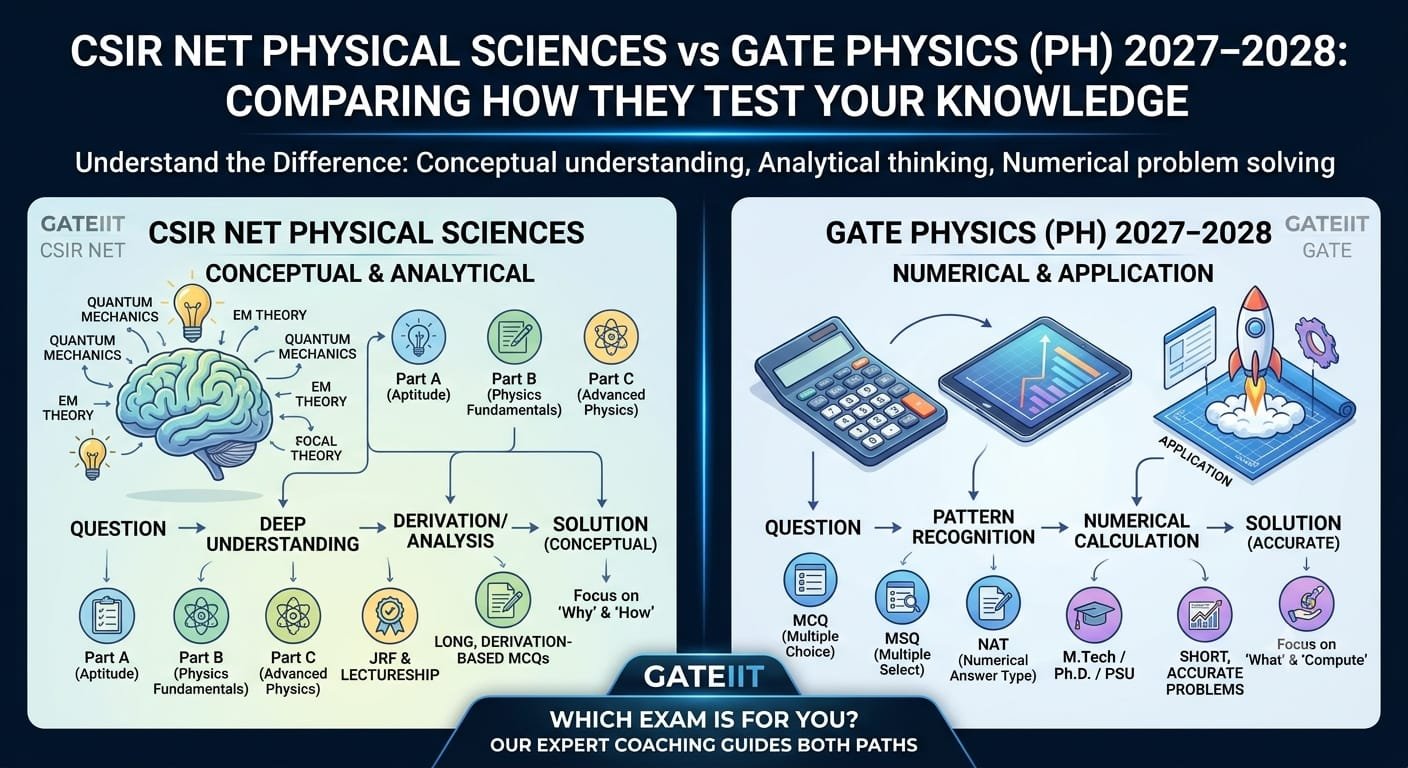
CSIR NET Physical Sciences vs GATE Physics 2027–2028: Understand the Difference Between Conceptual Understanding, Analytical Thinking and Numerical Problem Solving
Physics is not just about remembering equations, understanding theories or solving numerical problems. It is about developing the ability to understand physical phenomena, interpret mathematical relationships and apply scientific principles to unfamiliar situations.
However, students preparing for both CSIR-UGC NET Physical Sciences and GATE Physics (PH) often make one important mistake: they assume that studying the same Physics concepts and practising the same set of questions will be sufficient for both examinations.
Unfortunately, this approach may limit their performance.
Although CSIR NET Physical Sciences and GATE Physics share a substantial portion of their core Physics syllabus, their examination formats, question structures and problem-solving demands are different.
A student may understand Quantum Mechanics very well but struggle with an analytical CSIR NET Part C question. Another student may be excellent at solving numerical problems in Classical Mechanics but lose marks in GATE because of calculation errors, incorrect assumptions or poor time management.
The real challenge is not simply learning Physics. It is learning how to apply Physics differently according to the examination.
In this blog, we explain how conceptual Physics, analytical reasoning, mathematical derivations and numerical problem-solving are tested in CSIR NET and GATE PH, and why an integrated preparation strategy can help students perform better in both examinations.
1. Why Understanding the Same Physics Concept Is Not Enough
Consider a simple topic: Simple Harmonic Motion (SHM).
Every Physics student learns that the acceleration of a particle executing SHM is proportional to its displacement from the mean position and directed towards it.
The standard equation is:
a = -ω²x
A student who has memorised this equation may be able to answer a straightforward textbook question.
But competitive examinations can test the same concept in different ways.
A conceptual question may ask:
- Why does the acceleration become zero at the mean position?
- Why is the velocity maximum at the mean position?
- What happens to the frequency when the mass or spring constant changes?
- How are displacement, velocity and acceleration related?
An analytical question may ask:
- What happens when two oscillatory systems are coupled?
- How does the initial condition affect the subsequent motion?
- What is the relationship between energy and phase?
- How can the governing differential equation be interpreted physically?
A numerical problem may ask:
- Calculate the angular frequency of a spring-mass system.
- Determine the maximum velocity for a given amplitude.
- Calculate the total energy of oscillation.
- Find the time period after a specified change in system parameters.
All these questions are based on the same Physics concept, but they require different approaches.
This is precisely why students preparing for CSIR NET and GATE Physics should develop three complementary abilities:
- Conceptual understanding – knowing why a physical phenomenon occurs.
- Analytical reasoning – understanding how different physical quantities and principles interact.
- Numerical problem-solving – converting a physical situation into mathematical equations and obtaining the correct answer efficiently.
2. How CSIR NET Physical Sciences Tests Your Physics Knowledge
The CSIR-UGC NET Physical Sciences examination is designed to assess a student’s understanding of fundamental Physics concepts, scientific reasoning and the ability to apply scientific knowledge to analytical problems.
According to the December 2026 NTA Information Bulletin, the examination has three sections: Part A, Part B and Part C.
The Physical Sciences paper carries 200 marks, with a three-hour duration.
The December 2026 examination structure is:
| Section | Total Questions | Questions to Attempt | Marks per Question | Total Marks |
| Part A | 20 | 15 | 2 | 30 |
| Part B | 25 | 20 | 3.5 | 70 |
| Part C | 30 | 20 | 5 | 100 |
| Total | 75 | 55 | — | 200 |
All three sections use objective-type MCQs, with 25% negative marking for incorrect responses in each section.
Part A: General Aptitude and Scientific Reasoning
Part A is common to all CSIR NET subjects.
It evaluates skills such as:
- Logical reasoning
- Quantitative aptitude
- Graphical analysis
- Numerical ability
- Analytical reasoning
- Quantitative comparison
- Research aptitude
Students who concentrate exclusively on their Physics syllabus sometimes underestimate this section.
However, a strong performance in Part A can make a meaningful difference to the overall score.
Part B: Fundamental Physics Concepts
Part B generally covers conventional subject-related Physics MCQs.
Questions may test:
- Fundamental definitions and principles
- Physical interpretations of equations
- Standard mathematical relationships
- Conceptual understanding
- Direct applications of established theories
- Basic calculations involving Physics principles
Students must understand the underlying theory rather than simply memorise formulas.
For example, in Electromagnetic Theory, knowing Maxwell’s equations is important, but students should also understand their physical significance, boundary conditions and applications.
Part C: Advanced Analytical Physics
Part C is particularly important for students targeting CSIR NET JRF.
These questions are designed to examine higher-order conceptual understanding and the application of scientific knowledge to analytical problems.
Students may encounter:
- Multiple-step reasoning
- Advanced mathematical applications
- Unfamiliar physical situations
- Interpretation of equations and boundary conditions
- Application of fundamental principles
- Problems requiring a combination of two or more concepts
The ability to identify the correct physical principle and develop a solution is often more important than remembering a standard formula.
A student who has only practised direct numerical questions may find Part C challenging.
Important: Part C in CSIR NET Physical Sciences is not necessarily a numerical-answer section. Under the December 2026 pattern, all three parts are MCQ-based, with one correct or best answer.
3. How GATE Physics (PH) Tests Your Physics Knowledge
GATE Physics evaluates a student’s understanding of fundamental Physics, mathematical applications and the ability to solve problems accurately within a limited time.
The GATE PH examination includes:
- General Aptitude
- Physics subject questions
According to the GATE 2026 official examination pattern, the paper carries 100 marks and has a three-hour duration.
| Section | Marks |
| General Aptitude | 15 |
| Physics Subject Questions | 85 |
| Total | 100 |
GATE uses three major question formats:
- Multiple Choice Questions (MCQ)
Students select one correct answer from the available options.
These questions can test conceptual understanding, formula application, calculations and analytical reasoning.
- Multiple Select Questions (MSQ)
Students must identify all the correct options.
These questions require a deeper understanding because more than one statement may be correct.
Partial marking is not provided for MSQs under the stated GATE 2026 pattern.
- Numerical Answer Type (NAT)
Students calculate and enter a numerical answer without selecting from conventional options.
NAT questions are particularly useful for testing independent numerical problem-solving skills.
There is no negative marking for incorrect MSQ or NAT responses. Negative marking applies to incorrect MCQ responses.
Why Numerical Accuracy Matters in GATE PH
A student may understand a problem perfectly but still lose marks because of:
- Incorrect unit conversion
- Algebraic mistakes
- Wrong sign conventions
- Incorrect approximations
- Calculation errors
- Improper application of boundary conditions
- Failure to recognise the most efficient mathematical approach
GATE preparation therefore requires regular numerical practice, mathematical accuracy and examination-oriented time management.
4. CSIR NET vs GATE PH: The Fundamental Difference
Both examinations test Physics knowledge, but the emphasis of preparation should not be identical.
| Parameter | CSIR NET Physical Sciences | GATE Physics |
| Primary emphasis | Conceptual depth and analytical understanding | Conceptual understanding and problem application |
| Question format | MCQ | MCQ, MSQ and NAT |
| Analytical questions | Particularly important in Part C | Present across subject questions |
| Numerical calculations | Important | Very important |
| Multiple-select questions | Not part of the stated December 2026 PH pattern | Yes |
| Numerical answer entry | Not a separate question type | Yes |
| General aptitude | Part A | General Aptitude section |
| Total marks | 200 | 100 |
| Duration | 3 hours | 3 hours |
| Negative marking | 25% of the question’s marks for incorrect responses | MCQ only; no negative marking for MSQ and NAT |
The key takeaway is that neither examination is exclusively conceptual or exclusively numerical.
Both demand a combination of conceptual clarity, mathematical ability and application skills.
The difference lies in the way students must demonstrate these abilities.
5. Topic-Wise Comparison: How the Same Physics Concept Is Tested Differently
Let us understand the difference through some important topics common to CSIR NET Physical Sciences and GATE PH.
A. Classical Mechanics
Classical Mechanics is one of the most important foundations of advanced Physics preparation.
Topics include:
- Lagrangian and Hamiltonian mechanics
- Central force motion
- Conservation laws
- Small oscillations
- Rigid body dynamics
- Coupled oscillations
- Canonical transformations
CSIR NET approach:
Students should develop an understanding of the physical meaning of Lagrangian and Hamiltonian formulations, conservation laws, symmetries and the analytical structure of mechanical systems.
They should be comfortable with unfamiliar situations requiring the application of fundamental principles.
GATE PH approach:
Students should practise deriving equations of motion, solving standard mechanical systems, calculating frequencies, analysing energy and momentum, and obtaining numerical results accurately.
Preparation strategy: Understand the physical principles first, practise mathematical derivations next and solve examination-level numerical and analytical problems afterwards.
B. Mathematical Physics
Mathematical Physics is essential for both examinations.
Important areas include:
- Linear algebra
- Matrices and determinants
- Eigenvalues and eigenvectors
- Differential equations
- Complex analysis
- Fourier series and transforms
- Special functions
- Vector calculus
- Probability and statistics
CSIR NET approach:
Emphasis should be placed on mathematical reasoning, properties of functions, interpretation of mathematical expressions and their applications to Physics.
GATE PH approach:
Students should develop speed and accuracy in calculations involving matrices, eigenvalue problems, differential equations, integrals and mathematical transformations.
A student who understands the theory but lacks mathematical fluency may struggle in both examinations.
C. Quantum Mechanics
Quantum Mechanics is a major area where conceptual understanding and mathematical application must work together.
Important topics include:
- Wave functions
- Schrödinger equation
- Operators and commutators
- Eigenvalues and eigenfunctions
- Angular momentum
- Spin
- Hydrogen atom
- Perturbation theory
- Identical particles
CSIR NET approach:
Students must understand the interpretation of quantum states, measurement, operators, commutation relations, physical observables and the implications of quantum mechanical principles.
Advanced questions may require combining different concepts and applying mathematical reasoning to unfamiliar systems.
GATE PH approach:
Students should practise solving the Schrödinger equation for standard potentials, calculating expectation values, determining energy eigenvalues and applying operators and angular momentum algebra.
The important distinction: Memorising quantum mechanical equations is not sufficient. Students must understand what those equations represent and how to use them.
D. Electromagnetic Theory
Electromagnetic Theory is another subject where the same fundamental equations can produce very different question formats.
Important topics include:
- Electrostatics
- Magnetostatics
- Maxwell’s equations
- Electromagnetic waves
- Boundary conditions
- Wave propagation
- Dielectric and magnetic materials
CSIR NET approach:
Students should understand the physical meaning of Maxwell’s equations, the relationship between electric and magnetic fields, electromagnetic boundary conditions and the theoretical foundations of wave propagation.
GATE PH approach:
Students should develop the ability to calculate electric and magnetic fields, solve boundary-value problems, analyse wave propagation and apply mathematical techniques efficiently.
E. Thermodynamics and Statistical Physics
This subject requires a strong understanding of both physical interpretation and mathematical relationships.
Important topics include:
- Laws of thermodynamics
- Entropy
- Thermodynamic potentials
- Maxwell relations
- Ensembles
- Partition functions
- Bose-Einstein statistics
- Fermi-Dirac statistics
- Classical statistics
CSIR NET approach:
Focus on the physical significance of entropy, thermodynamic potentials, statistical distributions and the relationships between microscopic and macroscopic properties.
GATE PH approach:
Practise calculations involving partition functions, average energy, heat capacity, probability distributions and thermodynamic quantities.
Students should also understand the assumptions under which each statistical distribution is applicable.
F. Electronics
Electronics requires conceptual understanding as well as practical numerical ability.
Important areas include:
- Semiconductor physics
- Diodes
- Transistors
- Operational amplifiers
- Digital electronics
- Logic gates
- Oscillators
- Amplifiers
CSIR NET approach:
Understand the operation of electronic devices, circuit behaviour, theoretical principles and the physical interpretation of semiconductor characteristics.
GATE PH approach:
Practise circuit analysis, numerical calculations, device characteristics, logic operations and applications of electronic components.
6. One Concept, Three Different Question Styles: A Practical Example
Consider the topic of the quantum harmonic oscillator.
The energy eigenvalues are:
Eₙ = (n + 1/2) ħω
where:
- n is the quantum number.
- ħ is the reduced Planck constant.
- ω is the angular frequency.
A student preparing for both examinations should be able to approach the concept in three ways.
Level 1: Conceptual Understanding
Why does the quantum harmonic oscillator possess non-zero ground-state energy?
The student must understand the physical significance of zero-point energy and why the lowest possible energy is not zero.
Level 2: Analytical Understanding
How does the energy spectrum change when the angular frequency is doubled?
The student should recognise that the energy levels depend linearly on ω and that the energy spacing also doubles.
Level 3: Numerical Problem Solving
If the angular frequency is given, calculate the ground-state energy and the energy difference between the first and second excited states.
The student must substitute the correct values, identify the relevant quantum numbers and perform the calculation accurately.
These are not three unrelated topics. They are three different ways of testing the same concept.
Students who practise only one type of question may find themselves unprepared for the other formats.
7. Why Students Often Perform Well in One Examination but Struggle in the Other
It is not uncommon for students to have different levels of performance in CSIR NET and GATE PH.
Some common reasons are:
1. Memorising Formulas Without Understanding Their Applications
Knowing a formula does not automatically mean knowing when to apply it.
Students must understand the assumptions, limitations and physical meaning of every important equation.
2. Solving Only Previous-Year Numerical Questions
Previous-year questions are extremely useful, but repeatedly solving similar numerical problems may create a false sense of preparation.
Students must also practise unfamiliar and conceptually challenging problems.
3. Weak Mathematical Foundations
Many advanced Physics problems require strong mathematical skills.
Weaknesses in calculus, differential equations, linear algebra and complex analysis can affect performance in several subjects.
4. Ignoring Conceptual Questions
Some students spend most of their preparation time solving numerical questions and neglect theoretical interpretation.
This can become a disadvantage in conceptually demanding CSIR NET questions.
5. Poor Examination Strategy
A student may know the answer but spend too much time on one difficult question.
Effective question selection, time management and accuracy are essential for both examinations.
6. Inadequate Mock Test Practice
Solving questions during classroom learning is different from performing under actual examination conditions.
Regular timed mock tests help students identify their weaknesses and improve their examination strategy.
8. How to Prepare for Both CSIR NET Physical Sciences and GATE Physics Together
An integrated preparation strategy can help students avoid unnecessary duplication of effort.
Instead of studying the same subject twice using two disconnected approaches, students can develop a common conceptual foundation and practise examination-specific applications.
We recommend the following preparation framework.
Step 1: Develop Strong Conceptual Foundations
Begin with a systematic understanding of the core Physics subjects.
Recommended sequence:
- Mathematical Physics
- Classical Mechanics
- Electromagnetic Theory
- Quantum Mechanics
- Thermodynamics and Statistical Physics
- Electronics
- Atomic and Molecular Physics
- Nuclear and Particle Physics
- Condensed Matter Physics
Students should understand the theory, derive important equations and solve basic application-based problems.
Step 2: Practise Mathematical Derivations
Derivations help students understand the origin and applicability of Physics equations.
Rather than memorising final expressions, students should learn how to derive them.
For example:
- Derive the equations of motion using the Lagrangian formulation.
- Derive the time-independent Schrödinger equation for standard potentials.
- Understand the derivation of electromagnetic wave equations.
- Derive thermodynamic relations using thermodynamic potentials.
- Understand the mathematical basis of statistical distributions.
Step 3: Develop Separate CSIR NET and GATE Problem-Solving Skills
After completing a common topic, divide practice into two examination-oriented components.
CSIR NET practice:
- Conceptual MCQs
- Higher-order analytical questions
- Unfamiliar applications of Physics principles
- Multi-concept reasoning
- Part A aptitude practice
- Timed Part B and Part C practice
GATE PH practice:
- MCQ practice
- MSQ practice
- NAT numerical problems
- Mathematical calculations
- Application-oriented questions
- General Aptitude practice
- Timed subject-wise tests
Step 4: Solve Previous-Year Question Papers
Previous-year papers help students understand the examination level, question styles and recurring conceptual areas.
Students should solve papers from both examinations.
More importantly, they should analyse every incorrect answer.
Ask yourself:
- Did I misunderstand the concept?
- Did I select the wrong formula?
- Was my mathematical calculation incorrect?
- Did I overlook an important condition?
- Did I spend too much time on the question?
- Was the mistake caused by insufficient practice?
Step 5: Take Regular Mock Tests
A structured test programme should include:
- Topic-wise tests
- Subject-wise tests
- CSIR NET Part C analytical practice
- GATE MCQ, MSQ and NAT tests
- Full-length CSIR NET mock examinations
- Full-length GATE PH mock examinations
Mock tests should be followed by detailed performance analysis.
Step 6: Maintain a Personal Error and Revision Notebook
Students should maintain a notebook containing:
- Important Physics formulas
- Difficult derivations
- Frequently misunderstood concepts
- Common calculation mistakes
- Important mathematical identities
- Previous-year questions requiring revision
- Questions incorrectly answered in mock tests
This makes revision more systematic and productive.
9. Suggested Weekly Study Plan for CSIR NET + GATE PH Aspirants
Students preparing for both examinations can follow a balanced weekly routine.
| Activity | Suggested Weekly Time |
| Conceptual Physics learning | 10–12 hours |
| Mathematical derivations | 4–5 hours |
| Numerical problem solving | 7–8 hours |
| CSIR NET analytical practice | 4–5 hours |
| Previous-year questions | 3–4 hours |
| General Aptitude | 2–3 hours |
| Revision and mock test analysis | 4–5 hours |
The actual timetable should be adjusted according to the student’s academic background, preparation duration and examination schedule.
Students with weak mathematical foundations should initially allocate additional time to Mathematical Physics.
Students who are already strong in theory but struggle with numerical questions should increase their problem-solving practice.
10. Who Should Consider Integrated CSIR NET + GATE Physics Preparation?
An integrated course can be particularly useful for:
- MSc Physics students preparing for both examinations.
- BSc graduates planning to pursue postgraduate studies and research.
- Students targeting CSIR NET JRF.
- Students aspiring for research opportunities in IITs, IISc and other institutions.
- Candidates interested in PhD admissions.
- Students seeking opportunities through GATE qualification.
- Repeaters who want to improve their performance in both examinations.
- Students who have completed theoretical preparation but need more examination-oriented practice.
The biggest advantage of integrated preparation is that students can build a strong foundation once and then practise the specific question formats required by each examination.
11. Why Choose GATEIIT for CSIR NET Physical Sciences + GATE Physics Integrated Coaching?
At Gate Indian Institute of Tutorials (GATEIIT), our objective is to help students develop a strong understanding of Physics rather than merely memorise formulas and solve repetitive questions.
Our CSIR NET Physical Sciences + GATE Physics Integrated Coaching programme for 2027–2028 is designed to combine conceptual learning, mathematical understanding, analytical reasoning and numerical problem-solving.
Key Features of GATEIIT Integrated Coaching
- Integrated CSIR NET + GATE Physics Preparation
Prepare for both examinations through a coordinated academic programme covering common Physics concepts and examination-specific requirements.
- Concept-Based Live Classes
Understand fundamental Physics concepts through structured explanations, mathematical derivations and practical applications.
- Special Focus on Mathematical Physics
Develop mathematical skills essential for solving advanced Physics problems.
- CSIR NET Part C Analytical Preparation
Practise higher-order conceptual and analytical questions to develop the ability to solve unfamiliar problems.
- GATE PH Numerical Problem-Solving
Develop accuracy and speed through systematic practice of MCQs, MSQs and NAT questions.
- Previous-Year Question Discussions
Understand important examination trends and learn different approaches to solving previous-year questions.
- Daily Practice Problems (DPPs)
Strengthen subject knowledge through regular assignments and practice questions.
- Topic-Wise and Full-Length Mock Tests
Evaluate your progress through structured testing and performance analysis.
- Personalised Doubt-Solving Support
Get individual academic guidance to overcome difficult concepts and improve problem-solving ability.
- Regular Revision and Performance Monitoring
Identify weak areas, revise important topics and improve examination readiness through systematic feedback.
Flexible Learning Options
GATEIIT offers flexible learning options for students who prefer online or classroom-based preparation.
- Live online coaching
- Classroom coaching in Bangalore
- Hybrid learning options
- Personalised academic guidance
- Topic-wise practice and revision
- Examination-oriented mock tests
Students can select an appropriate course duration and learning mode according to their preparation level and academic requirements.
Learn Physics Differently. Prepare for Both Examinations Strategically.
At GATEIIT, we believe that a student should not simply learn how to solve a Physics problem.
A student should understand:
- Why a particular equation is used.
- How a physical system behaves.
- Which mathematical principle applies.
- How the same concept can be tested differently.
- How to arrive at the correct answer efficiently.
This approach can help students become more confident and capable of handling the diverse challenges of CSIR NET and GATE Physics.
12. Frequently Asked Questions (FAQs)
Q1. Is CSIR NET Physical Sciences more conceptual than GATE Physics?
CSIR NET Physical Sciences places considerable emphasis on conceptual understanding and analytical reasoning, particularly in Part C. GATE Physics also tests conceptual understanding but includes MCQ, MSQ and NAT formats that demand strong mathematical and numerical problem-solving skills. Neither examination is purely conceptual or numerical.
Q2. Can I prepare for CSIR NET Physical Sciences and GATE PH simultaneously?
Yes. Both examinations share several important Physics subjects, including Mathematical Physics, Classical Mechanics, Quantum Mechanics, Electromagnetic Theory, Thermodynamics and Statistical Physics. An integrated preparation strategy can help students cover common concepts efficiently while practising examination-specific questions.
Q3. Is numerical problem-solving important for CSIR NET Physical Sciences?
Yes. Numerical and mathematical problem-solving is important, particularly when dealing with analytical questions in Part C. However, students must also understand the theoretical and conceptual foundations of the problems.
Q4. Does GATE Physics contain conceptual questions?
Yes. GATE Physics tests conceptual understanding, mathematical applications and analytical reasoning through MCQs, MSQs and NAT questions.
Q5. What is the difference between CSIR NET Part B and Part C?
Part B generally contains conventional subject-related MCQs, while Part C contains higher-order questions designed to assess conceptual application and analytical reasoning. In Physical Sciences, both sections are MCQ-based under the December 2026 pattern.
Q6. Should I practise numerical problems every day?
Daily numerical practice is highly beneficial. It improves mathematical accuracy, familiarity with different problem types and the ability to solve questions within the examination time limit.
Q7. Which subjects should I prioritise for CSIR NET and GATE Physics?
Mathematical Physics, Classical Mechanics, Quantum Mechanics, Electromagnetic Theory and Thermodynamics/Statistical Physics provide important foundations. However, students should prepare the complete prescribed syllabus rather than depend exclusively on selected topics.
Q8. Is coaching necessary for CSIR NET and GATE Physics?
Coaching is not compulsory, but structured guidance can help students understand difficult topics, follow a systematic timetable, practise examination-level questions and receive feedback on their performance.
Q9. When should I start preparing for CSIR NET and GATE 2027–2028?
Starting early allows students to build conceptual foundations, strengthen mathematical skills, complete the syllabus and practise previous-year questions without excessive last-minute pressure.
Q10. Does GATEIIT offer integrated CSIR NET Physical Sciences and GATE Physics coaching?
Yes. GATEIIT offers an integrated preparation approach for CSIR NET Physical Sciences and GATE Physics, with conceptual classes, mathematical derivations, analytical problem-solving, numerical practice, doubt-solving, revision and mock tests.
Conclusion: Learn the Concept, Understand the Mathematics and Master the Application
A strong Physics student is not someone who can simply remember hundreds of equations.
A strong Physics student understands the physical meaning behind those equations, knows how to derive them, recognises when to apply them and can solve unfamiliar problems using scientific reasoning.
This is what makes integrated preparation for CSIR NET Physical Sciences and GATE Physics valuable.
While both examinations share a common Physics foundation, students must develop the ability to approach questions according to their respective examination patterns.
Do not prepare for two examinations by solving the same questions in the same way. Build one strong conceptual foundation and develop two complementary problem-solving strategies.
If your goal is CSIR NET JRF, research opportunities, PhD admissions or GATE qualification, begin preparing with the right combination of conceptual clarity, mathematical skills and examination-oriented practice.
Start Your CSIR NET + GATE Physics Preparation with GATEIIT
Gate Indian Institute of Tutorials (GATEIIT)
JP Nagar 2nd Phase, Bangalore
Website: https://www.gateiit.com/
Call: 8884416155
WhatsApp: 8884416154
Prepare Smarter. Understand Deeper. Solve Better. Succeed in CSIR NET and GATE Physics.