
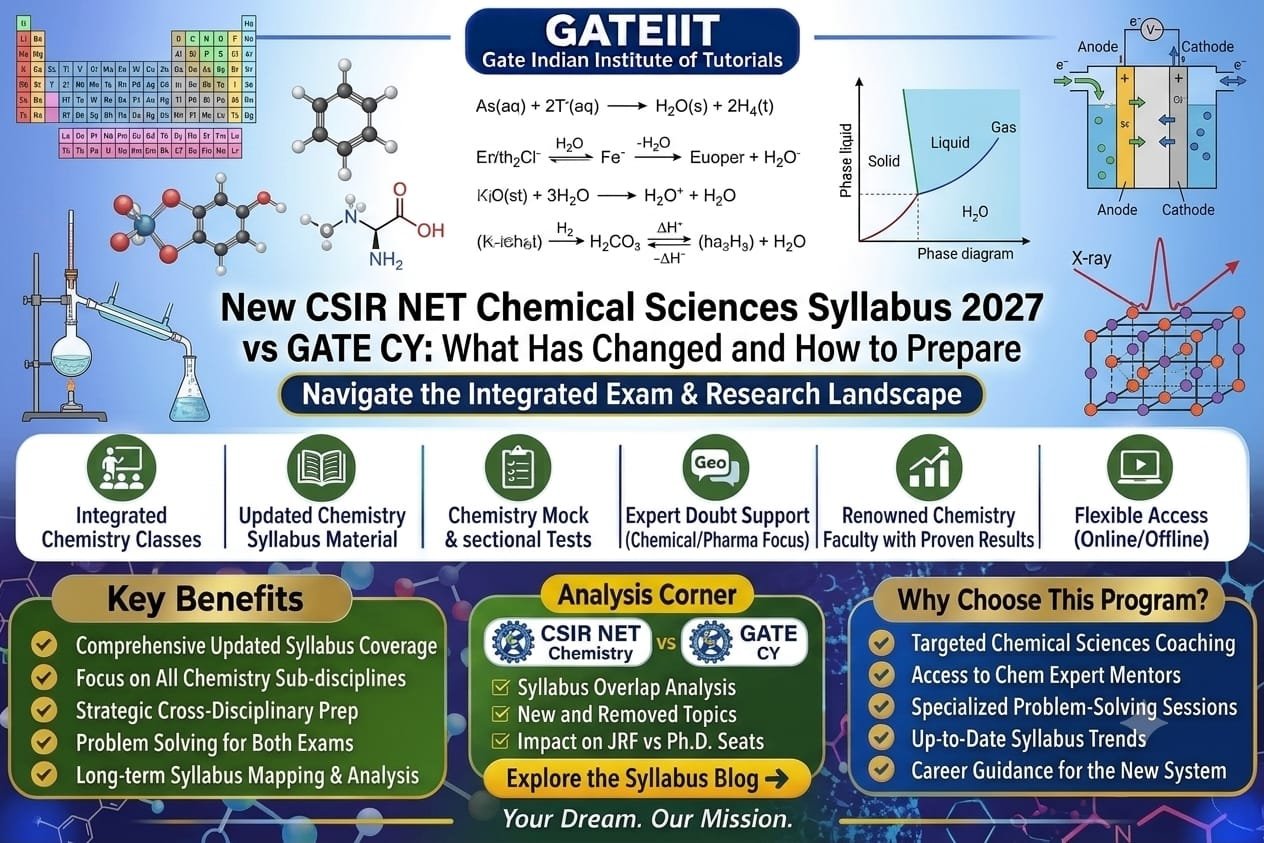
Introduction: Is 2027 the Right Time to Prepare for Both CSIR NET Chemical Sciences and GATE Chemistry?
Chemical Sciences students in India have several exciting academic and career opportunities after completing their BSc, MSc, integrated MSc or equivalent qualifications. Two of the most important national-level examinations for postgraduate admission, research opportunities, fellowships and academic careers are:
1.Joint CSIR–UGC NET Chemical Sciences.
2.Graduate Aptitude Test in Engineering (GATE) Chemistry, paper code CY.
For many years, students preparing for these examinations have studied Physical Chemistry, Organic Chemistry and Inorganic Chemistry separately, often following different coaching programmes and preparation schedules.
However, a closer examination of the two examination syllabuses reveals considerable academic overlap.
Students preparing systematically for CSIR NET Chemical Sciences can build a strong foundation for GATE CY as well. Similarly, GATE Chemistry aspirants can strengthen their conceptual understanding to prepare for CSIR NET, provided they cover the additional requirements and practise the different question formats.
The 2027 examination cycle deserves particular attention because syllabus-related developments have taken place in both examination systems.
CSIR-HRDG issued a stakeholder consultation notice dated 13 April 2026 concerning revised syllabuses for Chemical Sciences and three other disciplines. The notice confirmed that syllabus revision work had been undertaken and invited feedback on the proposed revisions.
Separately, the official GATE 2027 website, organised by IIT Madras, explicitly states that the GATE 2027 test-paper syllabuses have been revised and advises candidates to refer to the updated syllabus.
These developments make it important for students to stop relying exclusively on older coaching notes, outdated syllabus PDFs and previous examination trends.
The real question is not simply which syllabus is longer. It is how students can use one well-planned preparation strategy to become competitive in two different national examinations.
This guide explains the differences, common subjects, preparation priorities, examination patterns and benefits of integrated CSIR NET + GATE Chemistry preparation.
1. Understanding the CSIR NET Chemical Sciences Examination 2027
The Joint CSIR–UGC NET examination is conducted to determine eligibility for research fellowships and academic opportunities, including Junior Research Fellowship (JRF) and Assistant Professor eligibility, subject to the applicable qualification and eligibility conditions.
Chemical Sciences is one of the five traditional science subject areas under the CSIR–UGC NET examination.
The examination primarily tests a student’s understanding of chemistry, analytical ability, conceptual clarity and capacity to apply scientific principles to unfamiliar problems.
The major areas of Chemical Sciences preparation are:
- Physical Chemistry
- Organic Chemistry
- Inorganic Chemistry
- Interdisciplinary Chemistry
- General Aptitude and analytical reasoning
Students should understand that CSIR NET is not simply a test of remembering chemical reactions, equations or definitions.
Higher-level questions frequently require candidates to interpret information, apply theoretical concepts, analyse reaction mechanisms and solve numerical problems.
What is happening with the CSIR NET Chemical Sciences syllabus?
CSIR-HRDG published a notice on 13 April 2026 announcing stakeholder consultation on proposed revised syllabuses for:
- Chemical Sciences
- Earth, Atmospheric, Ocean and Planetary Sciences
- Mathematical Sciences
- Physical Sciences
The notice stated that the revised syllabuses had been uploaded for stakeholder feedback, with the consultation period scheduled from 13 April to 14 May 2026.
This is an important development for 2027 aspirants.
However, students must distinguish between a proposed syllabus, a final approved syllabus and the syllabus applicable to a particular examination notification. They should download and verify the applicable Chemical Sciences syllabus before finalising their preparation.
Do not assume that every topic circulating on coaching websites or social media represents a newly introduced CSIR NET topic.
The safest approach is to compare the applicable official syllabus with the previous syllabus and then prepare a topic-wise list of additions, deletions, modifications and retained concepts.
2. Understanding the GATE Chemistry (CY) Examination 2027
GATE Chemistry, commonly known as GATE CY, is one of the most important national-level examinations for postgraduate education and research opportunities in Chemistry.
It is particularly relevant to students interested in:
- MSc and postgraduate-level academic opportunities.
- PhD programmes.
- Research and scientific careers.
- Higher studies at participating IITs and other institutions.
- Eligible scholarship and fellowship opportunities.
- Certain recruitment opportunities where GATE qualification is accepted.
The GATE 2027 examination is organised by IIT Madras.
The official GATE 2027 website has announced revised syllabuses for its test papers, including Chemistry (CY).
The GATE CY syllabus is broadly divided into three major subject areas:
- Physical Chemistry
- Inorganic Chemistry
- Organic Chemistry
General Aptitude is also included in the examination.
Unlike some engineering papers, GATE CY does not have a separate Engineering Mathematics section. Its subject-specific portion carries 85 marks, while General Aptitude carries 15 marks.
Students should download the latest official GATE 2027 CY syllabus rather than relying on a GATE 2026 or older syllabus.
3. CSIR NET Chemical Sciences vs GATE CY: Examination Pattern Comparison
Understanding the examination pattern is essential because the two examinations test chemistry knowledge in different ways.
| Particulars | CSIR NET Chemical Sciences | GATE CY 2027 |
| Examination | Joint CSIR–UGC NET | GATE |
| Subject | Chemical Sciences | Chemistry |
| Paper code | Chemical Sciences | CY |
| Total marks | 200 | 100 |
| Duration | 3 hours | 3 hours |
| General Aptitude | Part A | Common GA section |
| Subject sections | Parts B and C | Chemistry subject section |
| Question types | MCQs | MCQ, MSQ and NAT |
| Main emphasis | Conceptual and analytical chemistry | Conceptual, numerical and analytical chemistry |
| Negative marking | Applicable | Applicable for MCQs; not for MSQ and NAT |
| Primary opportunities | JRF and academic eligibility | Higher studies, research and other GATE-based opportunities |
Important: CSIR NET candidates must follow the question-attempt rules and marking scheme in the applicable examination information bulletin. GATE candidates must similarly follow the official GATE 2027 question-paper pattern.
Understanding CSIR NET Parts A, B and C
The traditional CSIR NET examination structure consists of three parts.
Part A – General Aptitude
This section assesses:
- Quantitative reasoning.
- Logical reasoning.
- Numerical ability.
- Data interpretation.
- General science aptitude.
- Analytical thinking.
Part B – Subject Knowledge
This section tests fundamental and intermediate concepts from Chemical Sciences.
Questions may cover theoretical chemistry, reaction mechanisms, chemical bonding, spectroscopy, thermodynamics and other syllabus topics.
Part C – Higher-Level Analytical Questions
Part C is particularly important for candidates targeting JRF.
It tests the ability to apply scientific concepts to analytical problems, unfamiliar situations, numerical calculations and multi-step chemical reasoning.
Understanding GATE CY Question Types
GATE CY includes three major question formats:
- Multiple Choice Questions (MCQ).
- Multiple Select Questions (MSQ).
- Numerical Answer Type (NAT).
Candidates must understand that knowing the correct concept is not always enough. They must also develop speed, numerical accuracy and the ability to distinguish between closely related answer choices.
4. Physical Chemistry: CSIR NET vs GATE CY 2027
Physical Chemistry is one of the strongest areas of overlap between the two examinations.
Students who develop a strong foundation in quantum chemistry, thermodynamics, chemical kinetics and electrochemistry can benefit substantially from preparing for both examinations together.
Important Physical Chemistry Topics
| Topic | CSIR NET Preparation | GATE CY Preparation |
| Quantum Chemistry | Very important | Very important |
| Atomic Structure | Important | Very important |
| Molecular Orbital Theory | Important | Very important |
| Group Theory | Important | Very important |
| Molecular Spectroscopy | Very important | Very important |
| Thermodynamics | Very important | Very important |
| Chemical Equilibrium | Very important | Very important |
| Electrochemistry | Very important | Very important |
| Chemical Kinetics | Very important | Very important |
| Statistical Thermodynamics | Important | Very important |
| Phase Equilibria | Important | Very important |
| Surface Chemistry | Important | Important |
| Solid State Chemistry | Important | Important |
| Polymer Chemistry | Relevant | Relevant |
Important areas to strengthen for GATE CY 2027
The official GATE 2027 syllabus explicitly covers several areas that deserve focused numerical and conceptual practice.
These include:
- Quantum Mechanics
- Postulates of quantum mechanics.
- Operators and commutation relations.
- Expectation values.
- Schrödinger equations.
- Particle in a box.
- Harmonic oscillator.
- Hermite polynomials.
- Hydrogen-like atoms.
- Variational methods.
- Perturbation theory.
- Group Theory
- Symmetry elements.
- Symmetry operations.
- Point groups.
- Group multiplication tables.
- Reducible and irreducible representations.
- Molecular vibrations.
- Selection rules.
- Symmetry-adapted molecular orbitals.
- Statistical Thermodynamics
- Microcanonical, canonical and grand canonical ensembles.
- Boltzmann distribution.
- Partition functions.
- Translational, rotational and vibrational contributions.
- Thermodynamic properties of ideal gases.
- Chemical Kinetics and Reaction Dynamics
- Elementary reactions.
- Complex reaction mechanisms.
- Steady-state approximation.
- Transition-state theory.
- Eyring equation.
- Potential energy surfaces.
- Photophysical processes.
- Quantum yield.
- Static and dynamic quenching.
- Thermodynamics and Electrochemistry
- Gibbs free energy.
- Maxwell relations.
- Chemical potential.
- Fugacity and activity.
- Nernst equation.
- Debye–Hückel theory.
- Phase rule.
- Clausius–Clapeyron equation.
How should CSIR NET students prepare for Physical Chemistry?
Students should not study Physical Chemistry entirely through memorisation.
A better approach is to understand the mathematical foundation of every important concept.
For example, when studying quantum mechanics, candidates should understand the physical interpretation of wave functions, operators, eigenvalues and expectation values.
When studying thermodynamics, students should practise deriving relationships and solving numerical problems involving Gibbs energy, entropy, equilibrium and temperature dependence.
The same foundation can then be used for CSIR NET conceptual questions and GATE numerical questions.
5. Inorganic Chemistry: CSIR NET vs GATE CY 2027
Inorganic Chemistry has considerable overlap between CSIR NET and GATE CY.
However, the depth of preparation and the style of questions may differ.
Important topics include:
- Periodic properties.
- Chemical bonding.
- Main group chemistry.
- Coordination chemistry.
- Transition metal chemistry.
- Lanthanides and actinides.
- Organometallic chemistry.
- Bioinorganic chemistry.
- Solid-state chemistry.
- Instrumental and analytical chemistry.
High-priority Inorganic Chemistry topics
- Coordination Chemistry
Students should develop a detailed understanding of:
- Crystal Field Theory.
- Ligand Field Theory.
- Molecular Orbital Theory.
- Crystal Field Stabilisation Energy.
- Magnetic properties.
- Electronic spectra.
- Tanabe–Sugano diagrams.
- Orgel diagrams.
- Jahn–Teller distortion.
- Substitution mechanisms.
- Isomerism in coordination compounds.
- Organometallic Chemistry
Important areas include:
- 18-electron rule.
- Metal carbonyls.
- Metal alkyl complexes.
- Metal olefin complexes.
- Metal carbene complexes.
- Homogeneous catalysis.
- Heterogeneous catalysis.
- Wacker oxidation.
- Olefin metathesis.
- Fischer–Tropsch chemistry.
- Main Group Chemistry
Prepare:
- Boranes and carboranes.
- Interhalogen compounds.
- Noble gas compounds.
- Acid-base concepts.
- HSAB theory.
- Structure and bonding.
- Analytical and Instrumental Methods
- UV-Visible spectroscopy.
- IR spectroscopy.
- NMR spectroscopy.
- ESR spectroscopy.
- Mössbauer spectroscopy.
- Mass spectrometry.
- X-ray crystallography.
- Cyclic voltammetry.
What should students focus on?
GATE CY 2027 explicitly includes topics such as electron counting in polyhedral boranes, isolobal analogy, Ray-Dutt and Bailar twists, zeolites, thermal analytical methods and several instrumental techniques.
These topics deserve dedicated preparation.
For CSIR NET, students should also develop strong conceptual understanding and practise analytical questions based on coordination compounds, organometallic reactions, spectroscopy and chemical bonding.
6. Organic Chemistry: CSIR NET vs GATE CY 2027
Organic Chemistry is another important area of common preparation.
However, students must avoid the mistake of preparing only named reactions.
Both examinations require a strong understanding of reaction mechanisms, stereochemistry, selectivity and the relationship between molecular structure and chemical reactivity.
Major Organic Chemistry Topics
- Organic Reaction Mechanisms
- Electrophilic substitution.
- Nucleophilic substitution.
- Addition reactions.
- Elimination reactions.
- Free radicals.
- Reaction intermediates.
- Stereochemistry
- Optical activity.
- R/S configuration.
- E/Z configuration.
- Conformational analysis.
- Enantiomeric excess.
- Stereoselective synthesis.
- Named Reactions and Synthetic Chemistry
The GATE 2027 CY syllabus explicitly includes a wide range of named transformations, including:
- Heck reaction.
- Suzuki coupling.
- Stille coupling.
- Sonogashira coupling.
- Negishi coupling.
- Kumada coupling.
- Hiyama coupling.
- Tsuji–Trost reaction.
- Buchwald–Hartwig amination.
- Baylis–Hillman reaction.
- Henry reaction.
- Ritter reaction.
- Sakurai reaction.
- Pauson–Khand reaction.
- Nazarov cyclisation.
- Evans aldol reaction.
- Proline-catalysed aldol reaction.
Students should study the reaction mechanism, reagent, substrate requirements, stereochemical outcome and synthetic applications.
- Oxidation and Reduction
- Chromium-based oxidations.
- Manganese-based oxidations.
- DMSO-based oxidations.
- Hypervalent iodine reagents.
- Hydroboration–oxidation.
- Sharpless asymmetric epoxidation.
- Jacobsen epoxidation.
- DIBAL-H.
- Luche reduction.
- Selectride reagents.
- Catalytic hydrogenation.
- Pericyclic Reactions and Photochemistry
- Electrocyclic reactions.
- Cycloaddition reactions.
- Sigmatropic rearrangements.
- Diels–Alder reactions.
- Claisen rearrangement.
- Cope rearrangement.
- Woodward–Hoffmann rules.
- Frontier Molecular Orbital theory.
- Photochemical rearrangements.
- Heterocyclic Chemistry and Biomolecules
- Amino acids.
- Nucleic acids.
How to prepare Organic Chemistry for both examinations
Create a reaction-mechanism notebook.
For every important reaction, record:
- Name of the reaction.
- Reagents and conditions.
- Important intermediates.
- Stereochemical outcome.
- Important applications.
- Previous examination questions.
This approach is more effective than memorising hundreds of isolated reaction names.
7. What Has Changed? Understanding the 2027 Syllabus Developments
This is one of the most important sections for students preparing for the 2027 examinations.
There are two separate developments to understand.
A. CSIR NET Chemical Sciences syllabus revision
CSIR-HRDG officially announced a proposed revised syllabus consultation in April 2026.
This means that students should carefully verify the syllabus applicable to their examination rather than assuming that older syllabus documents are automatically valid.
The older Chemical Sciences syllabus contains broad subject divisions covering:
- Inorganic Chemistry.
- Physical Chemistry.
- Organic Chemistry.
- Interdisciplinary topics.
The published syllabus framework includes quantum chemistry, spectroscopy, thermodynamics, electrochemistry, kinetics, coordination chemistry, organometallic chemistry, stereochemistry, organic synthesis, pericyclic reactions and biomolecules.
The important preparation task is to compare the official revised document, where applicable, against the earlier syllabus and identify precisely what has been:
Do not treat a topic as newly introduced merely because it has become more prominent in coaching materials.
B. GATE CY 2027 syllabus revision
The GATE 2027 organising institute has explicitly announced revised syllabuses.
The updated official Chemistry syllabus contains detailed topic specifications across all three major Chemistry sections.
Some particularly important areas to examine include:
Physical Chemistry
- Expectation values and commutation relations.
- Hermite polynomials.
- Group theory and irreducible representations.
- Statistical ensembles and partition functions.
- Quantum yield and photophysical quenching.
Inorganic Chemistry
- Electron counting in polyhedral boranes.
- Isolobal analogy.
- Advanced coordination chemistry.
- Ray-Dutt and Bailar twists.
- TGA, DTA and DSC.
Organic Chemistry
- Enantiomeric excess and optical purity.
- Energy profile diagrams.
- Solvent effects.
- Named carbon-carbon bond-forming reactions.
- Evans and proline-catalysed aldol reactions.
- Oxidation and reduction reagents.
Many of these subjects are not entirely new concepts in advanced chemistry education. The important point is that candidates must follow the precise scope and wording of the official 2027 syllabus.
C. The biggest practical change for students
The most important change in preparation is the need to become more systematic.
Students should no longer depend entirely on old chapter lists or study notes prepared for earlier examination cycles.
They should:
- Download the applicable CSIR NET syllabus.
- Download the official GATE 2027 CY syllabus.
- Compare both documents.
- Identify common and examination-specific topics.
- Update their notes.
- Practise recent examination questions.
- Take separate mock tests for both examinations.
This is particularly important for students who want to qualify for both examinations in the same academic preparation cycle.
8. CSIR NET Chemical Sciences vs GATE CY: Common Syllabus and Overlapping Topics
The biggest advantage of integrated preparation is the common academic foundation.
The following table illustrates the major areas that students can study together.
| Common subject | Important overlapping topics |
| Quantum Chemistry | Operators, Schrödinger equation, particle in a box, harmonic oscillator |
| Molecular Structure | MO theory, VB theory, molecular bonding |
| Group Theory | Symmetry, point groups, representations, selection rules |
| Spectroscopy | IR, Raman, UV-Visible, NMR |
| Thermodynamics | Laws, Gibbs energy, entropy, equilibrium |
| Statistical Mechanics | Boltzmann distribution, partition functions |
| Electrochemistry | Nernst equation, conductance, electrochemical cells |
| Chemical Kinetics | Rate laws, mechanisms, transition-state theory |
| Coordination Chemistry | CFT, bonding, spectra, magnetism |
| Organometallic Chemistry | Metal carbonyls, electron counting, catalysis |
| Organic Mechanisms | Substitution, addition, elimination, rearrangements |
| Stereochemistry | Chirality, optical activity, stereoselectivity |
| Organic Synthesis | Named reactions, reagents, retrosynthesis |
| Pericyclic Chemistry | Electrocyclic, cycloaddition, sigmatropic reactions |
| Analytical Chemistry | Chromatography and instrumental techniques |
The overlap does not mean that both examinations have identical syllabuses.
It means that students can build one strong conceptual foundation and then adapt their practice to the requirements of each examination.
Why does this matter?
Suppose a student studies quantum chemistry for CSIR NET.
The same concepts can support preparation for GATE CY.
However, the student must also practise the particular numerical formats, question styles and level of application expected in GATE.
Similarly, studying organic reaction mechanisms for GATE CY can support CSIR NET preparation, but candidates must also practise the higher-level analytical questions expected in CSIR NET Part C.
One conceptual foundation, two examination-specific practice strategies: this is the central advantage of integrated preparation.
9. Which Examination Should You Prepare for First: CSIR NET or GATE CY?
There is no universal answer.
The correct decision depends on your academic background, career objective, preparation level and target examination dates.
Students targeting research fellowships
If your primary goal is a research fellowship, JRF qualification or academic research, CSIR NET should be a major priority.
Focus on:
- Conceptual understanding.
- Part C analytical questions.
- Subject-specific depth.
- General Aptitude.
- Research-oriented chemical reasoning.
Students targeting higher studies
If you want to pursue postgraduate or research programmes through GATE-based admission routes, GATE CY should receive special attention.
Focus on:
- Numerical problem-solving.
- Conceptual accuracy.
- MCQ, MSQ and NAT practice.
- Time management.
- General Aptitude.
Students who want both opportunities
If you are interested in both research fellowships and GATE-based higher-study opportunities, integrated preparation can be a sensible strategy.
You do not need to study every common topic independently for both examinations.
Instead, complete the shared fundamentals first and then dedicate separate sessions to examination-specific question practice.
10. Six-Month Preparation Strategy for CSIR NET Chemical Sciences + GATE CY
A structured six-month plan can help students organise their preparation.
The following is a suggested framework. It should be adjusted according to the actual examination dates and the student’s starting level.
Month 1: Physical Chemistry Foundation
Complete:
- Quantum Chemistry.
- Atomic Structure.
- Molecular Structure.
- Chemical Bonding.
- Basic Spectroscopy.
Practice:
- Conceptual questions.
- Quantum numerical problems.
- Previous-year questions.
Month 2: Advanced Physical Chemistry
Complete:
- Statistical Thermodynamics.
- Chemical Kinetics.
- Phase Equilibria.
- Surface Chemistry.
Practice:
- Numerical questions.
- CSIR NET Part C questions.
- GATE NAT questions.
Month 3: Inorganic Chemistry
Complete:
- Periodic Properties.
- Main Group Chemistry.
- Coordination Chemistry.
- Organometallic Chemistry.
- Bioinorganic Chemistry.
- Solid State Chemistry.
Practice:
- Electron counting.
- Magnetic moment problems.
- Spectroscopic interpretation.
- Reaction mechanisms.
- Previous-year questions.
Month 4: Organic Chemistry
Complete:
- Organic Reaction Mechanisms.
- Named Reactions.
- Organic Synthesis.
- Oxidation and Reduction.
- Pericyclic Reactions.
- Heterocyclic Chemistry.
Practice:
- Mechanism-based questions.
- Reagent identification.
- Stereochemical problems.
- Multi-step synthesis.
Month 5: Syllabus Completion and Intensive Practice
Focus on:
- Remaining syllabus topics.
- Interdisciplinary chemistry.
- Instrumental techniques.
- General Aptitude.
- Previous-year questions.
- Topic-wise tests.
Start taking separate CSIR NET and GATE CY mock tests.
Month 6: Revision and Mock Examinations
Focus on:
- Complete syllabus revision.
- Formula revision.
- Reaction mechanism revision.
- Important inorganic chemistry tables.
- Numerical practice.
- Full-length mock tests.
- Performance analysis.
Take at least one full-length examination simulation for each examination every week, increasing the frequency as the examination approaches.
11. Daily Study Timetable for Integrated Preparation
A practical daily schedule can help students maintain consistency.
| Activity | Suggested time |
| Physical Chemistry | 2 hours |
| Organic Chemistry | 1.5 hours |
| Inorganic Chemistry | 1.5 hours |
| Numerical and analytical practice | 1 hour |
| Previous-year questions | 1 hour |
| Revision and error analysis | 30 minutes |
| General Aptitude | 30 minutes |
Students who attend regular college classes or work alongside preparation can reduce the daily duration and extend the preparation period.
The most important requirement is consistency.
Studying for ten hours on one day and not revising for the next three days is less effective than maintaining a sustainable daily schedule.
12. Best Books and Study Resources for CSIR NET Chemical Sciences and GATE CY
Students should avoid collecting too many books.
The following standard references can help build subject knowledge.
Physical Chemistry
- Physical Chemistry– Peter Atkins and Julio de Paula.
- Physical Chemistry– Ira N. Levine.
- Quantum Chemistry– Ira N. Levine.
- Molecular Spectroscopy– Banwell and McCash.
Organic Chemistry
- Organic Chemistry– Morrison and Boyd.
- Organic Chemistry– Clayden, Greeves and Warren.
- Advanced Organic Chemistry– Jerry March.
- Stereochemistry of Organic Compounds– Eliel and Wilen.
Inorganic Chemistry
- Inorganic Chemistry– J. D. Lee.
- Inorganic Chemistry– Shriver and Atkins.
- Advanced Inorganic Chemistry– Cotton and Wilkinson.
- Concise Inorganic Chemistry– J. D. Lee.
Examination Practice
Along with textbooks, students should use:
- Official CSIR NET previous-year question papers.
- Official GATE CY previous-year question papers.
- Official answer keys.
- Topic-wise practice tests.
- Full-length mock examinations.
- Carefully prepared formula and reaction notes.
Books provide conceptual foundations, but regular examination-oriented practice is essential.
13. Common Mistakes Students Make While Preparing for Both Examinations
Even well-prepared students sometimes fail to achieve their target because of inefficient preparation.
Avoid the following mistakes.
Mistake 1: Following an outdated syllabus
Always verify the latest applicable syllabus.
Mistake 2: Preparing only Organic Chemistry
Physical, Inorganic and Interdisciplinary Chemistry must receive appropriate attention.
Mistake 3: Ignoring numerical problems
Quantum Chemistry, Thermodynamics, Electrochemistry and Kinetics require regular numerical practice.
Mistake 4: Memorising reactions without understanding mechanisms
Learn why a reaction occurs and how its outcome changes with different reagents and conditions.
Mistake 5: Ignoring General Aptitude
Both examinations include aptitude-related components.
Mistake 6: Using the same mock test strategy for both examinations
CSIR NET and GATE CY have different paper structures and question formats. Take separate mock tests.
Mistake 7: Postponing revision
Revision should start alongside syllabus coverage.
Mistake 8: Studying too many books
Use a limited number of standard references and good examination-oriented notes.
Mistake 9: Avoiding performance analysis
Every mock test should be followed by an analysis of incorrect answers, time management and weak chapters.
Mistake 10: Preparing without a timetable
A structured weekly and monthly plan helps prevent incomplete syllabus coverage.
14. Why Integrated CSIR NET Chemical Sciences + GATE CY Coaching Can Be a Smart Strategy
Students often enrol in separate coaching programmes for CSIR NET and GATE Chemistry.
Although separate preparation can work, it may result in duplicated lectures, repeated study material and inefficient use of preparation time.
An integrated coaching programme can address this problem.
A well-designed CSIR NET Chemical Sciences + GATE CY integrated course should include:
- Combined Conceptual Classes
Students learn common Physical, Organic and Inorganic Chemistry concepts through structured lectures.
- Examination-Specific Problem Solving
Separate sessions cover CSIR NET Part B and Part C questions and GATE CY MCQ, MSQ and NAT questions.
- Revised Syllabus Coverage
The teaching plan should be mapped to the applicable 2027 syllabus documents.
- Regular Practice Tests
Topic-wise tests, sectional tests and full-length mock examinations help students evaluate their progress.
- Previous-Year Question Discussions
Faculty should explain the logic, concepts and shortcuts behind important examination questions.
- Doubt-Clearing Sessions
Students should receive opportunities to clarify difficult topics and numerical problems.
- Revision Classes
Structured revision sessions help students retain important formulas, mechanisms and concepts.
- Personal Attention
Individual feedback can help students identify weak areas and improve their examination strategy.
Who should consider integrated coaching?
- MSc Chemistry students.
- BSc Chemistry graduates.
- Integrated MSc students.
- Final-year Chemistry students.
- CSIR NET JRF aspirants.
- GATE Chemistry aspirants.
- Repeaters preparing for the 2027 examination cycle.
- Students who want to pursue both research and postgraduate opportunities.
15. Prepare for CSIR NET Chemical Sciences and GATE CY 2027–2028 with GATEIIT
At Gate Indian Institute of Tutorials (GATEIIT), Bangalore, we focus on structured, examination-oriented coaching for competitive national-level examinations.
Our integrated preparation approach is designed to help Chemistry students develop strong conceptual foundations while preparing for the different requirements of CSIR NET Chemical Sciences and GATE Chemistry.
Key Features of GATEIIT Integrated Coaching
- CSIR NET Chemical Sciences + GATE CY integrated preparation.
- Physical, Organic and Inorganic Chemistry classes.
- Concept-based and application-oriented teaching.
- Coverage aligned with applicable examination syllabuses.
- Dedicated numerical problem-solving sessions.
- CSIR NET Part B and Part C practice.
- GATE CY MCQ, MSQ and NAT practice.
- Previous-year question discussions.
- Topic-wise assignments and practice questions.
- Regular mock examinations.
- Revision and doubt-clearing sessions.
- Online and offline learning options.
- Personal attention and academic guidance.
- Preparation plans for different learning levels.
Why choose GATEIIT?
Our approach focuses on helping students understand Chemistry rather than merely memorising examination notes.
The integrated learning model allows students to study common concepts systematically and then practise the examination-specific requirements of both tests.
Students can select a suitable preparation duration based on their academic background and examination target.
Start your CSIR NET Chemical Sciences + GATE CY 2027–2028 preparation with a structured study plan at GATEIIT.
Institute: Gate Indian Institute of Tutorials (GATEIIT)
Location: JP Nagar 2nd Phase, Bangalore.
Website: https://www.gateiit.com/
Call: 8884416155
WhatsApp: 8884416154
Contact our academic counselling team to understand the available integrated coaching programmes, batch schedules, course duration and fee structure.
16. Frequently Asked Questions (FAQs): CSIR NET Chemical Sciences Syllabus 2027 vs GATE CY
1. Is the CSIR NET Chemical Sciences syllabus changing in 2027?
CSIR-HRDG issued a stakeholder consultation notice on 13 April 2026 concerning proposed revised syllabuses, including Chemical Sciences. Candidates should verify the final applicable syllabus and examination notification before preparing.
2. Has GATE Chemistry CY 2027 syllabus been revised?
Yes. The official GATE 2027 organising institute has announced revised syllabuses and published the updated CY Chemistry syllabus.
3. Are CSIR NET Chemical Sciences and GATE CY syllabuses similar?
Yes. Both cover major areas of Physical, Organic and Inorganic Chemistry. However, their topic specifications and examination requirements are not identical.
4. Can I prepare for CSIR NET and GATE Chemistry together?
Yes. Integrated preparation is possible because many fundamental chemistry concepts overlap. Students must supplement common preparation with examination-specific practice.
5. Which is more difficult, CSIR NET Chemical Sciences or GATE CY?
Difficulty depends on the student’s strengths and preparation. CSIR NET includes higher-level analytical questions, while GATE CY requires strong conceptual understanding and numerical accuracy.
6. Is Physical Chemistry important for both examinations?
Yes. Quantum Chemistry, Thermodynamics, Chemical Kinetics, Electrochemistry and Spectroscopy are important preparation areas.
7. Is Organic Chemistry common in CSIR NET and GATE CY?
Yes. Reaction mechanisms, stereochemistry, organic synthesis, named reactions and pericyclic reactions are important in both.
8. Does GATE CY have General Aptitude?
Yes. General Aptitude carries 15 marks in GATE CY 2027.
9. Does CSIR NET Chemical Sciences have General Aptitude?
Yes. General Aptitude is covered in Part A of the traditional CSIR NET examination structure. Candidates should follow the applicable examination bulletin.
10. Does GATE CY include Engineering Mathematics?
No separate Engineering Mathematics section is prescribed for GATE CY. The paper includes 15 marks of General Aptitude and 85 marks of Chemistry.
11. Are MCQs asked in GATE Chemistry?
Yes. GATE CY includes MCQs, MSQs and Numerical Answer Type questions.
12. Are numerical questions important in CSIR NET Chemical Sciences?
Yes. Numerical and analytical problem-solving skills are particularly important in Physical Chemistry and higher-level Part C questions.
13. Which topics are important in Quantum Chemistry for GATE CY 2027?
Operators, commutation relations, expectation values, Schrödinger equations, particle in a box, harmonic oscillator, hydrogen-like atoms and approximation methods are important.
14. Is Group Theory important for CSIR NET and GATE CY?
Yes. Students should study symmetry, point groups, representations, character tables and selection rules.
15. Is Statistical Thermodynamics included in GATE CY 2027?
Yes. The official syllabus includes ensembles, Boltzmann distribution, partition functions and thermodynamic properties.
16. Which Organic Chemistry reactions should I prepare for GATE CY 2027?
Prepare important coupling reactions, named carbon-carbon bond-forming reactions, oxidation and reduction, aldol reactions and pericyclic transformations.
17. Is Coordination Chemistry important for CSIR NET JRF?
Yes. Crystal Field Theory, Molecular Orbital Theory, electronic spectra, magnetic properties and reaction mechanisms are important areas.
18. Can MSc Chemistry students apply for both examinations?
Students who satisfy the respective eligibility criteria can apply for both examinations. They should check the latest official eligibility conditions.
19. Can BSc Chemistry students start preparing for CSIR NET and GATE?
Yes. BSc students can begin building their conceptual foundation. However, actual examination eligibility depends on the respective examination rules and qualifying educational qualifications.
20. How many months are required to prepare for CSIR NET Chemical Sciences?
Preparation time depends on the student’s existing knowledge, study hours and target score. Six to twelve months of structured preparation can be a useful planning framework for many students.
21. How many months are required to prepare for GATE CY?
Students with a good Chemistry foundation may prepare within six months, while beginners or students with conceptual gaps may require a longer period.
22. Should I study separate books for CSIR NET and GATE CY?
Not necessarily. Standard Chemistry textbooks can build the common foundation. Use separate examination-oriented question banks, mock tests and previous-year papers.
23. Are previous-year question papers sufficient for preparation?
No. They are important for understanding examination trends and question formats, but must be combined with syllabus coverage, conceptual study and regular mock tests.
24. What is the best strategy for preparing both examinations?
Complete overlapping Chemistry topics first, practise examination-specific questions separately, revise regularly and analyse mock-test performance.
25. Can I prepare for CSIR NET JRF and GATE CY through one coaching programme?
Yes, if the programme genuinely covers the common syllabus and provides separate examination-specific practice for both examinations.
26. Is General Aptitude preparation common to CSIR NET and GATE?
There is some overlap in quantitative reasoning, logical reasoning and data interpretation. However, students should practise according to the individual examination patterns.
27. Which is better for a research career, CSIR NET JRF or GATE CY?
Both can support research and higher education pathways. CSIR NET JRF is particularly relevant to fellowship-based research opportunities, while GATE can support admission to eligible postgraduate and research programmes. The best route depends on institutional eligibility and career objectives.
28. Is Inorganic Chemistry difficult in GATE CY?
It can be challenging because questions may require detailed conceptual understanding of coordination chemistry, organometallics, spectroscopy, bonding and solid-state chemistry.
29. What is the best way to revise Organic Chemistry?
Use reaction-mechanism charts, reagent tables, stereochemistry notes, named-reaction summaries and regular mechanism-based problem solving.
30. Does integrated coaching reduce preparation time?
It can reduce duplication of lectures and study material by teaching overlapping concepts together. Students still need separate mock tests and practice for each examination.
31. Can working students prepare for CSIR NET and GATE together?
Yes. A flexible timetable, recorded or online classes where available, regular weekend tests and consistent revision can make preparation manageable.
32. How important are mock tests for CSIR NET Chemical Sciences?
Mock tests help improve question selection, time management, accuracy and analytical problem-solving.
33. How important are MSQ and NAT questions in GATE CY?
They are important because GATE uses multiple question formats. Students should practise them regularly rather than concentrating exclusively on MCQs.
34. Should I prepare for CSIR NET June 2027 or December 2027?
Choose according to your syllabus completion, academic schedule and readiness. Check the official examination calendar and notification before finalising your target.
35. Where can I download the official GATE CY 2027 syllabus?
The official GATE 2027 website provides the Chemistry syllabus under Test Papers and Syllabus.
36. Where can I check the CSIR NET Chemical Sciences syllabus?
Visit the official CSIR-HRDG website and the Joint CSIR–UGC NET portal for syllabus documents and examination updates.
37. Is CSIR NET Chemical Sciences useful for Assistant Professor eligibility?
Yes. Qualification in the relevant CSIR NET category can establish eligibility for Assistant Professor positions, subject to applicable UGC regulations and recruitment requirements.
38. Is GATE CY useful for PhD admission?
Yes. Several institutions accept GATE scores for eligible postgraduate and research admissions, subject to their individual admission policies.
39. Can students from different Chemistry specialisations prepare for both exams?
Yes. Students from Organic, Inorganic, Physical, Analytical and other Chemistry specialisations can prepare, but they should strengthen areas outside their primary specialisation.
40. Does GATEIIT offer integrated CSIR NET Chemical Sciences + GATE CY coaching?
GATEIIT offers integrated preparation-oriented coaching for students targeting CSIR NET Chemical Sciences and GATE Chemistry. Students can contact the institute to confirm current batch schedules, available modes, course duration and fees.
17. Final Conclusion: Prepare Smarter for Two National-Level Chemistry Examinations
The 2027 examination cycle presents an important opportunity for Chemistry students to review their preparation strategy.
With CSIR-HRDG’s syllabus revision initiative and the revised GATE 2027 CY syllabus, students must ensure that their preparation is aligned with the latest applicable official documents.
CSIR NET Chemical Sciences and GATE Chemistry are different examinations, but their shared foundation provides a valuable opportunity for integrated preparation.
Students who develop strong fundamentals in Physical, Organic and Inorganic Chemistry can prepare efficiently for both examinations through a combination of common conceptual learning and separate examination-specific practice.
Rather than preparing for two examinations independently from the beginning, students can adopt a more systematic strategy:
- Build a common Chemistry foundation.
- Follow the latest applicable syllabuses.
- Identify overlapping and examination-specific topics.
- Practise CSIR NET analytical questions.
- Solve GATE CY MCQ, MSQ and NAT questions.
- Revise consistently.
- Take regular mock tests.
- Analyse performance and improve weak areas.
Your Chemistry preparation should open more than one academic opportunity. Prepare with the right strategy, consistent practice and expert academic guidance.
Begin Your Integrated CSIR NET Chemical Sciences + GATE CY Preparation at GATEIIT
Gate Indian Institute of Tutorials (GATEIIT), JP Nagar 2nd Phase, Bangalore, provides structured coaching and academic guidance for students preparing for national-level competitive examinations.
Explore the integrated preparation programme:
CSIR NET Chemical Sciences + GATE Chemistry (CY) Integrated Coaching 2027–2028
Website: https://www.gateiit.com/
Call: 8884416155
WhatsApp: 8884416154
GATEIIT – Building Chemistry Concepts, Strengthening Competitive Exam Preparation and Supporting Your Academic Goals.
OFFICIAL REFERENCE LINKS
Students should use official sources for the latest examination information.
- CSIR-HRDG – Official Syllabus:
https://csirhrdg.res.in/ - CSIR-HRDG – April 2026 Syllabus Consultation Notice:
https://csirhrdg.res.in/SiteContent/ManagedContent/ATContent/Notice_En_Syb_13April2026.pdf - Joint CSIR–UGC NET Official Portal:
https://csirnet.nta.nic.in/ - GATE 2027 – Official Test Papers and Syllabus:
https://gate2027.iitm.ac.in/exam_papers_and_syllabus - GATE 2027 – Official Question Paper Pattern:
https://gate2027.iitm.ac.in/question_paper_pattern
Editorial note: This article is an educational comparison and preparation guide, not an official examination notification. Candidates should verify the final applicable CSIR NET Chemical Sciences syllabus, examination scheme, eligibility criteria and GATE CY syllabus before applying or preparing for the 2027 examinations.