
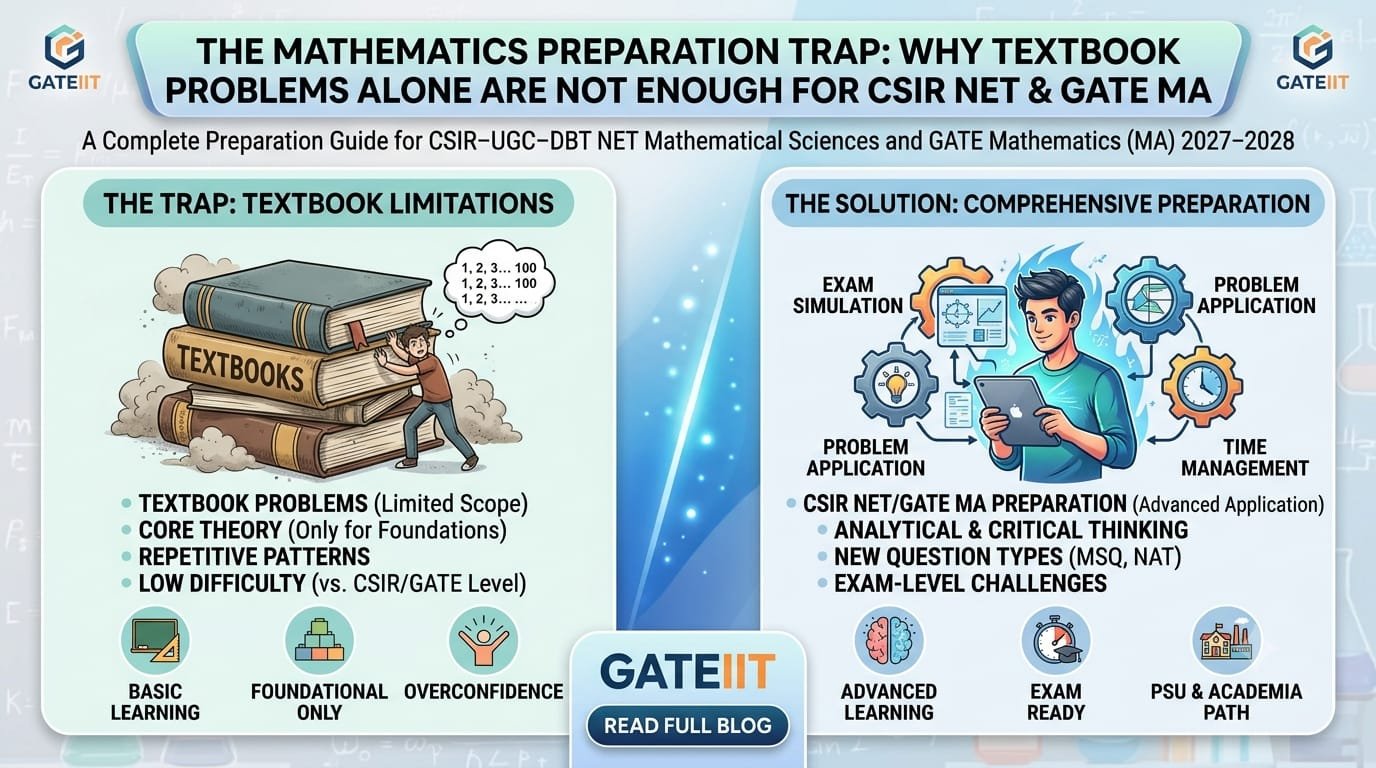
Introduction: Are You Studying Mathematics or Actually Preparing for a Competitive Mathematics Examination?
Mathematics is often considered a subject where consistent practice leads to mastery. Students spend hours studying textbooks, attending university lectures, solving chapter-end exercises and working through hundreds of mathematical problems. They understand definitions, remember important theorems and become comfortable with standard procedures.
Yet, when they appear for competitive examinations such as Joint CSIR–UGC–DBT NET Mathematical Sciences or GATE Mathematics (MA), many discover an uncomfortable reality.
Questions that appear familiar may become difficult when presented differently. A theorem they have studied may be tested through an unfamiliar application. A problem that resembles a standard textbook exercise may require a completely different approach. Sometimes, students know the underlying concept but cannot identify the correct method within the available time.
Why does this happen?
The problem is not necessarily a lack of mathematical knowledge. In many cases, it is a difference between learning mathematics academically and developing the mathematical thinking required for competitive examinations.
Textbooks are essential for developing mathematical foundations. However, textbook preparation alone may not sufficiently develop the proof-based understanding, analytical reasoning, conceptual flexibility, question-selection ability and examination temperament required to perform well in CSIR NET and GATE MA.
These examinations do not simply reward students who have solved the maximum number of exercises. They reward students who can understand mathematical structures, recognise relationships, apply theorems appropriately, analyse unfamiliar situations and arrive at correct answers efficiently.
For students targeting 2027–2028 examinations, understanding this distinction early can significantly improve the quality of their preparation.
In this article, we explore the common mathematics preparation traps, the differences between conventional academic study and competitive examination preparation, and a practical strategy for developing the mathematical skills required for CSIR NET and GATE MA.
1. The First Preparation Trap: Confusing Textbook Completion with Examination Readiness
One of the most common mistakes among Mathematics aspirants is assuming that completing the prescribed textbooks means completing the preparation.
A student may finish an entire chapter on Linear Algebra, solve all the standard exercises and confidently move to Real Analysis. However, this does not automatically mean that the student can solve competitive examination questions from those subjects.
Consider a simple example.
A textbook may introduce eigenvalues and eigenvectors through definitions, characteristic equations and standard matrix calculations.
A conventional exercise might ask:
Find the eigenvalues of a given matrix.
A competitive examination question may instead ask you to determine whether a matrix is diagonalizable under particular conditions, analyse the relationship between its eigenvalues and trace, or identify the consequences of a transformation having a specific algebraic property.
Both questions belong to Linear Algebra, but the mathematical thinking required is different.
Similarly, in Real Analysis, students may become proficient at calculating limits and checking continuity using familiar procedures.
However, a competitive question may test whether a function is uniformly continuous, whether a sequence of functions converges uniformly, or whether a particular theorem can be applied under the given assumptions.
The student who has memorised procedures may struggle when the question does not follow the expected pattern.
What textbook completion actually achieves
Textbook study helps students:
- Understand definitions and mathematical terminology.
- Develop familiarity with standard theorems.
- Learn important mathematical techniques.
- Build foundational problem-solving skills.
- Develop the language needed to understand advanced mathematics.
What competitive examination readiness additionally requires
Students must also learn to:
- Recognise which concept is being tested.
- Connect multiple mathematical ideas.
- Identify hidden assumptions in a question.
- Select appropriate theorems.
- Analyse whether a statement is always true, sometimes true or false.
- Solve unfamiliar problems without relying on memorised patterns.
- Complete questions accurately within a limited examination duration.
The important lesson: Completing a textbook is a milestone in preparation, not proof of examination readiness.
2. Why Proof-Based Understanding Is Essential for CSIR NET and GATE MA
Mathematics is fundamentally a subject of logical reasoning and proof.
Unlike subjects where remembering a formula may be sufficient for solving certain questions, higher mathematics frequently requires students to understand why a statement is true and under which conditions it remains valid.
This is particularly important in subjects such as:
- Real Analysis
- Linear Algebra
- Abstract Algebra
- Complex Analysis
- Functional Analysis
- Topology
- Differential Equations
A student who understands the proof behind a theorem often has an advantage when the same theorem is tested in a new mathematical situation.
Understanding a theorem versus memorising its statement
Consider the Bolzano–Weierstrass theorem.
A student may remember that every bounded sequence in the real numbers has a convergent subsequence.
But genuine understanding requires more than remembering this sentence.
The student should understand:
- What does boundedness mean?
- Why is the existence of a convergent subsequence important?
- Does the original sequence necessarily converge?
- What changes if the sequence is not bounded?
- How does the result extend to finite-dimensional Euclidean spaces?
- Can a similar conclusion be drawn in an arbitrary metric space?
These questions develop mathematical maturity.
Similarly, consider the Cayley–Hamilton theorem in Linear Algebra.
Simply remembering that every square matrix satisfies its characteristic polynomial is insufficient for advanced applications.
Students should understand how the theorem connects characteristic polynomials, matrix powers, invertibility and algebraic properties of linear transformations.
How proof-based preparation improves examination performance
Proof-based learning helps students:
- Identify the correct assumptions of a theorem.
- Avoid applying results outside their valid conditions.
- Eliminate incorrect answer choices.
- Solve questions involving counterexamples.
- Understand relationships between mathematical concepts.
- Approach unfamiliar questions with confidence.
An effective study technique
For every important theorem, follow this sequence:
Step 1: Definition
Understand the mathematical definition and terminology.
Step 2: Statement
Write the theorem accurately, including all assumptions.
Step 3: Proof
Study the logical reasoning behind the result.
Step 4: Application
Solve standard problems using the theorem.
Step 5: Variation
Attempt questions in which one or more assumptions are modified.
Step 6: Counterexample
Identify situations where the theorem does not apply.
This approach transforms theorem learning into a practical problem-solving skill.
3. The Second Preparation Trap: Solving Questions Without Understanding the Mathematical Idea
Many students measure their preparation by counting the number of problems they solve each day.
For example:
- 30 Linear Algebra questions.
- 25 Real Analysis questions.
- 20 Differential Equations questions.
Although regular practice is valuable, the number of questions solved is not necessarily an accurate measure of conceptual development.
A student may solve 100 routine questions using the same formula or procedure without developing the ability to handle a slightly modified problem.
Another student may spend more time analysing 15 carefully selected problems, understanding different approaches and identifying the mathematical principles behind them.
The second student may develop stronger examination-level reasoning.
Learn to analyse problems, not merely calculate answers
Whenever you solve a mathematical problem, ask:
- What is the central concept involved?
- Which definition or theorem is relevant?
- Why is this particular method appropriate?
- Is there another way to solve the problem?
- What happens if the given condition changes?
- Can the problem be generalised?
- Is there a simpler counterexample to an incorrect approach?
This habit develops mathematical flexibility.
Example: A Linear Algebra problem
Suppose a question asks whether every diagonalizable matrix is invertible.
A student who memorises standard properties may incorrectly assume that diagonalizability implies invertibility.
A student with conceptual understanding will immediately recognise that a diagonal matrix containing a zero diagonal entry can be diagonalizable but singular.
The difference is not calculation speed. It is understanding the relationship between mathematical properties.
Competitive Mathematics requires students to think about the structure of a problem before attempting its solution.
4. The Third Preparation Trap: Ignoring the Importance of Analytical Reasoning
Analytical reasoning is one of the most important skills required in advanced Mathematics examinations.
Students frequently practise questions that directly indicate the formula or method to be used.
However, competitive examinations may present information in a manner that requires candidates to identify the underlying mathematical concept independently.
For example, instead of directly asking students to calculate an integral, a question may provide information about a function and ask them to determine whether an integral converges.
Instead of asking for a matrix determinant, it may test the consequences of a particular rank condition.
Instead of asking students to solve a differential equation using a familiar procedure, it may examine the existence, uniqueness or qualitative behaviour of a solution.
Five analytical abilities students should develop
- Pattern recognition
Identify mathematical structures and recognise similarities between apparently different problems.
- Logical deduction
Use given conditions to establish what must be true and what cannot be true.
- Conceptual connections
Understand how different mathematical topics relate to one another.
- Mathematical interpretation
Translate statements, equations, graphs and conditions into meaningful mathematical conclusions.
- Alternative reasoning
Find different approaches when the conventional solution is lengthy or unsuitable.
How to develop analytical reasoning
Students should regularly practise:
- Assertion and statement-based questions.
- True/false mathematical propositions.
- Multiple-condition problems.
- Questions involving counterexamples.
- Problems combining two or more topics.
- Questions requiring theorem selection.
- Unfamiliar applications of standard results.
This is especially useful for developing the higher-order thinking required in CSIR NET Mathematical Sciences Part C and the analytical and application-oriented questions encountered in GATE MA.
5. CSIR NET Mathematical Sciences and GATE MA: Why Your Preparation Must Go Beyond Standard Exercises
Although both examinations assess higher-level mathematical understanding, their question formats and examination requirements are not identical.
Students preparing for both examinations should understand these differences rather than following one uniform practice strategy.
CSIR NET Mathematical Sciences
The Joint CSIR–UGC NET Mathematical Sciences examination is structured around three parts.
The established examination scheme includes:
Part A – General Aptitude
Tests general science, quantitative reasoning, analytical ability and research aptitude.
Part B – Subject Knowledge
Tests mathematical concepts through conventional subject-related questions.
Part C – Higher-Order Analytical Questions
Tests the ability to apply mathematical concepts and scientific reasoning to more analytical problems.
Part C deserves particular attention because students are expected to demonstrate more than familiarity with standard procedures.
They need to interpret mathematical conditions, recognise relationships and apply concepts logically.
GATE Mathematics (MA)
GATE MA evaluates undergraduate-level mathematical knowledge through a combination of:
- Multiple Choice Questions (MCQs).
- Multiple Select Questions (MSQs).
- Numerical Answer Type (NAT) questions.
- General Aptitude questions.
The GATE 2027 examination pattern provides a three-hour examination carrying 100 marks, including 15 marks for General Aptitude and 85 marks for the Mathematics paper.
The MA paper requires students to combine conceptual understanding with mathematical accuracy and efficient numerical problem-solving.
Key differences in preparation
| Preparation parameter | CSIR NET Mathematical Sciences | GATE Mathematics (MA) |
| Major emphasis | Mathematical concepts and analytical reasoning | Mathematical concepts, applications and problem-solving |
| Question structure | Parts A, B and C | MCQ, MSQ and NAT |
| Important skill | Higher-order conceptual analysis | Accuracy, analytical thinking and numerical efficiency |
| Proof understanding | Important for theorem-based and analytical questions | Important for understanding mathematical properties and applications |
| Problem selection | Important because of sectional attempt limits | Important for managing different question types |
| Time management | Requires effective sectional planning | Requires efficient allocation across the full paper |
| Practice requirement | Previous papers and analytical question sets | Previous papers, numerical practice and timed mocks |
The two examinations share a substantial mathematical foundation, but students must practise their respective examination formats separately.
Official examination patterns and notifications should always be checked before finalising the preparation strategy.
6. The Fourth Preparation Trap: Not Understanding the Importance of Problem Selection
An important difference between university examinations and competitive examinations is that students must learn to select questions strategically.
In university examinations, students generally attempt questions according to the prescribed paper structure.
In competitive examinations, the ability to identify which questions deserve immediate attention can influence the final score.
Some questions can be solved quickly using a familiar theorem.
Others may require several calculations, lengthy derivations or multiple logical steps.
Spending too much time on one difficult problem can reduce the time available for several relatively straightforward questions.
Develop a three-level question selection strategy
Level 1: Direct and familiar questions
These are questions involving concepts you understand well and methods you can apply confidently.
Attempt these early, subject to the examination’s sectional rules and question requirements.
Level 2: Moderate analytical questions
These questions require some reasoning, theorem application or multiple steps.
Attempt them after securing the easier opportunities.
Level 3: Complex or unfamiliar questions
These questions may involve complicated calculations, multiple concepts or an unfamiliar approach.
Mark them for review and return to them if time permits.
Why this strategy matters
A student who spends 12 minutes struggling with one difficult question may lose the opportunity to solve three other questions that could collectively contribute more marks.
The objective is not to avoid difficult questions.
The objective is to maximise the marks obtained with the available time and knowledge.
An important examination rule
Never confuse the time spent on a question with its importance.
A difficult question is not automatically a high-value question.
Students should evaluate:
- Marks available.
- Estimated solving time.
- Confidence in the method.
- Probability of arriving at the correct answer.
- Negative marking implications.
For CSIR NET, sectional attempt requirements and marking rules must be considered. For GATE, candidates should distinguish MCQs from MSQs and NAT questions because their marking rules differ.
7. The Fifth Preparation Trap: Ignoring Previous Year Questions Until the End
Some students postpone previous year question practice until they have completed the entire syllabus.
This is a mistake.
Previous year questions (PYQs) should be introduced early in preparation.
They help students understand how mathematical concepts are converted into examination questions.
A textbook may explain a topic in considerable detail, but previous examination questions reveal the ways in which that topic may be tested.
Why PYQs are important
Previous year questions help students:
- Understand examination-level difficulty.
- Identify frequently tested mathematical concepts.
- Recognise recurring problem structures.
- Discover conceptual weaknesses.
- Improve familiarity with question wording.
- Develop an understanding of time requirements.
- Evaluate the difference between theoretical knowledge and practical performance.
The correct way to practise PYQs
Do not simply solve a previous year question, check the answer and move forward.
Instead, follow this process:
First attempt: Solve the question independently without looking at the solution.
Second step: Identify the concept, theorem or mathematical property involved.
Third step: Compare your approach with the recommended solution.
Fourth step: Identify why your method worked or failed.
Fifth step: Record the question in a topic-wise error notebook if necessary.
Sixth step: Revisit the question after a few days and solve it again without assistance.
This process converts PYQs into a powerful learning resource.
8. Why Understanding Mathematical Connections Is More Important Than Studying Topics in Isolation
Mathematics is an interconnected subject.
A student who studies every topic independently may find it difficult to solve problems involving multiple mathematical ideas.
For example:
Linear Algebra and Functional Analysis
Vector spaces, linear transformations, norms, inner products and operators provide a common mathematical foundation.
Real Analysis and Topology
Continuity, compactness, connectedness and convergence are closely related.
Real Analysis and Functional Analysis
Convergence of sequences, completeness and normed spaces are fundamental to understanding advanced analysis.
Abstract Algebra and Linear Algebra
Groups, rings, fields, vector spaces and algebraic structures develop a broader understanding of mathematical systems.
Complex Analysis and Real Analysis
Convergence, continuity, differentiability and integration appear in both subjects, although their properties and results may differ.
Differential Equations and Analysis
Existence, uniqueness, continuity and differentiability play important roles in understanding differential equations.
Probability and Statistics
Probability distributions, convergence concepts, estimation and statistical inference require mathematical reasoning across several topics.
How integrated learning helps
When students understand these connections, they can approach unfamiliar questions more confidently.
Instead of memorising separate solutions for every topic, they develop a mathematical framework that allows them to identify relationships and select appropriate methods.
This is one of the most valuable benefits of concept-oriented preparation.
9. Topic-Wise Preparation Strategy for CSIR NET and GATE MA
Students should develop strong foundations in the major syllabus areas and understand the different levels of practice required for each subject.
The following approach provides a useful preparation framework.
A. Real Analysis
Real Analysis is one of the most conceptually demanding areas of mathematical preparation.
Important areas include:
- Real number systems.
- Sequences and series.
- Limits and continuity.
- Uniform continuity.
- Riemann integration.
- Sequences and series of functions.
- Uniform convergence.
- Metric spaces.
- Compactness and connectedness.
- Normed linear spaces.
Recommended preparation approach:
Understand definitions precisely. Study important theorems and their assumptions. Practise questions involving counterexamples, convergence, continuity and theorem applications.
Do not limit your preparation to routine limit calculations.
B. Linear Algebra
Important topics include:
- Vector spaces and subspaces.
- Linear independence and dependence.
- Basis and dimension.
- Linear transformations.
- Matrices and determinants.
- Rank and nullity.
- Eigenvalues and eigenvectors.
- Cayley–Hamilton theorem.
- Inner product spaces.
- Quadratic forms.
Recommended preparation approach:
Focus on conceptual relationships between rank, nullity, dimension, eigenvalues and linear transformations.
Practise problems involving conditions, properties and theoretical applications.
C. Abstract Algebra
Important topics include:
- Groups and subgroups.
- Cyclic groups.
- Permutation groups.
- Normal subgroups.
- Quotient groups.
- Homomorphisms and isomorphisms.
- Rings and ideals.
- Integral domains.
- Polynomial rings.
Recommended preparation approach:
Develop a strong understanding of definitions and structural properties. Practise proof-based questions, examples, counterexamples and applications of algebraic theorems.
D. Complex Analysis
Important topics include:
- Analytic functions.
- Cauchy–Riemann equations.
- Complex integration.
- Cauchy’s theorem.
- Cauchy’s integral formula.
- Taylor and Laurent series.
- Residue theorem.
- Conformal mappings.
Recommended preparation approach:
Understand the conditions under which major theorems apply. Practise problems involving singularities, residues, analyticity and integration.
E. Differential Equations
Important topics include:
- Ordinary differential equations.
- Linear differential equations.
- Initial value problems.
- Boundary value problems.
- Existence and uniqueness.
- Higher-order differential equations.
- Partial differential equations.
- Series solutions.
Recommended preparation approach:
Develop proficiency in standard solution techniques while also understanding the theoretical properties of solutions.
F. Numerical Analysis
Important topics include:
- Numerical solutions of equations.
- Numerical differentiation.
- Numerical integration.
- Error analysis.
- Iterative methods.
Recommended preparation approach:
Practise calculations carefully and understand convergence, error bounds and the mathematical reasoning behind numerical algorithms.
G. Probability and Statistics
Important topics include:
- Probability distributions.
- Random variables.
- Expectation and variance.
- Joint distributions.
- Conditional probability.
- Sampling distributions.
- Hypothesis testing.
- Statistical inference.
Recommended preparation approach:
Focus on mathematical interpretation, distributions, assumptions and numerical accuracy.
Important: CSIR NET Mathematical Sciences and GATE MA do not have identical syllabi. Students preparing for both must map their topics against the respective official syllabi rather than assuming that every topic is common.
10. The Sixth Preparation Trap: Poor Time Management During Preparation and Examination
Time management is not simply about studying for more hours.
It is about allocating time according to the importance, difficulty and current level of understanding of each topic.
Some students spend excessive time studying their favourite subjects while repeatedly postponing difficult areas.
Others spend too much time watching lectures and too little time solving questions independently.
Both approaches can create problems.
A balanced daily study structure
The following is an illustrative six-hour focused preparation schedule.
| Activity | Suggested time |
| Conceptual learning and theory | 90 minutes |
| Proofs and theorem applications | 60 minutes |
| Problem-solving practice | 90 minutes |
| PYQs and examination-level questions | 60 minutes |
| Revision and error analysis | 30 minutes |
| General Aptitude / speed practice | 30 minutes |
| Total | 6 hours |
Students with different academic commitments can adjust this schedule.
The important requirement is to maintain a balance between learning, practice, revision and assessment.
How to manage examination time
Develop the following habits:
- Read the complete question before attempting it.
- Identify the concept being tested.
- Avoid unnecessary calculations.
- Use elimination wherever logically justified.
- Do not spend excessive time on a single problem.
- Review flagged questions if time permits.
- Check numerical calculations before submission.
- Consider negative marking before making uncertain guesses.
Time management should be developed gradually through timed practice rather than attempted for the first time in the actual examination.
11. Why Mock Tests Are Essential for Mathematics Aspirants
A mock test is not merely a method of predicting your examination score.
It is a diagnostic tool that reveals how effectively you can apply your knowledge under pressure.
Students who regularly solve questions without time restrictions may perform differently when they face a full-length examination.
The reasons include:
- Examination anxiety.
- Difficulty switching between topics.
- Poor question selection.
- Calculation errors.
- Incorrect time allocation.
- Overconfidence in familiar topics.
- Difficulty handling unfamiliar questions.
What should you analyse after every mock test?
Do not look only at the final score.
Evaluate the following parameters:
Conceptual errors: Did you misunderstand the mathematical principle?
Application errors: Did you select an inappropriate theorem or formula?
Calculation errors: Was the method correct but the computation incorrect?
Time-related errors: Did you leave solvable questions unanswered?
Question-selection errors: Did you spend too much time on difficult questions?
Guessing errors: Did you attempt questions without sufficient justification?
Maintain a mock-test performance record
| Mock test parameter | What to evaluate |
| Total score | Overall performance |
| Accuracy | Correct answers compared with attempted answers |
| Time per question | Speed and efficiency |
| Topic-wise performance | Strong and weak areas |
| Unattempted questions | Possible missed opportunities |
| Negative marks | Risk management |
| Repeated mistakes | Concepts requiring revision |
The objective is continuous improvement, not simply increasing the number of mock tests attempted.
12. The Importance of an Error Notebook in Advanced Mathematics Preparation
One of the most effective yet underused preparation tools is a personal error notebook.
Students generally maintain formula books and short notes, but many do not systematically record their mistakes.
This creates a situation where the same conceptual errors are repeated across multiple practice sessions.
What should an error notebook contain?
Divide your notebook into five categories.
- Conceptual mistakes
Examples of misunderstood definitions or theorems.
- Theorem application mistakes
Situations where a theorem was applied without satisfying all its assumptions.
- Calculation mistakes
Errors involving algebraic simplification, integration, differentiation or numerical computation.
- Problem interpretation mistakes
Cases where the question was misunderstood or an important condition was overlooked.
- Time management mistakes
Questions that consumed excessive time or were approached inefficiently.
Weekly revision method
At the end of every week:
- Review all recorded mistakes.
- Re-solve selected problems.
- Revise the underlying concepts.
- Identify repeated weaknesses.
- Add new practice questions where required.
This creates a personalised learning cycle.
Over time, students become better at recognising their own mistakes before submitting an answer.
13. Why Standard Coaching and Self-Study May Not Always Be Sufficient
Self-study is an important part of mathematical preparation. Many successful candidates develop strong subject knowledge through independent learning.
However, students sometimes face challenges that are difficult to identify without external feedback.
For example:
- They may believe they understand a theorem but cannot apply it independently.
- They may repeatedly use lengthy methods when simpler approaches exist.
- They may neglect important syllabus areas.
- They may practise too many easy questions.
- They may fail to identify examination-specific weaknesses.
- They may not know whether their preparation level matches the actual examination.
This is where structured academic guidance can make a difference.
An effective Mathematics preparation programme should not simply deliver lectures or provide a large collection of questions.
It should help students develop the ability to think mathematically.
What should a good CSIR NET and GATE MA coaching programme provide?
- Systematic syllabus coverage.
- Conceptual teaching from fundamentals to advanced applications.
- Detailed explanations of important mathematical theorems.
- Proof-based learning.
- Topic-wise problem-solving sessions.
- Previous year question discussions.
- Higher-order analytical question practice.
- Separate examination-oriented preparation.
- Regular assignments and practice sheets.
- Topic-wise tests and full-length mock examinations.
- Doubt-solving support.
- Individual performance analysis.
- Revision classes.
- Guidance on examination strategy.
- Personal attention according to individual learning requirements.
Students should evaluate coaching programmes based on the quality of teaching, academic support, practice material and feedback rather than simply the number of lectures or questions provided.
14. Why Integrated CSIR NET Mathematical Sciences + GATE MA Preparation Can Be a Smart Strategy
Students targeting both CSIR NET Mathematical Sciences and GATE MA can benefit from a carefully structured integrated preparation strategy.
Both examinations require a strong foundation in higher mathematics.
Several important subject areas overlap, including:
- Real Analysis.
- Linear Algebra.
- Abstract Algebra.
- Complex Analysis.
- Differential Equations.
- Numerical Analysis.
- Probability and Statistics.
However, overlap does not mean that the examinations are identical.
A student must understand the common mathematical foundation and then prepare separately for the examination-specific requirements.
Benefits of integrated preparation
- Better utilisation of study time
Common mathematical concepts can be studied systematically instead of being taught independently for two examinations.
- Stronger conceptual foundations
Students get opportunities to study mathematical ideas in greater depth.
- More extensive problem-solving exposure
Different question formats help students develop conceptual flexibility.
- Better examination opportunities
Preparing for both examinations can provide access to different academic and career pathways, depending on eligibility, qualification requirements and selection criteria.
- Structured revision
Common subjects can be revised together, while examination-specific practice is scheduled separately.
The right integrated preparation model
A successful programme should have two complementary stages.
Stage 1: Common Mathematical Foundation
- Core concepts.
- Definitions and theorems.
- Proof-based understanding.
- Standard and advanced applications.
- Topic-wise problem-solving.
Stage 2: Examination-Specific Preparation
For CSIR NET:
- Part A practice.
- Part B subject questions.
- Part C analytical questions.
- Section-wise attempt strategy.
- CSIR NET PYQs and mock tests.
For GATE MA:
- General Aptitude.
- MCQ practice.
- MSQ practice.
- NAT problem-solving.
- GATE PYQs and full-length mock tests.
This ensures that students do not mistake syllabus overlap for examination readiness.
15. A Practical Six-Month Preparation Roadmap for CSIR NET and GATE MA
Students preparing for the 2027–2028 examination cycle can use the following illustrative six-month roadmap.
The exact schedule should be adjusted according to the official examination calendar, the student’s existing knowledge and the syllabus applicable to the target examination.
| Preparation phase | Main objective | Activities |
| Month 1 | Foundation building | Real Analysis and Linear Algebra fundamentals |
| Month 2 | Core mathematical development | Abstract Algebra and Complex Analysis |
| Month 3 | Additional core subjects | Differential Equations and Numerical Analysis |
| Month 4 | Advanced syllabus coverage | Remaining topics, Probability and Statistics as applicable |
| Month 5 | Examination-level preparation | PYQs, analytical problems, topic-wise tests and revision |
| Month 6 | Final examination preparation | Full-length mocks, error correction and rapid revision |
Month 1: Build strong foundations
Start with definitions, theorems and fundamental concepts.
Do not rush through topics simply to complete the syllabus.
Month 2: Develop mathematical maturity
Focus on proof-based understanding, algebraic structures and complex analysis.
Month 3: Improve application skills
Practise standard methods and more analytical questions from differential equations and numerical analysis.
Month 4: Complete the relevant syllabus
Cover remaining subjects and revisit important foundational concepts.
Month 5: Transition to competitive preparation
Increase the proportion of PYQs, mixed-topic problems and examination-level tests.
Month 6: Improve performance under examination conditions
Attempt full-length mocks, analyse errors and revise high-priority concepts.
Remember: This is a flexible planning model, not a fixed guarantee of syllabus completion or examination success. Students with weaker foundations may need more time for the initial conceptual stages.
16. How to Know Whether You Are Actually Ready for CSIR NET and GATE MA
Completing the syllabus does not automatically indicate readiness.
Students should evaluate their preparation using measurable indicators.
Ask yourself the following questions:
- Can I explain important mathematical definitions without looking at my notes?
- Can I state major theorems with all their assumptions?
- Can I understand the logic behind important proofs?
- Can I solve unfamiliar problems independently?
- Can I identify the mathematical concept hidden inside a question?
- Can I distinguish between similar mathematical properties?
- Can I construct counterexamples?
- Can I solve previous year questions under timed conditions?
- Can I identify questions that should be postponed?
- Can I analyse my mistakes after every mock test?
- Can I revise important topics without repeatedly relearning them?
If you struggle with several of these questions, you may need to improve your preparation method rather than simply increase your study hours.
17. How GATEIIT Can Help You Prepare More Effectively for CSIR NET and GATE Mathematics
Preparing for advanced Mathematics examinations requires a systematic approach, experienced academic guidance and continuous problem-solving practice.
At Gate Indian Institute of Tutorials (GATEIIT), JP Nagar 2nd Phase, Bangalore, students can explore structured preparation options for CSIR NET Mathematical Sciences and GATE Mathematics.
The focus of an effective preparation programme should be on developing mathematical understanding, improving analytical reasoning and building confidence in solving examination-level questions.
Key learning features at GATEIIT
Concept-oriented teaching
Develop a strong understanding of mathematical fundamentals instead of relying exclusively on memorisation.
Proof-based mathematical learning
Understand important definitions, theorems, proofs and their applications.
Advanced problem-solving sessions
Practise standard, moderate and challenging mathematical questions.
Previous year question discussions
Understand how important mathematical concepts are tested in CSIR NET and GATE MA.
Separate examination-oriented preparation
Learn to approach CSIR NET Parts A, B and C and GATE MA MCQ, MSQ and NAT formats.
Regular assignments and practice sheets
Strengthen conceptual understanding through systematic practice.
Mock tests and performance analysis
Identify weak areas, improve accuracy and develop examination confidence.
Doubt-solving and personal attention
Get academic support to address individual learning difficulties.
Flexible learning options
Explore available online, offline and hybrid learning arrangements.
Integrated preparation opportunities
Prepare for CSIR NET Mathematical Sciences and GATE Mathematics through a common conceptual foundation and separate examination-specific practice.
Who should consider this preparation programme?
- Sc. Mathematics students.
- Sc. Mathematics students.
- Final-year undergraduate students.
- Postgraduate students targeting CSIR NET JRF.
- Students preparing for GATE MA.
- Students planning for Ph.D. admissions.
- Aspirants who have previously attempted CSIR NET or GATE but need better problem-solving strategies.
- Students preparing simultaneously for both examinations.
Why choose a structured preparation approach?
The objective should be to move beyond textbook-level problem solving and develop the mathematical reasoning required for national-level competitive examinations.
At GATEIIT, students can explore a preparation approach combining conceptual learning, theorem understanding, analytical problem-solving, PYQs, assignments, mock tests and individual academic support.
Explore CSIR NET Mathematical Sciences and GATE MA Integrated Coaching 2027–2028 at GATEIIT.
Website: https://www.gateiit.com/
Location: JP Nagar 2nd Phase, Bangalore.
Call: 8884416155
WhatsApp: 8884416154
18. Conclusion: Mathematics Is Not About Solving More Problems. It Is About Learning to Think Better.
One of the biggest misconceptions in competitive Mathematics preparation is that solving more textbook problems automatically leads to better examination performance.
Practice is essential, but the quality of practice matters more than the number of exercises completed.
CSIR NET Mathematical Sciences and GATE MA require students to develop a combination of conceptual clarity, proof-based understanding, analytical reasoning, mathematical flexibility, numerical accuracy and examination strategy.
A student who understands why a theorem works is better equipped to apply it in an unfamiliar situation.
A student who understands the structure of a problem can identify an appropriate solution instead of blindly applying a memorised formula.
A student who analyses mistakes can improve more effectively than someone who repeatedly solves questions without evaluating their approach.
Therefore, the right preparation strategy should combine:
- Strong mathematical fundamentals.
- Proof-based conceptual learning.
- Analytical and logical reasoning.
- Topic-wise and mixed-topic problem solving.
- Previous year question practice.
- Examination-specific preparation.
- Regular revision.
- Timed mock tests.
- Performance analysis.
- Strategic question selection.
If you are preparing for CSIR NET Mathematical Sciences or GATE Mathematics 2027–2028, do not measure your preparation only by the number of chapters completed or questions solved.
Measure it by how independently, accurately and confidently you can solve an unfamiliar mathematical problem.
Stop preparing only to complete Mathematics textbooks. Start preparing to master Mathematics at the level your competitive examination demands.
For structured CSIR NET and GATE MA preparation, connect with GATEIIT and explore the available integrated coaching programmes.
Website: www.gateiit.com
Call: 8884416155 | WhatsApp: 8884416154
Frequently Asked Questions (FAQs)
40 Most Important FAQs on CSIR NET Mathematical Sciences and GATE MA Preparation
1. Is solving standard Mathematics textbooks enough to crack CSIR NET Mathematical Sciences?
No. Textbooks provide the conceptual foundation, but students must also practise proof-based questions, analytical problems, previous year questions and examination-level mock tests. Understanding how to apply mathematical concepts in unfamiliar situations is equally important.
2. Is GATE Mathematics more difficult than university-level Mathematics examinations?
GATE MA tests mathematical concepts through competitive examination questions that require conceptual clarity, accuracy and time management. University examinations and GATE assess different combinations of skills, so students should not assume that good university marks automatically guarantee a strong GATE score.
3. What is the difference between CSIR NET Mathematical Sciences and GATE MA?
CSIR NET Mathematical Sciences uses Parts A, B and C, with Part C emphasising higher-order analytical questions. GATE MA uses MCQ, MSQ and NAT formats along with General Aptitude. Both require strong mathematical fundamentals, but their examination strategies differ.
4. Why is proof-based learning important for CSIR NET Mathematics?
Proof-based learning helps students understand the assumptions, limitations and applications of mathematical theorems. It improves logical reasoning and prepares students to handle questions involving counterexamples, statements and unfamiliar applications.
5. Can I prepare for CSIR NET and GATE MA simultaneously?
Yes. Several core mathematical subjects overlap. Students can study the common syllabus together and then practise the separate examination patterns, question types and requirements of each examination.
6. Which subjects should I study first for GATE MA?
Real Analysis and Linear Algebra are useful starting points because they develop foundational mathematical concepts used in several other areas. However, the exact order should depend on your academic background and the official syllabus.
7. Which subjects are important for CSIR NET Mathematical Sciences?
Important syllabus areas include Analysis, Linear Algebra, Complex Analysis, Abstract Algebra, Ordinary Differential Equations, Partial Differential Equations, Numerical Analysis, Calculus of Variations, Linear Programming, Probability and Statistics, as applicable to the official syllabus structure.
8. How important is Real Analysis for CSIR NET and GATE MA?
Real Analysis is an important area because it develops understanding of limits, sequences, convergence, continuity, differentiability, integration and metric spaces. These concepts also support advanced mathematical learning.
9. How can I improve my mathematical problem-solving ability?
Develop a systematic approach: understand definitions, study theorem applications, solve standard questions, practise unfamiliar problems, analyse mistakes and revisit difficult concepts regularly.
10. Should I memorise mathematical theorems for competitive examinations?
You should know important theorem statements accurately, but memorisation alone is insufficient. Understand the assumptions, proof and applications of each important theorem.
11. What is the importance of counterexamples in Mathematics preparation?
Counterexamples help students understand why a mathematical statement may fail. They are particularly useful in Real Analysis, Linear Algebra, Abstract Algebra and Topology.
12. How many hours should I study daily for CSIR NET Mathematics?
There is no universal number. A focused study schedule of approximately four to six hours may be suitable for many full-time aspirants, while working students may need a different schedule. Consistency, quality of practice and revision are more important than simply counting hours.
13. When should I start solving previous year questions?
Start practising relevant PYQs alongside topic-wise learning. Do not wait until the entire syllabus is completed. Early exposure helps you understand the examination’s expectations.
14. Are previous year questions sufficient for GATE MA preparation?
PYQs are essential but should not be your only practice resource. Combine them with conceptual study, additional problem sets, numerical exercises and timed mock tests.
15. How many mock tests should I attempt before GATE MA?
There is no compulsory number. Begin with topic-wise tests, progress to sectional tests and then attempt multiple full-length mocks. Spend sufficient time analysing each mock rather than attempting tests without reviewing mistakes.
16. How can I improve accuracy in GATE Mathematics?
Improve conceptual clarity, practise calculations, avoid unnecessary assumptions, learn question-selection strategies and understand the negative marking rules for MCQs.
17. What is the best way to prepare for CSIR NET Part C?
Practise higher-order analytical questions involving theorem applications, mathematical relationships, multiple concepts and logical deductions. Understand the reasoning behind every solution.
18. Why do students struggle with unfamiliar Mathematics questions?
They may have practised standard exercises repeatedly without developing conceptual flexibility. Unfamiliar questions require students to identify underlying principles and apply them independently.
19. Is coaching necessary for CSIR NET and GATE MA?
Coaching is not compulsory. However, structured guidance can help students understand difficult concepts, identify preparation gaps, practise examination-level questions and receive feedback on their performance.
20. What should I look for in a good CSIR NET Mathematics coaching institute?
Look for qualified faculty, conceptual teaching, proof-based explanations, structured syllabus coverage, previous year question discussions, regular tests, doubt-solving support and individual academic guidance.
21. Can B.Sc. Mathematics students prepare for CSIR NET and GATE MA?
Yes, eligible undergraduate students can begin preparing during their degree. However, candidates must check the respective examination’s educational qualifications and subject-specific eligibility requirements before applying.
22. Can M.Sc. Mathematics students prepare for both examinations?
Yes. M.Sc. Mathematics students can benefit from integrated preparation because their academic background provides a foundation for studying advanced mathematical concepts.
23. What is the role of Linear Algebra in competitive Mathematics examinations?
Linear Algebra develops understanding of vector spaces, linear transformations, matrices, eigenvalues, eigenvectors, rank, dimension and inner product spaces. It is an important area of mathematical preparation.
24. How should I prepare for Abstract Algebra?
Begin with groups, subgroups and cyclic groups. Progress to homomorphisms, normal subgroups, quotient groups, rings, ideals and fields. Give particular attention to definitions, theorems, examples and counterexamples.
25. How can I master Complex Analysis for CSIR NET and GATE MA?
Understand analytic functions, Cauchy–Riemann equations, complex integration, Cauchy’s theorems, Taylor and Laurent series, singularities and residues. Practise both computational and conceptual problems.
26. Is Numerical Analysis important for GATE MA?
Numerical Analysis is part of the GATE MA syllabus. Students should understand numerical methods, interpolation, numerical integration, iterative procedures and error analysis.
27. How can I improve speed in solving Mathematics questions?
Speed develops through conceptual clarity, regular practice, familiarity with different problem types and efficient solution methods. Timed practice should be introduced gradually.
28. Should I solve difficult problems before completing the basic syllabus?
Build a reasonable foundation first. Then progressively introduce moderate and advanced problems. Attempting highly difficult questions without understanding basic definitions and theorems can waste valuable preparation time.
29. What is an error notebook and how does it help?
An error notebook records conceptual, calculation, interpretation and theorem-application mistakes. Regular revision helps students avoid repeating the same errors.
30. How can I balance theory and problem-solving practice?
Study the relevant theory, understand important proofs, solve standard problems and then practise examination-level questions. Revise the underlying concepts whenever you encounter repeated mistakes.
31. Is General Aptitude important for GATE MA?
Yes. General Aptitude carries 15 marks in GATE MA and should be included in regular preparation rather than postponed until the final weeks.
32. Is General Aptitude important for CSIR NET Mathematical Sciences?
Yes. Part A assesses general science, quantitative reasoning, analytical ability and research aptitude. Students should practise it alongside their subject preparation.
33. How can I overcome fear of difficult Mathematics questions?
Strengthen fundamentals, practise progressively challenging problems and learn to break unfamiliar questions into smaller logical steps. Regular timed practice also improves confidence.
34. Can I prepare for GATE MA through self-study?
Yes. Self-study can be effective with the right textbooks, official syllabus, PYQs, practice materials, revision schedule and mock tests. Students who need additional academic support may also consider structured coaching.
35. What is the biggest mistake Mathematics aspirants make?
Confusing syllabus completion and routine question practice with actual examination readiness. Students must develop analytical thinking and the ability to solve unfamiliar questions.
36. How important is revision for CSIR NET and GATE MA?
Revision is essential because mathematical concepts are interconnected. Regular revision helps students retain definitions, theorems, important results and problem-solving techniques.
37. How should repeaters prepare differently for CSIR NET and GATE MA?
Repeaters should first analyse their previous performance, identify weak subjects, examine conceptual mistakes and improve their examination strategy. Repeating the same preparation method without correcting weaknesses may produce similar results.
38. What is the benefit of integrated CSIR NET and GATE MA coaching?
Integrated preparation helps students study common mathematical foundations systematically while receiving separate practice for CSIR NET and GATE question formats. It can save preparation time and broaden examination opportunities.
39. Does GATEIIT offer CSIR NET Mathematical Sciences and GATE MA preparation?
GATEIIT provides coaching and integrated preparation options for competitive examinations. Students can contact the institute to enquire about current CSIR NET Mathematical Sciences and GATE Mathematics batches, available learning modes, course duration and fee structure.
40. Where can I join CSIR NET Mathematical Sciences and GATE MA coaching in Bangalore?
Students can contact Gate Indian Institute of Tutorials (GATEIIT), JP Nagar 2nd Phase, Bangalore, to enquire about available CSIR NET Mathematical Sciences and GATE MA preparation programmes.
Website: www.gateiit.com
Call: 8884416155
WhatsApp: 8884416154